

Single‐Cell Mass Spectrometry for Discovery Proteomics: Quantifying Translational Cell Heterogeneity in the 16‐Cell Frog (Xenopus) Embryo
Open accessThe DOI matches its Crossref record; 37 of the 37 references it cites were found in a registry or an index.
Abstract
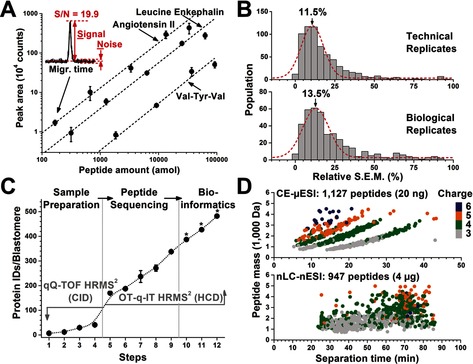
We advance mass spectrometry from a cell population‐averaging tool to one capable of quantifying the expression of diverse proteins in single embryonic cells. Our instrument combines capillary electrophoresis (CE), electrospray ionization, and a tribrid ultrahigh‐resolution mass spectrometer (HRMS) to enable untargeted (discovery) proteomics with ca. 25 amol lower limit of detection. CE‐μESI‐HRMS enabled the identification of 500–800 nonredundant protein groups by measuring 20 ng, or <0.2% of the total protein content in single blastomeres that were isolated from the 16‐cell frog (Xenopus laevis) embryo, amounting to a total of 1709 protein groups identified between n=3 biological replicates. By quantifying ≈150 nonredundant protein groups between all blastomeres and replicate measurements, we found significant translational cell heterogeneity along multiple axes of the embryo at this very early stage of development when the transcriptional program of the embryo has yet to begin.
Overview
The claims and statistics of this paper haven’t been checked yet.
Free: it reads the open-access text and checks the first 5 claims that cite a source we can check. Create a free account to check every claim.
Integrity signals
Registry
Cites
Statistics
Figures


Verification
Claims the paper makes
The claims and statistics of this paper haven’t been checked yet.
Free: it reads the open-access text and checks the first 5 claims that cite a source we can check. Create a free account to check every claim.
Claims other papers make about this one
Each is checked against this paper’s own text: does it say what the citing paper says it does?
The cited source says what the claim attributes to it.
In the citing paper
“In this study, the quantification of ~150 non-redundant protein groups revealed significant translational cell heterogeneity along multiple axes of the embryo at very early stage of development.”
From Recent trends of capillary electrophoresis‐mass spectrometry in proteomics research (2019) · cites this paper as [130]
Self-check
Percentages, sums and reported differences re-computed from the paper’s own numbers.
The self-check needs the paper’s full text.
Citations
Cites
Bendall, S. C., Simonds, E. F., Qiu, P., Amir, E.-A. D., Krutzik, P. O., Finck, R., Bruggner, R. V., Melamed, R., Trejo, A., Ornatsky, O. I., et al. (2011) · Science · doi:10.1126/science.1198704 · Cited by 2,279
A draft map of the human proteome
Kim, M.-S., Pinto, S. M., Getnet, D., Nirujogi, R. S., Manda, S. S., Chaerkady, R., Madugundu, A. K., Kelkar, D. S., Isserlin, R., Jain, S., et al. (2014) · Nature · doi:10.1038/nature13302 · Cited by 2,198
Ishihama, Y., Oda, Y., Tabata, T., Sato, T., Nagasu, T., Rappsilber, J., & Mann, M. (2005) · Molecular & Cellular Proteomics · doi:10.1074/mcp.m500061-mcp200 · Cited by 2,055
Protein Analysis by Shotgun/Bottom-up Proteomics
Zhang, Y., Fonslow, B. R., Shan, B., Baek, M.-C., & Yates, J. R. (2013) · Chemical Reviews · doi:10.1021/cr3003533 · Cited by 1,491
Cellular Heterogeneity: Do Differences Make a Difference?
Altschuler, S. J., & Wu, L. F. (2010) · Cell · doi:10.1016/j.cell.2010.04.033 · Cited by 1,214
Hebert, A. S., Richards, A. L., Bailey, D. J., Ulbrich, A., Coughlin, E. E., Westphall, M. S., & Coon, J. J. (2014) · Molecular & Cellular Proteomics · doi:10.1074/mcp.m113.034769 · Cited by 528
Attomole Protein Characterization by Capillary Electrophoresis-Mass Spectrometry
Valaskovic, G. A., Kelleher, N. L., & McLafferty, F. W. (1996) · Science · doi:10.1126/science.273.5279.1199 · Cited by 398
Fates of the blastomeres of the 32-cell-stage Xenopus embryo
Moody, S. A. (1987) · Developmental Biology · doi:10.1016/0012-1606(87)90296-x · Cited by 381
Self-citationProfiling metabolites and peptides in single cells
Rubakhin, S. S., Romanova, E. V., Nemes, P., & Sweedler, J. V. (2011) · Nature Methods · doi:10.1038/nmeth.1549 · Cited by 347
Self-citationAntagonizing the Spemann organizer: role of the homeobox gene Xvent-1.
Gawantka, V., Delius, H., Hirschfeld, K., Blumenstock, C., & Niehrs, C. (1995) · The EMBO Journal · doi:10.1002/j.1460-2075.1995.tb00317.x · Cited by 330
Research works printed but not linked: 1
- E. DeDomenico, N. D. L. Owens, I. M. Grant, RosaGomes-Faria, M. J. Gilchrist, Dev. Biol. 2015, 408, 252– 268. 26100918 PMC4684228
Cited by
Items 201–227 of 227
Shen, B., Zhou, F., & Nemes, P. (2025) · bioRxiv (Cold Spring Harbor Laboratory) · doi:10.1101/2025.04.16.649123 · Cited by 1
“5 Despite an overwhelming ~90% yolk protein content in these cells across early development 6-7 , the detectable proteome depth could be deepened by simplifying the sample preparation workflow 8 and engaging nanoLC-MS 9-10 to upscale the analyzed proteome amount from the entire cell.”
InfluentialSelf-citationProgenitor and Stem Cell Heterogeneity
Rodrigues, M., Mittermiller, P. A., Padmanabhan, J., & Gurtner, G. C. (2018) · Elsevier eBooks · doi:10.1016/b978-0-12-809880-6.00006-0
Early Concepts and Terminology
Collins, P. (2020) · Elsevier eBooks · doi:10.1016/b978-0-7020-6956-7.00001-4
Improving the Selectivity of High Pressure Mass Spectrometry
Hampton, A. (2017) · Carolina Digital Repository (University of North Carolina at Chapel Hill) · doi:10.17615/0g3a-1g51
Microfluidic Chip-Based Live Single-Cell Probes
Mao, S., & Lin, J. (2019) · Integrated analytical systems · doi:10.1007/978-981-32-9729-6_9
Hyphenation of analytical techniques to single cell capillary electrophoresis-mass spectrometry
Philip, M. C. (2020) · Illinois Digital Environment for Access to Learning and Scholarship (University of Illinois at Urbana-Champaign)
Single Cell Study of Malaria and Antimalarial Drug Impacts on Platelets and Mast Cells
Xiong-Hang, K. (2020) · University of Minnesota Digital Conservancy (University of Minnesota)
Johnson, K. R. (2022) · Digital Repository Service (Northeastern University) · doi:10.17760/d20467259
Application of Electrophoresis in Single-Cell Analysis by Mass Spectrometry
Li, H., & Xu, J. (2023) · IntechOpen eBooks · doi:10.5772/intechopen.1002755
Electrophoresis - Recent Advances, New Perspectives and Applications [Working Title]
Ku, Y.-S. (2023) · IntechOpen eBooks · doi:10.5772/intechopen.108843
The 15-min (Sub)Cellular ProteomePreprint
Shen, B., Pade, L. R., & Nemes, P. (2024) · bioRxiv (Cold Spring Harbor Laboratory) · doi:10.1101/2024.02.15.580399
Self-citationRecent advances in capillary electrophoresis-mass spectrometry analysis of trace biomolecules
Kawai, T. (2024) · Folia Pharmacologica Japonica · doi:10.1254/fpj.24036
Shen, B., Zhou, F., & Nemes, P. (2025) · Angewandte Chemie · doi:10.1002/ange.202510692
Self-citationSpecht, H., Emmott, E., Petelski, A. A., Huffman, R. G., Perlman, D. H., Serra, M., Kharchenko, P., Koller, A. A., & Slavov, N. (2021) · Figshare · doi:10.6084/m9.figshare.13655377
Specht, H., Emmott, E., Petelski, A. A., Huffman, R. G., Perlman, D. H., Serra, M., Kharchenko, P., Koller, A. A., & Slavov, N. (2021) · Figshare · doi:10.6084/m9.figshare.13655380
Regulation and cell-to-cell variability of estrogen-dependent transcription
Fritzsch, C. (2018) · Gutenberg Open Science · doi:10.25358/openscience-3843
Methods for the stereochemical analyses of endogenous cell-cell signaling peptides in animals
Mast, D. H. (2021) · Illinois Digital Environment for Access to Learning and Scholarship (University of Illinois at Urbana-Champaign)
Driesschaert, B. (2025) · Lirias (KU Leuven)
Zhou, F., & Nemes, P. (2026) · bioRxiv (Cold Spring Harbor Laboratory) · doi:10.64898/2026.01.10.698819
“3-4, 15, 20-21, 24-26 Nevertheless, isolating intact intercellular membrane segments from living embryos remains technically challenging, particularly as cells adhere tightly, decrease in size, and divide rapidly during development.”
Self-citationMiniaturized chromatography-based lipidomics methods towards single-cell analysis
Rellin, K. F., & Witting, M. A. (2026) · Analytical and Bioanalytical Chemistry · doi:10.1007/s00216-026-06488-0
“Direct infusion or capillary-based sampling utilizes microprobe approaches where a single cell is aspirated or lysed and the extract is ionized with minimal upfront separation [11].”
Kumar, R., O'Neal, R. M., & Nemes, P. (2026) · bioRxiv (Cold Spring Harbor Laboratory) · doi:10.64898/2026.07.03.736334
Self-citationEngineering pluripotent stem cell heterogeneity and its effects on differentiation
Wang, J. X. (2024) · Illinois Digital Environment for Access to Learning and Scholarship (University of Illinois at Urbana-Champaign)
Castro, D. C. (2023) · Illinois Digital Environment for Access to Learning and Scholarship (University of Illinois at Urbana-Champaign)
Zhou, F., Shen, B., Drouin, N., & Nemes, P. (2026) · Analytical Chemistry · doi:10.1021/acs.analchem.6c03247
Self-citationShen, B., Pade, L. R., Choi, S. B., Muñoz-LLancao, P., Manzini, M. C., & Nemes, P. (2022) · doi:10.3389/fchem.2022.863979.s001
Self-citation
Metadata
- Authors
- Lombard‐Banek, C., Moody, S. A., & Nemes, P.
- Affiliations
- George Washington University (US)
- Department of Chemistry W. M. Keck Institute for Proteomics Technology and Applications The George Washington University 800 22ndStreet, NW, Suite 4000 Washington DC 20052 USA
- Venue
- Angewandte Chemie International Edition
- Publisher
- Wiley
- Published
- 2016-01-12
- Volume
- 55
- Issue
- 7
- Pages
- 2454-2458
- ISSN
- 1433-7851 (ISSN-L)
- 1521-3773
- PMC
- PMC4755155
- OpenAlex
- W2237943218
- Cited by
- 214
- References
- 37
- Citations by year
- 2026: 5 · 2025: 16 · 2024: 15 · 2023: 20 · 2022: 12 · 2021: 26 · 2020: 25 · 2019: 28 · 2018: 38 · 2017: 19 · 2016: 10
- FWCI
- 15.74
- Type
- journal article
- Language
- en
- Open access
- hybrid
- doi.org
- Licence
- Locations
- Angewandte Chemie International Edition (publishedVersion, cc-by-nc)
- Europe PMC (PubMed Central) (publishedVersion, cc-by-nc)
- PubMed Central (publishedVersion, cc-by-nc)
- PubMed (publishedVersion)
- Funders
- National Science Foundation (DBI-1455474)
- Topics
- Physical Sciences › Chemistry › Spectroscopy › Advanced Proteomics Techniques and Applications
- Physical Sciences › Chemistry › Spectroscopy › Mass Spectrometry Techniques and Applications
- Life Sciences › Biochemistry, Genetics and Molecular Biology › Molecular Biology › Metabolomics and Mass Spectrometry Studies
- Keywords
- single-cell proteomics, discovery proteomics, Xenopus laevis embryos, blastomeres, capillary electrophoresis, electrospray ionization, ultrahigh-resolution mass spectrometry, protein expression quantification, early embryonic development, cell-to-cell variability
- MeSH terms
- Animals, Embryo, Nonmammalian, Xenopus, Spectrometry, Mass, Electrospray Ionization, Proteomics
About these checks
Registry, retraction, Cites and statistics results are computed, not judged, with one exception: a printed reference that no index lists is read once by a model before it counts as a citation error. Claims are extracted by a model and kept only when their quote appears verbatim in the text; each cited source is then checked, with a model’s help, for whether it says what the claim relies on. Those verdicts can be wrong — read the claim’s quote and the cited source before relying on one.
Statistics and arithmetic are recomputed, not judged.
Confidence bands are shown only for fields calibrated on our annotated test set. None is calibrated yet, so no band is shown.
What counts as a claim ›How we measure confidence ›How we check this ›
Are you an author, or do you see a problem with this page? Request a review
Data sources
Bibliographic data: Semantic Scholar, OpenAlex, Crossref.
Contains information from the Semantic Scholar Academic Graph Datasets, made available under the ODC Attribution License (ODC-BY 1.0).
Semantic Scholar’s data is described in: Kinney, R., et al. (2023). The Semantic Scholar Open Data Platform. arXiv:2301.10140.
