

The DOI matches its Crossref record; 100 of the 101 references it cites were found in a registry or an index, and 1 are not checked yet.
Fermentation and germination improve nutritional value of cereals and legumes through activation of endogenous enzymes
Open accessAbstract
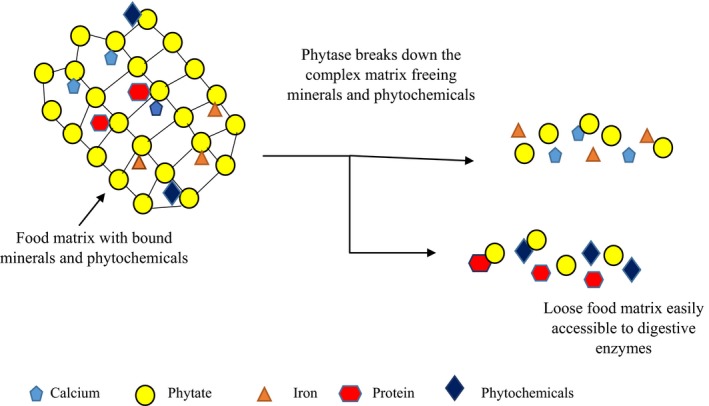
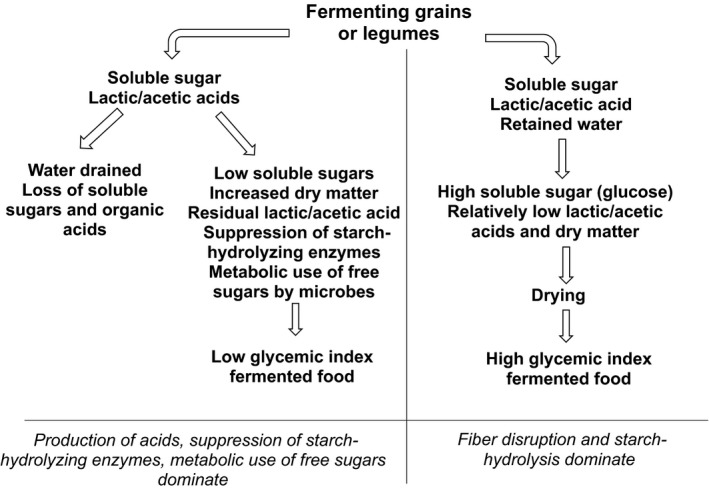
Cereals and legumes are outstanding sources of macronutrients, micronutrients, phytochemicals, as well as antinutritional factors. These components present a complex system enabling interactions with different components within food matrices. The interactions result in insoluble complexes with reduced bioaccessibility of nutrients through binding and entrapment thereby limiting their release from food matrices. The interactions of nutrients with antinutritional factors are the main factor hindering nutrients release. Trypsin inhibitors and phytates inherent in cereals and legumes reduce protein digestibility and mineral release, respectively. Interaction of phytates and phenolic compounds with minerals is significant in cereals and legumes. Fermentation and germination are commonly used to disrupt these interactions and make nutrients and phytochemicals free and accessible to digestive enzymes. This paper presents a review on traditional fermentation and germination processes as a means to address myriad interactions through activation of endogenous enzymes such as α-amylase, pullulanase, phytase, and other glucosidases. These enzymes degrade antinutritional factors and break down complex macronutrients to their simple and more digestible forms.
Overview
The claims and statistics of this paper haven’t been checked yet.
Run the check — free, no account needed. It reads the open-access text and checks the sources it cites.
Integrity signals
Registry
Cites
Statistics
Figures
Verification
Claims the paper makes
The claims and statistics of this paper haven’t been checked yet.
Run the check — free, no account needed. It reads the open-access text and checks the sources it cites.
Claims other papers make about this one
Each is checked against this paper’s own text: does it say what the citing paper says it does?
The source backs part of the claim, not all of it — or backs it for a different population, condition or comparison.
In the citing paper
“Additionally, fermentation further promotes the microbial degradation of antinutritional compounds by producing phytases and proteolytic enzymes, while also increasing the release of bioactive compounds and antioxidant activity [34].”
From Valorization of Microalgae as Multifunctional Protein Sources in Plant-Based Systems: Structural, Functional, and Processing Challenges (2026) · cites this paper as [34]
Experimental — accuracy not yet measuredThe source backs part of the claim, not all of it — or backs it for a different population, condition or comparison.
In the citing paper
“Germination activates endogenous enzymes, including phytases, proteases, and α-galactosidases, which degrade phytic acid, protease inhibitors, and raffinose-family oligosaccharides, thereby enhancing mineral bioavailability and protein digestibility [34,35].”
From Valorization of Microalgae as Multifunctional Protein Sources in Plant-Based Systems: Structural, Functional, and Processing Challenges (2026) · cites this paper as [34]
Experimental — accuracy not yet measured
Self-check
Percentages, sums and reported differences re-computed from the paper’s own numbers.
The self-check needs the paper’s full text.
Citations
Cites
Polyphenols: Food sources and bioavailability
Manach, C., Scalbert, A., Morand, C., Rémésy, C., & Jiménez, L. (2004) · The American Journal of Clinical Nutrition · doi:10.1093/ajcn/79.5.727 · Cited by 8,175
Short-chain fatty acids in control of body weight and insulin sensitivity
Canfora, E. E., Jocken, J. W., & Blaak, E. E. (2015) · Nature Reviews Endocrinology · doi:10.1038/nrendo.2015.128 · Cited by 2,298
The biosynthetic pathway of vitamin C in higher plants
Wheeler, G. L., Jones, M. A., & Smirnoff, N. (1998) · Nature · doi:10.1038/30728 · Cited by 1,143
Integrated food science and technology for the tropics.
Ihekoronye, A. I., & Ngoddy, P. O. (1985) · Cited by 1,061
Dietary roles of phytate and phytase in human nutrition: A review
Kumar, V., Sinha, A., Makkar, H., & Becker, K. (2010) · Food Chemistry · doi:10.1016/j.foodchem.2009.11.052 · Cited by 932
Factors affecting sorghum protein digestibility
Duodu, K. G., Taylor, J. R. N., Belton, P. S., & Hamaker, B. R. (2003) · Journal of Cereal Science · doi:10.1016/s0733-5210(03)00016-x · Cited by 782
The role of short chain fatty acids in appetite regulation and energy homeostasis
Byrne, C. S., Chambers, E. S., Morrison, D. J., & Frost, G. (2015) · International Journal of Obesity · doi:10.1038/ijo.2015.84 · Cited by 707
Hotz, C. S., & Gibson, R. S. (2007) · Journal of Nutrition · doi:10.1093/jn/137.4.1097 · Cited by 552
McNabney, S. M., & Henagan, T. M. (2017) · Nutrients · doi:10.3390/nu9121348 · Cited by 529
Mechanisms Underlying the Cholesterol-Lowering Properties of Soluble Dietary Fibre Polysaccharides
Gunness, P., & Gidley, M. J. (2010) · Food & Function · doi:10.1039/c0fo00080a · Cited by 527 · cited 1×
“…health by virtue of their antioxidant properties (Zhang et al., 2015), cholesterol- lowering effect (Golzarand, Mirmiran, Bahadoran, Alamdari, & Azizi, 2014; Gunness & Gidley, 2010), and reduction in the production of pro- inflammatory cytokines and immunosuppressive cells (Lesinski et al., 2015).”
Background
Research works printed but not linked: 8
- Alka S., 2012, Effect of fermentation on physicochemical properties & in vitro starch and protein digestibility of selected cereals, International Journal of Agricultural and Food Science, 2, 66
- Hassan G. F., 2015, Effect of fermentation on mineral and anti‐nutritional composition of cocoyam (Colocasia esculenta linn), Sky Journal of Food Science, 4, 042
- Ikeda K., 1984, Effect on buckwheat protein quality of seed germination and changes in trypsin inhibitor content, Cereal Chemistry, 61, 236
- Omemu A. M., 2011, Fermentation dynamics during production of ogi, a Nigerian fermented cereal porridge, Report and Opinion, 3, 8
- Sahlin P.(1999).Fermentation as a method of food processing production of organic acids pH‐development and microbial growth in fermenting cereals. Msc Thesis Lund University Department of Applied Nutrition and Food Chemistry.
- Tang Y., 1998, The relationship between phenylalanine deaminase activities and xanthoketone contents in buckwheat, Journal of Mianyang College of Economy & Technology, 15, 9
- Taur A. T., 1984, Nutritional improvement of grain sorghum by germination, The Indian Journal of Nutrition and Dietetics, 21, 168
- Zheng Y. M., 2006, Change of anti‐nutrient and phytic acid contents in brown rice during sprouting period, Journal of the Chinese Cereals and Oils Association, 21, 1
Cited by
Sorted by citations
Plant food anti-nutritional factors and their reduction strategies: an overview
Samtiya, M., Aluko, R. E., & Dhewa, T. (2020) · Food Production Processing and Nutrition · doi:10.1186/s43014-020-0020-5 · Cited by 1,228
Microbial Fermentation and Its Role in Quality Improvement of Fermented Foods
Sharma, R., Garg, P., Kumar, P., Bhatia, S. K., & Kulshrestha, S. (2020) · Fermentation · doi:10.3390/fermentation6040106 · Cited by 824
“Natural fermentation promotes enzymatic degradation of phytates by providing optimum pH conditions present in a complex form with polyvalent cations such as zinc, iron, magnesium, and calcium [1].”
BackgroundInfluentialProtein Digestibility of Cereal Products
Joye, I. (2019) · Foods · doi:10.3390/foods8060199 · Cited by 343
Health-Promoting Components in Fermented Foods: An Up-to-Date Systematic Review
Melini, F., Melini, V., Luziatelli, F., Ficca, A. G., & Ruzzi, M. (2019) · Nutrients · doi:10.3390/nu11051189 · Cited by 438
Grains – a major source of sustainable protein for health
Poutanen, K. S., Kårlund, A., Gómez-Gallego, C., Johansson, D. P., Scheers, N., Marklinder, I., Eriksen, A. K., Silventoinen, P., Nordlund, E., Sözer, N., et al. (2021) · Nutrition Reviews · doi:10.1093/nutrit/nuab084 · Cited by 347
“Germination of oats and sorghum has also been shown to improve protein solubility,(87,88) and to improve protein digestibility, either by increasing protein solubility or by removal of antinutrients.(89) Exogenous enzymes are widely applied in food processing, eg, enzymatic crosslinking of oat proteins is used as a to…”
Metadata
- Authors
- Nkhata, S. G., Ayua, E., Kamau, E. H., & Shingiro, J.
- Affiliations
- Department of Agriculture Extension Services Lilongwe Malawi
- University of Eldoret (KE)
- Rwanda Agriculture Board (RW)
- Corresponding author
- Nkhata, Smith G.
- Venue
- Food Science & Nutrition
- Publisher
- Wiley
- Published
- 2018-10-16
- Volume
- 6
- Issue
- 8
- Pages
- 2446-2458
- ISSN
- 2048-7177 (ISSN-L)
- PMC
- PMC6261201
- OpenAlex
- W2896888197
- Cited by
- 876
- References
- 100
- Citations by year
- 2026: 124 · 2025: 143 · 2024: 159 · 2023: 154 · 2022: 129 · 2021: 103 · 2020: 57 · 2019: 7
- FWCI
- 4.25
- Type
- journal article
- Language
- en
- Open access
- hybrid
- doi.org
- Licence
- Locations
- Food Science & Nutrition (publishedVersion, cc-by)
- Europe PMC (PubMed Central) (publishedVersion, other-oa)
- PubMed Central (publishedVersion, cc-by)
- PubMed (publishedVersion)
- DOAJ (DOAJ: Directory of Open Access Journals) (submittedVersion)
- Informationszentrum Lebenswissenschaften (ZB MED) (submittedVersion, cc-by)
- Topics
- Life Sciences › Agricultural and Biological Sciences › Plant Science › Phytase and its Applications
- Health Sciences › Nursing › Nutrition and Dietetics › Food composition and properties
- Life Sciences › Agricultural and Biological Sciences › Food Science › Food Nutrient Composition and Product Development
- Keywords
- cereal fermentation, Fabaceae, antinutritional factors, phytic acid, trypsin inhibitor, phenolic compounds, mineral bioaccessibility, protein digestibility, endogenous enzymes, phytase, alpha-amylase, pullulanase, glucosidase, nutrient bioavailability, phytochemicals
About these checks
Registry, retraction, Cites and statistics results are computed, not judged, with one exception: a printed reference that no index lists is read once by a model before it counts as a citation error. Claims are extracted by a model and kept only when their quote appears verbatim in the text; each cited source is then checked, with a model’s help, for whether it says what the claim relies on. Those verdicts can be wrong — read the claim’s quote and the cited source before relying on one.
Statistics and arithmetic are recomputed, not judged.
Confidence bands are shown only for fields calibrated on our annotated test set. None is calibrated yet, so no band is shown.
What counts as a claim ›How we measure confidence ›How we check this ›
Are you an author, or do you see a problem with this page? Request a review
