

The DOI matches its Crossref record; 32 of the 32 references it cites were found in a registry or an index.
The black hole interior from non-isometric codes and complexity
Abstract
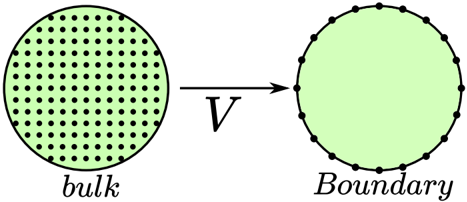
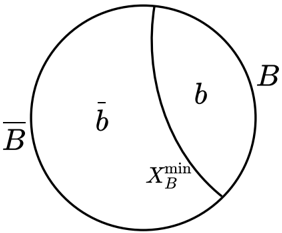
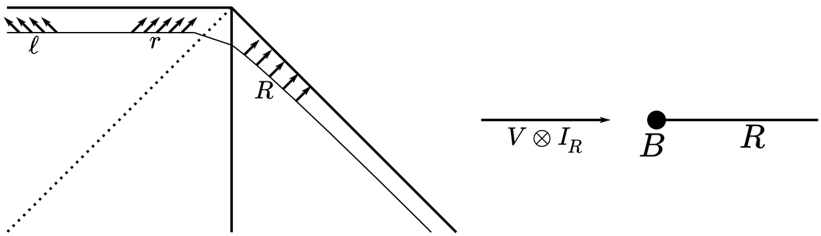
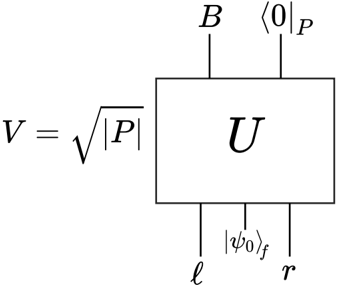
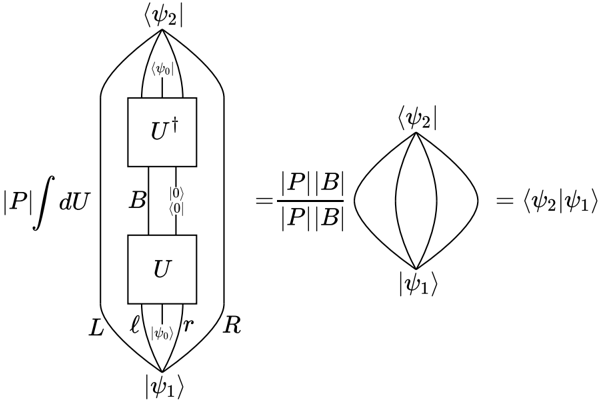
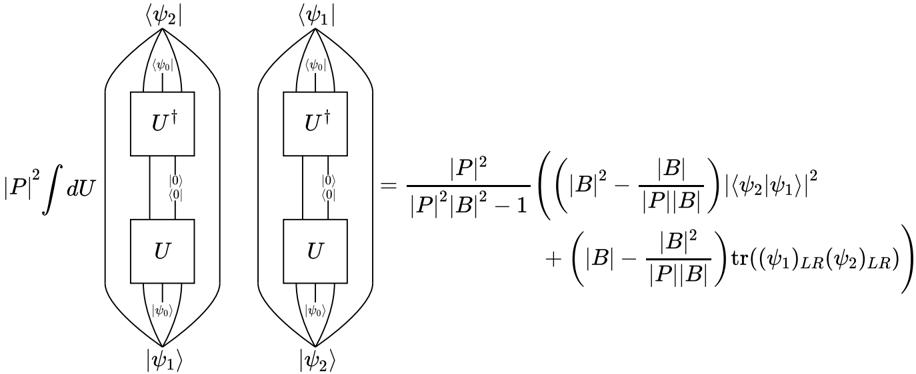
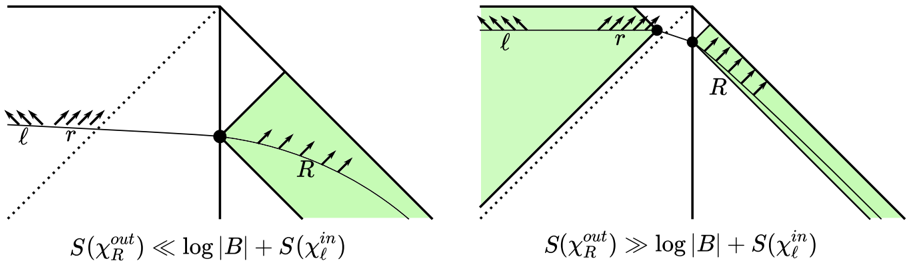
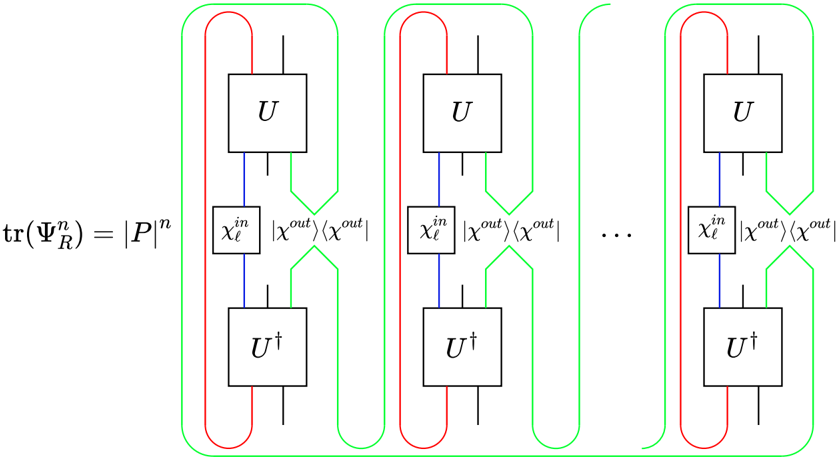
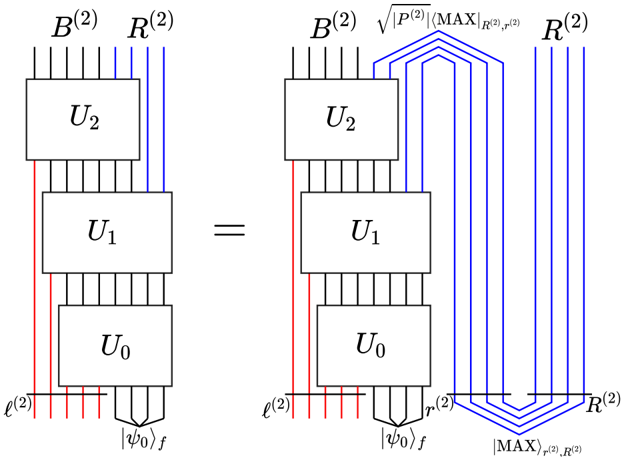
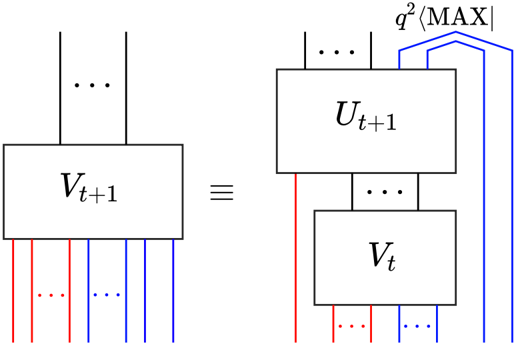
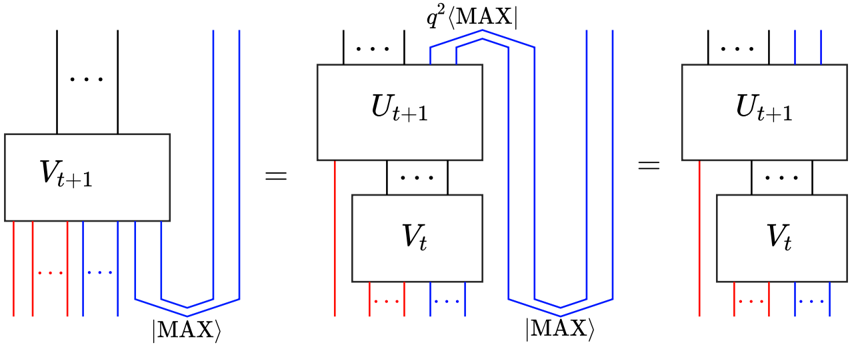
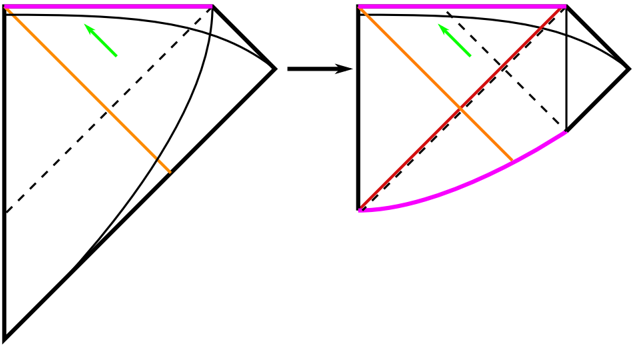
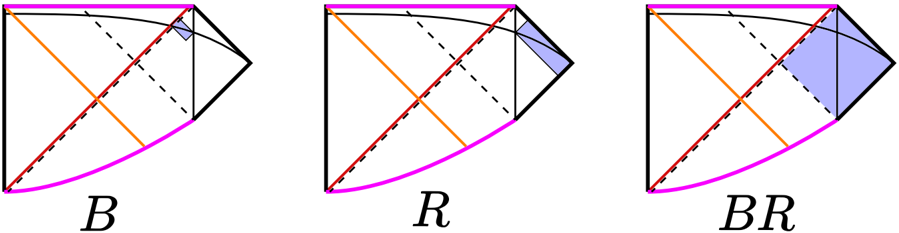
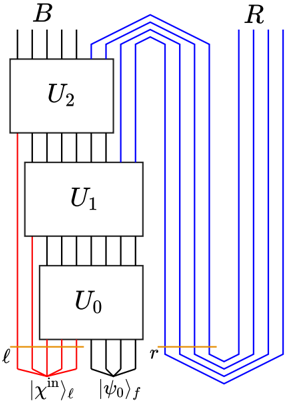
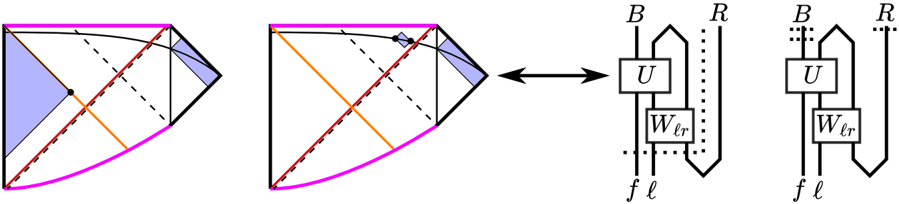
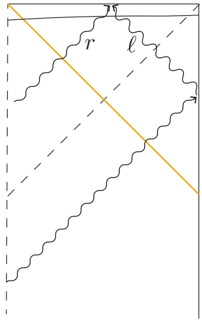
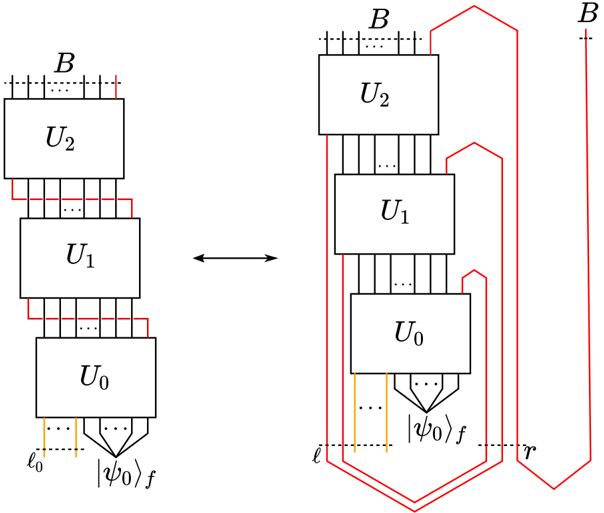
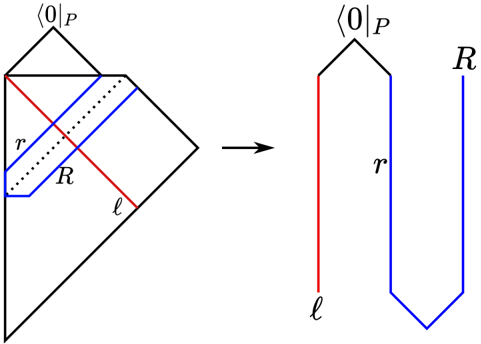
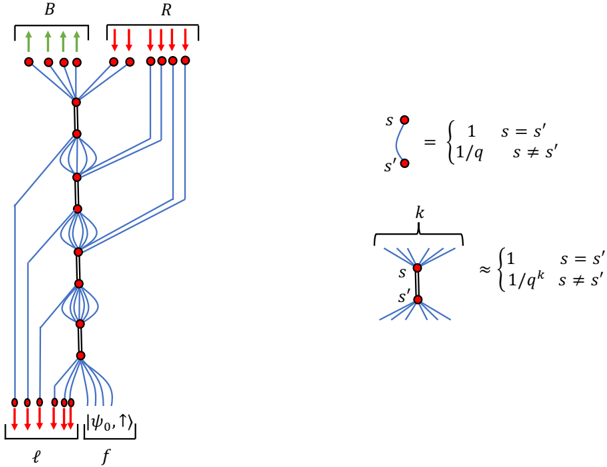
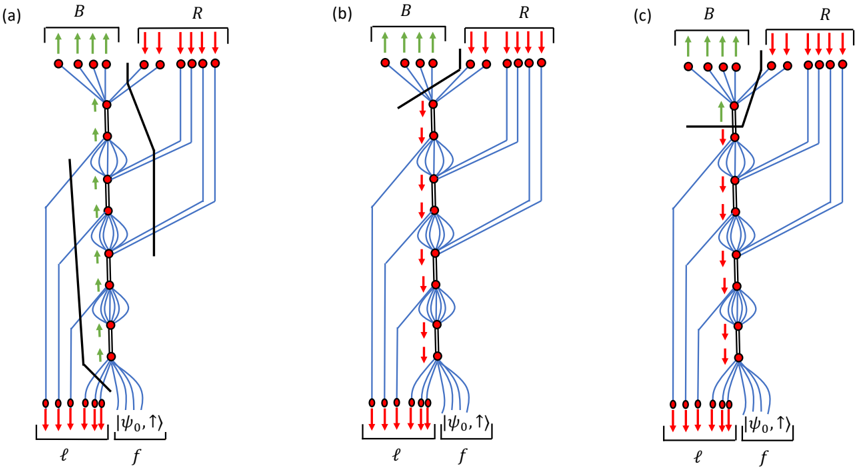
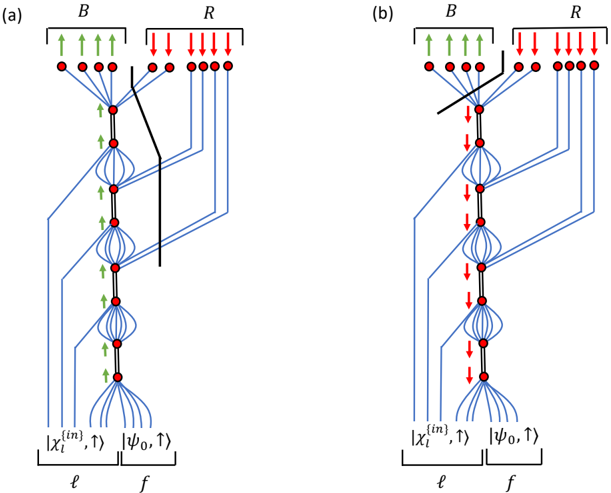
A bstract: Quantum error correction has given us a natural language for the emergence of spacetime, but the black hole interior poses a challenge for this framework: at late times the apparent number of interior degrees of freedom in effective field theory can vastly exceed the true number of fundamental degrees of freedom, so there can be no isometric (i.e. inner-product preserving) encoding of the former into the latter. In this paper we explain how quantum error correction nonetheless can be used to explain the emergence of the black hole interior, via the idea of “non-isometric codes protected by computational complexity”. We show that many previous ideas, such as the existence of a large number of “null states”, a breakdown of effective field theory for operations of exponential complexity, the quantum extremal surface calculation of the Page curve, post-selection, “state-dependent/state-specific” operator reconstruction, and the “simple entropy” approach to complexity coarse-graining, all fit naturally into this framework, and we illustrate all of these phenomena simultaneously in a soluble model.
Overview
The claims and statistics of this paper haven’t been checked yet.
Run the check — free, no account needed. It reads the open-access text and checks the sources it cites.
Integrity signals
Registry
Cites
Statistics
Figures

Verification
Claims the paper makes
The claims and statistics of this paper haven’t been checked yet.
Run the check — free, no account needed. It reads the open-access text and checks the sources it cites.
Claims other papers make about this one
Each is checked against this paper’s own text: does it say what the citing paper says it does?
The source backs part of the claim, not all of it — or backs it for a different population, condition or comparison.
In the citing paper
“This model satisfies a much stronger effective-isometricity property, due to the strong measure concentration of Gaussian random states [68,98].”
From The baby universe is fine and the CFT knows it: on holography for closed universes (2025) · cites this paper as [68]
Experimental — accuracy not yet measuredThe cited source says what the claim attributes to it.
In the citing paper
“This is much weaker than having a fixed isometry approximating the holographic map for any state[68,95,97].”
From The baby universe is fine and the CFT knows it: on holography for closed universes (2025) · cites this paper as [68]
In the citing paper
“From the bulk EFT point of view, AdS l plays the role of Hawking radiation in the Hawking state, the closed universe plays the role of the island [64][65][66][67][68] for Hawking radiation, and AdS r accounts for the remaining black hole microstates.”
From The baby universe is fine and the CFT knows it: on holography for closed universes (2025) · cites this paper as [68]
In the citing paper
“From a counting argument, it then follows from (2.21) that with extremely high probability, the map acts effectively isometrically for all of them as long as the entropy in the closed universe remains sub-exponential in the entropy of the AdS spaces, Splrq “ log Spcq (see [6,68]).”
From The baby universe is fine and the CFT knows it: on holography for closed universes (2025) · cites this paper as [68]
In the citing paper
“Under some mild assumptions about the holographic map, the non-isometric region can be divided into “effectively isometric” and “highly non-isometric”, as explained in [68].”
From The baby universe is fine and the CFT knows it: on holography for closed universes (2025) · cites this paper as [68]
In the citing paper
“The postselection implemented by the holographic map from the bulk QFT to the two CFTs is similar to the one considered in [68] for an evaporating black hole, and can also be interpreted in terms of a final state projection [104] and leads to the rEFT proj s perspective as discussed in Section 4.”
From The baby universe is fine and the CFT knows it: on holography for closed universes (2025) · cites this paper as [68]
In the citing paper
“When the entanglement entropy is sufficiently large, the situation is a rather conventional encoding, analogous to the situation for the black hole interior [68].”
From The baby universe is fine and the CFT knows it: on holography for closed universes (2025) · cites this paper as [68]
In the citing paper
“In the regime of large entanglement, the CFT can therefore probe the local semiclassical physics in the closed universe, which is preserved by the final state projection just like it is preserved by the projection arising in the non-isometric map, as it was discussed in [68] for evaporating black holes after the Page time.”
From The baby universe is fine and the CFT knows it: on holography for closed universes (2025) · cites this paper as [68]
In the citing paper
“The mathematical difference is that the state |O c y is Gaussian random, so Gaussian isoperimetric measure concentration theorems replace those of the Haar measure in[68].”
From The baby universe is fine and the CFT knows it: on holography for closed universes (2025) · cites this paper as [68]
In the citing paper
“Note that this model is very similar to the model in[68], with the different interpretation that part of the entanglement is non-geometric.”
From The baby universe is fine and the CFT knows it: on holography for closed universes (2025) · cites this paper as [68]
Self-check
Percentages, sums and reported differences re-computed from the paper’s own numbers.
The self-check needs the paper’s full text.
Citations
Cites
Particle creation by black holes
Hawking, S. W. (1975) · Communications In Mathematical Physics · doi:10.1007/bf02345020 · Cited by 13,106
Information theory and statistical mechanics
Jaynes, E. T. (1957) · Physical Review · doi:10.1103/physrev.106.620 · Cited by 12,931
Quantum Computation and Quantum Information: 10th Anniversary Edition
Nielsen, M. A., & Chuang, I. L. (2012) · doi:10.1017/cbo9780511976667 · Cited by 8,436
Ryu, S., & Takayanagi, T. (2006) · Physical Review Letters · doi:10.1103/physrevlett.96.181602 · Cited by 4,302
Information Theory and Statistical Mechanics. II
Jaynes, E. T. (1957) · Physical Review · doi:10.1103/physrev.108.171 · Cited by 3,253
Breakdown of predictability in gravitational collapse
Hawking, S. W. (1976) · Physical Review D · doi:10.1103/physrevd.14.2460 · Cited by 2,554
Computational Complexity: A Modern Approach
Arora, S., & Barak, B. (2009) · doi:10.1017/cbo9780511804090 · Cited by 1,690
Black Holes: Complementarity or Firewalls?
Almheiri, A., Marolf, D., Polchinski, J., & Sully, J. (2012) · arXiv · doi:10.48550/arxiv.1207.3123 · Cited by 1,471
The Theory of Quantum Information
Watrous, J. (2018) · doi:10.1017/9781316848142 · Cited by 1,325
On the quantum structure of a black hole
't Hooft, G. (1985) · Nuclear Physics B · doi:10.1016/0550-3213(85)90418-3 · Cited by 1,311
Research works printed but not linked: 100
- J.D. Bekenstein, Black holes and entropy, Phys. Rev. D 7 (1973) 2333 [INSPIRE]. · DOI · Paper page
- J.M. Maldacena, The large N limit of superconformal field theories and supergravity, Adv. Theor. Math. Phys. 2 (1998) 231 [hep-th/9711200] [INSPIRE]. · DOI · Paper page
- N. Engelhardt and A.C. Wall, Quantum Extremal Surfaces: Holographic Entanglement Entropy beyond the Classical Regime, JHEP 01 (2015) 073 [arXiv:1408.3203] [INSPIRE]. · DOI · Paper page
- T. Banks, M.R. Douglas, G.T. Horowitz and E.J. Martinec, AdS dynamics from conformal field theory, hep-th/9808016 [INSPIRE]. · arXiv
- A. Hamilton, D.N. Kabat, G. Lifschytz and D.A. Lowe, Holographic representation of local bulk operators, Phys. Rev. D 74 (2006) 066009 [hep-th/0606141] [INSPIRE]. · DOI · Paper page
- I. Heemskerk, D. Marolf, J. Polchinski and J. Sully, Bulk and Transhorizon Measurements in AdS/CFT, JHEP 10 (2012) 165 [arXiv:1201.3664] [INSPIRE]. · DOI
- R. Bousso et al., Null Geodesics, Local CFT Operators and AdS/CFT for Subregions, Phys. Rev. D 88 (2013) 064057 [arXiv:1209.4641] [INSPIRE]. · DOI
- B. Czech, J.L. Karczmarek, F. Nogueira and M. Van Raamsdonk, The Gravity Dual of a Density Matrix, Class. Quant. Grav. 29 (2012) 155009 [arXiv:1204.1330] [INSPIRE]. · DOI · Paper page
- A.C. Wall, Maximin Surfaces, and the Strong Subadditivity of the Covariant Holographic Entanglement Entropy, Class. Quant. Grav. 31 (2014) 225007 [arXiv:1211.3494] [INSPIRE]. · DOI · Paper page
- F. Pastawski, B. Yoshida, D. Harlow and J. Preskill, Holographic quantum error-correcting codes: Toy models for the bulk/boundary correspondence, JHEP 06 (2015) 149 [arXiv:1503.06237] [INSPIRE]. · DOI · Paper page
- X. Dong, D. Harlow and A.C. Wall, Reconstruction of Bulk Operators within the Entanglement Wedge in Gauge-Gravity Duality, Phys. Rev. Lett. 117 (2016) 021601 [arXiv:1601.05416] [INSPIRE]. · DOI · Paper page
- D. Harlow, The Ryu–Takayanagi Formula from Quantum Error Correction, Commun. Math. Phys. 354 (2017) 865 [arXiv:1607.03901] [INSPIRE]. · DOI
- P. Hayden et al., Holographic duality from random tensor networks, JHEP 11 (2016) 009 [arXiv:1601.01694] [INSPIRE]. · DOI · Paper page
- C. Akers, S. Leichenauer and A. Levine, Large Breakdowns of Entanglement Wedge Reconstruction, Phys. Rev. D 100 (2019) 126006 [arXiv:1908.03975] [INSPIRE]. · DOI
- C. Akers and G. Penington, Leading order corrections to the quantum extremal surface prescription, JHEP 04 (2021) 062 [arXiv:2008.03319] [INSPIRE]. · DOI
- C. Akers and G. Penington, Quantum minimal surfaces from quantum error correction, SciPost Phys. 12 (2022) 157 [arXiv:2109.14618] [INSPIRE]. · DOI · Paper page
- S.D. Mathur, The Information paradox: A Pedagogical introduction, Class. Quant. Grav. 26 (2009) 224001 [arXiv:0909.1038] [INSPIRE]. · DOI · Paper page
- D. Marolf and A.C. Wall, Eternal Black Holes and Superselection in AdS/CFT, Class. Quant. Grav. 30 (2013) 025001 [arXiv:1210.3590] [INSPIRE]. · DOI · Paper page
- E. Verlinde and H. Verlinde, Black Hole Entanglement and Quantum Error Correction, JHEP 10 (2013) 107 [arXiv:1211.6913] [INSPIRE]. · DOI
- A. Almheiri et al., An Apologia for Firewalls, JHEP 09 (2013) 018 [arXiv:1304.6483] [INSPIRE]. · DOI · Paper page
- D. Marolf and J. Polchinski, Gauge/Gravity Duality and the Black Hole Interior, Phys. Rev. Lett. 111 (2013) 171301 [arXiv:1307.4706] [INSPIRE]. · DOI · Paper page
- J.V. Rocha, Evaporation of large black holes in AdS: Coupling to the evaporon, JHEP 08 (2008) 075 [arXiv:0804.0055] [INSPIRE]. · DOI
- A. Almheiri, N. Engelhardt, D. Marolf and H. Maxfield, The entropy of bulk quantum fields and the entanglement wedge of an evaporating black hole, JHEP 12 (2019) 063 [arXiv:1905.08762] [INSPIRE]. · DOI · Paper page
- P. Hayden and J. Preskill, Black holes as mirrors: Quantum information in random subsystems, JHEP 09 (2007) 120 [arXiv:0708.4025] [INSPIRE]. · DOI · Paper page
- Y. Kiem, H.L. Verlinde and E.P. Verlinde, Black hole horizons and complementarity, Phys. Rev. D 52 (1995) 7053 [hep-th/9502074] [INSPIRE]. · DOI
- D.L. Jafferis, Bulk reconstruction and the Hartle-Hawking wavefunction, arXiv:1703.01519 [INSPIRE]. · arXiv
- P. Hayden and G. Penington, Learning the Alpha-bits of Black Holes, JHEP 12 (2019) 007 [arXiv:1807.06041] [INSPIRE]. · DOI · Paper page
- A. Almheiri, Holographic Quantum Error Correction and the Projected Black Hole Interior, arXiv:1810.02055 [INSPIRE]. · arXiv
- L. Susskind, Computational Complexity and Black Hole Horizons, Fortsch. Phys. 64 (2016) 24 [arXiv:1403.5695] [INSPIRE]. · DOI · Paper page
- L. Susskind, The Typical-State Paradox: Diagnosing Horizons with Complexity, Fortsch. Phys. 64 (2016) 84 [arXiv:1507.02287] [INSPIRE]. · DOI
- N. Engelhardt and A.C. Wall, Decoding the Apparent Horizon: Coarse-Grained Holographic Entropy, Phys. Rev. Lett. 121 (2018) 211301 [arXiv:1706.02038] [INSPIRE]. · DOI
- N. Engelhardt and A.C. Wall, Coarse Graining Holographic Black Holes, JHEP 05 (2019) 160 [arXiv:1806.01281] [INSPIRE]. · DOI
- A. Bouland, B. Fefferman and U. Vazirani, Computational pseudorandomness, the wormhole growth paradox, and constraints on the AdS/CFT duality, arXiv:1910.14646 [INSPIRE]. · arXiv
- I.H. Kim, E. Tang and J. Preskill, The ghost in the radiation: robust encodings of the black hole interior (invited paper), JHEP 06 (2020) 031 [arXiv:2003.05451] [INSPIRE]. · DOI · Paper page
- N. Engelhardt, G. Penington and A. Shahbazi-Moghaddam, A world without pythons would be so simple, Class. Quant. Grav. 38 (2021) 234001 [arXiv:2102.07774] [INSPIRE]. · DOI · Paper page
- N. Engelhardt, G. Penington and A. Shahbazi-Moghaddam, Finding pythons in unexpected places, Class. Quant. Grav. 39 (2022) 094002 [arXiv:2105.09316] [INSPIRE]. · DOI
- G.T. Horowitz and J.M. Maldacena, The black hole final state, JHEP 02 (2004) 008 [hep-th/0310281] [INSPIRE]. · DOI · Paper page
- D.N. Page, Average entropy of a subsystem, Phys. Rev. Lett. 71 (1993) 1291 [gr-qc/9305007] [INSPIRE]. · DOI · Paper page
- E.S. Meckes, The random matrix theory of the classical compact groups, vol. 218, Cambridge University Press (2019). · DOI
- J.M. Maldacena, Eternal black holes in anti-de Sitter, JHEP 04 (2003) 021 [hep-th/0106112] [INSPIRE]. · DOI · Paper page
- J.S. Cotler et al., Black Holes and Random Matrices, JHEP 05 (2017) 118 [Erratum ibid. 09 (2018) 002] [arXiv:1611.04650] [INSPIRE]. · arXiv
- D. Harlow and D. Jafferis, The Factorization Problem in Jackiw-Teitelboim Gravity, JHEP 02 (2020) 177 [arXiv:1804.01081] [INSPIRE]. · DOI · Paper page
- L. Susskind, Black Holes at Exp-time, arXiv:2006.01280 [INSPIRE]. · arXiv
- C. Akers and P. Rath, Holographic Renyi Entropy from Quantum Error Correction, JHEP 05 (2019) 052 [arXiv:1811.05171] [INSPIRE]. · DOI · Paper page
- X. Dong, D. Harlow and D. Marolf, Flat entanglement spectra in fixed-area states of quantum gravity, JHEP 10 (2019) 240 [arXiv:1811.05382] [INSPIRE]. · DOI · Paper page
- K. Papadodimas and S. Raju, Remarks on the necessity and implications of state-dependence in the black hole interior, Phys. Rev. D 93 (2016) 084049 [arXiv:1503.08825] [INSPIRE]. · DOI
- Y. Sekino and L. Susskind, Fast Scramblers, JHEP 10 (2008) 065 [arXiv:0808.2096] [INSPIRE]. · DOI · Paper page
- N. Lashkari et al., Towards the Fast Scrambling Conjecture, JHEP 04 (2013) 022 [arXiv:1111.6580] [INSPIRE]. · DOI
- W. Brown and O. Fawzi, Scrambling speed of random quantum circuits, arXiv:1210.6644 [INSPIRE]. · arXiv
- S.H. Shenker and D. Stanford, Black holes and the butterfly effect, JHEP 03 (2014) 067 [arXiv:1306.0622] [INSPIRE]. · DOI · Paper page
- V.E. Hubeny and M. Rangamani, Causal Holographic Information, JHEP 06 (2012) 114 [arXiv:1204.1698] [INSPIRE]. · DOI · Paper page
- W.R. Kelly and A.C. Wall, Coarse-grained entropy and causal holographic information in AdS/CFT, JHEP 03 (2014) 118 [arXiv:1309.3610] [INSPIRE]. · DOI
- N. Engelhardt and A.C. Wall, No Simple Dual to the Causal Holographic Information?, JHEP 04 (2017) 134 [arXiv:1702.01748] [INSPIRE]. · DOI
- R. Bousso, V. Chandrasekaran and A. Shahbazi-Moghaddam, From black hole entropy to energy-minimizing states in QFT, Phys. Rev. D 101 (2020) 046001 [arXiv:1906.05299] [INSPIRE]. · DOI
- N. Engelhardt, G. Penington and A. Shahbazi-Moghaddam, Twice upon a time: timelike-separated quantum extremal surfaces, JHEP 01 (2024) 033 [arXiv:2308.16226] [INSPIRE]. · DOI
- A. Almheiri and H.W. Lin, The entanglement wedge of unknown couplings, JHEP 08 (2022) 062 [arXiv:2111.06298] [INSPIRE]. · DOI
- D. Harlow and J.-Q. Wu, Algebra of diffeomorphism-invariant observables in Jackiw-Teitelboim gravity, JHEP 05 (2022) 097 [arXiv:2108.04841] [INSPIRE]. · DOI
- M. Van Raamsdonk, Building up spacetime with quantum entanglement, Gen. Rel. Grav. 42 (2010) 2323 [arXiv:1005.3035] [INSPIRE]. · DOI · Paper page
- N. Engelhardt and Å. Folkestad, Canonical purification of evaporating black holes, Phys. Rev. D 105 (2022) 086010 [arXiv:2201.08395] [INSPIRE]. · DOI
- Y. Zhao, Collision in the interior of wormhole, JHEP 03 (2020) 144 [arXiv:2011.06016] [INSPIRE]. · arXiv
- F.M. Haehl and Y. Zhao, Diagnosing collisions in the interior of a wormhole, Phys. Rev. D 104 (2021) L021901 [arXiv:2104.02736] [INSPIRE]. · DOI
- F.M. Haehl and Y. Zhao, Collisions of localized shocks and quantum circuits, JHEP 09 (2022) 002 [arXiv:2202.04661] [INSPIRE]. · DOI
- A. Strominger and C. Vafa, Microscopic origin of the Bekenstein-Hawking entropy, Phys. Lett. B 379 (1996) 99 [hep-th/9601029] [INSPIRE]. · DOI · Paper page
- A. Strominger, Black hole entropy from near horizon microstates, JHEP 02 (1998) 009 [hep-th/9712251] [INSPIRE]. · DOI · Paper page
- E. Witten, Anti-de Sitter space and holography, Adv. Theor. Math. Phys. 2 (1998) 253 [hep-th/9802150] [INSPIRE]. · DOI · Paper page
- G.W. Gibbons and S.W. Hawking, Action Integrals and Partition Functions in Quantum Gravity, Phys. Rev. D 15 (1977) 2752 [INSPIRE]. · DOI · Paper page
- A. Lewkowycz and J. Maldacena, Generalized gravitational entropy, JHEP 08 (2013) 090 [arXiv:1304.4926] [INSPIRE]. · DOI · Paper page
- T. Faulkner, A. Lewkowycz and J. Maldacena, Quantum corrections to holographic entanglement entropy, JHEP 11 (2013) 074 [arXiv:1307.2892] [INSPIRE]. · DOI · Paper page
- D. Harlow and E. Shaghoulian, Global symmetry, Euclidean gravity, and the black hole information problem, JHEP 04 (2021) 175 [arXiv:2010.10539] [INSPIRE]. · DOI
- S.R. Coleman, Black holes as red herrings: Topological fluctuations and the loss of quantum coherence, Nucl. Phys. B 307 (1988) 867 [INSPIRE]. · DOI · Paper page
- P. Saad, S.H. Shenker and D. Stanford, A semiclassical ramp in SYK and in gravity, arXiv:1806.06840 [INSPIRE]. · arXiv
- Y. Aharonov, P.G. Bergmann and J.L. Lebowitz, Time Symmetry in the Quantum Process of Measurement, Phys. Rev. 134 (1964) B1410 [INSPIRE]. · DOI
- D. Gottesman and J. Preskill, Comment on ‘The Black hole final state’, JHEP 03 (2004) 026 [hep-th/0311269] [INSPIRE]. · DOI · Paper page
- S. Lloyd and J. Preskill, Unitarity of black hole evaporation in final-state projection models, JHEP 08 (2014) 126 [arXiv:1308.4209] [INSPIRE]. · DOI · Paper page
- K. Papadodimas and S. Raju, Black Hole Interior in the Holographic Correspondence and the Information Paradox, Phys. Rev. Lett. 112 (2014) 051301 [arXiv:1310.6334] [INSPIRE]. · DOI
- D. Harlow, Aspects of the Papadodimas-Raju Proposal for the Black Hole Interior, JHEP 11 (2014) 055 [arXiv:1405.1995] [INSPIRE]. · DOI
- D. Marolf and J. Polchinski, Violations of the Born rule in cool state-dependent horizons, JHEP 01 (2016) 008 [arXiv:1506.01337] [INSPIRE]. · DOI
- I. Kourkoulou and J. Maldacena, Pure states in the SYK model and nearly-AdS2 gravity, arXiv:1707.02325 [INSPIRE]. · arXiv
- C. Akers, N. Engelhardt and D. Harlow, Simple holographic models of black hole evaporation, JHEP 08 (2020) 032 [arXiv:1910.00972] [INSPIRE]. · DOI
- V. Balasubramanian, A. Kar, C. Li and O. Parrikar, Quantum error correction in the black hole interior, JHEP 07 (2023) 189 [arXiv:2203.01961] [INSPIRE]. · DOI
- T. Anous, J. Kruthoff and R. Mahajan, Density matrices in quantum gravity, SciPost Phys. 9 (2020) 045 [arXiv:2006.17000] [INSPIRE]. · DOI
- K. Langhoff and Y. Nomura, Ensemble from Coarse Graining: Reconstructing the Interior of an Evaporating Black Hole, Phys. Rev. D 102 (2020) 086021 [arXiv:2008.04202] [INSPIRE]. · DOI
- A. Blommaert, L.V. Iliesiu and J. Kruthoff, Alpha states demystified — towards microscopic models of AdS2 holography, JHEP 08 (2022) 071 [arXiv:2203.07384] [INSPIRE]. · DOI
- R. Chao, B.W. Reichardt, C. Sutherland and T. Vidick, Overlapping qubits, arXiv:1701.01062 [https://doi.org/10.4230/LIPIcs.ITCS.2017.48]. · DOI
- H. Buhrman, R. Cleve, J. Watrous and R. de Wolf, Quantum Fingerprinting, Phys. Rev. Lett. 87 (2001) 167902 [quant-ph/0102001] [INSPIRE]. · DOI · Paper page
- R. Bousso, Violations of the Equivalence Principle by a Nonlocally Reconstructed Vacuum at the Black Hole Horizon, Phys. Rev. Lett. 112 (2014) 041102 [arXiv:1308.3697] [INSPIRE]. · DOI
- M. Van Raamsdonk, Evaporating Firewalls, JHEP 11 (2014) 038 [arXiv:1307.1796] [INSPIRE]. · DOI
- B. Guo, M.R.R. Hughes, S.D. Mathur and M. Mehta, Contrasting the fuzzball and wormhole paradigms for black holes, Turk. J. Phys. 45 (2021) 281 [arXiv:2111.05295] [INSPIRE]. · DOI
- R. Bousso and A. Shahbazi-Moghaddam, Quantum singularities, Phys. Rev. D 107 (2023) 066002 [arXiv:2206.07001] [INSPIRE]. · DOI
- D. Harlow and L. Susskind, Crunches, Hats, and a Conjecture, arXiv:1012.5302 [INSPIRE]. · arXiv
- B. Collins and P. Śniady, Integration with Respect to the Haar Measure on Unitary, Orthogonal and Symplectic Group, Commun. Math. Phys. 264 (2006) 773 [INSPIRE]. · DOI
- W. Fulton and J. Harris, Representation theory: a first course, vol. 129, Springer Science & Business Media (2013).
- C. Dankert, R. Cleve, J. Emerson and E. Livine, Exact and approximate unitary 2-designs and their application to fidelity estimation, Phys. Rev. A 80 (2009) 012304 [INSPIRE]. · DOI
- G.W. Anderson, A. Guionnet and O. Zeitouni, An introduction to random matrices, Cambridge university press (2010). · DOI
- M. Émery and J.E. Yukich, A simple proof of the logarithmic sobolev inequality on the circle, Séminaire de probabilités de Strasbourg 21 (1987) 173. · DOI
- D. Bakry and M. Émery, Diffusions hypercontractives, in Seminaire de probabilités XIX 1983/84, Springer (1985) pp. 177–206. · DOI
- M. Gromov and V.D. Milman, A topological application of the isoperimetric inequality, Am. J. MAth. 105 (1983) 843. · DOI
- S.J. Szarek, Spaces with large distance to $$ {\ell}_{\infty}^n $$ and random matrices, Am. J. MAth. 112 (1990) 899. · DOI
- A. Nahum, S. Vijay and J. Haah, Operator Spreading in Random Unitary Circuits, Phys. Rev. X 8 (2018) 021014 [arXiv:1705.08975] [INSPIRE]. · DOI
- C. von Keyserlingk, T. Rakovszky, F. Pollmann and S. Sondhi, Operator hydrodynamics, OTOCs, and entanglement growth in systems without conservation laws, Phys. Rev. X 8 (2018) 021013 [arXiv:1705.08910] [INSPIRE]. · DOI
Cited by
Sorted by citations
The baby universe is fine and the CFT knows it: on holography for closed universes
Antonini, S., Rath, P., Sasieta, M., Swingle, B., & Vilar López, A. (2025) · Journal of High Energy Physics · doi:10.1007/jhep12(2025)159 · Cited by 35
Further Evidence Against a Semiclassical Baby Universe in AdS/CFT
Engelhardt, N., & Gesteau, E. (2025) · arXiv · doi:10.48550/arxiv.2504.14586 · Cited by 28
Self-citation
Metadata
- Authors
- Akers, C., Engelhardt, N., Harlow, D., Penington, G., & Vardhan, S.
- Venue
- Journal of High Energy Physics
- Published
- 2024-06-24
- Volume
- 2024
- Issue
- 6
- ISSN
- 1029-8479
- Cited by
- 75
- References
- 32
- Language
- en
About these checks
Registry, retraction, Cites and statistics results are computed, not judged, with one exception: a printed reference that no index lists is read once by a model before it counts as a citation error. Claims are extracted by a model and kept only when their quote appears verbatim in the text; each cited source is then checked, with a model’s help, for whether it says what the claim relies on. Those verdicts can be wrong — read the claim’s quote and the cited source before relying on one.
Statistics and arithmetic are recomputed, not judged.
Confidence bands are shown only for fields calibrated on our annotated test set. None is calibrated yet, so no band is shown.
What counts as a claim ›How we measure confidence ›How we check this ›
Are you an author, or do you see a problem with this page? Request a review
