

Self-regulation of the inflammatory response by peroxisome proliferator-activated receptors
Open accessThe DOI matches its Crossref record; 232 of the 233 references it cites were found in a registry or an index.
Abstract
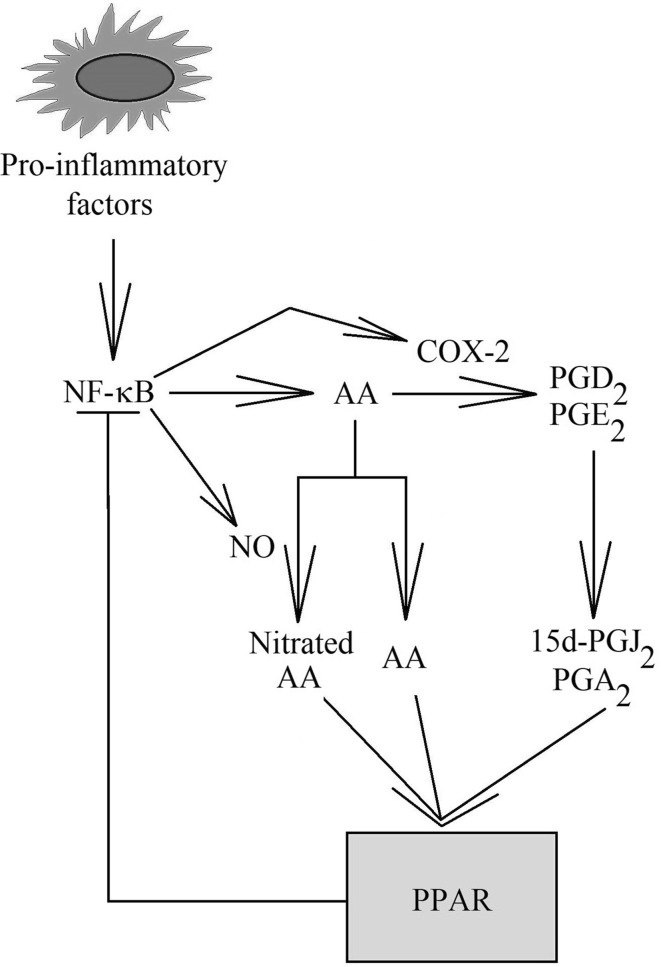
The peroxisome proliferator-activated receptor (PPAR) family includes three transcription factors: PPARα, PPARβ/δ, and PPARγ. PPAR are nuclear receptors activated by oxidised and nitrated fatty acid derivatives as well as by cyclopentenone prostaglandins (PGA 2 and 15d-PGJ 2 ) during the inflammatory response. This results in the modulation of the pro-inflammatory response, preventing it from being excessively activated. Other activators of these receptors are nonsteroidal anti-inflammatory drug (NSAID) and fatty acids, especially polyunsaturated fatty acid (PUFA) (arachidonic acid, ALA, EPA, and DHA). The main function of PPAR during the inflammatory reaction is to promote the inactivation of NF-κB. Possible mechanisms of inactivation include direct binding and thus inactivation of p65 NF-κB or ubiquitination leading to proteolytic degradation of p65 NF-κB. PPAR also exert indirect effects on NF-κB. They promote the expression of antioxidant enzymes, such as catalase, superoxide dismutase, or heme oxygenase-1, resulting in a reduction in the concentration of reactive oxygen species (ROS), i.e., secondary transmitters in inflammatory reactions. PPAR also cause an increase in the expression of IκBα, SIRT1, and PTEN, which interferes with the activation and function of NF-κB in inflammatory reactions.
Overview
The claims and statistics of this paper haven’t been checked yet.
Free: it reads the open-access text and checks the first 5 claims that cite a source we can check. Create a free account to check every claim.
Integrity signals
Registry
Cites
Statistics
Figures
Verification
Claims the paper makes
The claims and statistics of this paper haven’t been checked yet.
Free: it reads the open-access text and checks the first 5 claims that cite a source we can check. Create a free account to check every claim.
Claims other papers make about this one
Each is checked against this paper’s own text: does it say what the citing paper says it does?
In the citing paper
“PPAR-α directly binds to inflammatory transcription factors in hepatocytes such as p65 & c-Jun (NF-κB components), AP-1, STAT and thereby suppresses their transcriptional activity.[110]”
From Nuclear receptors in liver fibrosis (2021) · cites this paper as [110]
Self-check
Percentages, sums and reported differences re-computed from the paper’s own numbers.
The self-check needs the paper’s full text.
Citations
Cites
2 retracted
Subbaramaiah, K., Lin, D. T., Hart, J. C., & Dannenberg, A. J. (2001) · Journal of Biological Chemistry · doi:10.1074/jbc.m007237200 · Cited by 275
RetractedSodhi, K., Puri, N., Kim, D.-H., Hinds, T. D., Stechschulte, L. A., Favero, G., Rodella, L. F., Shapiro, J. I., Jude, D., & Abraham, N. G. (2013) · International Journal of Obesity · doi:10.1038/ijo.2013.116 · Cited by 28
RetractedModulation of NF‐κB‐dependent transcription and cell survival by the SIRT1 deacetylase
Yeung, F., Hoberg, J. E., Ramsey, C. S., Keller, M. D., Jones, D. R., Frye, R. A., & Mayo, M. W. (2004) · The EMBO Journal · doi:10.1038/sj.emboj.7600244 · Cited by 2,750
Kliewer, S. A., Sundseth, S. S., Jones, S. A., Brown, P. J., Wisely, G. B., Koble, C. S., Devchand, P., Wahli, W., Willson, T. M., Lenhard, J. M., et al. (1997) · Proceedings of the National Academy of Sciences · doi:10.1073/pnas.94.9.4318 · Cited by 2,164
Forman, B. M., Chen, J., & Evans, R. M. (1997) · Proceedings of the National Academy of Sciences · doi:10.1073/pnas.94.9.4312 · Cited by 2,116
Ros and ros-mediated cellular signaling
Zhang, J., Wang, X., Vikash, V., Ye, Q., Wu, D., Liu, Y., & Dong, W. (2016) · Oxidative Medicine and Cellular Longevity · doi:10.1155/2016/4350965 · Cited by 1,980
Sirt1 promotes fat mobilization in white adipocytes by repressing PPAR-γ
Picard, F., Kurtev, M., Chung, N., Topark-Ngarm, A., Senawong, T., Machado de Oliveira, R., Leid, M., McBurney, M. W., & Guarente, L. (2004) · Nature · doi:10.1038/nature02583 · Cited by 1,952
Rubbo, H., Radi, R., Trujillo, M., Telleri, R., Kalyanaraman, B., Barnes, S., Kirk, M., & Freeman, B. A. (1994) · Journal of Biological Chemistry · doi:10.1016/s0021-9258(18)47160-8 · Cited by 1,359 · cited 1×
“Both compounds, NO and ONOO−, lead to nitration of double bonds in unsaturated fatty acids [42, 61].”
BackgroundA SUMOylation-dependent pathway mediates transrepression of inflammatory response genes by PPAR-γ
Pascual, G., Fong, A. L., Ogawa, S., Gamliel, A., Li, A. C., Perissi, V., Rose, D. W., Willson, T. M., Rosenfeld, M. G., & Glass, C. K. (2005) · Nature · doi:10.1038/nature03988 · Cited by 1,254
Krey, G. D., Braissant, O., L’Horset, F., Kalkhoven, E., Perroud, M., Parker, M. G., & Wahli, W. (1997) · Molecular Endocrinology · doi:10.1210/me.11.6.779 · Cited by 1,221
Cited by
Items 201–300 of 484
Horikawa, C., Otsuka, R., Nishita, Y., Tange, C., Kato, Y., Tanaka, T., Rogi, T., Shibata, H., Ando, F., & Shimokata, H. (2021) · BMC Geriatrics · doi:10.1186/s12877-021-02359-8 · Cited by 12
“EPA certainly is less abundant in the brain than are DHA and ARA; however, a meta-analysis demonstrated that EPA may be more effective than DHA in the treatment of mood disorders, such as depression [54].”
BackgroundDuarte, I. D. A. E., de Souza, M. C. M., Curinga, R. M., Mendonça, H. M., de Oliveira, L. D. L., Milenković, D., Hassimotto, N. M. A., Costa, A. M., Malaquias, J. V., & Borges, T. K. D. S. (2022) · Food & Function · doi:10.1039/d1fo04334j · Cited by 12
Li, Y., Li, H., Chen, X., Li, X., Su, J., Yang, S., Xiao, W.-F., & Deng, Z. (2025) · Cellular & Molecular Biology Letters · doi:10.1186/s11658-025-00822-7 · Cited by 11
Zhou, Y., Li, L., Chen, X., Zhao, Q., Qu, N., Zhang, B., Jin, X., & Xia, C. (2023) · European journal of medical research · doi:10.1186/s40001-023-01267-4 · Cited by 12
“The main function of PPAR is to directly or indirectly promote the inactivation of NF-κB during inflammatory reactions [28].”
BackgroundComparative proteomic profiling of the ovine and human PBMC inflammatory response
ELKhamary, A. N., Gerner, I., Bileck, A., Oreff, G. L., Gerner, C., & Jenner, F. (2024) · Scientific Reports · doi:10.1038/s41598-024-66059-0 · Cited by 11
Mechanistic insight into pharmacological effects of secondary metabolites from Bidens pilosa
Mwesigwa, A., Ssempijja, S., & Kyada, A. (2024) · Phytochemistry Reviews · doi:10.1007/s11101-024-10011-7 · Cited by 11
“PPAR a and PPAR c have a role in the inflammatory pathways and promote necrotic factor-j B (NF-j B) inactivation (Korbecki et al. 2019).”
Olender, D., Kujawski, J., Skóra, B., Baranowska‐Wójcik, E., Sowa‐Kasprzak, K., Pawełczyk, A., Zaprutko, L., Szwajgier, D., & Szychowski, K. A. (2024) · Heliyon · doi:10.1016/j.heliyon.2024.e37147 · Cited by 11
“To date, SOD-1 expression can be controlled by PPAR γ [32] and AhR [33].”
BackgroundLiu, J., Li, B., Li, B., Qiu, F., Diao, Y., Lei, Y., Liu, J., & Zhang, W. (2022) · Molecules · doi:10.3390/molecules27165227 · Cited by 11
Yang, L., Liu, X., Huang, X., Zhang, L., Yan, H., Hou, X., Wang, L., & Wang, L. (2023) · International Journal of Molecular Sciences · doi:10.3390/ijms24065924 · Cited by 11
“AA can not only activate NADPH oxidase and induce oxidative stress, but can also be converted into prostaglandin D2 or prostaglandin E2 to form compounds with anti-inflammatory properties [28].”
BackgroundDoi, M., Morita, N., Okuzawa, T., Ohgiya, S., Okamoto, D., Sato, K., Ito, Y., Matsuura, H., & Hashidoko, Y. (2022) · Planta Medica · doi:10.1055/a-1345-9471 · Cited by 11
Wang, X., Hao, M., Li, Y., Zhang, J., Xu, Q.-S., Yang, F., Yang, Z., Xiong, Y.-R., Gong, E. S., Luo, J., et al. (2024) · International Journal of Biological Macromolecules · doi:10.1016/j.ijbiomac.2024.136410 · Cited by 10
Sun, Y., Yuan, X., Hu, Z., & Li, Y. (2024) · Biochemical Pharmacology · doi:10.1016/j.bcp.2024.116730 · Cited by 10
Cannabidiol reduces neuropathic pain and cognitive impairments through activation of spinal PPARγ
Islas-Espinoza, A. M., Ramos-Rodríguez, I. I., Escoto-Rosales, M. J., Pizaña-Encarnación, J. M., Morales-Galindo, D. K., Caram‐Salas, N. L., Déciga‐Campos, M., Rodríguez-Palma, E. J., & Granados‐Soto, V. (2025) · Journal of Pain · doi:10.1016/j.jpain.2025.105378 · Cited by 10
Effects of polyunsaturated fatty acids on gastric cancer immunity and immunotherapy
Dong, W., Fan, F., He, J., Wang, L., Zhu, C., Ji, Y., & Zhang, H. (2025) · Scientific Reports · doi:10.1038/s41598-025-97644-6 · Cited by 10
“membrane compositions 14,17 .”
Gui, S., Pu, H., Chen, Y., Liao, Z., Liu, J., & Fan, R. (2025) · Environmental Pollution · doi:10.1016/j.envpol.2025.127360 · Cited by 10
Thilakarathna, W. P. D. W., & Rupasinghe, H. P. V. (2023) · Journal of Functional Foods · doi:10.1016/j.jff.2023.105961 · Cited by 10
The role and regulation of SIRT1 in pulmonary fibrosis
Ma, X., Jiang, M., Ji, W., Yu, M., Tang, C., Tian, K., Gao, Z., Su, L., Tang, J., & Zhao, X. (2024) · Molecular Biology Reports · doi:10.1007/s11033-024-09296-w · Cited by 10
“Additionally, PPAR causes an increase in SIRT1 expression, which inhibits NF-κB acti - vation and its role in the inflammatory response [ 35].”
Ye, B., Wang, Q., Ye, Q., Wang, D., Wang, Z., Dong, Z., & Zou, J. (2023) · Journal of Hazardous Materials · doi:10.1016/j.jhazmat.2023.133130 · Cited by 10
Cruz, B. O. D., Cardozo, L., Coutinho‐Wolino, K. S., Mesquita, C. T., Leal, V. D. O., Mafra, D., & Stockler‐Pinto, M. B. (2021) · Journal of the American Nutrition Association · doi:10.1080/07315724.2021.1963882 · Cited by 10
Ramalingam, V., Mohan, H., & Hwang, I. (2022) · Journal of Alloys and Compounds · doi:10.1016/j.jallcom.2022.164300 · Cited by 10
Feng, S., Tang, J., Wei, X., Zou, L., Xu, Y. X., Zhang, T., & Han, H. (2024) · Journal of Ethnopharmacology · doi:10.1016/j.jep.2024.118956 · Cited by 9
From Fat to Brain: Adiponectin as a Mediator of Neuroplasticity in Depression
Genini, P., D’Aprile, I., Petrillo, G., Benedetto, M. G. D., Begni, V., Cattane, N., & Cattaneo, A. (2025) · Biomolecules · doi:10.3390/biom15121642 · Cited by 9
“Within adipocytes, ADIPOQ transcription is regulated by pathways involving PPAR γ and AMPK, both of which are activated by physical activity [160–162] and by reductions in pro-inflammatory signalling [163].”
Hong, Y., Jiang, L., Tang, F., Zhang, M., Cui, L., Zhong, H., Xu, F., Li, M., Chen, C., & Chen, L. (2023) · Molecular Biology Reports · doi:10.1007/s11033-023-08815-5 · Cited by 9
“CD200 and PPAR-γ have been shown to reduce inflamma - tion by preventing the activation of the NF-κB pathway [ 6, 21 ], while the PPAR-γ pathway is crucial in the control of microglial polarization [ 10 ].”
BackgroundMethodAbdel‐Reheim, M. A., Ali, G. F., Hassanein, E. H. M., & Mohamed, W. R. (2023) · Naunyn-Schmiedeberg s Archives of Pharmacology · doi:10.1007/s00210-023-02876-w · Cited by 9
“PPAR-γ is an important nuclear receptor that has been studied in a variety of diseases due to its favorable anti-oxidant and anti-inflammatory capabilities (Korbecki et al. 2019).”
Amorfrutins Relieve Neuropathic Pain through the PPARγ/CCL2 Axis in CCI Rats
Gao, P., Wang, J., Su, Z. Z., Li, F., & Zhang, X. (2021) · PPAR Research · doi:10.1155/2021/8894752 · Cited by 9
“Peroxisome proliferator-activated receptors (PPARs) are ligand-activated transcription factor belonging to a nuclear hormone receptor superfamily, containing three isoforms PPARα, PPARβ/δ, and PPARγ [5].”
Background14,15-EET involved in the development of diabetic cardiac hypertrophy mediated by PPARs
Zhang, J., Yang, C., Qiu, H., Yang, J., Wu, K., Ding, S., Jiang, C., & Jiang, Q. (2022) · Prostaglandins & Other Lipid Mediators · doi:10.1016/j.prostaglandins.2022.106620 · Cited by 9
Easwaran, M., Martinez, J. D., Kim, J. B., & Erickson, E. (2022) · Scientific Reports · doi:10.1038/s41598-022-23359-7 · Cited by 9
Jaureguiberry, S., & Venturino, A. (2020) · International Journal for Vitamin and Nutrition Research · doi:10.1024/0300-9831/a000630 · Cited by 9
TFEB – at the crossroads of host–pathogen interactions
Keerti, K., Pant, A., & Manjithaya, R. R. (2021) · Journal of Cell Science · doi:10.1242/jcs.252981 · Cited by 9
Raciti, L., Arcadi, F. A., & Calabrò, R. S. (2022) · PubMed Central · Cited by 9
Stat3 mediates Fyn kinase-driven dopaminergic neurodegeneration and microglia activation
Siddiqui, S., Liu, F., Kanthasamy, A. G., & McGrail, M. A. (2024) · Disease Models & Mechanisms · doi:10.1242/dmm.052011 · Cited by 8
“tryptophan and fatty acids, and the PPAR peroxisome proliferator-activated receptor pathway, which mediates inactivation of NF-κ B during the inflammatory response (Korbecki et al., 2019).”
Quarta, S., SANTARPINO, G., Calabriso, N., Carluccio, M. A., Siracusa, L., Strano, T., Cardetta, F., Siculella, L., Damiano, F., Caterina, R. D., et al. (2026) · Food & Function · doi:10.1039/d5fo03219a · Cited by 8
Rycyk, A., Kasztelan‐Szczerbińska, B., Cichoż‐Lach, H., Surdacka, A., & Roliński, J. (2024) · Journal of Clinical Medicine · doi:10.3390/jcm13051237 · Cited by 8
“The inactivation of NF-κ B signaling is possible through the peroxisome proliferator-activated receptor (PPAR) family [38].”
BackgroundTian, A., Yan, Z., Li, H., Zhang, Z., Du, L., Huang, X., Sun, L., & Wu, H. (2024) · Food & Function · doi:10.1039/d4fo00774c · Cited by 8
Shan, X., Xiao, Y., Hong, B., Lu, Z., Yin, H., Cheng, N., Wang, G., 俞年军, peng, D., Wang, L., et al. (2022) · Heliyon · doi:10.1016/j.heliyon.2024.e31923 · Cited by 8
“Our results suggested that the effect of S. miltiorrhiza extracts may be related to inhibiting the phosphorylation of NF-κ B downstream target proteins associated with activation of PPAR α and RXR α [36,37].”
ResultYe, J., Yan, L., Yu, Y., Fu, F., Lu, Y., Fan, X., Zhou, J., Zhu, Y., Liu, X., Ren, G., et al. (2024) · Life Medicine · doi:10.1093/lifemedi/lnae025 · Cited by 8
“Given the established role of PPAR γ in lipid metabolism [29], inflammation [30], and oxidative stress [31], its activation by CAs 1 & 2 offers a plausible explanation for the observed enhancement of ISC function and longevity.”
Yuan, T., Xiao‐hong, L., Tang, B., Chang, X., He, C., Wang, J., & Ci, C. (2022) · Journal of Proteomics · doi:10.1016/j.jprot.2022.104554 · Cited by 8
Polyunsaturated Fatty Acids And Lipid Mediators Controlling Chronic Inflammation In Asthma
Kytikovа, O. Y., Denisenko, Y., Novgorodtseva, T. P., Kovalenko, I. S., & Antonyuk, M. V. (2023) · Russian Open Medical Journal · doi:10.15275/rusomj.2023.0201 · Cited by 8
“Nevertheless, 5(S)-HETE, 8(S)-HETE, 15-HETE, and LTB4 are weaker activators [141].”
BackgroundGalenko-Yaroshevsky, P. A., Shelemekh, O. V., Popkov, V. L., Zadorozhniy, A. V., Борисовна, Н. И., Bunyatyan, N. D., Алексеевич, М. Р., Lebedeva, S. A., Владимировна, З. А., Uvarov, A. V., et al. (2024) · Research Results in Pharmacology · doi:10.18413/rrpharmacology.10.443 · Cited by 8
Mierzejewski, K., Paukszto, Ł., Kurzyńska, A., Kunicka, Z., Jastrzebski, J., & Bogacka, I. (2020) · Biology of Reproduction · doi:10.1093/biolre/ioaa200 · Cited by 8
PPAR Modulation Through Posttranslational Modification Control
Videira, N. B., Dias, M. M. G., Terra, M. F., de Oliveira, V. M., García‐Arévalo, M., Avelino, T. M., Torres, F. R., Batista, F. A. H., & Figueira, A. C. M. (2021) · Springer eBooks · doi:10.1007/978-3-030-78315-0_21 · Cited by 8
Brito, V. G. B., Patrocinio, M. S., Linjardi, M. C., Barreto, A. E. A., Frasnelli, S. C. T., Lara, V. S., Santos, C. F., & Oliveira, S. H. P. (2021) · Frontiers in Pharmacology · doi:10.3389/fphar.2020.635927 · Cited by 8
The Multitarget Compound ZLY032 Achieves Treatment of Chronic Wounds
Gong, M., Du, Z., Gong, T., Wang, Y., Yin, C., Sun, B., Liu, Z., Chen, L., Liao, Z., Wang, W., et al. (2025) · Advanced Science · doi:10.1002/advs.202503098 · Cited by 8
Velur, V., McCulloch, P. C., Taraballi, F., & Niclot, F. B. (2025) · International Journal of Molecular Sciences · doi:10.3390/ijms262010117 · Cited by 7
“Meanwhile, attention has turned to PPAR-β / δ , another lipid-sensitive transcription factor expressed in MSCs. Intriguingly, PPAR-β / δ appears to regulate the chondroprotective and immunomodulatory functions of MSCs [120].”
Das, R., Sow, P., Dey, S., & Samadder, A. (2020) · International Journal of experimental research and review · doi:10.52756/ijerr.2020.v21.004 · Cited by 7
The role of microglia in Neuroinflammation associated with cardiopulmonary bypass
Meng, L., Gu, T., Yu, P., Zhang, Z., & Wei, Z. (2024) · Frontiers in Cellular Neuroscience · doi:10.3389/fncel.2024.1496520 · Cited by 7
Computational Approaches for PPARγ Inhibitor Development: Recent Advances and Perspectives
Magwenyane, A. M., & Kumalo, H. M. (2025) · ChemistryOpen · doi:10.1002/open.202500087 · Cited by 7
Lee, J. A., Shin, M.-R., Park, H.-J., & Roh, S. (2022) · Evidence-based Complementary and Alternative Medicine · doi:10.1155/2022/6969241 · Cited by 7
The Role of Hydroxyeicosatetraenoic Acids in the Regulation of Inflammation in Bronchial Asthma
Kytikovа, O. Y., Kovalenko, I. S., Novgorodtseva, T. P., & Denisenko, Y. (2024) · Doklady Biochemistry and Biophysics · doi:10.1134/s1607672924701126 · Cited by 7
“For example, 15(S)-HETE interacts with PPAR γ , and 5(S)-HETE and 15-HETE can modulate the activity of PPAR α [41, 42].”
Picklo, M. J., Marcotte, B. V., Bukowski, M. R., de Toro‐Martín, J., RUST, B. M., Guénard, F., & Vohl, M. (2021) · Journal of the American Heart Association · doi:10.1161/jaha.120.018126 · Cited by 7
Liu, X., Wang, Y., Zhang, Y., Jiang, H., Huo, X., & Liu, R. (2023) · Combinatorial Chemistry & High Throughput Screening · doi:10.2174/1386207326666230127151049 · Cited by 7
Xiao, Y., Li, X., Wang, L., Hu, M., & Liu, Y. (2023) · Autoimmunity · doi:10.1080/08916934.2023.2250101 · Cited by 7
“Peroxisome proliferator-activated receptors (PPARs) contain three transcription factors: PPARalpha (PPARα), PPARbeta/delta (PPARβ/δ), and PPARgamma (PPARγ) [15].”
BackgroundWang, K., Xue, Y., Liu, Y., Su, X., Lei, W. I., Lv, C., Zhang, X., Zhang, L., Jia, L., Zheng, S., et al. (2024) · The Science of The Total Environment · doi:10.1016/j.scitotenv.2024.173088 · Cited by 7
Wu, J., Chu, E., Paul, B. A., & Kang, Y. (2022) · Cancers · doi:10.3390/cancers14215272 · Cited by 7
Kim, H. J., Kim, H., Song, J., Hong, J. Y., Lee, E. H., Londhe, A. M., Choi, J. W., Park, S. J., Oh, E., Yoon, H., et al. (2024) · Theranostics · doi:10.7150/thno.96707 · Cited by 6
“Besides direct inhibition of NF-кB, PPARδ indirectly inhibits the inflammatory responses by inducing the expression of antioxidant enzymes such as heme oxygenase-1 (HO-1) [44, 45].”
BackgroundSpigarelli, R., Calabrese, C., Spisni, E., Vinciguerra, S., Saracino, I. M., Dussias, N. K., Filippone, E., & Valerii, M. C. (2024) · Life · doi:10.3390/life14101221 · Cited by 6
“PEA has been identified as an agonist of the PPAR-α receptor, whose activation promotes NFkB inactivation, thus reducing the transcription of pro-inflammatory genes [28,29].”
BackgroundFernandes‐da‐Silva, A., Santana-Oliveira, D. A., de Oliveira, A. S., Ferreira, T. A. M., Monteiro, N. C., Silva-Veiga, F. M., Martins, F. F., Cummins, C. L., Romeiro, L. A. S., & Souza‐Mello, V. (2024) · Molecular and Cellular Endocrinology · doi:10.1016/j.mce.2024.112380 · Cited by 6
dos Santos, J. M., Faoro, J. A. M., de Souza, M. F., Balsalobre, N. D. M., Kassuya, C. A. L., Trichez, V. D. K., Mussury, R. M., & Formagio, A. S. N. (2024) · Journal of Ethnopharmacology · doi:10.1016/j.jep.2024.118973 · Cited by 6
Deng, W., Wang, X., Niu, X., Zhang, X., Hou, Y., & Qin, M. (2025) · Journal of Medicinal Chemistry · doi:10.1021/acs.jmedchem.5c00673 · Cited by 6
Fatty acid binding proteins and their involvement in anxiety and mood disorders
Jones, M., Uzuneser, T. C., & Laviolette, S. R. (2025) · Neurobiology of Disease · doi:10.1016/j.nbd.2025.106952 · Cited by 6
“By transporting PUFAs, FABPs facilitate NF-κ B activation and subsequent expression of pro-inflammatory mediators, including prostaglandin E2 (PGE2), via increased microsomal prostaglandin E synthase-1 (mPGES-1) expression (Ikeda-Matsuo, 2017; Korbecki et al., 2019; Wautier and Wautier, 2023).”
Gheita, H. A., Shafey, G. M., Aziz, M. M., & Fadel, N. A. (2025) · BMC Complementary Medicine and Therapies · doi:10.1186/s12906-025-04950-7 · Cited by 6
“Additionally, PPAR exerts an oblique indirect impact on NF-κB by stimulating the expression of antioxidant enzymes like catalase (CAT), superoxide dismutase (SOD), or heme oxygenase-1, leading to diminution of ROS, which are secondary transmitters in the inflammatory response [12].”
Li, Y., Liang, S., Wang, H., Cui, B., Cao, J., Chen, Z., Yan, Y., Li, Y., Wang, Y., Wang, C., et al. (2026) · Allergy · doi:10.1111/all.70301 · Cited by 6
“Previous studies have found that AA and its metabolites, such as 15(S)- HETE, 13-HODE, and 15(S)- HpETE, can directly bind to and activate PPAR-γ [68, 69].”
Acute Antioxidant Response to Two Types of Exercises: 2000 M Run vs. Burpee Test
Carrera-Quintanar, L., Funes, L., Herranz‐López, M., Vicente-Salar, N., Mielgo‐Ayuso, J., Moya‐Ramón, M., Pons, A., Micol, V., & Roche, E. (2024) · Antioxidants · doi:10.3390/antiox13020144 · Cited by 6
Pleiotropic effects of PPAR-α – from benchside to bedside
Shirinsky, I. V., & Shirinsky, V. S. (2021) · Medical Immunology (Russia) · doi:10.15789/1563-0625-peo-2222 · Cited by 6
“Считается, что PPARα является ключевым модулятором метаболизма липидов, углеводного обмена и воспаления [61].”
Hyun, Y. E., An, S., Kim, M., Park, I. G., Yoon, S.-H., Javaid, H. M. A., Vu, T. N. L., Kim, G., Choi, H., Lee, H. W., et al. (2023) · Journal of Medicinal Chemistry · doi:10.1021/acs.jmedchem.2c02071 · Cited by 6
MAY PPAR GAMMA BE SIGNIFICANT IN BIPOLAR DISORDER ONLY IN THE PRESENCE OF METABOLIC SYNDROME?
Kendirlioglu, B. K., Cihnioğlu, R., Kalelioğlu, T., Özperçin, P. Ü., Yüksel, Ö., Sözen, Ş., & Karamustafalıoğlu, N. (2023) · Psychiatria Danubina · doi:10.24869/psyd.2023.210 · Cited by 6
“Moreover, PPARγ reduces reactive oxygen species as a secondary messenger in the inflammatory response (Korbecki et al. 2019).”
BackgroundSun, B., Zhou, R., Zhu, G., Xie, X., Chai, A., Li, L., Fan, T., Li, B., & Shi, Y. (2023) · Microorganisms · doi:10.3390/microorganisms11122849 · Cited by 6
Socha, B. M., Socha, P. A., Szóstek-Mioduchowska, A. Z., Nowak, T., & Skarzynski, D. J. (2022) · Reproduction in Domestic Animals · doi:10.1111/rda.14121 · Cited by 6
Li, D., Li, F., Zhou, Y., Tang, Y., Hu, Z., Wu, Q., Xie, T., Lin, Q., Wang, H., & Luo, F. (2024) · Foods · doi:10.3390/foods13182984 · Cited by 5
Zhao, K., & Huang, Z. (2025) · Hereditas · doi:10.1186/s41065-025-00491-8 · Cited by 5
“The peroxisome proliferators-activated receptors (PPAR) pathway is a key transcriptional regulatory pathway that plays an important role in lipid metabolism, inflammatory response, and cardiovascular diseases [20].”
Roy, S., Kant, S., Saha, K. D., & Jha, T. (2024) · Drug Development and Industrial Pharmacy · doi:10.1080/03639045.2024.2393327 · Cited by 5
“Previous research has shown that PteN overexpression by PPaR-γ agonists mediates tumor suppressor and anti-inflammatory functions in colorectal and breast cancer cells [19].”
Molecular mechanisms underlying effects of n−3 and n−6 fatty acids in cardiovascular diseases
Kollareth, D. J. M., Chang, C. L., Zirpoli, H., & Deckelbaum, R. J. (2020) · Elsevier eBooks · doi:10.1016/b978-0-12-819404-1.00021-x · Cited by 5
Liu, H., Yu, L., Shao, B., Yin, N., Li, L., & Tang, R. (2022) · Basic & Clinical Pharmacology & Toxicology · doi:10.1111/bcpt.13742 · Cited by 5
“Antagomir group, mice administered with 100 mg/ml nicotine and 0.5 mg/kg/day of CuE for 4 weeks along with tail injection of let-7c-5p antagomir twice a week for 4 weeks Based on the previous study reported by Yan et al., let-7c5p has a regulatory effect on PGC/PPARγ axis.25 The PPARγ is a central factor contributing…”
BackgroundInfluentialGao, G., Zhang, X., Wang, Z., Xu, J., Wang, J., Liu, T., & Xie, Z. (2025) · Phytomedicine · doi:10.1016/j.phymed.2025.156809 · Cited by 4
Effect of Nut Consumption on Human Gene Expression: A Systematic Review of Clinical Trials
Wendling, A. L., Ribeiro, M. G. C., Kravchychyn, A. C. P., & Hermsdorff, H. H. M. (2025) · Nutrition Reviews · doi:10.1093/nutrit/nuaf023 · Cited by 4
Rui, X., Ruan, S., Zhang, Y., Fu, R., Sun, P., Lamu, D., & Wang, W. (2025) · Biomedicines · doi:10.3390/biomedicines13071616 · Cited by 4
“Recent research shows that PPARgamma can suppress pro-inflammatory genes such as NF— κ B [21] and MUC5AC [22–24].”
Alanazi, B. H., Nour, O. A., & Serrya, M. S. (2026) · Pharmaceuticals · doi:10.3390/ph19020266 · Cited by 4
“PPAR-γ also prompts nuclear factor-kappa B (NF-κ B) inactivation, decreasing the production of pro-inflammatory mediators such as tumor necrosis factor-alpha (TNF-α ) as well as interleukin-1 β (IL-1 β ) [25].”
PPARβ/δ-Interfering Peptide Enhanced Mesenchymal Stromal Cell Immunoregulatory Properties
Téjédor, G., Boisguérin, P., Vivès, É., Jørgensen, C., Guicheux, J., Vinatier, C. S., Gondeau, C., & Djouad, F. (2022) · Stem Cells International · doi:10.1155/2022/5494749 · Cited by 4
“Possible mechanisms of inactivation could include inhibition through direct binding and ubiquitination leading to proteolytic degradation of NF-κB TF65 as well as indirect effects on NF-κB [4].”
BackgroundKarmakar, E., Das, N., Mukherjee, B., Das, P., Mukhopadhyay, S., & Roy, S. S. (2023) · Biochemistry and Cell Biology · doi:10.1139/bcb-2022-0266 · Cited by 4
Liu, X., Miao, R., Liu, K., Xie, Q., Zheng, P., Zhu, J., Zhang, Y., & Peng, F. (2024) · American Journal of Cancer Research · doi:10.62347/pmda6193 · Cited by 4
Lv, Z., Zhang, Y., Lu, M., Wang, Z., Nong, X., Wen, G., & Zhang, W. (2024) · Current Pharmaceutical Biotechnology · doi:10.2174/0113892010314993240819065655 · Cited by 4
Design and Synthesis of Barbiturates and Hydantoins with Multitarget Antidiabetic Effect☆
Cruz, S. J., Estrada-Soto, S. E., Colín-Lozano, B., Marquina-Rodríguez, H., Aguilar, T. D., Martínez-Conde, C., Gutiérrez-Hernández, A., Hernández‐Núñez, E., Giacoman‐Martínez, A., Almanza-Pérez, J. C., et al. (2024) · Journal of the Mexican Chemical Society · doi:10.29356/jmcs.v68i4.2284 · Cited by 4
Silva, J. C., Bavestrello, M., Gazzola, V., Spinella, G., Pane, B., Grasselli, E., Demori, I., Canesi, L., Emionite, L., Cilli, M., et al. (2022) · Life Sciences · doi:10.1016/j.lfs.2022.120468 · Cited by 4
Passaponti, S., Signorini, C., Collodel, G., Moretti, E., Mattioli, S., Belmonte, G., & Noto, D. (2022) · Journal of Men s Health · doi:10.31083/j.jomh1803072 · Cited by 4
“Because of the presence of a polar binding domain, PPARs are activated by fatty acids and their derivatives [16,17].”
BackgroundPatents and applications of N-sulfonated N-heterocycles
Elgemeie, G. H., Azzam, R. A., Zaghary, W. A., Aly, A. A., Metwally, N. H., Sarhan, M. O., Abdelhafez, E. M. N., & Elsayed, R. E. (2022) · Elsevier eBooks · doi:10.1016/b978-0-12-822179-2.00004-5 · Cited by 4
Liu, Z., Yoon, C., Lee, H., Lee, H., & Lee, D. (2023) · International Journal of Molecular Sciences · doi:10.3390/ijms24087569 · Cited by 4
“Under unstimulated conditions, NF-κB is a complex composed of p65 and I-κB subunits, and exists in the cytoplasm [11].”
BackgroundRelationship of Sulfatides Physiological Function and Peroxisome Proliferator-Activated Receptor α
Li, T.-T., Li, G., Hu, R., Ji, X., Liu, C., & Shao, Y.-T. (2023) · Neurochemical Research · doi:10.1007/s11064-023-03895-y · Cited by 4
Manusov, E. G., Diego, V. P., Almeida, M., Ortiz, D., Curran, J. E., Galan, J. A., Leandro, A. C., Laston, S., Blangero, J., & Williams‐Blangero, S. (2024) · Genes · doi:10.3390/genes15081006 · Cited by 4
Involvement of GSK-3β, NF-κB, PPARγ, and apoptosis in amlodipine's anticancer effect in BALB/c mice
Arafa, E. A., Abdel‐Fattah, M. M., Hassanein, E. H. M., Buabeid, M. A., & Mohamed, W. R. (2025) · Toxicology and Applied Pharmacology · doi:10.1016/j.taap.2025.117298 · Cited by 3
Chen, J., Wang, Y., Chen, X., Di, F., Wang, G., Zhang, R., & Qiu, J. (2025) · Microbes and Infection · doi:10.1016/j.micinf.2025.105504 · Cited by 3
Clocking the damage: circadian rhythm, redox homeostasis and genome integrity in cancer
Ganesh, J. M., Singh, P., Murali, R., Chandramoorthy, H. C. K., Perumalsamy, L. R., & Gandhirajan, R. K. (2025) · Molecular and Cellular Biochemistry · doi:10.1007/s11010-025-05449-y · Cited by 3
Chu, X., Qi, Z.-Y., Li, S., Qiu, X., Yan, G., & Cui, C. (2025) · European Journal of Pharmacology · doi:10.1016/j.ejphar.2025.178483 · Cited by 3
Kong, Y., Deng, Y., Liu, Y., Han, Y., Zhang, Y., Qi, Z., Cao, M., Li, Y., Du, Y., Jin, Y., et al. (2026) · International Journal of Molecular Sciences · doi:10.3390/ijms27052315 · Cited by 3
“Additionally, SCFAs inhibit the nuclear factor κ B (NF-κ B) pathway [54,55], leading to the downregulation of pro-inflammatory mediators, including cytokines, chemokines, inducible nitric oxide synthase (iNOS), cyclooxygenase-2 (COX-2), adhesion molecules, and acute-phase proteins [56].”
Yuan, S., Liu, J., Wu, J., He, J., & Qiu, L. (2026) · Journal of Physiology and Biochemistry · doi:10.1007/s13105-026-01167-1 · Cited by 3
From endoplasmic reticulum to nucleus: the fate of cellular fatty acids
Jutras-Carignan, A., Guillemette, T., & Mounier, C. (2023) · Elsevier eBooks · doi:10.1016/b978-0-323-95582-9.00018-8 · Cited by 3
Promising role of peroxisome proliferator-activated receptors in respiratory disorders, a review
Beigoli, S., Kiani, S., Asgharzadeh, F., Memarzia, A., & Boskabady, M. H. (2024) · Drug Metabolism Reviews · doi:10.1080/03602532.2024.2442012 · Cited by 3
“PPARs, particularly PPARγ, can directly bind to and inactivate the p65 subunit of NF-κB, a key transcription factor in inflammation, or promote its degradation through ubiquitination (Korbecki et al. 2019).”
Zheng, S., Yang, L., Dai, Q., Li, X., Masuoka, T., & Lv, J. (2025) · Biomedical Reports · doi:10.3892/br.2025.1924 · Cited by 3
“A key function of SIRT1 in inflammation control is the suppression of pro‑inflammatory cytokine transcription via the deacetylation of NF‑ κ B; specifically, its p65 subunit (52).”
Olender, D., Skóra, B., Kasprzak, M., Kujawski, J., Sowa‐Kasprzak, K., Pawełczyk, A., Muszalska-Kolos, I., & Szychowski, K. A. (2025) · ACS Omega · doi:10.1021/acsomega.5c01417 · Cited by 3
Wang, R., Patel, D., Goruk, S., Rivas‐Serna, I. M., Mazurak, V. C., Richard, C., & Field, C. J. (2025) · Prostaglandins Leukotrienes and Essential Fatty Acids · doi:10.1016/j.plefa.2025.102689 · Cited by 3
Silva, A. F., & Motta, A. B. (2024) · Reproduction · doi:10.1530/rep-23-0325 · Cited by 3
Metadata
- Authors
- Korbecki, J., Bobiński, R., & Dutka, M.
- Affiliations
- Medical University of Silesia (PL)
- University of Bielsko-Biała (PL)
- Corresponding author
- Korbecki, Jan
- Venue
- Inflammation Research
- Published
- 2019-03-29
- Volume
- 68
- Issue
- 6
- Pages
- 443-458
- ISSN
- 1023-3830 (ISSN-L)
- 1420-908X
- PMC
- PMC6517359
- OpenAlex
- W2930592277
- Cited by
- 415
- References
- 233
- Citations by year
- 2026: 44 · 2025: 49 · 2024: 88 · 2023: 62 · 2022: 75 · 2021: 61 · 2020: 26 · 2019: 9
- FWCI
- 4.07
- Type
- journal article
- Language
- en
- Open access
- hybrid
- doi.org
- Licence
- cc-by
- creativecommons.org/licenses/by/4.0 (tdm)
- Locations
- Inflammation Research (publishedVersion, cc-by)
- Europe PMC (PubMed Central) (publishedVersion, cc-by)
- PubMed Central (publishedVersion, cc-by)
- PubMed (publishedVersion)
- Topics
- Life Sciences › Biochemistry, Genetics and Molecular Biology › Molecular Biology › Peroxisome Proliferator-Activated Receptors
- Health Sciences › Nursing › Nutrition and Dietetics › Fatty Acid Research and Health
- Life Sciences › Biochemistry, Genetics and Molecular Biology › Cancer Research › NF-κB Signaling Pathways
- Keywords
- peroxisome proliferator-activated receptors, PPARα, PPARδ, PPARγ, inflammation, NF-κB inactivation, cyclopentenone prostaglandins, oxidized fatty acids, nonsteroidal anti-inflammatory drugs, polyunsaturated fatty acids, reactive oxygen species, antioxidant enzymes, heme oxygenase-1, SIRT1, PTEN, IκBα, transcriptional regulation
- MeSH terms
- Animals, Humans, Inflammation, Ligands, NF-kappa B, Peroxisome Proliferator-Activated Receptors, Cyclooxygenase 2
About these checks
Registry, retraction, Cites and statistics results are computed, not judged, with one exception: a printed reference that no index lists is read once by a model before it counts as a citation error. Claims are extracted by a model and kept only when their quote appears verbatim in the text; each cited source is then checked, with a model’s help, for whether it says what the claim relies on. Those verdicts can be wrong — read the claim’s quote and the cited source before relying on one.
Statistics and arithmetic are recomputed, not judged.
Confidence bands are shown only for fields calibrated on our annotated test set. None is calibrated yet, so no band is shown.
What counts as a claim ›How we measure confidence ›How we check this ›
Are you an author, or do you see a problem with this page? Request a review
Data sources
Bibliographic data: Semantic Scholar, OpenAlex, Crossref.
Contains information from the Semantic Scholar Academic Graph Datasets, made available under the ODC Attribution License (ODC-BY 1.0).
Semantic Scholar’s data is described in: Kinney, R., et al. (2023). The Semantic Scholar Open Data Platform. arXiv:2301.10140.
