

Self-regulation of the inflammatory response by peroxisome proliferator-activated receptors
Open accessThe DOI matches its Crossref record; 232 of the 233 references it cites were found in a registry or an index.
Abstract
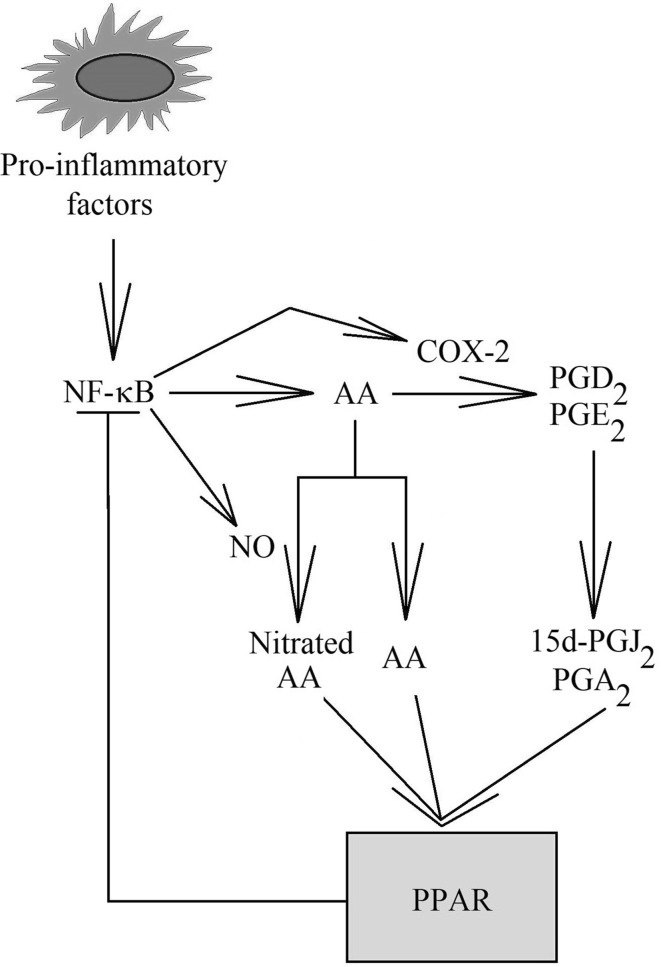
The peroxisome proliferator-activated receptor (PPAR) family includes three transcription factors: PPARα, PPARβ/δ, and PPARγ. PPAR are nuclear receptors activated by oxidised and nitrated fatty acid derivatives as well as by cyclopentenone prostaglandins (PGA 2 and 15d-PGJ 2 ) during the inflammatory response. This results in the modulation of the pro-inflammatory response, preventing it from being excessively activated. Other activators of these receptors are nonsteroidal anti-inflammatory drug (NSAID) and fatty acids, especially polyunsaturated fatty acid (PUFA) (arachidonic acid, ALA, EPA, and DHA). The main function of PPAR during the inflammatory reaction is to promote the inactivation of NF-κB. Possible mechanisms of inactivation include direct binding and thus inactivation of p65 NF-κB or ubiquitination leading to proteolytic degradation of p65 NF-κB. PPAR also exert indirect effects on NF-κB. They promote the expression of antioxidant enzymes, such as catalase, superoxide dismutase, or heme oxygenase-1, resulting in a reduction in the concentration of reactive oxygen species (ROS), i.e., secondary transmitters in inflammatory reactions. PPAR also cause an increase in the expression of IκBα, SIRT1, and PTEN, which interferes with the activation and function of NF-κB in inflammatory reactions.
Overview
The claims and statistics of this paper haven’t been checked yet.
Free: it reads the open-access text and checks the first 5 claims that cite a source we can check. Create a free account to check every claim.
Integrity signals
Registry
Cites
Statistics
Figures
Verification
Claims the paper makes
The claims and statistics of this paper haven’t been checked yet.
Free: it reads the open-access text and checks the first 5 claims that cite a source we can check. Create a free account to check every claim.
Claims other papers make about this one
Each is checked against this paper’s own text: does it say what the citing paper says it does?
In the citing paper
“PPAR-α directly binds to inflammatory transcription factors in hepatocytes such as p65 & c-Jun (NF-κB components), AP-1, STAT and thereby suppresses their transcriptional activity.[110]”
From Nuclear receptors in liver fibrosis (2021) · cites this paper as [110]
Self-check
Percentages, sums and reported differences re-computed from the paper’s own numbers.
The self-check needs the paper’s full text.
Citations
Cites
2 retracted
Subbaramaiah, K., Lin, D. T., Hart, J. C., & Dannenberg, A. J. (2001) · Journal of Biological Chemistry · doi:10.1074/jbc.m007237200 · Cited by 275
RetractedSodhi, K., Puri, N., Kim, D.-H., Hinds, T. D., Stechschulte, L. A., Favero, G., Rodella, L. F., Shapiro, J. I., Jude, D., & Abraham, N. G. (2013) · International Journal of Obesity · doi:10.1038/ijo.2013.116 · Cited by 28
RetractedModulation of NF‐κB‐dependent transcription and cell survival by the SIRT1 deacetylase
Yeung, F., Hoberg, J. E., Ramsey, C. S., Keller, M. D., Jones, D. R., Frye, R. A., & Mayo, M. W. (2004) · The EMBO Journal · doi:10.1038/sj.emboj.7600244 · Cited by 2,750
Kliewer, S. A., Sundseth, S. S., Jones, S. A., Brown, P. J., Wisely, G. B., Koble, C. S., Devchand, P., Wahli, W., Willson, T. M., Lenhard, J. M., et al. (1997) · Proceedings of the National Academy of Sciences · doi:10.1073/pnas.94.9.4318 · Cited by 2,164
Forman, B. M., Chen, J., & Evans, R. M. (1997) · Proceedings of the National Academy of Sciences · doi:10.1073/pnas.94.9.4312 · Cited by 2,116
Ros and ros-mediated cellular signaling
Zhang, J., Wang, X., Vikash, V., Ye, Q., Wu, D., Liu, Y., & Dong, W. (2016) · Oxidative Medicine and Cellular Longevity · doi:10.1155/2016/4350965 · Cited by 1,980
Sirt1 promotes fat mobilization in white adipocytes by repressing PPAR-γ
Picard, F., Kurtev, M., Chung, N., Topark-Ngarm, A., Senawong, T., Machado de Oliveira, R., Leid, M., McBurney, M. W., & Guarente, L. (2004) · Nature · doi:10.1038/nature02583 · Cited by 1,952
Rubbo, H., Radi, R., Trujillo, M., Telleri, R., Kalyanaraman, B., Barnes, S., Kirk, M., & Freeman, B. A. (1994) · Journal of Biological Chemistry · doi:10.1016/s0021-9258(18)47160-8 · Cited by 1,359 · cited 1×
“Both compounds, NO and ONOO−, lead to nitration of double bonds in unsaturated fatty acids [42, 61].”
BackgroundA SUMOylation-dependent pathway mediates transrepression of inflammatory response genes by PPAR-γ
Pascual, G., Fong, A. L., Ogawa, S., Gamliel, A., Li, A. C., Perissi, V., Rose, D. W., Willson, T. M., Rosenfeld, M. G., & Glass, C. K. (2005) · Nature · doi:10.1038/nature03988 · Cited by 1,254
Krey, G. D., Braissant, O., L’Horset, F., Kalkhoven, E., Perroud, M., Parker, M. G., & Wahli, W. (1997) · Molecular Endocrinology · doi:10.1210/me.11.6.779 · Cited by 1,221
Cited by
Items 401–484 of 484
Abd‐alhameed, E. K., Ali, F. E. M., Abo‐Youssef, A. M., & Azouz, A. A. (2025) · Immunopharmacology and Immunotoxicology · doi:10.1080/08923973.2025.2585088
“…in addition to its regulatory effect on inflammatory response and apoptosis [62,63]. also, PPaR-γ directly interacts with or targets the p65 subunit of NF-κB for ubiquitination and indirectly boosts anti-oxidant defense in the cells to diminish oxidative stress and inflammatory response [64].”
Zhao, S.-S., Tao, D.-L., Chen, J.-M., Wu, J.-P., Yang, X., Song, J., 朱兴全, & Zhao, G. (2022) · Figshare · doi:10.6084/m9.figshare.20580950
Boateng, E., Bonilla-Martinez, R., Ahlemeyer, B., Garikapati, V., Alam, M. R., Trompak, O., Oruqaj, G., El-Merhie, N., Seimetz, M., Ruppert, C., et al. (2024) · Figshare · doi:10.6084/m9.figshare.27093476
Zhou, Y., Li, L., Chen, X., Zhao, Q., Qu, N., Zhang, B., Jin, X., & Xia, C. (2024) · Figshare · doi:10.6084/m9.figshare.26616175
Zhao, S.-S., Tao, D.-L., Chen, J.-M., Wu, J.-P., Yang, X., Song, J., 朱兴全, & Zhao, G. (2022) · Figshare · doi:10.6084/m9.figshare.20581004
Zhou, Y., Li, L., Chen, X., Zhao, Q., Qu, N., Zhang, B., Jin, X., & Xia, C. (2024) · Figshare · doi:10.6084/m9.figshare.26616172
Additional file 1 of Metformin attenuates sepsis-induced neuronal injury and cognitive impairment
Qin, Z., Zhou, C., Xiao, X., & Guo, C. (2021) · Figshare · doi:10.6084/m9.figshare.17210662
ケルセチン高含有タマネギから単離同定したピネリン酸による核内受容体PPARα/γ活性化に関する研究
土居, 幹. (2021) · Institutional Repositories DataBase (IRDB) · doi:10.14943/doctoral.k14385
Zhao, S.-S., Tao, D.-L., Chen, J.-M., Wu, J.-P., Yang, X., Song, J., 朱兴全, & Zhao, G. (2022) · Figshare · doi:10.6084/m9.figshare.20580968
Zhao, S.-S., Tao, D.-L., Chen, J.-M., Wu, J.-P., Yang, X., Song, J., 朱兴全, & Zhao, G. (2022) · Figshare · doi:10.6084/m9.figshare.20580935
Investigation of the potential mechanisms behind dysfunctional labour with maternal obesity
Mustikaningrum, F. (2022) · Nottingham ePrints (University of Nottingham)
Chia seeds in dogs with cancer : review and clinical research protocol
Scannavino, E. (2023) · HAL
Aloufi, R. (2024) · Nottingham ePrints (University of Nottingham)
Marcotte, B. V. (2021) · Corpus Université Laval (Université Laval)
Noriega, K. A. C. (2021) · El Repositorio Academico Digital de la UANL (Universidad Autónoma de Nuevo León)
Sari, P. K. N., & Febyaningrum, V. D. (2025) · Medical Sains Jurnal Ilmiah Kefarmasian · doi:10.37874/ms.v10i4.1770
Yong, C., Zhang, J., Li, J., Liu, C., & Tan, L. (2026) · International Journal of General Medicine · doi:10.2147/ijgm.s566116
“29 Moreover, Ca 2+ overload can initiate intrinsic apoptotic pathways via caspases and calpains, degrading cytoskeletal and membrane proteins, triggering apoptosis, and compromising the BSCB. 30 Finally, dysfunction of Na + /K + ATPase leads to axolemmal depolarization, excessive Na + influx,…”
Raj, B., Bhatia, P., Kumar, A., Singh, N., & Jaggi, A. S. (2026) · European Journal of Pharmacology · doi:10.1016/j.ejphar.2026.178588
Galchenko, A. V., & Baroni, L. (2026) · Food Nutrition · doi:10.1016/j.fnutr.2026.100059
Targeting the PPAR-γ/OPTN axis to inhibit apoptosis in steroid-induced glaucoma
Liang, X., Li, N., Gong, Q., & (25821), H. W. (2026) · iScience · doi:10.1016/j.isci.2026.115247
“28,29 In this study, we found that pioglitazone-enhanced PPAR-γ function upregulated OPTN in TMCs (Figure 5A).”
Wanas, H., Khalifa, A. K., Elbadawy, H. M., Hamoud, A., Almikhlafi, M. A., Albadawi, E. A., Alghabban, H. M., Owaydhah, W. H., & Galal, A. M. (2026) · Pharmacology Research & Perspectives · doi:10.1002/prp2.70229
“In addition to suppressing the expression of these pro-inflammatory cytokines, PPAR-γ activation also inhibits NF-κB signaling, offering PF patients a multimodal strategy to manage inflammation and fibrosis [72–77].”
Toribio, D., Morokuma, J., Tai, A., & Zoukhri, D. (2026) · Frontiers in Ophthalmology · doi:10.3389/fopht.2026.1697924
Manusov, E. G., Diego, V. P., Almeida, M. A. A., Galan, J. A., Herklotz, K., Abrego, E., III, Sultana, H., Marquez, L. P., Arriaga, M. A., Leandro, M., et al. (2026) · Genes · doi:10.3390/genes17030343
“The protective role of THRAP3 involves reducing inflammation [60].”
Patil, P. M., Shegokar, N., Chopade, V. V., & Bagde, S. (2026) · Indian Journal of Pharmaceutical Education and Research · doi:10.5530/ijper.20266738
Peng, Y., He, H., Chen, Y., Zhang, Y., Wang, C., Yu, Q., Yu, J., Zhang, X., Yang, Z., Liang, H., et al. (2026) · Genes & Diseases · doi:10.1016/j.gendis.2026.102162
Lee, X., Wei, S., Zhu, K., Guo, M., Han, H., Peng, D., Lai, C., Wang, J., Wang, X., Qin, Q., et al. (2026) · Journal of Fish Biology · doi:10.1111/jfb.70421
脳虚血再灌流障害における脂肪酸結合タンパク質の役割に関する研究
郭青云 (2022) · Institutional Repositories DataBase (IRDB)
タデ藍 Persicaria tinctoria 含有機能性成分の PPAR 活性化を介したインスリン抵抗性の改善及び TNF-α 誘導炎症モデルにおける抗炎症作用の研究
金野, 太. (2020) · Institutional Repositories DataBase (IRDB)
Tao, T., Ye, J., Li, R., Ke, Y., Zheng, X., Zhang, Q., Zheng, L. S., Wang, S., Zhang, Z., Wang, L., et al. (2026) · Antioxidants · doi:10.3390/antiox15040449
“By integrating prior studies [53–55] with our experimental findings, we observed that multi-target activation ultimately converged on two critical processes: the regulation of oxidative stress and VEGF-A angiogenic signaling.”
Rôle dual de PPARγ dans les tumeurs de la vessie
Coutos-Thévenot, L. (2019) · theses.fr (ABES) · doi:10.70675/722cf0a1z8100z456dzaae3z4e9a5b9eba5b
Kaur, S., & Aran, K. R. (2026) · Gene · doi:10.1016/j.gene.2026.150150
Amélioration des propriétés anti-arthrosiques des MSC : développement de nouvelles méthodes
Bodic, B. (2021) · theses.fr (ABES) · doi:10.70675/4810014fza56az48d8z8091zc9c92263e98b
Aqil, M. S., Yaldo, M., Alahdab, G., Hsiung, C., Tawfik, A. M., & Al‐Shabrawey, M. (2026) · Frontiers in Medicine · doi:10.3389/fmed.2026.1802443
Zhu, Y., Zan, X., Fan, K., Wang, J., Zhi, Y., Liu, J., Yang, Y. S., & Zhang, L. (2026) · Immunological Investigations · doi:10.1080/08820139.2026.2663149
“Interestingly, a growing body of evidence suggests that promoting the degradation of the crucial pro-inflammatory regulators potently controls the degree of inflammation, which is emerging as a novel approach for the limitation of inflammatory injury (Korbecki et al., 2019; J. Liu et al., 2022).”
Protective Effect of Saroglitazar Against Acute Lung Injury Induced by LPS in Rats
Francis, M. R., El‐Sheakh, A. R., & Suddek, G. M. (2026) · Journal of Biochemical and Molecular Toxicology · doi:10.1002/jbt.70879
“Saroglitazar dual agonism of PPAR‐α and PPAR‐γ receptors downregulates NF‐κB partially by (a) direct binding, (b) mitigating NF‐κB acetylation, (c) augmenting NF‐κB inhibitor, IκBα, and (d) indirectly lowering ROS levels; thus, prohibiting anti‐inflammatory activities [33, 55].”
Anti-aging effects of glycyrrhizin via maintaining Klotho levels
Ohnishi, S., Hiramoto, K., Yoshikawa, N., & Kawanishi, S. (2026) · Journal of Clinical Biochemistry and Nutrition · doi:10.3164/jcbn.25-263
“(31) As a result, PPARγ indirectly prevents the reduction of Klotho through the inactivation of NF-κB.”
Zhou, Y., Shen, Y., Yao, S.-X., Wang, D., Chen, Z., & Chen, S. (2026) · Journal of Thrombosis and Haemostasis · doi:10.1016/j.jtha.2026.04.032
Ray, A. K., Ripon, M. A. R., Islam, M. M., Debi, H., Hossain, M. S., Muzahid, A. A., & Hossain, M. S. (2026) · Pharmacological Research - Modern Chinese Medicine · doi:10.1016/j.prmcm.2026.100823
Carvalho, A. V. S. (2025) · Lume (Universidade Federal do Rio Grande do Sul)
Kaempferol Protects Against Hindlimb Ischemia‐Reperfusion Injury via Activation of PPARα Signaling
Liu, Y., Lin, M., Qian, H., Wang, W., Yuan, T., Ren, Z., Hu, J., Wang, Y., Liu, G., Sun, Z., et al. (2026) · Journal of Biochemical and Molecular Toxicology · doi:10.1002/jbt.70914
Venu, G., Vignesh Pandi, A., & Justin, A. (2026) · International review of neurobiology · doi:10.1016/bs.irn.2026.05.014
Nunzio, M. D., Mora, D., & Borgonovi, S. M. (2024) · Archivio Istituzionale della Ricerca (Universita Degli Studi Di Milano)
Gut-joint axis in rheumatic diseases: Insights into pathogenesis and therapeutic strategies
Talukder, A., Deka, M., Buragohain, G., Saha, S., Bora, N. S., & Sahariah, B. J. (2026) · Medicine in Microecology · doi:10.1016/j.medmic.2026.100179
Vankova, A., Tillander, V., Lei, Y., Connelly, M. A., Arver, S., Wiik, A., Gustafsson, T. P., & Tietge, U. J. F. (2026) · Journal of Lipid Research · doi:10.1016/j.jlr.2026.101076
“…signaling molecules is highly context dependent and also anti-inflammatory lipoxins (LXA4/B4) can be generated via 5-lipoxygenase and 15-lipoxygenase pathways (26); alternatively, cyclopentenone prostaglandins can be formed that activate PPAR-ɤ and thereby inhibit the NFKB pathway (27).”
APOE interacts with COX-2 on lipid droplets to modulate inflammatory lipid signalingPreprint
Powers, A. E., Kamble, K., Nair, M., Windham, I. A., Miner, G. E., Prim, C. E., Mills, C. A., Lyons, S. P., Herring, L. E., Chirasani, V. R., et al. (2026) · bioRxiv (Cold Spring Harbor Laboratory) · doi:10.64898/2026.06.09.730852
“This binding is proposed to shift the cell to a state of increased lipid metabolism, reduced pro-inflammatory signaling, and decreased cytokine secretion (Rotondo and Davidson, 2002; Korbecki et al., 2019; Li et al., 2019).”
Bioflavonoid Fisetin Treatment Prevents the High Fat Diet Induced Metabolic Syndrome in Wistar Rats
Venkatesham, U., & Lalitha, R. (2026) · International Journal of Drug Delivery Technology · doi:10.25258/ijddt.16.52s.42
“…suppression of NF-κB IJDDT, Volume 16 Issue 52s, 2026 activation), modulation of lipid metabolism (upregulation of fatty acid oxidation; downregulation of lipogenesis), enhancement of insulin signaling (e.g., via IRS 1, Akt, GLUT4, AMPK), and potentially modulation of gut microbiota (9–10).”
Zubareva, O. E., Melik-Kasumov, T. B., Sinyak, D. S., Velikoborets, G. S., Kovalenko, A. A., Zhabinskaya, A. A., Kolyhan, S. A., Korneeva, M. A., Zakharova, M. V., & Zaitsev, A. V. (2026) · Neurochemistry International · doi:10.1016/j.neuint.2026.106206
Modulation of Respiratory Diseases by the Endocannabinoid System: A Therapeutic Perspective
Qin, S., Shen, S., Chen, X., Yi, P., Fu, B., & Peng, L.-Y. (2026) · Basic & Clinical Pharmacology & Toxicology · doi:10.1111/bcpt.70267
“Activation of PPARα suppresses the transcription of pro-inflammatory genes and has demonstrated protective effects in models of asthma and chronic obstructive pulmonary disease [42–44].”
PPARδ in neurological diseases: Mechanisms and therapeutic prospects
Liu, Y., Hu, Z., Luo, H., Li, M., Li, S., Xu, Y., Shi, C., & Tang, M. (2026) · Neurobiology of Disease · doi:10.1016/j.nbd.2026.107514
Cui, L., He, S., Song, W., Jiang, B., Yuan, C., Guo, L., Liu, K., Dong, J., Li, J., & Wang, H. (2026) · Developmental & Comparative Immunology · doi:10.1016/j.dci.2026.105666
Hong, M., Chen, L., Liu, Z.-J., Yang, Z.-T., Li, N.-H., Zhao, X.-L., Ren, G.-Y., Liu, J., Xie, L., Xie, M., et al. (2026) · European Journal of Inflammation · doi:10.1177/1721727x261463613
Precision nutrition in autoimmune diseases
la Cruz-Mosso, U. D., Macias, G. A., Campos-López, B., García, P. E. M., Alvarez-Chavez, Y. A., Muro-Dávalos, P. F., Cortes-Baltazar, J. A., Pesqueda-Cendejas, K., & Ramos-López, O. (2026) · Advances in food and nutrition research · doi:10.1016/bs.afnr.2026.07.002
Majdzadeh, B., Abbasnejad, M., Kooshki, R., & Esmaeili‐Mahani, S. (2023) · SSRN Electronic Journal · doi:10.2139/ssrn.4340681
Yuan, C., Yang, H., Pan, X., Lin, Y., Zhou, K., Lin, F., Chen, W., Li, Y., Han, Y., Wei, H., et al. (2026) · Antioxidants · doi:10.3390/antiox15070907
“PPARs, a family of nuclear receptors governing cellular energy metabolism, can antagonize the activation and function of NF-κ B during inflammatory responses, thereby exerting anti-inflammatory effects [72,73].”
Bifidobacterium breve MYQQ-7 alleviates hypertriglyceridemia-induced acute pancreatitis via PPARγ
Zou, H., Liang, W., Tian, H., Yang, S., Pan, L., Yang, J. Q., & Sun, J. (2026) · Food Bioscience · doi:10.1016/j.fbio.2026.109385
Pang, J., Do, L. N. H., Delgado, E., Zhao, J., Flynn, L., Liu, H. T., Autieri, M. V., Yang, X., & Liu, X. (2026) · Vascular Pharmacology · doi:10.1016/j.vph.2026.107693
Feng, Z., Wang, D., Sun, Y., Yang, Q., Li, Y., & Wu, Z. (2026) · Food Chemistry · doi:10.1016/j.foodchem.2026.150692
Ding, Z., Wang, Y., Chen, S., & Yu, L. (2026) · Inflammation · doi:10.1007/s10753-026-02542-2
The endocannabinoidome–microbiota axis in obesity: a potential link to colorectal cancer development
Alpino, G. D. C. Á., Brasiel, P. G. D. A., Almeida, M. M., & Luquetti, S. C. P. D. (2026) · Journal of Physiology and Biochemistry · doi:10.1007/s13105-026-01225-8
“For example, PEA binds to PPARα, which suppresses NF-κB activity, reducing inflammatory media - tors like TNF-α, IL-1β, iNOS, and COX-2, and increasing the activity of antioxidant enzymes, such as catalase and superoxide dismutase (SOD), thus modulating intestinal inflammation [ 36, 37].”
Malaník, M., Lisicic, J., Jedináková, T., Švajdlenka, E., Pečinková, P., Dvořák, Z., Mašek, J., Šmejkal, K., & Hošek, J. (2026) · Scientific Reports · doi:10.1038/s41598-026-68603-6
Abdullah, A. (2026) · UiTM Institutional Repositories (Universiti Teknologi MARA)
The Zinc–Senescence Axis in Skin Aging and Wound Healing: A Narrative Review
Mutig, K., Singh, P. B., Azhibek, D., & Lebedeva, S. A. (2026) · International Journal of Molecular Sciences · doi:10.3390/ijms27177713
“Zinc likely influences cytokine production by increasing the expression of peroxisome proliferator-activated receptors (PPARs) [129,130] and zinc-finger protein TNF-α -induced protein 3 (TNFAIP3, also known as A20), both of which suppress NF-κ B signaling [127].”
A critical review of the direct binding of PPARβ/δ with endocrine disrupting chemicals
Yang, D., Zheng, X., Liu, P., Wang, S., Bai, L., Li, M., & Zhenguang, Y. (2026) · Journal of Hazardous Materials Advances · doi:10.1016/j.hazadv.2026.101545
Lv, S., Li, H., Wang, Y., Sang, X., Wang, F., Yang, J., Fan, L., Ma, Z., Wang, L., Bian, Y., et al. (2026) · Journal of Cellular and Molecular Medicine · doi:10.1111/jcmm.71354
“FRTM's ability to activate PPARγ and inhibit NF-κB signalling underscores its anti-inflammatory potential [40].”
Luo, X., Wu, Y., Zhang, S., Qu, H., Shao, S., Chen, J., & Wu, X. (2026) · Advanced Science · doi:10.1002/advs.77785
“Because PPAR has been reported to interfere with inflammatory signaling and to antagonize NF-κ B activation under certain conditions [ 72 ], these results suggested that a P53/PPAR/NF-κ B-associated axis might have contributed to the anti-inflammatory effect of BN@NF.”
Avaliação da atividade de enzimas detoxificantes em ratas wistar tratadas com oxandrolona
Carvalho, V. D. S. D. (2024) · Lume (Universidade Federal do Rio Grande do Sul)
Lipotoxicity in MAFLD/MASH: cellular mechanisms and targetable nodes
Tawai, J., Zhou, K., & Xiong, J. (2026) · Targetome · doi:10.48130/targetome-0026-0047
Liu, Y., Zhou, X., Duan, Y., Shi, Q., Liu, Y., Hu, Z., Li, M., 孙金凤, Jin, M., Zong, T., et al. (2026) · Plants · doi:10.3390/plants15193052
“The AGE-RAGE axis triggers oxidative stress and inflammatory injury via activation of RAGE, thereby promoting ROS generation and the release of inflammatory cytokines [41,42].”
Vishwakarma, S. K., Bonjorno, A. F., Singh, S., Canales, C. S. C., dos Santos, J. L., Roque‐Borda, C. A., & Pavan, F. R. (2026) · ChemMedChem · doi:10.1002/cmdc.70557
“Anti‐inflammatory effects have been linked to PPAR‐ γ activation as well as inhibition of inflammatory mediators and enzymes such as COX‐2 and 15‐LOX [82].”
Rehman, S. U., Rehman, F. U., Khan, S. U., Zeb, A., Ashfaq, S., Khan, S. U., & Hafiz, W. U. (2026) · PPAR Research · doi:10.1155/ppar/9577380
Pletnov, V., Tkachenko, O. T., Akimov, O. Y., & Mykytenko, A. О. (2026) · Eastern Ukrainian Medical Journal · doi:10.21272/eumj.2026;14(3);975-985
Fish Oil Mitigates Ozone-Induced Lung Inflammation by Restoring Oxylipin Homeostasis
Zou, Y., Zeng, Z., Zhang, Y., He, S., Wang, X., Wei, Y., Chen, Q., Li, R., Lu, Y., Zou, Y., et al. (2026) · ACS Omega · doi:10.1021/acsomega.6c08205
Osorio, E. Y., Gugala, Z., Patterson, G. T., Palacios, G., Cordova, E., Uscanga-Palomeque, A., Travi, B. L., & Melby, P. C. (2022) · doi:10.3389/fimmu.2022.846246.s001
Jagirdar, G., Elsner, M., Scharf, C., Simm, S., Borucki, K., Peter, D., Lalk, M., Methling, K., Linnebacher, M., Krohn, M., et al. (2022) · doi:10.3389/fgene.2022.931017.s003
Chen, R., Lv, C., Zhao, Y., Gu, W., Zhang, L., Shi, B., & Tou, J. (2022) · doi:10.3389/fped.2022.836128.s004
Ding, Y., Hou, Y., Liu, Y., Yu, T., Cui, Y., & Nie, H. (2022) · doi:10.3389/fphar.2022.863646.s001
Zou, M.-L., Teng, Y.-Y., Chen, Z.-H., Liu, S.-Y., Jia, Y., Zhang, K.-W., Wu, J.-J., Yuan, Z.-D., Tang, X.-Y., Yu, S., et al. (2022) · doi:10.3389/fimmu.2022.845956.s001
Metadata
- Authors
- Korbecki, J., Bobiński, R., & Dutka, M.
- Affiliations
- Medical University of Silesia (PL)
- University of Bielsko-Biała (PL)
- Corresponding author
- Korbecki, Jan
- Venue
- Inflammation Research
- Published
- 2019-03-29
- Volume
- 68
- Issue
- 6
- Pages
- 443-458
- ISSN
- 1023-3830 (ISSN-L)
- 1420-908X
- PMC
- PMC6517359
- OpenAlex
- W2930592277
- Cited by
- 415
- References
- 233
- Citations by year
- 2026: 44 · 2025: 49 · 2024: 88 · 2023: 62 · 2022: 75 · 2021: 61 · 2020: 26 · 2019: 9
- FWCI
- 4.07
- Type
- journal article
- Language
- en
- Open access
- hybrid
- doi.org
- Licence
- cc-by
- creativecommons.org/licenses/by/4.0 (tdm)
- Locations
- Inflammation Research (publishedVersion, cc-by)
- Europe PMC (PubMed Central) (publishedVersion, cc-by)
- PubMed Central (publishedVersion, cc-by)
- PubMed (publishedVersion)
- Topics
- Life Sciences › Biochemistry, Genetics and Molecular Biology › Molecular Biology › Peroxisome Proliferator-Activated Receptors
- Health Sciences › Nursing › Nutrition and Dietetics › Fatty Acid Research and Health
- Life Sciences › Biochemistry, Genetics and Molecular Biology › Cancer Research › NF-κB Signaling Pathways
- Keywords
- peroxisome proliferator-activated receptors, PPARα, PPARδ, PPARγ, inflammation, NF-κB inactivation, cyclopentenone prostaglandins, oxidized fatty acids, nonsteroidal anti-inflammatory drugs, polyunsaturated fatty acids, reactive oxygen species, antioxidant enzymes, heme oxygenase-1, SIRT1, PTEN, IκBα, transcriptional regulation
- MeSH terms
- Animals, Humans, Inflammation, Ligands, NF-kappa B, Peroxisome Proliferator-Activated Receptors, Cyclooxygenase 2
About these checks
Registry, retraction, Cites and statistics results are computed, not judged, with one exception: a printed reference that no index lists is read once by a model before it counts as a citation error. Claims are extracted by a model and kept only when their quote appears verbatim in the text; each cited source is then checked, with a model’s help, for whether it says what the claim relies on. Those verdicts can be wrong — read the claim’s quote and the cited source before relying on one.
Statistics and arithmetic are recomputed, not judged.
Confidence bands are shown only for fields calibrated on our annotated test set. None is calibrated yet, so no band is shown.
What counts as a claim ›How we measure confidence ›How we check this ›
Are you an author, or do you see a problem with this page? Request a review
Data sources
Bibliographic data: Semantic Scholar, OpenAlex, Crossref.
Contains information from the Semantic Scholar Academic Graph Datasets, made available under the ODC Attribution License (ODC-BY 1.0).
Semantic Scholar’s data is described in: Kinney, R., et al. (2023). The Semantic Scholar Open Data Platform. arXiv:2301.10140.
