

Self-regulation of the inflammatory response by peroxisome proliferator-activated receptors
Open accessThe DOI matches its Crossref record; 232 of the 233 references it cites were found in a registry or an index.
Abstract
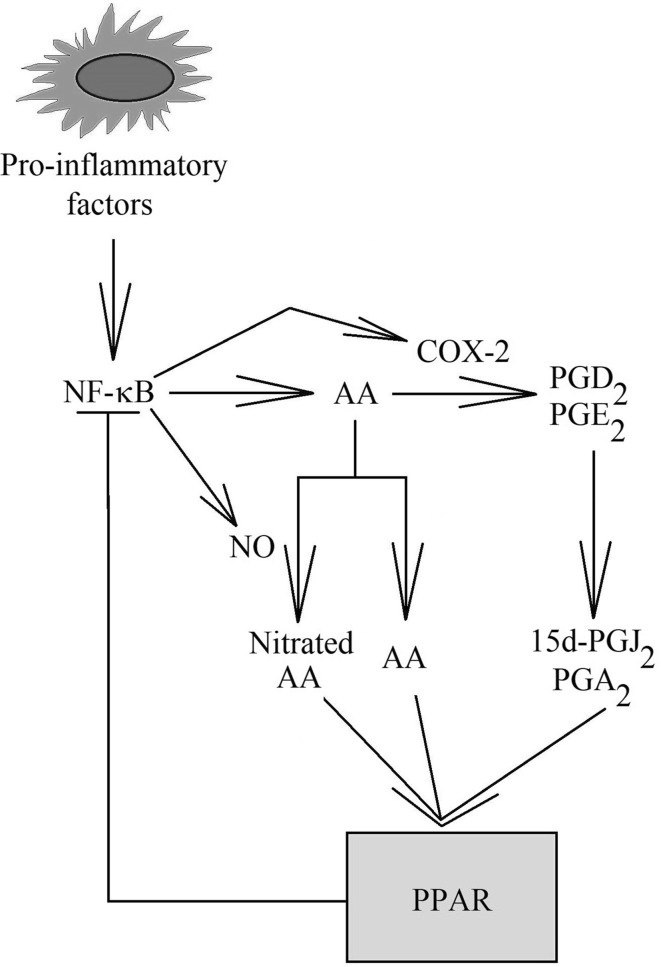
The peroxisome proliferator-activated receptor (PPAR) family includes three transcription factors: PPARα, PPARβ/δ, and PPARγ. PPAR are nuclear receptors activated by oxidised and nitrated fatty acid derivatives as well as by cyclopentenone prostaglandins (PGA 2 and 15d-PGJ 2 ) during the inflammatory response. This results in the modulation of the pro-inflammatory response, preventing it from being excessively activated. Other activators of these receptors are nonsteroidal anti-inflammatory drug (NSAID) and fatty acids, especially polyunsaturated fatty acid (PUFA) (arachidonic acid, ALA, EPA, and DHA). The main function of PPAR during the inflammatory reaction is to promote the inactivation of NF-κB. Possible mechanisms of inactivation include direct binding and thus inactivation of p65 NF-κB or ubiquitination leading to proteolytic degradation of p65 NF-κB. PPAR also exert indirect effects on NF-κB. They promote the expression of antioxidant enzymes, such as catalase, superoxide dismutase, or heme oxygenase-1, resulting in a reduction in the concentration of reactive oxygen species (ROS), i.e., secondary transmitters in inflammatory reactions. PPAR also cause an increase in the expression of IκBα, SIRT1, and PTEN, which interferes with the activation and function of NF-κB in inflammatory reactions.
Overview
The claims and statistics of this paper haven’t been checked yet.
Free: it reads the open-access text and checks the first 5 claims that cite a source we can check. Create a free account to check every claim.
Integrity signals
Registry
Cites
Statistics
Figures
Verification
Claims the paper makes
The claims and statistics of this paper haven’t been checked yet.
Free: it reads the open-access text and checks the first 5 claims that cite a source we can check. Create a free account to check every claim.
Claims other papers make about this one
Each is checked against this paper’s own text: does it say what the citing paper says it does?
In the citing paper
“PPAR-α directly binds to inflammatory transcription factors in hepatocytes such as p65 & c-Jun (NF-κB components), AP-1, STAT and thereby suppresses their transcriptional activity.[110]”
From Nuclear receptors in liver fibrosis (2021) · cites this paper as [110]
Self-check
Percentages, sums and reported differences re-computed from the paper’s own numbers.
The self-check needs the paper’s full text.
Citations
Cites
2 retracted
Subbaramaiah, K., Lin, D. T., Hart, J. C., & Dannenberg, A. J. (2001) · Journal of Biological Chemistry · doi:10.1074/jbc.m007237200 · Cited by 275
RetractedSodhi, K., Puri, N., Kim, D.-H., Hinds, T. D., Stechschulte, L. A., Favero, G., Rodella, L. F., Shapiro, J. I., Jude, D., & Abraham, N. G. (2013) · International Journal of Obesity · doi:10.1038/ijo.2013.116 · Cited by 28
RetractedModulation of NF‐κB‐dependent transcription and cell survival by the SIRT1 deacetylase
Yeung, F., Hoberg, J. E., Ramsey, C. S., Keller, M. D., Jones, D. R., Frye, R. A., & Mayo, M. W. (2004) · The EMBO Journal · doi:10.1038/sj.emboj.7600244 · Cited by 2,750
Kliewer, S. A., Sundseth, S. S., Jones, S. A., Brown, P. J., Wisely, G. B., Koble, C. S., Devchand, P., Wahli, W., Willson, T. M., Lenhard, J. M., et al. (1997) · Proceedings of the National Academy of Sciences · doi:10.1073/pnas.94.9.4318 · Cited by 2,164
Forman, B. M., Chen, J., & Evans, R. M. (1997) · Proceedings of the National Academy of Sciences · doi:10.1073/pnas.94.9.4312 · Cited by 2,116
Ros and ros-mediated cellular signaling
Zhang, J., Wang, X., Vikash, V., Ye, Q., Wu, D., Liu, Y., & Dong, W. (2016) · Oxidative Medicine and Cellular Longevity · doi:10.1155/2016/4350965 · Cited by 1,980
Sirt1 promotes fat mobilization in white adipocytes by repressing PPAR-γ
Picard, F., Kurtev, M., Chung, N., Topark-Ngarm, A., Senawong, T., Machado de Oliveira, R., Leid, M., McBurney, M. W., & Guarente, L. (2004) · Nature · doi:10.1038/nature02583 · Cited by 1,952
Rubbo, H., Radi, R., Trujillo, M., Telleri, R., Kalyanaraman, B., Barnes, S., Kirk, M., & Freeman, B. A. (1994) · Journal of Biological Chemistry · doi:10.1016/s0021-9258(18)47160-8 · Cited by 1,359 · cited 1×
“Both compounds, NO and ONOO−, lead to nitration of double bonds in unsaturated fatty acids [42, 61].”
BackgroundA SUMOylation-dependent pathway mediates transrepression of inflammatory response genes by PPAR-γ
Pascual, G., Fong, A. L., Ogawa, S., Gamliel, A., Li, A. C., Perissi, V., Rose, D. W., Willson, T. M., Rosenfeld, M. G., & Glass, C. K. (2005) · Nature · doi:10.1038/nature03988 · Cited by 1,254
Krey, G. D., Braissant, O., L’Horset, F., Kalkhoven, E., Perroud, M., Parker, M. G., & Wahli, W. (1997) · Molecular Endocrinology · doi:10.1210/me.11.6.779 · Cited by 1,221
Cited by
Items 301–400 of 484
Role of Ciminalum-4-thiazolidinone Hybrids in Molecular NF-κB Dependent Pathways
Szlachcikowska, D., Tabęcka-Łonczyńska, A., Holota, S. M., Roman, O., Shepeta, Y., Lesyk, R., & Szychowski, K. A. (2024) · International Journal of Molecular Sciences · doi:10.3390/ijms25137329 · Cited by 3
“The present results corroborate the crosstalk between PPAR γ and NF-κ B [59].”
ResultMorsy, M. M., Ahmed, R. G., & Abdel‐Gabbar, M. (2024) · Beni-Suef University Journal of Basic and Applied Sciences · doi:10.1186/s43088-024-00526-5 · Cited by 3
“The inflamma - tory reaction noticed in caffeine-treated rats might be due to elevated ROS production [46].”
BackgroundThe Anticonvulsant Effect of the Ketogenic Diet in the Treatment of Epilepsy
Yaghoubi, F., Jafarian, M., & Gorji, A. (2020) · The Neuroscience Journal of Shefaye Khatam · doi:10.52547/shefa.9.1.200 · Cited by 3
Chen, R., Lv, C., Zhao, Y., Gu, W., Zhang, L., Shi, B., & Tou, J. (2022) · Frontiers in Pediatrics · doi:10.3389/fped.2022.836128 · Cited by 3
“Reactive oxygen species (ROS) can stimulate and activate the NF-κB signaling pathway to enhance inflammatory responses while NF-κB also can enhance ROS to enhance oxidative stress (25).”
BackgroundDou, J., Sammad, A., Cánovas, Á., Schenkel, F. S., Usman, Τ., Muniz, M. M. M., Guo, K., & Wang, Y. (2022) · Biology · doi:10.3390/biology11121740 · Cited by 3
“Understanding mechanisms of heat stress response and discovering indicators to quantify the degree of heat stress are challenging for researchers [82,83].”
BackgroundRe, A. D., Franzin, S. B., Lu, J., Palenca, I., Zilli, A., Pepi, F., Troiani, A., Seguella, L., Pesce, M., Esposito, G., et al. (2024) · Translational Medicine Communications · doi:10.1186/s41231-024-00167-x · Cited by 3
“Additionally, PEA has the capability to hinder NF-κB through a dual mechanism: direct interaction with NF-κB p65 or the stimulation of NF-κB inhibitors (IκBs) expression across diverse cell types [48].”
BackgroundByron, M., Lection, J., Foster, R. A., Chenier, T., Wagner, B., & de Amorim, M. D. (2024) · Theriogenology · doi:10.1016/j.theriogenology.2024.07.014 · Cited by 3
On noise and hearing loss Prevalence and reference data
Johansson, M. (2003) · DiVA (Linkoping University) · Cited by 3
Rawat, S. S., Singh, G., & Prasad, A. (2024) · ACS Omega · doi:10.1021/acsomega.3c09253 · Cited by 2
Trávníček, Z., Vančo, J., Čajan, M., Malina, T., Dvořák, Z., Lenobel, R., Beláková, B., & Schmid, J. A. (2025) · Chemico-Biological Interactions · doi:10.1016/j.cbi.2025.111381 · Cited by 2
KAT2B regulates estradiol synthesis via H3K27ac/PPARα in granulosa cells of PCOS patients
Wang, A., Zhang, X., Luo, C.-J., Liu, Y., Chen, P., Wang, A.-L., Zhang, J., Huang, S.-Y., Huang, X., Chen, S., et al. (2025) · Journal of Translational Medicine · doi:10.1186/s12967-025-06848-x · Cited by 2
“The PPAR signaling pathway is one of the key transcriptional regulatory pathways, with research spanning its roles in inflammation [22], angiogenesis [23], lipid metabolism [24], cancer [25], and psychological disorders [26].”
Gazzillo, E., Saviano, A., Raucci, F., Casillo, G. M., Russo, M., Donniacuo, M., Patanè, V., Iacobellis, F., Lauro, G., Terracciano, S., et al. (2025) · Biomedicine & Pharmacotherapy · doi:10.1016/j.biopha.2025.118407 · Cited by 2
Wu, C., Li, Q., Zhao, Z., Sui, C., Liu, Q., Lai, W., Zhang, J., Li, Y., Mai, K., & Ai, Q. (2025) · The FASEB Journal · doi:10.1096/fj.202501468r · Cited by 2
“Notably, PPARγ, a nuclear receptor activated by DHA, can suppress NF-κB signaling and promote anti-inflammatory macrophage polarization [61, 62].”
Yun, Y., Xu, G., Jiang, X., Ren, X., Lu, M., Chen, J., & Zhang, S. (2025) · Comprehensive physiology · doi:10.1002/cph4.70078 · Cited by 2
Qiu, X., Zhou, J., Cao, H., Zhu, H., Cai, X., Wu, X., Zhongchang, W., Wang, X., & Pinghu, C. (2026) · Additive manufacturing · doi:10.1016/j.addma.2026.105147 · Cited by 2
The gut-liver axis: microbial mechanisms and therapeutic implications in MAFLD
Xue, L., Wang, H., Shan, B., Li, C., Chen, H., Yu, C., Xia, C., & Zhang, H. (2026) · Frontiers in Cellular and Infection Microbiology · doi:10.3389/fcimb.2026.1740163 · Cited by 2
Yao, H., Li, T., & Zhang, J. W. (2024) · Turkish Journal of Biochemistry · doi:10.1515/tjb-2023-0156 · Cited by 2
Tiwari, P., & Tripathi, L. P. (2024) · Cancers · doi:10.3390/cancers16162920 · Cited by 2
“The number of carbon atoms, degree of saturation and configuration of fatty acids play important roles in the activation of PPARs [87].”
BackgroundCrosstalk between YAP-TEAD and PPAR suppresses HIV-1 LTR transcription in vitro
Zhou, C., Liu, X., He, H., Wu, Z., Liu, Y., Rashid, H. K., & Li, L. (2025) · Biochemical Pharmacology · doi:10.1016/j.bcp.2025.117109 · Cited by 2
Kronik Hastalıklarda İnflamasyonun Rolü, Omega-3 Yağ Asitleri ve Epigenetik Yolaklar
Yıldırım, A., & Erge, S. (2022) · Journal of Nutrition and Dietetics · doi:10.33076/2021.bdd.1509 · Cited by 2
“Bunlara ek olarak, PPAR-γ katalaz, süperoksit dismutaz gibi antioksidan enzimlerin ekspresyonunu indükleyerek, inflamatuvar reaksiyonlarla ilişkili reaktif oksijen türlerinin (ROS) üretimini azaltmaktadır (27,28).”
BackgroundRoginskaya, A. I., Dyomina, A. V., Kovalenko, A. A., Zakharova, M. V., Schwarz, A. P., Melik-Kasumov, T. B., & Zubareva, O. E. (2022) · Journal of Evolutionary Biochemistry and Physiology · doi:10.1134/s0022093022020260 · Cited by 2
Emeka, P. M., Rasool, S. T., Morsy, M. A., Islam, M. I. H., & Chohan, M. S. (2021) · Korean Journal of Physiology and Pharmacology · doi:10.4196/kjpp.2021.25.5.495 · Cited by 2
Lu, J., Zhang, J., Jiang, H., Hu, Z., Zhang, Y., He, L., Yang, J., Xie, Y., Wu, D., Li, H., et al. (2024) · eLife · doi:10.7554/elife.87935.3 · Cited by 2
Genetic doping: realities, perspectives of application in sports and bioethical aspects
GORCHAKOVA, N., Belenichev, I. F., HNATIUK, V., OLIYNYK, S., KUCHKOVSKYI, O., MOSHKIVSKA, J., & Дорошенко, Э. Ю. (2023) · Fìtoterapìâ · doi:10.32782/2522-9680-2023-1-5 · Cited by 1
Nolsøe, J. M. J., Underhaug, J., Sørskår, Å. M., Antonsen, S. G., Malterud, K. E., Gani, O. A. B. S. M., Fan, Q., Hjorth, M., Sæther, T., Hansen, T. V., et al. (2024) · Molecules · doi:10.3390/molecules29050994 · Cited by 1
“The 2D NMR data can be found in Supplementary Materials.”
Method[Study on the mechanism of Fuzheng Huayu formula against biliary fibrosis in mice].
Zhang, Z., Liang, Y., Tang, E., Zhou, X., Hu, Y., Chen, G. F., Liu, W., Mu, Y., Liu, P., & Chen, J. M. (2024) · PubMed Central · doi:10.3760/cma.j.cn501113-20240815-00375 · Cited by 1
Ruelas, M. G., Queiroz, I., Pimentel, T., Tavares, A. H., Defante, M. L. R., Barbosa, L., & Eckert, I. D. C. (2025) · Prostaglandins Leukotrienes and Essential Fatty Acids · doi:10.1016/j.plefa.2025.102666 · Cited by 1
Research Progress on the Mechanism of Hyperuricemia Affecting Renal Function
陈, 秀. (2025) · Advances in Clinical Medicine · doi:10.12677/acm.2025.152339 · Cited by 1
HSPD1 regulates angiotensin II‑induced atrial fibrillation via the PPAR signaling pathway
Zhou, Y., Zhang, L., Zhou, S., Zhang, W., Gong, Q., Xu, N., Wang, J., Zhang, Z., & Chen, N. (2025) · Molecular Medicine Reports · doi:10.3892/mmr.2025.13696 · Cited by 1
“The peroxisome proliferator‑activated receptor (PPAR) signaling pathway, a nuclear receptor pathway regulating various physiological processes such as energy metabolism, lipid metabolism, inflammation, includes the ligand‑activated transcription factors PPAR α , PPar β / δ and PPAR γ (7,8).”
Perfluorooctanoic acid disrupts hepatic metabolism in the developing chicken embryo
Scherbak, N. N., Duberg, D., Kråkström, M., Tikka, P., Dickens, A. M., Engwall, M., Orešič, M., & Hyötyläinen, T. (2025) · Metabolomics · doi:10.1007/s11306-025-02374-5 · Cited by 1
“Interestingly, PPARα can be activated during the inflam - matory response by binding polyunsaturated fatty acids and AA-derived oxylipins (Fang et al. 2007, Korbecki et al. 2019), providing a plausible mechanistic link between the observed AA pathway disruption and PPAR-associated signaling.”
Bai, W., Aimaier, D., Li, X., Zhang, Y., Gu, J., Wang, J., & Zhang, L. (2026) · Chemico-Biological Interactions · doi:10.1016/j.cbi.2026.111958 · Cited by 1
Decreased corneal biomechanical stability and structural integrity in PPAR-α knockout mice
Zhu, C., He, H., Yan, H., Liu, A., Liang, M., Zong, R., Liu, B., Qin, X., Yang, J., & Lin, Z. (2026) · Experimental Eye Research · doi:10.1016/j.exer.2026.110911 · Cited by 1
Syringic Acid Converts Poor Learning Mice to Good Learners: Insinuations for Memory Enhancement
Khatun, A., Patra, S., Chowdhury, S., & Chakrabarti, S. (2026) · Phytotherapy Research · doi:10.1002/ptr.70264 · Cited by 1
The Effect of EPA and DHA on Skeletal Muscle Physiology and Energy Balance
Ghnaimawi, S. (2020) · Journal of the Arkansas Academy of Science · Cited by 1
Castillo, A. L., Jesus, P. D., Apostol, J. G., Yolo, R. T., & Nonato, M. G. (2023) · Acta Manilana · doi:10.53603/actamanil.71.2023.qhql3726 · Cited by 1
Генетичний допінг: реалії, перспективи застосування у спорті та біоетичні аспекти
Gorchakova, N., Бєленічев, І. Ф., HNATIUK, V., ОЛІЙНИК, С., Кучковський, О. М., МОШКІВСЬКА, Ю., & ДОРОШЕНКО, Е. (2023) · Fìtoterapìâ · doi:10.32782/2522-9680-2023-1-17 · Cited by 1
Noor, Y., Jasaputra, D. K., Gunadi, J. W., Lesmana, R., & Safira, R. A. (2023) · Journal Of Medicine & Health · doi:10.28932/jmh.v5i2.6684 · Cited by 1
“11,13 Therefore, PPAR can be used as a therapeutic implication against various diseases.”
BackgroundCytokines in Neurodegenerative Disorders
Pahan, K. (2024) · Springer eBooks · doi:10.1007/978-3-031-68237-7_12 · Cited by 1
Timlin, C. L. (2020) · VTechWorks (Virginia Tech) · Cited by 1
Lipoxidación de vimentina y su interacción con zinc
Mónico, A. (2019) · Library Open Repository (Universidad Complutense Madrid) · Cited by 1
Clinical value of PEX7 in Coronary Artery Heart Disease patients: Bioinformatics-based approachPreprint
Ji, X., Shi, L., Xi, Q., & Liu, Y. (2022) · Research Square · doi:10.21203/rs.3.rs-2331242/v1 · Cited by 1
Fouda, W. M., Abo‐Youssef, A. M., Messiha, B. A. S., Salman, M., & Taye, A. (2023) · Pakistan Journal of Pharmaceutical Sciences · doi:10.36721/pjps.2023.36.1.reg.149-157.1 · Cited by 1
Magalhães, R. P. M. D. (2022) · Portuguese National Funding Agency for Science, Research and Technology (RCAAP Project by FCT) · doi:10.34626/1snj-vq61 · Cited by 1
Petitfils, C. (2021) · theses.fr (ABES) · doi:10.70675/bc778947z305ez4f0cz8866z05cc7ee3d466 · Cited by 1
Perspectives thérapeutiques de la modulation de PPAR-gamma dans les leucémies aiguës myéloïdes
Zhu, J. (2023) · theses.fr (ABES) · doi:10.70675/8a7b9621z18bez4cf1z9eadzab40e77e9c18 · Cited by 1
Tuft cells restrain pancreatic tumorigenesis through paracrine eicosanoid signalingPreprint
DelGiorno, K. E., Chung, C., Mauer, H. C., Novak, S. W., Giraddi, R. R., Wang, D., Naeem, R. F., Fang, L., de Andrade, L. R., Lytle, N. K., et al. (2019) · bioRxiv (Cold Spring Harbor Laboratory) · doi:10.1101/2019.12.19.882985
“Within the stroma, PPARγ activation is known to suppress mPSC activation and is a mechanism by which the inflammatory system regulates itself through suppression of Nf-κb (39,44).”
BackgroundWhite, C. S. (2021) · The Knowledge Bank (The Ohio State University)
Liddle, D. M. (2021) · The Atrium (University of Guelph) · doi:10.1093/ajcn/nqab094
Hong, Y., Jiang, L., Huang, W. C., Deng, W., Tang, F., Shen, C., Lan, Q., Huang, H., Zhong, H., Lv, J. C., et al. (2022) · Research Square · doi:10.21203/rs.3.rs-1174536/v1
Zhao, Y., Jia, S., Li, X., Pang, M., Lv, E., Zhuang, W., Zhang, X., & Wang, Y. (2022) · Research Square · doi:10.21203/rs.3.rs-1499741/v1
Russell, K., Smith, J., Bremner, A., Chintoan‐Uta, C., Vervelde, L., Psifidi, A., & Stevens, M. P. (2021) · Research Square · doi:10.21203/rs.3.rs-198715/v1
Jagirdar, G., Elsner, M., Scharf, C., Simm, S., Borucki, K., Peter, D., Lalk, M., Methling, K., Linnebacher, M., Krohn, M., et al. (2022) · Frontiers in Genetics · doi:10.3389/fgene.2022.931017
Silva, M. A. (2022) · Digital Library of Theses and Dissertations (Universidade de São Paulo) · doi:10.11606/t.17.2022.tde-24112022-145126
Wu, S., Lv, X., Wu, J., Wei, H., Shiwei, L. I. U., Zou, C., Song, J., Li, X., & Ai, Y. (2023) · Research Square · doi:10.21203/rs.3.rs-2560274/v1
小山, 幸., & Heinbockel, T. (2023) · Elsevier eBooks · doi:10.1016/b978-0-323-90877-1.00033-4
Zhao, S., Tao, D.-L., Chen, J., Wu, J.-P., Yang, X., Song, J.-K., Zhu, X., & Zhao, G. (2022) · Figshare · doi:10.6084/m9.figshare.20580956
Zhao, S., Tao, D.-L., Chen, J., Wu, J.-P., Yang, X., Song, J.-K., Zhu, X., & Zhao, G. (2022) · Figshare · doi:10.6084/m9.figshare.20580947
Zhao, S., Tao, D.-L., Chen, J., Wu, J.-P., Yang, X., Song, J.-K., Zhu, X., & Zhao, G. (2022) · Figshare · doi:10.6084/m9.figshare.20580941
Zhao, S., Tao, D.-L., Chen, J., Wu, J.-P., Yang, X., Song, J.-K., Zhu, X., & Zhao, G. (2022) · Figshare · doi:10.6084/m9.figshare.20580938
Zhao, S., Tao, D.-L., Chen, J., Wu, J.-P., Yang, X., Song, J.-K., Zhu, X., & Zhao, G. (2022) · Figshare · doi:10.6084/m9.figshare.20580983
Zhao, S., Tao, D.-L., Chen, J., Wu, J.-P., Yang, X., Song, J.-K., Zhu, X., & Zhao, G. (2022) · Figshare · doi:10.6084/m9.figshare.20580986
Zhao, S., Tao, D.-L., Chen, J., Wu, J.-P., Yang, X., Song, J.-K., Zhu, X., & Zhao, G. (2022) · Figshare · doi:10.6084/m9.figshare.20581001
Zhao, S., Tao, D.-L., Chen, J., Wu, J.-P., Yang, X., Song, J.-K., Zhu, X., & Zhao, G. (2022) · Figshare · doi:10.6084/m9.figshare.20580974
Zhao, S., Tao, D.-L., Chen, J., Wu, J.-P., Yang, X., Song, J.-K., Zhu, X., & Zhao, G. (2022) · Figshare · doi:10.6084/m9.figshare.20580989
Zhao, S., Tao, D.-L., Chen, J., Wu, J.-P., Yang, X., Song, J.-K., Zhu, X., & Zhao, G. (2022) · Figshare · doi:10.6084/m9.figshare.20580962
Zhao, S., Tao, D.-L., Chen, J., Wu, J.-P., Yang, X., Song, J.-K., Zhu, X., & Zhao, G. (2022) · Figshare · doi:10.6084/m9.figshare.20580977
Zhao, S., Tao, D.-L., Chen, J., Wu, J.-P., Yang, X., Song, J.-K., Zhu, X., & Zhao, G. (2022) · Figshare · doi:10.6084/m9.figshare.20580944
Zhao, S., Tao, D.-L., Chen, J., Wu, J.-P., Yang, X., Song, J.-K., Zhu, X., & Zhao, G. (2022) · Figshare · doi:10.6084/m9.figshare.20580998
Zhao, S., Tao, D.-L., Chen, J., Wu, J.-P., Yang, X., Song, J.-K., Zhu, X., & Zhao, G. (2022) · Figshare · doi:10.6084/m9.figshare.20580995
Impact de perturbateurs endocriniens sur la stéatose hépatique et sa progression pathologique
Mentec, H. L. (2023) · theses.fr (ABES) · doi:10.70675/ecaf4c85z1295z4280zb43ezdb58695f5ff8
谭, 永. (2024) · Advances in Clinical Medicine · doi:10.12677/acm.2024.1441345
Lu, J., Zhang, J., Jiang, H., Hu, Z., Zhang, Y., He, L., Yang, J., Xie, Y., Wu, D., Li, H., et al. (2024) · eLife · doi:10.7554/elife.87935.2
Lu, J., Zhang, J., Jiang, H., Hu, Z., Zhang, Y., He, L., Yang, J., Xie, Y., Wu, D., Li, H., et al. (2024) · eLife · doi:10.7554/elife.87935.2.sa4
Lu, J., Zhang, J., Jiang, H., Hu, Z., Zhang, Y., He, L., Yang, J., Xie, Y., Wu, D., Li, H., et al. (2024) · eLife · doi:10.7554/elife.87935.3.sa0
López, M. P., Jimenez, M. L., Contreras, J. E., Rojas, L., Fiorentino, S., & Iglesias, J. (2024) · BioChem · doi:10.3390/biochem4030011
“These receptors are ligand-inducible transcription factors characterized by the transcriptional modulation of genes involved in processes such as energy metabolism [11], inflammation [12,13], and immunity [14].”
Li, X., Zhao, Y., Zhou, H., Hu, Y., Chen, Y., & Guo, D. (2024) · Current Topics in Medicinal Chemistry · doi:10.2174/0115680266306301240821073416
Kong, X., Tao, X., Xiang, H., Guo, F., Wu, Y., Lv, J., Zhao, X., Zhang, X., & Dong, D. (2024) · SSRN Electronic Journal · doi:10.2139/ssrn.5020662
Reducing Animal Use in Carcinogenicity Testing
Manuppello, J., Laan, J. W. V. D., & Madia, F. (2024) · Frontiers research topics · doi:10.3389/978-2-8325-5843-0
Youssef, A. H., Mansour, H. H., Shousha, W. G., Galal, S. M., & Abdo, S. M. (2025) · Dose-Response · doi:10.1177/15593258251326707
Wanzhen, L. I., Li, Y., HongXia, X., Kong, Y., Tan, J., Cai, A., Youmou, L. I., Zhang, J., & Zhu, B. (2025) · Research Square · doi:10.21203/rs.3.rs-6337423/v1
Chen, H., Li, K., Wang, W., Feng, D., Liu, Q., Jiang, H., & Zhao, F. (2025) · SSRN Electronic Journal · doi:10.2139/ssrn.5336178
Noriega, K. A. C., Soto‐Domínguez, A., Rodríguez-Tovar, L. E., Rodríguez‐Rocha, H., García‐García, A., Guillén‐Meléndez, G. A., & Castillo-Velázquez, U. (2025) · Advances in Animal and Veterinary Sciences · doi:10.17582/journal.aavs/2025/13.8.1773.1781
Accumulation of newly synthesized docosahexaenoic acid plays an essential role in heart regeneration
Tang, Z., Sun, Z., Yang, C., Gong, Q., Liu, Z., Chen, N., Liu, K., Wang, Y., Zhao, T., Ye, S., et al. (2025) · Protein & Cell · doi:10.1093/procel/pwaf062
“It has been demonstrated that ω -3 PUFAs, including DHA and EPA, can bind to PPAR β / δ to function as an agonist (Korbecki et al., 2019).”
Unlocking therapeutic potential: Exploring nuclear receptors in brain cancer treatment
Jayaprakash, S., Lam, H. Y., Vishwa, R., BharathwajChetty, B., Yap, K. C.-Y., Alqahtani, M. S., Abbas, M., Sethi, G., Kumar, A. P., & Kunnumakkara, A. B. (2025) · Chinese Medical Journal · doi:10.1097/cm9.0000000000003773
Zhang, M., Zhang, L., Li, S., Li, Y., Guo, Z., Hong, Y., Zhou, M., & Liu, W. (2025) · SSRN Electronic Journal · doi:10.2139/ssrn.5399943
Gong, B., Zhang, S., Zheng, Y., Wang, Y., Teng, Y., Ni, K., Chen, M., Chen, J., & Chen, X. (2025) · Fish & Shellfish Immunology · doi:10.1016/j.fsi.2025.110969
Metadata
- Authors
- Korbecki, J., Bobiński, R., & Dutka, M.
- Affiliations
- Medical University of Silesia (PL)
- University of Bielsko-Biała (PL)
- Corresponding author
- Korbecki, Jan
- Venue
- Inflammation Research
- Published
- 2019-03-29
- Volume
- 68
- Issue
- 6
- Pages
- 443-458
- ISSN
- 1023-3830 (ISSN-L)
- 1420-908X
- PMC
- PMC6517359
- OpenAlex
- W2930592277
- Cited by
- 415
- References
- 233
- Citations by year
- 2026: 44 · 2025: 49 · 2024: 88 · 2023: 62 · 2022: 75 · 2021: 61 · 2020: 26 · 2019: 9
- FWCI
- 4.07
- Type
- journal article
- Language
- en
- Open access
- hybrid
- doi.org
- Licence
- cc-by
- creativecommons.org/licenses/by/4.0 (tdm)
- Locations
- Inflammation Research (publishedVersion, cc-by)
- Europe PMC (PubMed Central) (publishedVersion, cc-by)
- PubMed Central (publishedVersion, cc-by)
- PubMed (publishedVersion)
- Topics
- Life Sciences › Biochemistry, Genetics and Molecular Biology › Molecular Biology › Peroxisome Proliferator-Activated Receptors
- Health Sciences › Nursing › Nutrition and Dietetics › Fatty Acid Research and Health
- Life Sciences › Biochemistry, Genetics and Molecular Biology › Cancer Research › NF-κB Signaling Pathways
- Keywords
- peroxisome proliferator-activated receptors, PPARα, PPARδ, PPARγ, inflammation, NF-κB inactivation, cyclopentenone prostaglandins, oxidized fatty acids, nonsteroidal anti-inflammatory drugs, polyunsaturated fatty acids, reactive oxygen species, antioxidant enzymes, heme oxygenase-1, SIRT1, PTEN, IκBα, transcriptional regulation
- MeSH terms
- Animals, Humans, Inflammation, Ligands, NF-kappa B, Peroxisome Proliferator-Activated Receptors, Cyclooxygenase 2
About these checks
Registry, retraction, Cites and statistics results are computed, not judged, with one exception: a printed reference that no index lists is read once by a model before it counts as a citation error. Claims are extracted by a model and kept only when their quote appears verbatim in the text; each cited source is then checked, with a model’s help, for whether it says what the claim relies on. Those verdicts can be wrong — read the claim’s quote and the cited source before relying on one.
Statistics and arithmetic are recomputed, not judged.
Confidence bands are shown only for fields calibrated on our annotated test set. None is calibrated yet, so no band is shown.
What counts as a claim ›How we measure confidence ›How we check this ›
Are you an author, or do you see a problem with this page? Request a review
Data sources
Bibliographic data: Semantic Scholar, OpenAlex, Crossref.
Contains information from the Semantic Scholar Academic Graph Datasets, made available under the ODC Attribution License (ODC-BY 1.0).
Semantic Scholar’s data is described in: Kinney, R., et al. (2023). The Semantic Scholar Open Data Platform. arXiv:2301.10140.
