

Self-regulation of the inflammatory response by peroxisome proliferator-activated receptors
Open accessThe DOI matches its Crossref record; 232 of the 233 references it cites were found in a registry or an index.
Abstract
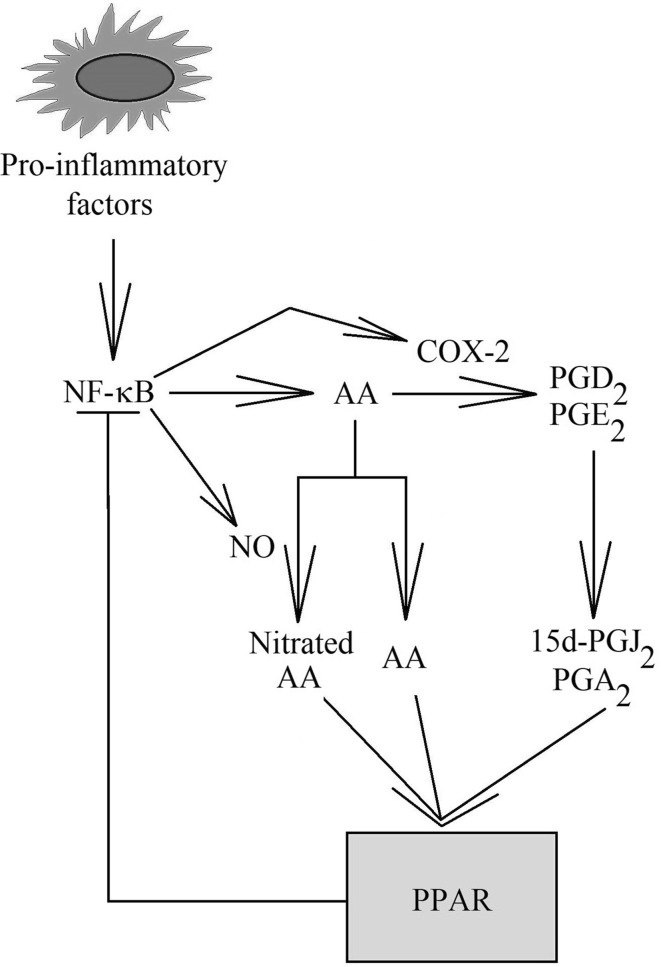
The peroxisome proliferator-activated receptor (PPAR) family includes three transcription factors: PPARα, PPARβ/δ, and PPARγ. PPAR are nuclear receptors activated by oxidised and nitrated fatty acid derivatives as well as by cyclopentenone prostaglandins (PGA 2 and 15d-PGJ 2 ) during the inflammatory response. This results in the modulation of the pro-inflammatory response, preventing it from being excessively activated. Other activators of these receptors are nonsteroidal anti-inflammatory drug (NSAID) and fatty acids, especially polyunsaturated fatty acid (PUFA) (arachidonic acid, ALA, EPA, and DHA). The main function of PPAR during the inflammatory reaction is to promote the inactivation of NF-κB. Possible mechanisms of inactivation include direct binding and thus inactivation of p65 NF-κB or ubiquitination leading to proteolytic degradation of p65 NF-κB. PPAR also exert indirect effects on NF-κB. They promote the expression of antioxidant enzymes, such as catalase, superoxide dismutase, or heme oxygenase-1, resulting in a reduction in the concentration of reactive oxygen species (ROS), i.e., secondary transmitters in inflammatory reactions. PPAR also cause an increase in the expression of IκBα, SIRT1, and PTEN, which interferes with the activation and function of NF-κB in inflammatory reactions.
Overview
The claims and statistics of this paper haven’t been checked yet.
Free: it reads the open-access text and checks the first 5 claims that cite a source we can check. Create a free account to check every claim.
Integrity signals
Registry
Cites
Statistics
Figures
Verification
Claims the paper makes
The claims and statistics of this paper haven’t been checked yet.
Free: it reads the open-access text and checks the first 5 claims that cite a source we can check. Create a free account to check every claim.
Claims other papers make about this one
Each is checked against this paper’s own text: does it say what the citing paper says it does?
In the citing paper
“PPAR-α directly binds to inflammatory transcription factors in hepatocytes such as p65 & c-Jun (NF-κB components), AP-1, STAT and thereby suppresses their transcriptional activity.[110]”
From Nuclear receptors in liver fibrosis (2021) · cites this paper as [110]
Self-check
Percentages, sums and reported differences re-computed from the paper’s own numbers.
The self-check needs the paper’s full text.
Citations
Cites
2 retracted
Subbaramaiah, K., Lin, D. T., Hart, J. C., & Dannenberg, A. J. (2001) · Journal of Biological Chemistry · doi:10.1074/jbc.m007237200 · Cited by 275
RetractedSodhi, K., Puri, N., Kim, D.-H., Hinds, T. D., Stechschulte, L. A., Favero, G., Rodella, L. F., Shapiro, J. I., Jude, D., & Abraham, N. G. (2013) · International Journal of Obesity · doi:10.1038/ijo.2013.116 · Cited by 28
RetractedModulation of NF‐κB‐dependent transcription and cell survival by the SIRT1 deacetylase
Yeung, F., Hoberg, J. E., Ramsey, C. S., Keller, M. D., Jones, D. R., Frye, R. A., & Mayo, M. W. (2004) · The EMBO Journal · doi:10.1038/sj.emboj.7600244 · Cited by 2,750
Kliewer, S. A., Sundseth, S. S., Jones, S. A., Brown, P. J., Wisely, G. B., Koble, C. S., Devchand, P., Wahli, W., Willson, T. M., Lenhard, J. M., et al. (1997) · Proceedings of the National Academy of Sciences · doi:10.1073/pnas.94.9.4318 · Cited by 2,164
Forman, B. M., Chen, J., & Evans, R. M. (1997) · Proceedings of the National Academy of Sciences · doi:10.1073/pnas.94.9.4312 · Cited by 2,116
Ros and ros-mediated cellular signaling
Zhang, J., Wang, X., Vikash, V., Ye, Q., Wu, D., Liu, Y., & Dong, W. (2016) · Oxidative Medicine and Cellular Longevity · doi:10.1155/2016/4350965 · Cited by 1,980
Sirt1 promotes fat mobilization in white adipocytes by repressing PPAR-γ
Picard, F., Kurtev, M., Chung, N., Topark-Ngarm, A., Senawong, T., Machado de Oliveira, R., Leid, M., McBurney, M. W., & Guarente, L. (2004) · Nature · doi:10.1038/nature02583 · Cited by 1,952
Rubbo, H., Radi, R., Trujillo, M., Telleri, R., Kalyanaraman, B., Barnes, S., Kirk, M., & Freeman, B. A. (1994) · Journal of Biological Chemistry · doi:10.1016/s0021-9258(18)47160-8 · Cited by 1,359 · cited 1×
“Both compounds, NO and ONOO−, lead to nitration of double bonds in unsaturated fatty acids [42, 61].”
BackgroundA SUMOylation-dependent pathway mediates transrepression of inflammatory response genes by PPAR-γ
Pascual, G., Fong, A. L., Ogawa, S., Gamliel, A., Li, A. C., Perissi, V., Rose, D. W., Willson, T. M., Rosenfeld, M. G., & Glass, C. K. (2005) · Nature · doi:10.1038/nature03988 · Cited by 1,254
Krey, G. D., Braissant, O., L’Horset, F., Kalkhoven, E., Perroud, M., Parker, M. G., & Wahli, W. (1997) · Molecular Endocrinology · doi:10.1210/me.11.6.779 · Cited by 1,221
Cited by
Items 101–200 of 484
As a Modulator, Multitasking Roles of SIRT1 in Respiratory Diseases
Zhou, Y., Zhang, F., & Ding, J. (2022) · Immune Network · doi:10.4110/in.2022.22.e21 · Cited by 28
“However, the proinflammatory function of SIRT1 may be related to repressed PPAR-γ activity (62).”
InfluentialMolecular mechanisms of wound healing: the role of zinc as an essential microelement
Лебедева, С. А., Galenko-Yaroshevsky, P. A., MIu, S., Erlich, A. B., Владимировна, З. А., Margaryan, A. G., Materenchuk, M. Y., Arshinov, I. R., Zharov, Y. V., Shelemekh, O. V., et al. (2023) · Research Results in Pharmacology · doi:10.18413/rrpharmacology.9.10003 · Cited by 28
“It is likely that A20 acts at several stages of NF-κB signaling pathway, inhibiting TNF- and TLR4-induced NF-κB activation, which ultimately leads to termination of signaling and decreases production of downstream mediators (Vereecke et al. 2009; Shembade et al. 2010).”
BackgroundInfluentialAutophagy and Redox Homeostasis in Parkinson’s: A Crucial Balancing Act
Jiménez-Moreno, N., & Lane, J. D. (2020) · Oxidative Medicine and Cellular Longevity · doi:10.1155/2020/8865611 · Cited by 28
“, nitrosylation) [365, 371, 372] and (ii) the transcription factor, farnesoid X receptor (FXR), mainly expressed in liver and intestine, a nuclear receptor involved in metabolism [373–375].”
BackgroundLayer by layer self-assembled hyaluronic acid nanoarmor for the treatment of ulcerative colitis
Zhao, X., Zhang, Y., Wang, P., Liu, K., Zheng, Y., Wen, J., Wang, K., & Wen, X. (2024) · Journal of Nanobiotechnology · doi:10.1186/s12951-024-02933-3 · Cited by 27
“…with the peroxisome proliferator-activated receptor (PPAR) signaling pathway, a ligand-activated receptor in the nuclear hormone receptor family that plays an important role in inflammatory responses and binds to the NF-κB subunit that regulates the expression of inflammatory factors [67].”
BackgroundRole of PPARs in Progression of Anxiety: Literature Analysis and Signaling Pathways Reconstruction
Рудько, О. И., Tretiakov, A. V., Наумова, Е. А., & Климов, Е. А. (2020) · PPAR Research · doi:10.1155/2020/8859017 · Cited by 27
“We suggest that ligand-activated PPARs block the activity of the NF-kappa B family of transcription factors [142, 143].”
BackgroundInfluence of a Polyherbal Mixture in Dairy Calves: Growth Performance and Gene Expression
Galván, C. D., MÉNDEZ-OLVERA, E. T., Gómez, D. M., Trujillo, A. G., Hernández-García, P. A., Ayala, E. E., Martínez, M. P., Lara-Bueno, A., Martínez, G. D. M., & Velázquez-Cruz, L. A. (2021) · Frontiers in Veterinary Science · doi:10.3389/fvets.2020.623710 · Cited by 27
Anjum, N. F., Shanmugarajan, D., Shivaraju, V. K., Faizan, S., Naishima, N. L., Kumar, B. R. P., Javid, S., & Purohit, M. N. (2022) · RSC Advances · doi:10.1039/d2ra02116a · Cited by 27
Wang, L., Yang, K., Jing, R., Zhao, W., Guo, K., Hu, Z., Liu, G., Xu, N., Zhao, J., Li, L., et al. (2023) · Frontiers in Pharmacology · doi:10.3389/fphar.2023.1089537 · Cited by 27
“The plots below the images show the quantitation analysis of ROS levels.”
BackgroundInfluentialSaroglitazar, a dual PPAR-α/γ agonist, alleviates LPS-induced hepatic and renal injury in rats
Francis, M. R., El‐Sheakh, A. R., & Suddek, G. M. (2023) · International Immunopharmacology · doi:10.1016/j.intimp.2023.109688 · Cited by 27
Lim, J., Kim, H. I., Bang, Y., & Choi, H. J. (2021) · Archives of Pharmacal Research · doi:10.1007/s12272-021-01333-7 · Cited by 27
Intestinal Microbial Metabolites in Ankylosing Spondylitis
Scalise, G., Ciancio, A., Mauro, D., & Ciccia, F. (2021) · Journal of Clinical Medicine · doi:10.3390/jcm10153354 · Cited by 27
“Among its various effects, PPAR-γ activation also inhibits the NF-κB pathway, thus decreasing inflammation [48].”
BackgroundDing, Y. P., Hou, Y., Liu, Y., Yu, T., Cui, Y., & Nie, H. (2022) · Frontiers in Pharmacology · doi:10.3389/fphar.2022.863646 · Cited by 28
“KEGG pathway analysis for macrophages showed a high enrichment for the PPAR and lysosome signaling pathway, which promotes the inactivation of NF-κB during the inflammatory reaction (Zhu et al., 2016; Korbecki et al., 2019).”
BackgroundOsorio, E. Y., Gugala, Z., Patterson, G. E., Palacios, G., Cordova, E., Uscanga‐Palomeque, A. C., Travi, B. L., & Melby, P. C. (2022) · Frontiers in Immunology · doi:10.3389/fimmu.2022.846246 · Cited by 26
“The increased bone marrow expression of PPARg could be a consequence of the NFKB activated through pro-inflammatory cytokines in concert with the mediator PGE2 (67), which is elevated in childhood malnutrition (68) and in our mouse model (37–39).”
BackgroundHuman CYP2B6 produces oxylipins from polyunsaturated fatty acids and reduces diet-induced obesity
Heintz, M. M., Eccles, J. A., Olack, E. M., Maner-Smith, K. M., Ortlund, E. A., & Baldwin, W. S. (2022) · PLoS ONE · doi:10.1371/journal.pone.0277053 · Cited by 26
PPARGC1A gene polymorphism is associated with exercise-induced fat loss
Mazur, I. I., Drozdovska, S., Валеріївна, А. О., Vinnichuk, Y., Поліщук, А. О., Dosenko, V., Andreev, I. O., Pickering, C., & Ahmetov, I. I. (2020) · Molecular Biology Reports · doi:10.1007/s11033-020-05801-z · Cited by 26
β-elemene blocks lipid-induced inflammatory pathways via PPARβ activation in heart failure
Shao, M., Wang, M., Ma, L., Wang, Q., Gao, P., Tian, X., Li, C., Lu, L., Li, C., Wang, W., et al. (2021) · European Journal of Pharmacology · doi:10.1016/j.ejphar.2021.174450 · Cited by 26
Vega Joubert, M. B., Ingaramo, P., Oliva, M. E., & D'Alessandro, M. E. (2022) · Food & Function · doi:10.1039/d2fo00642a · Cited by 25
Sharma, M., Singh, V., Sharma, R., Koul, A., McCarthy, E. T., Savin, V. J., Joshi, T., & Srivastava, T. (2022) · Biomedicines · doi:10.3390/biomedicines10020407 · Cited by 25
Lu, J., Guan, H., Wu, D., Hu, Z., Zhang, H., Jiang, H., Yu, J., Zeng, K., Li, H., Zhang, H., et al. (2021) · Journal of Cellular and Molecular Medicine · doi:10.1111/jcmm.16670 · Cited by 24
Yang, X., Wang, J., Jia, X.-T., Yang, Y., Fang, Y., Ying, X., Li, H., Zhang, M., Wei, J., & Pan, Y. (2025) · Journal of Alzheimer s Disease · doi:10.1177/13872877241313223 · Cited by 24
Sunagawa, Y., Kawaguchi, S., Miyazaki, Y., Katanasaka, Y., Funamoto, M., Shimizu, K., Shimizu, S., Hamabe‐Horiike, T., Kawase, Y., Komiyama, M., et al. (2022) · Phytomedicine · doi:10.1016/j.phymed.2022.154457 · Cited by 24
Abdel‐Fattah, M. M., Hassanein, E. H. M., Sayed, A. M. M., Alsufyani, S. E., El‐Sheikh, A. A. K., Arab, H. H., & Mohamed, W. R. (2023) · Pharmaceuticals · doi:10.3390/ph16040533 · Cited by 24
“In the colonic microenvironment, an enhanced protein expression of PPAR-γ has been reported to abrogate NF-κB pathway and enhance the antioxidant status in the colonic tissue [51,52]; thereby mitigating the colitis symptoms [18].”
BackgroundPurushothaman, K., Crawford, A. D., Rocha, S. D. C., Göksu, A. B., Lange, B. M., Mydland, L. T., Vij, S., Lin, Q., Øverland, M., & Press, C. M. (2024) · Heliyon · doi:10.1016/j.heliyon.2024.e26547 · Cited by 24
Kou, Y., Jing, Q., Yan, X., Chen, J., Shen, Y., Ma, Y., Xiang, Y., Li, X., Liu, X., Liu, Z., et al. (2024) · Chemico-Biological Interactions · doi:10.1016/j.cbi.2024.111262 · Cited by 23
Ansarey, S. H. (2021) · Frontiers in Psychiatry · doi:10.3389/fpsyt.2021.771144 · Cited by 23
“NOS, ROS, and RNS activate proinflammatory mediators, NF-kB, and AP-1 (180) and mediate GSH deficiency (72).”
BackgroundInfluentialSokołowska, P., Bleibel, L., Owczarek, J., & Wiktorowska‐Owczarek, A. (2024) · Advances in Clinical and Experimental Medicine · doi:10.17219/acem/174243 · Cited by 23
Role of peroxisome proliferator-activated receptors in osteoarthritis (Review)
Huang, G., Jiang, W. H., Xie, W., Lü, W., Zhu, W., & Deng, Z. (2020) · Molecular Medicine Reports · doi:10.3892/mmr.2020.11798 · Cited by 23
Bashiri, K., Mattar, M. C., Meighani, A., & Mason, A. L. (2025) · Intestinal Research · doi:10.5217/ir.2025.00090 · Cited by 21
“48,49 For instance, PPAR α agonists suppress IL-6 and TNF-α production in activated monocytes and adipocytes by these transrepression mechanisms.”
Sadikan, M. Z., Nasir, N. A. A., Bakar, N. S., Iezhitsa, I. N., & Agarwal, R. (2023) · BMC Complementary Medicine and Therapies · doi:10.1186/s12906-023-04005-9 · Cited by 22
“PPARα and PPARγ inhibit the activation of NFκB through increased expression of IκBα, PTEN, and increased antioxidants activity [104, 105].”
BackgroundAli, Z., Al-Ghouti, M. A., Abou-Saleh, H., & Rahman, M. M. (2024) · Marine Drugs · doi:10.3390/md22100446 · Cited by 23
“Among these fats, ω -3 PUFAs play a particularly crucial role due to their ability to regulate PPAR γ - mediated adipocyte differentiation [46] modulate inflammatory responses [47] and enhance bone marrow microcirculation [48].”
BackgroundFenofibrate promotes neuroprotection in a model of rotenone-induced Parkinson’s disease
Barbiero, J. K., Ramos, D. C., Boschen, S. L., Bassani, T. B., Cunha, C. D., & Vital, M. A. B. F. (2022) · Behavioural Pharmacology · doi:10.1097/fbp.0000000000000699 · Cited by 21
“These drugs act by activating peroxisome-proliferator-activated receptors alpha (PPAR-α) inducing pleiotropic effects, that involve regulation of inflammatory responses (Korbecki et al., 2019) and anti-inflammatory activity with the reduction of proinflammatory cytokines and other inflammatory molecules (Sung et al.”
BackgroundMierzejewski, K., Paukszto, Ł., Kurzyńska, A., Kunicka, Z., Jastrzebski, J., Makowczenko, K. G., Golubska, M., & Bogacka, I. (2022) · Scientific Reports · doi:10.1038/s41598-022-07986-8 · Cited by 21
Vivarelli, F., Morosini, C., Rullo, L., Losapio, L. M., Lacorte, A., Sangiorgi, S., Ghini, S., Fagiolino, I., Franchi, P., Lucarini, M., et al. (2024) · Frontiers in Pharmacology · doi:10.3389/fphar.2024.1328917 · Cited by 20
Deciphering adipose development: Function, differentiation and regulation
Guo, G., Wang, W., Tu, M., Zhao, B., Han, J., Li, J., Pan, Y., Zhou, J., Ma, W., Liu, Y., et al. (2024) · Developmental Dynamics · doi:10.1002/dvdy.708 · Cited by 20
“106 PPARs are involved in a variety of intracellular biological processes, including inflammation, 107 nutrient metabolism 108 and cell differentiation.”
Real-Sandoval, S. A., Gutiérrez‐López, G. F., Domínguez‐López, A., Paniagua‐Castro, N., Michicotl-Meneses, M. M., & Jaramillo‐Flores, M. E. (2020) · Journal of Functional Foods · doi:10.1016/j.jff.2020.103781 · Cited by 20
Phytotherapics in COVID19 : Why palmitoylethanolamide?
Pesce, M., Seguella, L., Cassarano, S., Aurino, L., Sanseverino, W., Lu, J., Corpetti, C., Re, A., Vincenzi, M., Sarnelli, G., et al. (2020) · Phytotherapy Research · doi:10.1002/ptr.6978 · Cited by 20
Li, X., Yu, H., Gong, Y., Wu, P., Feng, Q., & Liu, C. (2021) · Journal of Ethnopharmacology · doi:10.1016/j.jep.2021.114801 · Cited by 20
Ficus carica L. Attenuates Denervated Skeletal Muscle Atrophy via PPARα/NF-κB Pathway
Dai, J., Xiang, Y., Fu, D., Xu, L., Jiang, J., & Xu, J. (2020) · Frontiers in Physiology · doi:10.3389/fphys.2020.580223 · Cited by 20
Song, Y., Raheel, T. M., Jia, A., Dai, G., Liu, L., Long, X., & He, C. (2021) · Postgraduate Medical Journal · doi:10.1136/postgradmedj-2021-140354 · Cited by 19
The uPA System Differentially Alters Fibroblast Fate and Profibrotic Ability in Skin Fibrosis
Zou, M., Teng, Y., Chen, Z., Liu, S., Jia, Y., Zhang, K., Wu, J., Yuan, Z., Tang, X., Yu, S., et al. (2022) · Frontiers in Immunology · doi:10.3389/fimmu.2022.845956 · Cited by 19
“Since PPARg was reported to increase the expression of Smad7 in the TGF-b signalling pathway and thus alleviate skin fibrosis, we examined the expression of March 2022 | Volume 13 | Article 845956 Smad7 in control fibroblasts, uPAR-knockdown fibroblasts and uPAR-knockdown fibroblasts with an additional PPAR agonist.”
BackgroundInfluentialPotential safety implications of fatty acid-binding protein inhibition
Warren, W. G., Osborn, M., Duffy, P., Yates, A., & O’Sullivan, S. E. (2024) · Toxicology and Applied Pharmacology · doi:10.1016/j.taap.2024.117079 · Cited by 19
Jindal, J., Hill, J. W., Harte, J., Dunachie, S. J., & Kronsteiner, B. (2024) · Metabolism · doi:10.1016/j.metabol.2024.156035 · Cited by 20
Lifestyle and Food Habits Impact on Chronic Diseases: Roles of PPARs
d’Angelo, M., Castelli, V., Tupone, M. G., Catanesi, M., Antonosante, A., Dominguez-Benot, R., Ippoliti, R., Cimini, A., & Benedetti, E. (2019) · International Journal of Molecular Sciences · doi:10.3390/ijms20215422 · Cited by 19
“However, the anti-inflammatory mechanism is very complex, and takes different forms as extensively and best reviewed by Korbecki et al. 2019 [180].”
BackgroundEnhancing Cystic Fibrosis Immune Regulation
van Heeckeren, A. M., Sutton, M. T., Fletcher, D. R., Hodges, C. A., Caplan, A. I., & Bonfield, T. L. (2021) · Frontiers in Pharmacology · doi:10.3389/fphar.2021.573065 · Cited by 19
“Peroxisome proliferator activator receptor gamma (PPARγ) is an important regulator of the macrophage pro-inflammatory responses to infection regulating TNFα and IL-6 production (Knethen and Brune, 2002; Korbecki et al., 2019).”
BackgroundDu, D., Jiang, W., Feng, L., Zhang, Y., Chen, P., Wang, C., & Hu, Z. (2022) · Frontiers in Microbiology · doi:10.3389/fmicb.2022.935004 · Cited by 18
“In addition, PPAR signaling can inactivate NF-κB, promote antioxidant enzyme expression, and reduce the concentration of reactive oxygen species, thus improving antioxidant capacity (Korbecki et al., 2019).”
BackgroundBoateng, E., Bonilla-Martinez, R., Ahlemeyer, B., Garikapati, V., Alam, M. R., Trompak, O., Oruqaj, G., El-Merhie, N., Seimetz, M., Ruppert, C., et al. (2024) · Respiratory Research · doi:10.1186/s12931-024-02935-7 · Cited by 19
“Activation of PPAR-γ [23], but also of PPAR-β/δ (at the direct repeat 1 response element, [65]) increased catalase protein levels [65, 66].”
BackgroundLi, P., Zhao, S., Teng, Y., Han, S., Yang, Y., Wu, M., Guo, S., Ding, B., Xiao, L., & Yi, D. (2024) · Poultry Science · doi:10.1016/j.psj.2024.104429 · Cited by 19
Peroxisome proliferator-activator receptor γ and psoriasis, molecular and cellular biochemistry
Lin, X., Meng, X., Song, Z., & Lin, J. (2022) · Molecular and Cellular Biochemistry · doi:10.1007/s11010-022-04417-0 · Cited by 18
“PPARγ inhibits pro-inflammatory response by antagonizing the activity of transcription factors such as members of the nuclear factor kappa-light-chain-enhancer of activated B cells (NF-κB) and activator protein 1 (AP-1) [8].”
BackgroundLi, Y., He, X.-L., Zhou, L., Huang, X.-Z., Li, S., Guan, S., Li, J., & Zhang, L. (2022) · European Journal of Pharmacology · doi:10.1016/j.ejphar.2022.175193 · Cited by 18
Natural Bioactive Compounds against Oxidative Stress: Dietary Polyphenols Strike Back
Arrigoni, R., Cammarota, F., Porro, R., Cantore, S., Dioguardi, M., Cazzolla, A. P., Leonardis, F. D., Polimeno, L., Zerman, N., Cosola, M. D., et al. (2022) · Endocrine Metabolic & Immune Disorders - Drug Targets · doi:10.2174/1871530323666221107092553 · Cited by 18
Deciphering targets of Th17 cells fate: From metabolism to nuclear receptors
Boldrini, V. D. O., Farias, A. S., & Degasperi, G. R. (2019) · Scandinavian Journal of Immunology · doi:10.1111/sji.12793 · Cited by 18
Tobita, Y., Arima, T., Nakano, Y., Uchiyama, M., Shimizu, A., & Takahashi, H. (2021) · Pharmaceuticals · doi:10.3390/ph14020088 · Cited by 18
“Previous studies have reported that PPARα and PPARβ/δ suppress NF-κB [9,11,14].”
BackgroundRussell, K., Smith, J., Bremner, A., Chintoan‐Uta, C., Vervelde, L., Psifidi, A., & Stevens, M. P. (2021) · BMC Genomics · doi:10.1186/s12864-021-07748-2 · Cited by 17
Dana, N., Ferns, G. A., Nedaeinia, R., & Javanmard, S. H. (2022) · Clinical & Translational Oncology · doi:10.1007/s12094-022-02988-4 · Cited by 17
“One of the main regulators of NF-κB is the peroxisome proliferator-activated receptor (PPAR) family, which will be discussed in detail in the next section [82, 83].”
BackgroundFang, Z.-B., Wang, G., Cai, G.-Z., Zhang, P.-X., Liu, D., Chu, S.-F., Li, H.-L., & Zhao, H.-X. (2023) · Frontiers in Nutrition · doi:10.3389/fnut.2023.1033195 · Cited by 17
“Polyunsaturated fatty acids (PUFAs) affect bone metabolism by combining with PPARγ to induce bone marrow adipocyte differentiation (16), regulate inflammatory response (17), and improve bone marrow microcirculation (18).”
BackgroundLu, J., Zhang, J., Jiang, H., Hu, Z., Zhang, Y., He, L., Yang, J., Xie, Y., Wu, D., Li, H., et al. (2024) · eLife · doi:10.7554/elife.87935 · Cited by 18
Ye, P., Wang, Q., Liu, C., Li, G., Olatunji, O. J., Lin, J.-T., & Zuo, J. (2023) · Phytomedicine · doi:10.1016/j.phymed.2023.155132 · Cited by 17
Zhang, H., Tian, S., Zhao, Q., Xu, Y., Bi, L., Jiang, S., & Tang, Y. (2023) · Process Biochemistry · doi:10.1016/j.procbio.2023.11.005 · Cited by 17
Xiao, C., Liu, Y., Zhao, W., Liang, Y., Cui, C., Yang, S., Fang, W., Miao, L., Yuan, Z., Lin, Z., et al. (2024) · Frontiers in Nutrition · doi:10.3389/fnut.2024.1399390 · Cited by 17
In Vitro Models of Diabetes: Focus on Diabetic Retinopathy
Galgani, G., Bray, G., Martelli, A., Calderone, V., & Citi, V. (2024) · Cells · doi:10.3390/cells13221864 · Cited by 17
Emeka, P. M., Rasool, S. T., Morsy, M. A., Islam, M. I. H., & Chohan, M. S. (2021) · Korean Journal of Physiology and Pharmacology · doi:10.4196/kjpp.2021.25.4.321 · Cited by 17
“PPAR activity is said to be well-regulated during various cellular processes; indeed, nuclear factor-kappaB (NF-B) stimulation has shown to often suppress PPAR activity [12].”
BackgroundPioglitazone improves skeletal muscle functions in reserpine-induced fibromyalgia rat model
Hassan, F. E., Sakr, H. I., Mohie, P. M., Suliman, H. S., Mohamed, A. S., Attia, M. H., & Eid, D. (2021) · Annals of Medicine · doi:10.1080/07853890.2021.1916069 · Cited by 18
Research progress of non-coding RNAs regulation on intramuscular adipocytes in domestic animals
Gong, Y., Lin, Z., Wang, Y., & Liu, Y. (2023) · Gene · doi:10.1016/j.gene.2023.147226 · Cited by 17
Li, F., Lü, T., Liu, D., Zhang, C., Zhang, Y., & Dong, F. (2021) · Cell Death and Disease · doi:10.1038/s41419-021-03820-7 · Cited by 17
Anti-Inflammatory Activity of the Constituents from the Leaves of Perilla frutescens var. acuta
Youn, I. P., Han, S.-J., Jung, H. J., Noh, S. G., Chung, H. Y., Koo, Y. K., Shin, S., & Seo, E. K. (2023) · Pharmaceuticals · doi:10.3390/ph16121655 · Cited by 16
Sattari, M., Amri, J., Shahaboddin, M. E., Sattari, M., Tabatabaei‐Malazy, O., Azmon, M., Meshkani, R., & Panahi, G. (2024) · Journal of Diabetes & Metabolic Disorders · doi:10.1007/s40200-024-01502-7 · Cited by 16
“Similarly, PPAR-γ increases adiponectin expression (an adipokine known for its role in improving insulin sensitivity) while suppressing NF-κB [27].”
Μaione, F., Casillo, G. M., Raucci, F., Iqbal, A. J., & Mascolo, N. (2020) · Pharmacological Research · doi:10.1016/j.phrs.2020.104807 · Cited by 16
“Upon PPARs activation, two major biological functions can follow: i) blocking of the activation of p65 nuclear factor kappa-light-chain-enhancer of activated B cells (NF-κB, a transcription factor involved in inflammatory processes) and overexpression of nuclear factor of kappa-light-polypeptide-gene-enhancer in B cel…”
BackgroundRen, S., Hou, Y., Zuo, Z., Liu, Z., Wang, H., Xu, Y., Yamamoto, M. P., Zhang, Q., Fu, J., & Pi, J. (2020) · Food and Chemical Toxicology · doi:10.1016/j.fct.2020.111836 · Cited by 16
Liu, T., Zhuang, X., Qin, X. J., Wei, L. B., & Gao, J. (2022) · Naunyn-Schmiedeberg s Archives of Pharmacology · doi:10.1007/s00210-022-02208-4 · Cited by 16
Foumani, M. K., Amirshahrokhi, K., Namjoo, Z., & Niapour, A. (2023) · Naunyn-Schmiedeberg s Archives of Pharmacology · doi:10.1007/s00210-023-02914-7 · Cited by 15
“CVL alone significantly altered the levels of iNOS and Arg-1 compared to the control.”
InfluentialWu, Y., Ge, H., Zhao, H., Zou, K., Wang, P., Wáng, Y., & Zhang, Y. (2025) · International Immunopharmacology · doi:10.1016/j.intimp.2025.114470 · Cited by 15
Du, X., Wu, M., Tian, D., Zhou, J., Wang, L., & Zhan, L. (2020) · PPAR Research · doi:10.1155/2020/6633022 · Cited by 15
“More recently, emerging evidence revealed that PPARα activation could reduce the inflammatory response by promoting NF-κB inactivation [9].”
BackgroundRong, P., Wang, J., Angelova, A., Almsherqi, Z. A., & Deng, Y. (2022) · Frontiers in Cell and Developmental Biology · doi:10.3389/fcell.2022.859421 · Cited by 15
“These PUFAs may effectively reduce inflammatory responses through activating the PPARs proteins (Deplanque et al., 2003; Farooqui et al., 2007; Korbecki et al., 2019).”
BackgroundRaciti, L., Luca, R. D., Raciti, G., Arcadi, F. A., & Calabrò, R. S. (2022) · Medical Sciences · doi:10.3390/medsci10030037 · Cited by 15
“As an antagonist of the nuclear factor-κB (NF-κB) signaling pathway, PEA regulates the activation of the PPARα receptors [57,58], increasing macrophage activation and phagocytosis, without an increase in proinflammatory cytokines [57], regulating fatty acid metabolism [59,60] and reducing lipoperoxidation and reductio…”
BackgroundZhao, S., Tao, D.-L., Chen, J., Wu, J.-P., Yang, X., Song, J.-K., Zhu, X., & Zhao, G. (2022) · Parasites & Vectors · doi:10.1186/s13071-022-05405-5 · Cited by 15
Žarković, N., Łuczaj, W., Jarocka-Karpowicz, I., Orehovec, B., Baršić, B., Tarle, M., Kmet, M., Lukšić, I., Biernacki, M., & Skrzydlewska, E. (2022) · International Journal of Molecular Sciences · doi:10.3390/ijms231911810 · Cited by 15
“Additionally, in an experiment on mice with ARDS, it was shown that AEA introduced into experimental therapy significantly decreased the expression of pro-inflammatory IL-6 [32], an elevated level of which was observed in this study, especially in patients who did not survive.”
BackgroundInfluentialPalmitoylethanolamide and Related ALIAmides for Small Animal Health: State of the Art
Rocca, G. D., & Re, G. (2022) · Biomolecules · doi:10.3390/biom12091186 · Cited by 14
“Among the latter, the nuclear peroxisome proliferator-activated receptor alpha (PPARα) is of particular interest because it negatively interferes with inflammatory gene expression by regulating the IκBα/NF-κB pathway [64].”
BackgroundPDCD4 promotes inflammation/fibrosis by activating the PPAR‑γ/NF‑κB pathway in mouse atrial myocytes
Li, Y., Yang, Y., Wang, J., Bao, Z., Zheng, M., Wang, X., Zhu, Y., & Wulasihan, M. (2024) · Molecular Medicine Reports · doi:10.3892/mmr.2024.13333 · Cited by 14
“During inflammation, the activation of PPAR γ inactivates NF‑ κ B by direct binding to NF‑ κ B p65, resulting in a diminished inflammatory response after ubiquitin degradation (18).”
BackgroundResultModulation of NFκB signalling pathway by tocotrienol: A systematic review.
Nasir, N. A. A., Sadikan, M. Z., & Agarwal, R. (2021) · PubMed · doi:10.6133/apjcn.202109_30(3).0020 · Cited by 14
Abo‐Hiemad, H. M., Nassar, A. Y., Shatat, A. R., Mohamed, M. A., Soliman, M., Abdelrady, Y. A., & Sayed, A. M. M. (2022) · Journal of Food Biochemistry · doi:10.1111/jfbc.14160 · Cited by 14
Dietary Polyphenols against Oxidative Stress in Head and Neck Cancer: What's New, What's Next
Ballini, A., Zhurakivska, K., Troiano, G., Muzio, L. L., Caponio, V. C. A., Spirito, F., Porro, R., Rella, M., Cantore, S., Arrigoni, R., et al. (2023) · Journal of Cancer · doi:10.7150/jca.90545 · Cited by 14
“…that in physiological conditions ROS signaling as a second messenger in cells is crucial for a variety of biological actions, such as gene expression, signal transduction, and receptors activation [12-13], and also wound healing, tissue regeneration and protection from pathogens [14-15].”
BackgroundAbd‐alhameed, E. K., Azouz, A. A., Abo‐Youssef, A. M., & Ali, F. E. M. (2023) · International Immunopharmacology · doi:10.1016/j.intimp.2023.111298 · Cited by 14
Chen, J., Yi, C., Lu, C., Han, J., Shi, Q., Li, J., Zhou, J., & Su, X. (2021) · Journal of Functional Foods · doi:10.1016/j.jff.2021.104505 · Cited by 14
Brito, V. G. B., Patrocinio, M. S., Linjardi, M. C., Barreto, A. E. A., Frasnelli, S. C. T., Lara, V. S., Santos, C. F., & Oliveira, S. H. P. (2020) · Frontiers in Pharmacology · doi:10.3389/fphar.2020.579926 · Cited by 14
“In addition to the direct effect of Pparg on bone metabolism, it acts as an anti-inflammatory pathway, which inhibits NFkB and cytokine production (Korbecki et al., 2019).”
BackgroundThe ameliorative effects and mechanisms of abscisic acid on learning and memory
Liao, P., Wu, Q., Li, S., Hu, K., Liu, H., Wang, H., Long, Z.-Y., Lu, X., & Wang, Y. (2022) · Neuropharmacology · doi:10.1016/j.neuropharm.2022.109365 · Cited by 13
An insight into carcinogenic activity and molecular mechanisms of Bis(2-ethylhexyl) phthalate
Pillo, G., Aldrovandi, F., Mescoli, A., Maffei, G., Mascolo, M. G., Vaccari, M., & Colacci, A. (2024) · Frontiers in Toxicology · doi:10.3389/ftox.2024.1389160 · Cited by 13
Chang, M., Shi, K., Xia, J., Zhang, R., Li, Y., Zang, S., Tan, S., Wang, W., Chen, S., & Sha, Z. (2024) · Aquaculture · doi:10.1016/j.aquaculture.2024.741585 · Cited by 13
Ortega, M. A., Fraile‐Μartinez, O., Pekarek, L., Álvarez-Mon, M. Á., Asúnsolo, Á., Sánchez‐Trujillo, L., Coca, S., Buján, J., Álvarez‐Mon, M., García‐Honduvilla, N., et al. (2021) · PubMed · doi:10.14670/hh-18-322 · Cited by 13
Hadefi, A., Leprovots, M., Thulliez, M., Bastin, O., Lefort, A., Libert, F., Nonclercq, A., Delchambre, A., Reniers, F., Deviere, J. M., et al. (2022) · Cell Death Discovery · doi:10.1038/s41420-022-00835-7 · Cited by 13
“Pparg, a master regulator of lipid metabolism and immune response (20), was also found 158 upregulated in CAP-treated organoid cells (Fig.”
Wang, F., Zhang, M., Yin, L., Zhou, Z., Peng, Z., Li, W., Chen, H., Yu, G., & Tang, J. (2024) · International Immunopharmacology · doi:10.1016/j.intimp.2024.113651 · Cited by 13
Dong, L., Li, Y., & Wu, H. (2021) · Chemistry and Physics of Lipids · doi:10.1016/j.chemphyslip.2021.105103 · Cited by 13
Jie, Z., Yu, L., Yi, F., Zhang, H., Li, F., Li, X., Wei, Y. Z., & Wang, Z. (2022) · Evidence-based Complementary and Alternative Medicine · doi:10.1155/2022/5394514 · Cited by 13
“Reviews on ω-3 PUFAs for the self-regulation of the inflammatory response and cardiovascular disease suggest that ALA differs from EPA and DHA in terms of the expression and activation of cyclooxygenase-2 and the outcomes of clinical studies [33, 34].”
BackgroundLi, Z., Xing, S., Li, P., He, S., Cao, Z., Wang, X., Cao, X., Liu, B., & You, H. (2023) · Aquatic Toxicology · doi:10.1016/j.aquatox.2023.106441 · Cited by 13
Attri, N., Arora, D., Saini, R., Chandel, M., Suthar, P., & Dhiman, A. (2024) · Food Science and Biotechnology · doi:10.1007/s10068-024-01737-3 · Cited by 12
“This reduction in inflammatory responses leads to a decrease in the release of interleukin-6 and tumour necrosis factor alpha after lipopolysaccharide stimulation (Korbecki & Bobiński Rafałand Dutka, 2019).”
Otálora-Otálora, B. A., Payán‐Gómez, C., Rivera, J. J. L., Pedroza-Aconcha, N. B., Arboleda-Mojica, S. L., Aristizábal-Guzmán, C., Isaza-Ruget, M. A., & Álvarez, C. (2024) · Cells · doi:10.3390/cells14010001 · Cited by 12
“The PPARG N-terminus A/B domain is phosphorylated by MAPK, which modifies its nuclear receptor activity, influencing cell differentiation and inflammatory responses [124].”
Xu, X., Chen, Q., Li, S., & Xiong, T. (2025) · NeuroMarkers. · doi:10.1016/j.neumar.2024.100035 · Cited by 12
Comparative Analysis of the Antioxidant and Anti-Inflammatory Effects of Krill and Fish Oil
Sarıyer, E. T., Baş, M., & Yüksel, M. (2025) · International Journal of Molecular Sciences · doi:10.3390/ijms26157360 · Cited by 12
“PPAR α and PPAR-γ inhibit the NF-κ B activity, causing inhibition of inflammatory reactions by the products of these reactions [69,70].”
PPARβ/δ activation protects against hepatic ischaemia–reperfusion injury
Qian, B., Wang, C., Li, X., Ma, P., Dong, L., Shen, B., Wu, H., Li, N., Kang, K., & Ma, Y. (2023) · Liver International · doi:10.1111/liv.15760 · Cited by 12
“46 Moreover, activation of PPAR β / δ abrogated LPS-induced degradation of I κ B, thus suppressing LPS-induced NF– κ B activities.”
BackgroundPomianek, T., Zagórska-Dziok, M., Skóra, B., Ziemlewska, A., Nizioł‐Łukaszewska, Z., Wójciak, M., Sowa, I., & Szychowski, K. A. (2024) · International Journal of Molecular Sciences · doi:10.3390/ijms25105495 · Cited by 13
“Moreover, it is known that SOD1 expression can be controlled by PPAR γ [11], which confirms its important role in controlling the expression of antioxidant enzymes.”
BackgroundSun, Y., Lu, T., Pan, J., He, H., Xu, M., Chen, Y., Chen, Y., Fang, P., Ye, X., Li, S., et al. (2024) · Colloids and Surfaces B Biointerfaces · doi:10.1016/j.colsurfb.2024.114088 · Cited by 12
Metadata
- Authors
- Korbecki, J., Bobiński, R., & Dutka, M.
- Affiliations
- Medical University of Silesia (PL)
- University of Bielsko-Biała (PL)
- Corresponding author
- Korbecki, Jan
- Venue
- Inflammation Research
- Published
- 2019-03-29
- Volume
- 68
- Issue
- 6
- Pages
- 443-458
- ISSN
- 1023-3830 (ISSN-L)
- 1420-908X
- PMC
- PMC6517359
- OpenAlex
- W2930592277
- Cited by
- 415
- References
- 233
- Citations by year
- 2026: 44 · 2025: 49 · 2024: 88 · 2023: 62 · 2022: 75 · 2021: 61 · 2020: 26 · 2019: 9
- FWCI
- 4.07
- Type
- journal article
- Language
- en
- Open access
- hybrid
- doi.org
- Licence
- cc-by
- creativecommons.org/licenses/by/4.0 (tdm)
- Locations
- Inflammation Research (publishedVersion, cc-by)
- Europe PMC (PubMed Central) (publishedVersion, cc-by)
- PubMed Central (publishedVersion, cc-by)
- PubMed (publishedVersion)
- Topics
- Life Sciences › Biochemistry, Genetics and Molecular Biology › Molecular Biology › Peroxisome Proliferator-Activated Receptors
- Health Sciences › Nursing › Nutrition and Dietetics › Fatty Acid Research and Health
- Life Sciences › Biochemistry, Genetics and Molecular Biology › Cancer Research › NF-κB Signaling Pathways
- Keywords
- peroxisome proliferator-activated receptors, PPARα, PPARδ, PPARγ, inflammation, NF-κB inactivation, cyclopentenone prostaglandins, oxidized fatty acids, nonsteroidal anti-inflammatory drugs, polyunsaturated fatty acids, reactive oxygen species, antioxidant enzymes, heme oxygenase-1, SIRT1, PTEN, IκBα, transcriptional regulation
- MeSH terms
- Animals, Humans, Inflammation, Ligands, NF-kappa B, Peroxisome Proliferator-Activated Receptors, Cyclooxygenase 2
About these checks
Registry, retraction, Cites and statistics results are computed, not judged, with one exception: a printed reference that no index lists is read once by a model before it counts as a citation error. Claims are extracted by a model and kept only when their quote appears verbatim in the text; each cited source is then checked, with a model’s help, for whether it says what the claim relies on. Those verdicts can be wrong — read the claim’s quote and the cited source before relying on one.
Statistics and arithmetic are recomputed, not judged.
Confidence bands are shown only for fields calibrated on our annotated test set. None is calibrated yet, so no band is shown.
What counts as a claim ›How we measure confidence ›How we check this ›
Are you an author, or do you see a problem with this page? Request a review
Data sources
Bibliographic data: Semantic Scholar, OpenAlex, Crossref.
Contains information from the Semantic Scholar Academic Graph Datasets, made available under the ODC Attribution License (ODC-BY 1.0).
Semantic Scholar’s data is described in: Kinney, R., et al. (2023). The Semantic Scholar Open Data Platform. arXiv:2301.10140.
