

Metformin and the gastrointestinal tract
Open accessThe DOI matches its Crossref record; 89 of the 89 references it cites were found in a registry or an index.
Abstract
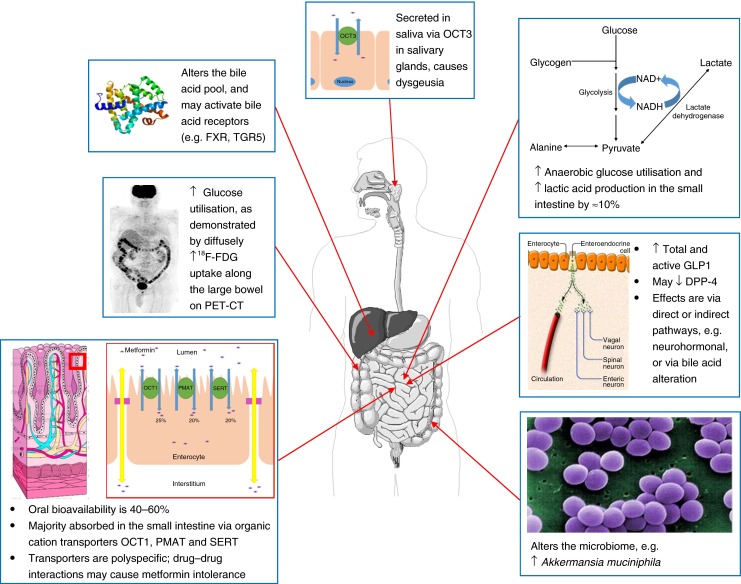
Metformin is an effective agent with a good safety profile that is widely used as a first-line treatment for type 2 diabetes, yet its mechanisms of action and variability in terms of efficacy and side effects remain poorly understood. Although the liver is recognised as a major site of metformin pharmacodynamics, recent evidence also implicates the gut as an important site of action. Metformin has a number of actions within the gut. It increases intestinal glucose uptake and lactate production, increases GLP-1 concentrations and the bile acid pool within the intestine, and alters the microbiome. A novel delayed-release preparation of metformin has recently been shown to improve glycaemic control to a similar extent to immediate-release metformin, but with less systemic exposure. We believe that metformin response and tolerance is intrinsically linked with the gut. This review examines the passage of metformin through the gut, and how this can affect the efficacy of metformin treatment in the individual, and contribute to the side effects associated with metformin intolerance.
Overview
The claims and statistics of this paper haven’t been checked yet.
Free: it reads the open-access text and checks the first 5 claims that cite a source we can check. Create a free account to check every claim.
Integrity signals
Registry
Cites
Statistics
Figures
Verification
Claims the paper makes
The claims and statistics of this paper haven’t been checked yet.
Free: it reads the open-access text and checks the first 5 claims that cite a source we can check. Create a free account to check every claim.
Claims other papers make about this one
Each is checked against this paper’s own text: does it say what the citing paper says it does?
The source backs part of the claim, not all of it — or backs it for a different population, condition or comparison.
In the citing paper
“Most of these minor side effects include gastrointestinal discomfort such as abdominal or stomach pain, early satiety, decreased appetite, and diarrhea, which usually subside after one or two weeks of use (McCreight et al. 2016).”
From Benefits of Metformin in Attenuating the Hallmarks of Aging (2020) · cites this paper as McCreight et al. 2016
Experimental — accuracy not yet measuredIn the citing paper
“As in most drugs, minor side effects occur with metformin, but it is important to understand whether they reveal anything about the mechanism of action of this drug.”
From Benefits of Metformin in Attenuating the Hallmarks of Aging (2020) · cites this paper as McCreight et al. 2016
Self-check
Percentages, sums and reported differences re-computed from the paper’s own numbers.
The self-check needs the paper’s full text.
Citations
Cites
A metagenome-wide association study of gut microbiota in type 2 diabetes
Qin, J., Li, Y., Cai, Z., Li, S., Zhu, J., Zhang, F., Liang, S., Zhang, W., Guan, Y., Shen, D., et al. (2012) · Nature · doi:10.1038/nature11450 · Cited by 6,762 · cited 2×
“Although these two studies differ in terms of the changes they identified, a common finding was a reduction in butyrate-producing bacteria and an increase in opportunistic pathogens [78, 81].”
BackgroundResultCross-talk between Akkermansia muciniphila and intestinal epithelium controls diet-induced obesity
Everard, A., Belzer, C., Geurts, L., Ouwerkerk, J. P., Druart, C., Bindels, L. B., Guiot, Y., Derrien, M., Muccioli, G. G., Delzenne, N. M., et al. (2013) · Proceedings of the National Academy of Sciences · doi:10.1073/pnas.1219451110 · Cited by 4,511 · cited 1×
“…(resulting in an increase in A. muciniphila ) or direct treatment with A. muciniphila has been reported to improve metabolic disorders, possibly by increasing endocannabinoids, which reduce inflammation, modify gut peptide secretion and improve the thickness of the gut mucous barrier [82].”
BackgroundGut metagenome in European women with normal, impaired and diabetic glucose control
Karlsson, F. H., Tremaroli, V., Nookaew, I., Bergström, G., Behre, C. J., Fagerberg, B., Nielsen, J., & Bäckhed, F. (2013) · Nature · doi:10.1038/nature12198 · Cited by 3,115 · cited 1×
“2) [79].”
Inzucchi, S. E., Bergenstal, R. M., Buse, J. B., Diamant, M., Ferrannini, E., Nauck, M., Peters, A. L., Tsapas, A., Wender, R., & Matthews, D. R. (2015) · Diabetes Care · doi:10.2337/dc14-2441 · Cited by 3,066
Disentangling type 2 diabetes and metformin treatment signatures in the human gut microbiota
MetaHIT consortium, Forslund, K., Hildebrand, F., Nielsen, T., Falony, G., Le Chatelier, E., Sunagawa, S., Prifti, E., Vieira-Silva, S., Gudmundsdottir, V., et al. (2015) · Nature · doi:10.1038/nature15766 · Cited by 2,116
TGR5-Mediated Bile Acid Sensing Controls Glucose Homeostasis
Thomas, C., Gioiello, A., Noriega, L., Strehle, A., Oury, J., Rizzo, G., Macchiarulo, A., Yamamoto, H., Mataki, C., Pruzanski, M., et al. (2009) · Cell Metabolism · doi:10.1016/j.cmet.2009.08.001 · Cited by 1,885 · cited 1×
“The increase in the bile acid pool may then stimulate TGR5 bile acid receptors on the L cell [62, 67], causing an increase in GLP-1 secretion via mitochondrial oxidative phosphorylation and calcium influx [67].”
BackgroundMolecular imaging of cancer with positron emission tomography
Gambhir, S. S. (2002) · Nature Reviews Cancer · doi:10.1038/nrc882 · Cited by 1,656 · cited 1×
“PET-CT is commonly used for the diagnosis, staging and monitoring of the response to treatment, of certain cancers [32].”
MethodShin, N.-R., Lee, J.-C., Lee, H.-Y., Kim, M.-S., Whon, T. W., Lee, M.-S., & Bae, J.-W. (2014) · Gut · doi:10.1136/gutjnl-2012-303839 · Cited by 1,550 · cited 2×
“Administration of A. muciniphila to mice receiving a high-fat diet improved glucose tolerance [86], suggesting that the effect of metformin on abundance of this species within in the microbiome may indirectly contribute to the glucose-lowering effect of metformin.”
Background
Cited by
Items 201–300 of 762
Isop, L. M., Neculau, A. E., Necula, R. D., Kakucs, C., Moga, M., & Dima, L. (2023) · Pharmaceuticals · doi:10.3390/ph16121714 · Cited by 41
“Additionally, metformin’s effects are also influenced by changes in composition of the gut microbiota, further contributing to its beneficial outcomes [42–44].”
Karim, N., Rahman, M. A., Chanudom, L., Thongsom, M., & Tangpong, J. (2019) · Journal of Food Science · doi:10.1111/1750-3841.14511 · Cited by 36
High Accumulation of Metformin in Colonic Tissue of Subjects With Diabetes or the Metabolic Syndrome
Paleari, L., Burhenne, J., Weiß, J., Foersch, S., Roth, W., Parodi, A. F., Gnant, M., Bachleitner‐Hofmann, T., Scherer, D., Ulrich, C. M., et al. (2018) · Gastroenterology · doi:10.1053/j.gastro.2017.12.040 · Cited by 36
Haber, R., Zarzour, F., Ghezzawi, M., Saadeh, N., Bacha, D. S., Jebbawi, L. A., Chakhtoura, M., & Mantzoros, C. S. (2024) · Diabetes Obesity and Metabolism · doi:10.1111/dom.15501 · Cited by 39
“Further high-quality and better powered studies are needed to examine the impact of MTF in patients with insulin resistance and NAFLD. metformin, nonalcoholic fatty liver disease, obesity, systematic review”
Current type 2 diabetes guidelines: Individualized treatment and how to make the most of metformin
Chan, J. C. N., Yang, A., Chu, N. H. S., & Chow, E. (2024) · Diabetes Obesity and Metabolism · doi:10.1111/dom.15700 · Cited by 38
“127 Apart from increasing the abundance of health-promoting microbiota with increased release of incretins and synthesis of SCFA, 128 the effects of metformin on bile acid pools are noteworthy.”
Lv, Y., Zhao, X. Y., Guo, W., Gao, Y., Yang, S., Li, Z., & Wang, G. (2018) · Journal of Diabetes Research · doi:10.1155/2018/1890978 · Cited by 38
“Recently, the relationship between metformin and the gut has been comprehensively reviewed [21]; researchers indicated that metformin can affect the gut microenvironment by modulating glucose uptake and utilization, increasing glucagon-like peptide-1 (GLP-1) and bile acid levels and altering gut microbiota.”
BackgroundInfluentialTreatment of Metabolic Syndrome in Children
Tagi, V. M., Samvelyan, S., & Chiarelli, F. (2020) · Hormone Research in Paediatrics · doi:10.1159/000510941 · Cited by 36
Alhajri, N., Khursheed, R., Ali, M. T., Izneid, T. A., Al-Kabbani, O., Al-Haidar, M. B., Al-Hemeiri, F., Alhashmi, M., & Pottoo, F. H. (2021) · Microorganisms · doi:10.3390/microorganisms9102013 · Cited by 35
“For example, a trial on precise inhabitants of Danish adults presented that food rich in whole grains rather than refined grain decreases the major risk factors (systemic inflammation and body mass) related to injurious projection of CVDs [97].”
BackgroundHuang, Y., Lou, X., Jiang, C., Ji, X., Tao, X., Sun, J., & Bao, Z. (2022) · Frontiers in Endocrinology · doi:10.3389/fendo.2022.1044030 · Cited by 35
Silverii, G. A. (2024) · Diabetes, Obesity and Metabolism · doi:10.1111/dom.15749 · Cited by 33
“People with diabetes are, in fact, at a higher risk of gastrointestinal disturbances, 53 with a doubled risk of diarrhoea, independent from metformin use 80 : among possible causes, other concomitant medications ( α -glucosidase inhibitors, GLP-1 RAs, canagliflozin, drugs containing lactose in…”
InfluentialHenry, R. R., Frías, J. P., Walsh, B., Skare, S., Hemming, J., Burns, C. M., Bicsak, T. A., Baron, A., & Fineman, M. S. (2018) · PLoS ONE · doi:10.1371/journal.pone.0203946 · Cited by 35
MCCREIGHT, L. J., Mari, A., Coppin, L., Jackson, N., Umpleby, A. M., & Pearson, E. R. (2019) · Diabetologia · doi:10.1007/s00125-019-05042-1 · Cited by 34
Self-citationBhosale, R. R., Osmani, R. A. M., Lila, A. S. A., Khafagy, E., Arab, H. H., Gowda, D. V., Rahamathulla, M., Hani, U., Adnan, M., & Gangadharappa, H. V. (2021) · RSC Advances · doi:10.1039/d1ra01536b · Cited by 33
Meligi, N. M., Dyab, A. K. F., & Paunov, V. N. (2021) · Pharmaceutics · doi:10.3390/pharmaceutics13071048 · Cited by 33
“Additionally, several studies have recently suggested that MTF increases glucose intestinal absorption and utilization in enterocytes, limiting glucose access to the bloodstream [96,97].”
BackgroundYang, R., Yu, H., Wu, J., Chen, H., Wang, M., Wang, S., Qin, X., Wu, T., Wu, Y., & Hu, Y. (2023) · Frontiers in Endocrinology · doi:10.3389/fendo.2023.1082720 · Cited by 40
“Frontiers in Endocrinology 05 vitamin B12 from the gastrointestinal tract by interfering with the calcium-dependent binding of the intrinsic factor vitamin B12 complex to the cuboid receptor at the end of the ileum (21).”
BackgroundCorchia, A., Wynckel, A., Journet, J., Moussi‐Francès, J., Skandrani, N., Lautrette, A., Zafrani, L., Lewandowski, E., Reboul, P., Vrigneaud, L., et al. (2019) · Clinical Toxicology · doi:10.1080/15563650.2019.1648816 · Cited by 36
“Some recent data emphasized the underlying mechanisms of metformin related DD: gut microbiota flora, genetic polymorphisms or co-prescribed drugs inhibiting transporters may play a role in metformin intolerance [26,27].”
BackgroundWang, F., Liu, X., Huang, F., Zhou, Y., Wang, X., Song, Z., Wang, S., Wang, X., Shi, D., Ruan, G., et al. (2024) · eLife · doi:10.7554/elife.89045.4 · Cited by 33
Bajetto, A., Pattarozzi, A., Sirito, R., Barbieri, F., & Florio, T. (2023) · International Immunopharmacology · doi:10.1016/j.intimp.2023.111078 · Cited by 35
Fiore, G., Pascuzzi, M. C., Profio, E. D., Corsello, A., Agostinelli, M., Mendola, A. L., Milanta, C., Campoy, C., Calcaterra, V., Zuccotti, G., et al. (2022) · Pharmacological Research · doi:10.1016/j.phrs.2022.106599 · Cited by 33
Rzeczycki, P., Pęciak, O., Plust, M., & Droździk, M. (2025) · International Journal of Molecular Sciences · doi:10.3390/ijms262411897 · Cited by 30
“[191–193] → indicates “causes” and ↑ indicates “increases”.”
Maniar, K., Singh, V., Moideen, A., Bhattacharyya, R., Chakrabarti, A., & Banerjee, D. (2018) · Biomedicine & Pharmacotherapy · doi:10.1016/j.biopha.2018.08.021 · Cited by 30
Luo, C., Wang, X., Huang, H., Mao, X., Zhou, H., & Liu, Z. (2019) · Frontiers in Pharmacology · doi:10.3389/fphar.2019.00371 · Cited by 31
The clinical application of metformin in children and adolescents: A short update.
Soliman, A., Sanctis, V. D., Alaaraj, N., & Hamed, N. (2020) · Acta bio-medica dell'Ateneo parmense/Acta biomedica · doi:10.23750/abm.v91i3.10127 · Cited by 33
“the transport of glucose from the circulation into stool (17).”
BackgroundNew Aspects of Diabetes Research and Therapeutic Development
Satin, L. S., Soleimanpour, S. A., & Walker, E. M. (2021) · Pharmacological Reviews · doi:10.1124/pharmrev.120.000160 · Cited by 34
Review article: drug‐induced small bowel injury
Hamdeh, S., Micić, D., & Hanauer, S. B. (2021) · Alimentary Pharmacology & Therapeutics · doi:10.1111/apt.16642 · Cited by 33
Lei, X., Huo, P., Xie, Y., Wang, Y., Liu, G., Tu, H., Shi, Q., Mo, Z., & Zhang, S. (2022) · Molecular Reproduction and Development · doi:10.1002/mrd.23556 · Cited by 31
“…of Type 2 diabetes, however, metformin treatment is often associated with side effects including nausea, vomiting, diarrhea and other gastrointestinal reactions, which limited its use for treating the diabetic complications (Bonnet & Scheen, 2017; McCreight et al., 2016; Thomas & Gregg, 2017).”
BackgroundThe Influence of Gut Microbial Species on Diabetes Mellitus
AL-Ishaq, R. K., Samuel, S. M., & Büsselberg, D. (2023) · International Journal of Molecular Sciences · doi:10.3390/ijms24098118 · Cited by 33
Metformin Cessation and Dementia Incidence
Zimmerman, S. C., Ferguson, E. L., Choudhary, V., Ranatunga, D. K., Oni‐Orisan, A., Hayes‐Larson, E., Folle, A. D., Mayeda, E. R., Whitmer, R. A., Gilsanz, P., et al. (2023) · JAMA Network Open · doi:10.1001/jamanetworkopen.2023.39723 · Cited by 34
Anwardeen, N. R., Naja, K., & Elrayess, M. A. (2024) · Frontiers in Pharmacology · doi:10.3389/fphar.2024.1506767 · Cited by 33
“Metformin is increasingly recognised for its role in the gut, including modi fi cations to the microbiome which might account for some of the drug ’ s therapeutic ef fi cacy and side effects (McCreight et al., 2016; Forslund et al., 2015).”
Clinical perspectives and concerns of metformin as an anti‐aging drug
Wang, C., Chen, B., Feng, Q., Nie, C., & Li, T. (2020) · Aging Medicine · doi:10.1002/agm2.12135 · Cited by 30
The Hormetic Effect of Metformin: “Less Is More”?
Panfoli, I., Puddu, A., Bertola, N., Ravera, S., & Maggi, D. C. (2021) · International Journal of Molecular Sciences · doi:10.3390/ijms22126297 · Cited by 31
“Indeed, MTF treatment leads to a marked increase in the bacterium Akkermansia muciniphila, a mucin-degrading bacterium, which plays an important role in maintaining the integrity of the mucin layer, probably by improving the number of mucin-producing globet cells [67,95].”
BackgroundMedical nutrition therapy for the management of type 2 diabetes mellitus
Barrea, L., Verde, L., Colao, A., Mandarino, L. J., & Muscogiuri, G. (2025) · Nature Reviews Endocrinology · doi:10.1038/s41574-025-01161-5 · Cited by 33
Unwin, D., Haslam, D., & Livesey, G. (2016) · Journal of Metabolic Health · doi:10.4102/jir.v1i1.8 · Cited by 28
Rittig, N. F., Aagaard, N. K., Sundelin, E. I. O., Villadsen, G. E., Sandahl, T. D., Holst, J. J., Hartmann, B., Brøsen, K., Grønbæk, H., & Jessen, N. (2021) · Clinical Pharmacology & Therapeutics · doi:10.1002/cpt.2382 · Cited by 29
Yuan, Z., Heng, Z., Lü, Y., Wei, J., & Cai, Z. (2021) · Frontiers in Endocrinology · doi:10.3389/fendo.2021.721213 · Cited by 29
“Besides its role in reducing blood glucose, metformin was also influential in several other areas such as cancer, longevity, and gastrointestinal disorders (15, 16).”
BackgroundMa, Q., Bian, L., Zhao, X., Tian, X., Yin, H., Wang, Y., Shi, A., & Wu, J. (2021) · Materials Today Bio · doi:10.1016/j.mtbio.2021.100181 · Cited by 32
“They can reduce blood sugar levels to an extent where the hypoglycaemic effect is not enough, accelerating the occurrence and progress of DN [5,6].”
BackgroundZubiaga, L., Briand, O., Auger, F., Touche, V., Hübert, T., Thévenet, J., Marciniak, C., Quenon, A., Bonner, C., Peschard, S., et al. (2019) · iScience · doi:10.1016/j.isci.2023.106057 · Cited by 31
Hao, Y., Zhang, H., Yue, X., Zhao, Z., & Zhao, S. (2023) · Microchemical Journal · doi:10.1016/j.microc.2023.108849 · Cited by 28
Ji, L., Liu, J., Yang, J., Li, Y., Liang, L., Zhu, D., Li, Q., Ma, T., Xu, H., Yang, Y., et al. (2018) · Diabetes Obesity and Metabolism · doi:10.1111/dom.13190 · Cited by 34
“Metformin treatment is limited by GI adverse events (AEs) in ≤ 30% of patients.(12) Although transient, these are associated with treatment discontinuation in ≤ 5% patients.”
BackgroundPharmacometabolomic profiles in type 2 diabetic subjects treated with liraglutide or glimepiride
Jendle, J., Hyötyläinen, T., Orešič, M., & Nyström, T. (2021) · Cardiovascular Diabetology · doi:10.1186/s12933-021-01431-2 · Cited by 27
“One of the explanations, for this finding, may be due to the co-treatment of metformin which as it is known to reduce serum bile acids and increase the intestinal bile acid pool, probably by decreasing ileal bile acid reuptake [43].”
BackgroundGao, Y., Zhao, T., Lv, N., Liu, S., Yuan, T., Fu, Y., Zhao, W., & Zhu, B. (2024) · Endocrine · doi:10.1007/s12020-024-03828-x · Cited by 27
“Metformin enhances intestinal glucose uptake, increases lactate production, ele-vates glucagon-like peptide 1 (GLP-1) concentrations, in fl uences the bile acid pool, and induces microbiota alterations [8].”
Advances in metformin‐delivery systems for diabetes and obesity management
Abbasi, M., Heath, B., & McGinness, L. (2024) · Diabetes Obesity and Metabolism · doi:10.1111/dom.15759 · Cited by 30
Yang, L., Li, X., Ni, L., & Lin, Y. (2025) · Frontiers in Physiology · doi:10.3389/fphys.2025.1555118 · Cited by 31
Metformin alleviates experimental colitis in mice by up-regulating TGF-β signaling
Liu, X., Sun, Z., & Wang, H. (2020) · Biotechnic & Histochemistry · doi:10.1080/10520295.2020.1776896 · Cited by 29
From Diabetes to Atherosclerosis: Potential of Metformin for Management of Cardiovascular Disease
Poznyak, A. V., Litvinova, L. S., Poggio, P., Moschetta, D., Sukhorukov, V. N., & Orekhov, A. N. (2022) · International Journal of Molecular Sciences · doi:10.3390/ijms23179738 · Cited by 31
“Different investigations revealed a direct effect on GLP-1 expression, indirect effects through dipeptidyl peptidase-4 (DPP4) activity, or no effect on GLP-1 at all [48].”
BackgroundInsulin alleviates murine colitis through microbiome alterations and bile acid metabolism
He, S., Li, J., Yao, Z., Gao, Z., Jiang, Y., Chen, X., & Peng, L. (2023) · Journal of Translational Medicine · doi:10.1186/s12967-023-04214-3 · Cited by 28
“This hypothesis was based on three observations reported in a previous study: (1) metformin is associated with a low risk of IBD in diabetes mellitus patients [28], (2) rectal insulin instillation reduces colon inflammation through the insulin receptor [12], and (3) the gut microbiota can influence the effect of hypog…”
ResultVillar, M. M.-D., Martínez‐Abundis, E., Preciado-Márquez, R. O., & González-Ortíz, M. (2017) · Archives of Endocrinology and Metabolism · doi:10.1590/2359-3997000000242 · Cited by 27
“It currently is the first-choice drug for T2DM treatment because of its effectiveness, low cost and safety (6).”
BackgroundMetformin-Associated Gastrointestinal Adverse Events Are Reduced by Probiotics: A Meta-Analysis
Szymczak-Pajor, I., Drzewoski, J., Wenclewska, S., & Śliwińska, A. (2024) · Pharmaceuticals · doi:10.3390/ph17070898 · Cited by 32
“The intestine can also be considered as the main site of adverse events associated with metformin treatment [7].”
BackgroundCardiovascular ageing: hallmarks, signaling pathways, diseases and therapeutic targets
Zheng, P., Yan, W., Ding, Y.-N., Zhang, Y., Chen, Z., Qian, J., & Ge, J. (2026) · Signal Transduction and Targeted Therapy · doi:10.1038/s41392-026-02630-7 · Cited by 40
“460 Few patients may complain about anxiety, sleeplessness, fast breathing, and other symptoms soon after taking metformin and will usually stop the drugs on their own.”
Gelin, L., Li, J., Corbin, K. L., Jahan, I., & Nunemaker, C. S. (2018) · Journal of Diabetes Research · doi:10.1155/2018/9163052 · Cited by 26
“In addition, metformin has effects on the gut including increased intestinal glucose uptake and increased GLP-1 levels, as well as possible effects on the gut microbiome [4, 5].”
BackgroundTulipano, G. (2021) · International Journal of Molecular Sciences · doi:10.3390/ijms222313068 · Cited by 30
“These actions are associated with reduced glucose absorption across the gut wall into circulation, and increased secretion of glucagon-like peptide-1 (GLP-1) and peptide YY from enteroendocrine L cells [40,41].”
BackgroundJing, X., Zhou, J., Zhang, N., Zhao, L., Wang, S., Zhang, L., & Zhou, F. L. (2022) · Foods · doi:10.3390/foods11233941 · Cited by 25
“In Hou’s study, to clarify the effect of puerarin on gluconeogenesis, a rat model of T2DM was induced by feeding a high-fat high-sucrose (HFHS) diet along with intraperitoneal injection of STZ.”
BackgroundInfluentialLong-term metformin treatment and risk of peripheral neuropathy in older Veterans
Serra, M. C., Kancherla, V., Khakharia, A., Allen, L. L., Phillips, L. S., Rhee, M. K., Wilson, P. W. F., & Vaughan, C. P. (2020) · Diabetes Research and Clinical Practice · doi:10.1016/j.diabres.2020.108486 · Cited by 25
“It is believed that metformin interferes with vitamin B12 absorption in the gastrointestinal tract [21].”
BackgroundEffect of frequently prescribed drugs on gastric cancer risk
Weltermann, T., Schulz, C., & Macke, L. (2021) · Best Practice & Research Clinical Gastroenterology · doi:10.1016/j.bpg.2021.101741 · Cited by 29
Cwynar-Zając, Ł. (2021) · Pediatric Endocrinology Diabetes and Metabolism · doi:10.5114/pedm.2021.107166 · Cited by 25
“Administration of metformin increases GLP-1 concentration and the bile acid pool in the intestine, and alters the microbiome [62].”
BackgroundChen, Y., & Wang, M. (2021) · Drug Design Development and Therapy · doi:10.2147/dddt.s334325 · Cited by 26
Saha, A., Samadder, A., & Nandi, S. (2022) · Current Topics in Medicinal Chemistry · doi:10.2174/1568026623666221201150933 · Cited by 30
Metformin exerts anti-obesity effect via gut microbiome modulation in prediabetics: A hypothesis
Maniar, K., Moideen, A., Bhattacharyya, R., & Banerjee, D. (2017) · Medical Hypotheses · doi:10.1016/j.mehy.2017.06.001 · Cited by 26
“prevention of weight gain) have been reported, recent literature suggests that metformin’s action may be predominantly mediated via the gut [16,17].”
BackgroundDrug-induced diabetes type 2: In silico study involving class B GPCRs
Latek, D., Rutkowska, E. E., Niewieczerzał, S., & Cielecka‐Piontek, J. (2019) · PLoS ONE · doi:10.1371/journal.pone.0208892 · Cited by 30
“example, it was confirmed in mouse and later in human studies that orally administrated metformin can influence the gut-brain axis by stimulating off-target interactions with the incretin receptor GLP1R [30].”
BackgroundA Bibliometrics Analysis of Metformin Development From 1980 to 2019
Song, Y., Ma, P., Gao, Y., Xiao, P., Xu, L., & Liu, H. (2021) · Frontiers in Pharmacology · doi:10.3389/fphar.2021.645810 · Cited by 27
Wang, J., Liu, Y., Hu, J., & Chen, C. (2023) · Frontiers in Pharmacology · doi:10.3389/fphar.2023.1109576 · Cited by 26
“4 Metformin Metformin is extensively used as a first-line therapy for type 2 diabetes and has a high safety profile (McCreight et al., 2016).”
BackgroundObesity-Associated Non-T2 Mechanisms in Obese Asthmatic Individuals
Shailesh, H., Bhat, A. A., & Janahi, I. A. (2023) · Biomedicines · doi:10.3390/biomedicines11102797 · Cited by 27
“Since SCFAs have shown anti-inflammatory effects in the airway, it is conceivable that metformin can have an anti-inflammatory impact in asthma patients by altering the gut microbiome. oral oral 81 81 15].”
BackgroundShen, Y.-J., Huang, Y.-C., & Cheng, Y. (2024) · Antioxidants · doi:10.3390/antiox14010017 · Cited by 33
“…candidate for SCI. Approved by the Food and Drug Administration for managing type II diabetes mellitus, metformin is generally well-tolerated, with mild-to-moderate digestive disturbances being the most common side effects, and rarer occurrences of hypoglycemia, anemia, or lactic acidosis [138].”
A Structural Basis for Biguanide Activity
Gabel, S. A., Duff, M. R., Pedersen, L. C., DeRose, E. F., Krahn, J. M., Howell, E. E., & London, R. E. (2017) · Biochemistry · doi:10.1021/acs.biochem.7b00619 · Cited by 24
Ding, L., & Xiao, X. (2020) · Chinese Medical Journal · doi:10.1097/cm9.0000000000000702 · Cited by 26
“glucose, which are inextricably related to the development of T2DM.([77])”
BackgroundEilenberg, W. H., Klopf, J., Sotir, A., Scheuba, A., Domenig, C. M., Loewe, C., Dalman, R. L., Wanhainen, A., Sakalihasan, N., Ristl, R., et al. (2025) · European Journal of Vascular and Endovascular Surgery · doi:10.1016/j.ejvs.2025.04.052 · Cited by 24
Pharmacological management of type 2 diabetes: what’s new in 2017?
Scheen, A. J. (2017) · Expert Review of Clinical Pharmacology · doi:10.1080/17512433.2017.1376652 · Cited by 28
“the intestine in the mechanism of action of the biguanide [15,16].”
BackgroundMechanisms and effects of metformin on skeletal muscle disorders
Shang, R., & Miao, J. (2023) · Frontiers in Neurology · doi:10.3389/fneur.2023.1275266 · Cited by 25
Cardiovascular Effects of Glucose-lowering Therapies for Type 2 Diabetes: New Drugs in Perspective
Thompson, P. L., & Davis, T. M. E. (2016) · Clinical Therapeutics · doi:10.1016/j.clinthera.2016.10.008 · Cited by 26
Metformin triggers PYY secretion in human gut mucosa
Sun, E. W. L., Martin, A. M., Wattchow, D. A., DeFontgalland, D., Rabbitt, P., Hollington, P., Young, R. L., & Keating, D. J. (2019) · The Journal of Clinical Endocrinology & Metabolism · doi:10.1210/jc.2018-02460 · Cited by 25
Afolayan, A. O., Adebusoye, L. A., Cadmus, E., & Ayeni, F. A. (2020) · Heliyon · doi:10.1016/j.heliyon.2020.e03971 · Cited by 28
“Metformin has been linked with improved glucose uptake and the alteration of gut microbiota diversity [10, 11].”
BackgroundIto, J., Nogami, M., Morita, Y., Sakaguchi, K., Komada, H., Hirota, Y., Sugawara, K., Tamori, Y., Zeng, F., Murakami, T., et al. (2020) · Diabetes Obesity and Metabolism · doi:10.1111/dom.14262 · Cited by 23
“Whereas the glucose-lowering effect of metformin is believed to be achieved primarily through suppression of gluconeogenesis in the liver,(1,2) this widely prescribed antidiabetic drug exerts multiple pharmacological effects on the intestine.(3,4) Metformin thus inhibits glucose absorption from the small intestine(5,6…”
BackgroundPastor‐Villaescusa, B., Plaza‐Díaz, J., Egea-Zorrilla, A., Leis, R., Bueno, G., Hoyos, R., Vázquez‐Cobela, R., Latorre-Millán, M., Cañete, M. D., Caballero‐Villarraso, J., et al. (2020) · Biomedicine & Pharmacotherapy · doi:10.1016/j.biopha.2020.111117 · Cited by 25
Sabaner, M. C., Duman, R., Doğan, M., Akdoğan, M., Vurmaz, A., Bozkurt, E., & Beysel, S. (2021) · Journal Français d Ophtalmologie · doi:10.1016/j.jfo.2021.01.005 · Cited by 24
Prevention and treatment strategies for type 2 diabetes based on regulating intestinal flora
Xie, D., Zhao, X., & Chen, M. (2021) · BioScience Trends · doi:10.5582/bst.2021.01275 · Cited by 23
“Metformin is recommended as a first-line oral drug to control blood glucose levels in patients with T2DM, and a meta-analysis showed that metformin increases abundance of bacteria that produce SCFAs in subjects with T2DM (39).”
BackgroundA Review on Metformin: Clinical Significance and Side Effects
Mazumder, A., & Ashini, S. (2021) · Research Journal of Pharmacy and Technology · doi:10.52711/0974-360x.2021.01070 · Cited by 28
Tehrani, S. S., Goodarzi, G., Panahi, G., Zamani‐Garmsiri, F., & Meshkani, R. (2023) · Life Sciences · doi:10.1016/j.lfs.2023.121706 · Cited by 24
Metformin Protects against Podocyte Injury in Diabetic Kidney Disease
Lehtonen, S. H. (2020) · Pharmaceuticals · doi:10.3390/ph13120452 · Cited by 25
“A common adverse effect of metformin therapy is gastrointestinal intolerance [5].”
BackgroundHosni, A., Abdel‐Moneim, A., Hussien, M., Zanaty, M. I., Eldin, Z. E., & El‐Shahawy, A. A. G. (2022) · International Journal of Biological Macromolecules · doi:10.1016/j.ijbiomac.2022.09.048 · Cited by 21
Wu, L., Gao, Y., Yang, S. U., Li, J., Ren, W.-C., Qiu-Hong, W. A. N. G., & Kuang, H. (2022) · Chinese Journal of Natural Medicines · doi:10.1016/s1875-5364(22)60210-3 · Cited by 22
Mechanism Underlying Metformin Action and Its Potential to Reduce Gastric Cancer Risk
Lan, W.-H., Lin, T., Yeh, J.-A., Feng, C., Hsu, J., Lin, H., Kuo, C., & Lai, C. (2022) · International Journal of Molecular Sciences · doi:10.3390/ijms232214163 · Cited by 25
The development and benefits of metformin in various diseases
Dong, Y., Qi, Y., Jiang, H., Tian, M., Zhang, Y., Peng, C. S., Li, W.-C., Zhang, Y., Zhou, Y., Zang, Y., et al. (2023) · Frontiers of Medicine · doi:10.1007/s11684-023-0998-6 · Cited by 21
Gluco-Metabolic Effects of Pharmacotherapy-Induced Modulation of Bile Acid Physiology
Brønden, A., & Knop, F. K. (2019) · The Journal of Clinical Endocrinology & Metabolism · doi:10.1210/clinem/dgz025 · Cited by 22
Sciannimanico, S. M., Grimaldi, F., Vescini, F., Pergola, G. D., Iacoviello, M., Licchelli, B., Guastamacchia, E., Giagulli, V. A., & Triggiani, V. (2019) · Endocrine Metabolic & Immune Disorders - Drug Targets · doi:10.2174/1871530319666190507125847 · Cited by 22
Proffitt, C., Bidkhori, G., Moyes, D. L., & Shoaie, S. (2020) · Microorganisms · doi:10.3390/microorganisms8091381 · Cited by 24
Wang, Z., Zeng, X., Zhang, S., Li, H., Jianchao, Z., Yang, Y., Huang, W., Zhao, F., Liu, Z., Liu, J., et al. (2025) · ACS Nano · doi:10.1021/acsnano.4c07866 · Cited by 22
The gastrointestinal tract is a major source of the acute metformin-stimulated rise in GDF15
Kincaid, J. W. R., Rimmington, D., Tadross, J. A., Cimino, I., Zvetkova, I., Kaser, A., Richards, P., Patel, S., O’Rahilly, S., & Coll, A. P. (2024) · Scientific Reports · doi:10.1038/s41598-024-51866-2 · Cited by 21
“However, prior to the demonstration of the striking impact of metformin on enterocyte expression of Gdf15 3 , there has been a long history of studies suggesting the gut as a key site of metformin action 41,42 .”
BackgroundYang, S., Hu, Z., Wu, P., Kirk, T. V., & Chen, X. D. (2024) · International Journal of Pharmaceutics · doi:10.1016/j.ijpharm.2024.123869 · Cited by 20
Nishibe, S., Mitsui-Saitoh, K., Sakai, J., & Fujikawa, T. (2021) · Molecules · doi:10.3390/molecules26082362 · Cited by 22
“In addition, a review article stated that metformin increases the bile acid pool within the intestine, predominantly through reduced ileal absorption [43].”
BackgroundTargeted intestinal delivery of incretin secretagogues—towards new diabetes and obesity therapies
Gribble, F. M., Meek, C. L., & Reimann, F. (2018) · Peptides · doi:10.1016/j.peptides.2017.11.008 · Cited by 21
“An alternative idea is that the effect of metformin on GLP-1 concentrations is indirect, acting for example through reduced intestinal absorption of glucose or bile acids [45].”
BackgroundRevisiting the concept of incretin and enteroendocrine L-cells as type 2 diabetes mellitus treatment
Lok, K.-H., Wareham, N. J., Nair, R. S., How, C. W., & Chuah, L. (2022) · Pharmacological Research · doi:10.1016/j.phrs.2022.106237 · Cited by 19
Colmer, S. F., Adams, A. A., Adam, E., Miller, R., Stefanovski, D., Kulp, J. C., & Eps, A. W. V. (2023) · Equine Veterinary Journal · doi:10.1111/evj.13979 · Cited by 19
Heidarpour, M., Mojarad, M., Mazaheri‐Tehrani, S., Kachuei, A., Najimi, A., Shafie, D., & Rezvanian, H. (2024) · International Journal of Endocrinology · doi:10.1155/2024/9900213 · Cited by 23
“Te most common side efect of metformin is gastrointestinal discomfort, such as nausea, vomiting, diarrhea, and abdominal pain [13, 14].”
BackgroundEffects of APS Activates Hepatic Insulin Signaling in HFD-induced IR Mice
Sun, J., Liu, Y., Yu, J., Wu, J. C., Gao, W., Ran, L., Jiang, R., Guo, M., Han, D., Liu, B., et al. (2019) · Journal of Molecular Endocrinology · doi:10.1530/jme-19-0035 · Cited by 28
Alshammari, A., Iqbal, R., & Baksh, I. (2019) · Journal of Family Medicine and Primary Care · doi:10.4103/jfmpc.jfmpc_416_19 · Cited by 19
“[29] However, studies have shown that metformin actually has nothing to do with intestinal transit time and much more, with bacterial overgrowth, but instead it increases lactate production from the gut and the liver with accumulation in the enterocytes.[30] Metformin causes gastrointestinal disturbances when started…”
BackgroundPretreatment with metformin protects mice from whole-body irradiation
Da, F., Guo, J., Yao, L., Gao, Q., Jiao, S., Miao, X., & Liu, J. (2021) · Journal of Radiation Research · doi:10.1093/jrr/rrab012 · Cited by 19
“Although the liver is thought to be a major site of metformin pharmacodynamics, recent emerging evidence implicates the gut as an important site of action [28].”
BackgroundLychee Seed as a Potential Hypoglycemic Agent, and Exploration of its Underlying Mechanisms
Zhang, Y., Jin, D., An, X., Duan, L., Duan, Y., & Lian, F. (2021) · Frontiers in Pharmacology · doi:10.3389/fphar.2021.737803 · Cited by 28
Metformin—mechanisms of its glycemia-reducing effect
Drewe, J., Foretz, M., & Krähenbühl, S. (2025) · Pharmacological Reviews · doi:10.1016/j.pharmr.2025.100106 · Cited by 19
Barrios‐Bernal, P., Zatarain-Barrón, Z. L., Hernández‐Pedro, N., Orozco‐Morales, M., Olivera-Ramírez, A., Ávila‐Moreno, F., Colín-González, A. L., Cardona, A. F., Rosell, R., & Arrieta, O. G. (2022) · Pharmaceuticals · doi:10.3390/ph15070786 · Cited by 19
Ursolic acid regulates gut microbiota and corrects the imbalance of Th17/Treg cells in T1DM rats
Chen, W., Yu, Y., Liu, Y., Song, C., Chen, H., Tang, C., Song, Y., & Zhang, X. (2022) · PLoS ONE · doi:10.1371/journal.pone.0277061 · Cited by 19
“MET can decrease glucose levels [28–30] and improve insulin sensitivity [31].”
Metadata
- Authors
- McCreight, L. J., Bailey, C. J., & Pearson, E. R.
- Affiliations
- University of Dundee (GB)
- Aston University (GB)
- Corresponding author
- Pearson, Ewan R.
- Venue
- Diabetologia
- Published
- 2016-01-16
- Volume
- 59
- Issue
- 3
- Pages
- 426-435
- ISSN
- 0012-186X (ISSN-L)
- 1432-0428
- PMC
- PMC4742508
- OpenAlex
- W2255443535
- Cited by
- 733
- References
- 89
- Citations by year
- 2026: 53 · 2025: 75 · 2024: 83 · 2023: 97 · 2022: 73 · 2021: 79 · 2020: 88 · 2019: 48 · 2018: 62 · 2017: 50 · 2016: 25
- FWCI
- 9.08
- Type
- journal article
- Language
- en
- Open access
- hybrid
- doi.org
- Locations
- Diabetologia (publishedVersion, cc-by)
- PubMed Central (publishedVersion, cc-by)
- PubMed (publishedVersion)
- Aston Publications Explorer (Aston University) (acceptedVersion)
- Discovery Research Portal (University of Dundee) (submittedVersion, cc-by)
- Funders
- Wellcome Trust (102820/Z/13/Z, 102820)
- Topics
- Health Sciences › Medicine › Endocrinology, Diabetes and Metabolism › Diabetes Treatment and Management
- Life Sciences › Biochemistry, Genetics and Molecular Biology › Molecular Biology › Metabolism, Diabetes, and Cancer
- Health Sciences › Medicine › Gastroenterology › Gastrointestinal motility and disorders
- Keywords
- metformin, gastrointestinal tract, type 2 diabetes, intestinal glucose absorption, lactic acid production, glucagon-like peptide-1, bile acids, gut microbiota, metformin intolerance, adverse drug reactions, glycemic control
- MeSH terms
- Humans, Metformin, Gastrointestinal Tract, Glucagon-Like Peptide 1, Microbiota
About these checks
Registry, retraction, Cites and statistics results are computed, not judged, with one exception: a printed reference that no index lists is read once by a model before it counts as a citation error. Claims are extracted by a model and kept only when their quote appears verbatim in the text; each cited source is then checked, with a model’s help, for whether it says what the claim relies on. Those verdicts can be wrong — read the claim’s quote and the cited source before relying on one.
Statistics and arithmetic are recomputed, not judged.
Confidence bands are shown only for fields calibrated on our annotated test set. None is calibrated yet, so no band is shown.
What counts as a claim ›How we measure confidence ›How we check this ›
Are you an author, or do you see a problem with this page? Request a review
Data sources
Bibliographic data: Semantic Scholar, OpenAlex, Crossref.
Contains information from the Semantic Scholar Academic Graph Datasets, made available under the ODC Attribution License (ODC-BY 1.0).
Semantic Scholar’s data is described in: Kinney, R., et al. (2023). The Semantic Scholar Open Data Platform. arXiv:2301.10140.
