

Metformin and the gastrointestinal tract
Open accessThe DOI matches its Crossref record; 89 of the 89 references it cites were found in a registry or an index.
Abstract
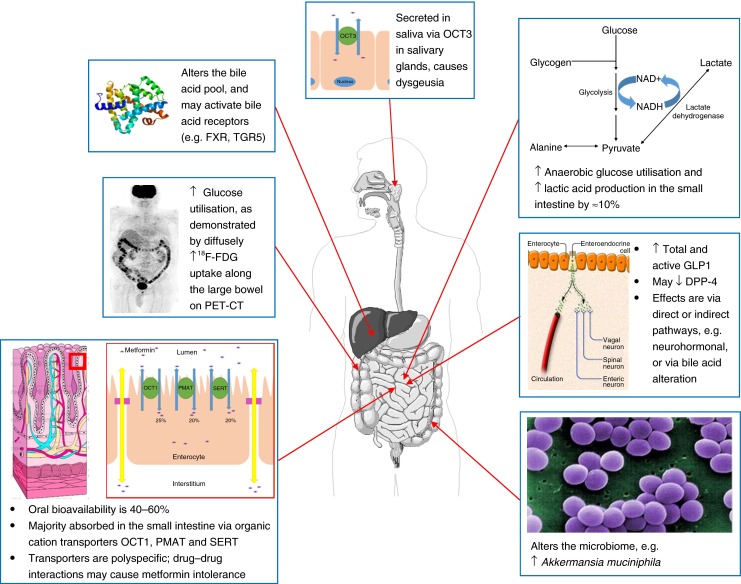
Metformin is an effective agent with a good safety profile that is widely used as a first-line treatment for type 2 diabetes, yet its mechanisms of action and variability in terms of efficacy and side effects remain poorly understood. Although the liver is recognised as a major site of metformin pharmacodynamics, recent evidence also implicates the gut as an important site of action. Metformin has a number of actions within the gut. It increases intestinal glucose uptake and lactate production, increases GLP-1 concentrations and the bile acid pool within the intestine, and alters the microbiome. A novel delayed-release preparation of metformin has recently been shown to improve glycaemic control to a similar extent to immediate-release metformin, but with less systemic exposure. We believe that metformin response and tolerance is intrinsically linked with the gut. This review examines the passage of metformin through the gut, and how this can affect the efficacy of metformin treatment in the individual, and contribute to the side effects associated with metformin intolerance.
Overview
The claims and statistics of this paper haven’t been checked yet.
Free: it reads the open-access text and checks the first 5 claims that cite a source we can check. Create a free account to check every claim.
Integrity signals
Registry
Cites
Statistics
Figures
Verification
Claims the paper makes
The claims and statistics of this paper haven’t been checked yet.
Free: it reads the open-access text and checks the first 5 claims that cite a source we can check. Create a free account to check every claim.
Claims other papers make about this one
Each is checked against this paper’s own text: does it say what the citing paper says it does?
The source backs part of the claim, not all of it — or backs it for a different population, condition or comparison.
In the citing paper
“Most of these minor side effects include gastrointestinal discomfort such as abdominal or stomach pain, early satiety, decreased appetite, and diarrhea, which usually subside after one or two weeks of use (McCreight et al. 2016).”
From Benefits of Metformin in Attenuating the Hallmarks of Aging (2020) · cites this paper as McCreight et al. 2016
Experimental — accuracy not yet measuredIn the citing paper
“As in most drugs, minor side effects occur with metformin, but it is important to understand whether they reveal anything about the mechanism of action of this drug.”
From Benefits of Metformin in Attenuating the Hallmarks of Aging (2020) · cites this paper as McCreight et al. 2016
Self-check
Percentages, sums and reported differences re-computed from the paper’s own numbers.
The self-check needs the paper’s full text.
Citations
Cites
A metagenome-wide association study of gut microbiota in type 2 diabetes
Qin, J., Li, Y., Cai, Z., Li, S., Zhu, J., Zhang, F., Liang, S., Zhang, W., Guan, Y., Shen, D., et al. (2012) · Nature · doi:10.1038/nature11450 · Cited by 6,762 · cited 2×
“Although these two studies differ in terms of the changes they identified, a common finding was a reduction in butyrate-producing bacteria and an increase in opportunistic pathogens [78, 81].”
BackgroundResultCross-talk between Akkermansia muciniphila and intestinal epithelium controls diet-induced obesity
Everard, A., Belzer, C., Geurts, L., Ouwerkerk, J. P., Druart, C., Bindels, L. B., Guiot, Y., Derrien, M., Muccioli, G. G., Delzenne, N. M., et al. (2013) · Proceedings of the National Academy of Sciences · doi:10.1073/pnas.1219451110 · Cited by 4,511 · cited 1×
“…(resulting in an increase in A. muciniphila ) or direct treatment with A. muciniphila has been reported to improve metabolic disorders, possibly by increasing endocannabinoids, which reduce inflammation, modify gut peptide secretion and improve the thickness of the gut mucous barrier [82].”
BackgroundGut metagenome in European women with normal, impaired and diabetic glucose control
Karlsson, F. H., Tremaroli, V., Nookaew, I., Bergström, G., Behre, C. J., Fagerberg, B., Nielsen, J., & Bäckhed, F. (2013) · Nature · doi:10.1038/nature12198 · Cited by 3,115 · cited 1×
“2) [79].”
Inzucchi, S. E., Bergenstal, R. M., Buse, J. B., Diamant, M., Ferrannini, E., Nauck, M., Peters, A. L., Tsapas, A., Wender, R., & Matthews, D. R. (2015) · Diabetes Care · doi:10.2337/dc14-2441 · Cited by 3,066
Disentangling type 2 diabetes and metformin treatment signatures in the human gut microbiota
MetaHIT consortium, Forslund, K., Hildebrand, F., Nielsen, T., Falony, G., Le Chatelier, E., Sunagawa, S., Prifti, E., Vieira-Silva, S., Gudmundsdottir, V., et al. (2015) · Nature · doi:10.1038/nature15766 · Cited by 2,116
TGR5-Mediated Bile Acid Sensing Controls Glucose Homeostasis
Thomas, C., Gioiello, A., Noriega, L., Strehle, A., Oury, J., Rizzo, G., Macchiarulo, A., Yamamoto, H., Mataki, C., Pruzanski, M., et al. (2009) · Cell Metabolism · doi:10.1016/j.cmet.2009.08.001 · Cited by 1,885 · cited 1×
“The increase in the bile acid pool may then stimulate TGR5 bile acid receptors on the L cell [62, 67], causing an increase in GLP-1 secretion via mitochondrial oxidative phosphorylation and calcium influx [67].”
BackgroundMolecular imaging of cancer with positron emission tomography
Gambhir, S. S. (2002) · Nature Reviews Cancer · doi:10.1038/nrc882 · Cited by 1,656 · cited 1×
“PET-CT is commonly used for the diagnosis, staging and monitoring of the response to treatment, of certain cancers [32].”
MethodShin, N.-R., Lee, J.-C., Lee, H.-Y., Kim, M.-S., Whon, T. W., Lee, M.-S., & Bae, J.-W. (2014) · Gut · doi:10.1136/gutjnl-2012-303839 · Cited by 1,550 · cited 2×
“Administration of A. muciniphila to mice receiving a high-fat diet improved glucose tolerance [86], suggesting that the effect of metformin on abundance of this species within in the microbiome may indirectly contribute to the glucose-lowering effect of metformin.”
Background
Cited by
Items 301–400 of 762
Fardous, R. S., Alshmmari, S. K., Tawfik, E. A., Khadra, I., Ramadan, Q., & Zourob, M. M. (2024) · ACS Applied Materials & Interfaces · doi:10.1021/acsami.4c08864 · Cited by 19
Msane, S., Khathi, A., & Sosibo, A. M. (2024) · Nutrients · doi:10.3390/nu16162692 · Cited by 22
“While the liver is the main target organ for metformin action, there is also evidence suggesting involvement of the intestines [84].”
BackgroundAcosta-Cota, S. D. J., Aguilar‐Medina, M., Ramos‐Payán, R., Rendón-Maldonado, J. G., Romero-Quintana, J. G., Montes‐Ávila, J., Sarmiento‐Sánchez, J. I., Plazas‐Guerrero, C. G., Vergara-Jiménez, M. D. J., Sánchez‐López, A., et al. (2019) · European Journal of Pharmacology · doi:10.1016/j.ejphar.2019.172699 · Cited by 19
Rogall, E. T., Jacob, S., Triebskorn, R., & Schwartz, T. (2020) · Environmental Sciences Europe · doi:10.1186/s12302-020-00341-6 · Cited by 20
Mazumdar, S., Marar, T., Patki, J., Devarajan, S., Zambare, V., & Swami, D. (2020) · Clinical Phytoscience · doi:10.1186/s40816-020-00175-y · Cited by 18
Li, Y., Zhao, H., Guo, Y., Duan, Y., Guo, Y., & Ding, X. (2021) · Frontiers in Endocrinology · doi:10.3389/fendo.2021.811776 · Cited by 19
“Furthermore, metformin has a low propensity for hyperlactatemia (27, 28).”
BackgroundAnti-Hyperglycemic Agents in the Adjuvant Treatment of Sepsis: Improving Intestinal Barrier Function
Wang, Y., Li, J., Wang, D., Jin, K., Hui, J., & Xu, H. (2022) · Drug Design Development and Therapy · doi:10.2147/dddt.s360348 · Cited by 18
Metformin delivery via iontophoresis based on κ-carrageenan cryogels
Saramas, T., Sakunpongpitiporn, P., Rotjanasuworapong, K., Morarad, R., Niamlang, S., & Sirivat, A. (2022) · International Journal of Biological Macromolecules · doi:10.1016/j.ijbiomac.2022.11.098 · Cited by 18
Clinical Trial: Probiotics in Metformin Intolerant Patients with Type 2 Diabetes (ProGasMet)
Nabrdalik, K., Drożdż, K., Kwiendacz, H., Skonieczna‐Żydecka, K., Łoniewski, I., Kaczmarczyk, M., Wijata, A. M., Nalepa, J., Holleman, F., Nieuwdorp, M., et al. (2023) · Biomedicine & Pharmacotherapy · doi:10.1016/j.biopha.2023.115650 · Cited by 22
Metformin for preventing the progression of chronic kidney disease
El-Damanawi, R., Stanley, I. K., Staatz, C. E., Pascoe, E. M., Craig, J. C., Johnson, D. W., Mallett, A. J., Hawley, C. M., Milanzi, E., Hiemstra, T. F., et al. (2024) · Cochrane Database of Systematic Reviews · doi:10.1002/14651858.cd013414.pub2 · Cited by 26
Vo, N., Zhang, Q., & Sung, H. (2024) · Journal of Pharmacy & Pharmaceutical Sciences · doi:10.3389/jpps.2024.13062 · Cited by 18
Effects of single-nucleotide polymorphism on the pharmacokinetics and pharmacodynamics of metformin
Li, S., Xu, B., Fan, S., Kang, B., Deng, L., Chen, D., Yang, B., Tang, F., He, Z., Xue, Y., et al. (2022) · Expert Review of Clinical Pharmacology · doi:10.1080/17512433.2022.2118714 · Cited by 19
Yang, T., Guan, Q., Shi, J., Xu, Z., & Geng, Y. (2023) · Biochimica et Biophysica Acta (BBA) - Molecular Basis of Disease · doi:10.1016/j.bbadis.2023.166664 · Cited by 19
Malekpour, K., Hazrati, A., Soudi, S., Roshangar, L., Pourfathollah, A. A., & Ahmadi, M. (2023) · Heliyon · doi:10.1016/j.heliyon.2023.e15489 · Cited by 17
“For this reason, other treatments along with metformin are being developed [13].”
BackgroundLi, J., Li, J., Shan, Z., Yang, W., Liu, J., Tian, H., Zhou, Z., Ji, Q., Weng, J., Jia, W., et al. (2021) · Endocrine Journal · doi:10.1507/endocrj.ej20-0006 · Cited by 16
“The alternation of gut microbi‐ otic flora by metformin might be related to GS in metformin-treated participants [24].”
BackgroundMetformin as a potential antidepressant: Mechanisms and therapeutic insights in depression
Cheng, Y., Yao, Q. Z., Miao, Y., & Guan, W. (2025) · Biochemical Pharmacology · doi:10.1016/j.bcp.2025.116773 · Cited by 16
Yao, L., Wang, Y., Qin, S., Zhu, S., & Wu, L. (2023) · Communications Biology · doi:10.1038/s42003-023-04475-0 · Cited by 16
“Metformin has been consistently suggested to be bene fi cial in promoting longevity and treating metabolic disorders in worms and humans through modulation of gut bacterial metabolism 16,18,45 .”
Kuai, Z., Chao, X., He, Y., & Ren, W. (2023) · Experimental Gerontology · doi:10.1016/j.exger.2023.112331 · Cited by 17
Metformin-regulated glucose flux from the circulation to the intestinal lumen
Sakaguchi, K., Sugawara, K., Hosokawa, Y., Ito, J., Morita, Y., Mizuma, H., Watanabe, Y., Kimura, Y., Aburaya, S., Takahashi, M., et al. (2025) · Communications Medicine · doi:10.1038/s43856-025-00755-4 · Cited by 16
“These fi ndings have prompted many researchers to investigate the intestinal actions of metformin 4 – 8 .”
Bahler, L., Holleman, F., Chan, M. W., Booij, J., Hoekstra, J. B. L., & Verberne, H. J. (2017) · PLoS ONE · doi:10.1371/journal.pone.0176242 · Cited by 16
Mapping of biguanide transporters in human fat cells and their impact on lipolysis
Arner, P., Kulyté, A., Batchelor, K. W., Laurencikiene, J., Livingston, J. N., & Rydén, M. (2018) · Diabetes Obesity and Metabolism · doi:10.1111/dom.13395 · Cited by 16
Jo, W., Kang, K., Chae, S., & Son, W. (2020) · International Journal of Molecular Sciences · doi:10.3390/ijms21041489 · Cited by 16
Guarino, G., Corte, T. D., Strollo, F., & Gentile, S. (2021) · Diabetes & Metabolic Syndrome Clinical Research & Reviews · doi:10.1016/j.dsx.2021.03.032 · Cited by 19
Metformin Inhibits Na+/H+ Exchanger NHE3 Resulting in Intestinal Water Loss
Han, Y., & Yun, C. C. (2022) · Frontiers in Physiology · doi:10.3389/fphys.2022.867244 · Cited by 16
“The mechanism of diarrhea resulting from taking metformin are not clear, but several explanations, including stimulation of secretion serotonin and histamine, malabsorption of bile acids, and bacterial overgrowth have been suggested (McCreight et al., 2016).”
BackgroundZhou, L., Chen, X.-Q., Yu, B., Pan, M.-X., Lu, F. Y., Li, J., Cui, X., Yao, M., & Lu, X. (2022) · Frontiers in Neuroscience · doi:10.3389/fnins.2022.946879 · Cited by 18
Wang, D., Liu, J. Y., Zhong, L., Ding, L., Zhang, Q., Yu, M., Li, M., & Xiao, X. (2022) · Frontiers in Pharmacology · doi:10.3389/fphar.2022.1004617 · Cited by 18
A phase Ib study of everolimus combined with metformin for patients with advanced cancer
Molenaar, R. J., van de Venne, T., Weterman, M. J., Mathôt, R. A. A., Klümpen, H., Richel, D. J., & Wilmink, J. W. (2017) · Investigational New Drugs · doi:10.1007/s10637-017-0478-4 · Cited by 16
Gutiérrez‐Repiso, C., Moreno‐Indias, I., Martín‐Núñez, G. M., Ho‐Plagaro, A., Rodríguez‐Cañete, A., Gonzalo, M., García‐Fuentes, E., & Tinahones, F. J. (2020) · Surgery for Obesity and Related Diseases · doi:10.1016/j.soard.2020.04.008 · Cited by 20
Gülsün, T., Akdağ, Y., Izat, N., Çetin, M., Öner, L., & Şahin, S. (2020) · Pharmaceutical Development and Technology · doi:10.1080/10837450.2020.1772290 · Cited by 17
Metformin‐associated lactic acidosis: M oving towards a new paradigm?
Bicsak, T. A., Walsh, B., & Fineman, M. S. (2017) · Diabetes Obesity and Metabolism · doi:10.1111/dom.12994 · Cited by 18
Improvement of Theaflavins on Glucose and Lipid Metabolism in Diabetes Mellitus
Xu, S., Chen, Y., & Gong, Y. (2024) · Foods · doi:10.3390/foods13111763 · Cited by 18
Langford, B., Evans, M., Haskins‐Coulter, T., O'Connor, M., Cant, H. E. O., Eddowes, L. A., Edmonds, C., & Tank, A. (2019) · Diabetes Obesity and Metabolism · doi:10.1111/dom.13863 · Cited by 15
“Moreover, recent literature in T2DM suggests that 20–30% of patients on metformin experience gastrointestinal AEs, leading to treatment discontinuation in approximately 5% of patients.(45,46) Although the gastrointestinal AE of diarrhoea specifically is a primary safety concern with metformin treatment in T2DM,(47) me…”
BackgroundSolute Carrier Transportome in Chemotherapy-Induced Adverse Drug Reactions
Anderson, J. T., Huang, K. M., Lustberg, M. B., Sparreboom, A., & Hu, S. (2020) · Reviews of physiology, biochemistry and pharmacology · doi:10.1007/112_2020_30 · Cited by 15
Ningrum, V. D. A., Sadewa, A. H., Ikawati, Z., Yuliwulandari, R., Ikhsan, M. R., & Fajriyah, R. (2022) · PLoS ONE · doi:10.1371/journal.pone.0271410 · Cited by 17
“Furthermore, latest studies found that such genetic variation was associated with metformin intolerance in the gastrointestinal tract [13,14].”
BackgroundMetformin-NSAIDs Molecular Salts: A Path towards Enhanced Oral Bioavailability and Stability
Acebedo-Martínez, F. J., Domínguez‐Martín, A., Alarcón-Payer, C., Garcés-Bastida, C., Verdugo‐Escamilla, C., Gómez‐Morales, J., & Choquesillo‐Lazarte, D. (2023) · Pharmaceutics · doi:10.3390/pharmaceutics15020449 · Cited by 15
“Bearing in mind that clinical side effects of metformin were mainly caused by the gastrointestinal accumulation of MTF·HCl due to its extreme solubility [12], the obtention of a less soluble phase might reduce such side effects.”
BackgroundOral Azelaic Acid Ester Decreases Markers of Insulin Resistance in Overweight Human Male Subjects
Streeper, R. T., Louden, C., & Izbicka, E. (2020) · In Vivo · doi:10.21873/invivo.11890 · Cited by 17
Metformin: still the sweet spot for CV protection in diabetes?
Rena, G., Mordi, I. R., & Lang, C. C. (2020) · Current Opinion in Pharmacology · doi:10.1016/j.coph.2020.10.018 · Cited by 16
A critical role for Phocaeicola vulgatus in negatively impacting metformin response in diabetes
Chen, M., Peng, Y., Hu, Y., Kang, Z., Chen, T., Zhang, Y., Chen, X., Li, Q., Yuan, Z., Wu, Y., et al. (2025) · Acta Pharmaceutica Sinica B · doi:10.1016/j.apsb.2025.02.008 · Cited by 15
“Approximately 30% of administered metformin remains unmetabolized in faeces, which leads to noticeable effects on the gut microbiome 34 .”
The effect of different prebiotics on intestinal probiotics in newly diagnosed diabetic patients
Zhang, Y., Yang, L., Wu, Y., He, H., Zeng, Y., An, Z., & Jia, W. (2023) · Food Science & Nutrition · doi:10.1002/fsn3.3709 · Cited by 15
“Multiple studies have demonstrated the potential impact of medications, such as metformin, on the composition of the intestinal microbiota (McCreight et al., 2016 ; Vallianou et al., 2019).”
BackgroundMetformin Effects on SHIP2, AMPKs and Gut Microbiota: Recent Updates on Pharmacology
Shivaprakash, P., Beeraka, N. M., Madhunapantula, S. V., Nikolenko, V. N., & Basalingappa, K. M. (2024) · Current Medicinal Chemistry · doi:10.2174/0109298673289342240213040144 · Cited by 15
Xu, H.-J., Liu, Z., Xu, W., & Zhang, Y. (2024) · Molecules · doi:10.3390/molecules29122791 · Cited by 15
Repurposing of Metabolic Drugs Metformin and Simvastatin as an Emerging Class of Cancer Therapeutics
Maurya, S. K., Chaudhri, S., Kumar, S., & Gupta, S. (2025) · Pharmaceutical Research · doi:10.1007/s11095-024-03811-1 · Cited by 15
Intranasal delivery of metformin using metal–organic framework (MOF)-74-Mg nanocarriers
Yuan, M., Han, Z., Somayaji, Y., Nguyen, N., Hu, H., Madhu, L. N., Attaluri, S., Kodali, M., Yang, Y., Hsu, Y., et al. (2025) · Advanced Composites and Hybrid Materials · doi:10.1007/s42114-025-01227-y · Cited by 16
Zhao, Y., Jiang, L., Li, N., Cao, J., & Pi, J. (2025) · Reproductive Sciences · doi:10.1007/s43032-025-01788-9 · Cited by 14
Rocha, S., Santos, I., Corvo, M. L., Fernandes, E. G. R., & Freitas, M. (2025) · Food & Function · doi:10.1039/d4fo06329e · Cited by 17
Striking a gut–liver balance for the antidiabetic effects of metformin
Barroso, E., Montori-Grau, M., Wahli, W., Palomer, X., & Vázquez‐Carrera, M. (2023) · Trends in Pharmacological Sciences · doi:10.1016/j.tips.2023.04.004 · Cited by 15
“Metformin increases intestinal glucose uptake and utilization and establishes a potent gut – liver crosstalk Metformin increases glucose uptake and utilization in the human small intestine and colon [40 – 42] (Table 1).”
BackgroundInfluentialLee, J., An, S., Jung, J. H., Kim, K., Kim, J. E., An, I., & Bae, S. (2019) · International Journal of Oncology · doi:10.3892/ijo.2019.4730 · Cited by 16
Carr, R. D., & Solomon, A. (2020) · Diabetic Medicine · doi:10.1111/dme.14325 · Cited by 14
Meyers, A. G., Hudson, J., Cravalho, C. K. L., Matta, S. T., VILLALOBOS-PEREZ, A., Cogen, F. R., & Chung, S. T. (2020) · Pediatric Diabetes · doi:10.1111/pedi.13148 · Cited by 16
García-Mena, J., Corona-Cervantes, K., Cuervo-Zanatta, D., Benítez-Guerrero, T., Vélez-Ixta, J. M., Zavala-Torres, N. G., Villalobos-Flores, L. E., Hernández-Quiroz, F., Perez‐Cruz, C., Murugesan, S., et al. (2021) · World Journal of Gastroenterology · doi:10.3748/wjg.v27.i41.7065 · Cited by 14
Yang, Q., Wang, G., Fang, D., Gao, X., Yu, L., Wang, L., Wu, J., Zeng, M., & Luo, M. (2022) · Biomedicine & Pharmacotherapy · doi:10.1016/j.biopha.2022.113130 · Cited by 14
Metformin: clinical topics and new mechanisms of action
Fujita, Y., & Inagaki, N. (2016) · Diabetology International · doi:10.1007/s13340-016-0300-0 · Cited by 14
“Metformin performs a number of actions within the gut [14].”
Metformin—Pharmacokinetic and Pharmacodynamics Journey Through the Body
Lewis, A., Williams, K., & Oroszi, T. L. (2024) · Pharmacology & Pharmacy · doi:10.4236/pp.2024.1512025 · Cited by 15
Low-dose metformin requires brain Rap1 for its antidiabetic action
Lin, H., Lu, W., He, Y., Fu, Y., Kaneko, K., Huang, P., la Puente-Gomez, A. B. D., Wang, C., Yang, Y., Li, F., et al. (2025) · Science Advances · doi:10.1126/sciadv.adu3700 · Cited by 13
Schreuder, N., Klarenbeek, H., Vendel, B. N., Jager, P. L., Kosterink, J. G. W., & van Puijenbroek, E. (2020) · Annals of Nuclear Medicine · doi:10.1007/s12149-020-01509-z · Cited by 13
Htet, T. D., Godneva, A., Liu, Z., Chalmers, E., Kolobkov, D. S., SNAITH, J. R., Richens, R., Toth, K., Danta, M., Hng, T., et al. (2020) · BMJ Open · doi:10.1136/bmjopen-2020-037859 · Cited by 14
“Hence, with an estimated dropout rate of 20%, we aim to enrol 132 individuals to each arm, totalling 264 individuals in the study.”
Yang, X., Wang, Y., Tang, X.-Q., Wei, J., Yu, X., Kang, J., Xi, Y., & Xue, X. (2023) · Journal of Functional Foods · doi:10.1016/j.jff.2023.105661 · Cited by 13
Geng, Y., Wang, Z., Xu, X., Sun, X., Dong, X., Luo, Y., & Sun, X. (2023) · Translational research · doi:10.1016/j.trsl.2023.08.001 · Cited by 17
Nguyen, T., Gong, M., Wen, S., Yuan, X., Wang, C., Jin, J., & Zhou, L. (2020) · Journal of Diabetes Research · doi:10.1155/2020/4727390 · Cited by 15
“The absorption of metformin is a transporter-dependent process that mainly occurs in the small intestine [9].”
BackgroundBonea, M., Filip, G. A., Toma, V. A., Bâldea, I., Sevastre-Berghian, A., Decea, N., Olteanu, D. E., Moldovan, R., Crivii, C. B., Vinași, R. C., et al. (2020) · Journal of Molecular Neuroscience · doi:10.1007/s12031-020-01593-w · Cited by 14
SNAITH, J. R., Samocha‐Bonet, D., Evans, J., Liu, Z., Kowalski, G. M., Bruce, C. R., Holmes-Walker, D. J., & Greenfield, J. R. (2021) · Diabetic Medicine · doi:10.1111/dme.14564 · Cited by 13
Pilmark, N. S., Oberholzer, L., Halling, J. F., Kristensen, J. M., Petersen-Bønding, C., Elkjær, I., Lyngbæk, M. P. P., Legaard, G. E., Siebenmann, C., Holm, N. F. R., et al. (2021) · Applied Physiology, Nutrition, and Metabolism · doi:10.1139/apnm-2021-0194 · Cited by 14
“…increasing evidence points towards the gut being important for the metformin effects on glucose metabolism (Bailey et al. 1994; Buse et al. 2016; McCreight et al. 2016; Wu et al. 2017), and we have previously suggested that a potential interaction between metformin and physical activity may be…”
BackgroundJones, M., Ionescu, C. M., Walker, D., Wagle, S. R., Kovačević, B., Chester, J., Foster, T., Johnston, E., Kuthubutheen, J., Brown, D. J., et al. (2022) · International Journal of Molecular Sciences · doi:10.3390/ijms23020836 · Cited by 15
“Metformin activates AMP-K, hence metformin’s impact on the BAs in the intestines and subsequent glucose-lowering effects [49,93,94].”
BackgroundPopulation pharmacokinetic of paracetamol and atorvastatin with co‐administration of semaglutide
Langeskov, E. K., & Kristensen, K. (2022) · Pharmacology Research & Perspectives · doi:10.1002/prp2.962 · Cited by 12
Fu, J., Zhang, Y., Cai, X., & Huang, Y. (2024) · Endocrine Practice · doi:10.1016/j.eprac.2024.07.014 · Cited by 15
Binsaleh, A. Y., El-Haggar, S. M., Hegazy, S. K., Maher, M., Bahgat, M. M., El-Masry, T. A., Alrubia, S., Alsegiani, A. S., Eldesoqui, M. B., & Bahaa, M. M. (2025) · Frontiers in Pharmacology · doi:10.3389/fphar.2025.1507009 · Cited by 12
Metformin Modifies the Gut Microbiota of Mice Infected with Helicobacter pylori
Jauvain, M., Courtois, S., Lehours, P., & Bessède, E. (2021) · Pharmaceuticals · doi:10.3390/ph14040329 · Cited by 12
“Metformin can also indirectly modify the microbiota by acting on host physiology; for example, metformin increases the bile acid pool within the intestine [25], which may affect stool consistency and the microbiome [26].”
BackgroundAbuEid, M., Keyes, R. F., McAllister, D. M., Peterson, F. C., Kadamberi, I. P., Sprague, D. J., Chaluvally–Raghavan, P., Smith, B. C., & Dwinell, M. B. (2022) · iScience · doi:10.1016/j.isci.2022.105670 · Cited by 13
“A caveat to that interpretation is that metformin is not metabolized and is instead excreted as an intact molecule in the urine.(41) While reports suggest metformin has a half-life of 5 h, the compound is poorly absorbed, with large inter-individual variability in pharmacokinetics.”
BackgroundZhang, R., Feng, C., Luo, D., Zhao, R., Kannan, P. R., Yin, Y., Iqbal, M. Z., Hu, Y., & Kong, X. (2023) · Pharmaceuticals · doi:10.3390/ph16091279 · Cited by 12
“It is indicated that metformin hydrochloride not only plays a role in liver function but also in intestinal function [15], and its uptake in the intestinal epithelial cells is mediated by OCTs [16].”
BackgroundMorrice, N., Vainio, S., Mikkola, K., van Aalten, L., Gallagher, J. R., Ashford, M. L. J., McNeilly, A. D., McCrimmon, R. J., Grosfeld, A., Serradas, P., et al. (2023) · Molecular Metabolism · doi:10.1016/j.molmet.2023.101807 · Cited by 16
“The gut is increasingly recognised as a major site of action for metformin [33].”
BackgroundSelf-citationBrīvība, M., Silamiķele, L., Kalniņa, I., Silamiķelis, I., Birzniece, L., Ansone, L., Jagare, L., Elbere, I., & Kloviņš, J. (2023) · Frontiers in Endocrinology · doi:10.3389/fendo.2023.1232143 · Cited by 13
“…of the drug ranging from anti-aging properties (5) to anti-in fl ammatory effects (6) and recognition of the gastrointestinal tract as one of the main sites of action of the drug with a signi fi cant contribution of gut microbiota yet with no persuasive underlying mechanism clari fi ed so far (7).”
BackgroundMethodRen, Z., Xu, X., & Yue, R. (2023) · Patient Preference and Adherence · doi:10.2147/ppa.s437267 · Cited by 12
“31,32 However, current evidence supports the efficacy of metformin in reducing blood glucose levels, improving insulin resistance, and promoting weight loss in the early treatment of diabetes.”
BackgroundOut, M., Miedema, I., Jager‐Wittenaar, H., van der Schans, C. P., Krijnen, W. P., Lehert, P., Stehouwer, C. D. A., & Kooy, A. (2017) · Diabetes Obesity and Metabolism · doi:10.1111/dom.13054 · Cited by 12
“Metformin may cause malabsorption of nutrients, possibly through reducing ileal bile salt reabsorption.(12) To what extent this may affect weight development remains to be established.”
BackgroundAcute Complications of Diabetes
Orban, J., OBBERGHEN, E. V., & Ichaï, C. (2017) · Springer eBooks · doi:10.1007/978-3-319-64010-5_15 · Cited by 15
Linagliptin safety profile: A systematic review
Gomes, G. K. A., Ramos, A. I. D. C., Sousa, C. T., Sanches, C., Pereira, M. L., & Baldoni, A. O. (2018) · Primary care diabetes · doi:10.1016/j.pcd.2018.04.006 · Cited by 12
Yi, L., Zhang, H., Zhang, J., You, X., Ning, Z., Yu, J., Qian, L., & Miao, L. (2019) · Clinical Pharmacology in Drug Development · doi:10.1002/cpdd.668 · Cited by 12
Yandrapalli, S., Jolly, G. P., Horblitt, A. M., Pemmasani, G., Sanaani, A., Aronow, W. S., & Frishman, W. H. (2020) · Cardiology in Review · doi:10.1097/crd.0000000000000308 · Cited by 15
Qi, Q., Chen, Y., Li, Y., Wei, J., Zhou, X., Le, F., Hu, H., & Chen, T. (2021) · Frontiers in Cellular and Infection Microbiology · doi:10.3389/fcimb.2021.719542 · Cited by 12
Mooranian, A., Carey, L., Ionescu, C. M., Walker, D., Jones, M., Wagle, S. R., Kovačević, B., Foster, T., Chester, J., Johnston, E., et al. (2021) · Pharmaceutics · doi:10.3390/pharmaceutics13101667 · Cited by 12
“Modified release formulations have been developed to try and reduce these impacts but have shown no reduction in side effects [57,58].”
BackgroundInfluence of modern antidiabetic therapy on body weight in patients with type 2 diabetes mellitus
Салухов, В. В., Ilyinskaya, Т. A., & Minakov, A. A. (2022) · Endocrinology News Opinions Training · doi:10.33029/2304-9529-2022-11-1-39-52 · Cited by 14
Sun, M., Liu, C., Bai, H., Wei, Y., Zhang, W., Liu, H., Li, Y.-J., Liu, L., Wang, Y., Tong, Y.-X., et al. (2022) · Annals of Medicine · doi:10.1080/07853890.2022.2125574 · Cited by 12
The safety of empagliflozin plus metformin for the treatment of type 2 diabetes
Scheen, A. J. (2018) · Expert Opinion on Drug Safety · doi:10.1080/14740338.2018.1497159 · Cited by 14
Metformin inhibits nuclear egress of chromatin fragments in senescence and aging
Kumazawa, T., Xu, Y., Wang, Y., Lee, J.-W., O’Brien, T. C., Ho, C., Çetinbaş, M., Weiner, A. I., Hochedlinger, K., Sadreyev, R. I., et al. (2026) · Nature Aging · doi:10.1038/s43587-025-01048-0 · Cited by 16
“Given that the intestine is a major target of metformin 40,41 , we focused on this organ to study the effects of metformin on the CCF–cGAS–STING pathway.”
Amino acid homeostasis is a target of metformin therapy
Forteath, C., Mordi, I. R., Nisr, R. B., Gutierrez-Lara, E. J., Alqurashi, N., Phair, I. R., Cameron, A., Beall, C., Bahr, I., Mohan, M., et al. (2023) · Molecular Metabolism · doi:10.1016/j.molmet.2023.101750 · Cited by 13
“Indeed, the highest concentrations of metformin observed in vivo are in the gut and there is evidence that this might be a major locus of action of the drug [23,24].”
BackgroundTel, B. M. A., Aktaş, G., Bilgin, S., Baltaci, S. B., & Duman, T. T. (2023) · Diagnostics · doi:10.3390/diagnostics13223433 · Cited by 12
Repurposing Metformin for the Treatment of Atrial Fibrillation: Current Insights
Sarkar, A., Fanous, K., Marei, I., Ding, H., Ladjimi, M. M., MacDonald, R. S., Hollenberg, M. D., Anderson, T. J., Hill, M. A., & Triggle, C. R. (2024) · Vascular Health and Risk Management · doi:10.2147/vhrm.s391808 · Cited by 11
“109 AMPK plays a key role in the regulation of endothelial-vascular smooth muscle function and the regulation of blood flow.”
BackgroundMetformin Indications, Dosage, Adverse Reactions, and Contraindications
Stoica, R. A., Ștefan, D. S., Rizzo, M., Suceveanu, A., Suceveanu, A. P., Serafinceanu, C., & Stoian, A. P. (2020) · IntechOpen eBooks · doi:10.5772/intechopen.88675 · Cited by 17
“Gastrointestinal side effects include diarrhea, nausea, meteorism, and constipation and affect approximately 20% of the patients [71, 72].”
BackgroundSOKOLOVA, L. K., Belchina, Y. B., PUSHKAREV, V. V., Cherviakova, S. A., Вацеба, Т. С., Ковзун, О. І., Pushkarev, V. M., & Tronko, M. D. (2021) · INTERNATIONAL JOURNAL OF ENDOCRINOLOGY (Ukraine) · doi:10.22141/2224-0721.16.8.2020.222882 · Cited by 11
“metabolism of bile acids and on the microbiome [7, 26, 27].”
BackgroundXiao, D., Liu, J., Zhang, S., Liu, R., Yin, J., Han, X., Li, X., Zhang, W., Chen, X., Zhou, H., et al. (2021) · Pharmacogenomics and Personalized Medicine · doi:10.2147/pgpm.s305020 · Cited by 11
Goon, D. E., Rahim, S. A., Sakri, A. H. M., Mazlan, M., Tan, J. K., Aziz, M. A., Noor, N. M., Ibrahim, E., & Kadir, S. H. S. A. (2021) · Scientific Reports · doi:10.1038/s41598-021-00454-9 · Cited by 13
Bidirectional pharmacokinetic drug interactions between olaparib and metformin
Stanisławiak‐Rudowicz, J., Karbownik, A., Szkutnik-Fiedler, D., Otto, F., Grabowski, T., Wolc, A., Grześkowiak, E., & Szałek, E. (2023) · Cancer Chemotherapy and Pharmacology · doi:10.1007/s00280-023-04591-y · Cited by 11
“According to some researchers, the weakening of the OCT1 function or the reduction of drug transport through OCT1 may result in gastrointestinal intolerance due to increased metformin concentration in the intestine [31, 32].”
BackgroundThe stress polarity pathway: AMPK 'GIV'-es protection against metabolic insults
Ghosh, P. (2017) · Aging · doi:10.18632/aging.101179 · Cited by 12
“These studies have challenged the conventional thinking and the importance of the gut barrier as the primary defect in metabolic diseases has gained traction [83-85].”
BackgroundZhang, B., Xu, K., Deng, W., Liu, C., Xu, Q., Sheng, H., Feng, J., & Yuan, Q. (2024) · Food Chemistry · doi:10.1016/j.foodchem.2024.142558 · Cited by 11
Zhang, Y., Wang, A., Zhao, W., Qin, J., Zhang, Y., Liu, B., Yao, C., Long, J., Yuan, M., & Yan, D. (2025) · Gut Microbes · doi:10.1080/19490976.2025.2450871 · Cited by 15
SNAITH, J. R., Olsen, N., Evans, J., Kowalski, G. M., Bruce, C. R., Samocha‐Bonet, D., Breit, S. N., Holmes-Walker, D. J., & Greenfield, J. R. (2025) · Nature Communications · doi:10.1038/s41467-025-65951-1 · Cited by 10
“…evidence for an interaction between metformin and the gut, a phenomena that is clearly apparent in metformin exposed individuals that exhibit increased colonic and small intestinal glucose tracer uptake when undergoing fl uoro-deoxyglucose (FDG)-positron emission topography (PET) imaging 21 – 23 .”
Metformin: Antidiabetic actions from cells to tissues
Bailey, C. J., Gwilt, M., & Brand, K. M. G. (2026) · Metabolism · doi:10.1016/j.metabol.2026.156589 · Cited by 10
Self-citationLi, A. P. Z., & Kariyawasam, D. (2021) · Elsevier eBooks · doi:10.1016/b978-0-12-820472-6.00098-0 · Cited by 11
Xu, J., Zhu, Q.-L., Bi, Y.-M., & Peng, Y. (2024) · BMC Cancer · doi:10.1186/s12885-024-12453-w · Cited by 11
“Metformin is recognized for inducing gastrointestinal side effects, including nausea, diarrhea, and abdominal discomfort, affecting 20–30% of the general population, notably during initial dose adjustment [68, 69].”
BackgroundRadioprotective effect of the anti-diabetic drug metformin
Siteni, S., Barron, S., Luitel, K., & Shay, J. W. (2024) · PLoS ONE · doi:10.1371/journal.pone.0307598 · Cited by 11
Zhang, C., Ji, Z., Xu, N., Yuan, J., Zeng, W., Wang, Y., He, Q., Dong, J., Zhang, X., Yang, D., et al. (2024) · Scientific Reports · doi:10.1038/s41598-024-73642-y · Cited by 13
“However, serious side effects, including hypoglycemia 4 , lactic acidosis 5 , and gastrointestinal damage 6 are inevitable with prolonged administration of hypoglycemic agents.”
Background
Metadata
- Authors
- McCreight, L. J., Bailey, C. J., & Pearson, E. R.
- Affiliations
- University of Dundee (GB)
- Aston University (GB)
- Corresponding author
- Pearson, Ewan R.
- Venue
- Diabetologia
- Published
- 2016-01-16
- Volume
- 59
- Issue
- 3
- Pages
- 426-435
- ISSN
- 0012-186X (ISSN-L)
- 1432-0428
- PMC
- PMC4742508
- OpenAlex
- W2255443535
- Cited by
- 733
- References
- 89
- Citations by year
- 2026: 53 · 2025: 75 · 2024: 83 · 2023: 97 · 2022: 73 · 2021: 79 · 2020: 88 · 2019: 48 · 2018: 62 · 2017: 50 · 2016: 25
- FWCI
- 9.08
- Type
- journal article
- Language
- en
- Open access
- hybrid
- doi.org
- Locations
- Diabetologia (publishedVersion, cc-by)
- PubMed Central (publishedVersion, cc-by)
- PubMed (publishedVersion)
- Aston Publications Explorer (Aston University) (acceptedVersion)
- Discovery Research Portal (University of Dundee) (submittedVersion, cc-by)
- Funders
- Wellcome Trust (102820/Z/13/Z, 102820)
- Topics
- Health Sciences › Medicine › Endocrinology, Diabetes and Metabolism › Diabetes Treatment and Management
- Life Sciences › Biochemistry, Genetics and Molecular Biology › Molecular Biology › Metabolism, Diabetes, and Cancer
- Health Sciences › Medicine › Gastroenterology › Gastrointestinal motility and disorders
- Keywords
- metformin, gastrointestinal tract, type 2 diabetes, intestinal glucose absorption, lactic acid production, glucagon-like peptide-1, bile acids, gut microbiota, metformin intolerance, adverse drug reactions, glycemic control
- MeSH terms
- Humans, Metformin, Gastrointestinal Tract, Glucagon-Like Peptide 1, Microbiota
About these checks
Registry, retraction, Cites and statistics results are computed, not judged, with one exception: a printed reference that no index lists is read once by a model before it counts as a citation error. Claims are extracted by a model and kept only when their quote appears verbatim in the text; each cited source is then checked, with a model’s help, for whether it says what the claim relies on. Those verdicts can be wrong — read the claim’s quote and the cited source before relying on one.
Statistics and arithmetic are recomputed, not judged.
Confidence bands are shown only for fields calibrated on our annotated test set. None is calibrated yet, so no band is shown.
What counts as a claim ›How we measure confidence ›How we check this ›
Are you an author, or do you see a problem with this page? Request a review
Data sources
Bibliographic data: Semantic Scholar, OpenAlex, Crossref.
Contains information from the Semantic Scholar Academic Graph Datasets, made available under the ODC Attribution License (ODC-BY 1.0).
Semantic Scholar’s data is described in: Kinney, R., et al. (2023). The Semantic Scholar Open Data Platform. arXiv:2301.10140.
