

Interference of Aspergillus fumigatus with the immune response
Open accessThe DOI matches its Crossref record; 134 of the 134 references it cites were found in a registry or an index.
Abstract
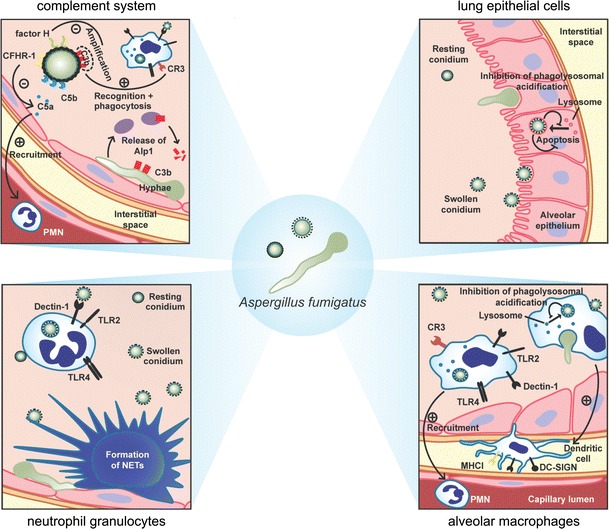
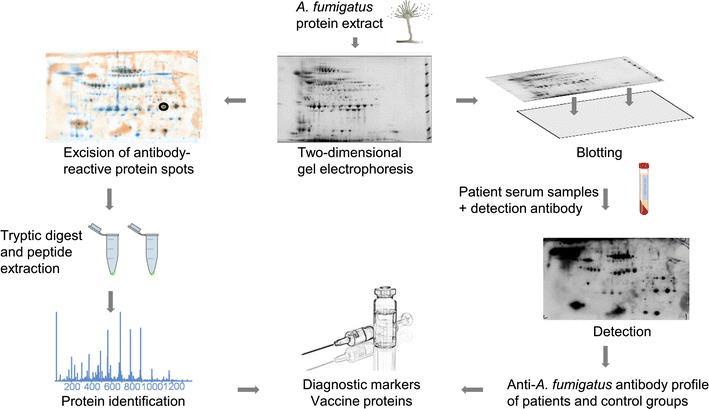
Aspergillus fumigatus is a saprotrophic filamentous fungus and also the most prevalent airborne fungal pathogen of humans. Depending on the host's immune status, the variety of diseases caused by A. fumigatus ranges from allergies in immunocompetent hosts to life-threatening invasive infections in patients with impaired immunity. In contrast to the majority of other Aspergillus species, which are in most cases nonpathogenic, A. fumigatus features an armory of virulence determinants to establish an infection. For example, A. fumigatus is able to evade the human complement system by binding or degrading complement regulators. Furthermore, the fungus interferes with lung epithelial cells, alveolar macrophages, and neutrophil granulocytes to prevent killing by these immune cells. This chapter summarizes the different strategies of A. fumigatus to manipulate the immune response. We also discuss the potential impact of recent advances in immunoproteomics to improve diagnosis and therapy of an A. fumigatus infection.
Overview
The claims and statistics of this paper haven’t been checked yet.
Free: it reads the open-access text and checks the first 5 claims that cite a source we can check. Create a free account to check every claim.
Integrity signals
Registry
Cites
Statistics
Figures
Verification
Claims the paper makes
The claims and statistics of this paper haven’t been checked yet.
Free: it reads the open-access text and checks the first 5 claims that cite a source we can check. Create a free account to check every claim.
Claims other papers make about this one
Each is checked against this paper’s own text: does it say what the citing paper says it does?
The cited source says what the claim attributes to it.
In the citing paper
“Firstly, A. fumigatus can survive within phagocytes [189, 190].”
From Mechanisms of fungal dissemination (2021) · cites this paper as [189]
Self-check
Percentages, sums and reported differences re-computed from the paper’s own numbers.
The self-check needs the paper’s full text.
Citations
Cites
Neutrophil Extracellular Traps Kill Bacteria
Brinkmann, V., Reichard, U., Goosmann, C., Fauler, B., Uhlemann, Y., Weiss, D. S., Weinrauch, Y., & Zychlinsky, A. (2004) · Science · doi:10.1126/science.1092385 · Cited by 10,268
Meijer, L., Nelson, D. J., Riazanski, V., Gabdoulkhakova, A. G., Hery-Arnaud, G., Le Berre, R., Loaëc, N., Oumata, N., Galons, H., Nowak, E., et al. (2016) · Journal of Innate Immunity · doi:10.1159/000444256 · Cited by 4,992
Hidden Killers: Human Fungal Infections
Brown, G. D., Denning, D. W., Gow, N. A. R., Levitz, S. M., Netea, M. G., & White, T. C. (2012) · Science Translational Medicine · doi:10.1126/scitranslmed.3004404 · Cited by 4,284 · cited 1×
“, in chemotherapy and organ or bone marrow transplantation, contributes to the steadily increasing number of patients with impaired immune status [1].”
BackgroundCalamita, E., Schmid, M., Kunz, M., Ndebele-Murisa, M. R., Magadza, C. H. D., Nyambe, I., & Wehrli, B. (2019) · Figshare · doi:10.26181/6153922fe919c · Cited by 4,222
Complement: a key system for immune surveillance and homeostasis
Ricklin, D., Hajishengallis, G., Yang, K., & Lambris, J. D. (2010) · Nature Immunology · doi:10.1038/ni.1923 · Cited by 3,654 · cited 3×
“Moreover, the complement system provides a platform for the cross-talk between innate and humoral circuits via the interaction of complement activation products and surface receptors resulting in governing both T and B cell responses [87].”
BackgroundInfluentialNovel cell death program leads to neutrophil extracellular traps
Fuchs, T. A., Abed, U., Goosmann, C., Hurwitz, R., Schulze, I., Wahn, V., Weinrauch, Y., Brinkmann, V., & Zychlinsky, A. (2007) · The Journal of Cell Biology · doi:10.1083/jcb.200606027 · Cited by 3,197
Aspergillus fumigatus and Aspergillosis
Latgé, J.-P. (1999) · Clinical Microbiology Reviews · doi:10.1128/cmr.12.2.310 · Cited by 2,307 · cited 1×
“Accordingly, neutropenic patients face the highest risk to develop an invasive aspergillosis [50].”
BackgroundNeutrophil elastase and myeloperoxidase regulate the formation of neutrophil extracellular traps
Papayannopoulos, V., Metzler, K. D., Hakkim, A., & Zychlinsky, A. (2010) · Journal of Cell Biology · doi:10.1083/jcb.201006052 · Cited by 2,103 · cited 4×
“Primary or azurophilic granules contain myeloperoxidase (MPO), lysozyme, and antimicrobial proteins like cathepsin G, elastase, and proteinase 3.”
BackgroundInfluentialMedzhitov, R., & Janeway, C. (2000) · New England Journal of Medicine · doi:10.1056/nejm200008033430506 · Cited by 1,825
Segal, A. W. (2005) · Annual Review of Immunology · doi:10.1146/annurev.immunol.23.021704.115653 · Cited by 1,789 · cited 1×
“Tertiary granules contain gelatinase [57, 58].”
Cited by
Items 101–129 of 129
Karasenko, A. Y. (2022) · Науковий вісник Львівського національного університету ветеринарної медицини та біотехнологій імені С.З. Ґжицького · doi:10.32718/nvlvet10706 · Cited by 2
Fageräng, B., Lau, C., Ekholt, K., Schjalm, C., Christiansen, D., Garred, P., Nilsson, P. H., & Mollnes, T. E. (2023) · Journal of Leukocyte Biology · doi:10.1093/jleuko/qiad151 · Cited by 6
Fageräng, B., Götz, M. P., Cyranka, L., Lau, C., Nilsson, P. H., Mollnes, T. E., & Garred, P. (2024) · Journal of Innate Immunity · doi:10.1159/000539368 · Cited by 2
“Prior studies have revealed that alveolar macrophages, epithelial cells, dendritic cells, and incoming granulocytes are pivotal in managing and eradicating A. fumigatus infection [9].”
Tian, X., Ji, X., Zhang, R., Long, X., Lin, J., Zhang, Y., Zhan, L., Luan, J., Zhao, G., & Peng, X. (2024) · Journal of Biomaterials Applications · doi:10.1177/08853282241280844 · Cited by 2
“25,26 In the course of treatment, the rapid resolution of in-fl ammation in the process of in fl ammation is the key to the treatment of FK. 29 Moreover, because of the excellent biodegradability and biocompatibility, BSP has wide applications in the fi eld of medicine and biomedical materials.”
González, K., Gangapurwala, G., Alex, J., Vollrath, A., Cseresnyés, Z., Weber, C., Czaplewska, J. A., Hoeppener, S., Svensson, C., Orasch, T., et al. (2022) · Applied Microbiology and Biotechnology · doi:10.1007/s00253-022-12287-1 · Cited by 2
Self-citationShen, W., Wang, M., Han, T., Yao, Y., Ying, X., Cui, Y., & Du, P. (2025) · Current Microbiology · doi:10.1007/s00284-025-04487-5 · Cited by 1
“These phagocytes utilize PRRs to identify various polysaccharide components present on the fungal cell wall, thereby facilitating phagocytosis [4, 38, 39].”
Luan, J., Lu, Y., Wang, Q., Li, C., Peng, X., Zheng, H., Zhang, S., Zhao, G., & Lin, J. (2025) · Experimental Eye Research · doi:10.1016/j.exer.2025.110744 · Cited by 1
Niu, Y., Wang, Q. L., Lin, H., Gu, L., Lin, J., & Zhao, G. (2026) · International Immunopharmacology · doi:10.1016/j.intimp.2026.117077 · Cited by 1
Hazar, A. F. (2018) · Southern Clinics of Istanbul Eurasia · doi:10.14744/scie.2018.92486 · Cited by 1
Extracellular Proteins and Their Roles in Aspergillus fumigatus Pathogenesis
Jia, L., & Brakhage, A. A. (2024) · The mycota · doi:10.1007/978-3-031-64853-3_4 · Cited by 1
Self-citationFernandes, R. B. (2019) · Digital Library of Theses and Dissertations (Universidade de São Paulo) · doi:10.11606/t.41.2019.tde-04062019-085223
Curvularia lunata interakciójának vizsgálata a természetes immunválasz sejtjeivel
Tóth, E. J. (2019) · SZTE Repository of Dissertations (University of Szeged) · doi:10.14232/phd.10223
Conrad, T. (2020) · Common Library Network (Der Gemeinsame Bibliotheksverbund) · doi:10.22032/dbt.41347
PLB-985 neutrophil-like cells as a model to study Aspergillus fumigatus pathogenesisPreprint
Rafiq, M., Rivieccio, F., Zimmermann, A.-K., Visser, C., Bruch, A., Krüger, T., Rojas, K. G., Kniemeyer, O., Blango, M. G., & Brakhage, A. A. (2021) · bioRxiv (Cold Spring Harbor Laboratory) · doi:10.1101/2021.07.28.454178
“153 The interference of the acidification pathway in alveolar macrophages by fungal DHN-melanin occurs 154 through the inhibition of V-ATPase assembly (24, 25).”
BackgroundSelf-citationYu, J., & Park, H.-S. (2018) · Faculty Opinions – Post-Publication Peer Review of the Biomedical Literature · doi:10.3410/f.734151230.793552591
Aspergilose broncopulmonar alérgica
Abreu, D. B., Silva, D., & Plácido, J. L. (2022) · Revista Portuguesa de Imunoalergologia · doi:10.32932/rpia.2022.06.080 · Cited by 4
Roles of Host Phospholipase D during Aspergillus fumigatus Infection in Mice
Chen, F., Liu, X., Zhao, R., Zhao, J., Li, D., & Han, L. (2023) · Zoonoses · doi:10.15212/zoonoses-2022-0044
Valero, C., Pinzan, C. F., de Castro, P. A., van Rhijn, N., Earle, K., Liu, H., Horta, M. A. C., Kniemeyer, O., Krüger, T., Pschibul, A., et al. (2023) · bioRxiv (Cold Spring Harbor Laboratory) · doi:10.1101/2023.08.22.553365
Self-citationWang, M., Hu, Y., Cai, F., Qiu, J., Mao, Y., & Zhang, Y. (2024) · Experimental and Therapeutic Medicine · doi:10.3892/etm.2024.12375
Enzymes conferring virulence traits among human pathogenic fungi
Kumari, A., Tripathi, A. H., Upadhyay, S. K., Gupta, T. M., & Prakash, P. Y. (2024) · Elsevier eBooks · doi:10.1016/b978-0-443-22072-2.00001-2 · Cited by 1
The Role of Pterocarpus in Aspergillus fumigatus Keratitis in Mice
刘, 婧. (2025) · Advances in Clinical Medicine · doi:10.12677/acm.2025.1541100
贺, 铜. (2025) · Advances in Clinical Medicine · doi:10.12677/acm.2025.1541268
“…keratitis, FK) 是一种由致病真菌侵袭角膜引起的眼部感染性疾病 [1] 。由于激 素的过度使用、角膜接触镜使用不当、植物性眼外伤等因素,真菌性角膜炎的发病率不断上升 [2]-[5] 。真 菌感染后,宿主为抵御真菌的侵袭启动防御机制,释放炎症因子,炎症因子的过度释放又加重组织损伤 [6] 。目前临床应用的一线抗真菌药物那他霉素,不但在药物稳定性、毒性以及耐药性等方面均存在较大 局限性,而且有促炎作用 [7] [8] ,因此在抗真菌的同时进行抗炎治疗也对烟曲霉菌角膜炎的愈后具有十分 重要的意义。 Progranulin (PGRN)…”
Calero, A. L. (2023) · Institutional Repository of the University of Granada (University of Granada)
Selevestru, R., Lungu, M., Dorosevici, N., Marina, A., Ceban, A., Conica, C., Şciuca, S. S., & Щука, С. (2023)
Cathepsin B-Cleavable Voriconazole Macromolecular Prodrugs for Intracellular Release
Alex, J., González, K., Haendel, M., Roesner, N. C., Stroe, M. C., Rosin, M., Bellstedt, P., Schlörer, N. E., Weber, C., Dietz, S., et al. (2026) · Biomacromolecules · doi:10.1021/acs.biomac.6c01503
Self-citationSystemic Aspergillosis in Dogs: A Historical and Current State-of-the-Art Review
Bordoni, T., Dini, F. M., & Galuppi, R. (2026) · Veterinary Sciences · doi:10.3390/vetsci13010048 · Cited by 1
“Aspergillus fumigatus , in fact, can survive inside these phagocytes [75,76].”
Parveen, A., Karak, P., Adhikari, A., & Das, S. K. (2026) · Frontiers in Molecular Biosciences · doi:10.3389/fmolb.2026.1829493
“This interactional framing is useful because it separates mechanisms that sustain colonization in structurally abnormal niches from those that enable deeper tissue penetration and vascular invasion in high-risk hosts (Figure 2) (Heinekamp et al., 2014).”
Kaur, S., Renner, A. K., Porschitz, P., Schmidt, F., Grau, S., Afolayan, H., Schmidt, S., Lehrnbecher, T., Haas, H., Brakhage, A. A., et al. (2026) · microLife · doi:10.1093/femsml/uqag034
“Although macrophages already possess a large repertoire of antifungal activities (Heinekamp et al. 2015 , Wang et al. 2023 ), it is also true that conidia employ several strategies to escape the macrophage’s antifungal activity (Jia et al. 2024 ) which underlines the necessity of recruitment of…”
Self-citationSöhnlein, J., Schäuble, S., Prada, J. P., Abboud, Z., Sheta, D., Hünniger-Ast, K., Seif, M., Einsele, H., Dandekar, T., Panagiotou, G., et al. (2026) · Frontiers in Microbiology · doi:10.3389/fmicb.2026.1922948
“…deploys multiple highly specialized immune evasion strategies, including masking of pathogen-associated molecular patterns by melanin and the hydrophobin RodA, resistance to oxidative stress, and rapid germination at physiological temperatures of the host (Liu et al., 2024; Heinekamp et al., 2015).”
Metadata
- Authors
- Heinekamp, T., Schmidt, H., Lapp, K., Pähtz, V., Shopova, I., Köster-Eiserfunke, N., Krüger, T., Kniemeyer, O., & Brakhage, A. A.
- Affiliations
- Leibniz-Institut für Naturstoff-Forschung und Infektionsbiologie e. V. - Hans-Knöll-Institut (HKI) (DE)
- Jena University Hospital (DE)
- Corresponding author
- Heinekamp, Thorsten
- Brakhage, Axel A.
- Venue
- Seminars in Immunopathology
- Published
- 2014-11-18
- Volume
- 37
- Issue
- 2
- Pages
- 141-152
- ISSN
- 1863-2297 (ISSN-L)
- 1863-2300
- PMC
- PMC4326658
- OpenAlex
- W1973988376
- Cited by
- 123
- References
- 133
- Citations by year
- 2026: 6 · 2025: 12 · 2024: 12 · 2023: 7 · 2022: 9 · 2021: 11 · 2020: 8 · 2019: 18 · 2018: 17 · 2017: 10 · 2016: 7 · 2015: 6
- FWCI
- 1.06
- Type
- journal article
- Language
- en
- Open access
- hybrid
- doi.org
- Locations
- Seminars in Immunopathology (publishedVersion, cc-by)
- Europe PMC (PubMed Central) (publishedVersion, cc-by)
- PubMed Central (publishedVersion, cc-by)
- PubMed (publishedVersion)
- Funders
- Deutsche Forschungsgemeinschaft (0315900, CRC/Transregio 124, Transregio 124)
- Bundesministerium für Bildung und Forschung
- Topics
- Health Sciences › Medicine › Infectious Diseases › Antifungal resistance and susceptibility
- Life Sciences › Biochemistry, Genetics and Molecular Biology › Molecular Biology › Fungal and yeast genetics research
- Health Sciences › Medicine › Infectious Diseases › Fungal Infections and Studies
- Keywords
- Aspergillus fumigatus, fungal virulence factors, immune evasion, complement evasion, complement regulatory proteins, lung epithelial cells, alveolar macrophages, neutrophils, invasive aspergillosis, allergic bronchopulmonary aspergillosis, immunoproteomics, fungal pathogenesis
- MeSH terms
- Antigens, Fungal, Aspergillosis, Aspergillus fumigatus, Complement System Proteins, Humans, Neutrophils, Macrophages, Alveolar, Proteomics, Host-Pathogen Interactions, Alveolar Epithelial Cells, Immune Evasion
About these checks
Registry, retraction, Cites and statistics results are computed, not judged, with one exception: a printed reference that no index lists is read once by a model before it counts as a citation error. Claims are extracted by a model and kept only when their quote appears verbatim in the text; each cited source is then checked, with a model’s help, for whether it says what the claim relies on. Those verdicts can be wrong — read the claim’s quote and the cited source before relying on one.
Statistics and arithmetic are recomputed, not judged.
Confidence bands are shown only for fields calibrated on our annotated test set. None is calibrated yet, so no band is shown.
What counts as a claim ›How we measure confidence ›How we check this ›
Are you an author, or do you see a problem with this page? Request a review
Data sources
Bibliographic data: Semantic Scholar, OpenAlex, Crossref.
Contains information from the Semantic Scholar Academic Graph Datasets, made available under the ODC Attribution License (ODC-BY 1.0).
Semantic Scholar’s data is described in: Kinney, R., et al. (2023). The Semantic Scholar Open Data Platform. arXiv:2301.10140.
