

Complement as a regulator of adaptive immunity
Open accessThe DOI matches its Crossref record; 101 of the 101 references it cites were found in a registry or an index.
Abstract
The complement system is an ancient and evolutionarily conserved effector system comprising in mammals over 50 circulating and membrane bound proteins. Complement has long been described as belonging to the innate immune system; however, a number of recent studies have demonstrated its key role in the modulation of the adaptive immune response. This review does not set out to be an exhaustive list of the numerous interactions of the many complement components with adaptive immunity; rather, we will focus more precisely on the role of some complement molecules in the regulation of antigen presenting cells, as well as on their direct effect on the activation of the core adaptive immune cells, B and T lymphocytes. Recent reports on the local production and activation of complement proteins also suggest a major role in the control of effector responses. The crucial role of complement in adaptive immunity is further highlighted by several examples of dysregulation of these pathways in human diseases.
Overview
The claims and statistics of this paper haven’t been checked yet.
Free: it reads the open-access text and checks the first 5 claims that cite a source we can check. Create a free account to check every claim.
Integrity signals
Registry
Cites
Statistics
Figures

Verification
Claims the paper makes
The claims and statistics of this paper haven’t been checked yet.
Free: it reads the open-access text and checks the first 5 claims that cite a source we can check. Create a free account to check every claim.
Claims other papers make about this one
Each is checked against this paper’s own text: does it say what the citing paper says it does?
In the citing paper
“In particular, complement may reduce Treg function (20, 21) and promote T and B cell activation (22, 23).”
From Pre-existing humoral immunity and complement pathway contribute to immunogenicity of adeno-associated virus (AAV) vector in human blood (2022) · cites this paper as [23]
Self-check
Percentages, sums and reported differences re-computed from the paper’s own numbers.
The self-check needs the paper’s full text.
Citations
Cites
Walport, M. J. (2001) · New England Journal of Medicine · doi:10.1056/nejm200104053441406 · Cited by 2,927
Posttranscriptional Control of T Cell Effector Function by Aerobic Glycolysis
Chang, C.-H., Curtis, J. D., Maggi, L. B., Faubert, B., Villarino, A. V., O’Sullivan, D., Huang, S. C.-C., van der Windt, G. J. W., Blagih, J., Qiu, J., et al. (2013) · Cell · doi:10.1016/j.cell.2013.05.016 · Cited by 2,204 · cited 1×
“the cells rise to support the increased energy demands of cellular proliferation and effector functions [81, 82].”
BackgroundThe transcription factor Myc controls metabolic reprogramming upon T lymphocyte activation
Wang, R., Dillon, C. P., Shi, L. Z., Milasta, S., Carter, R., Finkelstein, D., McCormick, L. L., Fitzgerald, P., Chi, H., Munger, J., et al. (2011) · Immunity · doi:10.1016/j.immuni.2011.09.021 · Cited by 2,140 · cited 2×
“This subsequently enhances the expression of the transcription factors myc and HIF1α, resulting in increased expression of the glycolytic machinery required for metabolic reprogramming and effector function [85, 87].”
BackgroundThe CD28 Signaling Pathway Regulates Glucose Metabolism
Frauwirth, K. A., Riley, J. L., Harris, M. H., Parry, R. V., Rathmell, J. C., Plas, D. R., Elstrom, R. L., June, C. H., & Thompson, C. B. (2002) · Immunity · doi:10.1016/s1074-7613(02)00323-0 · Cited by 1,475 · cited 1×
“the cells rise to support the increased energy demands of cellular proliferation and effector functions [81, 82].”
BackgroundRegulatory B Cells: Origin, Phenotype, and Function
Rosser, E. C., & Mauri, C. (2015) · Immunity · doi:10.1016/j.immuni.2015.04.005 · Cited by 1,455 · cited 5×
“Recent studies have highlighted the existence of specific regulatory B cells (Bregs) that also contribute to themaintenance of immune homeostasis in a manner analogous to Tregs [8].”
BackgroundInfluentialC3d of complement as a molecular adjuvant: Bridging innate and acquired immunity
Dempsey, P. W., Allison, M. E. D., Akkaraju, S., Goodnow, C. C., & Fearon, D. T. (1996) · Science · doi:10.1126/science.271.5247.348 · Cited by 1,197
Macintyre, A. N., Gerriets, V. A., Nichols, A. G., Michalek, R. D., Rudolph, M. C., Deoliveira, D., Anderson, S. M., Abel, E. D., Chen, B. J., Hale, L. P., et al. (2014) · Cell Metabolism · doi:10.1016/j.cmet.2014.05.004 · Cited by 1,127
Regulatory T cells exert checks and balances on self tolerance and autoimmunity
Wing, K., & Sakaguchi, S. (2010) · Nature Immunology · doi:10.1038/ni.1818 · Cited by 1,107 · cited 1×
“In counterpoint to these effector Th subsets, a variety of regulatory T cells (Tregs) operate, essential to control immune homeostasis by counteracting overactivation of effector T cells [7].”
BackgroundSinclair, L. V., Rolf, J., Emslie, E., Shi, Y.-B., Taylor, P. M., & Cantrell, D. A. (2013) · Nature Immunology · doi:10.1038/ni.2556 · Cited by 930 · cited 5×
“While a limitation of glucose availability severely impacts T cell activation and effector function [84, 87, 88], T cells display improved effector function with increased glucose [88].”
BackgroundInfluentialJacobs, S. R., Herman, C. E., MacIver, N. J., Wofford, J. A., Wieman, H. L., Hammen, J. J., & Rathmell, J. C. (2008) · The Journal of Immunology · doi:10.4049/jimmunol.180.7.4476 · Cited by 850 · cited 1×
“While a limitation of glucose availability severely impacts T cell activation and effector function [84, 87, 88], T cells display improved effector function with increased glucose [88].”
BackgroundKorb, L. C., & Ahearn, J. M. (1997) · The Journal of Immunology · doi:10.4049/jimmunol.158.10.4525 · Cited by 657 · cited 1×
“C1q binds directly to the apoptotic cell marker phosphatidylserine which aids in the clearance of apoptotic cells by the innate immune system [99].”
BackgroundFinlay, D. K., Rosenzweig, E., Sinclair, L. V., Feijoo-Carnero, C., Hukelmann, J. L., Rolf, J., Panteleyev, A. A., Okkenhaug, K., & Cantrell, D. A. (2012) · Journal of Experimental Medicine · doi:10.1084/jem.20112607 · Cited by 596 · cited 2×
“This subsequently enhances the expression of the transcription factors myc and HIF1α, resulting in increased expression of the glycolytic machinery required for metabolic reprogramming and effector function [85, 87].”
BackgroundLanzavecchia, A. (1990) · Annual Review of Immunology · doi:10.1146/annurev.iy.08.040190.004013 · Cited by 590 · cited 1×
“II receptors to activate local T cell responses [39].”
BackgroundActivation of human CD4+ cells with CD3 and CD46 induces a T-regulatory cell 1 phenotype
Kemper, C., Chan, A. C., Green, J. M., Brett, K. A., Murphy, K. M., & Atkinson, J. P. (2003) · Nature · doi:10.1038/nature01315 · Cited by 587 · cited 1×
“The release of high levels of IL-10 and low IFNγ leads to suppression of proliferation of bystander T cells; hence, CD46-costimulated T cells acquire a phenotype of so-called type I regulatory T cells (Tr1) [50].”
BackgroundLiszewski, M. K., Kolev, M., Le Friec, G., Leung, M., Bertram, P. G., Fara, A. F., Subias, M., Pickering, M. C., Drouet, C., Meri, S., et al. (2013) · Immunity · doi:10.1016/j.immuni.2013.10.018 · Cited by 582 · cited 11×
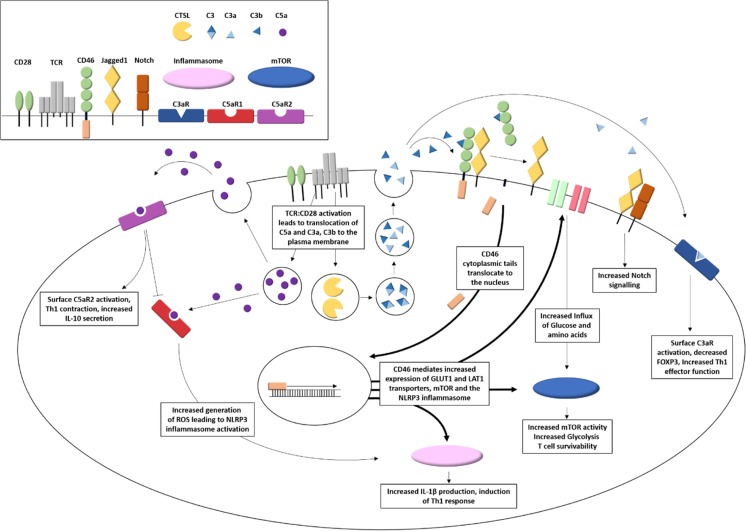
“Upon TCR activation, both C3a and C3b are exported to the cell surface within minutes and bind to surface C3aR, also expressed at the surface after activation, and CD46, respectively, leading to Tcell activation and Th1 differentiation.”
BackgroundInfluentialStrainic, M. G., Liu, J., Huang, D., An, F., Lalli, P. N., Muqim, N., Shapiro, V. S., Dubyak, G. R., Heeger, P. S., & Medof, M. E. (2008) · Immunity · doi:10.1016/j.immuni.2008.02.001 · Cited by 580 · cited 5×
“Local production of C3a and C5a at the APC–T cell interface is also key to regulate T cell activation and survival [30].”
BackgroundInfluentialMeri, S., Morgan, B. P., Davies, A., Daniels, R. H., Olavesen, M. G., Waldmann, H., & Lachmann, P. J. (1990) · PubMed Central · Cited by 533
T helper 1 immunity requires complement-driven NLRP3 inflammasome activity in CD4 + T cells
Arbore, G., West, E. E., Spolski, R., Robertson, A. A. B., Klos, A., Rheinheimer, C., Dutow, P., Woodruff, T. M., Yu, Z. X., O’Neill, L. A., et al. (2016) · Science · doi:10.1126/science.aad1210 · Cited by 513
CD21 is a ligand for CD23 and regulates IgE production
Aubry, J.-P., Pochon, S., Graber, P., Jansen, K. U., & Bonnefoy, J.-Y. (1992) · Nature · doi:10.1038/358505a0 · Cited by 474 · cited 12×
“The earliest indication of the involvement of CD21 in IgE class switching was the discovery of its ability to bind to CD23 [42].”
BackgroundInfluentialFunction, structure and therapeutic potential of complement C5a receptors
Monk, P. N., Scola, A., Madala, P., & Fairlie, D. P. (2007) · British Journal of Pharmacology · doi:10.1038/sj.bjp.0707332 · Cited by 404 · cited 1×
“Although initially suggested that C5a bound to C5aR1 with less affinity than C5a [10], this was recently challenged [11].”
BackgroundC1q and Systemic Lupus Erythematosus
Walport, M. J., Davies, K. A., & Botto, M. (1998) · Immunobiology · doi:10.1016/s0171-2985(98)80032-6 · Cited by 393 · cited 2×
“Due to the high occurrence of the autoimmune condition SLE associated with C1q deficiency [97], C1q is believed to play a role in immune tolerance [98].”
BackgroundRegulation of Humoral Immunity by Complement
Carroll, M. C., & Isenman, D. E. (2012) · Immunity · doi:10.1016/j.immuni.2012.08.002 · Cited by 387 · cited 3×
“Notably, the complement system has been shown to directly control B and T cell responses [2, 4].”
BackgroundSharpe, A. H. (2009) · Immunological Reviews · doi:10.1111/j.1600-065x.2009.00784.x · Cited by 357 · cited 5×
“surface of antigen presenting cells (APC) [5].”
InfluentialStrainic, M. G., Shevach, E. M., An, F., Lin, F., & Medof, M. E. (2013) · Nature Immunology · doi:10.1038/ni.2499 · Cited by 302
Heesters, B. A., Chatterjee, P., Kim, Y.-A., Gonzalez, S. F., Kuligowski, M. P., Kirchhausen, T., & Carroll, M. C. (2013) · Immunity · doi:10.1016/j.immuni.2013.02.023 · Cited by 300 · cited 1×
“B cells are observed to transfer complement-coated antigen to follicular DCs via the CR2 receptor; these store the antigen, periodically transferring it back to the B cells to maintain the germinal centers and extend the humoral response [22, 41].”
BackgroundRoss, G. D., Lambris, J. D., Cain, J. A., & Newman, S. L. (1982) · The Journal of Immunology · doi:10.4049/jimmunol.129.5.2051 · Cited by 293 · cited 15×
“B cell surface complement receptor 1 (CD35, CR1) binds to the complement components C3b and C4b, acting as a cofactor to facilitate their cleavage by factor I to iC3b, a substrate for CD21, and iC4b, respectively [36].”
BackgroundInfluentialAlterations in CD46-mediated Tr1 regulatory T cells in patients with multiple sclerosis
Astier, A. L., Meiffren, G., Freeman, S., & Hafler, D. A. (2006) · Journal of Clinical Investigation · doi:10.1172/jci29251 · Cited by 292 · cited 1×
“This was specific to CD46 costimulation as levels of IL-10 were normal when T cells were activated by CD28, indicating a specific defect in the CD46 pathway [57, 91, 92].”
BackgroundSelf-citationDecay-accelerating factor modulates induction of T cell immunity
Heeger, P. S., Lalli, P. N., Lin, F., Valujskikh, A., Liu, J., Muqim, N., Xu, Y., & Medof, M. E. (2005) · The Journal of Experimental Medicine · doi:10.1084/jem.20041967 · Cited by 286 · cited 1×
“In mice, it was observed that the lack of CD55 promotes T cell activation, suggesting an inhibitory role of CD55 in T cell effector function [68, 69].”
BackgroundCardone, J., Le Friec, G., Vantourout, P., Roberts, A., Fuchs, A., Jackson, I., Suddason, T., Lord, G., Atkinson, J. P., Cope, A., et al. (2010) · Nature Immunology · doi:10.1038/ni.1917 · Cited by 284 · cited 4×
“[46–48], and differentiation into Th1 cells characterized by IFNγ production [49].”
BackgroundInfluentialLalli, P. N., Strainic, M. G., Yang, M., Lin, F., Medof, M. E., & Heeger, P. S. (2008) · Blood · doi:10.1182/blood-2008-04-151068 · Cited by 271 · cited 1×
“Local production of C3 and C5 fragments has been demonstrated in mice, although this was thought to be due to increased C3 expression and extracellular cleavage by the C3 convertase [78].”
BackgroundVisualizing B cell capture of cognate antigen from follicular dendritic cells
Suzuki, K., Grigorova, I., Phan, T. G., Kelly, L. M., & Cyster, J. G. (2009) · Journal of Experimental Medicine · doi:10.1084/jem.20090209 · Cited by 271 · cited 14×
“Like CD55, CD35 has decay accelerating activity promoting the degradation of complement C3 and C5 convertases.”
BackgroundInfluentialC5L2, a Nonsignaling C5A Binding Protein
Okinaga, S., Slattery, D., Humbles, A., Zsengeller, Z., Morteau, O., Kinrade, M. B., Brodbeck, R. M., Krause, J. E., Choe, H.-R., Gerard, N. P., et al. (2003) · Biochemistry · doi:10.1021/bi034489v · Cited by 261 · cited 1×
“C5aR2 shares 38% sequence homology with the C5aR1 receptor but does not couple to G proteins [14].”
BackgroundAngela, M., Endo, Y., Asou, H. K., Yamamoto, T., Tumes, D. J., Tokuyama, H., Yokote, K., & Nakayama, T. (2016) · Nature Communications · doi:10.1038/ncomms13683 · Cited by 259 · cited 1×
“This increased nutrient uptake, particularly the augmented influx of amino acids through the LAT1 channel, is sensed by mTOR [85, 86].”
BackgroundComplement Regulates Nutrient Influx and Metabolic Reprogramming during Th1 Cell Responses
Kolev, M., Dimeloe, S., Le Friec, G., Navarini, A., Arbore, G., Povoleri, G. A., Fischer, M., Belle, R., Loeliger, J., Develioglu, L., et al. (2015) · Immunity · doi:10.1016/j.immuni.2015.05.024 · Cited by 255 · cited 2×
“ulates the metabolic reprogramming dependent on the CD46 cytoplasmic tails [56].”
BackgroundThe complement inhibitory protein DAF (CD55) suppresses T cell immunity in vivo
Liu, J., Miwa, T., Hilliard, B., Chen, Y., Lambris, J. D., Wells, A. D., & Song, W.-C. (2005) · The Journal of Experimental Medicine · doi:10.1084/jem.20040863 · Cited by 252 · cited 1×
“In mice, it was observed that the lack of CD55 promotes T cell activation, suggesting an inhibitory role of CD55 in T cell effector function [68, 69].”
BackgroundFour Viruses, Two Bacteria, and One Receptor: Membrane Cofactor Protein (CD46) as Pathogens' Magnet
Cattaneo, R. (2004) · Journal of Virology · doi:10.1128/jvi.78.9.4385-4388.2004 · Cited by 222 · cited 1×
“several pathogens including measles and adenoviruses and the Neisseria (N) gonorrhoeae and N meningitides bacteria [16].”
BackgroundKwan, W.-H., van der Touw, W., Paz-Artal, E., Li, M. O., & Heeger, P. S. (2013) · Journal of Experimental Medicine · doi:10.1084/jem.20121525 · Cited by 215 · cited 1×
“nTregs express C3aR and C5aR, and triggering of these receptors inhibits Treg suppressive function by modulating Foxp3 expression [74].”
BackgroundC5L2: a controversial receptor of complement anaphylatoxin, C5a
Li, R., Coulthard, L. G., Wu, M. C. L., Taylor, S. M., & Woodruff, T. M. (2013) · The FASEB Journal · doi:10.1096/fj.12-220509 · Cited by 206
The CD46-Jagged1 interaction is critical for human TH1 immunity
Le Friec, G., Sheppard, D., Whiteman, P., Karsten, C. M., Shamoun, S. A.-T., Laing, A., Bugeon, L., Dallman, M. J., Melchionna, T., Chillakuri, C., et al. (2012) · Nature Immunology · doi:10.1038/ni.2454 · Cited by 204
The physiological breakdown of the third component of human complement
Harrison, R. A., & Lachmann, P. J. (1980) · Molecular Immunology · doi:10.1016/0161-5890(80)90119-4 · Cited by 187 · cited 1×
“Factor H (FH) is a soluble complement regulator present in the plasma [21].”
BackgroundCherukuri, A., Cheng, P. C., & Pierce, S. K. (2001) · The Journal of Immunology · doi:10.4049/jimmunol.167.1.163 · Cited by 181 · cited 1×
“The interaction of C3 fragments with CD21 plays a fundamental role in B cell antigen internalization and presentation [38].”
BackgroundComplement-Mediated Regulation of Metabolism and Basic Cellular Processes
Hess, C., & Kemper, C. (2016) · Immunity · doi:10.1016/j.immuni.2016.08.003 · Cited by 179 · cited 1×
“term Bcomplosome^ has recently been suggested [80].”
Marie, J. C., Astier, A. L., Rivailler, P., Rabourdin-Combe, C., Wild, T. F., & Horvat, B. (2002) · Nature Immunology · doi:10.1038/ni810 · Cited by 178 · cited 1×
“The two tails exhibit antagonistic roles in the control of inflammation, in both huCD46-transgenic mice (mice only express CD46 on testis) [53] and in human Tcells in vitro [54, 55].”
BackgroundSelf-citationMaturation of dendritic cells abrogates C1q production in vivo and in vitro
Castellano, G., Woltman, A. M., Nauta, A. J., Roos, A., Trouw, L. A., Seelen, M. A., Schena, F. P., Daha, M. R., & van Kooten, C. (2004) · Blood · doi:10.1182/blood-2003-09-3046 · Cited by 164 · cited 2×
“along with macrophages and mast cells, are one of the largest producers of extra-hepatic C1q which induces cellular responses on local tissues in a paracrine manner [23].”
BackgroundAstier, A., Trescol-Biémont, M.-C., Azocar, O., Lamouille, B., & Rabourdin-Combe, C. (2000) · The Journal of Immunology · doi:10.4049/jimmunol.164.12.6091 · Cited by 161 · cited 1×
“It would be interesting to assess the role of the C3b receptor and complement regulator Crry in this response, especially as Crry has been also shown to act as a costimulatory molecule for murine T cells [79], similarly to CD46 engagement on human T cells [46].”
BackgroundSelf-citationNotch regulates IL-10 production by T helper 1 cells
Rutz, S., Janke, M., Kassner, N., Hohnstein, T., Krueger, M., & Scheffold, A. (2008) · Proceedings of the National Academy of Sciences · doi:10.1073/pnas.0712102105 · Cited by 154 · cited 1×
“Interestingly, Notch regulates IL-10 secretion in Th1 cells [52].”
BackgroundCD59 functions as a signal-transducing molecule for human T cell activation
Korty, P. E., Brando, C., & Shevach, E. M. (1991) · The Journal of Immunology · doi:10.4049/jimmunol.146.12.4092 · Cited by 151 · cited 1×
“A role for CD59 in T cell co-stimulation has also been reported [70] and shown to couple signaling events to the TCR [71].”
BackgroundThe human complement fragment receptor, C5L2, is a recycling decoy receptor
Scola, A.-M., Johswich, K.-O., Morgan, B. P., Klos, A., & Monk, P. N. (2009) · Molecular Immunology · doi:10.1016/j.molimm.2008.11.001 · Cited by 140 · cited 8×
“C5aR1 is present on a variety of cell types, not exclusively immune cells.”
BackgroundInfluentialTrouw, L. A., Bengtsson, A. A., Gelderman, K. A., Dahlbäck, B., Sturfelt, G., & Blom, A. M. (2007) · Journal of Biological Chemistry · doi:10.1074/jbc.m704354200 · Cited by 137 · cited 1×
“The binding of C4BP to apoptotic cells inhibits complement C3 and C5 convertase formation and subsequent lysis by MAC formation, preventing the induction of an inflammatory response due to excessive complement activation and the release of cellular contents due to cell lysis [20].”
BackgroundC4b-Binding Protein (C4BP) Activates B Cells through the CD40 Receptor
Brodeur, S. R., Angelini, F., Bacharier, L. B., Blom, A. M., Mizoguchi, E., Fujiwara, H., Plebani, A., Notarangelo, L. D., Dahlbäck, B., Tsitsikov, E. N., et al. (2003) · Immunity · doi:10.1016/s1074-7613(03)00149-3 · Cited by 136
Zaffran, Y., Destaing, O., Roux, A., Ory, S., Nheu, T. V., Jurdic, P., Rabourdin‐Combe, C., & Astier, A. (2001) · The Journal of Immunology · doi:10.4049/jimmunol.167.12.6780 · Cited by 123
Self-citationWebb, J. H., Blom, A. M., & Dahlbäck, B. (2002) · The Journal of Immunology · doi:10.4049/jimmunol.169.5.2580 · Cited by 114
Ghannam, A., Pernollet, M., Fauquert, J.-L., Monnier, N., Ponard, D., Villiers, M.-B., Péguet-Navarro, J., Tridon, A., Lunardi, J., Gerlier, D., et al. (2008) · The Journal of Immunology · doi:10.4049/jimmunol.181.7.5158 · Cited by 106
Clarke, E. V., Weist, B. M., Walsh, C. M., & Tenner, A. J. (2015) · Journal of Leukocyte Biology · doi:10.1189/jlb.3a0614-278r · Cited by 102 · cited 1×
“tic cells induced DCs to secrete IL-10 as opposed to IL-12p70, suppressing Th1 and Th17 cell proliferation [25].”
BackgroundAbnormal Tr1 differentiation in multiple sclerosis
Astier, A., & Hafler, D. A. (2007) · Journal of Neuroimmunology · doi:10.1016/j.jneuroim.2007.09.018 · Cited by 100 · cited 1×
“This was specific to CD46 costimulation as levels of IL-10 were normal when T cells were activated by CD28, indicating a specific defect in the CD46 pathway [57, 91, 92].”
BackgroundSelf-citationComplement regulation of T cell immunity
Kwan, W.-H., van der Touw, W., & Heeger, P. S. (2012) · Immunologic Research · doi:10.1007/s12026-012-8327-1 · Cited by 96 · cited 1×
“and T cells; however, much of the literature has focused on its role in modulating T cell-mediated immunity [9].”
BackgroundComplement Receptor Type 1 (CD35) Mediates Inhibitory Signals in Human B Lymphocytes
Józsi, M., Prechl, J., Bajtay, Z., & Erdei, A. (2002) · The Journal of Immunology · doi:10.4049/jimmunol.168.6.2782 · Cited by 95 · cited 2×
“As mentioned previously, CD35 suppresses B cell activation [37].”
BackgroundComplement protein C1q induces maturation of human dendritic cells
Csomor, E., Bajtay, Z., Sándor, N., Kristóf, K., Arlaud, G. J., Thiel, S., & Erdei, A. (2007) · Molecular Immunology · doi:10.1016/j.molimm.2007.02.014 · Cited by 84 · cited 1×
“C1q-matured DCs also secreted higher amounts of IL-12p70 which in turn stimulates a greater Th1 response from co-cultured T cells [24].”
BackgroundKurita-Taniguchi, M., Fukui, A., Hazeki, K., Hirano, A., Tsuji, S., Matsumoto, M., Watanabe, M., Ueda, S., & Seya, T. (2000) · The Journal of Immunology · doi:10.4049/jimmunol.165.9.5143 · Cited by 84
Complement’s hidden arsenal: New insights and novel functions inside the cell
Liszewski, M. K., Elvington, M. L., Kulkarni, H. S., & Atkinson, J. P. (2017) · Molecular Immunology · doi:10.1016/j.molimm.2017.01.004 · Cited by 80 · cited 2×
“Notably, the complement system has been shown to directly control B and T cell responses [2, 4].”
BackgroundChoileáin, S. N., Weyand, N. J., Neumann, C., Thomas, J., So, M., & Astier, A. (2011) · PLoS ONE · doi:10.1371/journal.pone.0016287 · Cited by 77 · cited 3×
“The two tails exhibit antagonistic roles in the control of inflammation, in both huCD46-transgenic mice (mice only express CD46 on testis) [53] and in human Tcells in vitro [54, 55].”
BackgroundSelf-citationMeasles: immunosuppression, interleukin‐12. and complement receptors
Karp, C. L. (1999) · Immunological Reviews · doi:10.1111/j.1600-065x.1999.tb01285.x · Cited by 75
Effector T cell differentiation: are master regulators of effector T cells still the masters?
Wang, C., Collins, M. A., & Kuchroo, V. K. (2015) · Current Opinion in Immunology · doi:10.1016/j.coi.2015.08.001 · Cited by 74 · cited 1×
“Depending on the cytokines and signals received by the naïve T cells, these will differentiate within different T helper (Th) subsets [6].”
BackgroundA Functional Interaction between CD46 and DLG4
Ludford‐Menting, M., Thomas, S. J., Crimeen, B., Harris, L. J., Loveland, B. E., Bills, M. M., Ellis, S. L., & Russell, S. M. (2002) · Journal of Biological Chemistry · doi:10.1074/jbc.m108479200 · Cited by 72
CD46 processing: A means of expression
Choileáin, S. N., & Astier, A. (2011) · Immunobiology · doi:10.1016/j.imbio.2011.06.003 · Cited by 72 · cited 3×
“The two tails exhibit antagonistic roles in the control of inflammation, in both huCD46-transgenic mice (mice only express CD46 on testis) [53] and in human Tcells in vitro [54, 55].”
BackgroundSelf-citationDeckert, M., Ticchioni, M., Mari, B. P., Mary, D. A. S. G., & Bernard, A. (1995) · European Journal of Immunology · doi:10.1002/eji.1830250704 · Cited by 69 · cited 6×
“Upon TCR activation, both C3a and C3b are exported to the cell surface within minutes and bind to surface C3aR, also expressed at the surface after activation, and CD46, respectively, leading to Tcell activation and Th1 differentiation.”
BackgroundInfluentialHakobyan, S., Luppe, S., Evans, D., Harding, K. E., Loveless, S., Robertson, N. P., & Morgan, B. P. (2016) · Multiple Sclerosis Journal · doi:10.1177/1352458516669002 · Cited by 68 · cited 1×
“neuromyelitis optica spectrum disorder [90].”
Vaknin‐Dembinsky, A., Murugaiyan, G., Hafler, D. A., Astier, A., & Weiner, H. L. (2008) · Journal of Neuroimmunology · doi:10.1016/j.jneuroim.2008.01.002 · Cited by 61 · cited 13×
“C1q-matured DCs also secreted higher amounts of IL-12p70 which in turn stimulates a greater Th1 response from co-cultured T cells [24].”
BackgroundInfluentialSelf-citationCD40-CD154 Interactions in B-Cell Signaling
Calderhead, D. M., Kosaka, Y., Manning, E. M., & Noelle, R. J. (2000) · Current topics in microbiology and immunology · doi:10.1007/978-3-642-59641-4_4 · Cited by 61 · cited 2×
“The second activation signal typically involves CD40 on B cells and its cognate ligand on T cells, CD154 (CD40L) [34].”
BackgroundCrry/p65, a Membrane Complement Regulatory Protein, Has Costimulatory Properties on Mouse T Cells
Fernández-Centeno, E., de Ojeda, G., Rojo, J. M., & Portolés, P. (2000) · The Journal of Immunology · doi:10.4049/jimmunol.164.9.4533 · Cited by 60 · cited 1×
“It would be interesting to assess the role of the C3b receptor and complement regulator Crry in this response, especially as Crry has been also shown to act as a costimulatory molecule for murine T cells [79], similarly to CD46 engagement on human T cells [46].”
BackgroundIdentification of early gene expression changes during human Th17 cell differentiation
Tuomela, S., Salo, V., Tripathi, S. K., Chen, Z. J., Laurila, K., Gupta, B., Äijö, T., Oikari, L. E., Stockinger, B., Lähdesmäki, H. J., et al. (2012) · Blood · doi:10.1182/blood-2012-01-407528 · Cited by 60 · cited 1×
“sponses and IL-17 production by controlling Th17 differentiation in both humans and mice [76, 77], suggesting a broader role of cathepsins in regulating inflammatory conditions.”
BackgroundReis, E. S., Chen, H., Sfyroera, G., Monk, P. N., Köhl, J., Ricklin, D., & Lambris, J. D. (2012) · The Journal of Immunology · doi:10.4049/jimmunol.1200834 · Cited by 60 · cited 1×
“Although initially suggested that C5a bound to C5aR1 with less affinity than C5a [10], this was recently challenged [11].”
BackgroundKandasamy, M., Ying, P. C., Ho, A. W. S., Sumatoh, H. R., Schlitzer, A., Hughes, T. R., Kemeny, D. M., Morgan, B. P., Ginhoux, F., & Sivasankar, B. (2013) · PLoS Pathogens · doi:10.1371/journal.ppat.1003115 · Cited by 56 · cited 1×
“In a model of influenza infection, C3 is required for the migration of lungDCs to the lymph nodes [26].”
BackgroundKing, B. C., Esguerra, J. L. S., Golec, E., Eliasson, L., Kemper, C., & Blom, A. M. (2016) · The Journal of Immunology · doi:10.4049/jimmunol.1500516 · Cited by 56
The paradoxical roles of C1q and C3 in autoimmunity
Scott, D., & Botto, M. (2015) · Immunobiology · doi:10.1016/j.imbio.2015.05.001 · Cited by 55 · cited 1×
“Due to the high occurrence of the autoimmune condition SLE associated with C1q deficiency [97], C1q is believed to play a role in immune tolerance [98].”
BackgroundOlivar, R., Luque, A., Cárdenas-Brito, S., Naranjo-Gómez, M., Blom, A. M., Borràs, F. E., Rodriguez de Córdoba, S., Zipfel, P. F., & Aran, J. M. (2016) · The Journal of Immunology · doi:10.4049/jimmunol.1500455 · Cited by 55 · cited 1×
“When co-cultured with CD3+ T cells, they induced a CD4CD127CD25Foxp3 regulatory T cell population [31].”
BackgroundDixon, K. O., O'Flynn, J., Klar‐Mohamad, N., Daha, M. R., & van Kooten, C. (2017) · European Journal of Immunology · doi:10.1002/eji.201646703 · Cited by 54
Sivasankar, B., Longhi, M. P., Gallagher, K. M. E., Betts, G. J., Morgan, B. P., Godkin, A. J., & Gallimore, A. M. (2009) · The Journal of Immunology · doi:10.4049/jimmunol.0804243 · Cited by 53 · cited 1×
“Moreover, recent studies have highlighted an immunomodulatory role of CD59 in T cells suggesting that its ligation may also potentially induce a regulatory T cell subset [72].”
BackgroundKremlitzka, M., Polgar, A., Fulop, L., Kiss, E., Poor, G., & Erdei, A. (2013) · International Immunology · doi:10.1093/intimm/dxs090 · Cited by 52 · cited 1×
“Reduced expression of CD35 in a number of autoimmune conditions such as rheumatoid arthritis and systemic lupus erythematosus (SLE) has been obsvered, although whether these reduced levels contribute to disease remains to be firmly established [96].”
BackgroundMa, A., Xiong, Z., Hu, Y., Qi, S., Song, L., Dun, H., Zhang, L., Lou, D., Yang, P., Zhao, Z., et al. (2009) · International Immunopharmacology · doi:10.1016/j.intimp.2009.01.034 · Cited by 49 · cited 1×
“As mice do not express CD46 on somatic cells, the role of CD46 has been studied using an MSmodel inmonkeys that express CD46 on every cell type in a similar fashion to man (although unlike humans, non-human primates also express CD46 on red blood cells), and a similar dysfunction of the regulatory function of CD46 on…”
BackgroundOliaro, J., Pasam, A., Waterhouse, N. J., Browne, K. A., Ludford‐Menting, M., Trapani, J. A., & Russell, S. M. (2006) · Proceedings of the National Academy of Sciences · doi:10.1073/pnas.0602458103 · Cited by 48 · cited 3×
“A few interactors of CD46 tails (albeit only with Cyt1) have been identified, leading to the discovery of the role of CD46 in controlling autophagy (via interaction with GOPC) [63] and cell polarity via binding to DLG4 [64, 65].”
BackgroundMeasles Virus Infection Synergizes with IL-4 in IgE Class Switching
Imani, F., Proud, D., & Griffin, D. E. (1999) · The Journal of Immunology · doi:10.4049/jimmunol.162.3.1597 · Cited by 46 · cited 10×
“Interaction of C4BP with CD40 alone induces B cell activation, proliferation, and antibody class switching from IgM to IgE.”
BackgroundInfluentialThe protease cathepsin L regulates Th17 cell differentiation
Hou, L., Cooley, J., Swanson, R., Ong, P. C., Pike, R. N., Bogyo, M. S., Olson, S. T., & Remold‐O’Donnell, E. (2015) · Journal of Autoimmunity · doi:10.1016/j.jaut.2015.08.006 · Cited by 45 · cited 1×
“sponses and IL-17 production by controlling Th17 differentiation in both humans and mice [76, 77], suggesting a broader role of cathepsins in regulating inflammatory conditions.”
BackgroundXu, Y., Gao, Y., Yang, J., & Guo, W. (2010) · Journal of Asthma · doi:10.3109/02770903.2010.481340 · Cited by 45 · cited 1×
“The lack of regulatory Th1-Tr1 switch was also reported in rheumatoid arthritis [49] as well as asthma patients [94, 95].”
BackgroundSutavani, R. V., Bradley, R., Ramage, J. M., Jackson, A. M., Durrant, L. G., & Spendlove, I. (2013) · The Journal of Immunology · doi:10.4049/jimmunol.1301458 · Cited by 43 · cited 1×
“Similar to CD46, CD55 affects co-stimulation of human T cells by binding to CD97, promoting T cell activation and Tr1 cell differentiation [67].”
BackgroundPathogen recognition by the cell surface receptor CD46 induces autophagy
Meiffren, G., Joubert, P.-E., Grégoire, I. P., Codogno, P., Rabourdin‐Combe, C., & Faure, M. (2010) · Autophagy · doi:10.4161/auto.6.2.11132 · Cited by 40 · cited 2×
“A few interactors of CD46 tails (albeit only with Cyt1) have been identified, leading to the discovery of the role of CD46 in controlling autophagy (via interaction with GOPC) [63] and cell polarity via binding to DLG4 [64, 65].”
BackgroundMasaki, T., Matsumoto, M., Nakanishi, I., Yasuda, R., & Seya, T. (1992) · The Journal of Biochemistry · doi:10.1093/oxfordjournals.jbchem.a123799 · Cited by 38 · cited 1×
“factor to facilitate their cleavage by factor I to iC3b, a substrate for CD21, and iC4b, respectively [36].”
BackgroundChiarini, M., Serana, F., Zanotti, C., Capra, R., Rasia, S., Rottoli, M., Rovaris, M., Caputo, D., Cavaletti, G., Frigo, M., et al. (2011) · Multiple Sclerosis Journal · doi:10.1177/1352458511427720 · Cited by 33 · cited 1×
“This was specific to CD46 costimulation as levels of IL-10 were normal when T cells were activated by CD28, indicating a specific defect in the CD46 pathway [57, 91, 92].”
BackgroundCalcitriol Modulates the CD46 Pathway in T Cells
Kickler, K., Choileáin, S. N., Williams, A., Richards, A., & Astier, A. (2012) · PLoS ONE · doi:10.1371/journal.pone.0048486 · Cited by 33 · cited 1×
“triggers the Th1 to Tr1 switch and favors CD46 cleavage [60].”
BackgroundSelf-citationCharacterization of the Regulation of CD46 RNA Alternative Splicing
Tang, S. J., Luo, S., Ho, J. X. J., Ly, P. T., Goh, E., & Roca, X. (2016) · Journal of Biological Chemistry · doi:10.1074/jbc.m115.710350 · Cited by 32
Monocyte:T‐cell interaction regulates human T‐cell activation through a CD28/CD46 crosstalk
Charron, L., Doctrinal, A., Choileáin, S. N., & Astier, A. (2015) · Immunology and Cell Biology · doi:10.1038/icb.2015.42 · Cited by 31
Self-citationProstaglandin E2 Affects T Cell Responses through Modulation of CD46 Expression
Kickler, K., Maltby, K., Choileáin, S. N., Stephen, J., Wright, S., Hafler, D. A., Jabbour, H. N., & Astier, A. (2012) · The Journal of Immunology · doi:10.4049/jimmunol.1103090 · Cited by 30
Self-citationTsai, Y., Niu, D., Yang, K. D., Hung, C., Yeh, Y.-J., Lee, C., & Lin, C. (2012) · Laboratory Investigation · doi:10.1038/labinvest.2012.86 · Cited by 24 · cited 1×
“The lack of regulatory Th1-Tr1 switch was also reported in rheumatoid arthritis [49] as well as asthma patients [94, 95].”
BackgroundCD46 signaling in T cells: Linking pathogens with polarity
Hawkins, E. D., & Oliaro, J. (2010) · FEBS Letters · doi:10.1016/j.febslet.2010.09.003 · Cited by 19
HENCHOZ‐LECOANET, S., Jeannin, P., Aubry, J., Graber, P., Bradshaw, C. G., Pochon, S., & Bonnefoy, J. (1996) · Immunology · doi:10.1046/j.1365-2567.1996.d01-651.x · Cited by 19
Hansen, A. S., Bundgaard, B. B., Møller, B. K., & Höllsberg, P. (2016) · Scientific Reports · doi:10.1038/srep35406 · Cited by 19
Ludford‐Menting, M., Crimeen‐Irwin, B., Oliaro, J., Pasam, A., Williamson, D. J., Pedersen, N., Guillaumot, P., Christansen, D., Manié, S. N., Gaus, K., et al. (2011) · Journal of Lipids · doi:10.1155/2011/521863 · Cited by 17 · cited 1×
“CD46 is recruited to lipid rafts [66] and T cell polarization is affected by CD46 ligation”
BackgroundRichter, M., Yumul, R., Saydaminova, K., Wang, H., Gough, M., Baldessari, A. E., Cattaneo, R., Lee, F., Wang, C.-H. K., Jang, H., et al. (2016) · Molecular Therapy — Methods & Clinical Development · doi:10.1038/mtm.2016.13 · Cited by 16
Self-citationUptake and Presentation of Myelin Basic Protein by Normal Human B Cells
Brimnes, M. K., Hansen, B. E., Nielsen, L. K., Dziegiel, M. H., & Nielsen, C. H. (2014) · PLoS ONE · doi:10.1371/journal.pone.0113388 · Cited by 15 · cited 1×
“[40] observed that B cells incubated in either serum-free media or with heat or chemically inactivated complement showed significantly reduced ability to uptake antigen.”
BackgroundB-cell co-receptors: The two-headed antigen
DeFranco, A. L. (1996) · Current Biology · doi:10.1016/s0960-9822(02)00539-0 · Cited by 12
Recombinant Ad35 adenoviral proteins as potent modulators of human T‐cell activation
Hay, J., Carter, D., Lieber, A., & Astier, A. (2014) · Immunology · doi:10.1111/imm.12391 · Cited by 8 · cited 1×
“used to modulate other diseases, independently of its complement regulatory function [101].”
BackgroundSelf-citation
Cited by
Complosome — the intracellular complement system
West, E. E., & Kemper, C. (2023) · Nature Reviews Nephrology · doi:10.1038/s41581-023-00704-1 · Cited by 253
Justification of specific genetic modifications in pigs for clinical organ xenotransplantation
Cooper, D. K. C., Hara, H., Iwase, H., Yamamoto, T., Li, Q., Ezzelarab, M., Federzoni, E., Dandro, A., & Ayares, D. (2019) · Xenotransplantation · doi:10.1111/xen.12516 · Cited by 178
Role of immune cells in hypertension
Caillon, A., Paradis, P., & Schiffrin, E. L. (2019) · British Journal of Pharmacology · doi:10.1111/bph.14427 · Cited by 163
“The complement system is an important component of the innate immune system that also plays an important role in the induction of adaptive immune responses (Cravedi et al., 2013; Killick et al., 2018).”
BackgroundChronic biofilm-based infections: skewing of the immune response
González, J. F., Hahn, M. M., & Gunn, J. S. (2018) · Pathogens and Disease · doi:10.1093/femspd/fty023 · Cited by 159
Myasthenia gravis: the changing treatment landscape in the era of molecular therapies
Iorio, R. (2024) · Nature Reviews Neurology · doi:10.1038/s41582-023-00916-w · Cited by 153
“One study provided insights into the involvement of complement in adaptive immunity 106 , supporting the hypothesis that inhibiting complement activation can also have an impact on T and B cell subsets in people with MG 107 .”
Metadata
- Authors
- Killick, J., Morisse, G., Sieger, D., & Astier, A. L.
- Affiliations
- Centre for Inflammation Research (GB)
- University of Edinburgh (GB)
- Centre National de la Recherche Scientifique (FR)
- Corresponding author
- Astier, Anne L.
- Venue
- Seminars in Immunopathology
- Published
- 2017-08-25
- Volume
- 40
- Issue
- 1
- Pages
- 37-48
- ISSN
- 1863-2297 (ISSN-L)
- 1863-2300
- PMC
- PMC5794818
- OpenAlex
- W2748098899
- Cited by
- 129
- References
- 101
- Citations by year
- 2026: 9 · 2025: 14 · 2024: 12 · 2023: 19 · 2022: 16 · 2021: 14 · 2020: 14 · 2019: 18 · 2018: 11 · 2017: 2
- FWCI
- 1.26
- Type
- journal article
- Language
- en
- Open access
- hybrid
- doi.org
- Locations
- Seminars in Immunopathology (publishedVersion, cc-by)
- PubMed Central (publishedVersion, cc-by)
- PubMed (publishedVersion)
- HAL (submittedVersion, other-oa)
- Edinburgh Research Explorer (University of Edinburgh) (submittedVersion, cc-by)
- Funders
- Multiple Sclerosis Society (41, 34)
- Topics
- Life Sciences › Immunology and Microbiology › Immunology › Complement system in diseases
- Life Sciences › Immunology and Microbiology › Immunology › Biomarkers in Disease Mechanisms
- Life Sciences › Immunology and Microbiology › Immunology › Immune Response and Inflammation
- Keywords
- complement system, adaptive immunity, antigen-presenting cells, B cells, T cells, complement dysregulation, local complement activation
- MeSH terms
- Animals, Antigen-Presenting Cells, B-Lymphocytes, Carrier Proteins, Cell Communication, Complement System Proteins, Complement Activation, Disease Susceptibility, Humans, Immunologic Factors, Lymphocyte Activation, Protein Binding, T-Lymphocytes, Signal Transduction, Adaptive Immunity, Immunomodulation, Molecular Targeted Therapy
About these checks
Registry, retraction, Cites and statistics results are computed, not judged, with one exception: a printed reference that no index lists is read once by a model before it counts as a citation error. Claims are extracted by a model and kept only when their quote appears verbatim in the text; each cited source is then checked, with a model’s help, for whether it says what the claim relies on. Those verdicts can be wrong — read the claim’s quote and the cited source before relying on one.
Statistics and arithmetic are recomputed, not judged.
Confidence bands are shown only for fields calibrated on our annotated test set. None is calibrated yet, so no band is shown.
What counts as a claim ›How we measure confidence ›How we check this ›
Are you an author, or do you see a problem with this page? Request a review
Data sources
Bibliographic data: Semantic Scholar, OpenAlex, Crossref.
Contains information from the Semantic Scholar Academic Graph Datasets, made available under the ODC Attribution License (ODC-BY 1.0).
Semantic Scholar’s data is described in: Kinney, R., et al. (2023). The Semantic Scholar Open Data Platform. arXiv:2301.10140.
