

Increasing vegetable intakes: rationale and systematic review of published interventions
Open accessThe DOI matches its Crossref record; 206 of the 208 references it cites were found in a registry or an index; 7 of the 51 sources its claims cite were checked for support.
Abstract
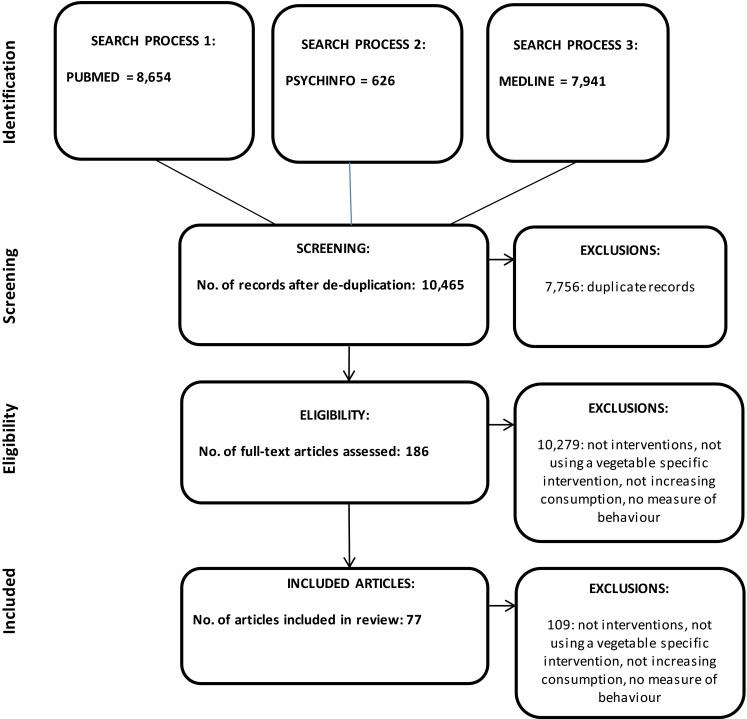
PURPOSE: While the health benefits of a high fruit and vegetable consumption are well known and considerable work has attempted to improve intakes, increasing evidence also recognises a distinction between fruit and vegetables, both in their impacts on health and in consumption patterns. Increasing work suggests health benefits from a high consumption specifically of vegetables, yet intakes remain low, and barriers to increasing intakes are prevalent making intervention difficult. A systematic review was undertaken to identify from the published literature all studies reporting an intervention to increase intakes of vegetables as a distinct food group. METHODS: Databases-PubMed, PsychInfo and Medline-were searched over all years of records until April 2015 using pre-specified terms. RESULTS: Our searches identified 77 studies, detailing 140 interventions, of which 133 (81 %) interventions were conducted in children. Interventions aimed to use or change hedonic factors, such as taste, liking and familiarity (n = 72), use or change environmental factors (n = 39), use or change cognitive factors (n = 19), or a combination of strategies (n = 10). Increased vegetable acceptance, selection and/or consumption were reported to some degree in 116 (83 %) interventions, but the majority of effects seem small and inconsistent. CONCLUSIONS: Greater percent success is currently found from environmental, educational and multi-component interventions, but publication bias is likely, and long-term effects and cost-effectiveness are rarely considered. A focus on long-term benefits and sustained behaviour change is required. Certain population groups are also noticeably absent from the current list of tried interventions.
Overview
CoChat Summary
TL;DR
This review identifies 77 published studies reporting 140 interventions to increase vegetable-specific intake, and concludes that many strategies can work but effects are often small, short-term, and not yet well tested for cost-effectiveness or sustainability. The strongest evidence in the paper is for environmental changes and repeated exposure/conditioning approaches, especially in children.
Key findings
- The review found 77 studies reporting 140 interventions; 113 of 140 interventions (81%) targeted children.
- Environmental interventions were highly successful: 39 interventions were found, and all except 3 reported increased vegetable selection and/or consumption.
- Repeated exposure/conditioning approaches also often worked: among interventions using repeated exposure, 16 of 23 (70%) improved liking and/or consumption; pairing with liked flavours succeeded in 12 of 14 (86%); pairing with nutrients in 4 of 6 (67%); pairing with reinforcement in 7 of 7 (100%); and reinforcement plus modelling in 1 of 1 (100%).
- The paper states that evaluation periods are typically short, effect sizes are often small, and when follow-up is longer, effects often diminish; it also notes that few interventions were identified specifically for adolescents or older individuals.
Methods
- Systematic review of published interventions aimed specifically at increasing vegetable intakes as a distinct food group, with vegetable selection, purchasing, or consumption as outcomes.
- Searched PubMed, PsychInfo, and Medline over all years using “vegetable” and “vegetables” in the title; last searches were conducted on 28 April 2015.
- Two authors independently screened titles and abstracts; 77 studies were included. Data were tabulated, but the authors did not assess risk of bias and did not meta-analyze because of heterogeneity and the early state of the literature.
Limitations
- Stated by the paper: the review only considered published literature, so it is likely biased toward English-language articles and away from grey literature; publication bias is also likely because failures and negative findings are underreported.
- Stated by the paper: the authors did not combine studies quantitatively because there were too few studies per intervention type and study methods were highly heterogeneous.
- Evident from the text: the search strategy used only title terms and did not search conference abstracts or book chapters, so it may have missed relevant interventions.
Model-written summary. Check it against the paper before relying on it.
Integrity signals
Registry
Cites
Statistics
Figures
Verification
Claims the paper makes
2 Valid · 1 Not valid · 13 Not checked · 22 Own results and interpretations
Every source the paper cites for this claim was checked and supports it.
In the paper
“Associations with all-cause mortality [ 2 , 3 ]”
What the sources say
- Supportedcites [2] Oyebode O, Gordon-Dseagu V, Walker A, Mindell JS (2014) Fruit and vegetable consumption and all-cause, cancer and CVD mortality: analysis of Health Survey for England data. J Epidemiol Community Health 68:856–862 source
The Abstract Results (p. 1) report fruit and vegetable consumption associated with decreased all-cause mortality (adjusted HR 0.67, 95% CI 0.58–0.78 for 7+ vs <1 portion daily), and the Discussion (p. 6) states 'a strong inverse relationship between fruit and vegetable consumption and all-cause mortality'. The key-points box likewise lists 'Fruit and vegetable consumption is inversely associated with all-cause, cancer and cardiovascular mortality in a nationally representative non-institutionalised population' with the lowest risk at 7+ portions. (LLM, conf=0.95)
- Supportedcites [3] Wang X, Ouyang Y, Liu J et al (2014) Fruit and vegetable consumption and mortality from all causes, cardiovascular disease, and cancer: systematic review and dose–response meta-analysis of prospective cohort studies. BMJ 349:g4490 source
The Abstract (p. 1) and Conclusions state that higher consumption of fruit and vegetables was significantly associated with a lower risk of all-cause mortality (pooled HR 0.95, 95% CI 0.92-0.98 per additional serving a day). The Discussion and Results sections (Table 3; dose-response analyses showing HR 0.83 for fruit at ~2 servings/day and 0.75 for vegetables at ~3 servings/day) reinforce this inverse association, with a threshold around five servings a day. (LLM, conf=0.95)
plainstates an association- Asserted: passes — The authors put it forward as true.
- Checkable: passes — It can be checked against evidence.
- Load-bearing: unclear — It is unclear whether the paper’s conclusions depend on it.
- Based: passes — The paper gives a reason why it holds.
- Supported
Every source the paper cites for this claim was checked and supports it.
In the paper
“mortality from cardiovascular disease [ 2 , 3 ], including coronary heart disease [ 4 ] and stroke [ 5 , 6 ], are well evidenced.”
What the sources say
- Supportedcites [2] Oyebode O, Gordon-Dseagu V, Walker A, Mindell JS (2014) Fruit and vegetable consumption and all-cause, cancer and CVD mortality: analysis of Health Survey for England data. J Epidemiol Community Health 68:856–862 source
The cited source is attached to the cardiovascular-disease mortality clause; the sentence cites other works for coronary heart disease and stroke. The Abstract Results report an association between fruit and vegetable consumption and reduced cardiovascular mortality, and the Discussion describes increasing benefits up to seven or more portions daily. (LLM, conf=0.93)
- Supportedcites [3] Wang X, Ouyang Y, Liu J et al (2014) Fruit and vegetable consumption and mortality from all causes, cardiovascular disease, and cancer: systematic review and dose–response meta-analysis of prospective cohort studies. BMJ 349:g4490 source
The Results section, under “Fruit and vegetable consumption and risk of cardiovascular mortality,” reports lower cardiovascular mortality with each additional daily serving of fruit and vegetables. In the citing sentence, separate citations accompany coronary heart disease and stroke; this source is cited for the broader cardiovascular-mortality association. (LLM, conf=0.94)
- Supportedcites [4] Dauchet L, Amouyel P, Hercberg S, Dallongeville J (2006) Fruit and vegetable consumption and risk of coronary heart disease: a meta-analysis of cohort studies. J Nutr 136:2588–2593 source
The citation to this paper is attached to coronary heart disease, not to the sentence’s separate claims about overall cardiovascular mortality or stroke. The Results (page unavailable) report an inverse association between fruit and vegetable intake and CHD risk; the analyzed outcomes include coronary death. (LLM, conf=0.90)
boostedstates an association- Asserted: passes — The authors put it forward as true.
- Checkable: passes — It can be checked against evidence.
- Load-bearing: passes — The paper’s conclusions depend on it.
- Based: passes — The paper gives a reason why it holds.
- Supported
A result the paper reports from its own data — it cites no other source for it, so there is none to check. The quote shows it is in the paper.
In the paper
“All of these, with the exception of three interventions (one increasing variety [ 158 ] and two improving presentation [ 141 , 164 ]) resulted in increased selection and/or consumption of vegetables in children and adults”
plainstates a cause- Asserted: passes — The authors put it forward as true.
- Checkable: passes — It can be checked against evidence.
- Load-bearing: passes — The paper’s conclusions depend on it.
- Based: passes — The paper gives a reason why it holds.
None of the sources cited for this claim have been checked yet.
In the paper
“Strategies such as pricing and marketing interventions, improved product provision, government subsidies, and population-wide awareness and education campaigns [ 205 – 207 ] specifically for vegetables do not yet exist or have not yet been evaluated as far as we are aware.”
hedged- Asserted: passes — The authors put it forward as true.
- Checkable: passes — It can be checked against evidence.
- Load-bearing: unclear — It is unclear whether the paper’s conclusions depend on it.
- Based: passes — The paper gives a reason why it holds.
A result the paper states — it cites no source for it, so there is none to check. The quote shows it is in the paper.
In the paper
“At present, there is a real lack of comparisons between interventions—i.e. interventions have not been compared, e.g. in the same age group or population, with the exception of comparisons of differing exposure and conditioning strategies in young children.”
plain- Asserted: passes — The authors put it forward as true.
- Checkable: passes — It can be checked against evidence.
- Load-bearing: passes — The paper’s conclusions depend on it.
- Based: passes — The paper gives a reason why it holds.
6 more claims
Create a free account to see all 38 claims and to verify the 44 references still open.
- It may state two separate claims as one. 22
- Probably not a substantial claim. 6
Citations
Cites
1 retracted
RETRACTED: Attractive names sustain increased vegetable intake in schools
Wansink, B. C., Just, D. R., Payne, C. R., & Klinger, M. Z. (2012) · Preventive Medicine · doi:10.1016/j.ypmed.2012.07.012 · Cited by 141 · cited 2×
“All of these, with the exception of three interventions (one increasing variety [158] and two improving presentation [141, 164]) resulted in increased selection and/or consumption of vegetables in children and adults, through the increased provision of vegetables (n = 20), through the increased provision of a variety…”
BackgroundRetractedFood, nutrition, physical activity, and the prevention of cancer: a global perspective
(2008) · Choice Reviews Online · doi:10.5860/choice.45-5024 · Cited by 5,350
Health Benefits of Fruits and Vegetables
Slavin, J. L., & Lloyd, B. (2012) · Advances in Nutrition · doi:10.3945/an.112.002154 · Cited by 2,128 · cited 4×
“Potatoes, for example, are sometimes included among vegetables, sometimes included as ‘white’ vegetables, and sometimes not considered at all [21, 22].”
BackgroundInfluentialWang, X., Ouyang, Y., Liu, J., Zhu, M., Zhao, G., Bao, W., & Hu, F. B. (2014) · BMJ · doi:10.1136/bmj.g4490 · Cited by 1,596 · cited 2×
“Associations also suggest a reduced risk of hypertension [7], osteoporosis [8], body weight and adiposity [9, 10], dementia and cognitive decline [11, 12], and some cancers [13–15], although the evidence for cancers is less consistent [1, 3].”
BackgroundLongitudinal tracking of adolescent smoking, physical activity, and food choice behaviors
Kelder, S. H., Perry, C. L., Klepp, K. I., & Lytle, L. L. (1994) · American Journal of Public Health · doi:10.2105/ajph.84.7.1121 · Cited by 1,388
Health-promoting components of fruits and vegetables in the diet.
Liu, R. H. (2013) · Advances in Nutrition · doi:10.3945/an.112.003517 · Cited by 1,310 · cited 2×
“Potatoes, for example, are sometimes included among vegetables, sometimes included as ‘white’ vegetables, and sometimes not considered at all [21, 22].”
BackgroundFood neophobia and ‘picky/fussy’ eating in children: A review
Dovey, T. M., Staples, P. A., Gibson, E. L., & Halford, J. C. G. (2008) · Appetite · doi:10.1016/j.appet.2007.09.009 · Cited by 1,222 · cited 2×
“In young children, the bitter and undesirable taste of vegetables is often provided as a major barrier to vegetable consumption [73–75], and food neophobia (the reluctance to eat, or the avoidance of, novel foods [76]) particularly, can interfere with young children’s acceptance of vegetables [76–78].”
BackgroundDauchet, L., Amouyel, P., Hercberg, S., & Dallongeville, J. (2006) · The Journal of Nutrition · doi:10.1093/jn/136.10.2588 · Cited by 1,204 · cited 1×
“1 3 mortality [2, 3] and mortality from cardiovascular disease [2, 3], including coronary heart disease [4] and stroke [5, 6], are well evidenced.”
BackgroundCarter, P., Gray, L. J., Troughton, J., Khunti, K., & Davies, M. J. (2010) · BMJ · doi:10.1136/bmj.c4229 · Cited by 728
De Irala-Estévez, J., Groth, M., Johansson, L., Oltersdorf, U., Prättälä, R., & Martínez-González, M. (2000) · European Journal of Clinical Nutrition · doi:10.1038/sj.ejcn.1601080 · Cited by 682
Cited by
Items 201–278 of 278
Nutrition and Vulnerable Groups
Devine, A., & Lawlis, T. (2019) · MDPI eBooks · doi:10.3390/books978-3-03921-121-0 · Cited by 2
Askelson, N. M., Brady, P., Jung, Y. S., Nguyen‐Hoang, P., Ryan, G. W., Scheidel, C. A., & Delger, P. J. (2022) · Evaluation and Program Planning · doi:10.1016/j.evalprogplan.2022.102072 · Cited by 1
Fitriani, A., Linda, O., & Aslam (2023) · Jurnal PROMKES · doi:10.20473/jpk.v11.i2.2023.209-217 · Cited by 1
Çapar, A. G., Çelik, N., Aslihan, B., et al. (2024) · Eskişehir Türk Dünyası Uygulama ve Araştırma Merkezi Halk Sağlığı Dergisi · doi:10.35232/estudamhsd.1390144 · Cited by 1
The Effect of an Intervention to Increase Fruit and Vegetable Intake on Skin Carotenoid Scores
Chauncey, K. B., DeCanio, B., Larumbe‐Zabala, E., & Reed, D. B. (2019) · Topics in Clinical Nutrition · doi:10.1097/tin.0000000000000177 · Cited by 1
Vegetable Preference and Prediction of Proteinuria: A Retrospective Cohort Study
Ozaki, S., Yamamoto, R., Shinzawa, M., Tomi, R., Yoshimura, R., Nakanishi, K., Nishida, M., Nagatomo, I., Kudo, T., Yamauchi‐Takihara, K., et al. (2021) · Annals of Nutrition and Metabolism · doi:10.1159/000520044 · Cited by 1
Mistura, M. (2017) · UVic’s Research and Learning Repository (University of Victoria) · Cited by 2
Greenwood, C., Sippy, R. J., Weinert, B. A., & Adams, A. (2016) · American Public Health Association eBooks · doi:10.2105/9780875532783ch08
Sorenson, K. E., Rice, J., & Droms, C. M. (2020) · Health Marketing Quarterly · doi:10.1080/07359683.2020.1754048 · Cited by 2
이미영, & Yoon, J. (2018) · The Korean Journal of Measurement and Evaluation in Physical Education and Sports Science · doi:10.21797/ksme.2018.20.4.010
Ownership Structures within Hungarian Family Businesses – Theories and Practice
Tobak, J. (2018) · Applied Studies in Agribusiness and Commerce · doi:10.19041/apstract/2018/1-2/5 · Cited by 1
Fresh Produce Retail Price Comparisons in Trinidad and Tobago
Iton, C. W. A., & Seepersad, G. (2018) · Applied Studies in Agribusiness and Commerce · doi:10.19041/apstract/2018/1-2/4
Machine Learning Approach on Evaluating Predictive Factors of Fall-Related Injuries
Ateeq, S. (2018) · MacSphere (McMaster University) · doi:10.71548/20231
Abstracts Creative Tastebuds 2020
Reynolds, C., Kluczkovski, A., Frankowska, A., Da Silva, J. T., Levy, R., Rauber, F., Rivera, X. C. S., & Bridle, S. (2020) · International Journal of Food Design · doi:10.1386/ijfd_00020_7
Plant Experience Questionnaire (Rioux & Wertz 2021)Preprint
Rioux, C., & Wertz, A. E. (2021) · PsyArXiv (OSF Preprints) · doi:10.31234/osf.io/k8dhu
Nekitsing, C., Blundell-Birtill, P., & Hetherington, M. M. (2021) · PsyArXiv (OSF Preprints) · doi:10.31234/osf.io/fejn6
Mkhize, N. X. (2020) · DUT Open Scholar (Durban University of Technology) · doi:10.51415/10321/3791 · Cited by 1
Migliavada, R., Coricelli, C., Bolat, E. E., Uçuk, C., & Torri, L. (2022) · doi:10.31234/osf.io/sqfmg
Vegetable research matters for Africa
Wopereis, M. C. S., & Kuo, C. G. (2022) · Acta Horticulturae · doi:10.17660/actahortic.2022.1348.1
Vegetables for Food Security and Economic Growth
Arsanti, I. W., & Perkasa, H. W. (2022) · doi:10.2991/978-94-6463-028-2_52
Tito Pizarro, Q., Jara, M., Margarit, D., Palacios, J. L., Pinheiro, A. C., Páez, K., Suárez‐Reyes, M., Silva, D. A., Arias, A. B., Rivas, M., et al. (2023) · Andes pediatrica · doi:10.32641/andespediatr.v94i2.4164 · Cited by 3
Appleton, K. M., & Borgonha, Z. (2023) · Research Square · doi:10.21203/rs.3.rs-2973106/v1
Self-citationRole of Fruits in Human Health and Disease Prevention – An Overview
Lavate, K. U. (2023) · International Journal of Zoological Investigations · doi:10.33745/ijzi.2023.v09i01.033
“Fruits have higher concentration of sugars than vegetables, while vegetables are more likely to have a higher concentration of fibers and proteins (Appleton et al., 2016).”
Actions et initiatives visant à encourager la consommation de fruits et légumes auprès des enfants
Lanckriet, S., Tricart, L., Chambrier, C., Komati, N., & Lecerf, J. (2024) · Pratiques en nutrition · doi:10.1016/j.pranut.2023.12.011
Krishnamurti, H., & Forestell, C. A. (2024) · Journal of American College Health · doi:10.1080/07448481.2024.2400102 · Cited by 1
“40,41 Therefore, in the present study, we assessed the consumption of a variety of vegetables that varied in their flavor profiles (green leafy, cruciferous, starchy, and red and orange vegetables).”
Optimising nutrition: a cornerstone of health and longevity
Alberts, T. (2024) · South African General Practitioner · doi:10.36303/sagp.1217
Kyan, A., Sato, K., & Kondo, N. (2025) · Journal of Nutritional Science · doi:10.1017/jns.2025.18
“(30) It is also possible that this part of the population answered the quiz more actively.”
Appleton, K. M., & Borgonha, Z. (2025) · Appetite · doi:10.1016/j.appet.2025.108014
“Various characteristics of potential impact on FV consumption were also assessed [Appleton, 2016; Appleton, 2023; Appleton, Dinnella, Spinelli, et al., 2019; Appleton et al., 2010; De Bruijn, 2010; De Bruijn, Kremers, de Vet et al., 2007; Herbert et al., 2010; Pollard et al., 2009].”
InfluentialSelf-citationGama, I. R. D. S., Xavier, J. A., Goulart, M. O. F., de Mendonça, E. L. S. S., & de Oliveira, A. C. M. (2024) · Arquivos Catarinenses de Medicina · doi:10.63845/41p57r29
Wiafe, M. A., Abdul-Hamid, D., Peprah, O., Toufick, Y., & Atosona, A. (2025) · Journal of Applied Science Arts and Business · doi:10.63882/gyxsny11
“…income level, marital status, social and cultural norms, workload, time pressures, taste, inconvenience, environmental factors and cost (Abraham et al., 2024; Kehoe et al., 2019; Stadlmayr et al., 2023; Campbell et al., 2014; Küçük et al., 2023; Duthie et al., 2018; Appleton et al., 2016).”
Cayley, T., Hickling, S., Francis, J., Veurink, S., & Trapp, G. S. A. (2025) · Health Promotion Journal of Australia · doi:10.1002/hpja.70058
Initiatives pour encourager la consommation de fruits et légumes chez les enfants
Lecerf, J., Amiot, M. J., Belzunces, L., Langé, C., Marette, S., Lanckriet, S., Komati, N., Tricart, L., & Chambrier, C. (2025) · Cahiers de Nutrition et de Diététique · doi:10.1016/j.cnd.2025.06.006
Gutierrez, V. A., James, K. F., Martin, L. E., Zumpano, K. T., Kay, K. E., Medler, K. F., & Torregrossa, A. (2025) · Appetite · doi:10.1016/j.appet.2025.108418
Karpouzis, F., Lindberg, R., Walsh, A. C., Shah, S., Abbott, G., Lai, J., Berner, A., & Ball, K. (2021) · Figshare · doi:10.6084/m9.figshare.14650556
Karpouzis, F., Lindberg, R., Walsh, A. C., Shah, S., Abbott, G., & Ball, K. (2024) · Figshare · doi:10.6084/m9.figshare.25329793
Karpouzis, F., Lindberg, R., Walsh, A. C., Shah, S., Abbott, G., & Ball, K. (2024) · Figshare · doi:10.6084/m9.figshare.26687384
Bel‐Serrat, S., von der Schulenburg, A., Marques-Previ, M., Mullee, A., & Murrin, C. M. (2024) · Figshare · doi:10.6084/m9.figshare.26557598
Karpouzis, F., Lindberg, R., Walsh, A. C., Shah, S., Abbott, G., Lai, J., Berner, A., & Ball, K. (2021) · Figshare · doi:10.6084/m9.figshare.14650568
Karpouzis, F., Lindberg, R., Walsh, A. C., Shah, S., Abbott, G., Lai, J., Berner, A., & Ball, K. (2021) · Figshare · doi:10.6084/m9.figshare.14650562
Karpouzis, F., Lindberg, R., Walsh, A. C., Shah, S., Abbott, G., & Ball, K. (2024) · Figshare · doi:10.6084/m9.figshare.26687378
Bel‐Serrat, S., von der Schulenburg, A., Marques-Previ, M., Mullee, A., & Murrin, C. M. (2024) · Figshare · doi:10.6084/m9.figshare.26557595
Karpouzis, F., Lindberg, R., Walsh, A. C., Shah, S., Abbott, G., & Ball, K. (2024) · Figshare · doi:10.6084/m9.figshare.26687387
Karpouzis, F., Walsh, A. C., S., S., Ball, K., & Lindberg, R. (2024) · Figshare · doi:10.6084/m9.figshare.26691241
Karpouzis, F., Lindberg, R., Walsh, A. C., Shah, S., Abbott, G., & Ball, K. (2024) · Figshare · doi:10.6084/m9.figshare.26687369
Rapson, J., von Hurst, P. R., Hetherington, M. M., & Conlon, C. A. (2021) · Figshare · doi:10.6084/m9.figshare.15058230
Karpouzis, F., Lindberg, R., Walsh, A. C., Shah, S., Abbott, G., & Ball, K. (2024) · Figshare · doi:10.6084/m9.figshare.25329682
Karpouzis, F., A., W., S., S., Ball, K., & R., L. (2024) · Figshare · doi:10.6084/m9.figshare.25376162
Karpouzis, F., Lindberg, R., Walsh, A. C., Shah, S., Abbott, G., & Ball, K. (2024) · Figshare · doi:10.6084/m9.figshare.26687375
Karpouzis, F., Lindberg, R., Walsh, A. C., Shah, S., Abbott, G., & Ball, K. (2024) · Figshare · doi:10.6084/m9.figshare.26687372
Karpouzis, F., Lindberg, R., Walsh, A. C., Shah, S., Abbott, G., & Ball, K. (2024) · Figshare · doi:10.6084/m9.figshare.26687363
Karpouzis, F., Lindberg, R., Walsh, A. C., Shah, S., Abbott, G., & Ball, K. (2024) · Figshare · doi:10.6084/m9.figshare.26687381
Hollis‐Hansen, K., Haskins, C. G., Turcios, J., Bowen, M. E., Leonard, T., Lee, M., Albin, J. L., Wadkins-Chambers, B., Thompson, C., Hall, T., et al. (2024) · Figshare · doi:10.6084/m9.figshare.26648307
Rapson, J., von Hurst, P. R., Hetherington, M. M., & Conlon, C. A. (2021) · Figshare · doi:10.6084/m9.figshare.15058233
Karpouzis, F., Lindberg, R., Walsh, A. C., Shah, S., Abbott, G., Lai, J., Berner, A., & Ball, K. (2021) · Figshare · doi:10.6084/m9.figshare.14650571
Karpouzis, F., Lindberg, R., Walsh, A. C., Shah, S., Abbott, G., Lai, J., Berner, A., & Ball, K. (2021) · Figshare · doi:10.6084/m9.figshare.14650550
Rapson, J., von Hurst, P. R., Hetherington, M. M., & Conlon, C. A. (2021) · Figshare · doi:10.6084/m9.figshare.15058236
Karpouzis, F., Lindberg, R., Walsh, A. C., Shah, S., Abbott, G., & Ball, K. (2024) · Figshare · doi:10.6084/m9.figshare.26687360
Rapson, J., von Hurst, P. R., Hetherington, M. M., & Conlon, C. A. (2021) · Figshare · doi:10.6084/m9.figshare.15058239
Karpouzis, F., Lindberg, R., Walsh, A. C., Shah, S., Abbott, G., Lai, J., Berner, A., & Ball, K. (2021) · Figshare · doi:10.6084/m9.figshare.14650553
Karpouzis, F., Lindberg, R., Walsh, A. C., Shah, S., Abbott, G., Lai, J., Berner, A., & Ball, K. (2021) · Figshare · doi:10.6084/m9.figshare.14650565
Karpouzis, F., Lindberg, R., Walsh, A. C., Shah, S., Abbott, G., Lai, J., Berner, A., & Ball, K. (2021) · Figshare · doi:10.6084/m9.figshare.14650559
Karpouzis, F., Lindberg, R., Walsh, A. C., Shah, S., Abbott, G., & Ball, K. (2024) · Figshare · doi:10.6084/m9.figshare.26687366
Karpouzis, F., Walsh, A. C., S., S., K., B., & Lindberg, R. (2024) · Figshare · doi:10.6084/m9.figshare.25376132
Gutierrez, V. A., Beede-James, K. F., Martin, L. E., et al. (2025) · SSRN Electronic Journal · doi:10.2139/ssrn.5538160
Clarke, K., Gough, T., Schofield, K., & Hardman, C. A. (2026) · SSRN Electronic Journal · doi:10.2139/ssrn.6144971
Appleton, K. M. (2026) · Appetite · doi:10.1016/j.appet.2026.108501 · Cited by 1
Self-citationBetter safe than sorry: discriminability and response bias in adult food neophobia
Foinant, D., Gagliardi, L., Borghini, A., Thibaut, J., & Lafraire, J. (2026) · Motivation and Emotion · doi:10.1007/s11031-026-10218-5
“Given these challenges, decades of research have sought to better understand food neophobia and inform effective interventions (Appleton et al. 2016; Karaağaç and Bellikci-Koyu 2023; Lafraire et al. 2016a; Reilly, 2018).”
Kinderknecht, K. L., Zimmer, M. C., Mozaffarian, R. S., & Kenney, E. L. (2026) · Journal of the Academy of Nutrition and Dietetics · doi:10.1016/j.jand.2026.156321
Twum-Dei, B., & Aduku, L. N. E. (2026) · Nutrition & Food Science · doi:10.1108/nfs-05-2025-0172
Keller, K. L., & Rolls, B. J. (2025) · Nutrition Reviews · doi:10.1093/nutrit/nuaf170
Jones, P., Blundell, R. A., & Spiteri, M. (2026) · Gastronomy · doi:10.3390/gastronomy4030013
“For instance, flavoured salts containing Mediterranean herbs were perceived as more intense yet equally pleasant despite containing less sodium, demonstrating that aromatic compounds can modulate fundamental taste perception [66].”
Alaofè, H., Bankolé, M., Ehiri, J. E., & Hounkpatin, W. A. (2026) · Frontiers in Nutrition · doi:10.3389/fnut.2026.1845418
Basilio, D. L., Paredes, H. J. C., Melgarejo, T. F. V., Lovatón, J. R. M., Rivera, W. F. R., Leandro, J. C., Espinoza, D. W. O., Arenas, L. T. Q., Pando, C. R., Zenteno-Quinto, A. E., et al. (2026) · Research Square · doi:10.21203/rs.3.rs-9954041/v1
Ricks, L. G. K., Haskard‐Zolnierek, K. B., & Howard, K. J. (2026) · Journal of Health Psychology · doi:10.1177/13591053261464459
Metadata
- Authors
- Appleton, K. M., Hemingway, A., Saulais, L., Dinnella, C., Monteleone, E., Depezay, L., Morizet, D., Armando Perez-Cueto, F. J., Bevan, A., & Hartwell, H.
- Affiliations
- Bournemouth University (GB)
- Institut Paul Bocuse (FR)
- University of Florence (IT)
- Fondation Louis Bonduelle (FR)
- Corresponding author
- Appleton, Katherine M.
- ORCID
- Venue
- European Journal of Nutrition
- Published
- 2016-01-11
- Volume
- 55
- Issue
- 3
- Pages
- 869-896
- ISSN
- 1436-6207 (ISSN-L)
- 1436-6215
- PMC
- PMC4819941
- OpenAlex
- W2238644473
- Semantic Scholar
- e90c7ea86b75b611a3bfce8c298a3bf6016e0583
- Cited by
- 275
- References
- 208
- Citations by year
- 2026: 11 · 2025: 13 · 2024: 33 · 2023: 23 · 2022: 35 · 2021: 50 · 2020: 33 · 2019: 27 · 2018: 27 · 2017: 19 · 2016: 4
- FWCI
- 3.43
- Type
- journal article
- Language
- en
- Open access
- hybrid
- doi.org
- Locations
- European Journal of Nutrition (publishedVersion, cc-by)
- Europe PMC (PubMed Central) (publishedVersion, cc-by)
- PubMed Central (publishedVersion, cc-by)
- PubMed (publishedVersion)
- Research at the University of Copenhagen (University of Copenhagen) (publishedVersion, cc-by)
- HAL (submittedVersion)
- Florence Research (University of Florence) (submittedVersion)
- Funders
- European Commission (612326)
- Topics
- Health Sciences › Nursing › Nutrition and Dietetics › Nutrition, Health and Food Behavior
- Health Sciences › Medicine › Public Health, Environmental and Occupational Health › Nutritional Studies and Diet
- Health Sciences › Medicine › Public Health, Environmental and Occupational Health › Obesity, Physical Activity, Diet
- Keywords
- vegetable consumption, fruit and vegetable intake, dietary intervention, children, food acceptance, food familiarity, environmental factors, cognitive factors, behavior change
- MeSH terms
- Diet, Healthy, Fruit, Humans, Health Knowledge, Attitudes, Practice, Vegetables
About these checks
Registry, retraction, Cites and statistics results are computed, not judged, with one exception: a printed reference that no index lists is read once by a model before it counts as a citation error. Claims are extracted by a model and kept only when their quote appears verbatim in the text; each cited source is then checked, with a model’s help, for whether it says what the claim relies on. Those verdicts can be wrong — read the claim’s quote and the cited source before relying on one.
The claim verdicts this report counts are experimental: their accuracy is not yet measured.
A language model drew the claims from the paper on 2026-10-11, under version 3 of the claim definition (model deepseek-v4.1-flash, prompt extract-v3).
A second model labelled each claim on 2026-10-11 (model jev-1.13-20260917, definition revision gold-guideline-v0.2).
Cited sources are checked with a language model’s help (qwen3.8-omni-flash and gpt-6-sol).
Statistics and arithmetic are recomputed, not judged.
Confidence bands are shown only for fields calibrated on our annotated test set. None is calibrated yet, so no band is shown.
What counts as a claim ›How we measure confidence ›How we check this ›
Are you an author, or do you see a problem with this page? Request a review
Data sources
Bibliographic data: Semantic Scholar, OpenAlex, Crossref.
Contains information from the Semantic Scholar Academic Graph Datasets, made available under the ODC Attribution License (ODC-BY 1.0).
Semantic Scholar’s data is described in: Kinney, R., et al. (2023). The Semantic Scholar Open Data Platform. arXiv:2301.10140.
