

The DOI matches its Crossref record; 305 of the 305 references it cites were found in a registry or an index.
European clinical guidelines for Tourette syndrome and other tic disorders. Part II: pharmacological treatment
Open accessAbstract
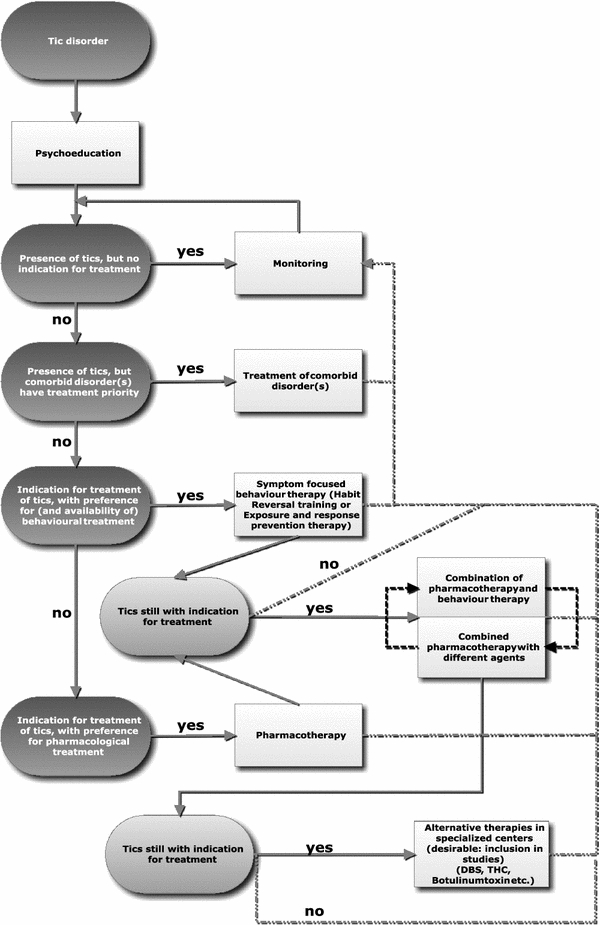
To develop a European guideline on pharmacologic treatment of Tourette syndrome (TS) the available literature was thoroughly screened and extensively discussed by a working group of the European Society for the Study of Tourette syndrome (ESSTS). Although there are many more studies on pharmacotherapy of TS than on behavioral treatment options, only a limited number of studies meets rigorous quality criteria. Therefore, we have devised a two-stage approach. First, we present the highest level of evidence by reporting the findings of existing Cochrane reviews in this field. Subsequently, we provide the first comprehensive overview of all reports on pharmacological treatment options for TS through a MEDLINE, PubMed, and EMBASE search for all studies that document the effect of pharmacological treatment of TS and other tic disorders between 1970 and November 2010. We present a summary of the current consensus on pharmacological treatment options for TS in Europe to guide the clinician in daily practice. This summary is, however, rather a status quo of a clinically helpful but merely low evidence guideline, mainly driven by expert experience and opinion, since rigorous experimental studies are scarce.
Overview
The claims and statistics of this paper haven’t been checked yet.
Run the check — free, no account needed. It reads the open-access text and checks the sources it cites.
Integrity signals
Registry
Cites
Statistics
Figures
Verification
Claims the paper makes
The claims and statistics of this paper haven’t been checked yet.
Run the check — free, no account needed. It reads the open-access text and checks the sources it cites.
Claims other papers make about this one
Each is checked against this paper’s own text: does it say what the citing paper says it does?
The cited source says what the claim attributes to it.
In the citing paper
“Several clinical trials have shown that administration of dopamine antagonists, such as risperidone and haloperidol, are effective in suppressing tics in most patients (Bloch et al., 2011; Roessner et al., 2011).”
From Response Inhibition and Interference Control in Obsessive–Compulsive Spectrum Disorders (2014) · cites this paper as Roessner et al., 2011
Self-check
Percentages, sums and reported differences re-computed from the paper’s own numbers.
The self-check needs the paper’s full text.
Citations
Cites
The yale global tic severity scale: initial testing of a clinician-rated scale of tic severity
LECKMAN, J. F., RIDDLE, M. A., HARDIN, M. T., ORT, S. I., SWARTZ, K. L., STEVENSON, J., & COHEN, D. J. (1989) · Journal of the American Academy of Child & Adolescent Psychiatry · doi:10.1097/00004583-198907000-00015 · Cited by 2,146
Burris, K. D., Molski, T. F. P., Xu, C., Ryan, E., Tottori, K., Kikuchi, T., Yocca, F. D., & Molinoff, P. B. (2002) · Journal of Pharmacology and Experimental Therapeutics · doi:10.1124/jpet.102.033175 · Cited by 924
Tourette syndrome, associated conditions and the complexities of treatment
Robertson, M. M. (2000) · Brain · doi:10.1093/brain/123.3.425 · Cited by 704
Leckman, J. F. (2002) · The Lancet · doi:10.1016/s0140-6736(02)11526-1 · Cited by 696
Bloch, M. H., Landeros-Weisenberger, A., Kelmendi, B., Coric, V, Bracken, M. B., & Leckman, J. F. (2006) · Molecular Psychiatry · doi:10.1038/sj.mp.4001823 · Cited by 635
Dulcan, M. (1997) · Journal of the American Academy of Child & Adolescent Psychiatry · doi:10.1097/00004583-199710001-00007 · Cited by 628
Antipsychotic-induced weight gain: a review of the literature.
Allison, D. B., & Casey, D. E. (2001) · PubMed · Cited by 594
Scahill, L., Chappell, P. B., Kim, Y. S., Schultz, R. T., Katsovich, L., Shepherd, E., Arnsten, A. F. T., Cohen, D. J., & Leckman, J. F. (2001) · American Journal of Psychiatry · doi:10.1176/appi.ajp.158.7.1067 · Cited by 588
Perlmutter, S. J., Leitman, S. F., Garvey, M. A., Hamburger, S., Feldman, E., Leonard, H. L., & Swedo, S. E. (1999) · The Lancet · doi:10.1016/s0140-6736(98)12297-3 · Cited by 556
Gilles de la Tourette Syndrome
(2021) · Springer eBooks · doi:10.1007/978-3-319-91280-6_300752 · Cited by 537
Research works printed but not linked: 3
- Bastiampillai T, Dhillon R, Mohindra R (2008) Exacerbation of tics secondary to clozapine therapy. Aust N Z J Psychiatry 42:1068–1070
- Bruun RD, Budman CL (1996) Risperidone as a treatment for Tourette’s syndrome. J Clin Psychiatry 57:29–31
- Miranda CM, Castiglioni TC (2007) Aripiprazole for the treatment of Tourette syndrome. Experience in 10 patients. Rev Med Chil 135:773–776
Cited by
Sorted by citations
The brain basis of emotion: a meta-analytic review
Lindquist, K. A., Wager, T. D., Kober, H., Bliss-Moreau, E., & Barrett, L. F. (2012) · Behavioral and Brain Sciences · doi:10.1017/s0140525x11000446 · Cited by 2,320
Live fast, die young? A review on the developmental trajectories of ADHD across the lifespan
Franke, B., Michelini, G., Asherson, P., Banaschewski, T., Bilbow, A., Buitelaar, J. K., Cormand, B., Faraone, S. V., Ginsberg, Y., Haavik, J., et al. (2018) · European Neuropsychopharmacology · doi:10.1016/j.euroneuro.2018.08.001 · Cited by 643
Cortese, S., Holtmann, M., Banaschewski, T., Buitelaar, J., Coghill, D., Danckaerts, M., Dittmann, R. W., Graham, J., Taylor, E., Sergeant, J., et al. (2013) · Journal of Child Psychology and Psychiatry · doi:10.1111/jcpp.12036 · Cited by 336
Neuromodulation in Tourette syndrome: dopamine and beyond
Buse, J., Schoenefeld, K., Münchau, A., & Roessner, V. (2013) · Neuroscience & Biobehavioral Reviews · doi:10.1016/j.neubiorev.2012.10.004 · Cited by 185
Self-citationResponse Inhibition and Interference Control in Obsessive–Compulsive Spectrum Disorders
van Velzen, L. S., Vriend, C., de Wit, S. J., & van den Heuvel, O. A. (2014) · Frontiers in Human Neuroscience · doi:10.3389/fnhum.2014.00419 · Cited by 169
Ganos, C., & Martino, D. (2015) · Neurologic Clinics · doi:10.1016/j.ncl.2014.09.008 · Cited by 119
Tourette Syndrome and comorbid ADHD: Current pharmacological treatment options
Rizzo, R., Gulisano, M., Calì, P. V., & Curatolo, P. (2013) · European Journal of Paediatric Neurology · doi:10.1016/j.ejpn.2013.01.005 · Cited by 76
Self-citationBehavioural treatment of tics: habit reversal and exposure with response prevention
van de Griendt, J. M. T. M., Verdellen, C. W. J., van Dijk, M. K., & Verbraak, M. J. P. M. (2013) · Neuroscience & Biobehavioral Reviews · doi:10.1016/j.neubiorev.2012.10.007 · Cited by 75
Metadata
- Authors
- the ESSTS Guidelines Group, Roessner, V., Plessen, K. J., Rothenberger, A., Ludolph, A. G., Rizzo, R., Skov, L., Strand, G., Stern, J. S., Termine, C., & Hoekstra, P. J.
- Affiliations
- University of Copenhagen (DK)
- Universität Ulm (DE)
- University of Catania (IT)
- Glostrup Hospital (DK)
- Oslo University Hospital (NO)
- St George's Hospital (GB)
- University of Insubria (IT)
- University Medical Center Groningen (NL)
- Corresponding author
- Roessner, Veit
- ORCID
- Venue
- European Child & Adolescent Psychiatry
- Published
- 2011-03-29
- Volume
- 20
- Issue
- 4
- Pages
- 173-196
- ISSN
- 1018-8827 (ISSN-L)
- 1435-165X
- PMC
- PMC3065650
- OpenAlex
- W2171208117
- Cited by
- 461
- References
- 305
- Citations by year
- 2026: 13 · 2025: 14 · 2024: 17 · 2023: 15 · 2022: 27 · 2021: 34 · 2020: 51 · 2019: 35 · 2018: 43 · 2017: 33 · 2016: 44 · 2015: 23 · 2014: 30 · 2013: 44 · 2012: 29
- FWCI
- 38.68
- Type
- journal article
- Language
- en
- Open access
- hybrid
- doi.org
- Licence
- cc-by-nc
- Locations
- European Child & Adolescent Psychiatry (publishedVersion, cc-by-nc)
- Europe PMC (PubMed Central) (publishedVersion, cc-by-nc)
- PubMed Central (publishedVersion, cc-by-nc)
- PubMed (publishedVersion)
- Research Publications (Maastricht University) (publishedVersion, cc-by-nc)
- University of Groningen research database (University of Groningen / Centre for Information Technology) (publishedVersion)
- SERVAL (Université de Lausanne) (publishedVersion, other-oa)
- HAL (submittedVersion, other-oa)
- IRIS (submittedVersion)
- BOA (University of Milano-Bicocca) (submittedVersion, cc-by-nc)
- UCL Discovery (University College London) (submittedVersion)
- GoeScholar The Publication Server of the Georg-August-Universität Göttingen (Georg-August-Universität Göttingen) (submittedVersion, cc-by)
- IrInSubria (University of Insubria) (submittedVersion)
- IRIS Research product catalog (Sapienza University of Rome) (submittedVersion)
- GRO (submittedVersion, cc-by)
- University of Birmingham Research Portal (University of Birmingham) (submittedVersion)
- Research at the University of Copenhagen (University of Copenhagen) (submittedVersion)
- Trinity's Access to Research Output (TARA) (Trinity College Dublin) (submittedVersion)
- University of Groningen research database (University of Groningen / Centre for Information Technology) (submittedVersion)
- Research Publications (Maastricht University) (submittedVersion, other-oa)
- Funders
- Eli Lilly and Company
- Lundbeckfonden
- H. Lundbeck A/S
- Cilag
- Topics
- Social Sciences › Psychology › Clinical Psychology › Obsessive-Compulsive Spectrum Disorders
- Social Sciences › Psychology › Clinical Psychology › Stuttering Research and Treatment
- Health Sciences › Medicine › Psychiatry and Mental health › Schizophrenia research and treatment
- Keywords
- Tourette syndrome, tic disorders, pharmacotherapy, evidence-based medicine, expert consensus
- MeSH terms
- Europe, Tourette Syndrome, Humans, Tic Disorders, Antipsychotic Agents
About these checks
Registry, retraction, Cites and statistics results are computed, not judged, with one exception: a printed reference that no index lists is read once by a model before it counts as a citation error. Claims are extracted by a model and kept only when their quote appears verbatim in the text; each cited source is then checked, with a model’s help, for whether it says what the claim relies on. Those verdicts can be wrong — read the claim’s quote and the cited source before relying on one.
Statistics and arithmetic are recomputed, not judged.
Confidence bands are shown only for fields calibrated on our annotated test set. None is calibrated yet, so no band is shown.
What counts as a claim ›How we measure confidence ›How we check this ›
Are you an author, or do you see a problem with this page? Request a review
