

All better than being disengaged: Student engagement patterns and their relations to academic self-concept and achievement
Open accessThe DOI matches its Crossref record; 96 of the 96 references it cites were found in a registry or an index.
Abstract
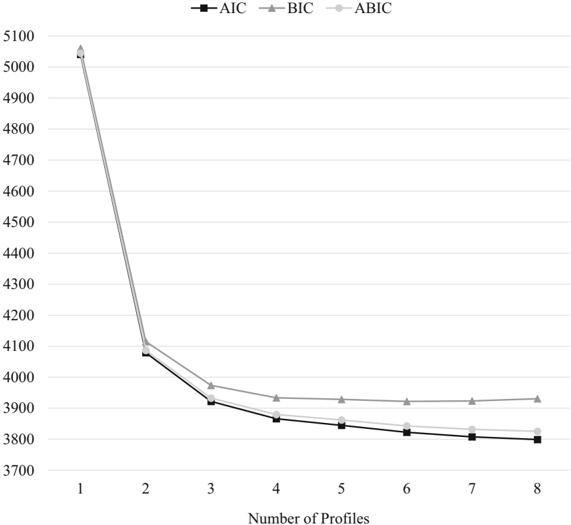
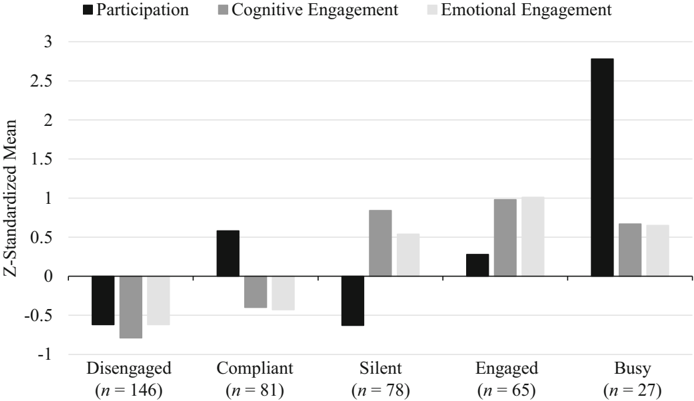
Student participation and cognitive and emotional engagement in learning activities play a key role in student academic achievement and are driven by student motivational characteristics such as academic self-concept. These relations have been well established with variable-centered analyses, but in this study, a person-centered analysis was applied to describe how the different aspects of student engagement are combined within individual students. Specifically, we investigated how the number of hand-raisings interacts with student cognitive and emotional engagement in various engagement patterns. Additionally, it was analyzed how these engagement patterns relate to academic self-concept as an antecedent and achievement as an outcome. In an empirical study, high school students ( N = 397) from 20 eighth-grade classrooms were surveyed and videotaped during one mathematics school lesson. The design included a pre- and post-test, with the videotaping occurring in between. Five within-student engagement patterns were identified by latent profile analysis: disengaged, compliant, silent, engaged, and busy. Students with higher academic self-concept were more likely to show a pattern of moderate to high engagement. Compared with students with low engagement, students with higher engagement patterns gained systematically in end-of-year achievement. These findings illustrate the power of person-centered analyses to illuminate the complexity of student engagement. They imply the need for differentiation beyond disengaged and engaged students and bring along the recognition that being engaged can take on various forms, from compliant to busy.
Overview
The claims and statistics of this paper haven’t been checked yet.
Free: it reads the open-access text and checks the first 5 claims that cite a source we can check. Create a free account to check every claim.
Integrity signals
Registry
Cites
Statistics
Figures
Verification
Claims the paper makes
The claims and statistics of this paper haven’t been checked yet.
Free: it reads the open-access text and checks the first 5 claims that cite a source we can check. Create a free account to check every claim.
Claims other papers make about this one
Each is checked against this paper’s own text: does it say what the citing paper says it does?
The cited source says what the claim attributes to it.
In the citing paper
“In the long-term, this could lead to decreased academic achievement and increased dropout rates [58].”
From Impact of online learning on student's performance and engagement: a systematic review (2024) · cites this paper as [58]
Self-check
Percentages, sums and reported differences re-computed from the paper’s own numbers.
The self-check needs the paper’s full text.
Citations
Cites
Ryan, R. M., & Deci, E. L. (2000) · American Psychologist · doi:10.1037//0003-066x.55.1.68 · Cited by 54,599
Estimating the Dimension of a Model
Schwarz, G. (1978) · The Annals of Statistics · doi:10.1214/aos/1176344136 · Cited by 47,033
Information Theory and an Extension of the Maximum Likelihood Principle
Akaike, H. (1998) · Springer Series in Statistics · doi:10.1007/978-1-4612-1694-0_15 · Cited by 17,781
School Engagement: Potential of the Concept, State of the Evidence
Fredricks, J. A., Blumenfeld, P. C., & Paris, A. H. (2004) · Review of Educational Research · doi:10.3102/00346543074001059 · Cited by 12,581 · cited 12×
“This approach does not fully use current methodological advances in its differentiation between the interdependencies of the engagement dimensions and identification of subgroups of students that share specific patterns across engagement dimensions (Fredricks et al. 2004).”
BackgroundInfluentialNylund, K. L., Asparouhov, T., & Muthén, B. O. (2007) · Structural Equation Modeling: A Multidisciplinary Journal · doi:10.1080/10705510701575396 · Cited by 11,415
Testing the number of components in a normal mixture
Lo, Y. (2001) · Biometrika · doi:10.1093/biomet/88.3.767 · Cited by 4,640
Self-concept: validation of construct interpretations.
Shavelson, R. J., Hubner, J. J., & Stanton, G. C. (1976) · Review of Educational Research · doi:10.3102/00346543046003407 · Cited by 4,164 · cited 1×
“One construct capturing student self-evaluations of their domain-specific competence is academic self-concept—the perception of one’s subject-specific academic abilities emerging from prior experiences (Shavelson et al. 1976).”
BackgroundPekrun, R., Goetz, T., Titz, W., & Perry, R. P. (2002) · Educational Psychologist · doi:10.1207/s15326985ep3702_4 · Cited by 3,931 · cited 2×
“…processing prompted, for example, by teacher questions and peer contributions (Chi et al. 2018; Jurik et al. 2014; Liem et al. 2008); and the experience of interest (Jansen et al. 2016; Wigfield and Cambria 2010) and enjoyment (Pekrun et al. 2002) are antecedents of academic achievement.”
BackgroundAuxiliary Variables in Mixture Modeling: Three-Step Approaches Using M plus
Asparouhov, T., & Muthén, B. (2014) · Structural Equation Modeling: A Multidisciplinary Journal · doi:10.1080/10705511.2014.915181 · Cited by 3,535
Skinner, E. A., & Belmont, M. J. (1993) · Journal of Educational Psychology · doi:10.1037/0022-0663.85.4.571 · Cited by 3,428 · cited 1×
“Silent students, for example, may be confronted with increased teacher control nurturing unfavorable motivational processes and decreased engagement over time due to their low participation (Skinner and Belmont 1993).”
Background
Research works printed but not linked: 5
- Muthén, L. K., & Muthén, B. O. (1998-2017). Mplus user's guide (8th ed.). Los Angeles: Muthén & Muthén.
- Seidel, T. (2005). Video analysis strategies of the IPN Video Study -a methodological overview. In T. Seidel, M. Prenzel, & M. Kobarg (Eds.). How to run a video study: Technical report of the IPN Video Study (pp. 70-78). Münster: Waxmann.
- Seidel, T., Rimmele, R., & Dalehefte, I. M. (2003). Skalendokumentation: Schülerfragebogen [Scales: student questionaire]. In T. Seidel, M. Prenzel, R. Duit, & M. Lehrke (Eds.). Technischer Bericht zur Videostudie "1Lehr-Lern-Prozesse im Physikunterricht" (pp. 317-388). Kiel: IPN.
- Böheim, R., Schnitzler, K., Gröschner, A., Weil, M., Knogler, M., Schindler, A.-K., Alles, M., & Seidel, T. (in press). How changes in teachers' dialogic discourse practice relate to changes in students' activation, motivation and cognitive engagement. Learning, Culture, and Social Interaction
- Seidel, T., Schnitzler, K., Kosel, C., Stürmer, K., & Holzberger, D. (2020). Student characteristics in the eyes of teachers: differences between novice and expert teachers in judgment accuracy, observed behavioral cues, and gaze. Educational Psychology Review. https://doi.org/10.1007/s10648-020-09532-2 · DOI
Cited by
Items 201–213 of 213
Ghasemi, M., Meissel, K., McIntosh, T., & Hashemi, L. (2026) · Adversity and Resilience Science · doi:10.1007/s42844-026-00229-z
Bitegeko, R. M. (2026) · Educational Technology Quarterly · doi:10.55056/etq.1116
Azzahra, F., Desy Auliya, A., Amirullah, A., Hidayatullah, A., & Hafsi, A. R. (2026) · ULIL ALBAB Jurnal Ilmiah Multidisiplin · doi:10.56799/jim.v5i9.18074
The Influence of Student Engagement in Gamified E-Learning on Intercultural Competence
Zhang, H., & Xia, Z. (2026) · International Conference on e-Education, e-Business, e-Management and e-Learning · doi:10.1109/ic4e69618.2026.11631531
Wang, X., Mei, J., Jia, L., Qu, L., & Jin, Y. (2026) · Behavioral Sciences · doi:10.3390/bs16091467
Xue, B., & Luo, H. (2026) · Frontiers in Psychology · doi:10.3389/fpsyg.2026.1915779
Cognitive engagement of slow learners during the observation stage in inclusive science classrooms
Dewi, R., Hidayat, S., & Hendrayana, A. (2026) · Multidisciplinary Science Journal · doi:10.31893/multiscience.2027229
Zhang, Y. K., Chang, S., Huang, Y., Xu, M., Xu, X., & Xin, S. (2026) · Behavioral Sciences · doi:10.3390/bs16091679
Lagestad, P., Westlie, K., Hagen, R. V., & Sorensen, A. (2026) · Frontiers in Education · doi:10.3389/feduc.2026.1912940
Morueta, R. T., Garrido, Y. C., Barragán, A. J., Enrique, J. M., & Andújar, J. M. (2026) · Multidisciplinary Journal for Education Social and Technological Sciences · doi:10.4995/muse.2026.25477
Lina, Y., Govindasamy, V. A., Piaw, C. Y., & Kharuddin, A. F. (2026) · Journal of Museum Education · doi:10.1080/10598650.2026.2749218
Vergara, C. R. (2026) · International Journal of ADVANCED AND APPLIED SCIENCES · doi:10.21833/ijaas.2026.09.003
Metadata
- Authors
- Schnitzler, K., Holzberger, D., & Seidel, T.
- Affiliations
- Technical University of Munich (DE)
- Corresponding author
- Schnitzler, Katharina
- Venue
- European Journal of Psychology of Education
- Published
- 2020-09-05
- Volume
- 36
- Issue
- 3
- Pages
- 627-652
- ISSN
- 0256-2928 (ISSN-L)
- 1878-5174
- OpenAlex
- W3083457042
- Cited by
- 213
- References
- 91
- Citations by year
- 2026: 37 · 2025: 58 · 2024: 47 · 2023: 35 · 2022: 24 · 2021: 10 · 2020: 2
- FWCI
- 17.16
- Type
- journal article
- Language
- en
- Open access
- hybrid
- doi.org
- Licence
- cc-by
- creativecommons.org/licenses/by/4.0 (tdm)
- creativecommons.org/licenses/by/4.0 (vor)
- Locations
- European Journal of Psychology of Education (publishedVersion, cc-by)
- mediaTUM – the media and publications repository of the Technical University Munich (Technical University Munich) (submittedVersion, other-oa)
- mediaTUM – the media and publications repository of the Technical University Munich (Technical University Munich) (submittedVersion)
- Funders
- Deutsche Forschungsgemeinschaft (SE1397/7-1 and SE1397/7-3)
- Topics
- Social Sciences › Psychology › Developmental and Educational Psychology › Education, Achievement, and Giftedness
- Social Sciences › Psychology › Developmental and Educational Psychology › Innovative Teaching and Learning Methods
- Social Sciences › Education › Early Childhood Education and Development
- Keywords
- student engagement, academic self-concept, academic performance, cognitive engagement, emotional engagement, engagement patterns, person-centered analysis, latent profile analysis, hand raising, high school students, mathematics education, student motivation
About these checks
Registry, retraction, Cites and statistics results are computed, not judged, with one exception: a printed reference that no index lists is read once by a model before it counts as a citation error. Claims are extracted by a model and kept only when their quote appears verbatim in the text; each cited source is then checked, with a model’s help, for whether it says what the claim relies on. Those verdicts can be wrong — read the claim’s quote and the cited source before relying on one.
Statistics and arithmetic are recomputed, not judged.
Confidence bands are shown only for fields calibrated on our annotated test set. None is calibrated yet, so no band is shown.
What counts as a claim ›How we measure confidence ›How we check this ›
Are you an author, or do you see a problem with this page? Request a review
Data sources
Bibliographic data: Semantic Scholar, OpenAlex, Crossref.
Contains information from the Semantic Scholar Academic Graph Datasets, made available under the ODC Attribution License (ODC-BY 1.0).
Semantic Scholar’s data is described in: Kinney, R., et al. (2023). The Semantic Scholar Open Data Platform. arXiv:2301.10140.
