

A practical guide to multi-objective reinforcement learning and planning
Open accessThe DOI matches its Crossref record; 218 of the 223 references it cites were found in a registry or an index.
Abstract
Real-world sequential decision-making tasks are generally complex, requiring trade-offs between multiple, often conflicting, objectives. Despite this, the majority of research in reinforcement learning and decision-theoretic planning either assumes only a single objective, or that multiple objectives can be adequately handled via a simple linear combination. Such approaches may oversimplify the underlying problem and hence produce suboptimal results. This paper serves as a guide to the application of multi-objective methods to difficult problems, and is aimed at researchers who are already familiar with single-objective reinforcement learning and planning methods who wish to adopt a multi-objective perspective on their research, as well as practitioners who encounter multi-objective decision problems in practice. It identifies the factors that may influence the nature of the desired solution, and illustrates by example how these influence the design of multi-objective decision-making systems for complex problems.
Overview
The claims and statistics of this paper haven’t been checked yet.
Free: it reads the open-access text and checks the first 5 claims that cite a source we can check. Create a free account to check every claim.
Integrity signals
Registry
Cites
Statistics
Figures
Verification
Claims the paper makes
The claims and statistics of this paper haven’t been checked yet.
Free: it reads the open-access text and checks the first 5 claims that cite a source we can check. Create a free account to check every claim.
Claims other papers make about this one
Each is checked against this paper’s own text: does it say what the citing paper says it does?
The source backs part of the claim, not all of it — or backs it for a different population, condition or comparison.
In the citing paper
“nl-MOMDPs are widely recognized in the reinforcement literature as particularly difficult to solve [26,27], and may admit of no computationally tractable exact solutions.”
From Phenomenal interface theory: a model for basal consciousness (2025) · cites this paper as [27]
Experimental — accuracy not yet measuredThe cited source says what the claim attributes to it.
In the citing paper
“The task faced by the bee is thus best modelled as a nonlinear multi-objective Markov Decision Process (nl-MOMDP) [26,27].”
From Phenomenal interface theory: a model for basal consciousness (2025) · cites this paper as [27]
Self-check
Percentages, sums and reported differences re-computed from the paper’s own numbers.
The self-check needs the paper’s full text.
Citations
Cites
A fast and elitist multiobjective genetic algorithm: NSGA-II
Deb, K., Pratap, A., Agarwal, S., & Meyarivan, T. (2002) · IEEE Transactions on Evolutionary Computation · doi:10.1109/4235.996017 · Cited by 50,053 · cited 1×
“…best vector from a solution set S according to: π∗ = arg max π∈S u(Vπ), (17) so it helps if the user has a larger variety of value vectors to select from.2 In multi-objective optimisation, this idea has been used to create algorithms that explicitly look for diverse solutions [Deb et al., 2002].”
MethodProximal Policy Optimization Algorithms
Schulman, J., Wolski, F., Dhariwal, P., Radford, A., & Klimov, O. (2017) · arXiv · doi:10.48550/arxiv.1707.06347 · Cited by 40,403
Human-level control through deep reinforcement learning
Mnih, V., Kavukcuoglu, K., Silver, D., Rusu, A. A., Veness, J., Bellemare, M. G., Graves, A., Riedmiller, M., Fidjeland, A. K., Ostrovski, G., et al. (2015) · Nature · doi:10.1038/nature14236 · Cited by 30,357 · cited 2×
“Deep reinforcement learning methods [Mnih et al., 2015, Lillicrap et al., 2015] have shown to scale beyond finite and discrete spaces to problem domains with high-dimensional, continuous state and action spaces.”
MethodReinforcement Learning: An Introduction
(2005) · IEEE Transactions on Neural Networks · doi:10.1109/tnn.2004.842673 · Cited by 24,496
Continuous control with deep reinforcement learning
Lillicrap, T. P., Hunt, J. J., Pritzel, A., Heess, N., Erez, T., Tassa, Y., Silver, D., & Wierstra, D. (2015) · arXiv · doi:10.48550/arxiv.1509.02971 · Cited by 10,782 · cited 2×
“In the second stage, the learned skills are used in a hierarchical version of DDPG [85] to produce a policy coverage set for the MOMDP.”
BackgroundMethodMultiobjective evolutionary algorithms: a comparative case study and the strength Pareto approach
Zitzler, E., & Thiele, L. (1999) · IEEE Transactions on Evolutionary Computation · doi:10.1109/4235.797969 · Cited by 8,798
Model-Agnostic Meta-Learning for Fast Adaptation of Deep Networks
Finn, C., Abbeel, P., & Levine, S. (2017) · arXiv · doi:10.48550/arxiv.1703.03400 · Cited by 8,512
Santos, A. G., da Rocha, G. O., & de Andrade, J. B. (2019) · Scientific Reports · doi:10.1038/s41598-018-37186-2 · Cited by 8,495
Nash, J. (1951) · The Annals of Mathematics · doi:10.2307/1969529 · Cited by 7,002
Nash, J. (1989) · Cournot Oligopoly · doi:10.1017/cbo9780511528231.007 · Cited by 5,595
Research works printed but not linked: 10
- 6. Aissani, N., Beldjilali, B., & Trentesaux, D. (2008). Efficient and effective reactive scheduling of manufacturing system using sarsa-multi-objective agents. In: MOSIM'08: 7th Conference Interna- tionale de Modelisation et Simulation, pp. 698-707.
- 28. Dazeley, R., Vamplew, P., & Cruz, F. (2021). Explainable reinforcement learning for broad-xai: A conceptual framework and survey. arXiv preprint arXiv: 2108. 09003.
- 72. Juozapaitis, Z., Koul, A., Fern, A., Erwig, M., & Doshi-Velez, F. (2019). Explainable reinforce- ment learning via reward decomposition. In: IJCAI/ECAI Workshop on Explainable Artificial Intelligence.
- 74. Kluyver, T., Ragan-Kelley, B., Pérez, F., Granger, B., Bussonnier, M., Frederic, J., Kelley, K., Hamrick, J., Grout, J., Corlay, S., Ivanov, P., Avila, D., Abdalla, S., Willing, C., & development team, J. (2016). Jupyter notebooks -a publishing format for reproducible computational work- flows. In: F. Loizides, B. Scmidt (eds.) Positioning and Power in Academic Publishing: Players, Agents and Agendas, pp. 87-90. IOS Press, Netherlands. URL https:// eprin ts. soton. ac. uk/ 403913/
- 140. Rollon, E., & Larrosa, J. (2008). Constraint optimization techniques for multiobjective branch and bound search. In: International conference on logic programming, ICLP. 150.
- Rowe, J., Smith, A., Pokorny, B., Mott, B., & Lester, J. (2018). Toward automated scenario generation with deep reinforcement learning in gift. In: Proceedings of the Sixth Annual GIFT User Symposium, pp. 65–74.
- 146. Smith, B. J., Klassert, R., & Pihlakas, R. (2021). Soft maximin approaches to multi-objective deci- sion-making for encoding human intuitive values. In: Multi-Objective Decision Making Workshop. 160.
- 163. Van Dijk, M.T., van Wingerden, J.W., Ashuri, T., Li, Y., & Rotea, M.A. (2016). Yaw-misalignment and its impact on wind turbine loads and wind farm power output. Journal of Physics: Conference Series, 753(6). 182. · DOI
- White, C. C., & Kim, K. W. (1980). Solution procedures for vector criterion Markov decision processes. Large Scale Systems, 1, 129–140.
- 179. Xu, J., Tian, Y., Ma, P., Rus, D., Sueda, S., & Matusik, W. (2020). Prediction-guided multi-objec- tive reinforcement learning for continuous robot control. In: Proceedings of the 37th International Conference on Machine Learning. 205.
Cited by
Items 201–300 of 401
Solving Complex Optimisation Problems by Machine Learning
Prestwich, S. (2024) · AppliedMath · doi:10.3390/appliedmath4030049 · Cited by 2
Inferring preferences from demonstrations in multi-objective reinforcement learning
Lu, J., Mannion, P., & Mason, K. (2024) · Neural Computing and Applications · doi:10.1007/s00521-024-10412-x · Cited by 2
“Given the variability in user preferences regarding objectives, the introduction of a preference factor, typically represented by a linear weight vector [4], is essential for the comparative evaluation of distinct solutions.”
InfluentialSelf-citationA Multi-objective Multi-agent Interactive Deep Reinforcement Learning Approach for Feature Selection
Hellali, R., Dagdia, Z. C., & Zeitouni, K. (2025) · Communications in computer and information science · doi:10.1007/978-981-96-6954-7_2 · Cited by 2
Information, Entanglement, and Emergent Social Norms: Searching for ‘Normal’
Cardinal, J. S., & Loughmiller-Cardinal, J. (2024) · Societies · doi:10.3390/soc14110227 · Cited by 7
Prediction-guided multi-objective reinforcement learning with corner solution search
Ajani, O. S., Ivan, D. F., Darlan, D., & Mallipeddi, R. (2024) · Computers & Electrical Engineering · doi:10.1016/j.compeleceng.2024.109964 · Cited by 3
Towards Optimized Dynamic Ridesharing System Through Multi-Objective Reinforcement Learning
Abdelmoumène, H., & Boussahoul, S. (2024) · IEEE International Multi-Conference on Smart Systems & Green Process (IMC-SSGP) · doi:10.1109/imc-ssgp63352.2024.10919539 · Cited by 2
Dynamic Non-Binary Prioritisation for UTM Resource Allocation
Conrad, C., Tsourdos, A., Panda, D. K., Guo, W., Shamim, M., & Vanhandenhove, G. (2025) · Integrated Communications, Navigation and Surveillance Conference (ICNS) · doi:10.1109/icns65417.2025.10976825 · Cited by 2
“Different objectives, however, must be statically weighted in a single reward function, unless multi-objective RL (MORL) are employed [48].”
MORL4PC: Multi-Objective Reinforcement Learning for Process Control
Kotecha, N., Bloor, M., Tsay, C., & del Rio‐Chanona, E. A. (2025) · Systems and Control Transactions · doi:10.69997/sct.161830 · Cited by 2
Multi-objective Reinforcement Learning for Energy-Efficient Industrial Control
Schäfer, G., Seliger, R., Rehrl, J., Huber, S., & Hirlaender, S. (2025) · Communications in computer and information science · doi:10.1007/978-3-032-02003-1_6 · Cited by 5
Online Pareto-Optimal Decision-Making for Complex Tasks Using Active Inference
Amorese, P., Wakayama, S., Ahmed, N. R., & Lahijanian, M. (2025) · IEEE Transactions on Robotics · doi:10.1109/tro.2025.3600155 · Cited by 3
“We evaluate the performance of our framework against the state-of-the-art in two benchmark problems.”
Building Altruistic and Moral AI Agent With Brain-Inspired Emotional Empathy Mechanisms
Zhao, F., Feng, H., Tong, H., Han, Z., Lin, E., Lu, E., Sun, Y., & Zeng, Y. (2025) · IEEE Transactions on Affective Computing · doi:10.1109/taffc.2025.3627936 · Cited by 5
“The algorithms’ common simplifying techniques, such as scalarization, are often inadequate for this task [61] and have been shown to lead to collective failure in social dilemmas that pit self-interest against altruism [62].”
Gobbi, H., dos, S., & Bazzan, A. L. C. (2023) · Computer Science and Information Systems · doi:10.2298/csis221210072g · Cited by 5
Renewable energy integration and distributed energy optimization in smart grid
Fu, G. S., Yin, X., & Xu, Y. L. (2024) · Journal of Physics Conference Series · doi:10.1088/1742-6596/2795/1/012004 · Cited by 1
Boudour, R., Aklouf, Y., Fekir, N. C., & Benmessai, S. (2024) · Global Congress on Emerging Technologies (GCET) · doi:10.1109/gcet64327.2024.10934302 · Cited by 1
“However, this simplification can be infeasible or undesirable, and setting user preferences in advance is not always practical due to individual variability [20].”
Autonomous Vehicle Decision Making Through Multi-grid Markov Decision Processes
Caldeira, T., Khonji, M., Dias, J. M. M., & Lima, P. U. (2025) · IFIP advances in information and communication technology · doi:10.1007/978-3-031-97051-1_17 · Cited by 1
Tian, S., Wei, C., Jian, S., & Ji, Z. (2025) · Engineering Science and Technology an International Journal · doi:10.1016/j.jestch.2025.102147 · Cited by 1
“Recently, MORL has gained significant attention in domains like robotic control [28,29].”
Li, T., Meng, Y., & Tang, L. (2025) · IEEE Transactions on Neural Networks and Learning Systems · doi:10.1109/tnnls.2025.3603165 · Cited by 1
“The employment of the nonlinear scalarization function may violate the additivity of the scalarized rewards to the Bellman equation [26].”
Generalizable Offline Multiobjective Reinforcement Learning via Preference-Conditioned Diffuser
Xiao, Y., Yuan, L., Li, L., Zhang, Z., Li, Y.-C., & Yu, Y. (2025) · IEEE Transactions on Neural Networks and Learning Systems · doi:10.1109/tnnls.2025.3591838 · Cited by 2
“Since the true Pareto front for many problems is unknown, two metrics [35] for relative comparisons on empirical Pareto front P among di ff erent algorithms will be used.”
Purpose-driven Open-Ended Learning: biasing OEL through external guidance
Morelli, A., Romero, A., Cerdas-Vargas, D., Duro, R. J., & Santucci, V. G. (2025) · IEEE International Conference on Development and Learning (ICDL) · doi:10.1109/icdl63968.2025.11204395 · Cited by 2
“Multi-objective RL [20], in a few cases, treats intrinsic and extrinsic motivations as independent objectives [21].”
Li, D., & Yang, Z. (2025) · Journal of Process Control · doi:10.1016/j.jprocont.2025.103578 · Cited by 1
Callaghan, A., Mason, K., & Mannion, P. (2025) · Neurocomputing · doi:10.1016/j.neucom.2025.132032 · Cited by 4
Self-citationTowards Autonomous Goal Management: A Decision Theoretic Approach and Key Challenges
de Oliveira, I. F. D., & Klös, V. (2025) · IEEE International Conference on Autonomic Computing and Self-Organizing Systems Companion (ACSOS-C) · doi:10.1109/acsos-c66519.2025.00023 · Cited by 1
Kammer-Kerwick, M., & Aldrich, E. (2025) · PLOS complex systems. · doi:10.1371/journal.pcsy.0000079 · Cited by 1
“This approach aligns with the broader research direction in multi-objective reinforcement learning (MORL) frameworks, which aim to address the challenges posed by decision-making in complex, multi-dimensional environments [58].”
Hau, B. M., You, S., Kim, H., Long, L. N. B., Cuong, T. N., & Nguyễn, D. A. (2025) · Maritime Economics & Logistics · doi:10.1057/s41278-025-00342-3 · Cited by 1
“This can offer the optimal strategy for a multi-objective problem when appropriate reward values are optimized for the objectives (Hayes et al. 2022 ).”
Passive Reinforcement Learning with Optimal Control for Safe Convergence in Cyber–physical Systems
Piccinelli, N., Meli, D., Bonoldi, E., & Muradore, R. (2025) · Robotics and Autonomous Systems · doi:10.1016/j.robot.2025.105293 · Cited by 1
Reinforcement Learning and Digital Human Modeling for Multi-objective Factory Layout Planning
Elango, V., Lind, A., Joseph, M. S., Makkar, A., Sandblad, J., Hanson, L., Syberfeldt, A., & Forsman, M. (2025) · Springer series in design and innovation · doi:10.1007/978-981-96-9334-4_44 · Cited by 1
Hairi, F., Jiao, Y., Zhou, T., Yang, H., Dong, C., Yang, F., Momma, M., Gao, Y., & Liu, J. (2025) · IEEE Conference on Decision and Control (CDC) · doi:10.1109/cdc57313.2025.11312471 · Cited by 1
“Multi-objective systems [1] have gained significant attention due to their applicabilities in many real-world applications.”
Node Criticality Estimation in Intermodal Networks
Bukvić, L., & Abramović, B. (2026) · Transportation research procedia · doi:10.1016/j.trpro.2025.12.019 · Cited by 1
A Deep Reinforcement Learning-Based Energy-Aware Open Shop Scheduling Method
Chou, Y.-L. (2026) · IEEE Access · doi:10.1109/access.2026.3659187 · Cited by 1
“Hayes et al. [51] provided a comprehensive guide to multi-objective reinforcement learning.”
Designing and generating reinforcement learning training simulators using goal models
Liaskos, S., Dang, N., Khan, S. M., Mylopoulos, J., Golipour, R., & Radjou, A. (2026) · Data & Knowledge Engineering · doi:10.1016/j.datak.2026.102603 · Cited by 2
MQLSTM-Based Daily Operation for Microgrid With Renewable Uncertainty and Multi-Objective
Bahij, Z., & Yan, B. Y. (2026) · IEEE Transactions on Automation Science and Engineering · doi:10.1109/tase.2026.3682340 · Cited by 1
“Hayes et al. [23] provided a comprehensive and practical overview of MORL techniques, highlighting both value-based and policy-based approaches, and emphasizing the importance of integrating planning and learning to e ff ectively address real-world multi-objective problems.”
Heterogeneous GNN for collective-task offloading in cloud-edge via deep Q-learning
Farabegoli, N., Domini, D., Aguzzi, G., & Viroli, M. (2026) · Future Generation Computer Systems · doi:10.1016/j.future.2026.108539 · Cited by 2
Sahebgharani, A., Wiśniewski, S., & Dulebenets, M. A. (2026) · Sustainable Cities and Society · doi:10.1016/j.scs.2026.107421 · Cited by 1
Kim, S. H., & Moon, H. J. (2026) · Indoor Air · doi:10.1155/ina/4881534 · Cited by 1
Nucci, F. (2026) · Eng—Advances in Engineering · doi:10.3390/eng7050244 · Cited by 1
“Hayes et al. [35] provide comprehensive MORL coverage, including preference-conditioned policies for Pareto front approximation.”
Khalili, M., Farhoudi, M., Katz, M., & Mikhaylov, K. (2026) · IEEE Transactions on Mobile Computing · doi:10.1109/tmc.2026.3708393 · Cited by 1
“To address this challenge, several approaches have been introduced, including Pareto front estimation and scalarization-based methods, as discussed in [25], [26], [34].”
Enhancing Mobile Multitasking with Reinforcement Learning-Based Attention Management
Lingler, A., Frijns, H. A., Silva, N., Ebel, P., & Wintersberger, P. (2026) · International Journal of Human-Computer Interaction · doi:10.1080/10447318.2026.2688492 · Cited by 3
Multi-objective Statistical Model Checking Using Lightweight Strategy Sampling
D’Argenio, P. R., Hartmanns, A., Wienhöft, P., & van Wijk, M. (2026) · Lecture notes in computer science · doi:10.1007/978-3-032-35298-9_10 · Cited by 1
Sustainability-oriented route generation for ridesharing services
Liu, M., Yazdanpanah, V., Stein, S., & Gerding, E. (2023) · Computer Science and Information Systems · doi:10.2298/csis221209053l · Cited by 3
“Although there are well-studied multiobjective optimisation methods [12], a GA algorithm generates a diverse set of so-4 lutions naturally for the ridesharing problem.”
BackgroundMethodDeep Hierarchical Variational Autoencoders for World Models in Reinforcement Learning
Ayyalasomayajula, S., Rekabdar, B., & Mousas, C. (2023) · International Conference on Transdisciplinary AI (TransAI) · doi:10.1109/transai60598.2023.00039 · Cited by 1
“Using the multi-objective RL [21] architecture, the panda-gym environment will produce a new goal for each episode, with the goal type changing depending on the activity.”
MethodRicci Planner: Zero-Shot Transfer for Goal-Conditioned Reinforcement Learning via Geometric Flow
Song, W., & Lee, J. (2024) · IEEE Access · doi:10.1109/access.2024.3361478 · Cited by 1
“One such approach is planning [4], [14], which involves creating a long-term plan prior to solving the task.”
BackgroundMethodMazaya, M. S., Budi, E. M., Syafalni, I., Sutisna, N., & Adiono, T. (2024) · IEEE Symposium in Low-Power and High-Speed Chips (COOL CHIPS) · doi:10.1109/coolchips61292.2024.10531164 · Cited by 1
“However, the typical approach of building a reward system usually involves an iterative process of assigning numerical rewards or penalties to events that can occur in the environment which is a semi-blind manual process [7].”
BackgroundNavigating Trade-offs: Policy Summarization for Multi-Objective Reinforcement Learning
Osika, Z., Salazar, J. Z., Oliehoek, F. A., & Murukannaiah, P. K. (2024) · Frontiers in artificial intelligence and applications · doi:10.3233/faia240830 · Cited by 4
“Depending on the assumptions and the information available, the solution set can be a Pareto set, a coverage set, or a convex hull [10].”
BackgroundInfluentialHuman-like Social Learning for Social Robots: A Systematic Review
Burkart, D., & Bruno, B. (2024) · IEEE RO-MAN · doi:10.1109/ro-man60168.2024.10731225 · Cited by 1
“RL allows for explicitly multi-objective approaches to learning [33], which we argue would be particularly useful for social robotics applications.”
BackgroundLearning Quadrupedal Motion Through Multi-Objective Soft Actor-Critic
Nimo, A. D., Piñeiro, J. M., Esarte, J., Folino, P. D., & Alberino, S. (2024) · IEEE Biennial Congress of Argentina (ARGENCON) · doi:10.1109/argencon62399.2024.10735806 · Cited by 1
“A significant problem that arises when designing the reward function is how to make the agent achieve multiple, and in many cases conflicting, objectives [5].”
BackgroundMethodArdon, L., Evans, B. P., Garg, D., Narayanan, A. L., Henry-Nickie, M., & Ganesh, S. (2024) · ACM International Conference on AI in Finance (ICAIF) · doi:10.1145/3677052.3698607 · Cited by 1
Nonlinear scalarization in stochastic multi-objective MDPs
Vincent, M. (2024) · Neural Computing and Applications · doi:10.1007/s00521-024-10504-8 · Cited by 1
A R2 Based Multi-objective Reinforcement Learning Algorithm
Miller, S. M. B., & Hernández, C. (2025) · Lecture notes in computer science · doi:10.1007/978-3-031-75623-8_22 · Cited by 1
Explaining Task Delegation Through Argumentation Debates with Votes
Baqueta, J. J., & Tacla, C. A. (2025) · Lecture notes in computer science · doi:10.1007/978-3-031-80366-6_31 · Cited by 1
Vicente, Ó. F., García, J., & Fernández, F. (2025) · Expert Systems with Applications · doi:10.1016/j.eswa.2025.128867 · Cited by 13
An efficient all-pairs approach for multi-objective dynamic shortest path problems
da Silva, J. M., Ramos, G. D. O., & Barbosa, J. L. V. (2025) · Neural Computing and Applications · doi:10.1007/s00521-025-11437-6 · Cited by 2
“This kind of scenario has been widely investigated in the literature of Multi-Objective Decision Making (MODM) [1, 2].”
Self-citationLi, L., Shi, Q., Wen, Z., Liu, H., Zhang, W., & Zhang, X. (2025) · Advances in Space Research · doi:10.1016/j.asr.2025.07.047 · Cited by 2
Multi-objective RL with Preference Exploration
Xi, W. D., & Guo, X. (2022) · Lecture notes in computer science · doi:10.1007/978-3-031-13844-7_62 · Cited by 1
Democratizing Traffic Control in Smart CitiesPreprint
Korecki, M., Dailisan, D. N., Yang, J. C., & Helbing, D. (2023) · SSRN Electronic Journal · doi:10.2139/ssrn.4598461 · Cited by 1
Testing the Limits of the World's Largest Control Task
Agrawal, E., & de Witt, C. S. (2025) · Wiley eBooks · doi:10.1002/9781394204847.ch12 · Cited by 1
UBCL: A Reinforcement Learning Framework for Controllable and Diverse Player Behaviors
Cilan, A., & Ozgovde, A. (2026) · IEEE Transactions on Games · doi:10.1109/tg.2026.3703355
“…can be situated within broader RL paradigms. multiobjective RL (MORL) methods search for Pareto-optimal tradeoffs among competing reward signals [39], while quality-diversity (QD) algorithms, such as MAP-Elites [40], maintain an archive of diverse, high-performing solutions without accepting…”
An Improved Multi-Objective Deep Reinforcement Learning Algorithm Based on Envelope Update
Hu, C., Zhu, Z., Wang, L., Zhu, C., & Yang, Y. (2022) · Electronics · doi:10.3390/electronics11162479
Chen, Y.-H., Sharma, C., Sharma, S., Sharma, K., & Sethi, G. K. (2023) · Research Square · doi:10.2139/ssrn.4573960
Learning to identify and settle dilemmas through contextual user preferences
Chaput, R., Matignon, L., & Guillermin, M. (2023) · IEEE International Conference on Tools with Artificial Intelligence (ICTAI) · doi:10.1109/ictai59109.2023.00075 · Cited by 8
“Several MORL benchmark environments exist [16], but none meet our needs: most consider only 2 objectives, and few consider continuous states and actions.”
BackgroundMethodInfluentialDairy cattle replacement under changing agri-environmental policies
Kulkarni, P. S. (2024) · doi:10.18174/642838
Interactive Multi-Objective Reinforcement Learning for Continuous Robot Control
Guo, H. (2023) · International Computer Conference on Wavelet Active Media Technology and Information Processing (ICCWAMTIP) · doi:10.1109/iccwamtip60502.2023.10387101
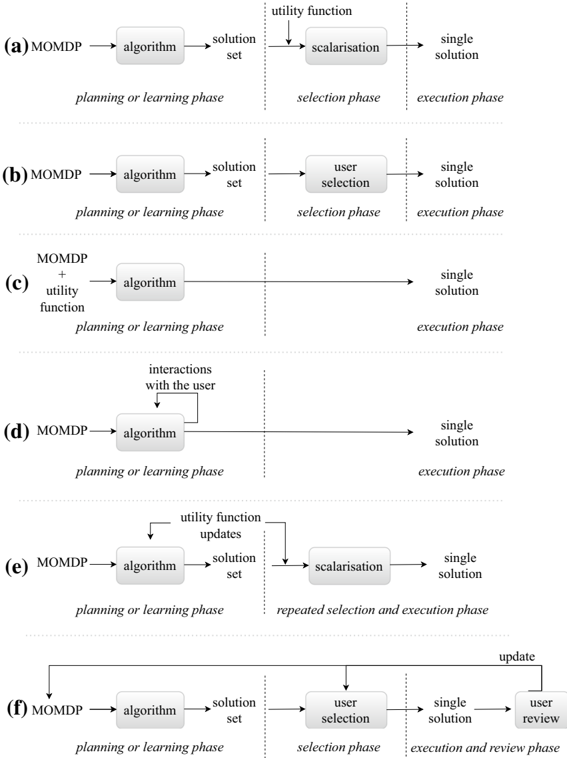
“The existing MORL algorithms based on DM's preferences currently fall into three categories [7]: (a) the known utility function scenario, (b) the decision support scenario, and (c) the interactive decision scenario.”
MethodEstimation of Non-Convex Pareto Front in Collision Avoidance at Urban Intersections
Tamura, A., & Arai, S. (2024) · IEEJ Transactions on Electronics Information and Systems · doi:10.1541/ieejeiss.144.88
Track Learning Agent Using Multi-objective Reinforcement Learning
Shah, R., Ruparel, V., Prabhu, M., & D’Mello, L. (2024) · Lecture notes in networks and systems · doi:10.1007/978-981-99-9037-5_3
Redefining the Behavior Space for Multi-Objective MAP-Elites
Nickelson, A., & Tumer, K. (2024) · Genetic and Evolutionary Computation Conference Companion (GECCO Companion) · doi:10.1145/3638530.3654351 · Cited by 1
Model‐based reinforcement learning control of reaction‐diffusion problems
Schenk, C., Vasudevan, A. V., Harańczyk, M., & Romero, I. (2024) · Optimal Control Applications and Methods · doi:10.1002/oca.3196
“Their research underscores the efficacy of NPIs in mitigating the spread of COVID-19, while also highlighting the need for further control-theoretic studies and targeted investigations into specific NPIs.”
Multi-Obstacle Path Planning using Deep Reinforcement Learning
Morgan, B., Trigg, L., Stringer, A., Schley, L., & Hougen, D. F. (2024) · IEEE/AIAA Digital Avionics Systems Conference (DASC) · doi:10.1109/dasc62030.2024.10748994
“Many real-world problems often involve multi-obstacle navigation in environments containing multiple objectives [16].”
Personalisation via Dynamic Policy Fusion
Palattuparambil, A. S., Karimpanal, T. G., & Rana, S. (2024) · International Conference on Human-Agent Interaction (HAI) · doi:10.1145/3687272.3690916 · Cited by 2
Sun, N.-A.-R., Palma, S. A., Nur, F. N., Rashid, H. B., & Islam, A. H. M. S. (2024) · IEEE International Conference on Computing, Applications and Systems (COMPAS) · doi:10.1109/compas60761.2024.10796663
Reinforcement Learning of Dolly-In Filming Using a Ground-Based Robot
Lorimer, P., Saunders, J., Hunter, A. J., & Li, W. (2024) · IEEE/RSJ International Conference on Intelligent Robots and Systems (IROS) · doi:10.1109/iros58592.2024.10802717
“In contrast, combined RL control treats the system as a unified entity, streamlining management and enhancing action coordination [14], offering a more practical approach for complex filming tasks.”
Solution methods for a class of finite-horizon vector-valued Markov decision processes
Mifrani, A., Saint-Pierre, P., & Savy, N. (2025) · INFOR Information Systems and Operational Research · doi:10.1080/03155986.2025.2484050
“This approach has been cited by a recent survey of multi-objective reinforcement learning (Hayes et al. 2022), and numerous authors have used it either to compare it experimentally with their own approaches (Wiering and De Jong 2007; Roijers et al. 2021) or as a point of departure for the…”
Deep Reinforcement Learning for Dynamic VNF Profiling and Resource Optimization
Jaisudthi, P., Phungkoed, N., Srisuk, K., Phueaknumpol, V., & Sridee, P. T. (2024) · International Conference on Intelligent Computing and Next Generation Networks (ICNGN) · doi:10.1109/icngn63705.2024.10871268 · Cited by 1
Barton, S. J., Brekken, T., & Cao, Y. (2025) · Applied Sciences · doi:10.3390/app15052512 · Cited by 1
LiRA: Light-Robust Adversary for model-based reinforcement learning in real world
Kobayashi, T. (2025) · Robotics and Autonomous Systems · doi:10.1016/j.robot.2025.105057 · Cited by 3
“Here, R ⊆ R holds normally, but the case of multi-objective RL, where multiple rewards are simultaneously considered [42], is assumed for generality.”
Multi-objective reinforcement learning framework for beneficent artificial intelligence
Nickelson, A., Perkins, R., London, A. J., Robinette, P., & Tumer, K. (2025) · Neural Computing and Applications · doi:10.1007/s00521-025-11311-5
Efficient Multi-Objective Optimisation for Real-World Power Grid Topology Control
Manyari, Y. E., Fuxjaeger, A. R., Zahlner, S., van Dijk, J., Castagna, A., Barbieri, D., Viebahn, J., & Wasserer, M. (2025) · ACM International Conference on Future Energy Systems (e-Energy) · doi:10.1145/3679240.3734659 · Cited by 2
“Comprehensive reviews of MORL methods can be found in [6, 10].”
Explainability for Unmanned Aerial Vehicle Control via Multi-Objective Reinforcement Learning
Clark, C. A., Albarado, K. M., Wilson, J. P., Bernard, C. A., Scott, J. D., & d'Aliberti, L. (2025) · IEEE Aerospace Conference (AERO) · doi:10.1109/aero63441.2025.11068676
“MORL addresses these limitations by explicitly representing and optimizing multiple objectives [11, 12].”
Kong, L., Mao, P., Sun, J., Zhan, C., & Guo, K. (2025) · International Journal of Systems Assurance Engineering and Management · doi:10.1007/s13198-025-02888-0
“…the diverse applications of deep learning technology in the fields of UAVs and robotic arms (Meng et al. 2023; Tian et al. 2020; Zhang et al. 2024; Shen et al. 2023; Hayes et al. 2022; Liu et al. 2022; Nguyen et al. 2020; Rădulescu et al. 2020; Roijers And White-son 2017; Zintgraf et al. 2015).”
Policy weighting via discounted Thomson sampling for non-stationary market-making
Vicente, Ó. F., García, J., & Fernández, F. (2025) · Artificial Intelligence Review · doi:10.1007/s10462-025-11312-9 · Cited by 1
“…problems can be done by simplifying them into a single-objective format using weighted or complex reward functions, also known as reward engineering (Dewey 2014 ; Eschmann 2021 ), or more robustly, by employing MORL frame - works (Hayes et al. 2022 ; García et al. 2020 ; Liu et al. 2015 ).”
Shabashkhan, S., Wang, X., & Mesnage, C. S. (2025) · Lecture notes in computer science · doi:10.1007/978-3-032-00800-8_18
MORL with Dynamic Weighted Sentiment Rewards for Decision-Making
Brown, D. L., Liu, C., & Rawat, D. B. (2025) · Communications in computer and information science · doi:10.1007/978-3-031-94937-1_19
Kotecha, N., & Chanona, A. D. R. (2025) · IFAC-PapersOnLine · doi:10.1016/j.ifacol.2025.07.151
Benchmarking MOEAs for solving continuous multi-objective RL problems
Santana, R., & Hernández, C. (2025) · Genetic and Evolutionary Computation Conference Companion (GECCO Companion) · doi:10.1145/3712255.3726699
Furqonuddin, A., Zakaria, Syarifuddin, E., Firdaos, R., & Muslihah, E. (2025) · doi:10.38124/ijisrt/25jul1426
Optimizing Ad Recommendations Using A Bayesian Multi-Armed Bandit Approach
Zeng, Y. (2025) · ITM Web of Conferences · doi:10.1051/itmconf/20257804026
Multi-Objective Reinforcement Learning Algorithm for Irregular Spatial Clusters Detection
Oliveira, D., Duarte, A. R., Ottoni, A. L. C., & Moreira, G. J. P. (2025) · Lecture notes in computer science · doi:10.1007/978-3-032-05176-9_32
Reinforcement Learning: Emerging Trends and Challenges
Mashhadihajiali, N., & Roayaei, M. (2025) · Information systems engineering and management · doi:10.1007/978-3-031-96871-6_4
Next‐Generation Water Purification
Srividya, R., Rao, A. V. R., Boppena, K., Manaswini, K. S., & Sameera, V. S. (2025) · Wiley eBooks · doi:10.1002/9781394303526.ch28
Zheng, K., & Meng, X. (2025) · International Conference on Cyber Security and Information Engineering (ICCSIE) · doi:10.1145/3759179.3760444
“Nevertheless, it fails to balance efficiency and fairness in scenarios involving multiple objectives and complex nonlinear constraints [5].”
An Adaptive Policy Switching Method for Episodic Cumulative Reward in Reinforcement Learning
Sato, N., & Yoshida, H. (2025) · International Conference on Machine Learning Technologies (ICMLT) · doi:10.1109/icmlt65785.2025.11193222
“Saiki and Arai [9] proposed a method for efficiently controlling signals by switching between policies learned with multi-objective reinforcement learning (MORL) [10], depending on the situation.”
A Novel Approach to Multi-objective Optimization in Machining
Cao, T.-A., Pham, M. T., Le, N.-S., Vu, D.-T., & Nguyen, V. C. (2025) · Proceedings in Technology Transfer · doi:10.1007/978-981-95-1750-3_71
Boiler combustion modeling and optimization based on reinforcement learning algorithm
Dou, J., & Wen, Z. (2025) · Discover Applied Sciences · doi:10.1007/s42452-025-08019-5
“RL, as an important branch of machine learning, enables agents to interact and continuously adjust in the environment in order to maximize accumulated rewards [17].”
Demonstration-Enhanced Adaptable Multi-Objective Robot Navigation
de Heuvel, J., Sethuraman, T. V., & Bennewitz, M. (2025) · IEEE/RSJ International Conference on Intelligent Robots and Systems (IROS) · doi:10.1109/iros60139.2025.11246392 · Cited by 2
“Multi-objective reinforcement learning (MORL) enhances traditional RL by integrating multiple, often conflicting, objectives [6].”
Deep Q-Managed: a new framework for multi-objective deep reinforcement learning
de Menezes, R. S. T., de Oliveira, T. H. F., Medeiros, L. P. D. S., & Neto, A. D. D. (2025) · Frontiers in Artificial Intelligence · doi:10.3389/frai.2025.1683323
jiang, Y., Liu, Q., Li, J., Dong, C., & Zhou, A. (2025) · SSRN Electronic Journal · doi:10.2139/ssrn.5891588
jiang, Y., Liu, Q., Li, J., Dong, C., & Zhou, A. (2025) · SSRN Electronic Journal · doi:10.2139/ssrn.5891587
Ding, K., Vamplew, P. W., Foale, C., & Dazeley, R. (2025) · The Knowledge Engineering Review · doi:10.1017/s0269888925100052 · Cited by 2
“However, it also suffers from a fundamental disadvantage that it is inca-pable of finding deterministic policies with expected returns lying in concave regions of the Pareto front (Vamplew et al ., 2008) 1 .”
Self-citationXia, C., Wang, Y., Zhao, J., Xu, C., Jin, X., & Zang, C. (2025) · SSRN Electronic Journal · doi:10.2139/ssrn.5526479
MO-GRPO: Mitigating Reward Hacking of Group Relative Policy Optimization on Multi-Objective Problems
Ichihara, Y., Jinnai, Y., Morimura, T., Sakamoto, M., Mitsuhashi, R., & Uchibe, E. (2026) · Transactions of the Association for Computational Linguistics · doi:10.1162/tacl.a.782 · Cited by 32
UCB-Driven Utility Function Search for Multi-objective Reinforcement Learning
Shi, Y., Lynch, D., & Agapitos, A. (2025) · Lecture notes in computer science · doi:10.1007/978-3-032-06106-5_10 · Cited by 2
Metadata
- Authors
- Hayes, C. F., Rădulescu, R., Bargiacchi, E., Källström, J., Macfarlane, M., Reymond, M., Verstraeten, T., Zintgraf, L. M., Dazeley, R., Heintz, F., Howley, E., Irissappane, A. A., Mannion, P., Nowé, A., Ramos, G., Restelli, M., Vamplew, P., & Roijers, D. M.
- Affiliations
- Ollscoil na Gaillimhe – University of Galway (IE)
- Vrije Universiteit Brussel (BE)
- Linköping University (SE)
- University of Amsterdam (NL)
- University of Oxford (GB)
- Deakin University (AU)
- University of Washington Tacoma (US)
- Universidade do Vale do Rio dos Sinos (BR)
- Politecnico di Milano (IT)
- Federation University (AU)
- Corresponding author
- Hayes, Conor F.
- Rădulescu, Roxana
- Bargiacchi, Eugenio
- Källström, Johan
- Macfarlane, Matthew
- Reymond, Mathieu
- Verstraeten, Timothy
- Zintgraf, Luisa M.
- Dazeley, Richard
- Heintz, Fredrik
- Howley, Enda
- Irissappane, Athirai A.
- Mannion, Patrick
- Nowé, Ann
- Ramos, Gabriel
- Restelli, Marcello
- Vamplew, Peter
- Roijers, Diederik M.
- ORCID
- Venue
- Autonomous Agents and Multi-Agent Systems
- Published
- 2022-04
- Volume
- 36
- Issue
- 1
- ISSN
- 1387-2532 (ISSN-L)
- 1573-7454
- OpenAlex
- W3139398491
- Cited by
- 400
- References
- 223
- Citations by year
- 2026: 119 · 2025: 125 · 2024: 80 · 2023: 52 · 2022: 22
- FWCI
- 22.98
- Type
- journal article
- Language
- en
- Open access
- hybrid
- doi.org
- Licence
- cc-by
- creativecommons.org/licenses/by/4.0 (tdm)
- creativecommons.org/licenses/by/4.0 (vor, 12 d)
- Locations
- Autonomous Agents and Multi-Agent Systems (publishedVersion, cc-by)
- arXiv (Cornell University) (submittedVersion)
- Virtual Community of Pathological Anatomy (University of Castilla La Mancha) (submittedVersion, cc-by)
- FedUni ResearchOnline (Federation University Australia) (submittedVersion, cc-by)
- DiVA (Linkoping University) (submittedVersion, other-oa)
- Figshare (submittedVersion, cc-by)
- VUBIR (Vrije Universiteit Brussel) (submittedVersion)
- arXiv (Cornell University)
- Funders
- Vlaamse regering (Onderzoeksprogramma Artificiële Intelligentie (AI) Vlaanderen)
- National University Ireland, Galway
- Topics
- Physical Sciences › Computer Science › Artificial Intelligence › Reinforcement Learning in Robotics
- Physical Sciences › Computer Science › Computational Theory and Mathematics › Advanced Multi-Objective Optimization Algorithms
- Physical Sciences › Computer Science › Artificial Intelligence › AI-based Problem Solving and Planning
- Keywords
- multi-objective reinforcement learning, sequential decision making, conflicting objectives, trade-offs between objectives, solution design, complex decision problems
About these checks
Registry, retraction, Cites and statistics results are computed, not judged, with one exception: a printed reference that no index lists is read once by a model before it counts as a citation error. Claims are extracted by a model and kept only when their quote appears verbatim in the text; each cited source is then checked, with a model’s help, for whether it says what the claim relies on. Those verdicts can be wrong — read the claim’s quote and the cited source before relying on one.
Statistics and arithmetic are recomputed, not judged.
Confidence bands are shown only for fields calibrated on our annotated test set. None is calibrated yet, so no band is shown.
What counts as a claim ›How we measure confidence ›How we check this ›
Are you an author, or do you see a problem with this page? Request a review
Data sources
Bibliographic data: Semantic Scholar, OpenAlex, Crossref.
Contains information from the Semantic Scholar Academic Graph Datasets, made available under the ODC Attribution License (ODC-BY 1.0).
Semantic Scholar’s data is described in: Kinney, R., et al. (2023). The Semantic Scholar Open Data Platform. arXiv:2301.10140.
