

Exploring the Relationship Between Exclusive Talent Management, Perceived Organizational Justice and Employee Engagement: Bridging the Literature
Open accessThe DOI matches its Crossref record; 118 of the 119 references it cites were found in a registry or an index, and 1 are not checked yet; none of the 157 sources its claims cite is checked for support yet.
Checked 2026-11-25 · 1 reference not checked yet
Overview
CoChat Summary
TL;DR
This conceptual paper proposes that exclusive talent management practices affect employee engagement through perceived organizational justice, with distributive justice mediating and procedural/interactional justice moderating the relationship. It focuses on employees not identified as “talented” but who believe they should be in the talent pool, arguing perceived unfairness may lower engagement.
Key findings
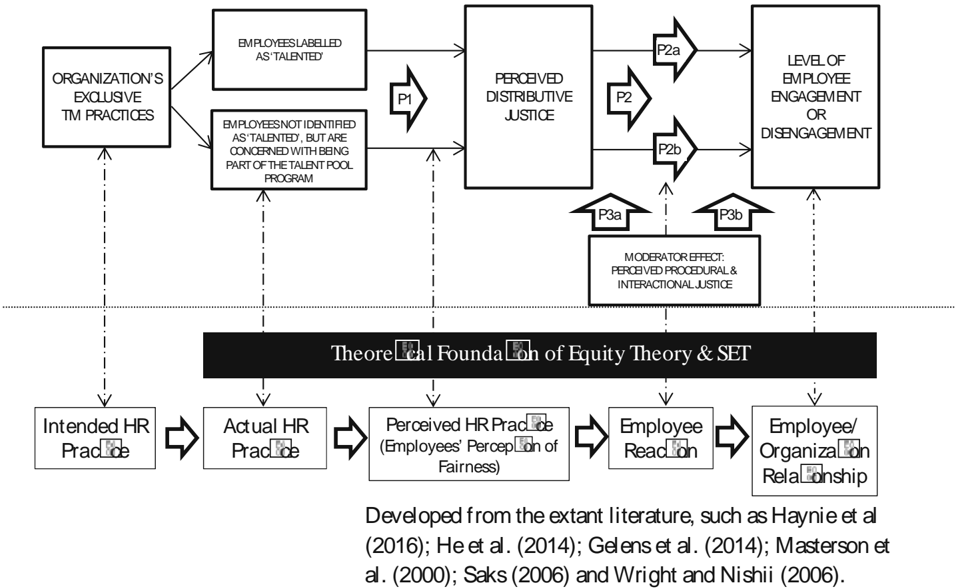
- Proposes P1: employees identified as “talented” are more likely to perceive higher distributive justice than employees not identified as “talented” but concerned with being in the talent pool program; the latter are more likely to perceive lower distributive justice.
- Proposes P2: perceived distributive justice mediates the relationship between exclusive TM practices and employee engagement; P2a predicts “talented” employees show higher engagement because of higher distributive justice, while P2b predicts “non-talented” but concerned employees who perceive their identification as unfair show lower engagement.
- Proposes P3: procedural and interactional justice moderate the distributive justice–engagement relationship; high procedural and/or interactional justice yields neutral-to-positive effects on engagement, while low procedural and interactional justice yields negative effects.
- Argues exclusive TM raises ethical concerns, can marginalize the majority of employees, and that secrecy in TM systems may inhibit the procedural/interactional justice buffer; no numerical results are reported because the paper is conceptual.
Methods
- Conceptual paper; no empirical data, sample, or statistical analysis are reported.
- Develops propositions and a conceptual framework from extant literature on exclusive TM, organizational justice, and employee engagement, using social exchange theory (Blau 1964) and equity theory (Adams 1963) as foundations.
- Presents exclusive TM practices as the input, employee engagement as the output, distributive justice as mediator, and procedural and interactional justice as moderators, with propositions offered for future empirical testing.
Limitations
- The paper states it is conceptual and that empirical testing is required to validate the propositions; it suggests survey research using scales such as Rich et al. (2010) for employee engagement and Colquitt (2001) for organizational justice, possibly augmented by qualitative interviews.
- The paper states the framework makes no allowance for possible gender or other individual attributes and characteristics; it notes gender may affect perceptions of justice and should be examined and controlled for in future testing.
- The paper states its focus is micro-level and it does not develop or discuss in depth the meso-perspective from the organization’s viewpoint, nor the wider macro-level societal ramifications of exclusive TM practices on workforce discrimination and inequality.
Model-written summary. Check it against the paper before relying on it.
Integrity signals
Registry
Cites
Statistics
Figures

Verification
Claims the paper makes
0 Valid · 2 Not valid · 80 Not checked · 31 Own results and interpretations
In the paper
“However, employee responses to perceived fairness often correspond to their organizational experiences (Cropanzano and Mitchell 2005), with 'low perceptions of fairness likely to cause employees to withdraw and disengage' (Saks 2006, p. 606).”
What the sources say
- Not checked yetcites Cropanzano and Mitchell 2005 matched to “Social Exchange Theory: An Interdisciplinary Review” (2005) source
hedgedstates an association- Asserted: passes — The authors put it forward as true.
- Checkable: passes — It can be checked against evidence.
- Load-bearing: passes — The paper’s conclusions depend on it.
- Based: passes — The paper gives a reason why it holds.
None of the sources cited for this claim have been checked yet.
In the paper
“However, as a minority group, 'talented' employees have a disproportionate amount of development resources invested in their future (Malik and Singh 2014; Swailes 2013a).”
What the sources say
plainstates a cause- Asserted: passes — The authors put it forward as true.
- Checkable: passes — It can be checked against evidence.
- Load-bearing: passes — The paper’s conclusions depend on it.
- Based: passes — The paper gives a reason why it holds.
In the paper
“Consistent with Hayibor's (2017, p. 49) assertion that 'a deficiency in the fairness-based perspective' is its assumption of homogeneity, we reject that all employees perceive the fairness of TM in the same way.”
What the sources say
- Not checked yetcites Hayibor 2017 matched to “Is Fair Treatment Enough? Augmenting the Fairness-Based Perspective on Stakeholder Behaviour” (2017) source
plain- Asserted: passes — The authors put it forward as true.
- Checkable: passes — It can be checked against evidence.
- Load-bearing: passes — The paper’s conclusions depend on it.
- Based: passes — The paper gives a reason why it holds.
None of the sources cited for this claim have been checked yet.
In the paper
“Exclusive TM, commonly practiced in organizations today (Malik and Singh 2014; Swailes et al. 2014), is at the crux of our conceptualization.”
What the sources say
plain- Asserted: passes — The authors put it forward as true.
- Checkable: passes — It can be checked against evidence.
- Load-bearing: passes — The paper’s conclusions depend on it.
- Based: passes — The paper gives a reason why it holds.
None of the sources cited for this claim have been checked yet.
In the paper
“Exclusive talent management (TM)-the human resource management (HRM) strategies, policies and practices where organizations identify and focus resources on a limited number of 'talented' employees, that is high-performing (Lewis and Heckman 2006), or high-potential employees (Gallardo-Gallardo et al. 2013)-has received limited consideration from an ethical and organizational justice (Greenberg 199”
- Also stated in: § Introduction · p. 2 · plain
“Nonetheless, there remains a gap in more fully examining the exclusive TM phenomenon from an ethical and organizational justice standpoint.”
- Also stated in: § Exploring the Relationship Between Exclusive Talent Management, Perceived Organizational Justice and Employee Engagement: Bridging the Literature · p. 2 · plain
“The perceived organizational justice and potential ramifications of exclusive TM practices for employees who are not included in corporate talent pools is an under-researched topic.”
What the sources say
- Not checked yetcites Greenberg 1990 matched to “Organizational Justice: Yesterday, Today, and Tomorrow” (1990) source
- Not matchedcites Gelens et al. 2013, 2014
A range of references, not one source.
plain- Asserted: passes — The authors put it forward as true.
- Checkable: passes — It can be checked against evidence.
- Load-bearing: passes — The paper’s conclusions depend on it.
- Based: passes — The paper gives a reason why it holds.
- Also stated in: § Introduction · p. 2 · plain
54 more claims
Create a free account to see all 113 claims and to verify the 135 references still open.
- It may state two separate claims as one. 25
- Probably not a substantial claim. 38
Claims other papers make about this one
Each is checked against this paper’s own text: does it say what the citing paper says it does?
In the citing paper
“On the one hand, it can signal recognition, investment and developmental support.On the other hand, if poorly communicated or perceived as elitist, it may raise concerns about inequality, exclusion or preferential treatment among employees (O'Connor & Crowley-Henry, 2019).”
From Talent management and organizational citizenship behavior. Exploring the role of organizational support and age-related differences (2026) · cites this paper as O'Connor & Crowley-Henry, 2019
Self-check
Percentages, sums and reported differences re-computed from the paper’s own numbers.
Each contradiction between two passages listed here was confirmed by an independent check.
Rated minor: it would not touch a result — a value no result rests on, a p-value that stays on the same side of the significance level, or a conflict that is clerical, resolved elsewhere in the paper, or outside its own findings.
In the paper
§ Toward the Conceptualization · p. 10
“employees, who are treated with respect (interpersonal injustice), provided with appropriate information (informational justice)”
§ Organizational Justice · p. 7
“interpersonal justice, relating to the dignity and respect employees receive from those in authority”
Citations
Cites
Exchange and Power in Social Life
Blau, P. M. (2017) · doi:10.4324/9780203792643 · Cited by 15,923
Exchange and Power in Social Life.
Bierstedt, R., & Blau, P. M. (1965) · American Sociological Review · doi:10.2307/2091154 · Cited by 13,624
Maslach, C., Schaufeli, W. B., & Leiter, M. P. (2001) · Annual Review of Psychology · doi:10.1146/annurev.psych.52.1.397 · Cited by 12,852
The norm of reciprocity: A preliminary statement
Gouldner, A. W. (1960) · American Sociological Review · doi:10.2307/2092623 · Cited by 12,001
(1993) · Journal of the American Dietetic Association · doi:10.1016/0002-8223(93)92196-5 · Cited by 11,976
PSYCHOLOGICAL CONDITIONS OF PERSONAL ENGAGEMENT AND DISENGAGEMENT AT WORK.
Kahn, W. A. (1990) · Academy of Management Journal · doi:10.2307/256287 · Cited by 10,975
Research in Organizational Behavior.
Grimes, A. J., Cummings, L. L., & Staw, B. M. (1986) · Administrative Science Quarterly · doi:10.2307/2392975 · Cited by 10,899
Social Exchange Theory: An Interdisciplinary Review
Cropanzano, R., & Mitchell, M. S. (2005) · Journal of Management · doi:10.1177/0149206305279602 · Cited by 10,068
The measurement of engagement and burnout: a two sample confirmatory factor analytic approach.
Schaufeli, W. B., Salanova, M., González-romá, V., & Bakker, A. B. (2002) · Journal of Happiness Studies · doi:10.1023/a:1015630930326 · Cited by 10,014
Justice at the millennium: A meta-analytic review of 25 years of organizational justice research.
Colquitt, J. A., Conlon, D. E., Wesson, M. J., Porter, C. O. L. H., & Ng, K. Y. (2001) · Journal of Applied Psychology · doi:10.1037/0021-9010.86.3.425 · Cited by 5,942 · cited 19×
“Next we unpack the core assumptions of SET and equity theory, and then we outline the importance of employee perceptions of HR practices (exclusive TM being a collection of HR practices targeted at an exclusive group of employees).”
BackgroundInfluential
Research works printed but not linked: 2
- O'Connor, E. & Crowley-Henry, M. (2015). Exclusive talent management, perceived organizational justice & employee engagement: Bridging the literature. In University Forum for Human Resource Development Conference University College Cork, Ireland.
- Soni, H. (2014). Ethical talent management: The hall mark of contemporary HRM. International Journal of Research in Management & Technology, 4(2), 122-130.
Cited by
There is no good war for talent: a critical review of the literature on talent management
Kwon, K., & Jang, S. (2021) · Employee Relations · doi:10.1108/er-08-2020-0374 · Cited by 182
Oubrich, M., Hakmaoui, A., Benhayoun-Sadafiyine, L., Söilen, K. S., & Abdulkader, B. (2021) · Journal of Business Research · doi:10.1016/j.jbusres.2021.08.045 · Cited by 180
Applicants’ Fairness Perceptions of Algorithm-Driven Hiring Procedures
Lavanchy, M., Reichert, P., Narayanan, J., & Savani, K. (2023) · Journal of Business Ethics · doi:10.1007/s10551-022-05320-w · Cited by 168
Employee reactions to talent pool membership
Swailes, S., & Blackburn, M. (2016) · Employee Relations · doi:10.1108/er-02-2015-0030 · Cited by 89
Ghani, B., Hyder, S. I., Yoo, S., & Han, H. (2023) · Heliyon · doi:10.1016/j.heliyon.2023.e21817 · Cited by 148
Towards a responsible talent management model
Anlesinya, A., & Amponsah‐Tawiah, K. (2020) · European journal of training and development · doi:10.1108/ejtd-07-2019-0114 · Cited by 142
Aggarwal, A., Jaisinghani, D., & Nobi, K. (2022) · International Journal of Quality and Service Sciences · doi:10.1108/ijqss-08-2021-0112 · Cited by 137
Alshaabani, A., Hamza, K. A., & Rudnák, I. (2021) · Sustainability · doi:10.3390/su14010420 · Cited by 127
Ghosh, D., Sekiguchi, T., & Fujimoto, Y. (2020) · Personnel Review · doi:10.1108/pr-12-2018-0480 · Cited by 99
Talent Management, Affective Organizational Commitment and Service Performance in Local Government
Arocas, R. L., & Lara, F. J. (2020) · International Journal of Environmental Research and Public Health · doi:10.3390/ijerph17134827 · Cited by 99
Crowley‐Henry, M., Benson, E. T., & Ariss, A. A. (2018) · European Management Review · doi:10.1111/emre.12304 · Cited by 95
Self-citationFriend or foe? Customer engagement’s value-based effects on fellow customers and the firm
Clark, M. K., Lages, C. R., & Hollebeek, L. D. (2020) · Journal of Business Research · doi:10.1016/j.jbusres.2020.03.011 · Cited by 95
Exploring the Link between Training and Development, Employee Engagement and Employee Retention
Bhakuni, S., & Saxena, S. (2023) · Journal of Business and Management Studies · doi:10.32996/jbms.2023.5.1.17 · Cited by 79
Azmy, A. (2021) · Media Ekonomi dan Manajemen · doi:10.24856/mem.v36i2.2190 · Cited by 77
Driving service-oriented organizational citizenship behavior through error management culture
Aggarwal, A., Lim, W. M., Jaisinghani, D., & Nobi, K. (2022) · Service Industries Journal · doi:10.1080/02642069.2022.2147160 · Cited by 67
Trust in leadership and perceptions of justice in fostering employee commitment
González-Cánovas, A., Trillo, A., Bretones, F. D., & Fernández-Millán, J. M. (2024) · Frontiers in Psychology · doi:10.3389/fpsyg.2024.1359581 · Cited by 66
Alriyami, H. M., Alneyadi, K., Alnuaimi, H., & Kampouris, I. (2024) · International Journal of Industrial Ergonomics · doi:10.1016/j.ergon.2024.103647 · Cited by 55
Organizational justice and turnover intentions: probing the Pakistani print media sector
Hussain, M., & Khan, M. S. (2018) · Evidence-based HRM a Global Forum for Empirical Scholarship · doi:10.1108/ebhrm-04-2018-0030 · Cited by 53
Makarem, Y., Metcalfe, B. D., & Afiouni, F. (2019) · BRQ Business Research Quarterly · doi:10.1016/j.brq.2019.04.004 · Cited by 51
The effects of organizational justice dimensions on facets of job engagement
Deepa, S. M. (2020) · International Journal of Organization Theory and Behavior · doi:10.1108/ijotb-05-2019-0066 · Cited by 50
Jaboob, M. S., Awain, A. M. S. B., & Al‐Ansi, A. M. (2023) · Social Sciences & Humanities Open · doi:10.1016/j.ssaho.2023.100693 · Cited by 49
Responsible talent management: towards guiding principles
Swailes, S. (2020) · Journal of Organizational Effectiveness People and Performance · doi:10.1108/joepp-04-2020-0068 · Cited by 47
Maham, R., Bhatti, O. K., & Öztürk, A. O. (2020) · Cogent Business & Management · doi:10.1080/23311975.2020.1788875 · Cited by 49
Dubord, M. G., Forest, J., Balčiūnaitė, L. M., Rauen, E., & Jungert, T. (2022) · Journal of Happiness Studies · doi:10.1007/s10902-022-00524-3 · Cited by 45
Dries, N., & Kaše, R. (2023) · Human Resource Management Journal · doi:10.1111/1748-8583.12501 · Cited by 25
Sofiyan, S., Agustina, T., Siahaan, R., Simatupang, S., & Sudirman, A. (2022) · KnE Social Sciences · doi:10.18502/kss.v7i10.11382 · Cited by 42
Cultivating Employee Engagement in Organizations: Development of a Conceptual Framework
Zeidan, S., & Itani, N. (2020) · Central European Management Journal · doi:10.7206/cemj.2658-0845.18 · Cited by 40
Exclusive Talent Management: Unveiling the Mechanisms of the Construction of an Elite Community
Bonneton, D., Festing, M., & Muratbekova‐Touron, M. (2020) · European Management Review · doi:10.1111/emre.12413 · Cited by 37
Exclusive talent management and its consequences: a review of literature
Bhatia, R., & Baruah, P. (2020) · Asian Journal of Business Ethics · doi:10.1007/s13520-020-00105-8 · Cited by 37
Haryanto, H., Suharman, H., Koeswayo, P. S., & Umar, H. (2022) · Economies · doi:10.3390/economies10110284 · Cited by 34
Farndale, E., Agarwal, P., & Budhwar, P. S. (2022) · Journal of Business Research · doi:10.1016/j.jbusres.2022.02.043 · Cited by 37
Inclusive talent management philosophy, talent management practices and employees’ outcomes
Graham, B. E., Zaharie, M. A., & Osoian, C. (2023) · European journal of training and development · doi:10.1108/ejtd-12-2022-0138 · Cited by 34
Razzak, M. R., Khan, G. M., & AlAbri, S. (2021) · Journal of Family Business Management · doi:10.1108/jfbm-11-2020-0103 · Cited by 32
Saraih, U. N., I., M. Z. M. I., Mohd Karim, K., Sakdan, M. F., & Amlus, M. H. (2019) · Humanities & Social Sciences Reviews · doi:10.18510/hssr.2019.7549 · Cited by 32
Meijerink, J., Fisher, S. L., McDonnell, A., & Wiblen, S. L. (2024) · Human Resource Management Review · doi:10.1016/j.hrmr.2024.101011 · Cited by 31
The impact of talent management on ethical behavior and intention to stay in the organization
Arocas, R. L., & del Valle, I. D. (2022) · Journal of Management & Organization · doi:10.1017/jmo.2022.64 · Cited by 30
Effects of Talent Management Practices on Organizational Engagement: A QuasiExperimental Study
Tetik, S., Zaim, H., & Researcher, I. (2021) · Eurasian Journal of Business and Economics · doi:10.17015/ejbe.2021.027.06 · Cited by 29
Sugiono, E., Efendi, S., & Hendryadi, H. (2023) · Cogent Social Sciences · doi:10.1080/23311886.2023.2244309 · Cited by 28
Peterson, J., Tahssain-Gay, L., & Benraïss-Noailles, L. (2022) · Employee Relations · doi:10.1108/er-03-2021-0123 · Cited by 27
Exploring the links between talent philosophies and talent management in service organizations
Pantouvakis, A., & Karakasnaki, M. (2019) · Industrial and Commercial Training · doi:10.1108/ict-03-2019-0026 · Cited by 27
Kamoche, K. N., & Leigh, F. S. (2021) · Human Relations · doi:10.1177/0018726721996778 · Cited by 25
Irshad, J., Malik, F., & Sarfraz, S. (2023) · Pakistan Journal of Commerce and Social Sciences · doi:10.64534/commer.2023.090 · Cited by 23
Effect of organisational justice on workplace deviance in Nigerian public universities
Obalade, G. O., & Mtembu, V. N. (2023) · Acta Commercii · doi:10.4102/ac.v23i1.1091 · Cited by 23
Model of talent management for registered nurses in Malawian public hospitals
Dzimbiri, G. L., & Molefi, M. A. (2022) · SA Journal of Industrial Psychology · doi:10.4102/sajip.v48i0.1953 · Cited by 24
The basic themes of talent management: Bibliometric analysis and systematic literature review
Hendrawan, R., Rosari, R., & Nastiti, T. (2024) · Cogent Business & Management · doi:10.1080/23311975.2024.2429016 · Cited by 22
Employee engagement during COVID-19 in Malaysia
Mustaffa, A., Lajuma, S. B., & Wider, W. (2022) · Frontiers in Sociology · doi:10.3389/fsoc.2022.976966 · Cited by 22
Khanam, Z., Khan, Z., Arwab, M., & Khan, A. (2024) · Leadership in health services · doi:10.1108/lhs-06-2023-0046 · Cited by 22
Liu, L., & Zhang, C. (2022) · Psychology Research and Behavior Management · doi:10.2147/prbm.s343927 · Cited by 21
Talent designation as a mixed blessing: Short‐ and long‐term employee reactions to talent status
Tyskbo, D., & Wikhamn, W. (2022) · Human Resource Management Journal · doi:10.1111/1748-8583.12485 · Cited by 21
Developing a measurement scale for employee engagement: a validation study in a South Korean context
So, B. H., Kim, J. H., Ro, Y. J., & Song, J. H. (2021) · European journal of training and development · doi:10.1108/ejtd-11-2020-0155 · Cited by 21
Critical success factors for integrating talent management strategies with wellness interventions
Nzonzo, J. C., & Plessis, Y. D. (2020) · SA Journal of Human Resource Management · doi:10.4102/sajhrm.v18i0.1353 · Cited by 22
Wibisono, G., Setiawan, Y., Aprianda, B., & Cendana, W. (2023) · Cogent Business & Management · doi:10.1080/23311975.2023.2287586 · Cited by 20
Decision-Making on Selection of Talent Management Methods in the Era of Digitalization
Cai, L., Ji, Y., Wijekoon, C., & Yuan, Y. (2023) · Systems · doi:10.3390/systems11090450 · Cited by 20
Yuwono, I. A., Suroso, A. I., & Hubeis, A. V. S. (2021) · Jurnal Aplikasi Bisnis dan Manajemen · doi:10.17358/jabm.7.1.212 · Cited by 24
Souki, K., Aad, S. S., & Karkoulian, S. (2024) · International journal of organizational analysis · doi:10.1108/ijoa-12-2023-4146 · Cited by 21
Talents Under Threat: The Anticipation of Being Ostracized by Non-Talents Drives Talent Turnover
Zelderen, A. P. A. V., Dries, N., & Marescaux, E. (2023) · Group & Organization Management · doi:10.1177/10596011231211639 · Cited by 17
de Castro, G. M., González‐Masip, J. J., & Menéndez, J. F. (2020) · Knowledge Management Research & Practice · doi:10.1080/14778238.2020.1808542 · Cited by 17
Swazan, I. S., & Youn, S. (2023) · Future Business Journal · doi:10.1186/s43093-023-00263-8 · Cited by 17
Xie, Z., Liu, Y., Liu, Y., & Xu, L. (2024) · Environment Development and Sustainability · doi:10.1007/s10668-024-04665-8 · Cited by 17
Employee engagement in logistics industry: a perspective in Indonesia
Haryanto, H., Suharman, H., Koeswayo, P. S., & Umar, H. (2023) · Acta Logistica · doi:10.22306/al.v10i3.419 · Cited by 16
Gayathri, G. N., & Savarimuthu, A. (2025) · Asia Pacific Journal of Health Management · doi:10.24083/apjhm.v20i1.3537 · Cited by 16
pasaribu, D. A., Absah, Y., & Sinulingga, S. (2021) · Cited by 16
Untangling Space and Career Action: Migrant Career Recontextualization in the Host City
Zikic, J., & Voloshyna, V. (2023) · Academy of Management Discoveries · doi:10.5465/amd.2020.0156 · Cited by 15
PENGARUSUTAMAAN MANAJEMEN TALENTA DALAM TATA KELOLA MSDM BIROKRASI INDONESIA
Noors, A. I. A. (2019) · Jurnal Ilmu Pemerintahan Suara Khatulistiwa · doi:10.33701/jipsk.v4i2.721 · Cited by 15
Relationship between organizational factors and job performance
Zeb, A. (2020) · UTHM Institutional Repository (Universiti Tun Hussein Onn Malaysia) · Cited by 14
The Paradox of Inclusion in Elite Workforce Differentiation Practices: Harnessing the Genius Effect
van Zelderen, A. P. A., Dries, N., & Marescaux, E. (2025) · Journal of Management Studies · doi:10.1111/joms.13084 · Cited by 12
Joseph, E. R., & Seshadri, V. (2025) · Acta Psychologica · doi:10.1016/j.actpsy.2025.105607 · Cited by 12
Strategic Talent Management in the Hospitality Industry
Garavan, T. N., Matthews-Smith, G., Gill, A. M., & O’Brien, F. (2021) · Emerald Group Publishing Limited eBooks · doi:10.1108/978-1-80071-306-220211002 · Cited by 12
Ding, K., Li, R., Li, Z., & Hu, S. (2025) · Journal Of Big Data · doi:10.1186/s40537-025-01100-1 · Cited by 12
UNRAVELING CAREER DEVELOPMENT PRACTICES AND EMPLOYEE ENGAGEMENT IN SOUTH AFRICAN LOGISTICS COMPANIES
Mdletshe, N. E. (2023) · European Journal of Human Resource Management Studies · doi:10.46827/ejhrms.v7i1.1606 · Cited by 11
Exploring the authenticity, or lack thereof, of the discourse of talent management
Gardiner, R. A., Fox‐Kirk, W., & Javaid, S. T. (2022) · European journal of training and development · doi:10.1108/ejtd-12-2021-0203 · Cited by 11
Talent Management and Employee Engagement: A Study in a Multigenerational and Multinational Context
Aljunaibi, M., & Suliman, A. (2023) · Advances in human resources management and organizational development book series · doi:10.4018/978-1-6684-9172-0.ch002 · Cited by 10
Festing, M., & Schäfer, L. (2022) · Emerald Group Publishing Limited eBooks · doi:10.1108/978-1-80117-834-120221008 · Cited by 11
Rahmana, H. A., & Soliha, E. (2022) · Among Makarti · doi:10.52353/ama.v15i1.225 · Cited by 10
Zhang, S. (2022) · International Journal of Business Governance and Ethics · doi:10.1504/ijbge.2023.130089 · Cited by 10
Zhou, Y., Yusof, R., Thurasamy, R., Li, X., Zhang, P., & Ling, S. (2026) · Acta Psychologica · doi:10.1016/j.actpsy.2025.106167 · Cited by 12
Bhatia, R., & Baruah, P. (2022) · South Asian Journal of Human Resources Management · doi:10.1177/23220937221118189 · Cited by 8
The effects of organizational ambidexterity and justice on organizational learning
Erarslan, İ., & Altındağ, E. (2021) · International Journal of Research in Business and Social Science (2147-4478) · doi:10.20525/ijrbs.v10i1.962 · Cited by 8
Khan, M., Kumari, A., Jain, A. K., & Srivastava, S. (2025) · Asia-Pacific Journal of Business Administration · doi:10.1108/apjba-05-2024-0306 · Cited by 8
Zaman, N. U., Ahmed, T., Ramayah, T., Khalid, Z., & Asad, M. R. (2021) · Human Systems Management · doi:10.3233/hsm-211205 · Cited by 8
Wu, H. (2024) · Journal of Applied Economics and Policy Studies · doi:10.54254/2977-5701/10/2024091 · Cited by 8
Human Capital Strategies to Reduce Employee Turnover in the Food Service and Automotive Industries
Miller, O. P. C., & Banks-Hall, R. (2020) · International Journal of Business and Management Research · doi:10.37391/ijbmr.080304 · Cited by 8
Talent Management: A Review and Research Agenda
Akbar, H., Pillai, Khan, F. M., & Anas, M. (2025) · Global Business and Organizational Excellence · doi:10.1002/joe.70008 · Cited by 7
Tan, L. P. (2024) · Practice, progress, and proficiency in sustainability · doi:10.4018/979-8-3693-2699-2.ch004 · Cited by 7
Inclusive climates in sales: Microaggressions, sales manager justice and salesperson engagement
Beeler, L. L., Burchett, M. R., Chase, K. S., Mullins, R. R., & Habel, J. (2025) · Journal of Business Research · doi:10.1016/j.jbusres.2025.115789 · Cited by 8
Im, H. (2022) · Journal of Personnel Psychology · doi:10.1027/1866-5888/a000305 · Cited by 7
Warman, A., Affandi, M. J., Sukmawati, A., Maarif, M. S., Alfiany, H., & Hanifah, R. I. (2022) · Jurnal Aplikasi Bisnis dan Manajemen · doi:10.17358/jabm.8.3.769 · Cited by 7
Faradiva, F. F., & Suratman, A. (2024) · Selekta Manajemen: Jurnal Mahasiswa Bisnis & Manajemen · Cited by 8
Carroll, Á. M., Collins, C., & McKenzie, J. (2025) · BMC Health Services Research · doi:10.1186/s12913-025-12310-x · Cited by 6
Aggarwal, A., Sadhna, P., & Daipuria, P. (2025) · Global Business Review · doi:10.1177/09721509251344444 · Cited by 6
Conceptualizing and operationalizing 'inclusive' talent management: four different approaches
Cadigan, F., Dries, N., & van Zelderen, A. (2023) · Smart Talent Management · doi:10.4337/9781802202717.00009 · Cited by 3
Can rewards induce corresponding forms of theft? Introducing the reward‐theft parity effect
Johnson, J. S., Friend, S. B., & Esteky, S. (2022) · Business Ethics the Environment & Responsibility · doi:10.1111/beer.12433 · Cited by 6
Abuelhassan, A. E., Alharbi, S., & Khreis, S. H. A. (2020) · International Journal of Heritage, Tourism, and Hospitality · doi:10.21608/ijhth.2020.128073 · Cited by 6
Sathyanarayana, S., Harsha, H., & Sandhya (2024) · doi:10.53555/kuey.v30i5.5153 · Cited by 6
Strategies to Reduce Absenteeism in the Public Sector Workplace
Turner, J. G. (2020) · ScholarWorks (Walden University) · Cited by 6
Exploring the Link between Employee Well-Being and Organizational Performance
Anand, N., Lakshmi, V., Jena, S. K., Pundir, A., Lourens, M., & Prusty, A. (2024) · International Conference on Trends in Quantum Computing and Emerging Business Technologies (TQCEBT) · doi:10.1109/tqcebt59414.2024.10545103 · Cited by 6
Elayan, M. B. (2022) · International Journal of Business and Management · doi:10.5539/ijbm.v17n6p43 · Cited by 5
Talent management in the context of AI adoption: implications for talent and firms
Latukha, M. O., & Scullion, H. (2026) · Personnel Review · doi:10.1108/pr-11-2025-1289 · Cited by 5
5Cs for 5Ps: Achieving sustainable development goals through transforming human resource management
Vashdi, D. R., & Birman, N. A. (2025) · Journal of Cleaner Production · doi:10.1016/j.jclepro.2025.146293 · Cited by 6
Ferrón‐Vílchez, V., Barrio, M. E. S., & Sánchez, R. L. (2024) · Small Business International Review · doi:10.26784/sbir.v8i1.611 · Cited by 6
Metadata
- Authors
- O’Connor, E. P., & Crowley-Henry, M.
- Affiliations
- National University of Ireland, Maynooth (IE)
- Corresponding author
- O’Connor, Edward P.
- ORCID
- O’Connor, Edward P.
- Venue
- Journal of Business Ethics
- Published
- 2017-04-17
- Volume
- 156
- Issue
- 4
- Pages
- 903-917
- ISSN
- 0167-4544 (ISSN-L)
- 1573-0697
- OpenAlex
- W2607164039
- Semantic Scholar
- 3fa83a07ee2062ad08a5680ef7624779479f0bd2
- Cited by
- 244
- References
- 117
- Citations by year
- 2026: 27 · 2025: 30 · 2024: 41 · 2023: 40 · 2022: 35 · 2021: 21 · 2020: 36 · 2019: 8 · 2018: 4 · 2017: 1
- FWCI
- 18.97
- Type
- journal article
- Language
- en
- Open access
- Licence
- www.springer.com/tdm (tdm)
- Locations
- Journal of Business Ethics (publishedVersion)
- Maynooth University ePrints and eTheses Archive (Maynooth University) (acceptedVersion)
- RePEc: Research Papers in Economics (submittedVersion)
- Funders
- Irish Research Council for Science, Engineering and Technology (GOIPG/2014/220)
- Topics
- Social Sciences › Business, Management and Accounting › Organizational Behavior and Human Resource Management › Human Resource and Talent Management
- Social Sciences › Business, Management and Accounting › Organizational Behavior and Human Resource Management › Job Satisfaction and Organizational Behavior
- Social Sciences › Business, Management and Accounting › Organizational Behavior and Human Resource Management › Employer Branding and e-HRM
- Keywords
- perceived organizational justice, employee engagement, talent pool, social exchange theory, equity theory, employee disengagement
About these checks
Registry, retraction, Cites and statistics results are computed, not judged, with one exception: a printed reference that no index lists is read once by a model before it counts as a citation error. Claims are extracted by a model and kept only when their quote appears verbatim in the text; each cited source is then checked, with a model’s help, for whether it says what the claim relies on. Those verdicts can be wrong — read the claim’s quote and the cited source before relying on one.
A language model drew the claims from the paper on 2026-11-22, under version 3 of the claim definition (model deepseek-v4.1-flash, prompt extract-v3).
A second model labelled each claim on 2026-11-22 (model jev-1.13-20260917, definition revision gold-guideline-v0.2).
Statistics and arithmetic are recomputed, not judged.
Confidence bands are shown only for fields calibrated on our annotated test set. None is calibrated yet, so no band is shown.
What counts as a claim ›How we measure confidence ›How we check this ›
Are you an author, or do you see a problem with this page? Request a review
Data sources
Bibliographic data: Semantic Scholar, OpenAlex, Crossref.
Contains information from the Semantic Scholar Academic Graph Datasets, made available under the ODC Attribution License (ODC-BY 1.0).
Semantic Scholar’s data is described in: Kinney, R., et al. (2023). The Semantic Scholar Open Data Platform. arXiv:2301.10140.
