

Exploring the Relationship Between Exclusive Talent Management, Perceived Organizational Justice and Employee Engagement: Bridging the Literature
Open accessThe DOI matches its Crossref record; 118 of the 119 references it cites were found in a registry or an index, and 1 are not checked yet; none of the 157 sources its claims cite is checked for support yet.
Checked 2026-11-25 · 1 reference not checked yet
Overview
CoChat Summary
TL;DR
This conceptual paper proposes that exclusive talent management practices affect employee engagement through perceived organizational justice, with distributive justice mediating and procedural/interactional justice moderating the relationship. It focuses on employees not identified as “talented” but who believe they should be in the talent pool, arguing perceived unfairness may lower engagement.
Key findings
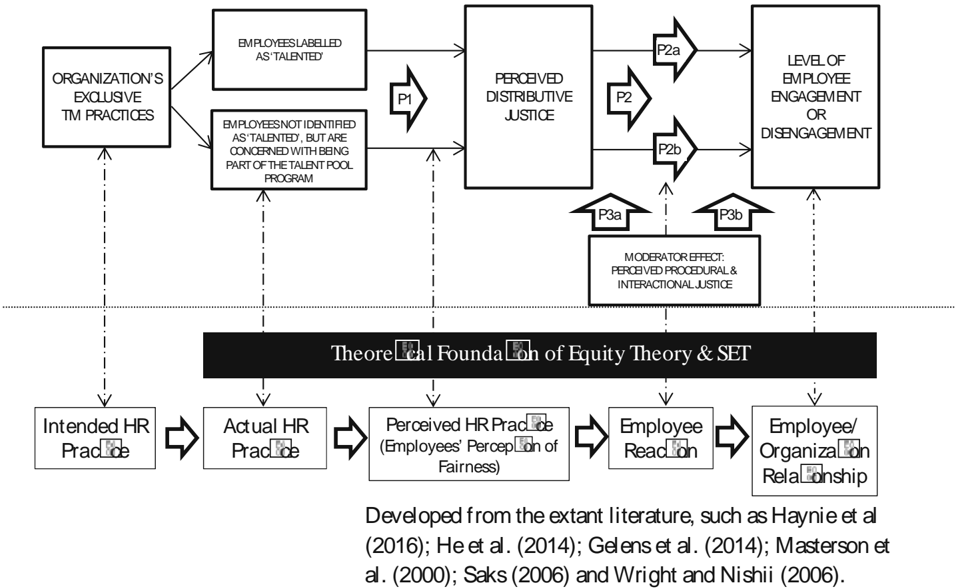
- Proposes P1: employees identified as “talented” are more likely to perceive higher distributive justice than employees not identified as “talented” but concerned with being in the talent pool program; the latter are more likely to perceive lower distributive justice.
- Proposes P2: perceived distributive justice mediates the relationship between exclusive TM practices and employee engagement; P2a predicts “talented” employees show higher engagement because of higher distributive justice, while P2b predicts “non-talented” but concerned employees who perceive their identification as unfair show lower engagement.
- Proposes P3: procedural and interactional justice moderate the distributive justice–engagement relationship; high procedural and/or interactional justice yields neutral-to-positive effects on engagement, while low procedural and interactional justice yields negative effects.
- Argues exclusive TM raises ethical concerns, can marginalize the majority of employees, and that secrecy in TM systems may inhibit the procedural/interactional justice buffer; no numerical results are reported because the paper is conceptual.
Methods
- Conceptual paper; no empirical data, sample, or statistical analysis are reported.
- Develops propositions and a conceptual framework from extant literature on exclusive TM, organizational justice, and employee engagement, using social exchange theory (Blau 1964) and equity theory (Adams 1963) as foundations.
- Presents exclusive TM practices as the input, employee engagement as the output, distributive justice as mediator, and procedural and interactional justice as moderators, with propositions offered for future empirical testing.
Limitations
- The paper states it is conceptual and that empirical testing is required to validate the propositions; it suggests survey research using scales such as Rich et al. (2010) for employee engagement and Colquitt (2001) for organizational justice, possibly augmented by qualitative interviews.
- The paper states the framework makes no allowance for possible gender or other individual attributes and characteristics; it notes gender may affect perceptions of justice and should be examined and controlled for in future testing.
- The paper states its focus is micro-level and it does not develop or discuss in depth the meso-perspective from the organization’s viewpoint, nor the wider macro-level societal ramifications of exclusive TM practices on workforce discrimination and inequality.
Model-written summary. Check it against the paper before relying on it.
Integrity signals
Registry
Cites
Statistics
Figures

Verification
Claims the paper makes
0 Valid · 2 Not valid · 80 Not checked · 31 Own results and interpretations
In the paper
“However, employee responses to perceived fairness often correspond to their organizational experiences (Cropanzano and Mitchell 2005), with 'low perceptions of fairness likely to cause employees to withdraw and disengage' (Saks 2006, p. 606).”
What the sources say
- Not checked yetcites Cropanzano and Mitchell 2005 matched to “Social Exchange Theory: An Interdisciplinary Review” (2005) source
hedgedstates an association- Asserted: passes — The authors put it forward as true.
- Checkable: passes — It can be checked against evidence.
- Load-bearing: passes — The paper’s conclusions depend on it.
- Based: passes — The paper gives a reason why it holds.
None of the sources cited for this claim have been checked yet.
In the paper
“However, as a minority group, 'talented' employees have a disproportionate amount of development resources invested in their future (Malik and Singh 2014; Swailes 2013a).”
What the sources say
plainstates a cause- Asserted: passes — The authors put it forward as true.
- Checkable: passes — It can be checked against evidence.
- Load-bearing: passes — The paper’s conclusions depend on it.
- Based: passes — The paper gives a reason why it holds.
In the paper
“Consistent with Hayibor's (2017, p. 49) assertion that 'a deficiency in the fairness-based perspective' is its assumption of homogeneity, we reject that all employees perceive the fairness of TM in the same way.”
What the sources say
- Not checked yetcites Hayibor 2017 matched to “Is Fair Treatment Enough? Augmenting the Fairness-Based Perspective on Stakeholder Behaviour” (2017) source
plain- Asserted: passes — The authors put it forward as true.
- Checkable: passes — It can be checked against evidence.
- Load-bearing: passes — The paper’s conclusions depend on it.
- Based: passes — The paper gives a reason why it holds.
None of the sources cited for this claim have been checked yet.
In the paper
“Exclusive TM, commonly practiced in organizations today (Malik and Singh 2014; Swailes et al. 2014), is at the crux of our conceptualization.”
What the sources say
plain- Asserted: passes — The authors put it forward as true.
- Checkable: passes — It can be checked against evidence.
- Load-bearing: passes — The paper’s conclusions depend on it.
- Based: passes — The paper gives a reason why it holds.
None of the sources cited for this claim have been checked yet.
In the paper
“Exclusive talent management (TM)-the human resource management (HRM) strategies, policies and practices where organizations identify and focus resources on a limited number of 'talented' employees, that is high-performing (Lewis and Heckman 2006), or high-potential employees (Gallardo-Gallardo et al. 2013)-has received limited consideration from an ethical and organizational justice (Greenberg 199”
- Also stated in: § Introduction · p. 2 · plain
“Nonetheless, there remains a gap in more fully examining the exclusive TM phenomenon from an ethical and organizational justice standpoint.”
- Also stated in: § Exploring the Relationship Between Exclusive Talent Management, Perceived Organizational Justice and Employee Engagement: Bridging the Literature · p. 2 · plain
“The perceived organizational justice and potential ramifications of exclusive TM practices for employees who are not included in corporate talent pools is an under-researched topic.”
What the sources say
- Not checked yetcites Greenberg 1990 matched to “Organizational Justice: Yesterday, Today, and Tomorrow” (1990) source
- Not matchedcites Gelens et al. 2013, 2014
A range of references, not one source.
plain- Asserted: passes — The authors put it forward as true.
- Checkable: passes — It can be checked against evidence.
- Load-bearing: passes — The paper’s conclusions depend on it.
- Based: passes — The paper gives a reason why it holds.
- Also stated in: § Introduction · p. 2 · plain
54 more claims
Create a free account to see all 113 claims and to verify the 135 references still open.
- It may state two separate claims as one. 25
- Probably not a substantial claim. 38
Claims other papers make about this one
Each is checked against this paper’s own text: does it say what the citing paper says it does?
In the citing paper
“On the one hand, it can signal recognition, investment and developmental support.On the other hand, if poorly communicated or perceived as elitist, it may raise concerns about inequality, exclusion or preferential treatment among employees (O'Connor & Crowley-Henry, 2019).”
From Talent management and organizational citizenship behavior. Exploring the role of organizational support and age-related differences (2026) · cites this paper as O'Connor & Crowley-Henry, 2019
Self-check
Percentages, sums and reported differences re-computed from the paper’s own numbers.
Each contradiction between two passages listed here was confirmed by an independent check.
Rated minor: it would not touch a result — a value no result rests on, a p-value that stays on the same side of the significance level, or a conflict that is clerical, resolved elsewhere in the paper, or outside its own findings.
In the paper
§ Toward the Conceptualization · p. 10
“employees, who are treated with respect (interpersonal injustice), provided with appropriate information (informational justice)”
§ Organizational Justice · p. 7
“interpersonal justice, relating to the dignity and respect employees receive from those in authority”
Citations
Cites
Exchange and Power in Social Life
Blau, P. M. (2017) · doi:10.4324/9780203792643 · Cited by 15,923
Exchange and Power in Social Life.
Bierstedt, R., & Blau, P. M. (1965) · American Sociological Review · doi:10.2307/2091154 · Cited by 13,624
Maslach, C., Schaufeli, W. B., & Leiter, M. P. (2001) · Annual Review of Psychology · doi:10.1146/annurev.psych.52.1.397 · Cited by 12,852
The norm of reciprocity: A preliminary statement
Gouldner, A. W. (1960) · American Sociological Review · doi:10.2307/2092623 · Cited by 12,001
(1993) · Journal of the American Dietetic Association · doi:10.1016/0002-8223(93)92196-5 · Cited by 11,976
PSYCHOLOGICAL CONDITIONS OF PERSONAL ENGAGEMENT AND DISENGAGEMENT AT WORK.
Kahn, W. A. (1990) · Academy of Management Journal · doi:10.2307/256287 · Cited by 10,975
Research in Organizational Behavior.
Grimes, A. J., Cummings, L. L., & Staw, B. M. (1986) · Administrative Science Quarterly · doi:10.2307/2392975 · Cited by 10,899
Social Exchange Theory: An Interdisciplinary Review
Cropanzano, R., & Mitchell, M. S. (2005) · Journal of Management · doi:10.1177/0149206305279602 · Cited by 10,068
The measurement of engagement and burnout: a two sample confirmatory factor analytic approach.
Schaufeli, W. B., Salanova, M., González-romá, V., & Bakker, A. B. (2002) · Journal of Happiness Studies · doi:10.1023/a:1015630930326 · Cited by 10,014
Justice at the millennium: A meta-analytic review of 25 years of organizational justice research.
Colquitt, J. A., Conlon, D. E., Wesson, M. J., Porter, C. O. L. H., & Ng, K. Y. (2001) · Journal of Applied Psychology · doi:10.1037/0021-9010.86.3.425 · Cited by 5,942 · cited 19×
“Next we unpack the core assumptions of SET and equity theory, and then we outline the importance of employee perceptions of HR practices (exclusive TM being a collection of HR practices targeted at an exclusive group of employees).”
BackgroundInfluential
Research works printed but not linked: 2
- O'Connor, E. & Crowley-Henry, M. (2015). Exclusive talent management, perceived organizational justice & employee engagement: Bridging the literature. In University Forum for Human Resource Development Conference University College Cork, Ireland.
- Soni, H. (2014). Ethical talent management: The hall mark of contemporary HRM. International Journal of Research in Management & Technology, 4(2), 122-130.
Cited by
Items 201–243 of 243
Quiroga, M. C. H., Torres, F. G., Giraldo, M. A. R., & Gómez, L. F. L. (2025) · Revista Perspectiva Empresarial · doi:10.16967/23898186.961
The war on loyalty: how justice and trust influence employee engagement and voluntary turnover
Clavon, N. D., & Gefen, D. (2024) · iDEA - Drexel University Institutional Repository · doi:10.17918/00001939
O outro lado do employer attractiveness : será esta uma estratégia exclusiva para talentos
Duarte, A. R. C. (2020) · Portuguese National Funding Agency for Science, Research and Technology (RCAAP Project by FCT)
Carroll, A. (2023) · CentAUR (University of Reading) · doi:10.48683/1926.00119315
Samaniyah, S. N., Siswanto, & Wafirah, M. (2024) · IMPROVEMENT Jurnal Ilmiah untuk peningkatan mutu manajemen pendidikan · doi:10.21009/improvement.v11i2.49894
Талант-менеджмент у розвитку персоналу організації
Казакова, В. І. (2025) · eKNUTSHIR
Yetenek yönetimi ve sınırsız kariyer yönelimi: Stratejik uyum ve esneklik yaklaşımı
Özçelik, G., & Uyargil, C. (2023) · OpenMETU (Middle East Technical University) · doi:10.60165/metusd.v50i2.1311
Ibraheem Alhamadi, S. S., Sidek, S., & Al-shami, S. A. (2022) · Mathematical Statistician and Engineering Applications
Performing talent: gendered and politicised talent management practice in a policing context
Handley, J. (2025) · White Rose eTheses Online (University of Leeds, The University of Sheffield, University of York)
Hema, R. (2023) · UUM Electronic Theses and Dissertation [eTheses] (Northern University of Malaysia)
Talent management practices and employees intention to stay A study in Indian IT industry
Narayanan, A., & Kumar, S. (2017) · Dyuthi Digital Repository (Cochin University of Science and Technology)
Dixit, S., & Sharma, A. (2020) · International Journal of Psychosocial Rehabilitation · doi:10.37200/ijpr/v24i1/pr200139
Ozoemenam, U. C. (2020) · NORMA
Antecedents of Career Advancement of Employees Living with Human Immunodeficiency Virus
Hamdi, M. H. A., & Alias, S. N. (2021) · International Journal of Academic Research in Business and Social Sciences · doi:10.6007/ijarbss/v11-i12/11755
VaniAnggaraWiriatmaja (2023) · Zenodo (CERN European Organization for Nuclear Research) · doi:10.5281/zenodo.7669774
زيدان, ر. ع. ا. (2023) · مجلة البحوث الإدارية · doi:10.21608/jso.2023.196544.1118
Trullen, T. F., Scullion, W. A., & Yousef, J. B. (2023) · Journal of Human Resource &Leadership · doi:10.53819/81018102t5241
The Impact of Exclusive Talent Management Philosophy on Employee Engagement in ABC Company
Shahaan, L., & Febriansyah, H. (2024) · Indikator Jurnal Ilmiah Manajemen dan Bisnis · doi:10.22441/indikator.v8i2.24813
Pradnyaswari, N., & Putra, M. S. (2024) · World Journal of Advanced Research and Reviews · doi:10.30574/wjarr.2024.22.3.1866
Constraint Clustering for Promotion Application: Central Java Case Study
Maulindar, J., Long, Z. A., Mustapha, J. C., & Purnomo, S. (2024) · International Journal Software Engineering and Computer Science (IJSECS) · doi:10.35870/ijsecs.v4i2.2586
Apeadido, S., & Alomenu, C. (2024) · Asian Journal of Interdisciplinary Research · doi:10.54392/ajir2432
Lực, P. T., & Phong, N. H. (2024) · Tạp chí Nghiên cứu Tài chính - Marketing · doi:10.52932/jfm.v15i7.384
Sharma, P., & Jyoti, K. (2025) · International Journal For Multidisciplinary Research · doi:10.36948/ijfmr.2025.v07i02.40307
The Impact of Exclusive Talent Management Philosophy on Employee Engagement in ABC Company
Shahaan, L., & Febriansyah, H. (2024) · Himalayan Journal of Economics and Business Management · doi:10.47310/hjebm.2024.v05i01.010
Sriminingsih, N., Kistyanto, A., & Wardoyo, D. T. W. (2024) · Journal of Business Management Education (JBME) · doi:10.17509/jbme.v9i2.72347
Zhang, L., Tan, H. S.-H., & Wah, N. C. (2025) · Business Management and Strategy · doi:10.5296/bms.v17i1.23002
Lavoie, D. (2024) · Archipel (Université du Québec à Montréal)
Impacto do género na qualidade da relação lmx e consequências na percepção de justiça organizacional
Cordeiro, C. C. (2023) · Portuguese National Funding Agency for Science, Research and Technology (RCAAP Project by FCT)
Employee outcomes of talent identification and development
He, Z. (2022) · Osuva (University of Vaasa)
Multi‐Level Triggers of Antiwoke Behaviour: Immigrant Marginalization in the Workplace
Kamaşak, R., & Alkan, D. P. (2026) · Canadian Journal of Administrative Sciences / Revue Canadienne des Sciences de l Administration · doi:10.1002/cjas.70038
Strategic Talent Management in Gen Z Remote Work Settings: What Really Drives Performance?
Taruna, H. I., Siboro, S. F., Yulianto, Y., Dhini, U. R., & Alatas, M. M. (2026) · Brilliant International Journal Of Management And Tourism · doi:10.55606/bijmt.v6i2.7083
Gestão da Formação na empresa Jordão: Avaliação e Propostas de Melhoria
Araújo, M. S. (2026) · Portuguese National Funding Agency for Science, Research and Technology (RCAAP Project by FCT)
Development of talent management in the company's personnel management system
Zhanbo, L. (2024) · Electronic Kharkiv National University Institutional Repository (Kharkiv National University)
أثر إدارة المواهب على استراتيجيات الريادةدراسة ميدانية على شركات الاتصالات للهاتف النقال في اليمن
غمضان, ح. أ. ع., & المرهضي, س. غ. (2026) · مجلة جامعة صنعاء للعلوم الإنسانية · doi:10.59628/jhs.v5i5.2818
Organizational justice perceptions of bank employees: Evidence from Kerala
Vishnu, P. M., & Pillai, P. S. (2026) · International journal of applied research · doi:10.22271/allresearch.2026.v12.i9b.14094
Organisational Commitment in relation to Organisational Justice among Front Line Workers
Nishant, P. G., & Mourya, R. K. (2024) · doi:10.67145/kuey.v29i4.12210
Workplace factors, islamic work ethics, and turnover intention among IT professionals in Bangladesh
Baten, A. K. M. A., Ahamad, S., Hassan, M. S., & Afrin, S. (2026) · Work · doi:10.1177/10519815261488427
Febrian, M., Jullimursyida, Yahya, A., Marbawi, Mariyudi, & Ikramuddin (2024) · International Journal of Economic Business Accounting Agriculture Management and Sharia Administration (IJEBAS) · doi:10.54443/ijebas.v4i5.2097
Yetenek Yönetimi Konusunda 2006-2021 Yıllarında Yapılan Çalışmaların Kategorik Olarak İncelenmesi
BULGUR, N. E., & Bal, Y. (2022) · Ulakbilge Dergisi · doi:10.7816/ulakbilge-10-69-04
Qazi, N., Qureshi, M. N., Kazi, S., & Anand, V. (2020) · International Journal of Psychosocial Rehabilitation · doi:10.61841/rnn47163
The Role of Business Ethics in Shaping Responsible Entrepreneurship: A Systematic Literature Review
Mu'arofah, A., Santoso, D., Sari, H. L., Sukarsih, Insani, Y. D., Nasikh, & Sumanto, A. (2024) · International Journal of Humanity Advance Business & Sciences (IJHABS)
Abomeh, O. S., & Ikechukwu, O. M. (2026) · Singaporean Journal of Business Economics and Management
Metadata
- Authors
- O’Connor, E. P., & Crowley-Henry, M.
- Affiliations
- National University of Ireland, Maynooth (IE)
- Corresponding author
- O’Connor, Edward P.
- ORCID
- O’Connor, Edward P.
- Venue
- Journal of Business Ethics
- Published
- 2017-04-17
- Volume
- 156
- Issue
- 4
- Pages
- 903-917
- ISSN
- 0167-4544 (ISSN-L)
- 1573-0697
- OpenAlex
- W2607164039
- Semantic Scholar
- 3fa83a07ee2062ad08a5680ef7624779479f0bd2
- Cited by
- 244
- References
- 117
- Citations by year
- 2026: 27 · 2025: 30 · 2024: 41 · 2023: 40 · 2022: 35 · 2021: 21 · 2020: 36 · 2019: 8 · 2018: 4 · 2017: 1
- FWCI
- 18.97
- Type
- journal article
- Language
- en
- Open access
- Licence
- www.springer.com/tdm (tdm)
- Locations
- Journal of Business Ethics (publishedVersion)
- Maynooth University ePrints and eTheses Archive (Maynooth University) (acceptedVersion)
- RePEc: Research Papers in Economics (submittedVersion)
- Funders
- Irish Research Council for Science, Engineering and Technology (GOIPG/2014/220)
- Topics
- Social Sciences › Business, Management and Accounting › Organizational Behavior and Human Resource Management › Human Resource and Talent Management
- Social Sciences › Business, Management and Accounting › Organizational Behavior and Human Resource Management › Job Satisfaction and Organizational Behavior
- Social Sciences › Business, Management and Accounting › Organizational Behavior and Human Resource Management › Employer Branding and e-HRM
- Keywords
- perceived organizational justice, employee engagement, talent pool, social exchange theory, equity theory, employee disengagement
About these checks
Registry, retraction, Cites and statistics results are computed, not judged, with one exception: a printed reference that no index lists is read once by a model before it counts as a citation error. Claims are extracted by a model and kept only when their quote appears verbatim in the text; each cited source is then checked, with a model’s help, for whether it says what the claim relies on. Those verdicts can be wrong — read the claim’s quote and the cited source before relying on one.
A language model drew the claims from the paper on 2026-11-22, under version 3 of the claim definition (model deepseek-v4.1-flash, prompt extract-v3).
A second model labelled each claim on 2026-11-22 (model jev-1.13-20260917, definition revision gold-guideline-v0.2).
Statistics and arithmetic are recomputed, not judged.
Confidence bands are shown only for fields calibrated on our annotated test set. None is calibrated yet, so no band is shown.
What counts as a claim ›How we measure confidence ›How we check this ›
Are you an author, or do you see a problem with this page? Request a review
Data sources
Bibliographic data: Semantic Scholar, OpenAlex, Crossref.
Contains information from the Semantic Scholar Academic Graph Datasets, made available under the ODC Attribution License (ODC-BY 1.0).
Semantic Scholar’s data is described in: Kinney, R., et al. (2023). The Semantic Scholar Open Data Platform. arXiv:2301.10140.
