

Exploring the Relationship Between Exclusive Talent Management, Perceived Organizational Justice and Employee Engagement: Bridging the Literature
Open accessThe DOI matches its Crossref record; 118 of the 119 references it cites were found in a registry or an index, and 1 are not checked yet; none of the 157 sources its claims cite is checked for support yet.
Checked 2026-11-25 · 1 reference not checked yet
Overview
CoChat Summary
TL;DR
This conceptual paper proposes that exclusive talent management practices affect employee engagement through perceived organizational justice, with distributive justice mediating and procedural/interactional justice moderating the relationship. It focuses on employees not identified as “talented” but who believe they should be in the talent pool, arguing perceived unfairness may lower engagement.
Key findings
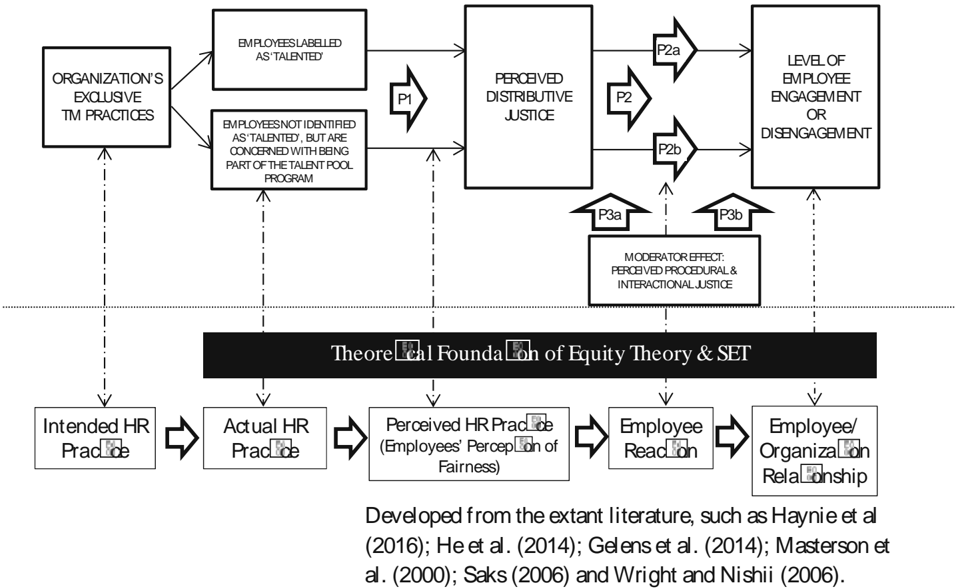
- Proposes P1: employees identified as “talented” are more likely to perceive higher distributive justice than employees not identified as “talented” but concerned with being in the talent pool program; the latter are more likely to perceive lower distributive justice.
- Proposes P2: perceived distributive justice mediates the relationship between exclusive TM practices and employee engagement; P2a predicts “talented” employees show higher engagement because of higher distributive justice, while P2b predicts “non-talented” but concerned employees who perceive their identification as unfair show lower engagement.
- Proposes P3: procedural and interactional justice moderate the distributive justice–engagement relationship; high procedural and/or interactional justice yields neutral-to-positive effects on engagement, while low procedural and interactional justice yields negative effects.
- Argues exclusive TM raises ethical concerns, can marginalize the majority of employees, and that secrecy in TM systems may inhibit the procedural/interactional justice buffer; no numerical results are reported because the paper is conceptual.
Methods
- Conceptual paper; no empirical data, sample, or statistical analysis are reported.
- Develops propositions and a conceptual framework from extant literature on exclusive TM, organizational justice, and employee engagement, using social exchange theory (Blau 1964) and equity theory (Adams 1963) as foundations.
- Presents exclusive TM practices as the input, employee engagement as the output, distributive justice as mediator, and procedural and interactional justice as moderators, with propositions offered for future empirical testing.
Limitations
- The paper states it is conceptual and that empirical testing is required to validate the propositions; it suggests survey research using scales such as Rich et al. (2010) for employee engagement and Colquitt (2001) for organizational justice, possibly augmented by qualitative interviews.
- The paper states the framework makes no allowance for possible gender or other individual attributes and characteristics; it notes gender may affect perceptions of justice and should be examined and controlled for in future testing.
- The paper states its focus is micro-level and it does not develop or discuss in depth the meso-perspective from the organization’s viewpoint, nor the wider macro-level societal ramifications of exclusive TM practices on workforce discrimination and inequality.
Model-written summary. Check it against the paper before relying on it.
Integrity signals
Registry
Cites
Statistics
Figures

Verification
Claims the paper makes
0 Valid · 2 Not valid · 80 Not checked · 31 Own results and interpretations
In the paper
“However, employee responses to perceived fairness often correspond to their organizational experiences (Cropanzano and Mitchell 2005), with 'low perceptions of fairness likely to cause employees to withdraw and disengage' (Saks 2006, p. 606).”
What the sources say
- Not checked yetcites Cropanzano and Mitchell 2005 matched to “Social Exchange Theory: An Interdisciplinary Review” (2005) source
hedgedstates an association- Asserted: passes — The authors put it forward as true.
- Checkable: passes — It can be checked against evidence.
- Load-bearing: passes — The paper’s conclusions depend on it.
- Based: passes — The paper gives a reason why it holds.
None of the sources cited for this claim have been checked yet.
In the paper
“However, as a minority group, 'talented' employees have a disproportionate amount of development resources invested in their future (Malik and Singh 2014; Swailes 2013a).”
What the sources say
plainstates a cause- Asserted: passes — The authors put it forward as true.
- Checkable: passes — It can be checked against evidence.
- Load-bearing: passes — The paper’s conclusions depend on it.
- Based: passes — The paper gives a reason why it holds.
In the paper
“Consistent with Hayibor's (2017, p. 49) assertion that 'a deficiency in the fairness-based perspective' is its assumption of homogeneity, we reject that all employees perceive the fairness of TM in the same way.”
What the sources say
- Not checked yetcites Hayibor 2017 matched to “Is Fair Treatment Enough? Augmenting the Fairness-Based Perspective on Stakeholder Behaviour” (2017) source
plain- Asserted: passes — The authors put it forward as true.
- Checkable: passes — It can be checked against evidence.
- Load-bearing: passes — The paper’s conclusions depend on it.
- Based: passes — The paper gives a reason why it holds.
None of the sources cited for this claim have been checked yet.
In the paper
“Exclusive TM, commonly practiced in organizations today (Malik and Singh 2014; Swailes et al. 2014), is at the crux of our conceptualization.”
What the sources say
plain- Asserted: passes — The authors put it forward as true.
- Checkable: passes — It can be checked against evidence.
- Load-bearing: passes — The paper’s conclusions depend on it.
- Based: passes — The paper gives a reason why it holds.
None of the sources cited for this claim have been checked yet.
In the paper
“Exclusive talent management (TM)-the human resource management (HRM) strategies, policies and practices where organizations identify and focus resources on a limited number of 'talented' employees, that is high-performing (Lewis and Heckman 2006), or high-potential employees (Gallardo-Gallardo et al. 2013)-has received limited consideration from an ethical and organizational justice (Greenberg 199”
- Also stated in: § Introduction · p. 2 · plain
“Nonetheless, there remains a gap in more fully examining the exclusive TM phenomenon from an ethical and organizational justice standpoint.”
- Also stated in: § Exploring the Relationship Between Exclusive Talent Management, Perceived Organizational Justice and Employee Engagement: Bridging the Literature · p. 2 · plain
“The perceived organizational justice and potential ramifications of exclusive TM practices for employees who are not included in corporate talent pools is an under-researched topic.”
What the sources say
- Not checked yetcites Greenberg 1990 matched to “Organizational Justice: Yesterday, Today, and Tomorrow” (1990) source
- Not matchedcites Gelens et al. 2013, 2014
A range of references, not one source.
plain- Asserted: passes — The authors put it forward as true.
- Checkable: passes — It can be checked against evidence.
- Load-bearing: passes — The paper’s conclusions depend on it.
- Based: passes — The paper gives a reason why it holds.
- Also stated in: § Introduction · p. 2 · plain
54 more claims
Create a free account to see all 113 claims and to verify the 135 references still open.
- It may state two separate claims as one. 25
- Probably not a substantial claim. 38
Claims other papers make about this one
Each is checked against this paper’s own text: does it say what the citing paper says it does?
In the citing paper
“On the one hand, it can signal recognition, investment and developmental support.On the other hand, if poorly communicated or perceived as elitist, it may raise concerns about inequality, exclusion or preferential treatment among employees (O'Connor & Crowley-Henry, 2019).”
From Talent management and organizational citizenship behavior. Exploring the role of organizational support and age-related differences (2026) · cites this paper as O'Connor & Crowley-Henry, 2019
Self-check
Percentages, sums and reported differences re-computed from the paper’s own numbers.
Each contradiction between two passages listed here was confirmed by an independent check.
Rated minor: it would not touch a result — a value no result rests on, a p-value that stays on the same side of the significance level, or a conflict that is clerical, resolved elsewhere in the paper, or outside its own findings.
In the paper
§ Toward the Conceptualization · p. 10
“employees, who are treated with respect (interpersonal injustice), provided with appropriate information (informational justice)”
§ Organizational Justice · p. 7
“interpersonal justice, relating to the dignity and respect employees receive from those in authority”
Citations
Cites
Exchange and Power in Social Life
Blau, P. M. (2017) · doi:10.4324/9780203792643 · Cited by 15,923
Exchange and Power in Social Life.
Bierstedt, R., & Blau, P. M. (1965) · American Sociological Review · doi:10.2307/2091154 · Cited by 13,624
Maslach, C., Schaufeli, W. B., & Leiter, M. P. (2001) · Annual Review of Psychology · doi:10.1146/annurev.psych.52.1.397 · Cited by 12,852
The norm of reciprocity: A preliminary statement
Gouldner, A. W. (1960) · American Sociological Review · doi:10.2307/2092623 · Cited by 12,001
(1993) · Journal of the American Dietetic Association · doi:10.1016/0002-8223(93)92196-5 · Cited by 11,976
PSYCHOLOGICAL CONDITIONS OF PERSONAL ENGAGEMENT AND DISENGAGEMENT AT WORK.
Kahn, W. A. (1990) · Academy of Management Journal · doi:10.2307/256287 · Cited by 10,975
Research in Organizational Behavior.
Grimes, A. J., Cummings, L. L., & Staw, B. M. (1986) · Administrative Science Quarterly · doi:10.2307/2392975 · Cited by 10,899
Social Exchange Theory: An Interdisciplinary Review
Cropanzano, R., & Mitchell, M. S. (2005) · Journal of Management · doi:10.1177/0149206305279602 · Cited by 10,068
The measurement of engagement and burnout: a two sample confirmatory factor analytic approach.
Schaufeli, W. B., Salanova, M., González-romá, V., & Bakker, A. B. (2002) · Journal of Happiness Studies · doi:10.1023/a:1015630930326 · Cited by 10,014
Justice at the millennium: A meta-analytic review of 25 years of organizational justice research.
Colquitt, J. A., Conlon, D. E., Wesson, M. J., Porter, C. O. L. H., & Ng, K. Y. (2001) · Journal of Applied Psychology · doi:10.1037/0021-9010.86.3.425 · Cited by 5,942 · cited 19×
“Next we unpack the core assumptions of SET and equity theory, and then we outline the importance of employee perceptions of HR practices (exclusive TM being a collection of HR practices targeted at an exclusive group of employees).”
BackgroundInfluential
Research works printed but not linked: 2
- O'Connor, E. & Crowley-Henry, M. (2015). Exclusive talent management, perceived organizational justice & employee engagement: Bridging the literature. In University Forum for Human Resource Development Conference University College Cork, Ireland.
- Soni, H. (2014). Ethical talent management: The hall mark of contemporary HRM. International Journal of Research in Management & Technology, 4(2), 122-130.
Cited by
Items 101–200 of 243
Retail Business Leaders’ Strategies to Increase Employee Engagement and Workforce Productivity
Jaman, S. H. (2020) · ScholarWorks (Walden University) · Cited by 5
Employee talent management in the Uganda health sector: a public institutions perspective
Nakato, J. (2019) · Nelson Mandela University Research Repository · Cited by 5
A Correlational Study of Manager-Employee Relationship, Employee Rewards, and Employee Engagement
Concepcion, H. M. (2020) · ScholarWorks (Walden University) · Cited by 5
Haromszeki, Ł. (2022) · Wroclaw University of Economics and Business eBooks · doi:10.15611/2022.987.0 · Cited by 4
Mishra, A., Newey, L. R., & Spee, P. (2024) · Journal of Business Ethics · doi:10.1007/s10551-024-05748-2 · Cited by 4
Iqbal, J., Shagirbasha, S., Madhan, K., & Mufeed, S. A. (2024) · Evidence-based HRM a Global Forum for Empirical Scholarship · doi:10.1108/ebhrm-03-2023-0048 · Cited by 4
Ansong, A., Gnankob, R. I., Agyemang, I. O., Issau, K., & Okorley, E. N. A. (2024) · European Journal of Management and Business Economics · doi:10.1108/ejmbe-12-2022-0385 · Cited by 4
Board-Level Diversity Management as a Strategy to Enhance Organizational Performance
Baporikar, N. (2023) · Advances in logistics, operations, and management science book series · doi:10.4018/978-1-6684-8536-1.ch012 · Cited by 4
Mehmood, N., Munir, M., & Batool, N. (2020) · Cited by 4
Building a contextual understanding of coaching: the role of social exchange theory
Mangion-Thornley, K., Gannon, J. M., & Wylie, N. (2025) · Human Resource Development International · doi:10.1080/13678868.2025.2541360 · Cited by 4
Career authenticity in academia: examining the role of antecedents across gender and academic rank
van Helden, D. L., den Dulk, L., Steijn, B., Boonstra, J. G., & Vernooij, M. W. (2023) · European Journal of Higher Education · doi:10.1080/21568235.2023.2201683 · Cited by 4
O'Connor, E. (2018) · Maynooth University ePrints and eTheses Archive (Maynooth University) · Cited by 4
Self-citationFasih, S. T., Jalbani, A. A., & Mubarik, S. (2022) · Market Forces · doi:10.51153/mf.v16i2.507 · Cited by 5
Goswami, I., D’Silva, N., & Kumar, V. (2025) · Regional Formation and Development Studies · doi:10.15181/rfds.v45i1.2703 · Cited by 4
Talent Policy: Problems and Solutions
Robb, C. M., Shahar, T. H. B., Meyer, K., Vetter, B., Steenbeek, H., Sardoč, M., & Hartigh, R. J. R. D. (2025) · The Political Quarterly · doi:10.1111/1467-923x.13538 · Cited by 4
Suwarno, E., Susita, D., & Wolor, C. W. (2022) · The International Journal of Social Sciences World (TIJOSSW) · doi:10.5281/zenodo.6629758 · Cited by 4
How can Organisations Support and Maximise the Contributions of Neurodiverse Employees?
Otaye‐Ebede, L., Loon, M. K. C., Stewart, J., & Nachmias, S. (2023) · Academy of Management Proceedings · doi:10.5465/amproc.2023.16986abstract · Cited by 3
Meaning in motion: Evolving images of talent in organisations in a disruptive world
van der Sluis, L. E. C., & Barkhuizen, E. N. (2023) · SA Journal of Industrial Psychology · doi:10.4102/sajip.v49i0.2099 · Cited by 3
The Effects of TM and CM on Organizational Leadership in Foreign Entities of MNCs
Haromszeki, Ł. (2023) · International Journal of Contemporary Management · doi:10.2478/ijcm-2023-0005 · Cited by 3
The Paradox of Attracting Key Talent in the Canadian Cannabis Industry: Turning Over a New Leaf
McPhee, D. M., & Schlosser, F. K. (2020) · Emerald Group Publishing Limited eBooks · doi:10.1108/978-1-83909-093-620201011 · Cited by 3
Effects of Organizational Justice on Social Loafing: The Mediating Role of Felt Obligation
Awee, A., Maludin, N. B., Mohsin, F. H., Raman, G., & Tazilah, M. D. A. K. (2024) · Journal of Entrepreneurship and Business · doi:10.17687/jeb.v12i1.1191 · Cited by 3
Effects of MDM Adoption on Employee in the Context of Consumerization of IT
Pani, A. K., Choudhary, P. K., Routray, S., & Pani, M. R. (2020) · IFIP advances in information and communication technology · doi:10.1007/978-3-030-64861-9_6 · Cited by 3
Rivera, P. C. (2020) · CSUSB ScholarWorks (California State University, San Bernardino) · Cited by 3
Developing a Strong HRM System: The Role of Line Managers
Fu, N. (2019) · Annals of Social Sciences & Management studies · doi:10.19080/asm.2019.02.555599 · Cited by 3
Romi, M. V., Bagenda, C., Kusuma, R. C. S. D., Setiyawami, S., & Handayani, K. (2022) · SULTANIST Jurnal Manajemen dan Keuangan · doi:10.37403/sultanist.v10i2.450 · Cited by 3
The Examination of Servant Leadership Style on Employee Empowerment and Employee Resistance
Ojeda, M. J. (2023) · ScholarWorks (Walden University) · Cited by 3
Al-Awadhi, T. H. A. (2024) · UUM Electronic Theses and Dissertation [eTheses] (Northern University of Malaysia) · Cited by 3
Leadership Strategies for Implementing Organizational Change
Carroll, A. H. (2021) · ScholarWorks (Walden University) · Cited by 3
Kramer, T. (2021) · Scholar Works at UT Tyler (The University of Texas at Tyler) · Cited by 4
Marques da Cunha, L. C. (2020) · Portuguese National Funding Agency for Science, Research and Technology (RCAAP Project by FCT) · Cited by 3
Tahir, M. S., Arul, P., Tummala, M., Hassan, F. D., & Shagoo, M. R. (2022) · International Journal of Applied Research in Social Sciences · doi:10.51594/ijarss.v4i10.425 · Cited by 3
-ul-Haq, A., & Rizvi, S. T. (2020) · NICE Research Journal · doi:10.51239/nrjss.v0i0.178 · Cited by 2
(2021) · Journal of International Business and Management · doi:10.37227/jibm-2021-07-1093 · Cited by 2
Nthei, L., Otieno, H. N., & Kamoche, K. N. (2026) · Employee Relations · doi:10.1108/er-10-2025-0895 · Cited by 2
Overcoming the “either/or” mindset: Towards an Integrated Talent Management Framework
O'Connor, E. P., Shao, J. J., Ariss, A. A., & Sidani, Y. M. (2025) · European Management Review · doi:10.1111/emre.70002 · Cited by 2
Self-citationİşveren Markası ile Yetenek Yönetimi İlişkisinin İşe Adanmışlık Üzerine Etkisi
Demir, K., & Bayraktar, O. (2020) · Turk Turizm Arastirmalari Dergisi · doi:10.26677/tr1010.2020.549 · Cited by 2
Krebs, B. P., & Kabst, R. (2024) · Journal of World Business · doi:10.1016/j.jwb.2024.101568 · Cited by 2
Thriving as the Synergy of Wellness, Fairness, and Worthiness
Prilleltensky, I., Scarpa, M. P., Martino, S. D., & Ness, O. (2024) · Cambridge University Press eBooks · doi:10.1017/9781009308953.001 · Cited by 2
Fu, C., & Wang, H. (2026) · Frontiers in Organizational Psychology · doi:10.3389/forgp.2025.1686237 · Cited by 2
Avoiding Hidden Inequalities in Challenging Times: Can Talent Management Help?
Alamri, M. A., Stone, M., Aravopoulou, E., Weinzierl, L., Calvini, G., & Maheswaran, L. (2019) · Palgrave explorations in workplace stigma · doi:10.1007/978-3-030-11644-6_8 · Cited by 2
Strategies Small Business Leaders Use to Improve Employee Engagement
Boyd, J. (2020) · ScholarWorks (Walden University) · Cited by 3
The Distribution Model of Fashion Products in Social Commerce: Brand Loyalty and Purchase Decisions
Sudirman, A., Setiyawami, S., & Setyawati, C. Y. (2025) · JURNAL MINDS Manajemen Ide dan Inspirasi · doi:10.24252/minds.v12i1.55511 · Cited by 2
Obalade, G. O. (2022) · ResearchSpace (University of KwaZulu-Natal) · Cited by 2
The difficulties in ensuring justice in temporary teams – managers’ perspective
Rogala, P., Bartniczak, B., Kusterka-Jefmańska, M., Panasiewicz, A., Płachciak, A., & Zaremba-Warnke, S. (2022) · Scientific Papers of Silesian University of Technology Organization and Management Series · doi:10.29119/1641-3466.2022.162.35 · Cited by 2
EXCLUSIVE, INCLUSIVE, AND HYBRID APPROACHES TO TALENT MANAGEMENT: A CONCEPTUAL MODEL
Shahid, Z. (2025) · Sohar University Journal of Sustainable Business · doi:10.69983/sujsb/0102/04 · Cited by 2
Social and Natural Constituents of Talent: A Critical Appreciation
Swailes, S. (2020) · Emerald Group Publishing Limited eBooks · doi:10.1108/978-1-83909-093-620201004 · Cited by 2
Enhancing Employee Engagement through Improving Motivation
Guo, F. (2021) · AU-HIU International Multidisciplinary Journal · Cited by 1
Do employees benefit from a perceived culture of companionate love? An attachment theory perspective
Liu, Z., Yang, D., Liu, Y., Chang, D., & Pan, Y. (2026) · Humanities and Social Sciences Communications · doi:10.1057/s41599-026-06570-z · Cited by 1
Goswami, I., & D’Silva, N. (2025) · Asia-Pacific Journal of Management Research and Innovation · doi:10.1177/2319510x251369220 · Cited by 1
Aldawod, A., & AL-Duhoki, A. A. A. (2026) · Employee Responsibilities and Rights Journal · doi:10.1007/s10672-026-09583-7 · Cited by 1
Civile, M., Pepper, J., & Civile, C. (2026) · European journal of training and development · doi:10.1108/ejtd-10-2025-0237 · Cited by 1
Yang, F., Ren, R., & Sun, X. (2025) · Journal of Business Ethics · doi:10.1007/s10551-025-06073-y · Cited by 1
Strategies Organizational Leaders Use to Engage Employees
Lewis, L. V. (2023) · ScholarWorks (Walden University) · Cited by 1
Exploring Strategies Leaders Use to Engage Employees
Gholz, E. L. (2018) · ScholarWorks (Walden University) · Cited by 1
أثر العدالة المدركة على الاحتفاظ بالعميل "الدور الوسيط لثقـــة ورضا العميــل" (دراسة تطبيقية)
شاذلى, ا. م. (2022) · Al-Maǧallaẗ Al-Miṣriyyaẗ Lil Dirāsāt Al-Tiǧāriyyaẗ /Al-Maǧallaẗ Al-Miṣriyyaẗ Lil Dirāsāt Al-Tiǧāriyyaẗ · doi:10.21608/alat.2022.260741 · Cited by 1
Evaluating Social Engagement Through Talent Management Practices
Johara, F. T., Yahya, S., & Zainal, S. R. M. (2020) · Springer eBooks · doi:10.1007/978-981-15-7014-8_12 · Cited by 1
Strategies to Improve Hospital Patient Satisfaction to Increase Performance-Based Reimbursements
Silla III, C. G. (2023) · ScholarWorks (Walden University) · Cited by 1
Maghfirah, H., Yanita, Y., Ikramuddin, I., & Ariska, J. (2023) · International Conference on Finance, Economics and Business (ICOFEB) · doi:10.29103/icofeb.v1i-.588 · Cited by 1
Pirzada, Z. A., Phulpoto, N. H., & Mahar, S. A. (2024) · JISR management and social sciences & economics · doi:10.31384/jisrmsse/2024.22.3.5 · Cited by 1
Coaching as a social exchange : examining the role of coaching in talent management
Mangion-Thornley, K. (2020) · Radar (Oxford Brookes University) · doi:10.24384/8wa0-8b60 · Cited by 1
Yoshinta, D. O., Wijoyo, S., & Suhariadi, F. (2025) · Edelweiss Applied Science and Technology · doi:10.55214/25768484.v9i6.7816 · Cited by 1
Akbari, S., Bakhshalipour, V., Khodaparast, S., & Kalashi, M. (2022) · Educación Física y Deporte · doi:10.17533/udea.efyd.e346661 · Cited by 1
Rout, M., & Satpathy, B. (2020) · Journal of Humanities and Social Sciences Studies · doi:10.32996/jhsss.2020.2.6.4 · Cited by 1
TALENT MANAGEMENT; A CRITICAL REVIEW OF LITERATURE
Resah, S., & EGESSA, D. R. (2021) · Strategic Journal of Business & Change Management · doi:10.61426/sjbcm.v8i1.1945 · Cited by 1
Research on Social Talent Governance Based on Genetic Algorithm
Zeng, Y. (2021) · Scientific Programming · doi:10.1155/2021/6288679 · Cited by 1
Malik, F., & Waheed, A. (2022) · Foundation University Journal of Psychology · doi:10.33897/fujp.v6i1.276 · Cited by 1
SYSTEMATIC LITERATURE REVIEW, MANAJEMEN TALENTA (TALENT MANAGEMENT)
Agustriyana, D., Marianti, M. M., & Deti, R. (2024) · Jurnal Darma Agung · doi:10.46930/ojsuda.v32i5.4785 · Cited by 1
Exploring Employee Engagement in Performance ManagementPreprint
Ishwar, T. R. (2025) · SSRN Electronic Journal · doi:10.2139/ssrn.5352869 · Cited by 1
Bansal, A., Mehta, A. K., & King, D. R. (2026) · International Journal of Conflict Management · doi:10.1108/ijcma-07-2025-0236
Ismail, H. N., Kertechian, S. K., & Abdallah, M. (2025) · International Journal of Bank Marketing · doi:10.1108/ijbm-02-2025-0094
Talent and identity: a hermeneutic exploration of employee perspectives
Widauer, J. (2021) · Sheffield Hallam University · doi:10.7190/shu-thesis-00392
The Impact of Talent Management Practices on Non-talent Employees
Supi, Irawanto, D. W., & Puspaningrum, A. (2023) · Advances in economics, business and management research/Advances in Economics, Business and Management Research · doi:10.2991/978-94-6463-214-9_7
Potipiroon, W. (2026) · Public Performance & Management Review · doi:10.1080/15309576.2026.2640892
Li, Z., 苗仁涛, & Cooke, F. L. (2026) · Asia Pacific Journal of Human Resources · doi:10.1111/1744-7941.70087
The Evolution of Talent Management: From Broad Strategies to Integrated Succession Planning
Daus, C. S., SWEIDA, G. L., Romanoff, A., & Zimmerman, D. (2026) · Administrative Sciences · doi:10.3390/admsci16070336
The management of criticism in talent assessment trials: from reactions to proactive strategies
Braun, P. (2026) · Employee Relations · doi:10.1108/er-11-2025-1007
Hung, T.-K., Lee, S.-L., Liou, S.-H., & Lin, J.-L. (2025) · SAGE Open · doi:10.1177/21582440251375524
Gajda, D. (2026) · Central European Management Journal · doi:10.1108/cemj-11-2024-0361
Beyond the surface: probing managers' mental representations in talent practices
Souak, Y., Fardi, W. A.-E., & Saïd, K. A. (2025) · Journal of Management Development · doi:10.1108/jmd-10-2023-0310
Micro-processes of paradoxical learning: how entrepreneurs reconcile financial and ESG tensions
Ante, L. (2026) · Digital Business · doi:10.1016/j.digbus.2026.100186
Mitigating knowledge hiding: how do active leadership styles and HRM practices matter?
Hakmaoui, A., Oubrich, M., & Benhayoun-Sadafiyine, L. (2026) · Journal of Intellectual Capital · doi:10.1108/jic-08-2025-0331
Quaresma, T. M. S., Marques, M. D. C., & Mota, L. (2026) · Nursing Reports · doi:10.3390/nursrep16090343
Workplace e-learning success: Learner characteristics, burnout, and psychological safety
Yakoob, N. B., Estellés-Miguel, S., Millán-Franco, M. A., & Aparisi-Torrijo, S. (2026) · Intangible Capital · doi:10.3926/ic.3939
Soomro, S. A., Qamar, F., Kundi, Y. M., Dar, N., & Muhammad, F. (2025) · Journal of Organizational Effectiveness People and Performance · doi:10.1108/joepp-04-2025-0241
Mutangandebvu, B. (2025) · DUT Open Scholar (Durban University of Technology) · doi:10.51415/10321/6278
Muchowe, R. M. (2026) · DUT Open Scholar (Durban University of Technology) · doi:10.51415/10321/6406
Strategies for Promoting Employee Engagement in the Information Technology Sector
Zelelew, E. B. (2023) · ScholarWorks (Walden University)
NEVER TOO MUCH: THE DYNAMIC NATURE OF INCLUSION PERCEPTIONS DURING CHIEF EXECUTIVE TRANSITIONS
Burgess, R. V. (2023) · Carolina Digital Repository (University of North Carolina at Chapel Hill) · doi:10.17615/8bxh-4704
Lavoie, D., Dubord, M. G., Jauvin, F., & Forest, J. (2025) · Canadian Journal of Career Development · doi:10.53379/cjcd.2025.427
Liu, B., Zhao, J., Xiao, F., & Jiang, N. (2026) · Current Issues in Tourism · doi:10.1080/13683500.2026.2713168
Strategies Leaders in the Retail Industry Use to Increase Employee Engagement
Crawford, Y. N. (2020) · ScholarWorks (Walden University)
Talent Management in Chinese University Context: A Comparative Case Study Approach
Liu, M. (2024) · Repository@Hull (Worktribe) (University of Hull)
Mileham, R. J. (2024) · ScholarWorks (Walden University)
Dubord, M. G. (2022) · Archipel (Université du Québec à Montréal)
Antecedents and performance consequences of talent management
Krebs, B. P. (2020) · Habilitation Regulations of the Faculty of Mechanical Engineering (University of Paderborn) · doi:10.17619/unipb/1-984
Doing it right: procurement talent for the 21st century
Bray, & Charles, E. (2019) · Pepperdine Digital Commons (Pepperdine University)
Salvamani, S. (2023) · UUM Electronic Theses and Dissertation [eTheses] (Northern University of Malaysia)
The influence of leader workplace aggression on work engagement, moderated by timing
Kubheka, M. (2024) · UpSpace Institutional Repository (University of Pretoria)
Schuch, C. D. O. S. (2023) · LA Referencia (Red Federada de Repositorios Institucionales de Publicaciones Científicas)
Metadata
- Authors
- O’Connor, E. P., & Crowley-Henry, M.
- Affiliations
- National University of Ireland, Maynooth (IE)
- Corresponding author
- O’Connor, Edward P.
- ORCID
- O’Connor, Edward P.
- Venue
- Journal of Business Ethics
- Published
- 2017-04-17
- Volume
- 156
- Issue
- 4
- Pages
- 903-917
- ISSN
- 0167-4544 (ISSN-L)
- 1573-0697
- OpenAlex
- W2607164039
- Semantic Scholar
- 3fa83a07ee2062ad08a5680ef7624779479f0bd2
- Cited by
- 244
- References
- 117
- Citations by year
- 2026: 27 · 2025: 30 · 2024: 41 · 2023: 40 · 2022: 35 · 2021: 21 · 2020: 36 · 2019: 8 · 2018: 4 · 2017: 1
- FWCI
- 18.97
- Type
- journal article
- Language
- en
- Open access
- Licence
- www.springer.com/tdm (tdm)
- Locations
- Journal of Business Ethics (publishedVersion)
- Maynooth University ePrints and eTheses Archive (Maynooth University) (acceptedVersion)
- RePEc: Research Papers in Economics (submittedVersion)
- Funders
- Irish Research Council for Science, Engineering and Technology (GOIPG/2014/220)
- Topics
- Social Sciences › Business, Management and Accounting › Organizational Behavior and Human Resource Management › Human Resource and Talent Management
- Social Sciences › Business, Management and Accounting › Organizational Behavior and Human Resource Management › Job Satisfaction and Organizational Behavior
- Social Sciences › Business, Management and Accounting › Organizational Behavior and Human Resource Management › Employer Branding and e-HRM
- Keywords
- perceived organizational justice, employee engagement, talent pool, social exchange theory, equity theory, employee disengagement
About these checks
Registry, retraction, Cites and statistics results are computed, not judged, with one exception: a printed reference that no index lists is read once by a model before it counts as a citation error. Claims are extracted by a model and kept only when their quote appears verbatim in the text; each cited source is then checked, with a model’s help, for whether it says what the claim relies on. Those verdicts can be wrong — read the claim’s quote and the cited source before relying on one.
A language model drew the claims from the paper on 2026-11-22, under version 3 of the claim definition (model deepseek-v4.1-flash, prompt extract-v3).
A second model labelled each claim on 2026-11-22 (model jev-1.13-20260917, definition revision gold-guideline-v0.2).
Statistics and arithmetic are recomputed, not judged.
Confidence bands are shown only for fields calibrated on our annotated test set. None is calibrated yet, so no band is shown.
What counts as a claim ›How we measure confidence ›How we check this ›
Are you an author, or do you see a problem with this page? Request a review
Data sources
Bibliographic data: Semantic Scholar, OpenAlex, Crossref.
Contains information from the Semantic Scholar Academic Graph Datasets, made available under the ODC Attribution License (ODC-BY 1.0).
Semantic Scholar’s data is described in: Kinney, R., et al. (2023). The Semantic Scholar Open Data Platform. arXiv:2301.10140.
