

Exploring the Relationship Between Exclusive Talent Management, Perceived Organizational Justice and Employee Engagement: Bridging the Literature
Open accessThe DOI matches its Crossref record; 118 of the 119 references it cites were found in a registry or an index, and 1 are not checked yet; none of the 157 sources its claims cite is checked for support yet.
Checked 2026-11-22 · 1 reference not checked yet
Overview
CoChat Summary
TL;DR
This conceptual paper proposes that exclusive talent management practices affect employee engagement through perceived organizational justice, with distributive justice mediating and procedural/interactional justice moderating the relationship. It focuses on employees not identified as “talented” but who believe they should be in the talent pool, arguing perceived unfairness may lower engagement.
Key findings
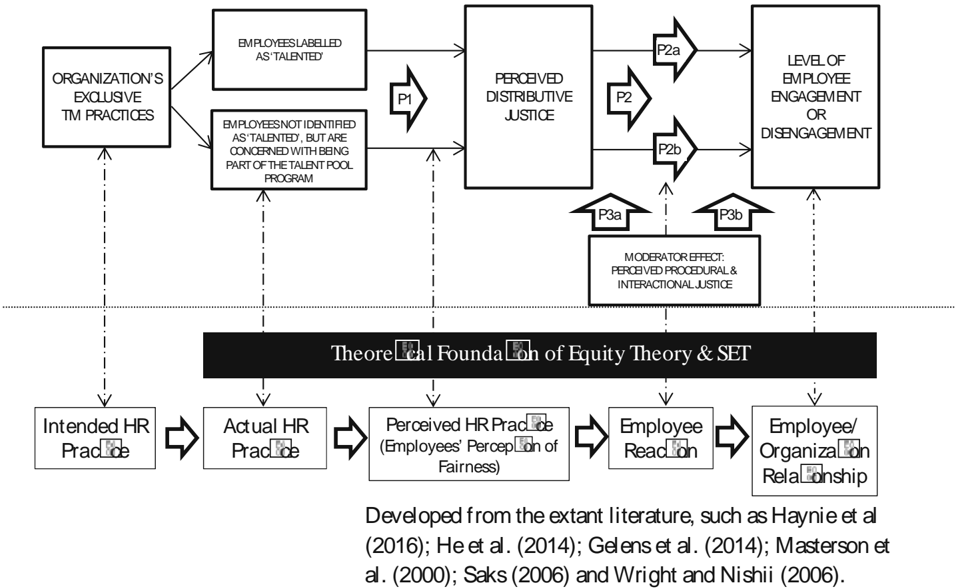
- Proposes P1: employees identified as “talented” are more likely to perceive higher distributive justice than employees not identified as “talented” but concerned with being in the talent pool program; the latter are more likely to perceive lower distributive justice.
- Proposes P2: perceived distributive justice mediates the relationship between exclusive TM practices and employee engagement; P2a predicts “talented” employees show higher engagement because of higher distributive justice, while P2b predicts “non-talented” but concerned employees who perceive their identification as unfair show lower engagement.
- Proposes P3: procedural and interactional justice moderate the distributive justice–engagement relationship; high procedural and/or interactional justice yields neutral-to-positive effects on engagement, while low procedural and interactional justice yields negative effects.
- Argues exclusive TM raises ethical concerns, can marginalize the majority of employees, and that secrecy in TM systems may inhibit the procedural/interactional justice buffer; no numerical results are reported because the paper is conceptual.
Methods
- Conceptual paper; no empirical data, sample, or statistical analysis are reported.
- Develops propositions and a conceptual framework from extant literature on exclusive TM, organizational justice, and employee engagement, using social exchange theory (Blau 1964) and equity theory (Adams 1963) as foundations.
- Presents exclusive TM practices as the input, employee engagement as the output, distributive justice as mediator, and procedural and interactional justice as moderators, with propositions offered for future empirical testing.
Limitations
- The paper states it is conceptual and that empirical testing is required to validate the propositions; it suggests survey research using scales such as Rich et al. (2010) for employee engagement and Colquitt (2001) for organizational justice, possibly augmented by qualitative interviews.
- The paper states the framework makes no allowance for possible gender or other individual attributes and characteristics; it notes gender may affect perceptions of justice and should be examined and controlled for in future testing.
- The paper states its focus is micro-level and it does not develop or discuss in depth the meso-perspective from the organization’s viewpoint, nor the wider macro-level societal ramifications of exclusive TM practices on workforce discrimination and inequality.
Model-written summary. Check it against the paper before relying on it.
Integrity signals
Registry
Cites
Statistics
Figures

Verification
Claims the paper makes
0 Valid · 2 Not valid · 80 Not checked · 31 Own results and interpretations
In the paper
“However, employee responses to perceived fairness often correspond to their organizational experiences (Cropanzano and Mitchell 2005), with 'low perceptions of fairness likely to cause employees to withdraw and disengage' (Saks 2006, p. 606).”
What the sources say
- Not checked yetcites Cropanzano and Mitchell 2005 matched to “Social Exchange Theory: An Interdisciplinary Review” (2005) source
hedgedstates an association- Asserted: passes — The authors put it forward as true.
- Checkable: passes — It can be checked against evidence.
- Load-bearing: passes — The paper’s conclusions depend on it.
- Based: passes — The paper gives a reason why it holds.
None of the sources cited for this claim have been checked yet.
In the paper
“However, as a minority group, 'talented' employees have a disproportionate amount of development resources invested in their future (Malik and Singh 2014; Swailes 2013a).”
What the sources say
plainstates a cause- Asserted: passes — The authors put it forward as true.
- Checkable: passes — It can be checked against evidence.
- Load-bearing: passes — The paper’s conclusions depend on it.
- Based: passes — The paper gives a reason why it holds.
In the paper
“Consistent with Hayibor's (2017, p. 49) assertion that 'a deficiency in the fairness-based perspective' is its assumption of homogeneity, we reject that all employees perceive the fairness of TM in the same way.”
What the sources say
- Not checked yetcites Hayibor 2017 matched to “Is Fair Treatment Enough? Augmenting the Fairness-Based Perspective on Stakeholder Behaviour” (2017) source
plain- Asserted: passes — The authors put it forward as true.
- Checkable: passes — It can be checked against evidence.
- Load-bearing: passes — The paper’s conclusions depend on it.
- Based: passes — The paper gives a reason why it holds.
None of the sources cited for this claim have been checked yet.
In the paper
“Exclusive TM, commonly practiced in organizations today (Malik and Singh 2014; Swailes et al. 2014), is at the crux of our conceptualization.”
What the sources say
plain- Asserted: passes — The authors put it forward as true.
- Checkable: passes — It can be checked against evidence.
- Load-bearing: passes — The paper’s conclusions depend on it.
- Based: passes — The paper gives a reason why it holds.
None of the sources cited for this claim have been checked yet.
In the paper
“Exclusive talent management (TM)-the human resource management (HRM) strategies, policies and practices where organizations identify and focus resources on a limited number of 'talented' employees, that is high-performing (Lewis and Heckman 2006), or high-potential employees (Gallardo-Gallardo et al. 2013)-has received limited consideration from an ethical and organizational justice (Greenberg 199”
- Also stated in: § Introduction · p. 2 · plain
“Nonetheless, there remains a gap in more fully examining the exclusive TM phenomenon from an ethical and organizational justice standpoint.”
- Also stated in: § Exploring the Relationship Between Exclusive Talent Management, Perceived Organizational Justice and Employee Engagement: Bridging the Literature · p. 2 · plain
“The perceived organizational justice and potential ramifications of exclusive TM practices for employees who are not included in corporate talent pools is an under-researched topic.”
What the sources say
- Not checked yetcites Greenberg 1990 matched to “Organizational Justice: Yesterday, Today, and Tomorrow” (1990) source
- Not matchedcites Gelens et al. 2013, 2014
A range of references, not one source.
plain- Asserted: passes — The authors put it forward as true.
- Checkable: passes — It can be checked against evidence.
- Load-bearing: passes — The paper’s conclusions depend on it.
- Based: passes — The paper gives a reason why it holds.
- Also stated in: § Introduction · p. 2 · plain
54 more claims
Create a free account to see all 113 claims and to verify the 135 references still open.
- It may state two separate claims as one. 25
- Probably not a substantial claim. 38
Claims other papers make about this one
Each is checked against this paper’s own text: does it say what the citing paper says it does?
In the citing paper
“On the one hand, it can signal recognition, investment and developmental support.On the other hand, if poorly communicated or perceived as elitist, it may raise concerns about inequality, exclusion or preferential treatment among employees (O'Connor & Crowley-Henry, 2019).”
From Talent management and organizational citizenship behavior. Exploring the role of organizational support and age-related differences (2026) · cites this paper as O'Connor & Crowley-Henry, 2019
Self-check
Percentages, sums and reported differences re-computed from the paper’s own numbers.
Each contradiction between two passages listed here was confirmed by an independent check.
Rated minor: it would not touch a result — a value no result rests on, a p-value that stays on the same side of the significance level, or a conflict that is clerical, resolved elsewhere in the paper, or outside its own findings.
In the paper
§ Toward the Conceptualization · p. 10
“employees, who are treated with respect (interpersonal injustice), provided with appropriate information (informational justice)”
§ Organizational Justice · p. 7
“interpersonal justice, relating to the dignity and respect employees receive from those in authority”
Citations
Cites
Exchange and Power in Social Life
Blau, P. M. (2017) · doi:10.4324/9780203792643 · Cited by 15,923
Exchange and Power in Social Life.
Bierstedt, R., & Blau, P. M. (1965) · American Sociological Review · doi:10.2307/2091154 · Cited by 13,624
Maslach, C., Schaufeli, W. B., & Leiter, M. P. (2001) · Annual Review of Psychology · doi:10.1146/annurev.psych.52.1.397 · Cited by 12,852
The norm of reciprocity: A preliminary statement
Gouldner, A. W. (1960) · American Sociological Review · doi:10.2307/2092623 · Cited by 12,001
(1993) · Journal of the American Dietetic Association · doi:10.1016/0002-8223(93)92196-5 · Cited by 11,976
PSYCHOLOGICAL CONDITIONS OF PERSONAL ENGAGEMENT AND DISENGAGEMENT AT WORK.
Kahn, W. A. (1990) · Academy of Management Journal · doi:10.2307/256287 · Cited by 10,975
Research in Organizational Behavior.
Grimes, A. J., Cummings, L. L., & Staw, B. M. (1986) · Administrative Science Quarterly · doi:10.2307/2392975 · Cited by 10,899
Social Exchange Theory: An Interdisciplinary Review
Cropanzano, R., & Mitchell, M. S. (2005) · Journal of Management · doi:10.1177/0149206305279602 · Cited by 10,068
The measurement of engagement and burnout: a two sample confirmatory factor analytic approach.
Schaufeli, W. B., Salanova, M., González-romá, V., & Bakker, A. B. (2002) · Journal of Happiness Studies · doi:10.1023/a:1015630930326 · Cited by 10,014
Justice at the millennium: A meta-analytic review of 25 years of organizational justice research.
Colquitt, J. A., Conlon, D. E., Wesson, M. J., Porter, C. O. L. H., & Ng, K. Y. (2001) · Journal of Applied Psychology · doi:10.1037/0021-9010.86.3.425 · Cited by 5,942 · cited 19×
“Next we unpack the core assumptions of SET and equity theory, and then we outline the importance of employee perceptions of HR practices (exclusive TM being a collection of HR practices targeted at an exclusive group of employees).”
BackgroundInfluentialAntecedents and consequences of employee engagement
Saks, A. M. (2006) · Journal of Managerial Psychology · doi:10.1108/02683940610690169 · Cited by 5,577
Homans, G. C. (1958) · American Journal of Sociology · doi:10.1086/222355 · Cited by 5,350
Carpenter, M. A., Cardon, M. S., McMullen, J. S., & Shepherd, D. A. (2011) · In Search of Research Excellence · doi:10.4337/9781849807630.00018 · Cited by 5,213
Towards an understanding of inequity
Adams, J. S. (1963) · The Journal of Abnormal and Social Psychology · doi:10.1037/h0040968 · Cited by 5,146 · cited 17×
“Specifically, SET (Blau 1964) and equity theory (Adams 1963) are utilized to explore the volition that individual employees have toward their engagement with organizational practices, and to consider the implications of exclusive TM practices on the ‘implicit social contract between an organization and its employees’…”
BackgroundMethodResultInfluential(2013) · Academy of Management Journal · doi:10.5465/amj · Cited by 4,798
Social Behavior: Its Elementary Forms
Hollander, E. P., & Homans, G. C. (1963) · The American Journal of Psychology · doi:10.2307/1419191 · Cited by 4,692
Harter, J. K., Schmidt, F. L., & Hayes, T. L. (2002) · Journal of Applied Psychology · doi:10.1037/0021-9010.87.2.268 · Cited by 4,623
On the dimensionality of organizational justice: A construct validation of a measure.
Colquitt, J. A. (2001) · Journal of Applied Psychology · doi:10.1037/0021-9010.86.3.386 · Cited by 4,114
Job Engagement: Antecedents and Effects on Job Performance
Rich, B. L., Lepine, J. A., & Crawford, E. R. (2010) · Academy of Management Journal · doi:10.5465/amj.2010.51468988 · Cited by 3,833
Organizational Justice: Yesterday, Today, and Tomorrow
Greenberg, J. (1990) · Journal of Management · doi:10.1177/014920639001600208 · Cited by 3,651
Cook, K. S. (2020) · The Blackwell Encyclopedia of Sociology · doi:10.1002/9781405165518.wbeoss149.pub2 · Cited by 3,637
The Role of Justice in Organizations: A Meta-Analysis
Cohen-Charash, Y., & Spector, P. E. (2001) · Organizational Behavior and Human Decision Processes · doi:10.1006/obhd.2001.2958 · Cited by 3,556
Patterns in Strategy Formation
Mintzberg, H. (1978) · Management Science · doi:10.1287/mnsc.24.9.934 · Cited by 3,494
May, D. R., Gilson, R. L., & Harter, L. M. (2004) · Journal of Occupational and Organizational Psychology · doi:10.1348/096317904322915892 · Cited by 3,483 · cited 1×
“Empirical research has linked investments of these three energies (physical, cognitive, and emotional) to job performance and employee engagement (Kahn 1990; May et al. 2004; Rich et al. 2010; Thomas and Rowland 2014).”
BackgroundEmerson, R. M. (1976) · Annual Review of Sociology · doi:10.1146/annurev.so.02.080176.002003 · Cited by 3,457
The Meaning of Employee Engagement
Macey, W. H., & Schneider, B. (2008) · Industrial and Organizational Psychology · doi:10.1111/j.1754-9434.2007.0002.x · Cited by 3,203
What Should Be Done with Equity Theory?
Leventhal, G. S. (1980) · Social Exchange · doi:10.1007/978-1-4613-3087-5_2 · Cited by 3,010
The Human Resource Architecture: Toward a Theory of Human Capital Allocation and Development
Lepak, D. P., & Snell, S. A. (1999) · The Academy of Management Review · doi:10.2307/259035 · Cited by 2,855
Interactional justice : communication criteria of fairness
Bies, R. (1986) · Medical Entomology and Zoology · Cited by 2,761
Social Behavior: Its Elementary Forms
Tréanton, J.-R., Homans, G. C., Merton, R. K., & Treanton, J.-R. (1962) · Revue Française de Sociologie · doi:10.2307/3319326 · Cited by 2,399
Retaliation in the workplace: The roles of distributive, procedural, and interactional justice.
Skarlicki, D. P., & Folger, R. G. (1997) · Journal of Applied Psychology · doi:10.1037//0021-9010.82.3.434 · Cited by 2,286
Masterson, S. S., Lewis, K., Goldman, B. M., & Taylor, M. S. (2000) · Academy of Management Journal · doi:10.2307/1556364 · Cited by 2,088
Leventhal, G. S. (1976) · Cited by 2,057
Strategic talent management: A review and research agenda
Collings, D. G., & Mellahi, K. (2009) · Human Resource Management Review · doi:10.1016/j.hrmr.2009.04.001 · Cited by 1,837
McFarlin, D. B., & Sweeney, P. D. (1992) · Academy of Management Journal · doi:10.2307/256489 · Cited by 1,704
Emotion in the Workplace: A Reappraisal
Ashforth, B. E., & Humphrey, R. H. (1995) · Human Relations · doi:10.1177/001872679504800201 · Cited by 1,470
Talent management: A critical review
Lewis, R. E., & Heckman, R. J. (2006) · Human Resource Management Review · doi:10.1016/j.hrmr.2006.03.001 · Cited by 1,341
Toward a Unifying Framework for Exploring Fit and Flexibility in Strategic Human Resource Management
Wright, P. M., & Snell, S. A. (1998) · The Academy of Management Review · doi:10.2307/259061 · Cited by 1,338
The Management of Organizational Justice
Cropanzano, R., Bowen, D. E., & Gilliland, S. W. (2007) · Academy of Management Perspectives · doi:10.5465/amp.2007.27895338 · Cited by 1,295
(1992) · Long Range Planning · doi:10.1016/0024-6301(92)90232-q · Cited by 1,290
Social behavior Its elementary forms
Homans, G., & Merton, R. K. (1974) · Cited by 886
Corporate social responsibility and employee commitment
Collier, J., & Esteban, R. (2007) · Business Ethics: A European Review · doi:10.1111/j.1467-8608.2006.00466.x · Cited by 848
Gender and Jobs: Sex Segregation of Occupations in the World
Anker, R. (1998) · Cited by 776
The predicament of injustice: The management of moral outrage.
Bies, R. J. (1987) · Research in Organizational Behavior · Cited by 685
What Do We Really Know About Employee Engagement?
Saks, A. M., & Gruman, J. A. (2014) · Human Resource Development Quarterly · doi:10.1002/hrdq.21187 · Cited by 678
Talent management strategy of employee engagement in Indian ITES employees: key to retention
Bhatnagar, J. (2007) · Employee Relations · doi:10.1108/01425450710826122 · Cited by 617
What is the meaning of ‘talent’ in the world of work?
Gallardo-Gallardo, E., Dries, N., & González-Cruz, T. F. (2013) · Human Resource Management Review · doi:10.1016/j.hrmr.2013.05.002 · Cited by 614
Talent management for the twenty-first century.
Cappelli, P. H. (2008) · PubMed · Cited by 579
Contemporary topics in social psychology
Thibaut, J. W., SPENCE, J. T., Carson, R. C., & Brehm, J. W. (1976) · Cited by 530
Talent management: Current theories and future research directions
Al Ariss, A., Cascio, W. F., & Paauwe, J. (2014) · Journal of World Business · doi:10.1016/j.jwb.2013.11.001 · Cited by 530
The psychology of talent management: A review and research agenda
Dries, N. (2013) · Human Resource Management Review · doi:10.1016/j.hrmr.2013.05.001 · Cited by 523
Procedural Justice, Participation, and the Fair Process Effect in Groups and Organizations
Greenberg, J., & Folger, R. (1983) · Basic Group Processes · doi:10.1007/978-1-4612-5578-9_10 · Cited by 468
Equity theory: A review and critique
Pritchard, R. D. (1969) · Organizational Behavior and Human Performance · doi:10.1016/0030-5073(69)90005-1 · Cited by 460 · cited 1×
“Employees will seek to uphold what they perceive to be a fair balance between what they put into an organization, their inputs, and what they receive in return or as reward, their outputs (Pritchard 1968).”
Background(2006) · eCommons (Cornell University) · Cited by 437
Bridging Micro and Macro Domains: Workforce Differentiation and Strategic Human Resource Management
Huselid, M. A., & Becker, B. E. (2011) · Journal of Management · doi:10.1177/0149206310373400 · Cited by 413
Linking justice, trust and innovative work behaviour to work engagement
A. Agarwal, U. (2014) · Personnel Review · doi:10.1108/pr-02-2012-0019 · Cited by 389
Asian Academy of Management Journal
(2021) · Asian Academy of Management Journal · doi:10.21315/aamj · Cited by 382
Gelens, J., Dries, N., Hofmans, J., & Pepermans, R. (2013) · Human Resource Management Review · doi:10.1016/j.hrmr.2013.05.005 · Cited by 370
Shuck, B. (2011) · Human Resource Development Review · doi:10.1177/1534484311410840 · Cited by 350
(1986) · Critical Issues in Social Justice · doi:10.1007/978-1-4684-5059-0 · Cited by 347
Satisfaction with HR practices and commitment to the organisation: why one size does not fit all
Kinnie, N., Hutchinson, S., Purcell, J., Rayton, B., & Swart, J. (2005) · Human Resource Management Journal · doi:10.1111/j.1748-8583.2005.tb00293.x · Cited by 343
Antecedents and consequences of justice perceptions in performance appraisals
Erdogan, B. (2002) · Human Resource Management Review · doi:10.1016/s1053-4822(02)00070-0 · Cited by 338
Mapping talent development: definition, scope and architecture
Garavan, T. N., Carbery, R., & Rock, A. (2012) · European Journal of Training and Development · doi:10.1108/03090591211192601 · Cited by 337
Ethics and HRM: A Review and Conceptual Analysis
Greenwood, M. R. (2002) · Journal of Business Ethics · doi:10.1023/a:1014090411946 · Cited by 331
A review of talent management: ‘infancy or adolescence?’
Thunnissen, M., Boselie, P., & Fruytier, B. (2013) · The International Journal of Human Resource Management · doi:10.1080/09585192.2013.777543 · Cited by 330
Festing, M., & Schäfer, L. (2014) · Journal of World Business · doi:10.1016/j.jwb.2013.11.010 · Cited by 306
Talent — Innate or acquired? Theoretical considerations and their implications for talent management
Meyers, M. C., van Woerkom, M., & Dries, N. (2013) · Human Resource Management Review · doi:10.1016/j.hrmr.2013.05.003 · Cited by 303
Employee Engagement and Well-Being: A Moderation Model and Implications for Practice
Shuck, B., & Reio, T. G. (2014) · Journal of Leadership & Organizational Studies · doi:10.1177/1548051813494240 · Cited by 299
Slack, R. E., Corlett, S., & Morris, R. (2015) · Journal of Business Ethics · doi:10.1007/s10551-014-2057-3 · Cited by 278
Talent or Not? Employee Reactions to Talent Identification
Björkman, I., Ehrnrooth, M., Mäkelä, K., Smale, A., & Sumelius, J. (2013) · Human Resource Management · doi:10.1002/hrm.21525 · Cited by 273
Fighting the war for talent is hazardous to your organization’s health
Pfeffer, J. (2001) · Organizational Dynamics · doi:10.1016/s0090-2616(01)00031-6 · Cited by 272
Talent management as a management fashion in HRD: towards a research agenda
Iles, P., Preece, D., & Chuai, X. (2010) · Human Resource Development International · doi:10.1080/13678861003703666 · Cited by 252
Talent management and organisational justice: employee reactions to high potential identification
Gelens, J., Hofmans, J., Dries, N., & Pepermans, R. (2014) · Human Resource Management Journal · doi:10.1111/1748-8583.12029 · Cited by 251
Talent management: Progress and prospects
Collings, D. G., Scullion, H., & Vaiman, V. (2015) · Human Resource Management Review · doi:10.1016/j.hrmr.2015.04.005 · Cited by 250
Contemporary Readings in Law and Social Justice
(2024) · doi:10.52783/crlsj · Cited by 230
Folger, R. (1986) · Critical Issues in Social Justice · doi:10.1007/978-1-4684-5059-0_8 · Cited by 222
He, H., Zhu, W., & Zheng, X. (2014) · Journal of Business Ethics · doi:10.1007/s10551-013-1774-3 · Cited by 220
Situational determinants of software piracy: An equity theory perspective
Glass, R. S., & Wood, W. A. (1996) · Journal of Business Ethics · doi:10.1007/bf00412817 · Cited by 216
Festing, M., Schäfer, L., & Scullion, H. (2013) · The International Journal of Human Resource Management · doi:10.1080/09585192.2013.777538 · Cited by 207
Hurrell, S. A. (2016) · Human Relations · doi:10.1177/0018726715591636 · Cited by 198
(2004) · Encyclopedia of Health Care Management · doi:10.4135/9781412950602.n390 · Cited by 197
The Association of Individual Spirituality on Employee Engagement: The Spirit at Work
Roof, R. A. (2015) · Journal of Business Ethics · doi:10.1007/s10551-014-2246-0 · Cited by 189
Seven myths of global talent management
Minbaeva, D., & Collings, D. G. (2013) · The International Journal of Human Resource Management · doi:10.1080/09585192.2013.777539 · Cited by 177
The ethics of talent management
Swailes, S. (2013) · Business Ethics: A European Review · doi:10.1111/beer.12007 · Cited by 119
HR practices and affective organisational commitment: (when) does HR differentiation pay off?
Marescaux, E., De Winne, S., & Sels, L. (2013) · Human Resource Management Journal · doi:10.1111/1748-8583.12013 · Cited by 110
Conceptualising inclusive talent management: potential, possibilities and practicalities
Swailes, S., Downs, Y., & Orr, K. (2014) · Human Resource Development International · doi:10.1080/13678868.2014.954188 · Cited by 109
Ethics, Values, and Organizational Justice: Individuals, Organizations, and Beyond
Schminke, M. J., Arnaud, A., & Taylor, R. M. (2014) · Journal of Business Ethics · doi:10.1007/s10551-014-2251-3 · Cited by 107
A capability approach to organizational talent management
Downs, Y., & Swailes, S. (2013) · Human Resource Development International · doi:10.1080/13678868.2013.782992 · Cited by 105
Ghosh, P., Rai, A., & Sinha, A. (2014) · Personnel Review · doi:10.1108/pr-08-2013-0148 · Cited by 101
Equity Theory and Time: A Reformulation
Cosier, R. A., & Dalton, D. R. (1983) · The Academy of Management Review · doi:10.5465/amr.1983.4284741 · Cited by 93 · cited 1×
“Cosier and Dalton (1983) stress the importance of fairness and equity in the workplace, forewarning of potentially dramatic ramifications from an organization’s mismanagement of these concepts.”
BackgroundTatli, A., Vassilopoulou, J., & Özbilgin, M. (2013) · International Business Review · doi:10.1016/j.ibusrev.2012.07.005 · Cited by 90
Employee reactions to talent pool membership
Swailes, S., & Blackburn, M. (2016) · Employee Relations · doi:10.1108/er-02-2015-0030 · Cited by 89
Talent management practice effectiveness: investigating employee perspective
Khoreva, V., Vaiman, V., & Van Zalk, M. (2017) · Employee Relations · doi:10.1108/er-01-2016-0005 · Cited by 86
Biswas, S., Varma, A., & Ramaswami, A. (2013) · The International Journal of Human Resource Management · doi:10.1080/09585192.2012.725072 · Cited by 79
Ethical issues in human resources systems
Buckley, M. R., Beu, D. S., Frink, D. D., Howard, J. L., Berkson, H., Mobbs, T. A., & Ferris, G. R. (2001) · Human Resource Management Review · doi:10.1016/s1053-4822(00)00038-3 · Cited by 76
Thornton, M. A., & Rupp, D. E. (2016) · Journal of Business Ethics · doi:10.1007/s10551-015-2748-4 · Cited by 70
Justice and job engagement: The role of senior management trust
Haynie, J. J., Mossholder, K. W., & Harris, S. G. (2016) · Journal of Organizational Behavior · doi:10.1002/job.2082 · Cited by 66
‘High potential’ programs: Let's hear it for ‘B’ players
Malik, A. R., & Singh, P. (2014) · Human Resource Management Review · doi:10.1016/j.hrmr.2014.06.001 · Cited by 64
Leadership, Pragmatism and Grace: A Review
Thomas, M. D., & Rowland, C. F. (2013) · Journal of Business Ethics · doi:10.1007/s10551-013-1802-3 · Cited by 58
Talent Management and Organizational Diversity: A Call for Research
Sheehan, M., & Anderson, V. (2015) · Human Resource Development Quarterly · doi:10.1002/hrdq.21247 · Cited by 55
Swailes, S. (2013) · Human Resource Management Review · doi:10.1016/j.hrmr.2013.08.005 · Cited by 49
Talent management for the 21st century
Salkey, J. (2005) · Strategic HR Review · doi:10.1108/14754390580000806 · Cited by 44
Fairness and the Main Management Theories of the Twentieth Century: A Historical Review, 1900–1965
Buren, H. J. V. (2007) · Journal of Business Ethics · doi:10.1007/s10551-007-9582-2 · Cited by 40
Justice, trust and employee reactions: an empirical examination of the HRM system
Katou, A. A. (2013) · Management Research Review · doi:10.1108/mrr-07-2012-0160 · Cited by 38
Female Perceptions of Organizational Justice
Jepsen, D. M., & Rodwell, J. (2012) · Gender, Work & Organization · doi:10.1111/j.1468-0432.2010.00538.x · Cited by 37
Tansley, C., Kirk, S., & Tietze, S. (2013) · Human Resource Management Review · doi:10.1016/j.hrmr.2013.08.004 · Cited by 35
Talent management collides with corporate social responsibility: creation of inadvertent hypocrisy
Y. Lacey, M., & Groves, K. (2014) · Journal of Management Development · doi:10.1108/jmd-06-2012-0073 · Cited by 32
Is Fair Treatment Enough? Augmenting the Fairness-Based Perspective on Stakeholder Behaviour
Hayibor, S. (2017) · Journal of Business Ethics · doi:10.1007/s10551-015-2665-6 · Cited by 30
Procedural justice in promotion decisions of managerial staff in Malaysia
Wan, H. L., Sulaiman, M., & Omar, A. (2012) · Asia Pacific Business Review · doi:10.1080/13602380903424167 · Cited by 27
Godkin, L. (2015) · Journal of Business Ethics · doi:10.1007/s10551-014-2149-0 · Cited by 25
Organisational justice climate, social capital and firm performance
Mahajan, A., & Benson, P. (2013) · Journal of Management Development · doi:10.1108/jmd-12-2010-0091 · Cited by 25
Career development and organizational justice: Practice and research implications
Wooten, K. C., & Cobb, A. T. (1999) · Human Resource Development Quarterly · doi:10.1002/hrdq.3920100207 · Cited by 24
Tackling the challenges of employee engagement
Snell, A. (2009) · Strategic HR Review · doi:10.1108/shr.2009.37208baa.002 · Cited by 13
Talent Management: Towards Balance in Theory and Research
Collings, D. G., & Paauwe, J. (2015) · Academy of Management Proceedings · doi:10.5465/ambpp.2015.14231symposium · Cited by 5
(2004)
(2012) · Redalyc (Universidad Autónoma del Estado de México)
(2011) · Asian Academy of Management Journal
(2013) · Contemporary Readings in Law and Social Justice
Research works printed but not linked: 2
- O'Connor, E. & Crowley-Henry, M. (2015). Exclusive talent management, perceived organizational justice & employee engagement: Bridging the literature. In University Forum for Human Resource Development Conference University College Cork, Ireland.
- Soni, H. (2014). Ethical talent management: The hall mark of contemporary HRM. International Journal of Research in Management & Technology, 4(2), 122-130.
Cited by
There is no good war for talent: a critical review of the literature on talent management
Kwon, K., & Jang, S. (2021) · Employee Relations · doi:10.1108/er-08-2020-0374 · Cited by 182
Oubrich, M., Hakmaoui, A., Benhayoun-Sadafiyine, L., Söilen, K. S., & Abdulkader, B. (2021) · Journal of Business Research · doi:10.1016/j.jbusres.2021.08.045 · Cited by 178
Applicants’ Fairness Perceptions of Algorithm-Driven Hiring Procedures
Lavanchy, M., Reichert, P., Narayanan, J., & Savani, K. (2023) · Journal of Business Ethics · doi:10.1007/s10551-022-05320-w · Cited by 168
Employee reactions to talent pool membership
Swailes, S., & Blackburn, M. (2016) · Employee Relations · doi:10.1108/er-02-2015-0030 · Cited by 89
Ghani, B., Hyder, S. I., Yoo, S., & Han, H. (2023) · Heliyon · doi:10.1016/j.heliyon.2023.e21817 · Cited by 148
Metadata
- Authors
- O’Connor, E. P., & Crowley-Henry, M.
- Affiliations
- National University of Ireland, Maynooth (IE)
- Corresponding author
- O’Connor, Edward P.
- ORCID
- O’Connor, Edward P.
- Venue
- Journal of Business Ethics
- Published
- 2017-04-17
- Volume
- 156
- Issue
- 4
- Pages
- 903-917
- ISSN
- 0167-4544 (ISSN-L)
- 1573-0697
- OpenAlex
- W2607164039
- Semantic Scholar
- 3fa83a07ee2062ad08a5680ef7624779479f0bd2
- Cited by
- 244
- References
- 117
- Citations by year
- 2026: 27 · 2025: 30 · 2024: 41 · 2023: 40 · 2022: 35 · 2021: 21 · 2020: 36 · 2019: 8 · 2018: 4 · 2017: 1
- FWCI
- 18.97
- Type
- journal article
- Language
- en
- Open access
- Licence
- www.springer.com/tdm (tdm)
- Locations
- Journal of Business Ethics (publishedVersion)
- Maynooth University ePrints and eTheses Archive (Maynooth University) (acceptedVersion)
- RePEc: Research Papers in Economics (submittedVersion)
- Funders
- Irish Research Council for Science, Engineering and Technology (GOIPG/2014/220)
- Topics
- Social Sciences › Business, Management and Accounting › Organizational Behavior and Human Resource Management › Human Resource and Talent Management
- Social Sciences › Business, Management and Accounting › Organizational Behavior and Human Resource Management › Job Satisfaction and Organizational Behavior
- Social Sciences › Business, Management and Accounting › Organizational Behavior and Human Resource Management › Employer Branding and e-HRM
- Keywords
- perceived organizational justice, employee engagement, talent pool, social exchange theory, equity theory, employee disengagement
About these checks
Registry, retraction, Cites and statistics results are computed, not judged, with one exception: a printed reference that no index lists is read once by a model before it counts as a citation error. Claims are extracted by a model and kept only when their quote appears verbatim in the text; each cited source is then checked, with a model’s help, for whether it says what the claim relies on. Those verdicts can be wrong — read the claim’s quote and the cited source before relying on one.
A language model drew the claims from the paper on 2026-11-22, under version 3 of the claim definition (model deepseek-v4.1-flash, prompt extract-v3).
A second model labelled each claim on 2026-11-22 (model jev-1.13-20260917, definition revision gold-guideline-v0.2).
Statistics and arithmetic are recomputed, not judged.
Confidence bands are shown only for fields calibrated on our annotated test set. None is calibrated yet, so no band is shown.
What counts as a claim ›How we measure confidence ›How we check this ›
Are you an author, or do you see a problem with this page? Request a review
Data sources
Bibliographic data: Semantic Scholar, OpenAlex, Crossref.
Contains information from the Semantic Scholar Academic Graph Datasets, made available under the ODC Attribution License (ODC-BY 1.0).
Semantic Scholar’s data is described in: Kinney, R., et al. (2023). The Semantic Scholar Open Data Platform. arXiv:2301.10140.
