

Ethical and Passive Leadership and Their Joint Relationships with Burnout via Role Clarity and Role Overload
Open accessThe DOI matches its Crossref record; 81 of the 82 references it cites were found in a registry or an index.
Abstract
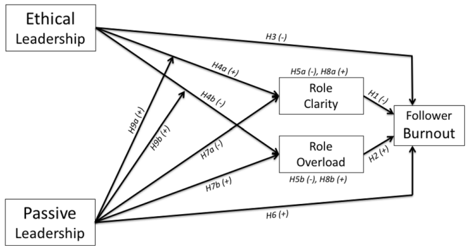
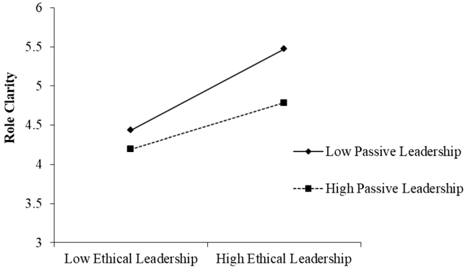
Burnout has important ramifications for employees and organizations and preventing burnout forms an ethical issue for managers. However, the role of the leader and especially the role of ethical aspects of leadership have received relatively little attention in relation to burnout to date. We conducted a survey among employees ( N = 386) of a Dutch retail organization, nested in 122 teams with a leader. Our first contribution is that we empirically show the hypothesized opposing relationships of ethical and passive leadership behavior with follower burnout. Furthermore, we examined two job characteristics as mechanisms that link these forms of leadership and burnout. Lastly, we show that the positive relationship of ethical leadership with burnout via role clarity (but not overload) is dependent on the degree of passive leadership the leader is perceived to display. Our results suggest that organizations should promote ethical leadership behaviors and limit passive leadership behaviors by stimulating leaders to be active in their role and use their social influence to promote ethical conduct.
Overview
The claims and statistics of this paper haven’t been checked yet.
Free: it reads the open-access text and checks the first 5 claims that cite a source we can check. Create a free account to check every claim.
Integrity signals
Registry
Cites
Statistics
Figures
Verification
Claims the paper makes
The claims and statistics of this paper haven’t been checked yet.
Free: it reads the open-access text and checks the first 5 claims that cite a source we can check. Create a free account to check every claim.
Claims other papers make about this one
Each is checked against this paper’s own text: does it say what the citing paper says it does?
The source backs part of the claim, not all of it — or backs it for a different population, condition or comparison.
In the citing paper
“as this leadership style is often associated with role conflict, work fatigue (Barling and Frone 2017;Skogstad et al. 2007Skogstad et al. , 2014;;Vullinghs et al. 2020), and workplace bullying (Dussault and Frenette 2015;Skogstad et al. 2007)”
From Leadership and technostress: A systematic literature review (2025) · cites this paper as Vullinghs et al. 2020
Experimental — accuracy not yet measured
Self-check
Percentages, sums and reported differences re-computed from the paper’s own numbers.
The self-check needs the paper’s full text.
Citations
Cites
Hu, L., & Bentler, P. M. (1999) · Structural Equation Modeling A Multidisciplinary Journal · doi:10.1080/10705519909540118 · Cited by 108,788
A Theory of Cognitive Dissonance
Festinger, L. (1957) · doi:10.1515/9781503620766 · Cited by 24,241 · cited 2×
“, being principled sometimes and diffusing responsibility at other times) may cause ambiguity and confusion, and may impede positive reactions (Festinger 1957).”
A Theory of Cognitive Dissonance
(2017) · Macat Library eBooks · doi:10.4324/9781912282432 · Cited by 18,122
The measurement of experienced burnout
Maslach, C., & Jackson, S. E. (1981) · Journal of Organizational Behavior · doi:10.1002/job.4030020205 · Cited by 14,496
Maslach, C., Schaufeli, W. B., & Leiter, M. P. (2001) · Annual Review of Psychology · doi:10.1146/annurev.psych.52.1.397 · Cited by 12,852
Job Demands, Job Decision Latitude, and Mental Strain: Implications for Job Redesign
Karasek, R. A. (1979) · Administrative Science Quarterly · doi:10.2307/2392498 · Cited by 12,597 · cited 7×
“Here, building on the demand-control model (Karasek 1979), we propose that role clarity and overload form two such mechanisms.”
BackgroundMethodInfluentialAddressing Moderated Mediation Hypotheses: Theory, Methods, and Prescriptions
Preacher, K. J., Rucker, D. D., & Hayes, A. F. (2007) · Multivariate Behavioral Research · doi:10.1080/00273170701341316 · Cited by 9,973
Job demands, job resources, and their relationship with burnout and engagement: a multi‐sample study
Schaufeli, W. B., & Bakker, A. B. (2004) · Journal of Organizational Behavior · doi:10.1002/job.248 · Cited by 9,297
Carroll, A. B. (1991) · Business Horizons · doi:10.1016/0007-6813(91)90005-g · Cited by 9,036 · cited 1×
“Organizations have an ethical obligation to serve the interests of all legitimate stakeholders, including employees (Carroll 1991; Donaldson and Preston 1995), and as such, Guest (2017) states that safeguarding employee well-being is an important ethical concern for managers.”
BackgroundHealthy work: stress, productivity, and the reconstruction of working life
(1990) · Choice Reviews Online · doi:10.5860/choice.28-0381 · Cited by 8,220 · cited 2×
“, Maslach and Leiter 2008), which have both received considerable research attention in studies addressing the demand-control model (Karasek 1979; Karasek and Theorell 1990).”
Background
Research works printed but not linked: 3
- 16. De Hoogh, A. H. B., Den Hartog, D. N., & Koopman, P. L. (2004). The development of the CLIO: A questionaire for measuring Charis- matic Leadership in Organisations. Gedrag & Organisatie, 100, 354-382.
- 21. Duxbury, L., & Higgins, C. (2001). Work-Life balance in the new mil- lennium: Where are we? Where do we need to go? Ottawa: Cana- dian Policy Research Networks.
- 61. Schaufeli, W. B., & Dierendonck, D. (2000). Utrechtse Burnout Scale- UBOS: Testmanual. Lisse: Swets & Zeitlinger.
Cited by
Items 101–144 of 144
Exhaustion disorder among social workers in Iceland- a national survey
Snorradóttir, Á., Hrafnsdóttir, S., & Tómasdóttir, M. Ó. (2026) · European Journal of Social Work · doi:10.1080/13691457.2026.2621289 · Cited by 1
Sánchez, I. (2026) · Business Strategy and the Environment · doi:10.1002/bse.71204 · Cited by 2
Narwal, M., & Mehra, H. (2026) · International Journal of Ethics and Systems · doi:10.1108/ijoes-12-2025-0742 · Cited by 1
Ruíz, Á. V., Rojas, L. A. G., Pezzia, A. E., Calderón-Prada, A., Mego, M., & Ticona, S. (2023) · Cuadernos de Administración · doi:10.11144/javeriana.cao36.adrloe · Cited by 1
Hastuti, R., Samsudin, W. W., Yoga, I., & Rohmatika, A. (2026) · Jurnal Kependidikan Jurnal Hasil Penelitian dan Kajian Kepustakaan di Bidang Pendidikan Pengajaran dan Pembelajaran · doi:10.33394/jk.v12i1.18783 · Cited by 1
Yang, Q., & Zhu, X. (2022) · BCP Business & Management · doi:10.54691/bcpbm.v31i.2670 · Cited by 1
“Roles aren't clearly defined in some instances as a result of the laissez-faire attitude [10].”
BackgroundWould you like to become a union leader? Analysing leadership intentions through a generational lens
Smith, C., Zhang, T., Frangi, L., & Duxbury, L. E. (2023) · Industrial Relations Journal · doi:10.1111/irj.12402 · Cited by 2
Digital Leadership and Virtual Team Collaboration: Options and Success Factors for Industry 4.0
Mahadevan, J. (2024) · Springer eBooks · doi:10.1007/978-3-658-44969-8_7 · Cited by 1
Elidrissi, R. (2023) · La Revue des Sciences de Gestion · doi:10.3917/rsg.317.0072 · Cited by 6
Work From Home and Role Clarity: Keys to Employee Satisfaction in a Dual Role Context
Silvianita, A., Nursyabani, A. P., & Syarifuddin, S. (2024) · International Journal of Economics Business and Management Research · doi:10.51505/ijebmr.2024.81018 · Cited by 1
“Role clarity is crucial for reducing stress stemming from ambiguity, including role conflict (Vullinghs et al., 2020).”
BackgroundA influência da liderança em micro e pequenas empresas: um estudo multicaso
Arruda, K. T., & da Silva, F. M. V. (2022) · Ciências sociais em perspectiva · doi:10.48075/revistacsp.v20i39.27376 · Cited by 1
Cavazos‐Arroyo, J., & Máynez-Guaderrama, A. I. (2023) · Cuadernos de Administración · doi:10.11144/javeriana.cao36.sltcm · Cited by 3
“En un estudio realizado en Holanda sobre el impacto que tienen dos estilos de liderazgo –pasivo y activo– sobre la claridad de rol, se comprobó que el primero impacta negativamente y el segundo inuye positivamente sobre la claridad de rol (Vullinghs et al., 2020).”
BackgroundInfluentialOverstressed and Understudied: An Examination of Stress and Workplace Leaders
McEvoy, A. (2021) · Carleton University's Institutional Repository (MacOdrum Library, Carleton University) · doi:10.22215/etd/2021-14934 · Cited by 1
Role Clarity and Service Delivery: A Case of Masaza System in Uganda
Kyagaba, R. F., Munene, K. J. C., Mafabi, S., & Byarugaba, J. M. (2022) · Emerald Group Publishing Limited eBooks · doi:10.1108/978-1-80262-437-320221014
The Role of accountability in Business organizations
Effendy, F., John, B., & Jamali, M. C. (2022) · International Journal of Multidisciplinary Research & Reviews · doi:10.56815/ijmrr.v1.i2.2022/28-35
EROĞLU, Y., & Güney, S. (2022) · Business And Management Studies An International Journal · doi:10.15295/bmij.v10i4.2149
YILMAZ, B. K. (2023) · Dokuz Eylül Üniversitesi Sosyal Bilimler Enstitüsü Dergisi · doi:10.16953/deusosbil.1344389
Influence of management styles on the commitment of local government employees
Đurović, M., Petrović, D. Č., & Perić, G. (2023) · Tehnika · doi:10.5937/tehnika2302215d
Nor, N. S. M., Ma’rof, A. A., & Sulaiman, A. H. (2023) · International Journal of Academic Research in Business and Social Sciences · doi:10.6007/ijarbss/v13-i17/19821
Path Analysis of Factors Related to Burnout for Campus-Based Victim Advocates
Nightingale, S. D. (2024) · Social Work Research · doi:10.1093/swr/svad024 · Cited by 2
The phenomenon of passivity in public and business organisations
(2022) · Scientific Papers of Silesian University of Technology Organization and Management Series · doi:10.29119/1641-3466.2022.163.9
Mediocre Leadership is Not Inconsequential: Mental Health Outcomes for Young Employees
Vine, E. (2024) · Carleton University's Institutional Repository (MacOdrum Library, Carleton University) · doi:10.22215/etd/2024-16321
Siang, J. M. L. D., Cheng, J. M.-S., & Ramayah, T. (2024) · International Journal of Business and Management · doi:10.5539/ijbm.v20n1p23
“It also goes beyond job descriptions to transparent expectation management (Yadav & Rangnekar, 2016) and positively influences psychological empowerment (Nel et al., 2015; Vullinghs et al., 2018; Wang et al., 2016).”
Understanding Leadership Styles, Their Uses and Drawbacks
Hoque, K. E. (2025) · Springer eBooks · doi:10.1007/978-981-96-1086-0_9
Perception of Local Youth Development Council Programs in the City of El Salvador, Misamis Oriental
Maña, R., & Perido, L. (2025) · Psychology and Education A Multidisciplinary Journal · doi:10.70838/pemj.480504
Elkırmış, Ö. (2025) · Özgür Yayınları eBooks · doi:10.58830/ozgur.pub939.c3944
Green (Sustainable) Leadership
Özdemirkol, M. (2025) · Özgür Yayınları eBooks · doi:10.58830/ozgur.pub939.c3943
Kobanoğlu, M. S., & Bayram, A. (2025) · Özgür Yayınları eBooks · doi:10.58830/ozgur.pub939.c3931
Altıntaş, M. (2025) · Özgür Yayınları eBooks · doi:10.58830/ozgur.pub939.c3930
Topçuoğlu, V. (2025) · Özgür Yayınları eBooks · doi:10.58830/ozgur.pub939.c3937
Topçuoğlu, E., & Bozkır, E. (2025) · Özgür Yayınları eBooks · doi:10.58830/ozgur.pub939.c3935
ERDOĞAN, S. U. (2025) · Özgür Yayınları eBooks · doi:10.58830/ozgur.pub939.c3932 · Cited by 1
Özkes, S. (2025) · Özgür Yayınları eBooks · doi:10.58830/ozgur.pub939.c3938
Bektaş, T. (2025) · Özgür Yayınları eBooks · doi:10.58830/ozgur.pub939.c3936
Torun, B. T. (2025) · Özgür Yayınları eBooks · doi:10.58830/ozgur.pub939.c3934
Beyond Authority: Leadership Approaches From Classical to Contemporary
Oktaysoy, O., Elkırmış, Ö., Kaygın, E., Altıntaş, M., Kobanoğlu, M. S., Bayram, A., Uygungil-Erdoğan, S., Şahin, Y., Torun, B. T., Topçuoğlu, E., et al. (2025) · Özgür Yayınları eBooks · doi:10.58830/ozgur.pub939
Wacker, E., Fischer, A., & Schorlemmer, J. (2021) · Figshare · doi:10.6084/m9.figshare.14443101
Beltou, N. (2019) · theses.fr (ABES) · doi:10.70675/986213c7z09b1z4421za8d9z6864f3a9d37a · Cited by 2
Koder, D., Brennan, C., & Gooi, C. H. (2026) · Australian Psychologist · doi:10.1080/00050067.2026.2666419
“Increased burnout has been linked to poor role clarity and excessive job demand (Essenko & Rothmann, 2007; Vullinghs et al., 2020).”
Katjiteo, A., Mbangula, D. K., & Katjiteo, A. (2026) · IGI Global eBooks · doi:10.4018/979-8-3373-3356-4.ch012
Evolution of Leadership Theories and Positive Psychology Integration
Reddy, K. J., & Devassy, V. P. (2026) · Springer eBooks · doi:10.1007/978-3-032-25498-6_2
Yao, K., Chen, W., Tian, H., & Bao, C. (2026) · Employee Relations · doi:10.1108/er-09-2025-0791
Rosada, R. S., Suliyanto, S., Wening, N., & Pariyanti, E. (2026) · Konselor · doi:10.24036/02026152195-0-86
Analisis Burnout terhadap Kinerja Karyawan Berdasarkan Systematic Literature
Djaneta, D., Mawardini, J., & Putri, A. A. (2026) · MAMEN Jurnal Manajemen · doi:10.55123/mamen.v5i3.8868
“Selain faktor organisasi, kepemimpinan yang etis, suportif, serta mampu membangun hubungan kerja yang positif juga terbukti berkontribusi dalam mengurangi risiko burnout (Vullinghs et al., 2020); (Zhang et al., n.d.).”
Influential
Metadata
- Authors
- Vullinghs, J. T., De Hoogh, A. H. B., Den Hartog, D. N., & Boon, C.
- Affiliations
- Vrije Universiteit Amsterdam (NL)
- University of Amsterdam (NL)
- Venue
- Journal of Business Ethics
- Published
- 2018-12-11
- Volume
- 165
- Issue
- 4
- Pages
- 719-733
- ISSN
- 0167-4544 (ISSN-L)
- 1573-0697
- OpenAlex
- W2905035641
- Cited by
- 132
- References
- 82
- Citations by year
- 2026: 10 · 2025: 25 · 2024: 21 · 2023: 17 · 2022: 25 · 2021: 21 · 2020: 11 · 2019: 2
- FWCI
- 14.06
- Type
- journal article
- Language
- en
- Open access
- hybrid
- doi.org
- Licence
- cc-by
- creativecommons.org/licenses/by/4.0 (tdm)
- creativecommons.org/licenses/by/4.0 (vor)
- Locations
- Journal of Business Ethics (publishedVersion, cc-by)
- VU Research Portal (publishedVersion, other-oa)
- UvA-DARE (University of Amsterdam) (submittedVersion, cc-by)
- RePEc: Research Papers in Economics (submittedVersion)
- Data Archiving and Networked Services (DANS) (submittedVersion, other-oa)
- Topics
- Social Sciences › Business, Management and Accounting › Organizational Behavior and Human Resource Management › Job Satisfaction and Organizational Behavior
- Social Sciences › Psychology › Social Psychology › Stress and Burnout Research
- Social Sciences › Business, Management and Accounting › Organizational Behavior and Human Resource Management › Ethics in Business and Education
- Keywords
- ethical leadership, passive leadership, burnout, role clarity, role overload, job characteristics, leader-follower relationships, retail employees, social influence, burnout prevention
About these checks
Registry, retraction, Cites and statistics results are computed, not judged, with one exception: a printed reference that no index lists is read once by a model before it counts as a citation error. Claims are extracted by a model and kept only when their quote appears verbatim in the text; each cited source is then checked, with a model’s help, for whether it says what the claim relies on. Those verdicts can be wrong — read the claim’s quote and the cited source before relying on one.
Statistics and arithmetic are recomputed, not judged.
Confidence bands are shown only for fields calibrated on our annotated test set. None is calibrated yet, so no band is shown.
What counts as a claim ›How we measure confidence ›How we check this ›
Are you an author, or do you see a problem with this page? Request a review
Data sources
Bibliographic data: Semantic Scholar, OpenAlex, Crossref.
Contains information from the Semantic Scholar Academic Graph Datasets, made available under the ODC Attribution License (ODC-BY 1.0).
Semantic Scholar’s data is described in: Kinney, R., et al. (2023). The Semantic Scholar Open Data Platform. arXiv:2301.10140.
