

Ethical and Passive Leadership and Their Joint Relationships with Burnout via Role Clarity and Role Overload
Open accessThe DOI matches its Crossref record; 81 of the 82 references it cites were found in a registry or an index.
Abstract
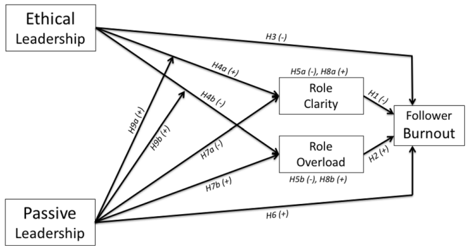
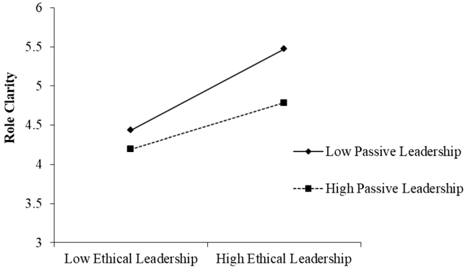
Burnout has important ramifications for employees and organizations and preventing burnout forms an ethical issue for managers. However, the role of the leader and especially the role of ethical aspects of leadership have received relatively little attention in relation to burnout to date. We conducted a survey among employees ( N = 386) of a Dutch retail organization, nested in 122 teams with a leader. Our first contribution is that we empirically show the hypothesized opposing relationships of ethical and passive leadership behavior with follower burnout. Furthermore, we examined two job characteristics as mechanisms that link these forms of leadership and burnout. Lastly, we show that the positive relationship of ethical leadership with burnout via role clarity (but not overload) is dependent on the degree of passive leadership the leader is perceived to display. Our results suggest that organizations should promote ethical leadership behaviors and limit passive leadership behaviors by stimulating leaders to be active in their role and use their social influence to promote ethical conduct.
Overview
The claims and statistics of this paper haven’t been checked yet.
Free: it reads the open-access text and checks the first 5 claims that cite a source we can check. Create a free account to check every claim.
Integrity signals
Registry
Cites
Statistics
Figures
Verification
Claims the paper makes
The claims and statistics of this paper haven’t been checked yet.
Free: it reads the open-access text and checks the first 5 claims that cite a source we can check. Create a free account to check every claim.
Claims other papers make about this one
Each is checked against this paper’s own text: does it say what the citing paper says it does?
The source backs part of the claim, not all of it — or backs it for a different population, condition or comparison.
In the citing paper
“as this leadership style is often associated with role conflict, work fatigue (Barling and Frone 2017;Skogstad et al. 2007Skogstad et al. , 2014;;Vullinghs et al. 2020), and workplace bullying (Dussault and Frenette 2015;Skogstad et al. 2007)”
From Leadership and technostress: A systematic literature review (2025) · cites this paper as Vullinghs et al. 2020
Experimental — accuracy not yet measured
Self-check
Percentages, sums and reported differences re-computed from the paper’s own numbers.
The self-check needs the paper’s full text.
Citations
Cites
Hu, L., & Bentler, P. M. (1999) · Structural Equation Modeling A Multidisciplinary Journal · doi:10.1080/10705519909540118 · Cited by 108,788
A Theory of Cognitive Dissonance
Festinger, L. (1957) · doi:10.1515/9781503620766 · Cited by 24,241 · cited 2×
“, being principled sometimes and diffusing responsibility at other times) may cause ambiguity and confusion, and may impede positive reactions (Festinger 1957).”
A Theory of Cognitive Dissonance
(2017) · Macat Library eBooks · doi:10.4324/9781912282432 · Cited by 18,122
The measurement of experienced burnout
Maslach, C., & Jackson, S. E. (1981) · Journal of Organizational Behavior · doi:10.1002/job.4030020205 · Cited by 14,496
Maslach, C., Schaufeli, W. B., & Leiter, M. P. (2001) · Annual Review of Psychology · doi:10.1146/annurev.psych.52.1.397 · Cited by 12,852
Job Demands, Job Decision Latitude, and Mental Strain: Implications for Job Redesign
Karasek, R. A. (1979) · Administrative Science Quarterly · doi:10.2307/2392498 · Cited by 12,597 · cited 7×
“Here, building on the demand-control model (Karasek 1979), we propose that role clarity and overload form two such mechanisms.”
BackgroundMethodInfluentialAddressing Moderated Mediation Hypotheses: Theory, Methods, and Prescriptions
Preacher, K. J., Rucker, D. D., & Hayes, A. F. (2007) · Multivariate Behavioral Research · doi:10.1080/00273170701341316 · Cited by 9,973
Job demands, job resources, and their relationship with burnout and engagement: a multi‐sample study
Schaufeli, W. B., & Bakker, A. B. (2004) · Journal of Organizational Behavior · doi:10.1002/job.248 · Cited by 9,297
Carroll, A. B. (1991) · Business Horizons · doi:10.1016/0007-6813(91)90005-g · Cited by 9,036 · cited 1×
“Organizations have an ethical obligation to serve the interests of all legitimate stakeholders, including employees (Carroll 1991; Donaldson and Preston 1995), and as such, Guest (2017) states that safeguarding employee well-being is an important ethical concern for managers.”
BackgroundHealthy work: stress, productivity, and the reconstruction of working life
(1990) · Choice Reviews Online · doi:10.5860/choice.28-0381 · Cited by 8,220 · cited 2×
“, Maslach and Leiter 2008), which have both received considerable research attention in studies addressing the demand-control model (Karasek 1979; Karasek and Theorell 1990).”
BackgroundMultilevel analysis techniques and applications
Hox, J. J., Moerbeek, M., & van de Schoot, R. (2002) · Cited by 6,845
The Stakeholder Theory of the Corporation: Concepts, Evidence, and Implications
Donaldson, T., & Preston, L. E. (1995) · The Academy of Management Review · doi:10.2307/258887 · Cited by 5,846
Adverse health effects of high-effort/low-reward conditions.
Siegrist, J. (1996) · Journal of Occupational Health Psychology · doi:10.1037/1076-8998.1.1.27 · Cited by 5,713 · cited 1×
“Taken together, when followers perceive such ethical leader behaviors, this will help them experience greater well-being, and less stress and burnout (Siegrist 1996).”
BackgroundEthical leadership: A social learning perspective for construct development and testing
Brown, M. E., Treviño, L. K., & Harrison, D. A. (2005) · Organizational Behavior and Human Decision Processes · doi:10.1016/j.obhdp.2005.03.002 · Cited by 5,435
Edwards, J. R., & Lambert, L. S. (2007) · Psychological Methods · doi:10.1037/1082-989x.12.1.1 · Cited by 4,711
Ireland, R. D., Elfring, T., & Hmieleski, K. M. (2011) · In Search of Research Excellence · doi:10.4337/9781849807630.00017 · Cited by 4,553
Ethical leadership: A review and future directions
Brown, M. E., & Treviño, L. K. (2006) · The Leadership Quarterly · doi:10.1016/j.leaqua.2006.10.004 · Cited by 4,029
Role Conflict and Ambiguity in Complex Organizations
Rizzo, J. R., House, R. J., & Lirtzman, S. I. (1970) · Administrative Science Quarterly · doi:10.2307/2391486 · Cited by 3,700
A meta-analytic examination of the correlates of the three dimensions of job burnout
Lee, R. T., & Ashforth, B. E. (1996) · Journal of Applied Psychology · doi:10.1037/0021-9010.81.2.123 · Cited by 3,262
Organizational Stress: Studies in Role Conflict and Ambiguity.
Roy, D. F., Kahn, R. L., Wolfe, D. M., Quinn, R. P., Snoek, J. D., & Rosenthal, R. A. (1965) · American Sociological Review · doi:10.2307/2091375 · Cited by 3,016
Johnson, J. V., & Hall, E. M. (1988) · American Journal of Public Health · doi:10.2105/ajph.78.10.1336 · Cited by 2,693
A Review and an Integration of Research on Job Burnout
Cordes, C. L., & Dougherty, T. W. (1993) · The Academy of Management Review · doi:10.2307/258593 · Cited by 2,608
Hox, J., Moerbeek, M., & van de Schoot, R. (2002) · doi:10.4324/9781410604118 · Cited by 2,419
Early predictors of job burnout and engagement.
Maslach, C., & Leiter, M. P. (2008) · Journal of Applied Psychology · doi:10.1037/0021-9010.93.3.498 · Cited by 2,397
Maslach, C. (1982) · Cited by 2,389
Burnout: 35 years of research and practice.
Schaufeli, W. B., Leiter, M. P., & Maslach, C. (2009) · Career Development International · doi:10.1108/13620430910966406 · Cited by 1,964
Organizational Stress: Studies in Role Conflict and Ambiguity.
Levinson, H., Kahn, R. L., Wolfe, D. M., Quinn, R. P., Snoek, J. D., & Rosenthal, R. A. (1965) · Administrative Science Quarterly · doi:10.2307/2391654 · Cited by 1,734 · cited 2×
“On the contrary, a lack of role clarity, also referred to as role ambiguity, results in attempted coping behavior in order to prevent negative outcomes such as stress and anxiety (Kahn et al. 1964).”
BackgroundPsychological Testing: A Practical Approach to Design and Evaluation
Kline, T. (2005) · doi:10.4135/9781483385693 · Cited by 1,588 · cited 1×
“Studies have shown that this method generally outperforms other methods to deal with missing data (Allison 2003; Kline 2005).”
MethodSOCIAL UNDERMINING IN THE WORKPLACE.
Duffy, M. K., Ganster, D. C., & Pagon, M. (2002) · Academy of Management Journal · doi:10.2307/3069350 · Cited by 1,482
Treviño, L. K., Brown, M., & Hartman, L. P. (2003) · Human Relations · doi:10.1177/0018726703056001448 · Cited by 1,372
Human resource management and employee well-being: towards a new analytic framework
Guest, D. E. (2017) · Human Resource Management Journal · doi:10.1111/1748-8583.12139 · Cited by 1,362 · cited 3×
“Safeguarding employee well-being forms an ethical concern in organizations (e.g., Guest 2017) and given its strong negative impact, the prevention of burnout forms a major ethical issue for management and organizations (Barnett et al.”
BackgroundDERUE, D. S., NAHRGANG, J. D., WELLMAN, N., & HUMPHREY, S. E. (2011) · Personnel Psychology · doi:10.1111/j.1744-6570.2010.01201.x · Cited by 1,356
Sources of social support and burnout: a meta-analytic test of the conservation of resources model
Halbesleben, J. R. B. (2006) · Journal of Applied Psychology · doi:10.1037/0021-9010.91.5.1134 · Cited by 1,336 · cited 3×
“Burnout is a chronic work-related stress syndrome characterized by three main elements: exhaustion, depersonalization, and reduced personal accomplishment (Halbesleben 2006; Maslach 1982; Maslach et al.”
BackgroundMissing Data Techniques for Structural Equation Modeling.
Allison, P. D. (2003) · Journal of Abnormal Psychology · doi:10.1037/0021-843x.112.4.545 · Cited by 1,333 · cited 1×
“Studies have shown that this method generally outperforms other methods to deal with missing data (Allison 2003; Kline 2005).”
MethodBurnout in Organizational Life
Halbesleben, J. R. B., & Buckley, M. R. (2004) · Journal of Management · doi:10.1016/j.jm.2004.06.004 · Cited by 1,240
Jackson, S. E., & Schuler, R. S. (1985) · Organizational Behavior and Human Decision Processes · doi:10.1016/0749-5978(85)90020-2 · Cited by 1,219
Walumbwa, F. O., & Schaubroeck, J. (2009) · Journal of Applied Psychology · doi:10.1037/a0015848 · Cited by 1,114
Destructive leadership behaviour: A definition and conceptual model
Einarsen, S., Aasland, M. S., & Skogstad, A. (2007) · The Leadership Quarterly · doi:10.1016/j.leaqua.2007.03.002 · Cited by 1,066
De Hoogh, A. H. B., & Den Hartog, D. N. (2008) · The Leadership Quarterly · doi:10.1016/j.leaqua.2008.03.002 · Cited by 1,039
Bolino, M. C., & Turnley, W. H. (2005) · Journal of Applied Psychology · doi:10.1037/0021-9010.90.4.740 · Cited by 935 · cited 2×
“Role overload is characterized by a workload, work demands or a set of responsibilities that exceeds the particular role and capacity of the employee in the time available (Beehr et al. 1976; Bolino and Turnley 2005).”
BackgroundSkakon, J., Nielsen, K., Borg, V., & Guzman, J. (2010) · Work & Stress · doi:10.1080/02678373.2010.495262 · Cited by 875
The destructiveness of laissez-faire leadership behavior.
Skogstad, A., Einarsen, S., Torsheim, T., Aasland, M. S., & Hetland, H. (2007) · Journal of Occupational Health Psychology · doi:10.1037/1076-8998.12.1.80 · Cited by 864
Kalshoven, K., Den Hartog, D. N., & De Hoogh, A. H. B. (2011) · The Leadership Quarterly · doi:10.1016/j.leaqua.2010.12.007 · Cited by 824
Applied social psychology annual
Bickman, L. (1982) · Cited by 811
The Role-Based Performance Scale: Validity Analysis of a Theory-Based Measure
Welbourne, T. M., Johnson, D. E., & Erez, A. (1998) · Academy of Management Journal · doi:10.2307/256941 · Cited by 809
Burnout in organizational settings.
Maslach, C., & Jackson, S. E. (1984) · Cited by 664
Allen, T. D., & Rush, M. C. (1998) · Journal of Applied Psychology · doi:10.1037//0021-9010.83.2.247 · Cited by 640
Beehr, T. A., Walsh, J. T., & Taber, T. D. (1976) · PubMed · Cited by 580
A Cross-Cultural Examination of the Endorsement of Ethical Leadership
Resick, C. J., Hanges, P. J., Dickson, M. W., & Mitchelson, J. K. (2006) · Journal of Business Ethics · doi:10.1007/s10551-005-3242-1 · Cited by 549
Beehr, T. A., Walsh, J. T., & Taber, T. D. (1976) · Journal of Applied Psychology · doi:10.1037//0021-9010.61.1.41 · Cited by 481 · cited 1×
“Role overload is characterized by a workload, work demands or a set of responsibilities that exceeds the particular role and capacity of the employee in the time available (Beehr et al. 1976; Bolino and Turnley 2005).”
BackgroundKarasek, R. A. (1998) · Cited by 429
Xu, A. J., Loi, R., & Lam, L. W. (2015) · The Leadership Quarterly · doi:10.1016/j.leaqua.2015.03.002 · Cited by 387
Thau, S., Bennett, R. J., Mitchell, M. S., & Marrs, M. B. (2009) · Organizational Behavior and Human Decision Processes · doi:10.1016/j.obhdp.2008.06.003 · Cited by 387
Lin, S.-H. (., Ma, J., & Johnson, R. E. (2016) · Journal of Applied Psychology · doi:10.1037/apl0000098 · Cited by 382
Linking Ethical Leadership to Employee Well-Being: The Role of Trust in Supervisor
Chughtai, A., Byrne, M., & Flood, B. (2015) · Journal of Business Ethics · doi:10.1007/s10551-014-2126-7 · Cited by 347
Den Hartog, D. N. (2015) · Annual Review of Organizational Psychology and Organizational Behavior · doi:10.1146/annurev-orgpsych-032414-111237 · Cited by 324
In pursuit of wellness: The self-care imperative.
Barnett, J. E., Baker, E. K., Elman, N. S., & Schoener, G. R. (2007) · Professional Psychology: Research and Practice · doi:10.1037/0735-7028.38.6.603 · Cited by 294
Johnson, R. E., Venus, M., Lanaj, K., Mao, C., & Chang, C.-H. (2012) · Journal of Applied Psychology · doi:10.1037/a0029043 · Cited by 291
Mulki, J. P., Jaramillo, F., & Locander, W. B. (2006) · Journal of Business Research · doi:10.1016/j.jbusres.2006.09.001 · Cited by 279
van Veldhoven, M. J. P. M., & Meijman, T. F. (1994) · TNO Repository · Cited by 277
Mo, S., & Shi, J. (2017) · Journal of Business Ethics · doi:10.1007/s10551-015-2821-z · Cited by 254
Veldhoven, M. V., Jonge, J. D., Broersen, S., Kompier, M., & Meijman, T. (2002) · Work & Stress · doi:10.1080/02678370210166399 · Cited by 246
Encouraging employees to report unethical conduct internally: It takes a village
Mayer, D. M., Nurmohamed, S., Treviño, L. K., Shapiro, D. L., & Schminke, M. (2013) · Organizational Behavior and Human Decision Processes · doi:10.1016/j.obhdp.2013.01.002 · Cited by 244
Nye, C. D., & Drasgow, F. (2011) · Journal of Applied Psychology · doi:10.1037/a0022955 · Cited by 211
De Hoogh, A. H. B., & Den Hartog, D. N. (2009) · Journal of Applied Psychology · doi:10.1037/a0016253 · Cited by 203
Lanaj, K., Johnson, R. E., & Lee, S. M. (2016) · Journal of Applied Psychology · doi:10.1037/apl0000052 · Cited by 193
Golkar, A., Johansson, E., Kasahara, M., Osika, W., Perski, A., & Savic, I. (2014) · PLoS ONE · doi:10.1371/journal.pone.0104550 · Cited by 190
Ethical and Unethical Leadership: A Cross-Cultural and Cross-Sectoral Analysis
Eisenbeiß, S. A., & Brodbeck, F. (2014) · Journal of Business Ethics · doi:10.1007/s10551-013-1740-0 · Cited by 184 · cited 2×
“Empirical research on passive leadership and its consequences to date is even more scarce (Eisenbeiss and Brodbeck 2014).”
BackgroundWhen Leaders Fail to “Walk the Talk”: Supervisor Undermining and Perceptions of Leader Hypocrisy
Greenbaum, R. L., Mawritz, M. B., & Piccolo, R. F. (2015) · Journal of Management · doi:10.1177/0149206312442386 · Cited by 184
Winter, D. G. (1991) · The Leadership Quarterly · doi:10.1016/1048-9843(91)90023-u · Cited by 181 · cited 1×
“2003) and De Hoogh and Den Hartog (2009a) note that the responsible power use inherent in ethical leadership also has the connotation of being aware of the consequences of actions for others, as in ‘being responsible for’ someone (Den Hartog 2015; Winter 1991).”
BackgroundSkogstad, A., Hetland, J., Glasø, L., & Einarsen, S. (2014) · Work & Stress · doi:10.1080/02678373.2014.957362 · Cited by 167
Inconsistent style of leadership as a predictor of safety behaviour
Mullen, J., Kelloway, E. K., & Teed, M. (2011) · Work & Stress · doi:10.1080/02678373.2011.569200 · Cited by 154
Barling, J., & Frone, M. R. (2017) · Stress and Health · doi:10.1002/smi.2697 · Cited by 130
Effects of ethical leadership on emotional exhaustion in high moral intensity situations
Zheng, D., Witt, L. A., Waite, E. M., David, E., van Driel, M., McDonald, D. P., Callison, K., & Crepeau, L. J. (2015) · The Leadership Quarterly · doi:10.1016/j.leaqua.2015.01.006 · Cited by 124
The Destructiveness of Laissez-Faire Leadership Behavior
Buch, R., Martinsen, Ø. L., & Kuvaas, B. (2014) · Journal of Leadership & Organizational Studies · doi:10.1177/1548051813515302 · Cited by 117
Hannah, S. T., Sumanth, J. J., Lester, P., & Cavarretta, F. (2014) · Journal of Organizational Behavior · doi:10.1002/job.1931 · Cited by 116
Holden, L., Scuffham, P., Hilton, M. F., Ware, R. S., Vecchio, N., & Whiteford, H. (2011) · BMC Public Health · doi:10.1186/1471-2458-11-417 · Cited by 90
Ethical leadership: The socially responsible use of power
Hoogh, A. H. B. D., & Hartog, D. N. D. (2009) · Cambridge University Press eBooks · doi:10.1017/cbo9780511626562.021 · Cited by 63
De ontwikkeling van de CLIO: een vragenlijst voor charismatisch leiderschap in organisaties
H.B. de Hoogh, A., L. Koopman, P., & N. Den Hartog, D. (2004) · Gedrag & Organisatie · doi:10.5117/2004.017.005.008 · Cited by 56
Steinmann, B., Nübold, A., & Maier, G. W. (2016) · Frontiers in Psychology · doi:10.3389/fpsyg.2016.00446 · Cited by 23
Psychosociale arbeidsbelasting en werkstress in Nederland
van Veldhoven, M. J. P. M., & Broersen, J. P. J. (1999) · Cited by 12
Research works printed but not linked: 3
- 16. De Hoogh, A. H. B., Den Hartog, D. N., & Koopman, P. L. (2004). The development of the CLIO: A questionaire for measuring Charis- matic Leadership in Organisations. Gedrag & Organisatie, 100, 354-382.
- 21. Duxbury, L., & Higgins, C. (2001). Work-Life balance in the new mil- lennium: Where are we? Where do we need to go? Ottawa: Cana- dian Policy Research Networks.
- 61. Schaufeli, W. B., & Dierendonck, D. (2000). Utrechtse Burnout Scale- UBOS: Testmanual. Lisse: Swets & Zeitlinger.
Cited by
Curbing nurses' burnout during COVID‐19: The roles of servant leadership and psychological safety
Ma, Y., Faraz, N. A., Ahmed, F., Iqbal, M. K., Saeed, U., Mughal, M. F., & Raza, A. (2021) · Journal of Nursing Management · doi:10.1111/jonm.13414 · Cited by 206
“Burnout at the workplace is defined as “the employees’ negative response to chronic work stressors” (Vullinghs et al., 2018).”
BackgroundChen, J., Ghardallou, W., Comite, U., Ahmad, N., Ryu, H. B., Ariza‐Montes, A., & Han, H. (2022) · International Journal of Environmental Research and Public Health · doi:10.3390/ijerph191710941 · Cited by 189
“Previous researchers investigated the mediating effect of resilience and role clarity on burnout [12,159]; such studies did not explain how resilience and role clarity simultaneously act as mediators to reduce the risk of burnout.”
BackgroundInfluentialUsman, M., Ali, M., Yousaf, Z., Anwar, F., Waqas, M., & Khan, M. A. S. (2020) · Canadian Journal of Administrative Sciences / Revue Canadienne des Sciences de l Administration · doi:10.1002/cjas.1568 · Cited by 95
Mostafa, A. M. S., Farley, S., & Zaharie, M. A. (2020) · Journal of Business Ethics · doi:10.1007/s10551-020-04586-2 · Cited by 99
Mihalca, L., Ratiu, L. C. I., Brendea, G., Metz, D., Drâgan, M., & Dobre, F. (2021) · Oeconomia Copernicana · doi:10.24136/oc.2021.010 · Cited by 83
Metadata
- Authors
- Vullinghs, J. T., De Hoogh, A. H. B., Den Hartog, D. N., & Boon, C.
- Affiliations
- Vrije Universiteit Amsterdam (NL)
- University of Amsterdam (NL)
- Venue
- Journal of Business Ethics
- Published
- 2018-12-11
- Volume
- 165
- Issue
- 4
- Pages
- 719-733
- ISSN
- 0167-4544 (ISSN-L)
- 1573-0697
- OpenAlex
- W2905035641
- Cited by
- 132
- References
- 82
- Citations by year
- 2026: 10 · 2025: 25 · 2024: 21 · 2023: 17 · 2022: 25 · 2021: 21 · 2020: 11 · 2019: 2
- FWCI
- 14.06
- Type
- journal article
- Language
- en
- Open access
- hybrid
- doi.org
- Licence
- cc-by
- creativecommons.org/licenses/by/4.0 (tdm)
- creativecommons.org/licenses/by/4.0 (vor)
- Locations
- Journal of Business Ethics (publishedVersion, cc-by)
- VU Research Portal (publishedVersion, other-oa)
- UvA-DARE (University of Amsterdam) (submittedVersion, cc-by)
- RePEc: Research Papers in Economics (submittedVersion)
- Data Archiving and Networked Services (DANS) (submittedVersion, other-oa)
- Topics
- Social Sciences › Business, Management and Accounting › Organizational Behavior and Human Resource Management › Job Satisfaction and Organizational Behavior
- Social Sciences › Psychology › Social Psychology › Stress and Burnout Research
- Social Sciences › Business, Management and Accounting › Organizational Behavior and Human Resource Management › Ethics in Business and Education
- Keywords
- ethical leadership, passive leadership, burnout, role clarity, role overload, job characteristics, leader-follower relationships, retail employees, social influence, burnout prevention
About these checks
Registry, retraction, Cites and statistics results are computed, not judged, with one exception: a printed reference that no index lists is read once by a model before it counts as a citation error. Claims are extracted by a model and kept only when their quote appears verbatim in the text; each cited source is then checked, with a model’s help, for whether it says what the claim relies on. Those verdicts can be wrong — read the claim’s quote and the cited source before relying on one.
Statistics and arithmetic are recomputed, not judged.
Confidence bands are shown only for fields calibrated on our annotated test set. None is calibrated yet, so no band is shown.
What counts as a claim ›How we measure confidence ›How we check this ›
Are you an author, or do you see a problem with this page? Request a review
Data sources
Bibliographic data: Semantic Scholar, OpenAlex, Crossref.
Contains information from the Semantic Scholar Academic Graph Datasets, made available under the ODC Attribution License (ODC-BY 1.0).
Semantic Scholar’s data is described in: Kinney, R., et al. (2023). The Semantic Scholar Open Data Platform. arXiv:2301.10140.
