

Artificial Intelligence and Declined Guilt: Retailing Morality Comparison Between Human and AI
Open accessThe DOI matches its Crossref record; 102 of the 102 references it cites were found in a registry or an index.
Abstract
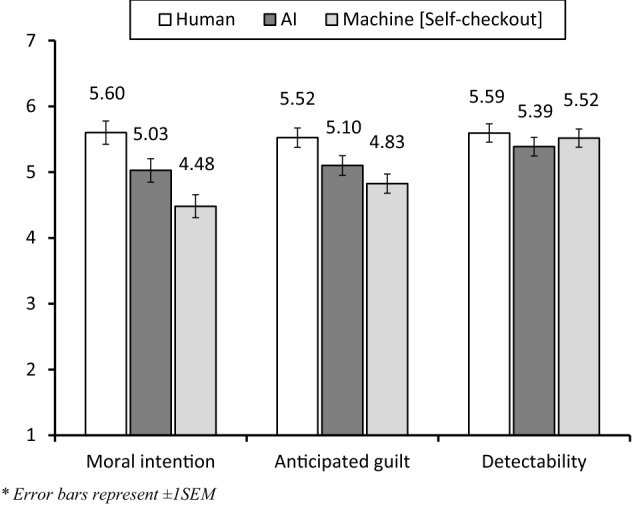
Several technological developments, such as self-service technologies and artificial intelligence (AI), are disrupting the retailing industry by changing consumption and purchase habits and the overall retail experience. Although AI represents extraordinary opportunities for businesses, companies must avoid the dangers and risks associated with the adoption of such systems. Integrating perspectives from emerging research on AI, morality of machines, and norm activation, we examine how individuals morally behave toward AI agents and self-service machines. Across three studies, we demonstrate that consumers’ moral concerns and behaviors differ when interacting with technologies versus humans. We show that moral intention (intention to report an error) is less likely to emerge for AI checkout and self-checkout machines compared with human checkout. In addition, moral intention decreases as people consider the machine less humanlike. We further document that the decline in morality is caused by less guilt displayed toward new technologies. The non-human nature of the interaction evokes a decreased feeling of guilt and ultimately reduces moral behavior. These findings offer insights into how technological developments influence consumer behaviors and provide guidance for businesses and retailers in understanding moral intentions related to the different types of interactions in a shopping environment.
Overview
The claims and statistics of this paper haven’t been checked yet.
Free: it reads the open-access text and checks the first 5 claims that cite a source we can check. Create a free account to check every claim.
Integrity signals
Registry
Cites
Statistics
Figures
Verification
Claims the paper makes
The claims and statistics of this paper haven’t been checked yet.
Free: it reads the open-access text and checks the first 5 claims that cite a source we can check. Create a free account to check every claim.
Claims other papers make about this one
Each is checked against this paper’s own text: does it say what the citing paper says it does?
The source backs part of the claim, not all of it — or backs it for a different population, condition or comparison.
In the citing paper
“Earlier research into anthropomorphism has already shown that beliefs of humanness elicit more positive emotions and lead users to experience feelings of moral responsibility, increasing their inclination to “do the right thing” toward the chatbot (101).”
From The benefits and dangers of anthropomorphic conversational agents (2025) · cites this paper as [101]
Experimental — accuracy not yet measured
Self-check
Percentages, sums and reported differences re-computed from the paper’s own numbers.
The self-check needs the paper’s full text.
Citations
Cites
(2013) · Cited by 44,563
Advances In Experimental Social Psychology
(2022) · Advances in Experimental Social Psychology · doi:10.1016/s0065-2601(22)x0002-6 · Cited by 22,259
Searle, J. R. (1980) · Behavioral and Brain Sciences · doi:10.1017/s0140525x00005756 · Cited by 6,954 · cited 1×
“Thus, existing literature suggests that the human mind is unique, and that machines and AI cannot hold all the human mental abilities (Searle, 1980).”
BackgroundNormative Influences on Altruism
Schwartz, S. H. (1977) · Advances in Experimental Social Psychology · doi:10.1016/s0065-2601(08)60358-5 · Cited by 5,364 · cited 1×
“This model states that anticipated guilt or pride will lead individuals to act in a way that is congruent with their personal norms and standards (Schwartz, 1977).”
Background(1997) · Choice Reviews Online · doi:10.5860/choice.34-3702 · Cited by 4,887
Artificial intelligence in service
Huang, M.-H., & Rust, R. T. (2018) · Journal of Service Research · doi:10.1177/1094670517752459 · Cited by 3,978 · cited 2×
“Individuals can also perceive more risk and experience discomfort when interacting with automated services and robots (Huang & Rust, 2018).”
BackgroundConverging measurement of horizontal and vertical individualism and collectivism.
Triandis, H. C., & Gelfand, M. J. (1998) · Journal of Personality and Social Psychology · doi:10.1037//0022-3514.74.1.118 · Cited by 3,656
The Uncanny Valley [From the Field]
Mori, M., MacDorman, K., & Kageki, N. (2012) · IEEE Robotics & Automation Magazine · doi:10.1109/mra.2012.2192811 · Cited by 3,542 · cited 2×
“Indeed, this relationship states that individuals can experience a feeling of unease or strangeness when robots/ machines appear too humanlike (Ho & MacDorman, 2017; Mori et al., 2012).”
BackgroundAlgorithm aversion: People erroneously avoid algorithms after seeing them err.
Dietvorst, B. J., Simmons, J. P., & Massey, C. (2015) · Journal of Experimental Psychology: General · doi:10.1037/xge0000033 · Cited by 3,232 · cited 2×
“…usage, researchers have documented a certain resistance to the adoption of AI not only due to regulation and privacy issues but also due to their inaccuracy to make inferences and predictions (Dietvorst et al., 2015; Longoni et al., 2019) and the inauthenticity of those predictions (Jago, 2019).”
BackgroundSherry, J. F., & Sternthal, B. (1992) · Cited by 2,917
Research works printed but not linked: 1
- Rosen C More retailers to tell customers ‘do it yourself’ Information Week 2001 826 29
Cited by
Artificial intelligence (AI) applications for marketing: A literature-based study
Haleem, A., Javaid, M., Asim Qadri, M., Pratap Singh, R., & Suman, R. (2022) · International Journal of Intelligent Networks · doi:10.1016/j.ijin.2022.08.005 · Cited by 948
Effect of disclosing AI-generated content on prosocial advertising evaluation
Baek, T. H., Kim, J., & Kim, J. H. (2026) · International Journal of Advertising · doi:10.1080/02650487.2024.2401319 · Cited by 150
Self-citationRuan, Y., & Mezei, J. (2022) · Journal of Retailing and Consumer Services · doi:10.1016/j.jretconser.2022.103059 · Cited by 238
Artificial intelligence and consumer behavior: From predictive to generative AI
Hermann, E., & Puntoni, S. (2024) · Journal of Business Research · doi:10.1016/j.jbusres.2024.114720 · Cited by 230
Hossain, S., Fernando, M., & Akter, S. (2025) · Journal of Leadership & Organizational Studies · doi:10.1177/15480518251319624 · Cited by 93
“…(Choudhury et al., 2020); perceived users ’ value (Gregory et al., 2021); organizational design choices (Murray et al., 2021); individual morality (Giroux et al., 2022; Tóth et al., 2022); ethical and cultural implications (Wright & Schultz, 2018); and paradoxical automation-augmentation…”
Artificial intelligence consumer behavior: A hybrid review and research agenda
Jain, V., Wadhwani, K., & Eastman, J. K. (2024) · Journal of Consumer Behaviour · doi:10.1002/cb.2233 · Cited by 184
Applicants’ Fairness Perceptions of Algorithm-Driven Hiring Procedures
Lavanchy, M., Reichert, P., Narayanan, J., & Savani, K. (2023) · Journal of Business Ethics · doi:10.1007/s10551-022-05320-w · Cited by 168
“Our studies’ sample size is in line with other experimental studies (e.g., Giroux et al., 2022), and is sufficient to ensure the detection of a medium effect size (80% power).”
MethodResultDeploying artificial intelligence in services to AID vulnerable consumers
Hermann, E., Williams, G. Y., & Puntoni, S. (2023) · Journal of the Academy of Marketing Science · doi:10.1007/s11747-023-00986-8 · Cited by 137
“Moreover, consumers are found to perceive algorithms and AI to be less authentic (Jago, 2019; Jago et al., 2022) and less moral (Bigman & Gray, 2018; Giroux et al., 2022) than a human, and to neglect their unique characteristics (Longoni et al., 2019).”
Student Perspectives on the Role of Artificial Intelligence in Education: A Survey-Based Analysis
Idroes, G. M., Noviandy, T. R., Maulana, A., Irvanizam, I., Jalil, Z., Lensoni, L., Lala, A., Abas, A. H., Tallei, T. E., & Idroes, R. (2023) · Journal of Educational Management and Learning · doi:10.60084/jeml.v1i1.58 · Cited by 68
“Moreover, worries persist regarding irresponsible entities' utilization and potential misuse of AI-collected data [22].”
BackgroundEffects of AI ChatGPT on travelers’ travel decision-making
Kim, J. H., Kim, J., Kim, S. (., & Hailu, T. B. (2024) · Tourism Review · doi:10.1108/tr-07-2023-0489 · Cited by 107
Self-citationGuest Editorial: Business Ethics in the Era of Artificial Intelligence
Haenlein, M., Huang, M., & Kaplan, A. (2022) · Journal of Business Ethics · doi:10.1007/s10551-022-05060-x · Cited by 119
Wu, X., Liu, Q., Qu, H., & Wang, J. (2022) · Tourism Management · doi:10.1016/j.tourman.2022.104716 · Cited by 114
The benefits and dangers of anthropomorphic conversational agents
Peter, S., Riemer, K., & West, J. D. (2025) · Proceedings of the National Academy of Sciences · doi:10.1073/pnas.2415898122 · Cited by 110
The impact of AI identity disclosure on consumer unethical behavior: A social judgment perspective
Li, T.-G., Zhang, C., Chang, Y., & Zheng, W. T. (2023) · Journal of Retailing and Consumer Services · doi:10.1016/j.jretconser.2023.103606 · Cited by 99
Haque, A., Akther, N., Khan, M. I., Agarwal, K., & Uddin, N. (2024) · Informatics · doi:10.3390/informatics11040074 · Cited by 95
Robertson, J., Botha, E., Oosthuizen, K., & Montecchi, M. (2025) · Journal of Business Research · doi:10.1016/j.jbusres.2025.115198 · Cited by 88
Exploring ethical frontiers of artificial intelligence in marketing
Hari, H., Sharma, A., Verma, S., & Chaturvedi, R. (2024) · Journal of Responsible Technology · doi:10.1016/j.jrt.2024.100103 · Cited by 85
Beyari, H., & Garamoun, H. H. (2022) · Sustainability · doi:10.3390/su14159637 · Cited by 80
Liu, Y., Wang, X., Du, Y., & Wang, S. (2023) · Journal of Hospitality and Tourism Management · doi:10.1016/j.jhtm.2023.05.015 · Cited by 64
A Review of Artificial Intelligence, Algorithms, and Robots Through the Lens of Stakeholder Theory
Matthews, M. J., Su, R., Yonish, L., McClean, S. T., Koopman, J., & Yam, K. C. (2025) · Journal of Management · doi:10.1177/01492063241311855 · Cited by 64
Lei, S., Xie, L., & Peng, J. (2024) · Journal of Service Research · doi:10.1177/10946705241278837 · Cited by 61
“Recent research has provided initial evidence that the introduction of AI service agents does not necessarily reduce costs, but rather leads to unexpected costs in the form of increased unethical behaviors (Giroux et al. 2022; Kim et al. 2023).”
InfluentialBaek, T. H., Kim, H. J., & Kim, J. (2025) · International Journal of Hospitality Management · doi:10.1016/j.ijhm.2025.104106 · Cited by 63
Self-citationThe impact of artificial intelligence on consumer behavior towards brands: a systematic review
Ribeiro, A., Rivero, A. J. L., & Abrantes, J. L. (2025) · Electronic Commerce Research · doi:10.1007/s10660-025-10063-7 · Cited by 63
“In a digital world, the top of mind is essential so that consumers remember to ask for the brand when searching [ 136 ], and the influence of AI’s human likeness on consumer behavior is evident [25].”
Hossain, S., Fernando, M., & Akter, S. (2025) · Journal of Management & Organization · doi:10.1017/jmo.2025.10010 · Cited by 60
Riandhi, A. N., Arviansyah, M. R., & Sondari, M. C. (2025) · Cogent Business & Management · doi:10.1080/23311975.2025.2544984 · Cited by 56
“…al., 2024; Šola et al., 2024; tereszkiewicz & Cichowicz, 2024; Zhu et al., 2023) experimental studies 19 (ameen et al., 2022; Brüns & Meißner, 2024; giroux et al., 2022; t. Kim et al., 2023; Kirshner, 2024; Kovács, 2024; Letheren et al., 2021; sohn et al., 2020; Y. Zhang & Wang, 2023)…”
Liu, Y., Yan, W., Hu, B., Zhi, L., & Song, Y. (2023) · International Journal of Human-Computer Interaction · doi:10.1080/10447318.2023.2238974 · Cited by 55
“Human agents possess normative norms and moral integrity (Giroux et al., 2022).”
BackgroundHumanlike service robots: A systematic literature review and research agenda
Zhang, W., Slade, E. L., & Pantano, E. (2024) · Psychology and Marketing · doi:10.1002/mar.22099 · Cited by 56
Bohara, S., Gupta, G., & Kumar, V. (2025) · Journal of Marketing Communications · doi:10.1080/13527266.2025.2508181 · Cited by 49
Exploring Motivators for Trust in the Dichotomy of Human—AI Trust Dynamics
Gerlich, M. (2024) · Social Sciences · doi:10.3390/socsci13050251 · Cited by 46
Scoring the Ethics of AI Robo-Advice: Why We Need Gateways and Ratings
Kofman, P. (2024) · Journal of Business Ethics · doi:10.1007/s10551-024-05753-5 · Cited by 44
Le, H. T. P. M., Nguyen, P. V., & Stokes, P. (2025) · Journal of Retailing and Consumer Services · doi:10.1016/j.jretconser.2025.104256 · Cited by 48
Zhao, P., He, G., & Guan, J. (2025) · Journal of Business Ethics · doi:10.1007/s10551-025-06060-3 · Cited by 45
“…management—have shown that several AI-related constructs, such as exposure to robots (Yam et al., 2023), awareness of AI (Zhao et al., 2023), and one-time interactions with AI in marketing contexts (Giroux et al., 2022; Zhou et al., 2022), can lead individuals to engage in unethical behavior.”
InfluentialAI-Generated News Content: The Impact of AI Writer Identity and Perceived AI Human-Likeness
Lee, D. C., Jhang, J., & Baek, T. H. (2025) · International Journal of Human-Computer Interaction · doi:10.1080/10447318.2025.2477739 · Cited by 43
“Moreover, perceiving AI as more human-like leads to stronger attachment and more active engagement, ultimately resulting in higher intentions to purchase products recommended by it (Kim et al., 2022).”
InfluentialMadathil, J. C. (2025) · Journal of Retailing and Consumer Services · doi:10.1016/j.jretconser.2025.104381 · Cited by 42
The dark side of AI in professional services
Trincado-Munoz, F. J., Cordasco, C. L., & Vorley, T. (2024) · Service Industries Journal · doi:10.1080/02642069.2024.2336208 · Cited by 36
“From the user’s viewpoint, one may tend to ascribe some degree of authority to the outcomes suggested by the machines, as these can be perceived to act independently (Giroux et al., 2022).”
Mittal, A., Chaturvedi, D. D., Chaturvedi, S., & Singh, P. K. (2024) · Advances in human resources management and organizational development book series · doi:10.4018/979-8-3693-0724-3.ch010 · Cited by 35
Meng, K., Mahapatra, M. S., & Xiao, J. J. (2025) · Journal of Consumer Behaviour · doi:10.1002/cb.2497 · Cited by 35
The Impact of AI on Trends, Design, and Consumer Behavior
Yazdani, A., & Darbani, S. (2023) · AI and Tech in Behavioral and Social Sciences · doi:10.61838/kman.aitech.1.4.2 · Cited by 32
Hammerschmidt, T., Hafner, A., Stolz, K., Passlack, N., Posegga, O., & Gerholz, K.-H. (2025) · Information Systems Frontiers · doi:10.1007/s10796-025-10596-0 · Cited by 32
Yhee, Y., & Koo, C. (2025) · Tourism Management · doi:10.1016/j.tourman.2025.105305 · Cited by 33
Gonçalves, A. R., Pinto, D. C., González‐Jiménez, H., Dalmoro, M., & Mattila, A. S. (2024) · Journal of Business Research · doi:10.1016/j.jbusres.2024.114974 · Cited by 31
The dark side of robot anthropomorphism: cognitive load, stress, and dysfunctional customer behavior
Gong, T. (2025) · Service Industries Journal · doi:10.1080/02642069.2025.2500320 · Cited by 28
“…and emotional intelligence, interactions with service robots may lead some customers to disregard social norms, behaving in ways they would not typically consider in human-to-human interactions (Giroux et al., 2022; Kim et al., 2023; Kong et al., 2024; Lei et al., 2024; Liu et al., 2023).”
The Role of Artificial Intelligence in Improving Organizational Behavior: A Systematic Study
Rostamzadeh, R., Alizadeh, F. K., Keivani, S., & ISAVI, H. (2025) · Human Behavior and Emerging Technologies · doi:10.1155/hbe2/8094428 · Cited by 28
AI enabled travel: a MOA-nificent journey
Saxena, S., Kaurav, R. P. S., Ramasundaram, A., Kataria, S., & Halvadia, N. B. (2025) · Asia Pacific Journal of Tourism Research · doi:10.1080/10941665.2025.2486022 · Cited by 25
“Somewhat similar arguments are present in information systems literature where authors assert that customers tend to engage positively, i.e. with low intent to point out the error in self-service checkout compared to human service providers (Delgosha & Hajiheydari, 2021; Giroux et al., 2022).”
Bai, M., Zhang, H., Zhang, J., Jiang, Y., & Xu, J. (2024) · Journal of Business Ethics · doi:10.1007/s10551-024-05768-y · Cited by 24
“They suggested that intelligent systems, due to the lack of human-like features (e.g., emotions, discernment capability), could unexpectedly bring about unfavorable individual ethical implications (e.g., Giroux et al., 2022; LaMothe & Bobek, 2020; Zhou et al., 2022).”
Sun, H., Ge, Y., & Qu, W. (2024) · Accident Analysis & Prevention · doi:10.1016/j.aap.2024.107623 · Cited by 23
Reducing prejudice with counter‐stereotypical AI
Hermann, E., De Freitas, J., & Puntoni, S. (2025) · Consumer Psychology Review · doi:10.1002/arcp.1102 · Cited by 21
Xu, Y., Chi, C. G., Gürsoy, D., & Cai, R. (2025) · Technology in Society · doi:10.1016/j.techsoc.2025.103189 · Cited by 21
Waltermann, J., & Henkel, S. (2023) · Transportation Research Interdisciplinary Perspectives · doi:10.1016/j.trip.2022.100743 · Cited by 22
Artificial intelligence’s effect on customer loyalty in the context of electronic commerce
Beyari, H. (2025) · Journal of Umm Al-Qura University for Engineering and Architecture · doi:10.1007/s43995-025-00142-z · Cited by 20
“Artificial intelligence solves these shortcomings by utilizing data-driven algorithms for personalized recommendations, automating customer service through chatbots, and enabling predictive analytics for customer behavior [6, 11].”
Fukukawa, K., & Trivedi, R. H. (2025) · Psychology and Marketing · doi:10.1002/mar.22235 · Cited by 19
“Indeed, consumers exhibit lower moral intentions, like reporting billing errors, when interacting with machines, compared with human (Giroux et al. 2022”
Telehealth in Remote Areas: A New Artificial Intelligence-Based Model
Rintyarna, B. S., Sasmiyanto, S., Insantuan, O. D., Widiawati, I., & Purwoko, R. Y. (2023) · International Journal of Science and Society · doi:10.54783/ijsoc.v5i4.782 · Cited by 20
“AI is a field of study based on the premise that intelligent thought can be thought of as a form of computation (Giroux et al., 2022).”
BackgroundPasslack, N., Hammerschmidt, T., & Posegga, O. (2024) · Behaviour and Information Technology · doi:10.1080/0144929x.2024.2431050 · Cited by 19
Dancing with AI: AI-employee collaboration in the systemic view
Meng, Y. I. N., & Niu, X. (2023) · Advances in Psychological Science · doi:10.3724/sp.j.1042.2024.00162 · Cited by 19
Tugarin, N., & van Husen, C. (2025) · International Journal of Information Management Data Insights · doi:10.1016/j.jjimei.2025.100357 · Cited by 20
Wang, Z., Yuan, R., & Li, B. (2024) · Journal of Consumer Behaviour · doi:10.1002/cb.2408 · Cited by 18
Miazek, K., & Bocian, K. (2025) · Computers in Human Behavior Reports · doi:10.1016/j.chbr.2025.100719 · Cited by 17
Kumar, S., Jain, R., & Sharma, A. (2025) · Journal of Internet Commerce · doi:10.1080/15332861.2025.2542138 · Cited by 17
“Numerous studies utilize multiple methods to handle their datasets (Baek et al. 2022; Cui 2022; Giroux et al. 2022; Hong, Choi, and Williams 2020; Omrani et al. Note : the totals in analysis methods may exceed the number of studies retrieved in respective category due to application of more than…”
Research on moral issues related to the use of artificial intelligence in modern society
Rakhimov, T. K. (2023) · Futurity Philosophy. · doi:10.57125/fp.2023.06.30.03 · Cited by 15
Mitigating consumer guilt through resale
Chu, H. (2024) · Marketing Intelligence & Planning · doi:10.1108/mip-05-2023-0237 · Cited by 14
Rosa, F., & Vaccaro, A. (2025) · SpringerBriefs in philosophy · doi:10.1007/978-3-031-85478-1_1 · Cited by 14
Ferhataj, A., Biçoku, J., & Memaj, F. (2025) · Economics and Culture · doi:10.2478/jec-2025-0011 · Cited by 14
Socially (un)acceptable errors of AI: Consumer perceptions of different AI-induced errors
Mueller, A., Kuester, S., & von Janda, S. (2025) · Journal of Business Research · doi:10.1016/j.jbusres.2025.115673 · Cited by 14
Using Artificial Intelligence for Retail Value Chain
Burakhanova, A., Baizhaxynova, G. K., Duisebayeva, A., Давлетова, М. Т., & Nurakhova, B. Z. (2023) · International Journal of Service Science Management Engineering and Technology · doi:10.4018/ijssmet.330018 · Cited by 14
“At the time of theoretical literature analysis, academic researchers’ interest in ethical (Giroux et al., 2022; Mahmoud et al., 2020) and legal issues in AI application in retailing was very high, as modern scientific thought recognizes the need to apply ethical standards in AI application (Jaheer…”
BackgroundMore polite, more immoral: how does politeness in service robots influence consumer moral choices?
Dong, X., Zvereva, G., Wen, X., & Xi, N. (2025) · Service Industries Journal · doi:10.1080/02642069.2025.2453676 · Cited by 13
“…cultural and social contexts, making decisions that are considered to violate ethical principles in conventional interpersonal relationships (Kipnis et al., 2022); to a large extent due to the lack of fear of being morally condemned and judged by unbiased, non-human entities (Giroux et al., 2022).”
InfluentialDealing with blame in digital ecosystems: The DAO failure in the Ethereum blockchain
Ungureanu, P., Bellesia, F., & Cochis, C. (2025) · Technological Forecasting and Social Change · doi:10.1016/j.techfore.2025.124096 · Cited by 13
Lei, S., & Xie, L. (2025) · Journal of Business Research · doi:10.1016/j.jbusres.2025.115549 · Cited by 13
Gabelaia, I., & Hendieh, J. (2025) · International Journal of Innovation Science · doi:10.1108/ijis-02-2025-0051 · Cited by 13
Close encounters with the virtual kind: Defining a human-virtual agent coexistence framework
Arsenyan, J., Mirowska, A., & Piepenbrink, A. (2023) · Technological Forecasting and Social Change · doi:10.1016/j.techfore.2023.122644 · Cited by 13
An Aid of Business Intelligence in Retailing Services and Experience Using Artificial Intelligence
Roja, M. P., Kuppam, M., Koduru, S. K. R., Byloppilly, R., Trivedi, S. D., & Rajest, S. S. (2024) · Advances in computational intelligence and robotics book series · doi:10.4018/979-8-3693-5951-8.ch002 · Cited by 13
Subbaiah, P. V., Mallela, J., Manjushree, P., & Kondamudi, S. G. (2024) · International Journal of Intelligent Systems and Applications in Engineering · Cited by 13
Manikandan, G., & Bhuvaneswari, G. (2024) · International Journal of Scientific Research in Science Engineering and Technology · doi:10.32628/ijsrset2411122 · Cited by 12
Fioravante, R., & Vaccaro, A. (2024) · Humanistic Management Journal · doi:10.1007/s41463-024-00193-9 · Cited by 13
“…freedom as tied to human uniqueness, thus posing outmost relevance to keeping humans in charge of the “last word” upon creative outputs release, as machines would not and cannot be held morally accountable for their outputs (Ammanath and Black-man 2021; Giroux et al. 2022; Blackman and Niño 2023).”
Consumer response to failure by service robots: the role of anticipatory guilt
Shu, L., Wu, Y., Wang, K., Li, S., & Lin, H. (2025) · Journal of Services Marketing · doi:10.1108/jsm-05-2024-0237 · Cited by 13
Seeing is believing: societal differences in AI awareness and the link to AI-related beliefs
Bentley, S. V., & Evans, D. (2025) · AI & Society · doi:10.1007/s00146-025-02554-w · Cited by 14
A review of caveats and future considerations of research on responsible AI across disciplines
Memarian, B., & Doleck, T. (2024) · Human Technology · doi:10.14254/1795-6889.2024.20-3.4 · Cited by 11
“This has as a result sparked concerns on who, when, and how should be accounted responsible for actions and their subsequent implications (Giroux et al., 2022; Puaschunder, 2019).”
The Dark Side of AI Anthropomorphism: A Case of Misplaced Trustworthiness in Service Provisions
Hasan, R., Ojala, A., Quach, S., Thaichon, P., & Weaven, S. K. (2025) · Hawaii International Conference on System Sciences (HICSS) · doi:10.24251/hicss.2025.682 · Cited by 11
Human-centred AI vs machine-centred AI: navigating AI ethical crises in luxury retail
Li, J., & Kang, J. (2025) · International Journal of Retail & Distribution Management · doi:10.1108/ijrdm-11-2024-0600 · Cited by 12
Kim, B., Wen, R., de Visser, E. J., Tossell, C. C., Zhu, Q., Williams, T., & Phillips, E. K. (2024) · International Journal of Human-Computer Studies · doi:10.1016/j.ijhcs.2024.103217 · Cited by 11
Wu, M., Li, Z., & Yuen, K. F. (2024) · Computers in Human Behavior · doi:10.1016/j.chb.2024.108299 · Cited by 11
Navigating the Nexus of ethical standards and moral values
Hammerschmidt, T. (2025) · Ethics and Information Technology · doi:10.1007/s10676-025-09826-5 · Cited by 11
The Impact of Visual Perspectives in Advertisements on Consumers’ Reactions to Close-to-Expiry Food
Meng, L. M., Zhang, E., Duan, S., & Liang, C. (2025) · Journal of Business Ethics · doi:10.1007/s10551-025-05992-0 · Cited by 10
“The other-focus mechanism suggests a critical moderator of the proposed effect through the process-by-moderation approach (Giroux et al., 2022): the misfit (vs. fit) between the level of self-construal and visual perspectives in terms of the level of other-focus elicited.”
Generative AI-Destination Marketing: Do Privacy Concerns and Justification Matter?
Yhee, Y., Kim, J. Y., Kim, J., & Koo, C. (2025) · Journal of Travel Research · doi:10.1177/00472875251349235 · Cited by 12
“Therefore, we predicted that the presence of people in AI-generated recommendation images could exacerbate privacy concerns, leading to a diminished perception of the destination among those with heightened sensitivities to privacy (Giroux et al., 2022).”
Self-citationLying toward AI agent: the roles of type of lie, moral disengagement and perceived emotional ability
Zhu, M., Liu, M. T., & Tian, A. D. (2025) · European Journal of Marketing · doi:10.1108/ejm-01-2024-0040 · Cited by 10
Empathetic AI Encounters: Pathways to Prosocial Behavior
Shi, H., Yin, B. M., Teng, L., & Ma, B. (2025) · Journal of Service Research · doi:10.1177/10946705251380568 · Cited by 10
“Additionally, feelings of guilt are diminished when AI is perceived as less human-like (Giroux et al. 2022), which aligns with findings that dehumanization negatively predicts emotional engagement (Čehajić, Brown, and González 2009).”
Engaging Self-service in a Customer Service Ecosystem
Spais, G. S. (2023) · Springer eBooks · doi:10.1007/978-3-031-33898-4_6 · Cited by 10
Artificial Intelligence in the Consumer Behavior Process in Business
Rosário, A. T. (2024) · Advances in marketing, customer relationship management, and e-services book series · doi:10.4018/979-8-3693-4453-8.ch004 · Cited by 10
Understanding the Impact of Algorithmic Discrimination on Unethical Consumer Behavior
Sun, B., Pei, S., Wang, Q., & Meng, X. (2025) · Behavioral Sciences · doi:10.3390/bs15040494 · Cited by 9
“AI service agents are transforming traditional service models, and AI brings new challenges while providing convenience to enterprises and consumers.”
InfluentialSharma, A. J., Rathore, B., Biswas, B. N., Xiao, X., & Gupta, R. (2026) · Information Systems Journal · doi:10.1111/isj.70029 · Cited by 9
Das, S., Iqbal, R., Khanzode, V., & Raut, R. D. (2026) · International Journal of Consumer Studies · doi:10.1111/ijcs.70161 · Cited by 9
Xu, L., Tian, H., Zhang, Y., & Feng, Y. U. (2026) · Journal of Business Research · doi:10.1016/j.jbusres.2026.116313 · Cited by 10
The ethics of automation: How the degree of robot adoption shapes unethical consumer behavior
Deng, C., Chang, Y., & Xia, Y. (2025) · Journal of Retailing and Consumer Services · doi:10.1016/j.jretconser.2025.104599 · Cited by 8
The role of artificial intelligence in shaping entrepreneurial consumer behavior
Ahmed, R. R., Anwar, R. S., Štreimikienė, D., & Štreimikis, J. (2026) · International Entrepreneurship and Management Journal · doi:10.1007/s11365-025-01116-2 · Cited by 8
“Privacy assurances and security features refer to transparency, data protection, and safeguard measures of an online shopping site intended to allay the purchaser’s fear about the safety of the shopper’s data (Giroux et al., 2022).”
InfluentialThe Digital Siren’s Call: Accepting Unethical AI Advice
Xu, C., Xu, H., Sun, Y., & Xiong, W. (2024) · International Journal of Human-Computer Interaction · doi:10.1080/10447318.2024.2400396 · Cited by 8
“Similarly, when receiving advice from an AI system, individuals may perceive a psychological distance that allows them to disengage from the ethical implications of their decisions (Coeckelbergh, 2012; Giroux et al., 2022).”
Supporting and Humiliating Dignity with Biometric Technologies: An Affordance Perspective
Killoran, J., Manseau, J., Park, A., & Kietzmann, J. (2024) · Journal of Business Ethics · doi:10.1007/s10551-024-05889-4 · Cited by 9
“This is surprising given the recent surge in scholarship on how innovations in artificial intelligence and autonomous technologies may subvert or augment human contributions in the workforce (Bankins & Formosa, 2023; Giroux et al., 2022; Raisch & Krakowski, 2021).”
Dong, X., Wang, B., Chu, W., Filieri, R., & Liao, J. (2025) · Psychology and Marketing · doi:10.1002/mar.70003 · Cited by 8
AI Identity, Empowerment, and Mindfulness in Mitigating Unethical AI UsePreprint
Shaayesteh, M. T., Esfahani, S. M., & Mohit, H. (2025) · arXiv (Cornell University) · doi:10.48550/arxiv.2503.20099 · Cited by 8
Makovi, K., Bonnefon, J., Oudah, M., Sargsyan, A., & Rahwan, T. (2025) · iScience · doi:10.1016/j.isci.2025.112833 · Cited by 7
“Some evidence for this reluctance comes from industrial settings 6 or customer relations, 7,8 but the bulk of the evidence comes from the same kind of lab-based, incentivized games that have long been used to study human-human cooperation.”
Xu, X., Xian, X., Zhang, M., & Shi, S. (2025) · Journal of Sustainable Tourism · doi:10.1080/09669582.2025.2523914 · Cited by 7
“While prior studies link robots to increased unethical consumer behaviors (UCBs) by reducing guilt and social monitoring (Giroux et al., 2022; Gong & Zhang, 2023), our findings reveal a contrasting effect in the context of PEBs.”
Adoption of AI-Based Technologies in the Food Supplement Industry: An Italian Start-Up Case Study
Rapa, M., Ciano, S., Orsini, F., Tullo, M. G., Giannetti, V., & Mariani, M. B. (2023) · Systems · doi:10.3390/systems11060265 · Cited by 7
Metadata
- Authors
- Giroux, M., Kim, J., Lee, J. C., & Park, J.
- Affiliations
- Auckland University of Technology (NZ)
- Dongguk University (KR)
- Korea University (KR)
- Corresponding author
- Kim, Jungkeun
- Lee, Jacob C.
- Venue
- Journal of Business Ethics
- Published
- 2022-02-12
- Volume
- 178
- Issue
- 4
- Pages
- 1027-1041
- ISSN
- 0167-4544 (ISSN-L)
- 1573-0697
- PMC
- PMC8853322
- OpenAlex
- W4211089551
- Cited by
- 194
- References
- 102
- Citations by year
- 2026: 48 · 2025: 76 · 2024: 34 · 2023: 30 · 2022: 6
- FWCI
- 12.01
- Type
- journal article
- Language
- en
- Open access
- hybrid
- doi.org
- Licence
- cc-by
- creativecommons.org/licenses/by/4.0 (tdm)
- creativecommons.org/licenses/by/4.0 (vor)
- Locations
- Journal of Business Ethics (publishedVersion, cc-by)
- PubMed Central (publishedVersion, cc-by)
- PubMed (publishedVersion)
- RePEc: Research Papers in Economics (submittedVersion)
- Funders
- Auckland University of Technology
- Topics
- Social Sciences › Business, Management and Accounting › Marketing › AI in Service Interactions
- Social Sciences › Business, Management and Accounting › Organizational Behavior and Human Resource Management › Ethics in Business and Education
- Life Sciences › Neuroscience › Cognitive Neuroscience › Psychology of Moral and Emotional Judgment
- Keywords
- artificial intelligence, self-checkout, moral intention, guilt, norm activation, consumer behavior, retail trade, error reporting
About these checks
Registry, retraction, Cites and statistics results are computed, not judged, with one exception: a printed reference that no index lists is read once by a model before it counts as a citation error. Claims are extracted by a model and kept only when their quote appears verbatim in the text; each cited source is then checked, with a model’s help, for whether it says what the claim relies on. Those verdicts can be wrong — read the claim’s quote and the cited source before relying on one.
Statistics and arithmetic are recomputed, not judged.
Confidence bands are shown only for fields calibrated on our annotated test set. None is calibrated yet, so no band is shown.
What counts as a claim ›How we measure confidence ›How we check this ›
Are you an author, or do you see a problem with this page? Request a review
Data sources
Bibliographic data: Semantic Scholar, OpenAlex, Crossref.
Contains information from the Semantic Scholar Academic Graph Datasets, made available under the ODC Attribution License (ODC-BY 1.0).
Semantic Scholar’s data is described in: Kinney, R., et al. (2023). The Semantic Scholar Open Data Platform. arXiv:2301.10140.
