

Artificial Intelligence and Declined Guilt: Retailing Morality Comparison Between Human and AI
Open accessThe DOI matches its Crossref record; 102 of the 102 references it cites were found in a registry or an index.
Abstract
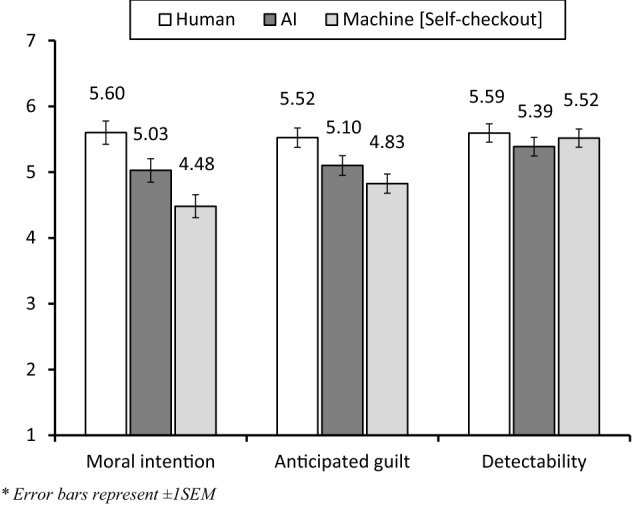
Several technological developments, such as self-service technologies and artificial intelligence (AI), are disrupting the retailing industry by changing consumption and purchase habits and the overall retail experience. Although AI represents extraordinary opportunities for businesses, companies must avoid the dangers and risks associated with the adoption of such systems. Integrating perspectives from emerging research on AI, morality of machines, and norm activation, we examine how individuals morally behave toward AI agents and self-service machines. Across three studies, we demonstrate that consumers’ moral concerns and behaviors differ when interacting with technologies versus humans. We show that moral intention (intention to report an error) is less likely to emerge for AI checkout and self-checkout machines compared with human checkout. In addition, moral intention decreases as people consider the machine less humanlike. We further document that the decline in morality is caused by less guilt displayed toward new technologies. The non-human nature of the interaction evokes a decreased feeling of guilt and ultimately reduces moral behavior. These findings offer insights into how technological developments influence consumer behaviors and provide guidance for businesses and retailers in understanding moral intentions related to the different types of interactions in a shopping environment.
Overview
The claims and statistics of this paper haven’t been checked yet.
Free: it reads the open-access text and checks the first 5 claims that cite a source we can check. Create a free account to check every claim.
Integrity signals
Registry
Cites
Statistics
Figures
Verification
Claims the paper makes
The claims and statistics of this paper haven’t been checked yet.
Free: it reads the open-access text and checks the first 5 claims that cite a source we can check. Create a free account to check every claim.
Claims other papers make about this one
Each is checked against this paper’s own text: does it say what the citing paper says it does?
The source backs part of the claim, not all of it — or backs it for a different population, condition or comparison.
In the citing paper
“Earlier research into anthropomorphism has already shown that beliefs of humanness elicit more positive emotions and lead users to experience feelings of moral responsibility, increasing their inclination to “do the right thing” toward the chatbot (101).”
From The benefits and dangers of anthropomorphic conversational agents (2025) · cites this paper as [101]
Experimental — accuracy not yet measured
Self-check
Percentages, sums and reported differences re-computed from the paper’s own numbers.
The self-check needs the paper’s full text.
Citations
Cites
(2013) · Cited by 44,563
Advances In Experimental Social Psychology
(2022) · Advances in Experimental Social Psychology · doi:10.1016/s0065-2601(22)x0002-6 · Cited by 22,259
Searle, J. R. (1980) · Behavioral and Brain Sciences · doi:10.1017/s0140525x00005756 · Cited by 6,954 · cited 1×
“Thus, existing literature suggests that the human mind is unique, and that machines and AI cannot hold all the human mental abilities (Searle, 1980).”
BackgroundNormative Influences on Altruism
Schwartz, S. H. (1977) · Advances in Experimental Social Psychology · doi:10.1016/s0065-2601(08)60358-5 · Cited by 5,364 · cited 1×
“This model states that anticipated guilt or pride will lead individuals to act in a way that is congruent with their personal norms and standards (Schwartz, 1977).”
Background(1997) · Choice Reviews Online · doi:10.5860/choice.34-3702 · Cited by 4,887
Artificial intelligence in service
Huang, M.-H., & Rust, R. T. (2018) · Journal of Service Research · doi:10.1177/1094670517752459 · Cited by 3,978 · cited 2×
“Individuals can also perceive more risk and experience discomfort when interacting with automated services and robots (Huang & Rust, 2018).”
BackgroundThe Uncanny Valley [From the Field]
Mori, M., MacDorman, K., & Kageki, N. (2012) · IEEE Robotics & Automation Magazine · doi:10.1109/mra.2012.2192811 · Cited by 3,542 · cited 2×
“Indeed, this relationship states that individuals can experience a feeling of unease or strangeness when robots/ machines appear too humanlike (Ho & MacDorman, 2017; Mori et al., 2012).”
BackgroundAlgorithm aversion: People erroneously avoid algorithms after seeing them err.
Dietvorst, B. J., Simmons, J. P., & Massey, C. (2015) · Journal of Experimental Psychology: General · doi:10.1037/xge0000033 · Cited by 3,232 · cited 2×
“…usage, researchers have documented a certain resistance to the adoption of AI not only due to regulation and privacy issues but also due to their inaccuracy to make inferences and predictions (Dietvorst et al., 2015; Longoni et al., 2019) and the inauthenticity of those predictions (Jago, 2019).”
BackgroundConverging measurement of horizontal and vertical individualism and collectivism.
Triandis, H. C., & Gelfand, M. J. (1998) · Journal of Personality and Social Psychology · doi:10.1037//0022-3514.74.1.118 · Cited by 2,967
Sherry, J. F., & Sternthal, B. (1992) · Cited by 2,917
Meuter, M. L., Ostrom, A. L., Roundtree, R. I., & Bitner, M. J. (2000) · Journal of Marketing · doi:10.1509/jmkg.64.3.50.18024 · Cited by 2,905 · cited 1×
“SSTs are described as “technological interfaces that enable customers to produce a service independent of direct service employee involve-ment” (Meuter et al., 2000, p. 50).”
BackgroundHow artificial intelligence will change the future of marketing
Davenport, T., Guha, A., Grewal, D., & Bressgott, T. (2020) · Journal of the Academy of Marketing Science · doi:10.1007/s11747-019-00696-0 · Cited by 2,875 · cited 1×
“Several opportunities, such as self-service checkouts and recommendation systems-based data analysis, can result in considerable gains for businesses and long-term cost savings and contribute to the overall consumer experience (Davenport et al., 2020; Grewal et al., 2018; Kim, 2017; Oh et al., 2013).”
BackgroundHaenlein, M., & Kaplan, A. (2019) · California Management Review · doi:10.1177/0008125619864925 · Cited by 2,655 · cited 1×
“With its ability to accurately perform tasks and goals based on external inputs, AI is revolutionizing how companies and organizations create content, make recommendations, and interact within the store (de Ruyter et al., 2018; Haenlein & Kaplan, 2019; Weber & Schütte, 2019).”
BackgroundTangney, J. P., & Dearing, R. L. (2002) · Medical Entomology and Zoology · Cited by 2,063
Resistance to Medical Artificial Intelligence
Longoni, C., Bonezzi, A., & Morewedge, C. K. (2019) · Journal of Consumer Research · doi:10.1093/jcr/ucz013 · Cited by 2,015 · cited 2×
“…usage, researchers have documented a certain resistance to the adoption of AI not only due to regulation and privacy issues but also due to their inaccuracy to make inferences and predictions (Dietvorst et al., 2015; Longoni et al., 2019) and the inauthenticity of those predictions (Jago, 2019).”
BackgroundGuilt: An interpersonal approach
Baumeister, R. F., Stillwell, A. M., & Heatherton, T. F. (1994) · Psychological Bulletin · doi:10.1037/0033-2909.115.2.243 · Cited by 1,884 · cited 3×
“Relationship contexts and norms can explain how guilt comes across because communal relationships are more about each other’s welfare, care, and commitments toward the other entity (Baumeister et al., 1994).”
BackgroundInfluentialAwad, E., Dsouza, S., Kim, R., Schulz, J., Henrich, J., Shariff, A., Bonnefon, J.-F., & Rahwan, I. (2018) · Nature · doi:10.1038/s41586-018-0637-6 · Cited by 1,859 · cited 2×
“With the rise and importance of AI for both practitioners and researchers, more online experiments will continue to include manipulations of AI and AI agents (e.g., Aoki, 2021; Awad et al., 2018).”
BackgroundEvaluating amazon’s mechanical turk as a tool for experimental behavioral research
Crump, M. J. C., McDonnell, J. V., & Gureckis, T. M. (2013) · PLoS ONE · doi:10.1371/journal.pone.0057410 · Cited by 1,617 · cited 1×
“Moreover, although the use of online panels such as Amazon Mechanical Turk and Prolific can be an effective method (e.g., Crump et al., 2013), future studies should replicate the effects with participants in a more controlled setting.”
MethodThe social dilemma of autonomous vehicles
Bonnefon, J.-F., Shariff, A., & Rahwan, I. (2016) · Science · doi:10.1126/science.aaf2654 · Cited by 1,527 · cited 1×
“Individuals also expect autonomous vehicles to minimize the overall harm (e.g., sacrifice one life to save many) (Bonnefon et al., 2016).”
BackgroundInterpersonal attraction in exchange and communal relationships.
Clark, M. S., & Mills, J. (1979) · Journal of Personality and Social Psychology · doi:10.1037//0022-3514.37.1.12 · Cited by 1,527 · cited 1×
“Thus, we propose that people will perceive the relationship between AI and humans to be an exchange (rather than communal) relationship (Aggarwal, 2004; Clark & Mills, 1979; Clark et al., 1987; Yi et al., 2018).”
BackgroundThe mind in the machine: Anthropomorphism increases trust in an autonomous vehicle
Waytz, A., Heafner, J., & Epley, N. (2014) · Journal of Experimental Social Psychology · doi:10.1016/j.jesp.2014.01.005 · Cited by 1,439 · cited 1×
“This anthropomorphism process drives individuals’ perceptions of more humanlike machines to have more moral responsibility (De Visser et al., 2016; Waytz et al., 2014).”
BackgroundThomson, J. J. (1985) · The Yale Law Journal · doi:10.2307/796133 · Cited by 1,304 · cited 2×
“Using the “trolley problem” (Thomson, 1985), they found that robots are expected to make a “utilitarian” choice (i.e., sacrifice one person to save many lives) to a greater degree than human agents.”
BackgroundThe Effects of Brand Relationship Norms on Consumer Attitudes and Behavior
Aggarwal, P. (2004) · Journal of Consumer Research · doi:10.1086/383426 · Cited by 1,068 · cited 1×
“Thus, we propose that people will perceive the relationship between AI and humans to be an exchange (rather than communal) relationship (Aggarwal, 2004; Clark & Mills, 1979; Clark et al., 1987; Yi et al., 2018).”
BackgroundFeeling robots and human zombies: Mind perception and the uncanny valley
Gray, K., & Wegner, D. M. (2012) · Cognition · doi:10.1016/j.cognition.2012.06.007 · Cited by 941 · cited 4×
“…opportunities, such as self-service checkouts and recommendation systems-based data analysis, can result in considerable gains for businesses and long-term cost savings and contribute to the overall consumer experience (Daven-port et al., 2020; Grewal et al., 2018; Kim, 2017; Oh et al., 2013).”
BackgroundInfluentialPeople are averse to machines making moral decisions.
Bigman, Y. E., & Gray, K. (2018) · Cognition · doi:10.1016/j.cognition.2018.08.003 · Cited by 738 · cited 2×
“Although prior research has investigated how individuals morally perceive and react to behaviors from machines and robots (Awad et al., 2019; Bigman & Gray, 2018; Gamez et al., 2020) or social media platforms, such as WeChat (He & Tan, 2021), research on consumers’ moral reactions toward those…”
BackgroundCan computer personalities be human personalities?
Nass, C., Moon, Y., Fogg, B. J., Reeves, B., & Dryer, D. C. (1995) · International Journal of Human-Computer Studies · doi:10.1006/ijhc.1995.1042 · Cited by 615
Almost human: Anthropomorphism increases trust resilience in cognitive agents.
de Visser, E. J., Monfort, S. S., McKendrick, R., Smith, M. A. B., McKnight, P. E., Krueger, F., & Parasuraman, R. (2016) · Journal of Experimental Psychology: Applied · doi:10.1037/xap0000092 · Cited by 614 · cited 1×
“This anthropomorphism process drives individuals’ perceptions of more humanlike machines to have more moral responsibility (De Visser et al., 2016; Waytz et al., 2014).”
BackgroundPreference for robot service or human service in hotels? Impacts of the COVID-19 pandemic
Kim, S. (., Kim, J., Badu-Baiden, F., Giroux, M., & Choi, Y. (2021) · International Journal of Hospitality Management · doi:10.1016/j.ijhm.2020.102795 · Cited by 567 · cited 2×
“Additionally, COVID-19 is expected to increase our reliance on new technology (Kim et al., 2021), meaning that our results can have a more substantial impact on corporations and business owners.”
BackgroundMethodSelf-citationRecipient's mood, relationship type, and helping.
Clark, M. S., Oullette, R., Powell, M. C., & Milberg, S. (1987) · Journal of Personality and Social Psychology · doi:10.1037/0022-3514.53.1.94 · Cited by 531 · cited 1×
“Thus, we propose that people will perceive the relationship between AI and humans to be an exchange (rather than communal) relationship (Aggarwal, 2004; Clark & Mills, 1979; Clark et al., 1987; Yi et al., 2018).”
BackgroundThe Role of Big Data and Predictive Analytics in Retailing
Bradlow, E. T., Gangwar, M., Kopalle, P., & Voleti, S. (2017) · Journal of Retailing · doi:10.1016/j.jretai.2016.12.004 · Cited by 516 · cited 2×
“…of retailing has drastically and rapidly changed in the past decades with the development of new technologies (e.g., Internet and mobile shopping, robots, machines, and AI), disrupting the way individuals consume and interact (Bradlow et al., 2017; Grewal et al., 2018; Rafaelli et al., 2017).”
BackgroundArtificial Intelligence and Marketing: Pitfalls and Opportunities
De Bruyn, A., Viswanathan, V., Beh, Y. S., Brock, J. K.-U., & Von Wangenheim, F. (2020) · Journal of Interactive Marketing · doi:10.1016/j.intmar.2020.04.007 · Cited by 515 · cited 1×
“The existing literature has mainly focused on examining technological benefits and issues related to AI and identifying factors to optimize the adoption level of those technologies (De Bruyn et al., 2020; Lee, 2004).”
BackgroundBrave, S., Nass, C., & Hutchinson, K. (2005) · International Journal of Human-Computer Studies · doi:10.1016/j.ijhcs.2004.11.002 · Cited by 511 · cited 2×
“Also, a stream of research theo-rized computers as social actors, indicating individuals’ reaction to machines according to social psychological principles (Brave et al., 2005; Nass et al., 1995; Reeves & Nass, 1996).”
BackgroundYour Morals Depend on Language
Costa, A., Foucart, A., Hayakawa, S., Aparici, M., Apesteguia, J., Heafner, J., & Keysar, B. (2014) · PLoS ONE · doi:10.1371/journal.pone.0094842 · Cited by 505 · cited 1×
“For example, people showed a lower level of morality in a foreign language (Costa et al., 2014).”
BackgroundPeloza, J., White, K., & Shang, J. (2013) · Journal of Marketing · doi:10.1509/jm.11.0454 · Cited by 498 · cited 1×
“This anticipation of guilt often results in avoidance behaviors or actions (Peloza et al., 2013) to avoid the negative feeling of guilt.”
BackgroundInfluence of new-age technologies on marketing: A research agenda
Kumar, V., Ramachandran, D., & Kumar, B. (2021) · Journal of Business Research · doi:10.1016/j.jbusres.2020.01.007 · Cited by 492 · cited 3×
“Several technological developments, such as the Internet, self-service technologies, and artificial intelligence (AI), have entirely changed the face of retailing, altering purchase and consumption patterns and interactions within the retail environment (Grewal et al., 2018; Guha et al., 2021; Kumar et al., 2020; Rafa…”
BackgroundBryson, J. J. (2010) · Natural Language Processing · doi:10.1075/nlp.8.11bry · Cited by 455 · cited 1×
“Contradictory views about the moral treatments of machines and AI suggest that moral relations with those agents are not equivalent to human interactions (Bryson, 2010; Gunkel, 2018; Levy, 2009).”
BackgroundOn conceptualizing and assessing guilt.
Kugler, K., & Jones, W. H. (1992) · Journal of Personality and Social Psychology · doi:10.1037/0022-3514.62.2.318 · Cited by 450 · cited 1×
“Guilt is often experienced when individuals perceive responsibility for transgressions or not respecting their own moral standards (Kugler & Jones, 1992; Tangney & Dearing, 2012).”
BackgroundGoldstein, J. H. (1980) · Social Psychology · doi:10.1016/b978-0-12-287050-7.50011-4 · Cited by 437
How Artificial Intelligence (AI) is Reshaping Retailing
Shankar, V. (2018) · Journal of Retailing · doi:10.1016/s0022-4359(18)30076-9 · Cited by 417 · cited 2×
“Technological developments are changing the business world (e.g., Kumar et al., 2020; Shankar, 2018); thus, more research is needed to understand how customers react to those innovations.”
BackgroundCialdini, R. B., & Kenrick, D. T. (1976) · Journal of Personality and Social Psychology · doi:10.1037//0022-3514.34.5.907 · Cited by 408 · cited 1×
“The avoidance of possible transgressions can be linked to the Negative State relief model that stipulates individuals’ motivation to reduce negative moods (Cialdini & Kenrick, 1976).”
BackgroundKim, J., Giroux, M., & Lee, J. C. (2021) · Psychology & Marketing · doi:10.1002/mar.21498 · Cited by 353 · cited 2×
“Additionally, COVID-19 is expected to increase our reliance on new technology (Kim et al., 2021), meaning that our results can have a more substantial impact on corporations and business owners.”
BackgroundMethodSelf-citationHow artificial intelligence will affect the future of retailing
Guha, A., Grewal, D., Kopalle, P. K., Haenlein, M., Schneider, M. J., Jung, H., Moustafa, R., Hegde, D. R., & Hawkins, G. (2021) · Journal of Retailing · doi:10.1016/j.jretai.2021.01.005 · Cited by 339 · cited 2×
“Several technological developments, such as the Internet, self-service technologies, and artificial intelligence (AI), have entirely changed the face of retailing, altering purchase and consumption patterns and interactions within the retail environment (Grewal et al., 2018; Guha et al., 2021; Kumar et al., 2020; Rafa…”
BackgroundEnhancing or disrupting guilt: the role of ad credibility and perceived manipulative intent
Cotte, J., Coulter, R. A., & Moore, M. (2005) · Journal of Business Research · doi:10.1016/s0148-2963(03)00102-4 · Cited by 324 · cited 1×
“Participants were then asked to assess their perceived guilt for not reporting the error, with three items adapted from Cotte et al. (2005) (I would feel irresponsible/guilty/accountable if I do not report the billing error) on 7-point scales (1 = strongly disa-gree , 7 = strongly agree , α =…”
MethodRobots, Artificial Intelligence, and Service Automation in Travel, Tourism and Hospitality
(2019) · Emerald Group Publishing Limited eBooks · doi:10.1108/9781787566873 · Cited by 248
Ho, C.-C., & MacDorman, K. F. (2017) · International Journal of Social Robotics · doi:10.1007/s12369-016-0380-9 · Cited by 247
Sacrifice One For the Good of Many?: People Apply Different Moral Norms to Human and Robot Agents
Malle, B. F., Scheutz, M., Arnold, T., Voiklis, J., & Cusimano, C. (2015) · Proceedings of the Tenth Annual ACM/IEEE International Conference on Human-Robot Interaction · doi:10.1145/2696454.2696458 · Cited by 246 · cited 5×
“Researchers have also investigated whether people tend to apply the same norms in evaluating moral actions of AI and humans (Li et al., 2016; Malle et al., 2015).”
BackgroundInfluentialThe other question: can and should robots have rights?
Gunkel, D. J. (2018) · Ethics and Information Technology · doi:10.1007/s10676-017-9442-4 · Cited by 232 · cited 1×
“Contradictory views about the moral treatments of machines and AI suggest that moral relations with those agents are not equivalent to human interactions (Bryson, 2010; Gunkel, 2018; Levy, 2009).”
BackgroundFix It or Leave It? Customer Recovery from Self-service Technology Failures
Zhu, Z., Nakata, C., Sivakumar, K., & Grewal, D. (2013) · Journal of Retailing · doi:10.1016/j.jretai.2012.10.004 · Cited by 232
Drivers are blamed more than their automated cars when both make mistakes
Awad, E., Levine, S., Kleiman-Weiner, M., Dsouza, S., Tenenbaum, J. B., Shariff, A., Bonnefon, J., & Rahwan, I. (2019) · Nature Human Behaviour · doi:10.1038/s41562-019-0762-8 · Cited by 212 · cited 2×
“Although prior research has investigated how individuals morally perceive and react to behaviors from machines and robots (Awad et al., 2019; Bigman & Gray, 2018; Gamez et al., 2020) or social media platforms, such as WeChat (He & Tan, 2021), research on consumers’ moral reactions toward those technologies is limited.”
BackgroundIntegrating robot ethics and machine morality: the study and design of moral competence in robots
Malle, B. F. (2016) · Ethics and Information Technology · doi:10.1007/s10676-015-9367-8 · Cited by 200 · cited 2×
“This research stream has stipulated that we cannot equally apply human norms and moral reactions to machines (Malle, 2016; Malle et al., 2019).”
BackgroundAlgorithmic discrimination causes less moral outrage than human discrimination
Bigman, Y. E., Wilson, D., Arnestad, M. N., Waytz, A., & Gray, K. (2023) · Journal of Experimental Psychology: General · doi:10.1037/xge0001250 · Cited by 198
Strutton, D., Vitell, S. J., & Pelton, L. E. (1994) · Journal of Business Research · doi:10.1016/0148-2963(94)90055-8 · Cited by 198 · cited 1×
“Anticipatory guilt normally stimulates ethical behaviors in consumption and retailing contexts since individuals can experience guilt when considering the possible violation of their moral standards (Kim et al., 2012; Rawlings, 1970; Steenhaut & Van Kenhove, 2005; Strutton et al., 1994).”
BackgroundTourists' adoption of self-service technologies at resort hotels
Oh, H., Jeong, M., & Baloglu, S. (2013) · Journal of Business Research · doi:10.1016/j.jbusres.2011.09.005 · Cited by 197 · cited 2×
“Several opportunities, such as self-service checkouts and recommendation systems-based data analysis, can result in considerable gains for businesses and long-term cost savings and contribute to the overall consumer experience (Davenport et al., 2020; Grewal et al., 2018; Kim, 2017; Oh et al., 2013).”
BackgroundTechnology with No Human Responsibility?
Johnson, D. G. (2015) · Journal of Business Ethics · doi:10.1007/s10551-014-2180-1 · Cited by 195 · cited 1×
“Given the substantial development in the area of AI and automated services, this study investigates how individuals morally behave toward AI agents and self-service machines along with recent interests regarding morality issues with new technology (e.g., Brusoni & Vaccaro, 2017; Johnson, 2015; Martin & Freeman, 2004;…”
MethodThe Evolution and Future of Retailing and Retailing Education
Grewal, D., Motyka, S., & Levy, M. (2018) · Journal of Marketing Education · doi:10.1177/0273475318755838 · Cited by 192 · cited 7×
“…of retailing has drastically and rapidly changed in the past decades with the development of new technologies (e.g., Internet and mobile shopping, robots, machines, and AI), disrupting the way individuals consume and interact (Bradlow et al., 2017; Grewal et al., 2018; Rafaelli et al., 2017).”
BackgroundInfluentialLee, J. (2016) · Journal of Computer Information Systems · doi:10.1080/08874417.2004.11647596 · Cited by 191 · cited 1×
“The existing literature has mainly focused on examining technological benefits and issues related to AI and identifying factors to optimize the adoption level of those technologies (De Bruyn et al., 2020; Lee, 2004).”
BackgroundSelf-citationThe Mediating Role of Anticipated Guilt in Consumers’ Ethical Decision-Making
Steenhaut, S., & Van Kenhove, P. (2006) · Journal of Business Ethics · doi:10.1007/s10551-006-9090-9 · Cited by 185 · cited 2×
“After that, participants were asked to indicate their perceived guilt for not reporting the billing error, using ten items adapted from Steenhaut and Van Kenhove (2006) (e.g., “I would feel tension if I did not report the billing error,” α = 0.955).”
BackgroundMethodInfluentialThe Future of Frontline Research: Invited Commentaries
Rafaeli, A., Altman, D., Gremler, D. D., Huang, M.-H., Grewal, D., Iyer, B., Parasuraman, A., & de Ruyter, K. (2017) · Journal of Service Research · doi:10.1177/1094670516679275 · Cited by 184
Holding Robots Responsible: The Elements of Machine Morality
Bigman, Y. E., Waytz, A., Alterovitz, R., & Gray, K. (2019) · Trends in Cognitive Sciences · doi:10.1016/j.tics.2019.02.008 · Cited by 183 · cited 4×
“, voices, bodies, and intelligence), leading to an enhanced tendency for morality (Bigman et al., 2019).”
BackgroundInfluentialKandaurova, M., & Lee, S. H. (. (2019) · Journal of Business Research · doi:10.1016/j.jbusres.2018.10.027 · Cited by 173 · cited 1×
“Indeed, guilt has been shown to be the critical emotion leading to more ethical, altruistic, and reparative prosocial behaviors and higher support of social causes (Deem & Ramsey, 2016; Kandaurova & Lee, 2019).”
BackgroundEmotion regulation consumption: When feeling better is the aim
Kemp, E., & Kopp, S. W. (2011) · Journal of Consumer Behaviour · doi:10.1002/cb.341 · Cited by 165
Anthropomorphism, agency, and ethopoeia: computers as social actors
Nass, C., Steuer, J., Tauber, E., & Reeder, H. (1993) · INTERACT '93 and CHI '93 conference companion on Human factors in computing systems - CHI '93 · doi:10.1145/259964.260137 · Cited by 162 · cited 1×
“Even adding minimal social cues, such as a distinctive voice or a name, can prompt humans to use social principles and paradigms (Nass et al., 1993).”
BackgroundInterpersonal service quality, self-service technology (SST) service quality, and retail patronage
Lee, H., & Yang, K. (2012) · Journal of Retailing and Consumer Services · doi:10.1016/j.jretconser.2012.10.005 · Cited by 161 · cited 2×
“SSTs have several benefits for businesses, including cost reduction, efficiency, and increasing store patronage, consumer satisfaction, and perceived control (Lee & Yang, 2013; Leung & Matanda, 2013; Rosen, 2001; Yang & Klassen, 2008; Zhu et al., 2013).”
BackgroundJago, A. S. (2019) · Academy of Management Discoveries · doi:10.5465/amd.2017.0002 · Cited by 160 · cited 2×
“…usage, researchers have documented a certain resistance to the adoption of AI not only due to regulation and privacy issues but also due to their inaccuracy to make inferences and predictions (Dietvorst et al., 2015; Longoni et al., 2019) and the inauthenticity of those predictions (Jago, 2019).”
BackgroundAttributions of morality and mind to artificial intelligence after real-world moral violations
Shank, D. B., & DeSanti, A. (2018) · Computers in Human Behavior · doi:10.1016/j.chb.2018.05.014 · Cited by 155
The Ethical Treatment of Artificially Conscious Robots
Levy, D. (2009) · International Journal of Social Robotics · doi:10.1007/s12369-009-0022-6 · Cited by 146 · cited 1×
“Contradictory views about the moral treatments of machines and AI suggest that moral relations with those agents are not equivalent to human interactions (Bryson, 2010; Gunkel, 2018; Levy, 2009).”
BackgroundBulmer, S., Elms, J., & Moore, S. (2018) · Journal of Retailing and Consumer Services · doi:10.1016/j.jretconser.2018.01.016 · Cited by 142 · cited 3×
“Due to the numerous benefits attached to those technologies, such as reducing operating costs and increased ability and efficacy for consumers (Bulmer et al., 2018), businesses have focused on developing”
BackgroundInfluentialLeung, L. S. K., & Matanda, M. J. (2013) · Journal of Retailing and Consumer Services · doi:10.1016/j.jretconser.2013.06.003 · Cited by 133 · cited 2×
“SSTs have several benefits for businesses, including cost reduction, efficiency, and increasing store patronage, consumer satisfaction, and perceived control (Lee & Yang, 2013; Leung & Matanda, 2013; Rosen, 2001; Yang & Klassen, 2008; Zhu et al., 2013).”
BackgroundInvestigating the Effects of Anger and Guilt on Unethical Behavior: A Dual-Process Approach
Motro, D., Ordóñez, L. D., Pittarello, A., & Welsh, D. T. (2016) · Journal of Business Ethics · doi:10.1007/s10551-016-3337-x · Cited by 131 · cited 1×
“Second, we advance the role of guilt (e.g., Motro et al., 2018; Steenhaut & Van Kenhove, 2006) as a crucial mechanism in understanding people’s actions concerning AI and machines.”
BackgroundState-of-the-art and adoption of artificial intelligence in retailing
Weber, F. D., & Schütte, R. (2019) · Digital Policy, Regulation and Governance · doi:10.1108/dprg-09-2018-0050 · Cited by 130 · cited 1×
“With its ability to accurately perform tasks and goals based on external inputs, AI is revolutionizing how companies and organizations create content, make recommendations, and interact within the store (de Ruyter et al., 2018; Haenlein & Kaplan, 2019; Weber & Schütte, 2019).”
BackgroundBusiness and the Ethical Implications of Technology: Introduction to the Symposium
Martin, K. E., Shilton, K., & Smith, J. A. (2019) · Journal of Business Ethics · doi:10.1007/s10551-019-04213-9 · Cited by 125 · cited 4×
“Given the substantial development in the area of AI and automated services, this study investigates how individuals morally behave toward AI agents and self-service machines along with recent interests regarding morality issues with new technology (e.g., Brusoni & Vaccaro, 2017; Johnson, 2015; Martin & Freeman, 2004;…”
BackgroundMethodInfluentialAI in the Sky: How People Morally Evaluate Human and Machine Decisions in a Lethal Strike Dilemma
Malle, B. F., Magar, S. T., & Scheutz, M. J. (2019) · International series on intelligent systems, control and automation: science and engineering · doi:10.1007/978-3-030-12524-0_11 · Cited by 117 · cited 1×
“This research stream has stipulated that we cannot equally apply human norms and moral reactions to machines (Malle, 2016; Malle et al., 2019).”
BackgroundBlame It on the Self-Driving Car: How Autonomous Vehicles Can Alter Consumer Morality
Gill, T. (2020) · Journal of Consumer Research · doi:10.1093/jcr/ucaa018 · Cited by 112 · cited 4×
“…competence of robots should accompany (a) moral cognition and affect (e.g., judgments of blame and the process of reasoning), (b) moral decision-making and action (e.g., making choices among options), and (c) moral communications (e.g., expressing moral judgments of others’ behavior) (Gill, 2020).”
BackgroundInfluentialInvestigating the Effects of Gender on Consumers’ Moral Philosophies and Ethical Intentions
Bateman, C. R., & Valentine, S. R. (2010) · Journal of Business Ethics · doi:10.1007/s10551-010-0386-4 · Cited by 110 · cited 2×
“Then, all participants were asked to indicate their moral intention to report the billing error on a 7-point scale (1 = I definitely would take advantage of the miscalculation , 7 = I definitely would NOT take advantage of the miscalculation ) used in Bateman and Valentine (2010).”
MethodMachine ethics: The robot’s dilemma
Deng, B. (2015) · Nature · doi:10.1038/523024a · Cited by 108 · cited 1×
““Machine ethics” or “machine morality” (Deng, 2015; Malle, 2016), the new field that studies the morality of machines, has investigated questions about the degree of moral capacity that autonomous machines should possess and how morality can be implemented (Malle, 2016).”
BackgroundAgerström, J., & Björklund, F. (2009) · Basic and Applied Social Psychology · doi:10.1080/01973530802659885 · Cited by 108
Aoki, N. (2021) · Computers in Human Behavior · doi:10.1016/j.chb.2020.106572 · Cited by 106 · cited 1×
“With the rise and importance of AI for both practitioners and researchers, more online experiments will continue to include manipulations of AI and AI agents (e.g., Aoki, 2021; Awad et al., 2018).”
BackgroundShank, D. B., DeSanti, A., & Maninger, T. (2019) · Information, Communication & Society · doi:10.1080/1369118x.2019.1568515 · Cited by 105 · cited 1×
“Extending these findings, Shank et al. (2019) investigated the role of decision-making structures (individual decision-making vs. joint decision-making) involving moral violations by AI and human agents.”
BackgroundLi, J., Zhao, X., Cho, M.-J., Ju, W., & Malle, B. F. (2016) · SAE Technical Paper Series · doi:10.4271/2016-01-0164 · Cited by 92 · cited 2×
“The literature has pointed out that people perceive AI to behave toward humans in a utilitarian and economical way (Li et al., 2016; Malle et al., 2015).”
BackgroundGamez, P., Shank, D. B., Arnold, C., & North, M. (2020) · AI & Society · doi:10.1007/s00146-020-00977-1 · Cited by 89 · cited 2×
“…research has investigated how individuals morally perceive and react to behaviors from machines and robots (Awad et al., 2019; Bigman & Gray, 2018; Gamez et al., 2020) or social media platforms, such as WeChat (He & Tan, 2021), research on consumers’ moral reactions toward those technologies is…”
BackgroundYoung, A. D., & Monroe, A. E. (2019) · Journal of Experimental Social Psychology · doi:10.1016/j.jesp.2019.103870 · Cited by 88 · cited 1×
“Finally, participants’ humanlike perception of the checkout agent was measured with three items of 7-point scales that were used in Young and Monroe (2019) (1 = mindless/unthinking/unconscious , 7 = mindful/thinking/conscious , α = 0.910).”
MethodInfluentialThe Separation of Technology and Ethics in Business Ethics
Martin, K. E., & Freeman, R. E. (2004) · Journal of Business Ethics · doi:10.1023/b:busi.0000043492.42150.b6 · Cited by 86 · cited 1×
“…area of AI and automated services, this study investigates how individuals morally behave toward AI agents and self-service machines along with recent interests regarding morality issues with new technology (e.g., Brusoni & Vaccaro, 2017; Johnson, 2015; Martin & Freeman, 2004; Martin et al., 2019).”
BackgroundTwo paths to blame: Intentionality directs moral information processing along two distinct tracks.
Monroe, A. E., & Malle, B. F. (2017) · Journal of Experimental Psychology: General · doi:10.1037/xge0000234 · Cited by 86 · cited 1×
“Morality judgments are often based on the mental capacities (e.g., recognizing the consequences of actions) of the agents (Monroe & Malle, 2017).”
BackgroundTrust and Fairness During Strategic Change Processes in Franchise Systems
Croonen, E. P. M. (2010) · Journal of Business Ethics · doi:10.1007/s10551-009-0354-z · Cited by 82 · cited 2×
“The size of the business could impact reactions; drawing from the prevailing B2B literature, we found that smaller firms (or retailers) typically exercise more risk with their stakeholders (and partner organizations) and rely more heavily on a larger cross-section of customers/clients (Croonen, 2010).”
BackgroundSteenhaut, S., & Kenhove, P. V. (2005) · Journal of Business Ethics · doi:10.1007/s10551-004-5969-5 · Cited by 74 · cited 1×
“Anticipatory guilt normally stimulates ethical behaviors in consumption and retailing contexts since individuals can experience guilt when considering the possible violation of their moral standards (Kim et al., 2012; Rawlings, 1970; Steenhaut & Van Kenhove, 2005; Strutton et al., 1994).”
BackgroundEthics, Technology and Organizational Innovation
Brusoni, S., & Vaccaro, A. (2016) · Journal of Business Ethics · doi:10.1007/s10551-016-3061-6 · Cited by 71 · cited 2×
“First, it extends our understanding of consumers’ reactions toward technologies, machines, and AI (e.g., Brusoni & Vaccaro, 2017; Martin et al., 2019).”
BackgroundWhen Nothing is What it Seems: A Digital Marketing Research Agenda
de Ruyter, K., Isobel Keeling, D., & Ngo, L. V. (2018) · Australasian Marketing Journal · doi:10.1016/j.ausmj.2018.07.003 · Cited by 64
Artificial decision-making and artificial ethics: A management concern
Khalil, O. E. M. (1993) · Journal of Business Ethics · doi:10.1007/bf01666535 · Cited by 57 · cited 1×
“Besides, morality plays such an essential role in human society; therefore, it is crucial to investigate how AI and the topic of morality interact (Khalil, 1993; Martin et al., 2019).”
BackgroundWe perceive a mind in a robot when we help it
Tanibe, T., Hashimoto, T., & Karasawa, K. (2017) · PLOS ONE · doi:10.1371/journal.pone.0180952 · Cited by 53 · cited 3×
“First, individuals can perceive inorganic creatures, such as robots and AI agents, to have a mind (Tanibe et al., 2017).”
BackgroundSerafimova, S. (2020) · Humanities and Social Sciences Communications · doi:10.1057/s41599-020-00614-8 · Cited by 52
Shank, D. B. (2013) · Computers in Human Behavior · doi:10.1016/j.chb.2012.11.006 · Cited by 51 · cited 1×
“Still, those interactions and responses cannot be directly compared with human–human interactions (Shank, 2013, 2014).”
BackgroundKim, J., Kim, J., & Park, J. (2012) · Marketing Letters · doi:10.1007/s11002-012-9194-1 · Cited by 51 · cited 1×
“Anticipatory guilt normally stimulates ethical behaviors in consumption and retailing contexts since individuals can experience guilt when considering the possible violation of their moral standards (Kim et al., 2012; Rawlings, 1970; Steenhaut & Van Kenhove, 2005; Strutton et al., 1994).”
BackgroundSelf-citationAre Individuals More Willing to Lie to a Computer or a Human? Evidence from a Tax Compliance Setting
LaMothe, E. G., & Bobek, D. D. (2020) · Journal of Business Ethics · doi:10.1007/s10551-019-04408-0 · Cited by 49 · cited 2×
“Also, past research has demonstrated that temporal distance (Agerstöm & Björklund, 2009) and motivations (e.g., economic gain; LaMothe & Bobek, 2020) can influence moral concerns.”
BackgroundMethodInfluentialHow financial markets reflect the benefits of self‐service technologies
Yang, J., & Klassen, K. J. (2008) · Journal of Enterprise Information Management · doi:10.1108/17410390810904238 · Cited by 46 · cited 2×
“SSTs have several benefits for businesses, including cost reduction, efficiency, and increasing store patronage, consumer satisfaction, and perceived control (Lee & Yang, 2013; Leung & Matanda, 2013; Rosen, 2001; Yang & Klassen, 2008; Zhu et al., 2013).”
BackgroundSupermarket self-checkouts and retail theft: The curious case of the SWIPERS
Taylor, E. (2016) · Criminology & Criminal Justice · doi:10.1177/1748895816643353 · Cited by 45 · cited 3×
“, cost savings) for businesses, negative aspects and undesirable behaviors from consumers such as augmentation and normalization of consumer theft and shoplifting have also been observed (Dimoff, 2020; Taylor, 2016).”
BackgroundHow to think about emotion and morality: circles, not arrows
Gray, K. J., Schein, C., & Cameron, C. D. (2017) · Current Opinion in Psychology · doi:10.1016/j.copsyc.2017.06.011 · Cited by 33 · cited 3×
“Individuals’ moral decisions are strongly embedded in emotions (Gray et al., 2017).”
BackgroundDeem, M. J., & Ramsey, G. (2016) · Philosophical Psychology · doi:10.1080/09515089.2015.1126706 · Cited by 29 · cited 1×
“Indeed, guilt has been shown to be the critical emotion leading to more ethical, altruistic, and reparative prosocial behaviors and higher support of social causes (Deem & Ramsey, 2016; Kandaurova & Lee, 2019).”
BackgroundAnalysis of an impact-driven capsule robot
Ivanov, A. P. (2019) · International Journal of Non-Linear Mechanics · doi:10.1016/j.ijnonlinmec.2019.103257 · Cited by 21 · cited 1×
“For the moment, robots are mainly implemented in the manufacturing and delivery of products and services (Ivanov, 2020), but we can expect their growing presence in frontline services.”
BackgroundRetailing and the Ethical Challenges and Dilemmas Behind Artificial Intelligence
Kaplan, A. (2020) · Emerald Group Publishing Limited eBooks · doi:10.1108/978-1-83867-663-620201020 · Cited by 20 · cited 2×
“, Alibaba, Amazon, McDonald’s, and Walmart) investing massively to project themselves in the new retailing experience (Kaplan, 2020; Kats, 2020).”
BackgroundShank, D. B. (2014) · International Journal of Human-Computer Studies · doi:10.1016/j.ijhcs.2014.05.002 · Cited by 16 · cited 1×
“Still, those interactions and responses cannot be directly compared with human–human interactions (Shank, 2013, 2014).”
BackgroundYi, Y., Lee, J. C., & Kim, S. (2018) · Social Influence · doi:10.1080/15534510.2018.1546616 · Cited by 10 · cited 4×
“Thus, we propose that people will perceive the relationship between AI and humans to be an exchange (rather than communal) relationship (Aggarwal, 2004; Clark & Mills, 1979; Clark et al., 1987; Yi et al., 2018).”
BackgroundInfluentialSelf-citationStrangers in the Borderlands: WeChat and ethical ambiguity in Yunnan, China
He, H., & Tan, C. K. K. (2020) · Chinese Journal of Communication · doi:10.1080/17544750.2020.1769701 · Cited by 7 · cited 2×
“…has investigated how individuals morally perceive and react to behaviors from machines and robots (Awad et al., 2019; Bigman & Gray, 2018; Gamez et al., 2020) or social media platforms, such as WeChat (He & Tan, 2021), research on consumers’ moral reactions toward those technologies is limited.”
Background
Research works printed but not linked: 1
- Rosen C More retailers to tell customers ‘do it yourself’ Information Week 2001 826 29
Cited by
Artificial intelligence (AI) applications for marketing: A literature-based study
Haleem, A., Javaid, M., Asim Qadri, M., Pratap Singh, R., & Suman, R. (2022) · International Journal of Intelligent Networks · doi:10.1016/j.ijin.2022.08.005 · Cited by 948
Effect of disclosing AI-generated content on prosocial advertising evaluation
Baek, T. H., Kim, J., & Kim, J. H. (2026) · International Journal of Advertising · doi:10.1080/02650487.2024.2401319 · Cited by 150
Self-citationRuan, Y., & Mezei, J. (2022) · Journal of Retailing and Consumer Services · doi:10.1016/j.jretconser.2022.103059 · Cited by 238
Artificial intelligence and consumer behavior: From predictive to generative AI
Hermann, E., & Puntoni, S. (2024) · Journal of Business Research · doi:10.1016/j.jbusres.2024.114720 · Cited by 230
Hossain, S., Fernando, M., & Akter, S. (2025) · Journal of Leadership & Organizational Studies · doi:10.1177/15480518251319624 · Cited by 93
“…(Choudhury et al., 2020); perceived users ’ value (Gregory et al., 2021); organizational design choices (Murray et al., 2021); individual morality (Giroux et al., 2022; Tóth et al., 2022); ethical and cultural implications (Wright & Schultz, 2018); and paradoxical automation-augmentation…”
Metadata
- Authors
- Giroux, M., Kim, J., Lee, J. C., & Park, J.
- Affiliations
- Auckland University of Technology (NZ)
- Dongguk University (KR)
- Korea University (KR)
- Corresponding author
- Kim, Jungkeun
- Lee, Jacob C.
- Venue
- Journal of Business Ethics
- Published
- 2022-02-12
- Volume
- 178
- Issue
- 4
- Pages
- 1027-1041
- ISSN
- 0167-4544 (ISSN-L)
- 1573-0697
- PMC
- PMC8853322
- OpenAlex
- W4211089551
- Cited by
- 194
- References
- 102
- Citations by year
- 2026: 48 · 2025: 76 · 2024: 34 · 2023: 30 · 2022: 6
- FWCI
- 12.01
- Type
- journal article
- Language
- en
- Open access
- hybrid
- doi.org
- Licence
- cc-by
- creativecommons.org/licenses/by/4.0 (tdm)
- creativecommons.org/licenses/by/4.0 (vor)
- Locations
- Journal of Business Ethics (publishedVersion, cc-by)
- PubMed Central (publishedVersion, cc-by)
- PubMed (publishedVersion)
- RePEc: Research Papers in Economics (submittedVersion)
- Funders
- Auckland University of Technology
- Topics
- Social Sciences › Business, Management and Accounting › Marketing › AI in Service Interactions
- Social Sciences › Business, Management and Accounting › Organizational Behavior and Human Resource Management › Ethics in Business and Education
- Life Sciences › Neuroscience › Cognitive Neuroscience › Psychology of Moral and Emotional Judgment
- Keywords
- artificial intelligence, self-checkout, moral intention, guilt, norm activation, consumer behavior, retail trade, error reporting
About these checks
Registry, retraction, Cites and statistics results are computed, not judged, with one exception: a printed reference that no index lists is read once by a model before it counts as a citation error. Claims are extracted by a model and kept only when their quote appears verbatim in the text; each cited source is then checked, with a model’s help, for whether it says what the claim relies on. Those verdicts can be wrong — read the claim’s quote and the cited source before relying on one.
Statistics and arithmetic are recomputed, not judged.
Confidence bands are shown only for fields calibrated on our annotated test set. None is calibrated yet, so no band is shown.
What counts as a claim ›How we measure confidence ›How we check this ›
Are you an author, or do you see a problem with this page? Request a review
Data sources
Bibliographic data: Semantic Scholar, OpenAlex, Crossref.
Contains information from the Semantic Scholar Academic Graph Datasets, made available under the ODC Attribution License (ODC-BY 1.0).
Semantic Scholar’s data is described in: Kinney, R., et al. (2023). The Semantic Scholar Open Data Platform. arXiv:2301.10140.
