

Artificial Intelligence and Declined Guilt: Retailing Morality Comparison Between Human and AI
Open accessThe DOI matches its Crossref record; 102 of the 102 references it cites were found in a registry or an index.
Abstract
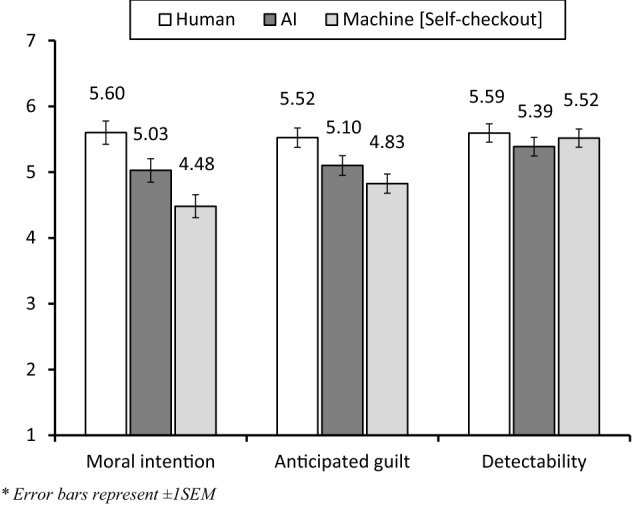
Several technological developments, such as self-service technologies and artificial intelligence (AI), are disrupting the retailing industry by changing consumption and purchase habits and the overall retail experience. Although AI represents extraordinary opportunities for businesses, companies must avoid the dangers and risks associated with the adoption of such systems. Integrating perspectives from emerging research on AI, morality of machines, and norm activation, we examine how individuals morally behave toward AI agents and self-service machines. Across three studies, we demonstrate that consumers’ moral concerns and behaviors differ when interacting with technologies versus humans. We show that moral intention (intention to report an error) is less likely to emerge for AI checkout and self-checkout machines compared with human checkout. In addition, moral intention decreases as people consider the machine less humanlike. We further document that the decline in morality is caused by less guilt displayed toward new technologies. The non-human nature of the interaction evokes a decreased feeling of guilt and ultimately reduces moral behavior. These findings offer insights into how technological developments influence consumer behaviors and provide guidance for businesses and retailers in understanding moral intentions related to the different types of interactions in a shopping environment.
Overview
The claims and statistics of this paper haven’t been checked yet.
Free: it reads the open-access text and checks the first 5 claims that cite a source we can check. Create a free account to check every claim.
Integrity signals
Registry
Cites
Statistics
Figures
Verification
Claims the paper makes
The claims and statistics of this paper haven’t been checked yet.
Free: it reads the open-access text and checks the first 5 claims that cite a source we can check. Create a free account to check every claim.
Claims other papers make about this one
Each is checked against this paper’s own text: does it say what the citing paper says it does?
The source backs part of the claim, not all of it — or backs it for a different population, condition or comparison.
In the citing paper
“Earlier research into anthropomorphism has already shown that beliefs of humanness elicit more positive emotions and lead users to experience feelings of moral responsibility, increasing their inclination to “do the right thing” toward the chatbot (101).”
From The benefits and dangers of anthropomorphic conversational agents (2025) · cites this paper as [101]
Experimental — accuracy not yet measured
Self-check
Percentages, sums and reported differences re-computed from the paper’s own numbers.
The self-check needs the paper’s full text.
Citations
Cites
(2013) · Cited by 44,563
Advances In Experimental Social Psychology
(2022) · Advances in Experimental Social Psychology · doi:10.1016/s0065-2601(22)x0002-6 · Cited by 22,259
Searle, J. R. (1980) · Behavioral and Brain Sciences · doi:10.1017/s0140525x00005756 · Cited by 6,954 · cited 1×
“Thus, existing literature suggests that the human mind is unique, and that machines and AI cannot hold all the human mental abilities (Searle, 1980).”
BackgroundNormative Influences on Altruism
Schwartz, S. H. (1977) · Advances in Experimental Social Psychology · doi:10.1016/s0065-2601(08)60358-5 · Cited by 5,364 · cited 1×
“This model states that anticipated guilt or pride will lead individuals to act in a way that is congruent with their personal norms and standards (Schwartz, 1977).”
Background(1997) · Choice Reviews Online · doi:10.5860/choice.34-3702 · Cited by 4,887
Artificial intelligence in service
Huang, M.-H., & Rust, R. T. (2018) · Journal of Service Research · doi:10.1177/1094670517752459 · Cited by 3,978 · cited 2×
“Individuals can also perceive more risk and experience discomfort when interacting with automated services and robots (Huang & Rust, 2018).”
BackgroundConverging measurement of horizontal and vertical individualism and collectivism.
Triandis, H. C., & Gelfand, M. J. (1998) · Journal of Personality and Social Psychology · doi:10.1037//0022-3514.74.1.118 · Cited by 3,656
The Uncanny Valley [From the Field]
Mori, M., MacDorman, K., & Kageki, N. (2012) · IEEE Robotics & Automation Magazine · doi:10.1109/mra.2012.2192811 · Cited by 3,542 · cited 2×
“Indeed, this relationship states that individuals can experience a feeling of unease or strangeness when robots/ machines appear too humanlike (Ho & MacDorman, 2017; Mori et al., 2012).”
BackgroundAlgorithm aversion: People erroneously avoid algorithms after seeing them err.
Dietvorst, B. J., Simmons, J. P., & Massey, C. (2015) · Journal of Experimental Psychology: General · doi:10.1037/xge0000033 · Cited by 3,232 · cited 2×
“…usage, researchers have documented a certain resistance to the adoption of AI not only due to regulation and privacy issues but also due to their inaccuracy to make inferences and predictions (Dietvorst et al., 2015; Longoni et al., 2019) and the inauthenticity of those predictions (Jago, 2019).”
BackgroundSherry, J. F., & Sternthal, B. (1992) · Cited by 2,917
Research works printed but not linked: 1
- Rosen C More retailers to tell customers ‘do it yourself’ Information Week 2001 826 29
Cited by
Items 201–250 of 250
Peran Ekosistem Global dalam Praktik Pembelajaran Berbasis Animasi AI di Lingkungan Pendidikan Islam
Novitasari, D. R., Safitri, N. D., & Mas’odi, M. (2023) · Ashlach Journal of Islamic Education · doi:10.55757/ashlach.v1i2.986
Subbarao, A., Ţarălungă, D. D., & Malik, N. I. S. A. (2026) · Lecture notes on multidisciplinary industrial engineering · doi:10.1007/978-3-032-02452-7_20
Yi, H., Zhaoyi, M. A., & Shuwei, Z. (2026) · Advances in Psychological Science · doi:10.3724/sp.j.1042.2026.0626
Nasr, I. B., Hallem, Y., Zaoui, I., & Khvatova, T. (2026) · Creativity and Innovation Management · doi:10.1111/caim.70051
The impact of resource scarcity on filial consumption behavior of adult children
Yan, Y., Wumei, L. I. U., & Zengguang, M. A. (2026) · Advances in Psychological Science · doi:10.3724/sp.j.1042.2026.0817
Liu, R., He, X., Lv, L., Shu, B., & Lü, K. (2026) · Asia Pacific Journal of Marketing and Logistics · doi:10.1108/apjml-01-2026-0246
Motivators and detractors to integration of the user AI experience
Mueller, T. S. (2026) · Advances in Computational Intelligence · doi:10.1007/s43674-026-00088-2
“There is also less guilt in this process when such actions are displayed toward a machine (Giroux et al. 2022).”
Nguyen, D. Y. L., Thien, D. D. P., Hoang, P. N., & Ho, T.-L. (2026) · Advances in economics, business and management research/Advances in Economics, Business and Management Research · doi:10.2991/978-94-6239-624-1_15
Bullying an AI? Misbehavior toward an AI moral patient in interactive marketing
Zhu, M., Liu, M. T., Lo, F., & Lee, V. (2026) · Journal of Research in Interactive Marketing · doi:10.1108/jrim-07-2025-0408
Choung, H., & Kim, S. (2026) · CHI Conference on Human Factors in Computing Systems · doi:10.1145/3772318.3791772
The moral impact of delegating to artificial intelligence
Wei, T., Wenrui, Z., Zhen, L., & Dandan, Z. (2026) · Advances in Psychological Science · doi:10.3724/sp.j.1042.2026.1084
Determining Consumer Purchase Intention On Social Commerce Shopee With The S-O-R Approach
Yusuf, B. Y. B., MS, M. M. M., & Roslina, R. (2026) · IOSR Journal of Business and Management · doi:10.9790/487x-2803014051 · Cited by 1
Menschenzentrierte KI für produktive und innovative Dienstleistungen
Tugarin, N. (2026) · Repository of Futwangen University of Applied Sciences (Furtwangen University) · doi:10.5281/zenodo.20020239
Innovation, Entrepreneurship, Artificial Intelligence, and Sustainability
Sophocleous, H., & Prodromou, A. (2026) · Advances in computational intelligence and robotics book series · doi:10.4018/979-8-3373-7021-7.ch002
FAKTOR PENENTU NIAT PEMBELIAN KONSUMENPADA PERDAGANGAN SOSIAL TIKTOK DENGAN PENDEKATAN S-O-R
Yusuf, B. Y. B. (2026) · Digilib Repository Unila (Lampung University)
Hasan, I. F. (2026) · Journal of Research in Interactive Marketing · doi:10.1108/jrim-01-2026-0054
From Tools to Proxy Executors: The Role of Perceived AI Agency in Unethical Consumer Behavior
wang, C., Zhang, J., Liu, X., & Wang, X. (2026) · AIS Electronic Library (AISeL)
Surbhi Kansal, D. M. A., Arora, M., & GOYAL, A. K. (2026) · Economic Sciences. · doi:10.69889/5bk1en66
“Some key themes in the results include artificial intelligence, e-commerce, purchase intention and consumer behavior suggesting that the constructs form the main pillars of the literature(Giroux et al., 2022; Steinhoff et al., 2019).”
Mandal, B., Kumar, V., Roy, S., Singh, S. K., & Begum, S. I. (2026) · Indian Journal of Animal Health · doi:10.36062/ijah.2026.spl.08626
What Should (A)I Do? The Heuristic Role of Artificial Advice in Moral Decision-Making
Wolff, J. (2026) · University of Regensburg Publication Server (University of Regensburg) · doi:10.5283/epub.79660
Zhang, W., Slade, E. L., & Pantano, E. (2026) · Developments in marketing science: proceedings of the Academy of Marketing Science · doi:10.1007/978-3-032-20132-4_12
Su, L., Gong, L., Huang, Y., & He, X. (2026) · Journal of Hospitality and Tourism Management · doi:10.1016/j.jhtm.2026.101504
Predicting User Acceptance of Solar-Powered Vending Machines Based on Quality Dimensions
Lindo, G. S. (2026) · ASEAN Journal of Scientific and Technological Reports · doi:10.55164/ajstr.v29i8.262407
No one is watching: AI service agents and the rise of unethical consumer behavior
Espartel, L. B., Rohden, S. F., & Araújo, C. F. (2026) · Journal of Retailing and Consumer Services · doi:10.1016/j.jretconser.2026.105001
Threats or supports? The dual mediating process from AI technology adoption to bootleg innovation
Li, S., Tang, C., Yang, X., Luo, J., & Zhang, Z. (2026) · The International Journal of Human Resource Management · doi:10.1080/09585192.2026.2711898
“For example, an attribution error made by AI can lower employees’ moral standards, such as in incidents involving passport photos where Asians are registered as having closed, instead of open, eyes (Giroux et al., 2022; Shank et al., 2019; Shank & DeSanti, 2018).”
Giri, A., Chakrabarty, D., Rath, D., Bera, M., & Adhikary, S. (2026) · Lecture notes in networks and systems · doi:10.1007/978-3-032-26905-8_19
When AI feels unobserved: consumer unethical behavior in AI-mediated post-Service
Jiaxuan, L., & Yuan, Q. (2026) · Service Industries Journal · doi:10.1080/02642069.2026.2690257 · Cited by 1
Amutha, V., Victoria, D. G. M., Reni, G., & vani, S. K. (2026) · doi:10.65647/msp/132/2026
Alhelaly, Y., & Ashofteh, A. (2026) · IEEE Annual International Computer Software and Applications Conference (COMPSAC) · doi:10.1109/compsac69091.2026.00162
The Passenger’s Dilemma: Rethinking Consumer Responsibility for Autonomous Machine Behavior
Teychenié, T., Cloarec, J., Kuhn, M. M., & Meyer‐Waarden, L. (2026) · Journal of Business Ethics · doi:10.1007/s10551-026-06432-3
The social cost of free: service robots, anticipatory indebtedness, and free-trial acceptance
Xie, Z., Li, O., Yining, Y., & Zhang, W. (2026) · Journal of Business Research · doi:10.1016/j.jbusres.2026.116489
Artificial Intelligence and Consumer Well‐Being: A Cross‐Domain Systematic Review
Lytle, S., & Gopinath, M. (2026) · International Journal of Consumer Studies · doi:10.1111/ijcs.70251
Kim, J., Kim, J. H., Lee, D. C., Baek, T. H., & Kim, K. (2026) · Journal of Travel & Tourism Marketing · doi:10.1080/10548408.2026.2722640
“According to the CASA paradigm, when users perceive AI as human-like, they are more likely to apply interpersonal social rules and norms in their interactions (Giroux et al., 2022).”
InfluentialSelf-citationKim, T. H., Chang, B., & Kim, K. H. (2026) · Corporate Social Responsibility and Environmental Management · doi:10.1002/csr.70996
Dong, X., Wang, C., Zhou, C., & Wan, X. (2026) · Food Quality and Preference · doi:10.1016/j.foodqual.2026.106119
Kim, H., Choi, S., & Shin, H. H. (2026) · Journal of Business Research · doi:10.1016/j.jbusres.2026.116556
Tan, X., & Dong, C. (2026) · Journal of Applied Economics · doi:10.1080/15140326.2026.2737330
อิทธิพลของปัญญาประดิษฐ์ต่อการตัดสินใจซื้อสินค้าออนไลน์ของ ผู้บริโภคครัวเรือน ในประเทศไทย
ธรรมะ, น., อนิวรรตนพงศ์, ว., ทองประยูร, ว., ลือพงษ์, ป., & อนิวรรตนพงศ์, เ. (2023) · Journal of Digital Business and Social Sciences
Pallavi, T. S., & Chithambar, G. V. (2026) · The International tax journal
SYSTEMATIC REVIEW OF CONSUMER RESISTANCE TO AI DRIVEN PERSONALIZATION
Ali, M. (2025) · Management Studies and Business Journal (PRODUCTIVITY) · doi:10.62207/r2vy5689
Chhabra, J. (2024) · Journal of Electrical Systems
A Study on Factors Affecting Intention of Ai Enabled Self Checkout Retail Customer
Hooda, D. N. (2025) · European Economic Letters (EEL)
Kachawangsie, A., Pattanawongwaran, A., & Kiawmeesuan, V. (2025) · MANAGEMENT SCIENCES VALAYA ALONGKORN REVIEW
The Influence of Artificial Intelligence on Online Purchasing Decisions of Consumers in Bangkok
Meekeawcharoen, A. (2026) · Rajapark International Journal
Factors Impacting Technology Adoption In Retail
Chhabra, J., Bhoola, V., & Das, S. (2024) · African Journal of Biomedical Research · doi:10.53555/ajbr.v27i3s.3122
Ayong, L., Ai-zhong, H., & Wang, W. (2026) · Journal of Consumer Behaviour · doi:10.1002/cb.70253
Chen, Q., He, Y., Hachey, S., Wang, H., & Hu, M. (2026) · Information & Management · doi:10.1016/j.im.2026.104467
Understanding Policy Aspects of Local Government Responsible Artificial Intelligence
David, A. J. (2026) · Queensland University of Technology · doi:10.5204/thesis.eprints.268730
Wang, Y., Yao, T., & Qiu, Q. (2023) · doi:10.3389/fpsyg.2023.1094536.s001
Harun, Z. F. (2026) · Information Management and Business Review · doi:10.22610/imbr.v18i4(s).4895
Metadata
- Authors
- Giroux, M., Kim, J., Lee, J. C., & Park, J.
- Affiliations
- Auckland University of Technology (NZ)
- Dongguk University (KR)
- Korea University (KR)
- Corresponding author
- Kim, Jungkeun
- Lee, Jacob C.
- Venue
- Journal of Business Ethics
- Published
- 2022-02-12
- Volume
- 178
- Issue
- 4
- Pages
- 1027-1041
- ISSN
- 0167-4544 (ISSN-L)
- 1573-0697
- PMC
- PMC8853322
- OpenAlex
- W4211089551
- Cited by
- 194
- References
- 102
- Citations by year
- 2026: 48 · 2025: 76 · 2024: 34 · 2023: 30 · 2022: 6
- FWCI
- 12.01
- Type
- journal article
- Language
- en
- Open access
- hybrid
- doi.org
- Licence
- cc-by
- creativecommons.org/licenses/by/4.0 (tdm)
- creativecommons.org/licenses/by/4.0 (vor)
- Locations
- Journal of Business Ethics (publishedVersion, cc-by)
- PubMed Central (publishedVersion, cc-by)
- PubMed (publishedVersion)
- RePEc: Research Papers in Economics (submittedVersion)
- Funders
- Auckland University of Technology
- Topics
- Social Sciences › Business, Management and Accounting › Marketing › AI in Service Interactions
- Social Sciences › Business, Management and Accounting › Organizational Behavior and Human Resource Management › Ethics in Business and Education
- Life Sciences › Neuroscience › Cognitive Neuroscience › Psychology of Moral and Emotional Judgment
- Keywords
- artificial intelligence, self-checkout, moral intention, guilt, norm activation, consumer behavior, retail trade, error reporting
About these checks
Registry, retraction, Cites and statistics results are computed, not judged, with one exception: a printed reference that no index lists is read once by a model before it counts as a citation error. Claims are extracted by a model and kept only when their quote appears verbatim in the text; each cited source is then checked, with a model’s help, for whether it says what the claim relies on. Those verdicts can be wrong — read the claim’s quote and the cited source before relying on one.
Statistics and arithmetic are recomputed, not judged.
Confidence bands are shown only for fields calibrated on our annotated test set. None is calibrated yet, so no band is shown.
What counts as a claim ›How we measure confidence ›How we check this ›
Are you an author, or do you see a problem with this page? Request a review
Data sources
Bibliographic data: Semantic Scholar, OpenAlex, Crossref.
Contains information from the Semantic Scholar Academic Graph Datasets, made available under the ODC Attribution License (ODC-BY 1.0).
Semantic Scholar’s data is described in: Kinney, R., et al. (2023). The Semantic Scholar Open Data Platform. arXiv:2301.10140.
