

Artificial Intelligence and Declined Guilt: Retailing Morality Comparison Between Human and AI
Open accessThe DOI matches its Crossref record; 102 of the 102 references it cites were found in a registry or an index.
Abstract
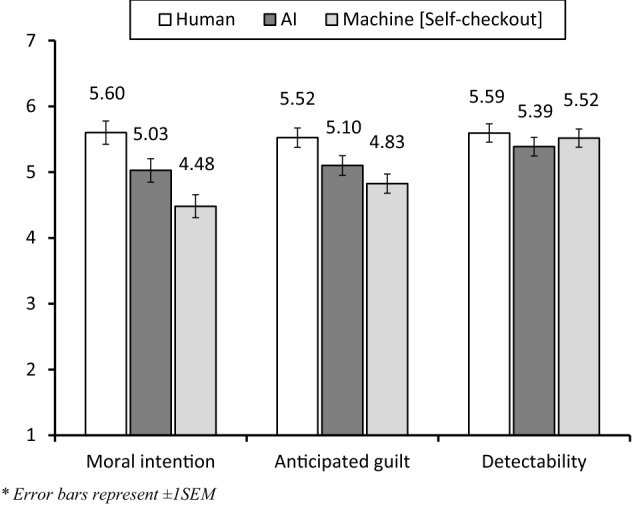
Several technological developments, such as self-service technologies and artificial intelligence (AI), are disrupting the retailing industry by changing consumption and purchase habits and the overall retail experience. Although AI represents extraordinary opportunities for businesses, companies must avoid the dangers and risks associated with the adoption of such systems. Integrating perspectives from emerging research on AI, morality of machines, and norm activation, we examine how individuals morally behave toward AI agents and self-service machines. Across three studies, we demonstrate that consumers’ moral concerns and behaviors differ when interacting with technologies versus humans. We show that moral intention (intention to report an error) is less likely to emerge for AI checkout and self-checkout machines compared with human checkout. In addition, moral intention decreases as people consider the machine less humanlike. We further document that the decline in morality is caused by less guilt displayed toward new technologies. The non-human nature of the interaction evokes a decreased feeling of guilt and ultimately reduces moral behavior. These findings offer insights into how technological developments influence consumer behaviors and provide guidance for businesses and retailers in understanding moral intentions related to the different types of interactions in a shopping environment.
Overview
The claims and statistics of this paper haven’t been checked yet.
Free: it reads the open-access text and checks the first 5 claims that cite a source we can check. Create a free account to check every claim.
Integrity signals
Registry
Cites
Statistics
Figures
Verification
Claims the paper makes
The claims and statistics of this paper haven’t been checked yet.
Free: it reads the open-access text and checks the first 5 claims that cite a source we can check. Create a free account to check every claim.
Claims other papers make about this one
Each is checked against this paper’s own text: does it say what the citing paper says it does?
The source backs part of the claim, not all of it — or backs it for a different population, condition or comparison.
In the citing paper
“Earlier research into anthropomorphism has already shown that beliefs of humanness elicit more positive emotions and lead users to experience feelings of moral responsibility, increasing their inclination to “do the right thing” toward the chatbot (101).”
From The benefits and dangers of anthropomorphic conversational agents (2025) · cites this paper as [101]
Experimental — accuracy not yet measured
Self-check
Percentages, sums and reported differences re-computed from the paper’s own numbers.
The self-check needs the paper’s full text.
Citations
Cites
(2013) · Cited by 44,563
Advances In Experimental Social Psychology
(2022) · Advances in Experimental Social Psychology · doi:10.1016/s0065-2601(22)x0002-6 · Cited by 22,259
Searle, J. R. (1980) · Behavioral and Brain Sciences · doi:10.1017/s0140525x00005756 · Cited by 6,954 · cited 1×
“Thus, existing literature suggests that the human mind is unique, and that machines and AI cannot hold all the human mental abilities (Searle, 1980).”
BackgroundNormative Influences on Altruism
Schwartz, S. H. (1977) · Advances in Experimental Social Psychology · doi:10.1016/s0065-2601(08)60358-5 · Cited by 5,364 · cited 1×
“This model states that anticipated guilt or pride will lead individuals to act in a way that is congruent with their personal norms and standards (Schwartz, 1977).”
Background(1997) · Choice Reviews Online · doi:10.5860/choice.34-3702 · Cited by 4,887
Artificial intelligence in service
Huang, M.-H., & Rust, R. T. (2018) · Journal of Service Research · doi:10.1177/1094670517752459 · Cited by 3,978 · cited 2×
“Individuals can also perceive more risk and experience discomfort when interacting with automated services and robots (Huang & Rust, 2018).”
BackgroundConverging measurement of horizontal and vertical individualism and collectivism.
Triandis, H. C., & Gelfand, M. J. (1998) · Journal of Personality and Social Psychology · doi:10.1037//0022-3514.74.1.118 · Cited by 3,656
The Uncanny Valley [From the Field]
Mori, M., MacDorman, K., & Kageki, N. (2012) · IEEE Robotics & Automation Magazine · doi:10.1109/mra.2012.2192811 · Cited by 3,542 · cited 2×
“Indeed, this relationship states that individuals can experience a feeling of unease or strangeness when robots/ machines appear too humanlike (Ho & MacDorman, 2017; Mori et al., 2012).”
BackgroundAlgorithm aversion: People erroneously avoid algorithms after seeing them err.
Dietvorst, B. J., Simmons, J. P., & Massey, C. (2015) · Journal of Experimental Psychology: General · doi:10.1037/xge0000033 · Cited by 3,232 · cited 2×
“…usage, researchers have documented a certain resistance to the adoption of AI not only due to regulation and privacy issues but also due to their inaccuracy to make inferences and predictions (Dietvorst et al., 2015; Longoni et al., 2019) and the inauthenticity of those predictions (Jago, 2019).”
BackgroundSherry, J. F., & Sternthal, B. (1992) · Cited by 2,917
Research works printed but not linked: 1
- Rosen C More retailers to tell customers ‘do it yourself’ Information Week 2001 826 29
Cited by
Items 101–200 of 250
Scenario-Based Approach to AI’s Agency to Perform Human-Specific Tasks
Pelău, C., Pop, Ș., & Ciofu, I. (2024) · Proceedings of the ... International Conference on Business Excellence · doi:10.2478/picbe-2024-0195 · Cited by 7
“According to research that has examined how consumers interact with humans and other technologies (such as machines, robots, and AI agents), it has been observed that they are more likely to act unethically toward technologies, (Giroux et al., 2022; Kim et al., 2023).”
Song, D., Deng, Z., & Evans, R. D. (2025) · Technological Forecasting and Social Change · doi:10.1016/j.techfore.2025.124482 · Cited by 6
Robots with hearts: How in-store AI’s task types impact brand attitude and ethicality
Bhoumik, K., Fang, L., & Igarashi, R. (2025) · Journal of Business Research · doi:10.1016/j.jbusres.2025.115923 · Cited by 8
“Few studies have directly examined how task type influences ethical evaluations of brands, particularly in human-AI collaboration scenarios (McLeay et al., 2021; Giroux et al., 2022).”
Comparing AI and human moral reasoning: context-sensitive patterns beyond utilitarian bias
Barabadi, E., Fotuhabadi, Z., Arghavan, A., & Booth, J. R. (2026) · Frontiers in Artificial Intelligence · doi:10.3389/frai.2025.1710410 · Cited by 6
When algorithms meet ethics: Mapping consumer moral responses to AI versus human marketing practices
tana, G., Chai, J., Chen, W., & Wauk, G. (2026) · Journal of Retailing and Consumer Services · doi:10.1016/j.jretconser.2026.104729 · Cited by 7
Financial perceptions and AI infringement risks
Wei, T., Wu, H., Dowling, M., & Ardekani, A. M. (2025) · International Review of Economics & Finance · doi:10.1016/j.iref.2025.104204 · Cited by 6
Identifying the Applications of Artificial Intelligence in Online Marketing
Abbasi, R., & Esmaili, M. (2024) · Advances in marketing, customer relationship management, and e-services book series · doi:10.4018/979-8-3693-1339-8.ch003 · Cited by 6
Recovery and Recidivism: The Aftermath of Helping the Organization Unethically
Yan, H., Okimoto, T. G., & Solnet, D. (2024) · Journal of Business and Psychology · doi:10.1007/s10869-024-09988-x · Cited by 5
Yin, Y., Shen, Z., Deng, B., & Xu, Q. (2025) · Journal of Business Ethics · doi:10.1007/s10551-025-06144-0 · Cited by 5
“Meanwhile, a growing body of research has drawn attention to the impact of robotic AI, particularly humanoid robots (i.e., robots possessing an anthropomorphic appearance), on human moral behaviors (Giroux et al., 2022).”
Sun, J., Ma, B., & Li, X. (2025) · Journal of Hospitality Marketing & Management · doi:10.1080/19368623.2025.2569062 · Cited by 5
“By contrast, although service robots have become more empathetic and proactive (Giroux et al., 2022; Pitardi et al., 2022), their limited social presence and emotional expressiveness (Lee & Yi, 2024; Yoganathan et al., 2021) can reduce perceived service authenticity.”
Voiseux, G., Zhou, R. T., & Huang, H. (2025) · Behavioral Science & Policy · doi:10.1177/23794607251384574 · Cited by 5
“31–33 The use of AI algorithms in managerial decision-making has also been linked to reductions in employees’ desire to help others.”
Fan, H., Wang, W., & Meng, L. (. (2025) · Tourism Management · doi:10.1016/j.tourman.2025.105333 · Cited by 5
Li, J., Han, M., & Yuan, Q. (2026) · Journal of Hospitality Marketing & Management · doi:10.1080/19368623.2026.2623405 · Cited by 5
“Furthermore, in emergency service recovery scenarios, feelings of anxiety, disappointment, or frustration further enhance consumers’ willingness to manipulate information to influence outcomes or secure greater benefits (Giroux et al., 2022).”
Probst, T. M., Shoss, M. K., Bankins, S., Behrend, T. S., Dragano, N., Jetha, A., Koopman, J., Selenko, E., Tang, P. M., Tay, L., et al. (2026) · Occupational Health Science · doi:10.1007/s41542-026-00262-5 · Cited by 5
“…interacting with AI agents, rather than humans, report weaker moral intentions, greater willingness to behave unethically, and reduced feelings of guilt (Giroux et al., 2022 ), and individuals acting through AI assistants show increased willingness to deceive others (Gratch & Fast, 2022 ).”
From experience to expectation: The reverse effect of power on purchasing impulsiveness
Wang, Y., Yao, T., & Qiu, Q. (2023) · Frontiers in Psychology · doi:10.3389/fpsyg.2023.1094536 · Cited by 5
“Guilt is a self-conscious emotion with negative valence, which can influence consumers’ self-control (Giroux et al., 2022).”
BackgroundNo Hard Feelings: The Protective Power of AI Empathy During Service Interaction FailuresPreprint
Efthymiou, F., Mari, A., Uysal, E., & Brooks, J. (2025) · SSRN Electronic Journal · doi:10.2139/ssrn.5367747 · Cited by 5
Boni, E. K. (2024) · Brunel University Research Archive (BURA) (Brunel University London) · Cited by 5
Fan, H., Han, B., & Ye, Q. (2025) · Journal of Business Ethics · doi:10.1007/s10551-025-06110-w · Cited by 5
Lin, H., Zhang, Q., Tian, J., Li, J., & Liu, N. (2025) · Asia Pacific Journal of Marketing and Logistics · doi:10.1108/apjml-02-2025-0207 · Cited by 4
Customer misbehavior in AI-enabled services
Zhao, X., Tan, H., Zhang, Y., Mattila, A. S., & Hua, N. (2025) · International Journal of Contemporary Hospitality Management · doi:10.1108/ijchm-04-2025-0520 · Cited by 4
Chatbot or cheatbot? Moral judgments of AI usage in academic writing
Xu, Y., Guo, J., Zhou, D., & Li, M. (2026) · Education and Information Technologies · doi:10.1007/s10639-026-13947-9 · Cited by 4
“…scholarship suggests individuals are more cognitively oriented when evaluating algorithmic decisions because they attribute less emotional and intentional agency to artificial actors, inherently reducing emotional moral judgments such as guilt or blame (Giroux et al., 2022; Moser et al., 2022).”
Wang, J., Lian, X., Yiling, W. A. N. G., & Mou, J. (2025) · International Journal of Human-Computer Interaction · doi:10.1080/10447318.2025.2545453 · Cited by 4
“…service robots are increasingly utilized across diverse sectors, including hotels, supermarkets and hospitals, where they are progressively replacing traditional human roles and becoming integral to service provision (Choi et al., 2021; Giroux et al., 2022; Kim & Han, 2020; Xiao & Kumar, 2021).”
Torturing the algorithm: Everyday sadism predicts acceptance of anthropomorphic AI
Li, H., & Cao, Y. (2025) · Personality and Individual Differences · doi:10.1016/j.paid.2025.113448 · Cited by 4
Effects of morality and reputation on sharing behaviors in human-robot teams
Chen, N., Hu, X., & Zhai, Y. (2023) · Frontiers in Psychology · doi:10.3389/fpsyg.2023.1280127 · Cited by 4
Khalil, H., Al-Azzawi, N., & Khatiry, A. R. (2024) · Studies in systems, decision and control · doi:10.1007/978-3-031-71526-6_6 · Cited by 4
Machine and human agents in moral dilemmas: automation–autonomic and EEG effect
Cassioli, F., Angioletti, L., & Balconi, M. (2023) · AI & Society · doi:10.1007/s00146-023-01772-4 · Cited by 4
“Conversely, perceiving an agent as more human makes a stronger projection of guilt connected to a violation of moral norms (Giroux et al. 2022).”
Consumer Behavior in Staffless Stores: A Systematic Literature Review
Staab, M., Zimmermann, R., Brandtner, P., & Schauer, O. (2023) · Lecture notes in computer science · doi:10.1007/978-3-031-48060-7_40 · Cited by 4
AI-powered Self-service Technologies
Barone, A. M., & Stagno, E. (2023) · Springer eBooks · doi:10.1007/978-3-031-48792-7_2 · Cited by 4
Importance of Human Judgment in Artificial Intelligence: A Panoramic Overview
Bahadure, N. B., Khomane, R. B., Shafaq, Pathan, S., Sharma, A., & Satokar, P. (2025) · Advances in Science, Technology & Innovation/Advances in science, technology & innovation · doi:10.1007/978-3-031-72747-4_34 · Cited by 3
How do AI agents influence customers’ moral choices? A social identity perspective
Wang, Y., Miao, H., Wang, Y., & Zhou, J. W. (2026) · International Journal of Contemporary Hospitality Management · doi:10.1108/ijchm-08-2025-1256 · Cited by 3
Yu, X., He, L., Qin, J., & Liu, T. (2026) · International Journal of Industrial Ergonomics · doi:10.1016/j.ergon.2026.103942 · Cited by 3
Korosec-Serfaty, M., Negoita, B., Sénécal, S., & Léger, P. (2026) · Information Systems Frontiers · doi:10.1007/s10796-026-10707-5 · Cited by 3
Lu, Y., & Li, G. (2026) · Journal of theoretical and applied electronic commerce research · doi:10.3390/jtaer21060195 · Cited by 3
“Interactions with AI evoke lower levels of negative emotions, such as guilt [74], embarrassment [75], or anger [34], in consumers, which also limits AI’s application in service recovery scenarios [76].”
Shu, L., Kui, W. A. N. G., Yueyan, W. U., & Chen, S. (2024) · Advances in Psychological Science · doi:10.3724/sp.j.1042.2024.00451 · Cited by 3
Seamless Payment Through Artificial Intelligence in Food Retail: Factors Influencing Purchase Intent
Jordan, S., Netscher, M., Leinweber, J., Kaplan, C., & Kracklauer, A. H. (2023) · Lecture notes in business information processing · doi:10.1007/978-3-031-42788-6_10 · Cited by 3
Do consumers trust it? : Exploring consumers trust in artificial intelligence personalization
Viberg, E., & Halldén, L. (2023) · DiVA (Linnaeus University) · Cited by 3
Cao, C., Hu, Y., & Zhang, Q. (2025) · International Journal of Human-Computer Interaction · doi:10.1080/10447318.2025.2524498 · Cited by 2
“Anticipatory guilt focuses on the anticipation of potential negative effects of future behavior, which may prompt individuals to adjust their behaviors to avoid feeling guilty (Giroux et al., 2022).”
InfluentialWaseem, M., & Shehryar, M. (2025) · Business review of digital revolution. · doi:10.70890/brdr.2025.5103 · Cited by 2
Hwang, K., Lee, E., & Yoon, Y. (2025) · Journal of Consumer Behaviour · doi:10.1002/cb.70048 · Cited by 2
Zhu, Y., Liang, J., & Zhang, J. (2025) · Journal of Research in Interactive Marketing · doi:10.1108/jrim-06-2024-0314 · Cited by 2
Shang, Q., Zhou, Y., & Fu, H. (2026) · Service Industries Journal · doi:10.1080/02642069.2026.2612705 · Cited by 2
“These studies have mainly discussed the different impacts of human versus robot service on UCB, revealing that robot service tends to provoke UCB compared to human service (Giroux et al., 2022; T. Kim et al., 2023; Y. Liu et al., 2023).”
InfluentialOffended by the algorithm: The hidden interpersonal costs of clients seeking AI second opinion
Spassova, G., & Palmeira, M. M. (2026) · Computers in Human Behavior · doi:10.1016/j.chb.2026.108934 · Cited by 2
Esteban, L. T. P. (2026) · Aula Virtual. · doi:10.5281/zenodo.19334269 · Cited by 2
Hoang, T. G., Quang, H. T., Luc, N. H., Binh, A. D. T., & Akbari, M. (2026) · Behaviour and Information Technology · doi:10.1080/0144929x.2026.2651110 · Cited by 2
14Advances in E‐commerce Through the Integration of Distributed Computing Approaches
Podile, V., Kumar, K. S., Cavaliere, L. P. L., Annapureddy, S. R. R., Praneeth, K. V. S., Sabareesh, K. P. S., & Rao, D. B. S. (2024) · Wiley eBooks · doi:10.1002/9781394188093.ch14 · Cited by 2
Not my responsibility: The framing of autonomous systems impacts sustainable choices
Puntiroli, M., Pino, G., Bezençon, V., & Lemarié, L. (2025) · Computers in Human Behavior · doi:10.1016/j.chb.2025.108685 · Cited by 3
Kim, J. Y., & Botto, E. (2023) · Nature Biotechnology · doi:10.1038/s41587-023-01817-5 · Cited by 2
Self-citationEthical Issues of the Use of Artificial Intelligence in Purchasing Negotiations
Voeth, M., Oryl, M., & Weinmann, N. (2023) · Forum Dienstleistungsmanagement · doi:10.1007/978-3-658-41815-1_24 · Cited by 1
Magd, H. A. E., & Khan, S. A. (2023) · International Conference on Computer Theory and Applications (ICCTA) · doi:10.1109/iccta60978.2023.10969368 · Cited by 1
Demystifying the mist: Why do individuals hesitate to accept AI educational services?
Shao, A., Lü, Z., Liu, S. Q., Shi, Y., & Lu, W. (2025) · British Journal of Psychology · doi:10.1111/bjop.70040 · Cited by 1
“Another potential factor may be the negative emotions triggered by social norms (e.g., Giroux et al., 2022).”
Consumer Behavior in the Digital Era: A Meta Review
Jaishi, R. G., & Gyanwali, S. (2025) · The Lumbini Journal of Business and Economics · doi:10.3126/ljbe.v13i2.82069 · Cited by 2
IDIMT-2025 : ICT in Business : AI Everywhere? Glory and Disgrace of AI
unknown (2025) · University Library Linz repository (Johannes Kepler Universitat Linz) · doi:10.35011/idimt-2025 · Cited by 1
Purohit, S., Saha, R., & Akram, U. (2026) · Journal of Consumer Behaviour · doi:10.1002/cb.70091 · Cited by 2
Can Artificial Intelligence Destroy Future Industry?
Terziyan, V. Y., Gryshko, S., Kaikova, O., & Golovianko, M. (2026) · Procedia Computer Science · doi:10.1016/j.procs.2026.02.338 · Cited by 1
Li, J., Qin, Q., & Cheng, B. (2026) · Journal of Business Research · doi:10.1016/j.jbusres.2026.116159 · Cited by 1
Ma, C., Chong, A. Y. L., Thatcher, J. B., & Phang, C. W. (2026) · Information Systems Journal · doi:10.1111/isj.70042 · Cited by 3
Liang, J., Zhu, Y., & Wu, J. (2026) · Journal of Business Research · doi:10.1016/j.jbusres.2026.116271 · Cited by 1
Moriuchi, E., Hollebeek, L. D., Clark, M. K., & Wright, M. (2026) · Journal of Retailing and Consumer Services · doi:10.1016/j.jretconser.2026.104886 · Cited by 1
How human-AI collaboration affects corporate green technology innovation
Yao, W., Wu, J., Ma, Q., & Yang, W. (2026) · Economic Analysis and Policy · doi:10.1016/j.eap.2026.07.003 · Cited by 1
Torres, A. I., & Filipe, S. (2026) · Contributions to management science · doi:10.1007/978-3-032-22360-9_2 · Cited by 1
Seeing humans in technology: The antecedents, boundaries and consequences of AI anthropomorphism
Kim, S., & Liu, J. (2026) · Current Opinion in Psychology · doi:10.1016/j.copsyc.2026.102397 · Cited by 1
AI applications in physical retail: technologies, consumer interaction, and operational impact
Schierbaum, C. (2026) · The International Review of Retail Distribution and Consumer Research · doi:10.1080/09593969.2026.2726782 · Cited by 1
Ingriana, A. (2023) · AIRA (Artificial Intelligence Research and Applied Learning) · Cited by 1
Leveraging AI Technologies in Retail in a Resilient Economy: Theory and Innovative Practices
Natorina, A. (2024) · Journal of Management and Training for Industries · doi:10.12792/jmti.11.1.12 · Cited by 1
On the Economics of Moral Behavior
de Moraes, M. L., Domingues, R., Fantini, G., & Biondi, L. (2024) · Integrated science · doi:10.1007/978-3-031-75996-3_6 · Cited by 1
Khan, S. (2024) · Library Progress (International) · Cited by 1
Dina, S., & Sabililhaq, I. (2024) · Proceeding International Conference on Religion Science and Education · Cited by 1
Martuza, J., Sjåstad, H., & Thorbjørnsen, H. (2023) · PsyArXiv (OSF Preprints) · doi:10.31234/osf.io/aujfy · Cited by 1
Bylykbashi, A., & Gavranović, L. (2024) · Jönköping University Publications (Jönköping University) · Cited by 1
Understanding and Managing Human-AI Interaction : Ethical Considerations
Hammerschmidt, T. (2024) · doi:10.20378/irb-109667 · Cited by 1
Do Consumers Accept AIs as Moral Compliance Agents?Preprint
Nyilasy, G., Hito, A. R. A. P., Overbeck, J. R., Bastian, B. B., & Dahl, D. W. (2026) · arXiv (Cornell University) · doi:10.48550/arxiv.2603.22617 · Cited by 1
(2023) · Advances in educational marketing, administration, and leadership book series · doi:10.4018/978-1-6684-6528-8.ch007
Incorporating Ethics in Delegation To and From Artificial Intelligence-Enabled Information Systems
Saeed, K. (2023) · University of North Texas Digital Library (University of North Texas) · doi:10.12794/metadc2179298
Research in social psychology, prevention activities and mental health promotion
(2024) · Frontiers research topics · doi:10.3389/978-2-8325-4552-2
Morality Retail: The Case of Dutch Store, Crafted Stories, and Its Common Good Strategy
Glover, C. (2024) · Springer eBooks · doi:10.1007/978-3-031-50252-1_7
“Thus spoke Socrates”: enhancing ethical inquiry, decision, and reflection through generative AI
Li, Y. (2025) · AI and Ethics · doi:10.1007/s43681-025-00694-9
“Although recent literature has extensively explored the ethics of emerging technology such as artificial intelli - gence [15, 20, 21, 37–39], there is still limited attention on employing AI to enhance individuals’ ethical activities.”
Gilormini, P., & Hachana, R. (2025) · RIMHE Revue Interdisciplinaire Management Homme(s) & Entreprise · doi:10.3917/rimhe.057.0079
Artificial Intelligence Marketing (AIM): Digital Transformation and Consumer Behaviour
Songur, A. (2025) · Özgür Yayınları eBooks · doi:10.58830/ozgur.pub710.c3032
Delegating moral dilemmas in autonomous vehicles evidence from an online experiment in China
Gao, Y., Blayac, T., & Willinger, M. (2025) · Transport Policy · doi:10.1016/j.tranpol.2025.04.017
Martuza, J., Sjåstad, H., & Thorbjørnsen, H. (2025) · PsyArXiv (OSF Preprints) · doi:10.31234/osf.io/aujfy_v2
Martuza, J., Sjåstad, H., & Thorbjørnsen, H. (2023) · PsyArXiv (OSF Preprints) · doi:10.31234/osf.io/aujfy_v1
Martuza, J., Sjåstad, H., & Thorbjørnsen, H. (2025) · PsyArXiv (OSF Preprints) · doi:10.31234/osf.io/aujfy_v4
Martuza, J., Sjåstad, H., & Thorbjørnsen, H. (2025) · PsyArXiv (OSF Preprints) · doi:10.31234/osf.io/aujfy_v5
Martuza, J., Sjåstad, H., & Thorbjørnsen, H. (2025) · PsyArXiv (OSF Preprints) · doi:10.31234/osf.io/aujfy_v6
Mansouri, S., Kaswengi, J., RODRIGUEZ, V., & Liba, B. B. B. (2025) · SSRN Electronic Journal · doi:10.2139/ssrn.5409088
When Algorithms Whisper: Do Accountants Listen to Unethical AI Suggestions?Preprint
Liu, Y., Yuan, Y., Li, Y., Chen, Y., Qi, Z., & Xie, H. (2025) · SSRN Electronic Journal · doi:10.2139/ssrn.5461334
Credibility Assessment of Human–Generative AI Interaction
Zhao, Y., Song, S., & Jing, Y. (2025) · Cambridge University Press eBooks · doi:10.1017/9781009587877.005
Awad, B. K. (2025) · Lecture notes in networks and systems · doi:10.1007/978-981-96-5013-2_19
Human: The Final Decision-Maker in the Technological Era
Fung, K. C., Cheung, K. Y., & Lai, C. Y. (2025) · Signals and communication technology · doi:10.1007/978-3-031-96855-6_9
Zhang, Z., Su, X. X., Wang, X., & Deng, Z. (2025) · 中国科学基金 · doi:10.3724/bnsfc-2025.06.20.0002
(2024) · UpSpace Institutional Repository (University of Pretoria)
Tehisaru rakendamise võimalused ja probleemid Eesti reklaamiagentuuride teenuste arendamise näitel
Paas, J. (2024) · DSpace repository (University of Tartu)
How Leaders’ Morality Influences Their Responsibility Perceptions When Relying on Algorithmic Advice
Passlack, N., Hammerschmidt, T., & Posegga, O. (2025) · Journal of the Association for Information Systems
Understanding the impact of technology interaction on dysfunctional consumer behavior
Rohden, S. F., & Espartel, L. B. (2025) · Portuguese National Funding Agency for Science, Research and Technology (RCAAP Project by FCT)
YAPAY ZEKA PAZARLAMASINDA TRENDLER: BİBLİYOMETRİK BİR ANALİZ
Efendioğlu, İ. H. (2023) · Uluslararası İktisadi ve İdari Akademik Araştırmalar Dergisi
The Confluence of AI and Retail: A Case Study of Continuous Transformation
Alenazi, M., & Tang, Y. (2024) · International Journal of Intelligent Systems and Applications in Engineering
Models of morality value integration and inference
Surdina, A. (2026) · Warwick Research Archive Portal (University of Warwick) · doi:10.82444/warw.33884914
Nieminen, M. (2025) · Osuva (University of Vaasa)
Exploring the Metaverse: How Digital Twin Avatars Fuel Competitive Edge and Drive Employee Growth
Vijayalakshmi, M., Subramani, A. K., & Pandian, R. D. (2025) · Emerald Group Publishing Limited eBooks · doi:10.1108/978-1-83708-250-620251010
Boundary conditions between humans and AI: insights from Paul Virilio's philosophy
Hachana, R., & Gilormini, P. (2026) · Journal of Managerial Psychology · doi:10.1108/jmp-07-2024-0511
Metadata
- Authors
- Giroux, M., Kim, J., Lee, J. C., & Park, J.
- Affiliations
- Auckland University of Technology (NZ)
- Dongguk University (KR)
- Korea University (KR)
- Corresponding author
- Kim, Jungkeun
- Lee, Jacob C.
- Venue
- Journal of Business Ethics
- Published
- 2022-02-12
- Volume
- 178
- Issue
- 4
- Pages
- 1027-1041
- ISSN
- 0167-4544 (ISSN-L)
- 1573-0697
- PMC
- PMC8853322
- OpenAlex
- W4211089551
- Cited by
- 194
- References
- 102
- Citations by year
- 2026: 48 · 2025: 76 · 2024: 34 · 2023: 30 · 2022: 6
- FWCI
- 12.01
- Type
- journal article
- Language
- en
- Open access
- hybrid
- doi.org
- Licence
- cc-by
- creativecommons.org/licenses/by/4.0 (tdm)
- creativecommons.org/licenses/by/4.0 (vor)
- Locations
- Journal of Business Ethics (publishedVersion, cc-by)
- PubMed Central (publishedVersion, cc-by)
- PubMed (publishedVersion)
- RePEc: Research Papers in Economics (submittedVersion)
- Funders
- Auckland University of Technology
- Topics
- Social Sciences › Business, Management and Accounting › Marketing › AI in Service Interactions
- Social Sciences › Business, Management and Accounting › Organizational Behavior and Human Resource Management › Ethics in Business and Education
- Life Sciences › Neuroscience › Cognitive Neuroscience › Psychology of Moral and Emotional Judgment
- Keywords
- artificial intelligence, self-checkout, moral intention, guilt, norm activation, consumer behavior, retail trade, error reporting
About these checks
Registry, retraction, Cites and statistics results are computed, not judged, with one exception: a printed reference that no index lists is read once by a model before it counts as a citation error. Claims are extracted by a model and kept only when their quote appears verbatim in the text; each cited source is then checked, with a model’s help, for whether it says what the claim relies on. Those verdicts can be wrong — read the claim’s quote and the cited source before relying on one.
Statistics and arithmetic are recomputed, not judged.
Confidence bands are shown only for fields calibrated on our annotated test set. None is calibrated yet, so no band is shown.
What counts as a claim ›How we measure confidence ›How we check this ›
Are you an author, or do you see a problem with this page? Request a review
Data sources
Bibliographic data: Semantic Scholar, OpenAlex, Crossref.
Contains information from the Semantic Scholar Academic Graph Datasets, made available under the ODC Attribution License (ODC-BY 1.0).
Semantic Scholar’s data is described in: Kinney, R., et al. (2023). The Semantic Scholar Open Data Platform. arXiv:2301.10140.
