

Phase 1 study of the MDM2 inhibitor AMG 232 in patients with advanced P53 wild-type solid tumors or multiple myeloma
Open accessThe DOI matches its Crossref record; 37 of the 37 references it cites were found in a registry or an index.
Abstract
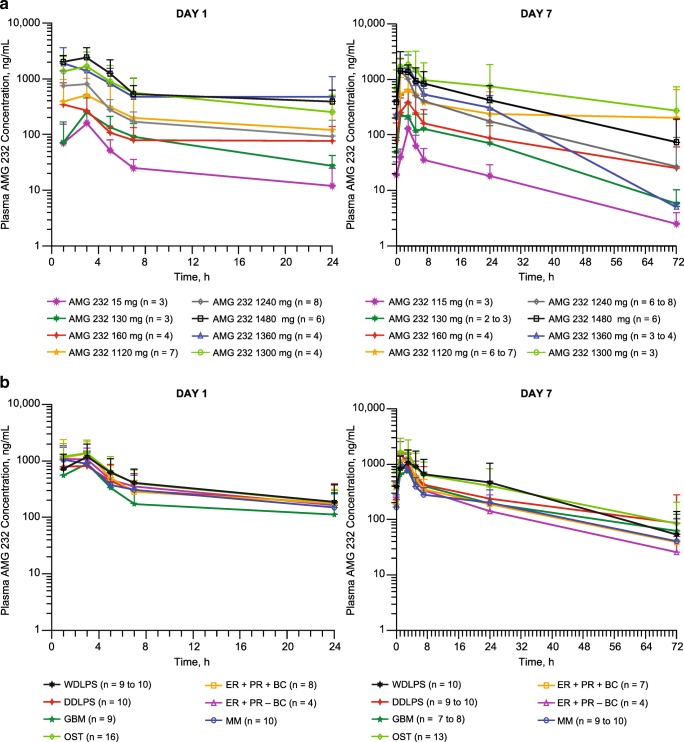
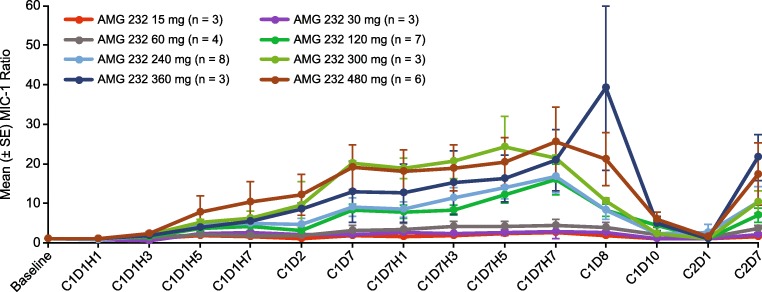
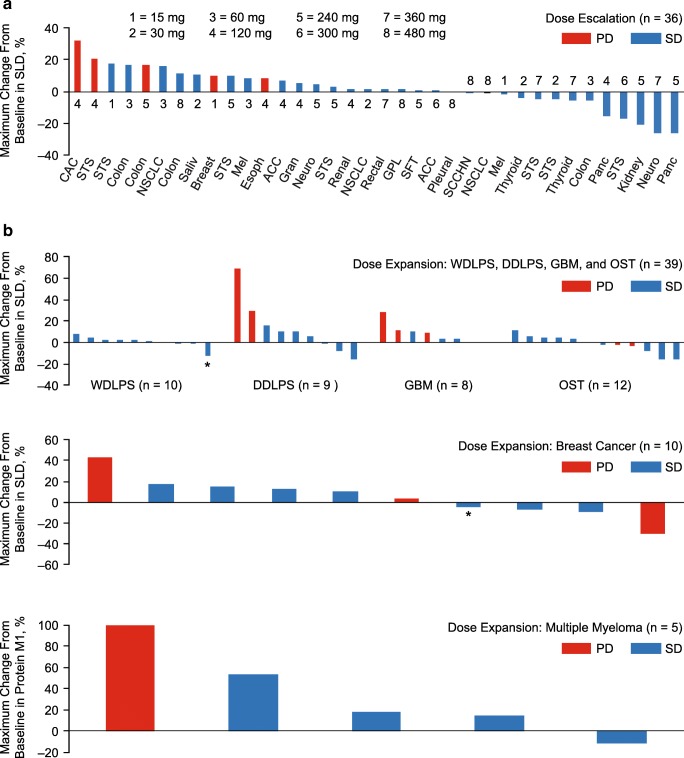
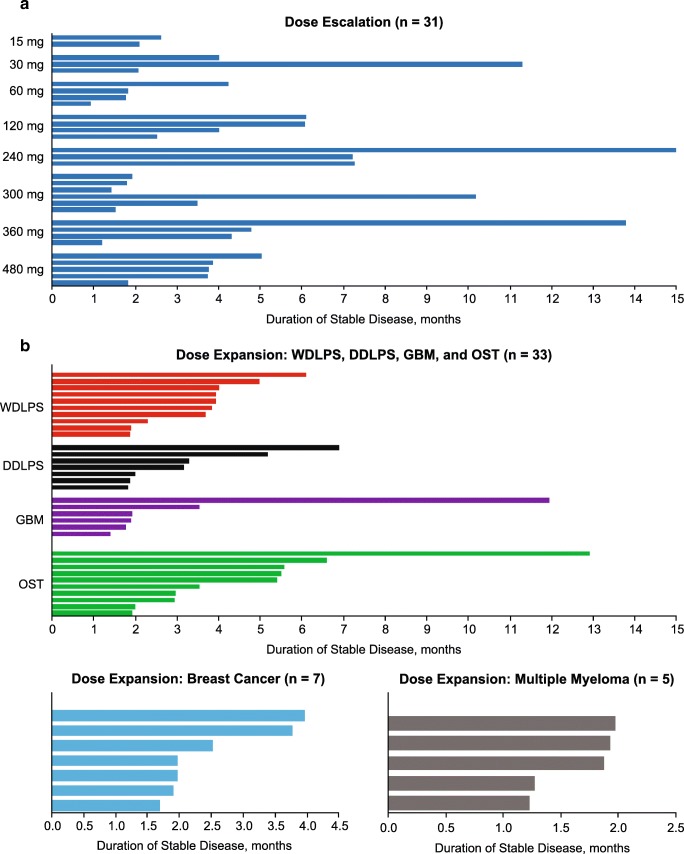
Summary: Background This open-label, first-in-human, phase 1 study evaluated AMG 232, an oral selective MDM2 inhibitor in patients with TP53 wild-type (P53WT), advanced solid tumors or multiple myeloma (MM). Methods In the dose escalation ( n = 39), patients with P53WT refractory solid tumors enrolled to receive once-daily AMG 232 (15, 30, 60, 120, 240, 480, and 960 mg) for seven days every 3 weeks (Q3W). In the dose expansion ( n = 68), patients with MDM2 -amplified (well-differentiated and de-differentiated liposarcomas [WDLPS and DDLPS], glioblastoma multiforme [GBM], or other solid tumors [OST]), MDM2-overexpressing ER+ breast cancer (BC), or MM received AMG 232 at the maximum tolerated dose (MTD). Safety, pharmacokinetics, pharmacodynamics, and efficacy were assessed. Results AMG 232 had acceptable safety up to up to 240 mg. Three patients had dose-limiting toxicities of thrombocytopenia ( n = 2) and neutropenia ( n = 1). Due to these and other delayed cytopenias, AMG 232 240 mg Q3W was determined as the highest tolerable dose assessed in the dose expansion. Adverse events were typically mild/moderate and included diarrhea, nausea, vomiting, fatigue, decreased appetite, and anemia. AMG 232 plasma concentrations increased dose proportionally. Increases in serum macrophage inhibitor cytokine-1 from baseline were generally dose dependent, indicating p53 pathway activation. Per local review, there were no responses. Stable disease (durability in months) was observed in patients with WDLPS (3.9), OST (3.3), DDLPS (2.0), GBM (1.8), and BC (1.4–2.0). Conclusions In patients with P53WT advanced solid tumors or MM, AMG 232 showed acceptable safety and dose-proportional pharmacokinetics, and stable disease was observed.
Overview
The claims and statistics of this paper haven’t been checked yet.
Free: it reads the open-access text and checks the first 5 claims that cite a source we can check. Create a free account to check every claim.
Integrity signals
Registry
Cites
Statistics
Figures
Verification
Claims the paper makes
The claims and statistics of this paper haven’t been checked yet.
Free: it reads the open-access text and checks the first 5 claims that cite a source we can check. Create a free account to check every claim.
Claims other papers make about this one
Each is checked against this paper’s own text: does it say what the citing paper says it does?
The source backs part of the claim, not all of it — or backs it for a different population, condition or comparison.
In the citing paper
“Most notably, the half-life of navtemadlin in mice was measured as 1.68 hours but is much longer in humans at 14.3 hours (12).”
From Preclinical Modeling of Navtemadlin Pharmacokinetics, Pharmacodynamics, and Efficacy in IDH–Wild-type Glioblastoma (2025) · cites this paper as [12]
Experimental — accuracy not yet measuredThe source backs part of the claim, not all of it — or backs it for a different population, condition or comparison.
In the citing paper
“The first-in-human phase I trial of navtemadlin (NCT01723020) defined a recommended phase II dose of 240 mg daily (12).”
From Preclinical Modeling of Navtemadlin Pharmacokinetics, Pharmacodynamics, and Efficacy in IDH–Wild-type Glioblastoma (2025) · cites this paper as [12]
Experimental — accuracy not yet measuredThe check wasn’t confident either way, so it gives no verdict — never disputed.
In the citing paper
“Navtemadlin is a potent small-molecule inhibitor of MDM2”
From Preclinical Modeling of Navtemadlin Pharmacokinetics, Pharmacodynamics, and Efficacy in IDH–Wild-type Glioblastoma (2025) · cites this paper as [12]
Experimental — accuracy not yet measuredThe check wasn’t confident either way, so it gives no verdict — never disputed.
In the citing paper
“Navtemadlin (KRT-232) is a potent small-molecule MDM2 inhibitor, which has completed first-in-human studies (12)”
From Preclinical Modeling of Navtemadlin Pharmacokinetics, Pharmacodynamics, and Efficacy in IDH–Wild-type Glioblastoma (2025) · cites this paper as [12]
Experimental — accuracy not yet measuredIn the citing paper
“In a phase I trial, AMG232 showed good safety and pharmacokinetic parameters in patients with p53 WT advanced solid tumor or multiple myeloma and could control the progression of the disease [64].”
From Targeting p53–MDM2 interaction by small-molecule inhibitors: learning from MDM2 inhibitors in clinical trials (2022) · cites this paper as [64]
Self-check
Percentages, sums and reported differences re-computed from the paper’s own numbers.
The self-check needs the paper’s full text.
Citations
Cites
New response evaluation criteria in solid tumours: revised RECIST guideline (version 1.1)
Eisenhauer, E. A., Therasse, P., Bogaerts, J., Schwartz, L. H., Sargent, D., Ford, R., Dancey, J., Arbuck, S., Gwyther, S., Mooney, M., et al. (2009) · European Journal of Cancer · doi:10.1016/j.ejca.2008.10.026 · Cited by 29,534
p53, the cellular gatekeeper for growth and division
Levine, A. J. (1997) · Cell · doi:10.1016/s0092-8674(00)81871-1 · Cited by 7,693
International Myeloma Working Group updated criteria for the diagnosis of multiple myeloma
Rajkumar, S. V., Dimopoulos, M. A., Palumbo, A., Blade, J., Merlini, G., Mateos, M.-V., Kumar, S., Hillengass, J., Kastritis, E., Richardson, P., et al. (2014) · The Lancet Oncology · doi:10.1016/s1470-2045(14)70442-5 · Cited by 4,978
Response criteria for phase II studies of supratentorial malignant glioma.
Macdonald, D. R., Cascino, T. L., Schold, S. C., & Cairncross, J. G. (1990) · Journal of Clinical Oncology · doi:10.1200/jco.1990.8.7.1277 · Cited by 2,409
The first 30 years of p53: growing ever more complex.
Levine, A. J., & Oren, M. (2009) · Nature Reviews Cancer · doi:10.1038/nrc2723 · Cited by 1,967
Moll, U. M., & Petrenko, O. (2003) · PubMed · Cited by 1,140
Binh, M. B. N., Sastre-Garau, X., Guillou, L., Pinieux, G. D., Terrier, P., Lagacé, R., Aurias, A., Hostein, I., & Coindre, J. M. (2005) · American Journal of Surgical Pathology · doi:10.1097/01.pas.0000170343.09562.39 · Cited by 639
Ray-Coquard, I., Blay, J.-Y., Italiano, A., Le Cesne, A., Penel, N., Zhi, J., Heil, F., Rueger, R., Graves, B., Ding, M., et al. (2012) · The Lancet Oncology · doi:10.1016/s1470-2045(12)70474-6 · Cited by 571
Self-citationResults of the Phase I trial of RG7112, a small-molecule MDM2 antagonist in leukemia
Andreeff, M., Kelly, K. R., Yee, K., Assouline, S., Strair, R., Popplewell, L., Bowen, D., Martinelli, G., Drummond, M. W., Vyas, P., et al. (2016) · Clinical Cancer Research · doi:10.1158/1078-0432.ccr-15-0481 · Cited by 352
Sun, D., Li, Z., Rew, Y., Gribble, M., Bartberger, M. D., Beck, H. P., Canon, J., Chen, A., Chen, X., Chow, D., et al. (2014) · Journal of Medicinal Chemistry · doi:10.1021/jm401753e · Cited by 290
Tisato, V., Voltan, R., Gonelli, A., Secchiero, P., & Zauli, G. (2017) · Journal of Hematology & Oncology · doi:10.1186/s13045-017-0500-5 · Cited by 256
Well-differentiated and dedifferentiated liposarcomas
Coindre, J.-M., Pédeutour, F., & Aurias, A. (2010) · Virchows Archiv · doi:10.1007/s00428-009-0815-x · Cited by 252
Warso, M. A., Richards, J. M., Mehta, D., Christov, K., Schaeffer, C., Rae Bressler, L., Yamada, T., Majumdar, D., Kennedy, S. A., Beattie, C. W., et al. (2013) · British Journal of Cancer · doi:10.1038/bjc.2013.74 · Cited by 190
Canon, J., Osgood, T., Olson, S. H., Saiki, A. Y., Robertson, R., Yu, D., Eksterowicz, J., Ye, Q., Jin, L., Chen, A., et al. (2015) · Molecular Cancer Therapeutics · doi:10.1158/1535-7163.mct-14-0710 · Cited by 152
Lulla, R. R., Goldman, S., Yamada, T., Beattie, C. W., Bressler, L., Pacini, M., Pollack, I. F., Fisher, P. G., Packer, R. J., Dunkel, I. J., et al. (2016) · Neuro-Oncology · doi:10.1093/neuonc/now047 · Cited by 148
Regulation of p53: a collaboration between Mdm2 and MdmX
Pei, D., Zhang, Y., & Zheng, J. (2012) · Oncotarget · doi:10.18632/oncotarget.443 · Cited by 140
A survey of glioblastoma genomic amplifications and deletions
Rao, S. K., Edwards, J. B., Joshi, A. D., Siu, I., & Riggins, G. J. (2009) · Journal of Neuro-Oncology · doi:10.1007/s11060-009-9959-4 · Cited by 132
McCann, A., Kirley, A., Carney, D., Corbally, N., Magee, H., Keating, G., & Dervan, P. (1995) · British Journal of Cancer · doi:10.1038/bjc.1995.189 · Cited by 126
de Jonge, M., de Weger, V. A., Dickson, M. A., Langenberg, M., Le Cesne, A., Wagner, A. J., Hsu, K., Zheng, W., Macé, S., Tuffal, G., et al. (2017) · European Journal of Cancer · doi:10.1016/j.ejca.2017.02.005 · Cited by 124
Self-citationKonduri, S. D., Medisetty, R., Liu, W., Kaipparettu, B. A., Srivastava, P., Brauch, H., Fritz, P., Swetzig, W. M., Gardner, A. E., Khan, S. A., et al. (2010) · Proceedings of the National Academy of Sciences · doi:10.1073/pnas.1009575107 · Cited by 123
Phase I Trial of the Human Double Minute 2 Inhibitor MK-8242 in Patients With Advanced Solid Tumors
Wagner, A. J., Banerji, U., Mahipal, A., Somaiah, N., Hirsch, H., Fancourt, C., Johnson-Levonas, A. O., Lam, R., Meister, A. K., Russo, G., et al. (2017) · Journal of Clinical Oncology · doi:10.1200/jco.2016.70.7117 · Cited by 120
Self-citationSingle-nucleotide Polymorphisms in the p53 Signaling Pathway
Grochola, L. F., Zeron-Medina, J., Meriaux, S., & Bond, G. L. (2010) · Cold Spring Harbor Perspectives in Biology · doi:10.1101/cshperspect.a001032 · Cited by 103
Erba, H. P., Becker, P. S., Shami, P. J., Grunwald, M. R., Flesher, D. L., Zhu, M., Rasmussen, E., Henary, H. A., Anderson, A. A., & Wang, E. S. (2019) · Blood Advances · doi:10.1182/bloodadvances.2019030916 · Cited by 98
Self-citationTP53 mutations emerge with HDM2 inhibitor SAR405838 treatment in de-differentiated liposarcoma
Jung, J., Lee, J. S., Dickson, M. A., Schwartz, G. K., Le Cesne, A., Varga, A., Bahleda, R., Wagner, A. J., Choy, E., de Jonge, M. J., et al. (2016) · Nature Communications · doi:10.1038/ncomms12609 · Cited by 95
Self-citationTargeting apoptosis in acute myeloid leukaemia
Cassier, P. A., Castets, M., Belhabri, A., & Vey, N. (2017) · British Journal of Cancer · doi:10.1038/bjc.2017.281 · Cited by 85
Self-citationYee, K., Martinelli, G., Vey, N., Dickinson, M. J., Seiter, K., Assouline, S., Drummond, M., Yoon, S.-S., Kasner, M., Lee, J.-H., et al. (2014) · Blood · doi:10.1182/blood.v124.21.116.116 · Cited by 76
Over‐expression of the MDM2 gene is found in some cases of haematological malignancies
Quesnel, B., Preudhomme, C., Oscier, D., Lepelley, P., Hooghe, M. C., Facon, T., Zandecki, M., & Fenaux, P. (1994) · British Journal of Haematology · doi:10.1111/j.1365-2141.1994.tb05044.x · Cited by 64
Siu, L. L., Italiano, A., Miller, W. H., Blay, J.-Y., Gietema, J. A., Bang, Y.-J., Mileshkin, L. R., Hirte, H. W., Reckner, M., Higgins, B., et al. (2014) · Journal of Clinical Oncology · doi:10.1200/jco.2014.32.15_suppl.2535 · Cited by 60
Self-citationGene abnormalities in multiple myeloma; the relevance of TP53, MDM2, and CDKN2A.
Elnenaei, M. O., Gruszka, A., A'Hernt, R., Matutes, E., Sirohi, B., Powles, R., & Catovsky, D. (2003) · PubMed · Cited by 57
Ravandi, F., Gojo, I., Patnaik, M. M., Minden, M. D., Kantarjian, H., Johnson-Levonas, A. O., Fancourt, C., Lam, R., Jones, M. B., Knox, C. D., et al. (2016) · Leukemia Research · doi:10.1016/j.leukres.2016.07.004 · Cited by 57
Meta-Analysis of Hematological Biomarkers as Reliable Indicators of Soft Tissue Sarcoma Prognosis
Li, L., Bai, Z.-H., Zhang, L., Zhang, Y., Lu, X., Zhang, Y., Liu, Y.-K., Wen, J., & Li, J. (2020) · Frontiers in Oncology · doi:10.3389/fonc.2020.00030 · Cited by 57
McCubrey, J. A., Lertpiriyapong, K., Fitzgerald, T. L., Martelli, A. M., Cocco, L., Rakus, D., Gizak, A., Libra, M., Cervello, M., Montalto, G., et al. (2016) · Advances in Biological Regulation · doi:10.1016/j.jbior.2016.10.001 · Cited by 55
Subcellular localization of Mdm2 expression and prognosis of breast cancer
Park, H. S., Park, J. M., Park, S., Cho, J., Kim, S. I., & Park, B. (2013) · International Journal of Clinical Oncology · doi:10.1007/s10147-013-0639-1 · Cited by 36
A phase I study of MDM2 antagonist RG7112 in patients (pts) with relapsed/refractory solid tumors.
Kurzrock, R., Blay, J.-Y., Bui Nguyen, B., Wagner, A. J., Maki, R. G., Schwartz, G. K., Patnaik, A., Gore, L., Wu, L., Vassilev, L. T., et al. (2012) · Journal of Clinical Oncology · doi:10.1200/jco.2012.30.15_suppl.e13600 · Cited by 30
Self-citationChoschzick, M., Heilenkötter, U., Lebeau, A., Jaenicke, F., Terracciano, L., Bokemeyer, C., Sauter, G., & Simon, R. (2011) · Cancer Biomarkers · doi:10.3233/dma-2011-0806 · Cited by 24
Nemunaitis, J. J., Young, A., Ejadi, S., Miller, W. H., Chen, L.-C., NICHOLS, G. L., Blotner, S. D., Vazvaei, F., Zhi, J., & Razak, A. R. A. (2018) · Cancer Chemotherapy and Pharmacology · doi:10.1007/s00280-018-3521-z · Cited by 19
Yee, K. W. L., Uy, G. L., Assouline, S. E., Britten, C. D., Zhi, J., Blotner, S. D., Pierceall, W. E., Higgins, B., & Chen, L.-C. (2018) · Molecular Cancer Therapeutics · doi:10.1158/1535-7163.targ-17-a082 · Cited by 5
Cited by
Glioma targeted therapy: insight into future of molecular approaches
Yang, K., Wu, Z., Zhang, H., Zhang, N., Wu, W., Wang, Z., Dai, Z., Zhang, X., Zhang, L., Peng, Y., et al. (2022) · Molecular Cancer · doi:10.1186/s12943-022-01513-z · Cited by 704
“The MDM2 inhibitor AMG 232 suppressed tumor progression in the course of the trial (NCT01723020) [107].”
BackgroundMDM2 inhibition: an important step forward in cancer therapy
Konopleva, M., Martinelli, G., Daver, N., Papayannidis, C., Wei, A., Higgins, B., Ott, M., Mascarenhas, J., & Andreeff, M. (2020) · Leukemia · doi:10.1038/s41375-020-0949-z · Cited by 376
“The most common treatment-related AEs in the dose-escalation and dose-expansion phases included diarrhea, nausea, vomiting, fatigue, decreased appetite, neutropenia, and thrombocytopenia [45].”
BackgroundUbiquitination and deubiquitination in cancer: from mechanisms to novel therapeutic approaches
Liu, F., Chen, J., Li, K., Li, H., Zhu, Y., Zhai, Y., Lu, B., Fan, Y., Liu, Z., Chen, X., et al. (2024) · Molecular Cancer · doi:10.1186/s12943-024-02046-3 · Cited by 326
“AMG232 has also been studied in clinical trials [241].”
BackgroundRole of p53 in breast cancer progression: An insight into p53 targeted therapy
Marvalim, C., Datta, A., & Lee, S. C. (2023) · Theranostics · doi:10.7150/thno.81847 · Cited by 225
Zhu, H., Gao, H., Ji, Y., Zhou, Q., Du, Z., Tian, L., Jiang, Y., Yao, K., & Zhou, Z. (2022) · Journal of Hematology & Oncology · doi:10.1186/s13045-022-01314-3 · Cited by 223
“In a phase I trial, AMG232 showed good safety and pharmacokinetic parameters in patients with p53 WT advanced solid tumor or multiple myeloma and could control the progression of the disease [64].”
Background
Metadata
- Authors
- Gluck, W. L., Gounder, M. M., Frank, R., Eskens, F., Blay, J. Y., Cassier, P. A., Soria, J.-C., Chawla, S., de Weger, V., Wagner, A. J., Siegel, D., De Vos, F., Rasmussen, E., & Henary, H. A.
- Affiliations
- Prisma Health (US)
- Memorial Sloan Kettering Cancer Center (US)
- Norwalk Hospital (US)
- Erasmus MC Cancer Institute (NL)
- Centre Léon Bérard (FR)
- Université Paris-Sud (FR)
- Sarcoma Oncology Center (US)
- Harvard University (US)
- Hackensack University Medical Center (US)
- Amgen (United States) (US)
- Corresponding author
- Gluck, W. Larry
- ORCID
- Venue
- Investigational New Drugs
- Published
- 2019-07-29
- Volume
- 38
- Issue
- 3
- Pages
- 831-843
- ISSN
- 0167-6997 (ISSN-L)
- 1573-0646
- PMC
- PMC7211202
- OpenAlex
- W2965547724
- Cited by
- 127
- References
- 37
- Citations by year
- 2026: 9 · 2025: 22 · 2024: 26 · 2023: 20 · 2022: 19 · 2021: 25 · 2020: 3 · 2019: 2
- FWCI
- 5.11
- Type
- journal article
- Language
- en
- Open access
- hybrid
- doi.org
- Licence
- cc-by
- creativecommons.org/licenses/by/4.0 (tdm)
- creativecommons.org/licenses/by/4.0 (vor)
- Locations
- Investigational New Drugs (publishedVersion, cc-by)
- PubMed Central (publishedVersion, cc-by)
- PubMed (publishedVersion)
- EUR Research Repository (Erasmus University Rotterdam) (publishedVersion, other-oa)
- EUR Research Repository (Erasmus University Rotterdam) (submittedVersion, other-oa)
- RePub (Erasmus University Rotterdam) (submittedVersion, other-oa)
- Utrecht University Repository (Utrecht University) (submittedVersion, other-oa)
- Funders
- Amgen
- Topics
- Health Sciences › Medicine › Oncology › Cancer-related Molecular Pathways
- Life Sciences › Biochemistry, Genetics and Molecular Biology › Molecular Biology › PI3K/AKT/mTOR signaling in cancer
- Life Sciences › Biochemistry, Genetics and Molecular Biology › Cancer Research › Cancer Mechanisms and Therapy
- Keywords
- MDM2 inhibitors, wild-type p53, multiple myeloma, advanced solid tumors, liposarcoma, glioblastoma, estrogen receptor-positive breast cancer, MDM2 amplification, MDM2 overexpression, thrombocytopenia, neutropenia, dose-limiting toxicity, pharmacokinetics, pharmacodynamics, maximum tolerated dose
- MeSH terms
- Acetates, Adult, Aged, Aged, 80 and over, Dose-Response Relationship, Drug, Female, Humans, Male, Middle Aged, Multiple Myeloma, Piperidones, Tumor Suppressor Protein p53, Maximum Tolerated Dose, Proto-Oncogene Proteins c-mdm2
About these checks
Registry, retraction, Cites and statistics results are computed, not judged, with one exception: a printed reference that no index lists is read once by a model before it counts as a citation error. Claims are extracted by a model and kept only when their quote appears verbatim in the text; each cited source is then checked, with a model’s help, for whether it says what the claim relies on. Those verdicts can be wrong — read the claim’s quote and the cited source before relying on one.
Statistics and arithmetic are recomputed, not judged.
Confidence bands are shown only for fields calibrated on our annotated test set. None is calibrated yet, so no band is shown.
What counts as a claim ›How we measure confidence ›How we check this ›
Are you an author, or do you see a problem with this page? Request a review
Data sources
Bibliographic data: Semantic Scholar, OpenAlex, Crossref.
Contains information from the Semantic Scholar Academic Graph Datasets, made available under the ODC Attribution License (ODC-BY 1.0).
Semantic Scholar’s data is described in: Kinney, R., et al. (2023). The Semantic Scholar Open Data Platform. arXiv:2301.10140.
