

Key factors in digital literacy in learning and education: a systematic literature review using text mining
Open accessThe DOI matches its Crossref record; 97 of the 97 references it cites were found in a registry or an index; 13 of the 40 sources its claims cite were checked for support.
Abstract
This research aims at providing an overview of the research field of digital literacy into learning and education. Using text mining, it reviews 1037 research articles published on the topic between 2000 and 2020. This review reveals that there is a plurality of terms associated with digital literacy. Moreover, our research identifies six key factors that define the literature, which are information literacy, developing digital literacy, digital learning, ICT, social media, and twenty-first century digital skills. These factors can be grouped into three main streams, which are 1) digital literacy, 2) digital learning and 3) twenty-first century digital skills. These three streams are supported by informational and technological foundations. These results provide research avenues and offer a framework for digital literacy in education.
Overview
CoChat Summary
TL;DR
This systematic review uses text mining on 1,037 articles published between 2000 and 2020 to map digital literacy in learning and education. It finds fragmented terminology and six key factors grouped into three streams—digital literacy, digital learning, and twenty-first century digital skills—supported by informational and technological foundations.
Key findings
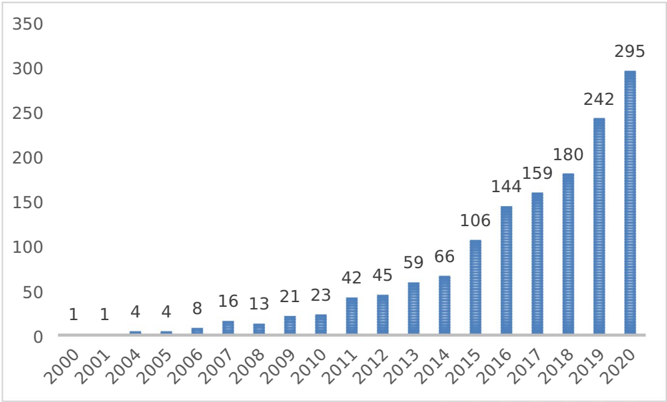
- The corpus contained 1,037 articles after duplicate removal; publication volume grew from 42 articles in 2011 to 242 in 2019 and almost 300 in 2020, with a threshold crossed in 2015 when yearly publications exceeded 100. Four journals published more than 20 papers, led by *Computers & Education* (41) and *International Journal of Digital Literacy and Digital Competence* (27).
- Terminology was plural: “digital literacy” occurred 1,734 times across 849 articles (59.41%), followed by “digital competence” (556 occurrences among 235 articles), “digital skills” (455 among 308), and “digital competencies” (255 among 148); the authors note these terms are often used interchangeably.
- Factor analysis identified six factors with eigenvalues higher than 1: information literacy (2.48), developing digital literacy (1.97), digital learning (1.63), ICT (1.49), social media (1.28), and twenty-first century digital skills (1.26). These group into three main streams—digital literacy, digital learning, and twenty-first century digital skills—supported by informational and technological foundations.
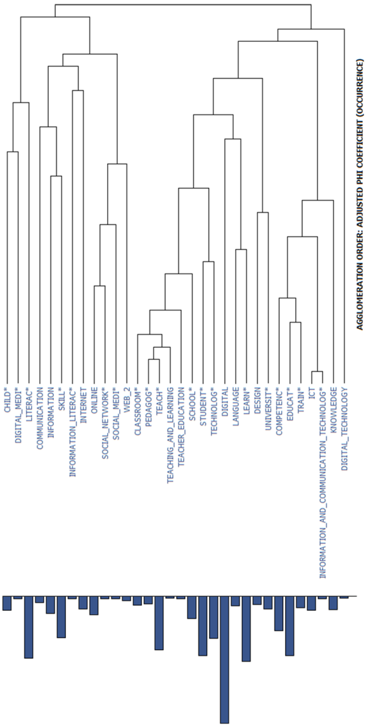
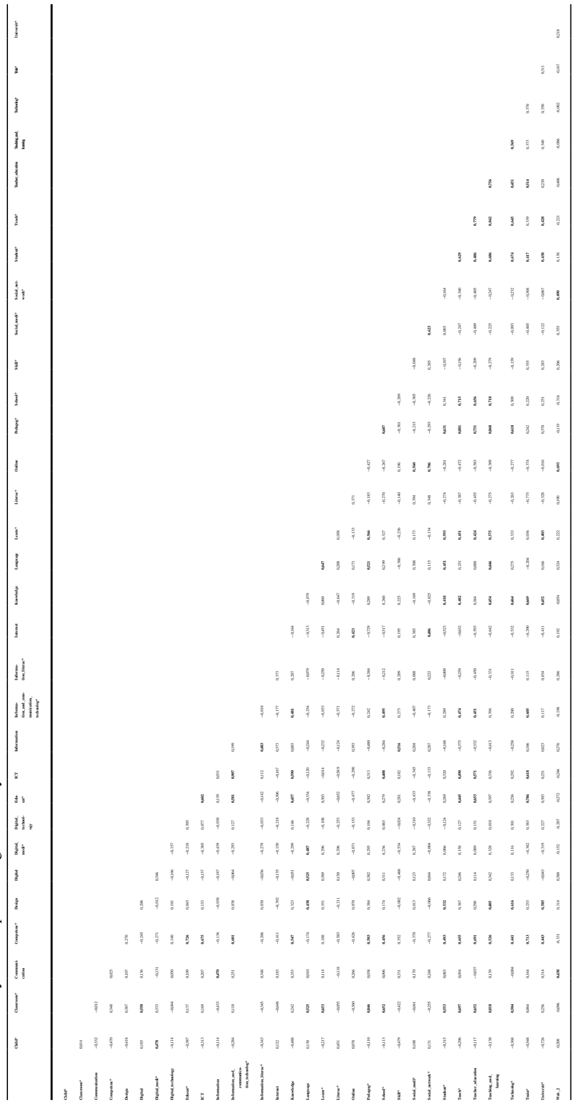
- Co-occurrence analysis separated classroom/learning terms from everyday-life/practice terms: “internet” was negatively associated with pedagogy (phi = -.729), teaching (-.652), teaching and learning (-.642), school (-.517), and student (-.523); classroom-related terms had associations higher than .5 with “classroom”; competence was strongly related to “train*” (phi = .713) and “universit*” (.443).
Methods
- Systematic literature review using text mining. Searched PsycINFO, Web of Science, and ERIC for English peer-reviewed journal articles published January 2000–November 2020, requiring constructs such as “digital*”, “learn*”, and “educ*” in title and/or abstract; initial pool was 1,460 articles, reduced to 1,037 after removing duplicates.
- Analyzed titles and abstracts with WordStat 8 using frequency analysis, co-occurrence analysis, multidimensional scaling, link analysis, and latent semantic analysis via factor analysis with Varimax rotation. Phrases were sequences of 2–8 co-occurring words; dictionary items occurred more than 100 times; phrases occurring less than 30 times were removed; factors accounting for at least 20% of cases were retained; loadings higher than .3 were kept; Phi coefficient measured associations.
Limitations
- Stated: text mining allows only a surface analysis and may miss keywords; the review focuses on education only, limiting understanding of digital skills in daily life and work; it cannot provide the depth of traditional systematic literature reviews; private/personal-context literature was absent because no single keyword captured it.
- Evident from the text: the analysis is based on titles and abstracts rather than full article texts, and inclusion was restricted to English peer-reviewed journal articles, which may further narrow the mapped literature.
Model-written summary. Check it against the paper before relying on it.
Integrity signals
Registry
Cites
Statistics
Figures
Verification
Claims the paper makes
12 Valid · 1 Not valid · 15 Not checked · 83 Own results and interpretations
The sources with a verdict support this claim; the rest weren’t checked yet, have no full text we could read, or their verdicts aren’t rated yet.
In the paper
“This factor, however, plays an important role in the research as it seems to be a determinant of digital literacy.”
§ Key factors in digital literacy in learning and education: a systematic literature review using text mining > 4 Discussion
What the sources say
- Not checked — no full text of the sourcecites Juhaňák et al., 2019 matched to “The relationship between the age at first computer use and students' perceived competence and autonomy in ICT usage: A mediation analysis” (2019) source
- Supportedcites Gui & Argentin, 2011 matched to “Digital skills of internet natives: Different forms of digital literacy in a random sample of northern Italian high school students” (2011) source
The 'Differences in skills due to ascriptive characteristics' section frames the core analysis as testing whether ascriptive (personal) characteristics — gender and family education background — affect students' digital-skills scores, and reports that the mean differences 'are not random and prove the existence of a digital skills divide; hence, gender and family background generate inequality'. The Discussion and Conclusions likewise state that the data support Hypothesis 1 (impact of parental education) and that gender is a significant factor for theoretical knowledge, so the hedged attribution ('seems to be a determinant of digital literacy') matches. The only caveat is magnitude: the paper stresses the effects are small (gender 0.40, parental education 0.30, cumulative 0.62 SD), so 'plays an important role' is at the upper end of what the source claims, but the source does treat these personal factors as determinants. (LLM, conf=0.82)
- Not checked — no full text of the sourcecites Hatlevik et al., 2015 matched to “Predictors of digital competence in 7th grade: a multilevel analysis” (2015) source
hedgedstates a possible cause- Asserted: passes — The authors put it forward as true.
- Checkable: passes — It can be checked against evidence.
- Load-bearing: unclear — It is unclear whether the paper’s conclusions depend on it.
- Based: passes — The paper gives a reason why it holds.
Every source the paper cites for this claim was checked and supports it.
In the paper
“While this is crucial for pupils, the implementation of such digital literacy pedagogies strongly relies on the teachers' digital skills (Fernández-Cruz & Fernández-Díaz, 2016), revealing that there is a gap between teachers' actual skills and the optimal skills required for them to efficiently propose learning activities using technological tools.”
§ Key factors in digital literacy in learning and education: a systematic literature review using text mining > 3.4 Factor analysis
What the sources say
- Supportedcites Fernández-Cruz & Fernández-Díaz, 2016 matched to “Generation Z’s teachers and their digital skills” (2016) source
The Abstract states that the results show an 'alarmante diferencia' between the competences teachers should have to develop digital competence in their students and those they actually have, directly matching the claimed gap between actual and optimal skills. Passage (Additional information) adds that the low profile in the 'Uso de las TIC' subdimension means teachers lacking technical knowledge of digital tools can hardly implement them effectively in educational activities with students — supporting the 'efficiently propose learning activities using technological tools' element. The Abstract also states that the key is determined by teachers' technological and pedagogical competences, supporting the reliance clause of the citing sentence. Population is Primary/Secondary teachers in the Community of Madrid (80 schools, 1,433 teachers), consistent with the general phrasing used. (LLM, conf=0.90)
plain- Asserted: passes — The authors put it forward as true.
- Checkable: passes — It can be checked against evidence.
- Load-bearing: unclear — It is unclear whether the paper’s conclusions depend on it.
- Based: passes — The paper gives a reason why it holds.
- Supported
A result the paper reports from its own data — it cites no other source for it, so there is none to check. The quote shows it is in the paper.
In the paper
“These terms are also strongly related with the term “competence” (association higher than .4).”
§ Key factors in digital literacy in learning and education: a systematic literature review using text mining > 3.3 Co-occurrence analysis: Classroom versus everyday life
boostedstates an association- Asserted: passes — The authors put it forward as true.
- Checkable: passes — It can be checked against evidence.
- Load-bearing: unclear — It is unclear whether the paper’s conclusions depend on it.
- Based: passes — The paper gives a reason why it holds.
A result the paper reports from its own data — it cites no other source for it, so there is none to check. The quote shows it is in the paper.
In the paper
“This leads us to the second main group of phrases, which are related to the classroom.”
§ Key factors in digital literacy in learning and education: a systematic literature review using text mining > 3.3 Co-occurrence analysis: Classroom versus everyday life
plainstates an association- Asserted: passes — The authors put it forward as true.
- Checkable: passes — It can be checked against evidence.
- Load-bearing: unclear — It is unclear whether the paper’s conclusions depend on it.
- Based: passes — The paper gives a reason why it holds.
A result the paper reports from its own data — it cites no other source for it, so there is none to check. The quote shows it is in the paper.
In the paper
“Moreover, our research identifies six key factors that define the literature, which are information literacy, developing digital literacy, digital learning, ICT, social media, and twenty-first century digital skills.”
§ Key factors in digital literacy in learning and education: a systematic literature review using text mining > Abstract
plain- Asserted: passes — The authors put it forward as true.
- Checkable: passes — It can be checked against evidence.
- Load-bearing: passes — The paper’s conclusions depend on it.
- Based: passes — The paper gives a reason why it holds.
30 more claims
Create a free account to see all 111 claims and to verify the 5 references still open.
- Probably not a substantial claim. 57
- It may state two separate claims as one. 34
- The quote only partly states this claim. 1
Self-check
Percentages, sums and reported differences re-computed from the paper’s own numbers.
Each contradiction between two passages listed here was confirmed by an independent check.
Rated minor: it would not touch a result — a value no result rests on, a p-value that stays on the same side of the significance level, or a conflict that is clerical, resolved elsewhere in the paper, or outside its own findings.
In the paper
§ Key factors in digital literacy in learning and education: a systematic literature review using text mining > 3.4 Factor analysis
“This factor focuses on the development of digital literacy, being related with keywords such as classroom (loading = .389)and pedagogy (loading = .227).”
§ Key factors in digital literacy in learning and education: a systematic literature review using text mining > 2.3 Data analysis
“To define our factors, we retained words whose loadings (standardized link between a word and its factor) were higher than .3.”
Rated minor: it would not touch a result — a value no result rests on, a p-value that stays on the same side of the significance level, or a conflict that is clerical, resolved elsewhere in the paper, or outside its own findings.
In the paper
§ Key factors in digital literacy in learning and education: a systematic literature review using text mining > 5 Conclusion
“5. Social media (Informational base)”
§ Key factors in digital literacy in learning and education: a systematic literature review using text mining > 3.4 Factor analysis
“Factor five focuses on a specific aspect of digital communication tools that is social media, which can be considered as another part of the "technological base" of digital literacy.”
Citations
Cites
PRISMA-P Group, Moher, D., Shamseer, L., Clarke, M., Ghersi, D., Liberati, A., Petticrew, M., Shekelle, P., & Stewart, L. A. (2015) · Systematic Reviews · doi:10.1186/2046-4053-4-1 · Cited by 26,223 · cited 1×
“As defined by Moher et al. (2015), the purpose of a systematic review is “to collate all relevant evidence that fits pre-specified eligibility criteria to answer a specific research question” (Moher et al., 2015, p. 3).”
BackgroundIntroduction to Information Retrieval
Manning, C. D., Raghavan, P., & Schütze, H. (2008) · doi:10.1017/cbo9780511809071 · Cited by 11,288
Understanding digital transformation: A review and a research agenda
Vial, G. (2019) · The Journal of Strategic Information Systems · doi:10.1016/j.jsis.2019.01.003 · Cited by 7,337 · cited 1×
“In the same way that the term digital transformation covers a vast and varied set of phenomena (Audrin, 2019; Vial, 2019), there is a wide range of concepts for addressing the notions of digital skills in education literature, with some specificities and overlaps among definitions.”
BackgroundThe relation between 21st-century skills and digital skills: A systematic literature review
van Laar, E., van Deursen, A. J. A. M., van Dijk, J. A. G. M., & de Haan, J. (2017) · Computers in Human Behavior · doi:10.1016/j.chb.2017.03.010 · Cited by 2,006 · cited 4×
“This definition offers a very interesting starting point as to what digital literacy encompasses by emphasizing that digital literacy is not only about technical skills but also encompasses a cognitive dimension (van Laar et al., 2017; Spante et al., 2018).”
BackgroundMethodInfluentialCan we teach digital natives digital literacy?
Ng, W. (2012) · Computers & Education · doi:10.1016/j.compedu.2012.04.016 · Cited by 1,621 · cited 2×
“Other scholars such as Aviram and Eshet-Alkalai (2006); Ng (2012); Tuamsuk and Subramaniam (2017) even go beyond in suggesting that there is another dimension to digital literacy, which is the socio-emotional dimen-sion.”
Background(1997) · Cited by 1,482
Digital Literacy: A Conceptual Framework for Survival Skills in the Digital era
Eshet‐Alkalai, Y. (2004) · Journal of educational multimedia and hypermedia · Cited by 1,326
A New Paradigm for Systematic Literature Reviews in Supply Chain Management
Durach, C. F., Kembro, J., & Wieland, A. (2017) · Journal of Supply Chain Management · doi:10.1111/jscm.12145 · Cited by 924 · cited 1×
“As specified by Durach et al. (2017), researchers performing a literature review are required to summarize the findings of the different studies.”
BackgroundSpante, M., Hashemi, S. S., Lundin, M., & Algers, A. (2018) · Cogent Education · doi:10.1080/2331186x.2018.1519143 · Cited by 832 · cited 6×
“This point has already been highlighted in various literature reviews on the topic (Aviram & Eshet-Alkalai, 2006; Spante et al., 2018), where scholars have tried to decipher the relationships between e-skills, digital literacy, information and communication technology (ICT) literacy, digital…”
BackgroundResultInfluentialLivingstone, S., Ólafsson, K., Helsper, E. J., Lupiáñez-Villanueva, F., Veltri, G. A., & Folkvord, F. (2017) · Journal of Communication · doi:10.1111/jcom.12277 · Cited by 724 · cited 1×
“…on children’s first use of ICT (Juhaňák et al., 2019), cultural background (Gui & Argentin, 2011), socioeconomic status (Hatlevik et al., 2015; Jara et al., 2015; Zhong, 2011), parental active mediation of ICT use (Livingstone et al., 2017), parental level of education (Cabello-Hutt et al., 2018).”
Background
Research works printed but not linked: 6
- 6. Alvermann, D. E., Hutchins, R. J., & McDevitt, R. (2012). Adolescents' engagement with web 2.0 and social media: Research, theory, and practice. Research in the Schools, 19(1), 33-44.
- 10. Audrin, B. (2019). Making sense of digitization: three studies on the digitization concept and its imple- mentation in organizations (Doctoral dissertation, Université de Fribourg).
- 35. European Commission. (2020, February 18). The European digital strategy [text]. Shaping Europe's Digital Future -European Commission. https:// ec. europa. eu/ digit al-single-market/ en/ conte nt/ europ ean-digit al-strat egy
- 42. Fieldhouse, M., & Nicholas, D. (2008). Digital literacy as information savvy: The road to information literacy. In C. Lankshear & M. Knobel (Eds.), digital literacies: Concepts, policies and practices (Peter Lange).
- 95. van Dijk, J. (2006). The network society: Social aspects of new media (2nd ed). Sage Publications.
- 101. Vijayarani, S., Ilamathi, M. J., & Nithya, M. (2015). Preprocessing techniques for text mining-an over- view. International Journal of Computer Science & Communication Networks, 5(1), 7-16.
Cited by
Items 101–200 of 200
School principals managerial leadership strategies in increasing students' digital literacy
Abdurrohman, M., & Hidayati, D. (2024) · Jurnal Fundadikdas (Fundamental Pendidikan Dasar) · doi:10.12928/fundadikdas.v7i1.9987 · Cited by 2
“…stem from applying digital literacy in education, including enlivening teaching and learning activities, saving time and costs, nurturing a positive reading culture, enhancing the learning environment's interactivity, providing knowledge, and motivating independent information seeking [12].”
BackgroundFernández-Otoya, F. A., Bravo, J., Postigo, G. S. P., Alcázar-Holguin, M. A., & Chumacero, S. C. L. (2025) · Frontiers in Education · doi:10.3389/feduc.2024.1447127 · Cited by 11
Rebernik, M., & Hojnik, B. B. (2022) · doi:10.18690/um.epf.2.2022 · Cited by 20
Effectual Text Classification in Data Mining: A Practical Approach
Salem, I. E., Abdulqader, A. W., & Shaker, A. S. (2023) · Mesopotamian Journal of Big Data · doi:10.58496/mjbd/2023/007 · Cited by 3
Fostering Peace and Harmony Through Indonesian Heroes’ Stories: A Systematic Review of Literature
Parlindungan, F., Rifai, I., Nuthihar, R., et al. (2023) · Advances in Social Science, Education and Humanities Research/Advances in social science, education and humanities research · doi:10.2991/978-2-38476-060-2_32 · Cited by 2
Vrana, R. (2023) · International Convention on Information and Communication Technology, Electronics and Microelectronics · doi:10.23919/mipro57284.2023.10159932 · Cited by 4
“Audrin and Audrin [7] did a systematic literature review on digital literacy definitions and aspects of definitions and found out plentitude of approaches suggesting the development of notions about digital literacy since 1997.”
BackgroundDeveloping Text Mining Web Applications for Teaching and Learning Using Shiny Apps
Rosli, I. N. I. B. M., & Yusop, N. M. (2023) · International Journal of Academic Research in Progressive Education and Development · doi:10.6007/ijarped/v12-i3/18199 · Cited by 3
“The accessibility to vast amounts of textual content, ranging from academic journals and research papers to news articles and online discussions, presents both opportunities and challenges for educators and learners alike (Nawaz et al., 2023; Audrin & Audrin, 2022).”
BackgroundDigital Literacy and its Impact on Reading Interest in Prospective Elementary School Teachers
Haeroni, R., Saptono, B., Kawuryan, S. P., & Sayekti, O. M. (2023) · International Journal of Elementary Education · doi:10.23887/ijee.v7i3.61819 · Cited by 13
“In this era of disruption, of course, digital literacy skills are not usually separated from society, especially in the field of education (Reddy et al., 2020; Audrin & Audrin, 2022).”
BackgroundA Brief Survey of Text Mining: Domains, Implemented Algorithms and Evaluation Metrics
Kavitha, D., & Mala, G. S. A. (2024) · Journal of Information & Knowledge Management · doi:10.1142/s0219649224500783 · Cited by 2
Liu, J., Zhang, Y., Luo, H., Zhang, X., & Li, W. (2024) · Sustainability · doi:10.3390/su162411110 · Cited by 3
Yan, R., & Hu, W. (2025) · Frontiers in Psychology · doi:10.3389/fpsyg.2025.1571926 · Cited by 7
“…robust environment of technological support and rich educational resources (Diseiye et al., 2024), which provides more learning opportunities and enhances individuals’ understanding and application of new technologies, thereby fostering the development of digital literacy (Audrin and Audrin, 2022).”
Darmaji, D., Astalini, A., Kurniawan, D. A., & Triani, E. (2025) · Journal of Education Research and Evaluation · doi:10.23887/jere.v9i1.81139 · Cited by 1
“This high level of digital literacy can be attributed the increasingly widespread use of technology in daily learning activities (Audrin & Audrin, 2022; Yustika & Iswati, 2020).”
Alfabetización informacional en la era digital: un panorama de la investigación actua
Espinal, C., & Pichardo, J. (2025) · Ciencia y Educación · doi:10.22206/cyed.2025.v9i1.3376 · Cited by 2
Kosasih, F. R., Budiman, R., Warsihna, J., Ramdani, Z., Pratama, E. Y., & Kurniawan, R. (2024) · KEMBARA Journal of Scientific Language Literature and Teaching · doi:10.22219/kembara.v10i2.32736 · Cited by 1
Determinants of active learning from the perspective of students and teachers in Croatia
Žižanović, S. (2025) · Journal of Pedagogical Research · doi:10.33902/jpr.202533518 · Cited by 6
Kılıçkaya, F. (2025) · Advances in computational intelligence and robotics book series · doi:10.4018/979-8-3373-5092-9.ch009 · Cited by 1
Phetsombat, P., & Thanvisitthpon, N. T. (2025) · Evaluation and Program Planning · doi:10.1016/j.evalprogplan.2025.102663 · Cited by 4
Sun, H., Tang, X., & Jiang, Y. (2025) · Disability and Rehabilitation Assistive Technology · doi:10.1080/17483107.2025.2573221 · Cited by 1
“…giving rise to “informal digital learning,” a new paradigm that integrates technological affordances with the essence of self-directed learning [13,14]; contemporary research on informal digital learning primarily converges around three dimensions: first, the technological dimension focuses on…”
RetractedRiswanto, R., Alarifin, D. H., & Hidayat, A. (2025) · Jurnal Pendidikan Fisika · doi:10.26618/ghc8bt46 · Cited by 6
“Digital literacy, defined as the ability to access, evaluate, and effectively use digital information, has become a crucial competence for success in the 21st century (Arono et al., 2022; Audrin & Audrin, 2022).”
Aleksić, V., Mandić, M., & Ivanović, M. D. (2025) · Education Sciences · doi:10.3390/educsci15121582 · Cited by 8
Diplan, D. (2025) · Journal Evaluation in Education (JEE) · doi:10.37251/jee.v7i1.2319 · Cited by 4
“This finding strengthens the results of [56] who found that poetry writing based on personal experience improves creative literacy because students express narratives close to their emotional reality.”
Singha, R., & Singha, S. (2026) · IGI Global eBooks · doi:10.4018/979-8-3693-0997-1.ch002 · Cited by 1
Wang, Y. (2026) · Information Development · doi:10.1177/02666669261434926 · Cited by 2
Üstün, A. G., Kayalı, B., Yavuz, M., & Bozkurt, A. (2026) · Turkish Online Journal of Distance Education · doi:10.17718/tojde.1674490 · Cited by 1
“As an alternative to such traditionally conducted literature reviews, the use of semi-automated methods is recommended (Audrin & Audrin, 2022).”
Ortiz‐Martínez, G., Coral, J. S., & Mendoza, A. (2026) · Discover Sustainability · doi:10.1007/s43621-026-03864-9 · Cited by 4
“LDA is a generative probabilistic model that defines a joint probability distribution over observed variables (words) and hidden variables (topics) [41–45, where q d are document-level variables, and z dn and w dn are word-level variables.”
Valtiņš, K., Araignon, C., Puertas, E., & Stathopoulou, E. (2026) · Pedagogy Culture and Society · doi:10.1080/14681366.2026.2708190 · Cited by 1
“As digital environments continue to evolve, higher education institutions must move beyond providing access and infrastructure towards fostering critical forms of digital participation and engagement (Audrin and Audrin 2022).”
Rubab, S., & Saleem, A. (2026) · Qlantic journal of social sciences. · doi:10.55737/qjss.vii-ii.26544 · Cited by 1
Using peer wisdom in the digital wave: A study on peer effects of digital literacy
Wang, Y., Cao, Y., Zhu, M., Yang, L., & Yang, H. (2026) · Journal of Information Science · doi:10.1177/01655515261468663 · Cited by 1
Zhou, Z., Zhang, Z., Lu, Y., Wang, Z., Cui, J., & Ni, G. (2024) · Education and Information Technologies · doi:10.1007/s10639-023-12416-x · Cited by 2
“The widespread adoption of ICTs has become one of the features of contemporary higher education, as it is increasingly integrated into students’ recreational, interactive, and academic activities (Afari et al., 2023; Audrin & Audrin, 2022).”
Nuraeni, A., & Rosana, D. (2023) · Journal of Environment and Sustainability Education · doi:10.62672/joease.v1i2.17 · Cited by 3
“Given the increasing adoption of digital technology by educators in recent decades, it is evident that digital literacy has garnered significant attention and a crucial role in society (Audrin, 2023).”
BackgroundDigital Learning and the Teaching-Learning Environment in the Post-Pandemic 21st Century
Adeoye, B. F., & Oni, A. A. (2024) · Advances in educational technologies and instructional design book series · doi:10.4018/979-8-3693-7645-4.ch001 · Cited by 3
Lukmantoro, D., Hariyati, N., Riyanto, Y., & Setyowati, S. (2024) · IJORER International Journal of Recent Educational Research · doi:10.46245/ijorer.v5i4.622 · Cited by 8
“Digital literacy is a more general skill, namely life and career skills, skills in learning and innovating, and skills in utilizing information, media, and technology (Anthonysamy et al., 2020; Audrin & Audrin, 2022; Kateryna, 2020; Rinekso et al., 2021).”
BackgroundTürkiye’de Uluslararası Ticaret Lisansüstü Programlarının Metin Madenciliği ile Analizi
Kumral, A. A., & Üzümcü, A. (2024) · Journal of Higher Education and Science · doi:10.5961/higheredusci.1368506 · Cited by 1
Digital Learning and Social Sustainability: A Global Perspective
Yadav, N. S., Yadav, P. S., & Goar, V. K. (2024) · Advances in educational technologies and instructional design book series · doi:10.4018/979-8-3693-1854-6.ch001 · Cited by 1
Koilo, V., & Zaitsev, M. (2024) · Knowledge and Performance Management · doi:10.21511/kpm.08(2).2024.04 · Cited by 1
Ambríz, G. S., Hernández, A. Y., Tinajero, P. G., Ambriz, M. L. S., & Thirión, R. F. C. (2025) · Revista Universitaria Digital de Ciencias Sociales (RUDICS) · doi:10.22201/fesc.20072236e.2025.16.30.2 · Cited by 1
Wang, C., & d’Haenens, L. (2025) · Communications in computer and information science · doi:10.1007/978-3-031-95627-0_1 · Cited by 1
Fajri, S. R., Citrawathi, D. M., Adnyana, P. B., Arnyana, I. B. P., Sarnita, F., Fajri, N., & Fitriani, H. (2025) · Journal of Turkish Science Education · doi:10.36681/tused.2025.019 · Cited by 10
Ibrahim, R. K., Sabbah, S. A., Al-Jarrah, M. D., et al. (2024) · Research Square · doi:10.21203/rs.3.rs-4045707/v1 · Cited by 1
THE EFFECT OF DIGITAL LITERATURE ON STUDENTS' LEARNING INDEPENDENCE IN THE 2019 COVID SITUATION
Santa, D. K. W. N. (2022) · Jurnal Pendidikan dan Pengajaran Guru Sekolah Dasar (JPPGuseda) · doi:10.55215/jppguseda.v5i2.6000
Canals-Botines, M., Kohut, I., & Alonso, Á. R. (2022) · Pedagogical education theory and practice Psychology Pedagogy · doi:10.28925/2311-2409.2022.383
Wartoyo, B. P., & Agung, M. (2023) · Advances in Social Science, Education and Humanities Research/Advances in social science, education and humanities research · doi:10.2991/978-2-38476-084-8_16
Dental Students’ Digital Competence Evaluation: Preliminary Results of a Cohort Study
Morgado, M., Mendes, J. J., & Proença, L. (2023) · doi:10.3390/msf2023022025
Искажая восприятие агрессии России: как нам воевать в информационной войне?
Хун, Х. Т. (2022) · Connections The Quarterly Journal · doi:10.11610/connections.rus.21.3.05
Innovative Approaches to Bridging the Digital Divide: A Focus on Public Organizations
Thomas, J. V., & Mallika Sankar, M. (2024) · Advances in logistics, operations, and management science book series · doi:10.4018/978-1-6684-9833-0.ch007
Digital Inclusion and Digital Divide in the Context of Bosnia and Herzegovina
Đipa, A., & Turulja, L. (2023) · Lecture notes in educational technology · doi:10.1007/978-981-99-7645-4_3
A Literacy Education Model with Commercial Video Games to Address Digital Divide Problem
Hanakawa, N. (2024) · International Journal of Information and Education Technology · doi:10.18178/ijiet.2024.14.4.2077 · Cited by 1
“In addition, recent digital literacy education is not sufficient not only for elders but also for various generations of students, especially the total education process with IT literacy maturity levels [5, 6].”
Background李, 锦. (2024) · Advances in Education · doi:10.12677/ae.2024.145781
Habilidades y competencias digitales e informacionales: ¿coadyuvantes de la docencia universitaria?
Ambríz, G. S., Hernández, A. Y., Ambriz, M. L. S., Tinajero, P. G., Thirión, R. F. C., & Sánchez, C. C. (2024) · Revista de Gestão e Secretariado (Management and Administrative Professional Review) · doi:10.7769/gesec.v15i9.4219
Zhang, Q., Yang, D., & Bai, B. (2024) · Applied Mathematics and Nonlinear Sciences · doi:10.2478/amns-2024-2990
Latifah, S. R., Winoto, Y., & Khadijah, U. L. S. (2024) · IQRA` Jurnal Ilmu Perpustakaan dan Informasi (e-Journal) · doi:10.30829/iqra.v18i2.21627
A 21st-Century Digital Literacy Skills Development Framework for Undergraduate Students
Sukonthasing, N., & Bhumpenpein, N. (2024) · International Conference on ICT and Knowledge Engineering · doi:10.1109/ictke62841.2024.10787189
Pradipta, R. F., Dewantoro, D. A., Ediyanto, E., Jauhari, M. N., Irvan, M., Pratama, T. Y., & Utami, Y. T. (2024) · IEEE International Symposium on Consumer Electronics (ISCE) · doi:10.1109/isct62336.2024.10791264
“According to [11], [12], [13], the main foundation that a teacher must have is literacy skills.”
Innovation in Building Digital Literacy: Stakeholder Challenges in Growing Suburban Communities
Harris, T., Faizin, A. K., Thohirin, A., & Romdhoni, A. (2024) · IJORER International Journal of Recent Educational Research · doi:10.46245/ijorer.v5i6.716
“…to adapt to the new language of technology can benefit from the digital intelligence of the younger generation of teachers by learning, embracing technology, and developing their digital literacy and competence (Audrin et al., 2022; Alakrash et al., 2021; Pratolo et al., 2020; Statti et al., 2020).”
Febrina, R., & Mahmudi, W. (2024) · Kontigensi Jurnal Ilmiah Manajemen · doi:10.56457/jimk.v12i2.685
Yolviansyah, F., Amin, N. F. M., Retutas, M. J., et al. (2023) · Journal of Educational Technology and Learning Creativity · doi:10.37251/jetlc.v1i2.1398
“Teachers can use ICT media to optimize the understanding of abstract concepts through interesting simulations and visualizations [21]-[23].”
Digital Literacy and Farmers' Income Level: A Difference Analysis Based on K-prototypes Clustering
Bu, X. (2024) · International Conference on Computer Science and Management Technology (ICCSMT) · doi:10.1145/3708036.3708199
Digital Media Literacy as a Driver of e-Governance Services in Ghana
Demuyakor, J. (2024) · Studies in national governance and emerging technologies · doi:10.1007/978-3-031-75079-3_7
Hartawan, M., & Nurhayati, S. A. (2025) · Jurnal Riset dan Inovasi Pembelajaran · doi:10.51574/jrip.v5i1.2578 · Cited by 3
Empowering future educators: enhancing digital literacy among pre-service teachers
Hou, Y., & Xiong, X. (2025) · International Journal of Information and Communication Technology · doi:10.1504/ijict.2025.146168
Sigar, P. A., Nguyen-Quang, D., & Hendry, R. (2025) · Journal of Educational Technology and Learning Creativity · doi:10.37251/jetlc.v3i1.1843
Suhada, S., Diantoro, A. K., Jannah, A. W., Valya, R., & Trianti, D. (2024) · SERAMBI Jurnal Ekonomi Manajemen dan Bisnis Islam · doi:10.36407/serambi.v6i2.1410 · Cited by 9
Nawastheen, F. M., Fernando, W. M. A. P. S., & Safeek, N. M. M. (2025) · Muallim Journal of Social Science and Humanities · doi:10.33306/mjssh/359
Effectiveness of Digital Teaching Materials with Content Ethnoscience in Increase Digital Literacy
Mufrihah, F., Ellianawati, E., & Rusilowati, A. (2024) · Unnes Science Education Journal · doi:10.15294/usej.v13i3.13886 · Cited by 2
“teaching materials and the use of mobile learning platforms have been widely developed to improve students’ digital literacy (Audrin & Audrin, 2022).”
A Study of the Impact of Digital Competence on Household Sports ConsumptionPreprint
Wang, Z., Song, H., & Tang, Y. (2025) · Research Square · doi:10.21203/rs.3.rs-7472716/v1 · Cited by 1
Embracing the Digital Age in Contemporary Classrooms
Young, K. (2025) · IGI Global eBooks · doi:10.4018/979-8-3693-1293-3.ch012
10 180Developing Student Digital Literacies Through Insights from Educators and Employers
Cham, K. M., Kruesi, L., Celeste, T., & Hennessey, T. (2025) · De Gruyter eBooks · doi:10.1515/9783110533583-011
Chukwuma, N., & Zondo, R. W. D. (2025) · Springer eBooks · doi:10.1007/978-981-95-0687-3_14
AlGhannam, B. A., Alsaber, A., Alkandari, A. M., & Anbar, A. (2025) · New Review of Information Networking · doi:10.1080/13614576.2025.2588758 · Cited by 5
Sakul, R. A., Fobia, P., & Pane, E. E. (2025) · Indonesian Journal of Science and Mathematics Education · doi:10.24042/08h02874 · Cited by 3
Özsaydı, Ş., Uslu, Ö. S., Kabak, B., Erdoğan, M., Çavuş, M. F., & Erdoğan, A. (2025) · BMC Sports Science Medicine and Rehabilitation · doi:10.1186/s13102-025-01472-0 · Cited by 2
“Studies conducted by Yılmaz and Yiğit [38], Holm [30], and Audrin and Audrin [39] demonstrate that digital literacy levels are associated with social interaction and personal development, consequently increasing life satisfaction.”
Durodolu, O. O. (2025) · Bibliotechnyi visnyk · doi:10.15407/bv2025.04.164
Saray, B. Y., ALTINTAŞ, E., & İLGÜN, Ş. (2025) · Uşak üniversitesi eğitim araştırmaları dergisi/Uşak Üniversitesi eğitim araştırmaları dergisi · doi:10.29065/usakead.1812364 · Cited by 1
Wang, S., Yan, R., & Hu, W. (2026) · Asia Pacific Journal of Education · doi:10.1080/02188791.2026.2613807
Singha, S. (2026) · IGI Global eBooks · doi:10.4018/979-8-3693-0997-1.ch008 · Cited by 1
EDUCATIONAL ASPIRATIONS AND ARTISTIC IDENTITY FORMATION AMONG SLUM YOUTH: A MIXED-METHODS STUDY
Kumar, A., Singh, G., Kumar, N., Tiwari, P. K., & Kumar, A. (2026) · ShodhKosh Journal of Visual and Performing Arts · doi:10.29121/shodhkosh.v7.i1s.2026.7174
Karkar-Esperat, T. M., Nash, B. L., Ivanyuk, L., Shimek, C., & Pierce, K. M. (2026) · Teaching and Teacher Education · doi:10.1016/j.tate.2026.105432 · Cited by 4
Syahrial, M. F., Adi, H. I. S., Hadi, D., Yuliasari, U., & Rahayu, E. P. (2026) · AIP conference proceedings · doi:10.1063/5.0317741 · Cited by 1
Istiqomatudiniyah, & Eminita, V. (2026) · Academia Open · doi:10.21070/acopen.11.2026.13622 · Cited by 1
“Banyak siswa masih menggunakan media digital secara pasif, bukan untuk membangun interaksi dan pemahaman bersama [9].”
Williams, J. P. (2026) · DIY Alternative Cultures & Society · doi:10.1177/27538702261432684
“Formal institutions such as schools are obvious sites for teaching twenty-fi rst century competencies or “ digital literacy ” (Audrin and Audrin, 2022), and in Singapore and elsewhere, governments implement educational programs to develop people ’ s digital literacy at the national level…”
Ruijer, E. H. J. M., Brinkhuis, M. J. S., & Hassink, W. (2026) · Information Polity · doi:10.1177/15701255251406770
“…to digital skills in general (e.g., Cordella et al., 2024; van Deursen & van Dijk, 2009; van Laar et al., 2017), but the research on digital skills is fragmented, and an understanding is lacking of what “digital skills are made of and how they can be used in everyday life” (Audrin & Audrin, 2022).”
Suryawati, E., Linggasari, M. N., Dianti, P. R., Erna, M., & Elviana, T. (2026) · Discover Education · doi:10.1007/s44217-026-01613-8
“In the digital era, literacy is increasingly crucial due to the rapid advancement of information technology that has transformed all aspects of life [10, 11].”
Ailede Dijital İyi Oluş ve Teknoferans: Sosyal Hizmet Bağlamında Bir Değerlendirme
Hüseyin Zahid, K. A. R. A. (2026) · Sinop Üniversitesi Sosyal Bilimler Dergisi · doi:10.30561/sinopusd.1835755
Siying, X., & Sudatha, I. G. W. (2026) · Jurnal Media dan Teknologi Pendidikan · doi:10.23887/jmt.v6i1.107942
Li, X., Zhu, J., Zhuang, W., Chang, D., Zeng, Q., & Lee, C.-H. (2026) · Journal of Engineering Design · doi:10.1080/09544828.2026.2680612
Arifin, F., Yurniwati, Manurung, A. S., & Suryaningsih, T. (2026) · AIP conference proceedings · doi:10.1063/5.0338070
Long, D., Kim, L. N. T., Thanh, V. T. T., & Khanh, V. T. (2026) · Education for Information · doi:10.1177/01678329261466778 · Cited by 2
Graßl, I. (2026) · ACM/IEEE International Conference on Software Engineering: Companion Proceedings (ICSE-Companion) · doi:10.1145/3786580.3786983
The TA'AWUN Model for Digital Library Management in Indonesian Islamic Boarding Schools
Farisi, S. A., Badrudin, Gerhana, Y. A., & Sadiah, D. (2026) · Women Education and Social Welfare · doi:10.70211/wesw.v3i3.524
AAC and Digital Image Literacy: Advancing Inclusive Education through Multimodal Communication
Legel, M., Norrie, C. S., & Steenbergen, B. (2026) · Current Developmental Disorders Reports · doi:10.1007/s40474-026-00358-1
“In contrast, digital literacy encompasses a broader set of competencies, including technical digital skills, information management, and digital content creation [20].”
Do, H. V., Dinh, L. D., & Bui, T. T. (2026) · The International Information & Library Review · doi:10.1080/10572317.2026.2717675
Fur, É. L. (2026) · Lecture notes in networks and systems · doi:10.1007/978-3-032-27538-7_21
Lin, S., Hu, Y., Duan, J., Wang, X., Ma, W., & Xu, J. (2026) · International Conference on Computer Science and Technologies in Education (CSTE) · doi:10.1109/cste69562.2026.11649734
“At the individual level, vocational teachers’ digital literacy has been shown to be closely associated with technological self-efficacy, professional background, occupational identity, and prior industry experience [6-8].”
Çutuk, S., Çutuk, Z. A., AYDOĞAN, R., Perez, J., & Prieto-González, P. (2026) · European Journal of Investigation in Health Psychology and Education · doi:10.3390/ejihpe16090127 · Cited by 1
“In this context, digital literacy is viewed not merely as a technological skill but also as an essential component of digital innovation and learner-centered pedagogical approaches (Audrin & Audrin, 2022; Eshet, 2004; Ng, 2012).”
Aslan, S., & SÜĞÜMLÜ, Ü. (2026) · Participatory Educational Research · doi:10.17275/per.26.66.13.5
Digital skills assessment in jobs in Canada
Aubert, B. A., Bourdeau, S., Warin, T., Schneider, J., & Sénegas, T. (2026) · Journal for Labour Market Research · doi:10.1186/s12651-026-00440-6 · Cited by 2
“This has led to significant work looking at the integration of digital skills in education (Audrin and Audrin 2022; Su and Yang 2024).”
Querevalú, P. E., Zevallos, E. E. C., Estares, D. I. Y., Sialer, M. A. H., & Chávez-Díaz, J. M. (2026) · Societies · doi:10.3390/soc16090291
Saha, S., & Singh, M. K. (2026) · Advances in computational intelligence and robotics book series · doi:10.4018/979-8-3373-9089-5.ch001
Eullaran, L. (2026) · QualiSearch Journal of Educational Research and Practice · doi:10.66437/qjerp.v2i9.006
Differential patterns of digital literacy among Indonesian students: a Rasch-based DIF analysis
Putera, A. R., Utami, M. A., Oktariani, D., & Zulfitria, Z. (2026) · Journal of Applied Research in Higher Education · doi:10.1108/jarhe-11-2025-1034
Metadata
- Authors
- Audrin, C., & Audrin, B.
- Affiliations
- University of Fribourg (CH)
- Corresponding author
- Audrin, Catherine
- Venue
- Education and Information Technologies
- Published
- 2022-02-10
- Volume
- 27
- Issue
- 6
- Pages
- 7395-7419
- ISSN
- 1360-2357 (ISSN-L)
- 1573-7608
- OpenAlex
- W4210963630
- Cited by
- 206
- References
- 95
- Citations by year
- 2026: 42 · 2025: 54 · 2024: 52 · 2023: 41 · 2022: 15
- FWCI
- 5.11
- Type
- journal article
- Language
- en
- Open access
- hybrid
- doi.org
- Licence
- cc-by
- creativecommons.org/licenses/by/4.0 (tdm)
- creativecommons.org/licenses/by/4.0 (vor)
- Locations
- Education and Information Technologies (publishedVersion, cc-by)
- Topics
- Social Sciences › Education › Digital literacy in education
- Social Sciences › Education › Literacy, Media, and Education
- Social Sciences › Library and Information Sciences › Library Science and Information Literacy
- Keywords
- digital literacy, online learning, information literacy, ICT in education, social media in education, digital literacy development, digital literacy framework
About these checks
Registry, retraction, Cites and statistics results are computed, not judged, with one exception: a printed reference that no index lists is read once by a model before it counts as a citation error. Claims are extracted by a model and kept only when their quote appears verbatim in the text; each cited source is then checked, with a model’s help, for whether it says what the claim relies on. Those verdicts can be wrong — read the claim’s quote and the cited source before relying on one.
The claim verdicts this report counts are experimental: their accuracy is not yet measured.
A language model drew the claims from the paper on 2026-10-10, under version 3 of the claim definition (model deepseek-v4.1-flash, prompt extract-v3).
A second model labelled each claim on 2026-10-10 (model jev-1.13-20260917, definition revision gold-guideline-v0.2).
Cited sources are checked with a language model’s help (qwen3.8-omni-flash).
Statistics and arithmetic are recomputed, not judged.
Confidence bands are shown only for fields calibrated on our annotated test set. None is calibrated yet, so no band is shown.
What counts as a claim ›How we measure confidence ›How we check this ›
Are you an author, or do you see a problem with this page? Request a review
Data sources
Bibliographic data: Semantic Scholar, OpenAlex, Crossref.
Contains information from the Semantic Scholar Academic Graph Datasets, made available under the ODC Attribution License (ODC-BY 1.0).
Semantic Scholar’s data is described in: Kinney, R., et al. (2023). The Semantic Scholar Open Data Platform. arXiv:2301.10140.
