

Interacting with educational chatbots: A systematic review
Open accessThe DOI matches its Crossref record; 116 of the 117 references it cites were found in a registry or an index, and 1 are not checked yet; 14 of the 67 sources its claims cite were checked for support.
Abstract
Abstract Chatbots hold the promise of revolutionizing education by engaging learners, personalizing learning activities, supporting educators, and developing deep insight into learners’ behavior. However, there is a lack of studies that analyze the recent evidence-based chatbot-learner interaction design techniques applied in education. This study presents a systematic review of 36 papers to understand, compare, and reflect on recent attempts to utilize chatbots in education using seven dimensions: educational field, platform, design principles, the role of chatbots, interaction styles, evidence, and limitations. The results show that the chatbots were mainly designed on a web platform to teach computer science, language, general education, and a few other fields such as engineering and mathematics. Further, more than half of the chatbots were used as teaching agents, while more than a third were peer agents. Most of the chatbots used a predetermined conversational path, and more than a quarter utilized a personalized learning approach that catered to students’ learning needs, while other chatbots used experiential and collaborative learning besides other design principles. Moreover, more than a third of the chatbots were evaluated with experiments, and the results primarily point to improved learning and subjective satisfaction. Challenges and limitations include inadequate or insufficient dataset training and a lack of reliance on usability heuristics. Future studies should explore the effect of chatbot personality and localization on subjective satisfaction and learning effectiveness.
Verified 2026-11-25 · 1 reference not checked yet
Overview
CoChat Summary
TL;DR
This systematic review analyzes 36 papers on educational chatbots across seven dimensions: field, platform, role, interaction style, design principles, empirical evidence, and limitations. It finds most chatbots are web-based teaching agents with chatbot-driven flow-based interaction, evaluated mainly by experiments showing improved learning and satisfaction, while dataset training and usability/personality gaps remain.
Key findings
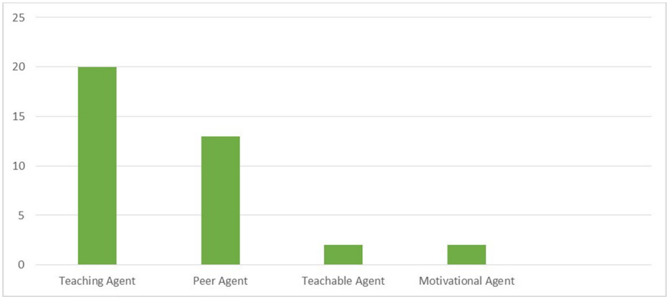
- Roles: 20 (55.55%) chatbots were teaching agents, 13 (36.11%) peer agents, 2 teachable agents, and 2 motivational agents.
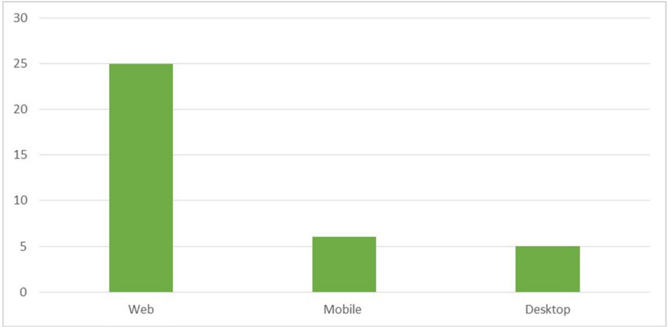
- Platforms: 25 (69.44%) operated on the web, 6 (16.66%) on mobile, and 5 (13.88%) on desktop.
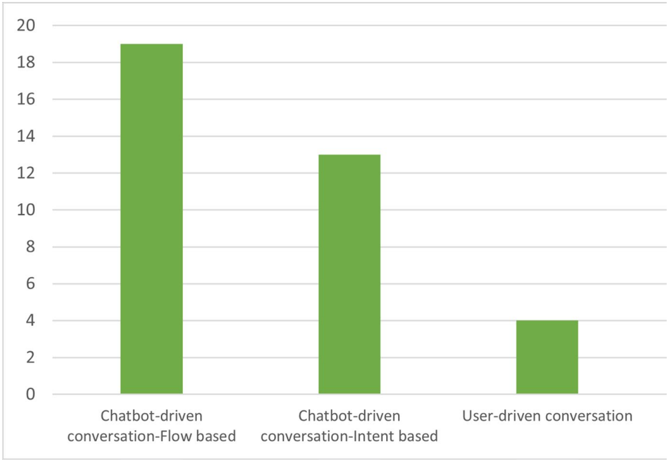
- Interaction styles: 88.88% used chatbot-driven conversation; 52.77% were flow-based, 36.11% intent-based, and 4 (11.11%) were user-driven.
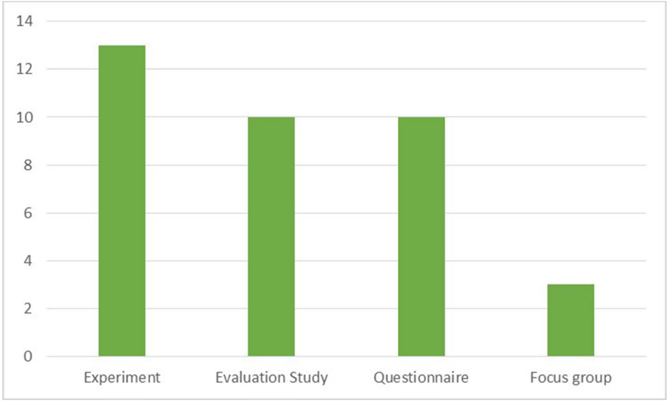
- Evaluation and outcomes: 13 (36.11%) used experiments, 10 (27.77%) evaluation studies, 10 (27.77%) questionnaires, and 3 (8.22%) focus groups; 8 experiments produced statistically significant improved learning, with other studies reporting improved engagement, interest, and subjective satisfaction.
Methods
- Systematic review following Keele et al. (2007), with seven research questions covering educational field, platform, role, interaction style, design principles, empirical evidence, and challenges/limitations.
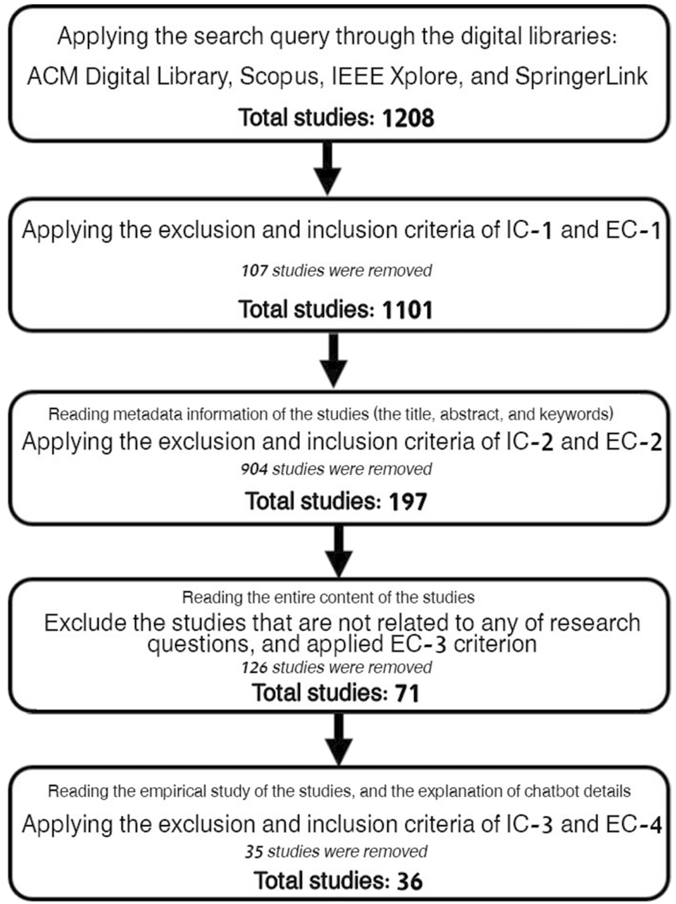
- Searched ACM Digital Library, Scopus, IEEE Xplore, and SpringerLink for January 2011–April 2021 using Boolean terms for chatbot/conversational agent/pedagogical agent and education/learning/learner/teaching/teacher/student.
- From 1,208 initial articles, applied inclusion/exclusion criteria to select 36 papers; four authors worked in pairs to cross-check selection and classification.
Limitations
- Stated: the review was restricted to January 2011–April 2021 and four digital libraries (ACM, Scopus, IEEE Xplore, SpringerLink), so relevant articles in other libraries such as Web of Science may have been missed.
- Stated: exclusion criteria applied to 1,208 initial articles may have introduced bias (e.g., excluding short papers with original ideas or papers without sufficient evidence), and classification may have been somewhat inaccurate due to researchers’ diverse experience, mitigated by cross-checking.
- Evident from the text: many evaluations rely on questionnaires or small focus groups (e.g., focus groups with 10 participants), and the review notes that none of the surveyed articles explicitly relied on usability heuristics or assessed a distinct chatbot personality.
Model-written summary. Check it against the paper before relying on it.
Integrity signals
Registry
Cites
Statistics
Figures
Verification
Claims the paper makes
13 Valid · 5 Not valid · 53 Not checked · 119 Own results and interpretations
Every source the paper cites for this claim was checked and supports it.
In the paper
“only one study (Wollny et al., 2021) analyzed the educational roles the chatbots are playing”
§ Interacting with educational chatbots: A systematic review > 3 Related work
What the sources say
- Supportedcites Wollny et al., 2021 matched to “Are We There Yet? - A Systematic Literature Review on Chatbots in Education” (2021) source
The Methods (Analysis) identify pedagogical roles as a question used to code the reviewed publications. The Results (Pedagogical Roles) and Discussion (Answer to Research Questions) analyze those roles as Learning, Assisting, and Mentoring. The citation identifies Wollny et al. as the study doing that analysis; “only one” describes the citing authors’ selection of related studies. (LLM, conf=0.91)
plain- Asserted: passes — The authors put it forward as true.
- Checkable: passes — It can be checked against evidence.
- Load-bearing: passes — The paper’s conclusions depend on it.
- Based: passes — The paper gives a reason why it holds.
- Supported
The cited sources support only part of this claim — read each source’s verdict below.
In the paper
“Only four studies (Hwang & Chang, 2021;Wollny et al., 2021;Smutny & Schreiberova, 2020;Winkler & Söllner, 2018) examined the field of application.”
§ Interacting with educational chatbots: A systematic review > 3 Related work
What the sources say
- Not matchedcites Hwang & Chang, 2021
An author–year citation the paper’s reference list doesn’t settle. We don’t search these by name.
- Supportedcites Wollny et al., 2021 matched to “Are We There Yet? - A Systematic Literature Review on Chatbots in Education” (2021) source
The Related Work section discusses application clusters for educational chatbots, and the Results section examines their domains. Wollny et al. is therefore a study of the field of application; the count of four refers to the citing authors’ list of studies, not a finding attributed to Wollny et al. (LLM, conf=0.92)
- Supportedcites Smutny & Schreiberova, 2020 matched to “Chatbots for learning: A review of educational chatbots for the Facebook Messenger” (2020) source
The Discussion states that this study reviewed educational chatbots by subject matter, and Table 1 lists the subject-matter categories. That supports citing it as a study that examined the field of application; the count of four studies is the citing authors’ description of their selected literature. (LLM, conf=0.90)
plain- Asserted: passes — The authors put it forward as true.
- Checkable: passes — It can be checked against evidence.
- Load-bearing: unclear — It is unclear whether the paper’s conclusions depend on it.
- Based: passes — The paper gives a reason why it holds.
- Not matched
The sources with a verdict support this claim; the rest weren’t checked yet, have no full text we could read, or their verdicts aren’t rated yet.
In the paper
“some teaching agents recommended tutorials to students based upon learning styles (Redondo-Hernández & Pérez-Marín, 2011), students' historical learning (Coronado et al., 2018), and pattern matching (Ondáš et al., 2019).”
§ Interacting with educational chatbots: A systematic review > Teaching agents
What the sources say
- Not matchedcites Redondo-Hernández & Pérez-Marín, 2011
An author–year citation the paper’s reference list doesn’t settle. We don’t search these by name.
- Supportedcites Coronado et al., 2018 matched to “A cognitive assistant for learning java featuring social dialogue” (2018) source
Section 4 (Design of a teaching agent) states that 'The agent behaviours and decision making are based on the information provided by i) the properties and relations given by the domain model, ii) the stages in the learning path, and iii) the historical student queries stored in the KB', and describes the teaching agent's proactive behaviours 'Suggest related content to learn about' (analysing the topics of the student's last queries) and 'Suggest follow up topics to learn' (using the learning path refined by students' behaviour). Section 5 adds that 'Since it stores the students progress, in successive conversations, the same concepts will not be suggested as relevant', i.e. recommendations driven by the student's learning history, which is what the citing sentence attributes here (rendering the suggested learning content as 'tutorials'). (LLM, conf=0.82)
- Not checked — no full text of the sourcecites Ondáš et al., 2019 matched to “How chatbots can be involved in the education process” (2019) source
plainstates a cause- Asserted: passes — The authors put it forward as true.
- Checkable: passes — It can be checked against evidence.
- Load-bearing: unclear — It is unclear whether the paper’s conclusions depend on it.
- Based: passes — The paper gives a reason why it holds.
- Not matched
The cited sources support only part of this claim — read each source’s verdict below.
In the paper
“With this approach, the students received 12% more accurate answers than those given chatbots without personalized learning materials.”
§ Interacting with educational chatbots: A systematic review > 5.5 RQ5 -What are the principles used to guide the design of the educational chatbots?
What the sources say
- Partly supportedcites Latham et al., 2011 matched to “Oscar: An Intelligent Adaptive Conversational Agent Tutoring System” (2011) sourceExperimental — accuracy not yet measured
The Experimental section reports that students given learning materials matched to their learning styles averaged 73% correct answers, versus 61% for students given mismatched materials; the Conclusions describe this as 12% more correct answers. The study measured students’ answers, not answers students received from chatbots, and its comparator was mismatched material within Oscar rather than chatbots without personalized materials. (LLM, conf=0.90)
plainstates a cause- Asserted: passes — The authors put it forward as true.
- Checkable: passes — It can be checked against evidence.
- Load-bearing: unclear — It is unclear whether the paper’s conclusions depend on it.
- Based: passes — The paper gives a reason why it holds.
- Partly supported
The cited sources support only part of this claim — read each source’s verdict below.
In the paper
“Our results are similar to those reported in (Smutny & Schreiberova, 2020) which classified most chatbots as teaching agents that recommend content, conducted formative assessments, and set learning goals.”
§ Interacting with educational chatbots: A systematic review > 6 Discussion and future research directions
What the sources say
- Partly supportedcites Smutny & Schreiberova, 2020 matched to “Chatbots for learning: A review of educational chatbots for the Facebook Messenger” (2020) sourceExperimental — accuracy not yet measured
Table 2 (section 5, Conclusions; page unavailable) lists recommending learning content, quiz feedback, and setting goals as teaching-related quality attributes. The Discussion reports that all ten top-ranked chatbots used quizzes or a question-and-answer module. The paper does not say it classified most chatbots as teaching agents that performed all three functions. (LLM, conf=0.86)
plain- Asserted: passes — The authors put it forward as true.
- Checkable: passes — It can be checked against evidence.
- Load-bearing: unclear — It is unclear whether the paper’s conclusions depend on it.
- Based: passes — The paper gives a reason why it holds.
- Partly supported
86 more claims
Create a free account to see all 190 claims and to verify the 14 references still open.
- Probably not a substantial claim. 78
- It may state two separate claims as one. 31
- Borderline: one of the tests for a substantial claim is unclear. 2
- The quote only partly states this claim. 1
Claims other papers make about this one
Each is checked against this paper’s own text: does it say what the citing paper says it does?
The source backs part of the claim, not all of it — or backs it for a different population, condition or comparison.
In the citing paper
“chatbots, including ChatGPT, have demonstrated the potential to reshape and revolutionize education, creating new, novel opportunities for enhancing the learning process and outcomes [83], facilitating different learning approaches, and offering a range of pedagogical benefits [19, 43, 72]”
From A systematic literature review of empirical research on ChatGPT in education (2024) · cites this paper as [43]
Experimental — accuracy not yet measuredThe source backs part of the claim, not all of it — or backs it for a different population, condition or comparison.
In the citing paper
“Chatbots allow learners to engage in conversations anytime and anywhere, free from time and space constraints. Learners can interact with chatbots, lower tension and stress levels, and engage in repetitive learning [36].”
From Development and effects of a chatbot education program for self-directed learning in nursing students (2025) · cites this paper as [36]
Experimental — accuracy not yet measuredThe cited source says what the claim attributes to it.
In the citing paper
“This contrasts with earlier studies such as Kuhail et al. (2023) and Huang et al. (2022), which emphasized motivation and engagement as key affordances of chatbots.”
From Motivations and Affordances of ChatGPT Usage for College Students’ Learning (2025) · cites this paper as Kuhail et al. (2023)
In the citing paper
“Erosion of human relations: The emphasis on AI-driven verbal communication tools may inadvertently contribute to the erosion of nonverbal communication competencies and social skills among learners and educators2,85,86.”
From On opportunities and challenges of large multimodal foundation models in education (2025) · cites this paper as [85]
In the citing paper
“chatbots have been shown to be effective in various roles when engaging with students, including teaching agents, peer agents, teachable agents, and motivational agents [3].”
From Interacting with a Chatbot-Based Advising System: Understanding the Effect of Chatbot Personality and User Gender on Behavior (2022) · cites this paper as [3]
3 more claims about this paper
Create a free account to see every claim other papers make about this one.
Self-check
Percentages, sums and reported differences re-computed from the paper’s own numbers.
Each contradiction between two passages listed here was confirmed by an independent check.
Rated minor: it would not touch a result — a value no result rests on, a p-value that stays on the same side of the significance level, or a conflict that is clerical, resolved elsewhere in the paper, or outside its own findings.
In the paper
§ Interacting with educational chatbots: A systematic review > 6 Discussion and future research directions
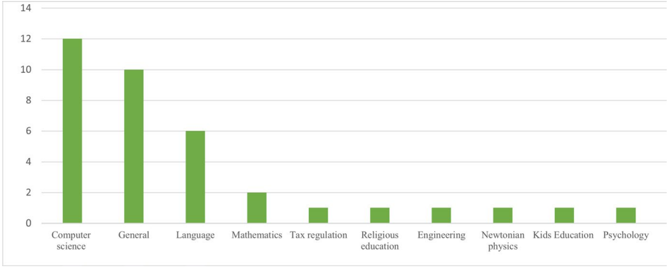
“More than a third of the chatbots were developed to teach computer science topics, including programming languages and networks.”
§ Interacting with educational chatbots: A systematic review > 5 Results
“12 articles; 33.33%) developed chatbots used to teach computer science”
Rated minor: it would not touch a result — a value no result rests on, a p-value that stays on the same side of the significance level, or a conflict that is clerical, resolved elsewhere in the paper, or outside its own findings.
In the paper
§ Interacting with educational chatbots: A systematic review > 5.3 RQ3 -What role do the educational chatbots play when interacting with students?
“four roles (teaching agents, peer agents, teachable agents, and peer agents)”
§ Interacting with educational chatbots: A systematic review > 5.3 RQ3 -What role do the educational chatbots play when interacting with students?
“Only two studies used chatbots as teachable agents, and two studies used them as motivational agents.”
Rated minor: it would not touch a result — a value no result rests on, a p-value that stays on the same side of the significance level, or a conflict that is clerical, resolved elsewhere in the paper, or outside its own findings.
In the paper
§ Interacting with educational chatbots: A systematic review > 5 Results
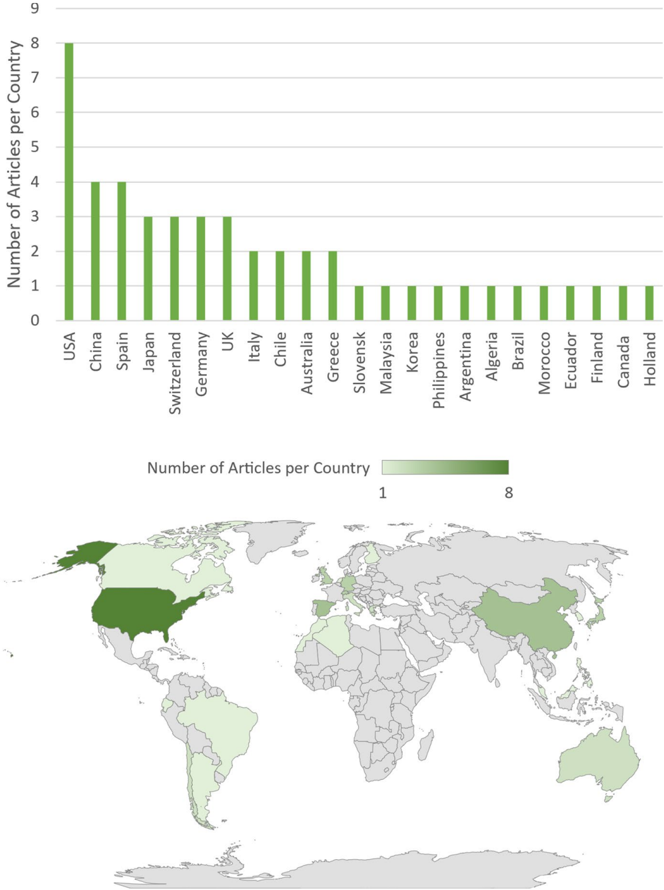
“The vast majority of selected articles were written or co-written by researchers from American universities.”
§ Interacting with educational chatbots: A systematic review > 5 Results
“the research that emerged from all European universities combined was the highest in the number of articles (19 articles).Asian universities have contributed 10 articles, while American universities contributed 9 articles.”
Citations
Cites
(2002) · Cited by 13,211
Hattie, J., & Timperley, H. (2007) · Review of Educational Research · doi:10.3102/003465430298487 · Cited by 12,905 · cited 1×
“• Lack of Feedback Feedback is a crucial element that affects learning in various environments (Hattie and Timperley, 2007).”
BackgroundELIZA—a computer program for the study of natural language communication between man and machine
Weizenbaum, J. (1966) · Communications of the ACM · doi:10.1145/365153.365168 · Cited by 4,452
International Journal of Scientific and Research Publications
(2022) · International Journal of Scientific and Research Publications · doi:10.29322/ijsrp · Cited by 2,691
Morgan, D. L. (1996) · Annual Review of Sociology · doi:10.1146/annurev.soc.22.1.129 · Cited by 2,353
Nass, C., Steuer, J., & Tauber, E. R. (1994) · Proceedings of the SIGCHI Conference on Human Factors in Computing Systems · doi:10.1145/191666.191703 · Cited by 2,148 · cited 1×
“…words such as “family” or “together” (Hirsh et al., 2009), words that are regarded as positive emotionally such as “like” or “nice” (Hirsh et al., 2009), words indicating assurance such as “sure” (Nass et al., 1994), as well as certain emojis (Völkel et al., 2019), as suggested by the literature.”
Encyclopedia of the Sciences of Learning
(2012) · doi:10.1007/978-1-4419-1428-6 · Cited by 1,091
Key Concepts in Social Research
Payne, G., & Payne, J. (2004) · doi:10.4135/9781849209397 · Cited by 975
Effectiveness of Intelligent Tutoring Systems: A Meta-Analytic Review
Kulik, J. A., & Fletcher, J. D. (2016) · Review of Educational Research · doi:10.3102/0034654315581420 · Cited by 930 · cited 1×
“Teaching agents play the role of human teachers and can present instructions, illustrate examples, ask questions (Wambs-ganss et al., 2020), and provide immediate feedback (Kulik & Fletcher, 2016).”
BackgroundChatbots applications in education: A systematic review
Okonkwo, C. W., & Ade-Ibijola, A. (2021) · Computers and Education: Artificial Intelligence · doi:10.1016/j.caeai.2021.100033 · Cited by 879
Research works printed but not linked: 7
- 4. Benotti, L., Martnez, M.C., & Schapachnik, F. (2018). Atool for introducing computer science with auto- matic formative assessment. IEEE Transactions on Learning Technologies, 11(2), 179-192. https:// doi. org/ 10. 1109/ TLT. 2017. 26820 · DOI · Paper page
- 33. Ruttkay, Z., & Pelachaud, C. (2006). From browstotrust: Evaluating embodied conversational agents Vol. 7. Berlin: Springer Science & Business Media.
- 38. Shneiderman, B., Plaisant, C., Cohen, M.S, Jacobs, S., Elmqvist, N., & Diakopoulos, N. (2016). Design- ingthe user interface: strategies for effective human-computer interaction. London: Pearson.
- 54. Bradeško, L., & Mladenić, D. (2012). A survey of chatbot systemsthrough a loebner prize competition. In Proceedings of Slovenian language technologies society eighth conference of language technolo- gies (pp. 34-37).
- 72. Hobert, S., & Meyer von Wolff, R. (2019). Say helloto your new automatedtutor-a structured literature review on pedagogical conversational agents.
- 86. Laurillard, D. (2013). Rethinking university teaching: A conversational framework for the effective use of learning technologies. Routledge.
- 102. Qin, C., Huang, W., & Hew, K.F. (2020). Usingthe community of inquiry framework to develop an educational chatbot: lesson learned from a mobile instant messaging learning environment. In Proceedings ofthe 28th international conference on computers in education.
Cited by
Items 101–200 of 824
Innovative Early Childhood STEM Education with ChatGPT: Teacher Perspectives
Uğraş, H., Uğraş, M., Papadakis, S., & Kalogiannakis, M. (2024) · Technology Knowledge and Learning · doi:10.1007/s10758-024-09804-8 · Cited by 81
Students' mindset to adopt AI chatbots for effectiveness of online learning in higher education
Rahman, M. K., Ismail, N. A., Hossain, D., & Hossen, M. S. (2025) · Future Business Journal · doi:10.1186/s43093-025-00459-0 · Cited by 113
Fang, Q., Reynaldi, R., Araminta, A. S., Kamal, I., Saini, P., Afshari, F. S., Tan, S.-C., Yuan, J. C.-C., Qomariyah, N. N., & Sukotjo, C. (2025) · The Journal of Prosthetic Dentistry · doi:10.1016/j.prosdent.2024.03.038 · Cited by 52
Personalized Gamification for Learning: A Reactive Chatbot Architecture Proposal
González, C. S. G., Muñoz, V., Toledo, P., & Nacimiento-García, E. (2023) · Sensors · doi:10.3390/s23010545 · Cited by 68
Kiuchi, K., Otsu, K., & Hayashi, Y. (2023) · Behaviour and Information Technology · doi:10.1080/0144929x.2023.2286528 · Cited by 64
Ortega-Ochoa, E., Quiroga Pérez, J., Arguedas, M., Daradoumis, T., & Marquès Puig, J. M. (2024) · Internet of Things · doi:10.1016/j.iot.2024.101101 · Cited by 50
Labrague, L. J., & Sabei, S. A. (2025) · Teaching and Learning in Nursing · doi:10.1016/j.teln.2024.11.010 · Cited by 48
On opportunities and challenges of large multimodal foundation models in education
Küchemann, S., Avila, K. E., Dinc, Y., Hortmann, C., Revenga, N., Ruf, V., Stausberg, N., Steinert, S., Fischer, F., Fischer, M., et al. (2025) · npj Science of Learning · doi:10.1038/s41539-025-00301-w · Cited by 47
“(cid:129) Erosion of human relations : The emphasis on AI-driven verbal communication tools may inadvertently contribute to the erosion of nonverbal communication competencies and social skills among learners and educators 2,85,86 .”
Lee, G.-G., Mun, S., Shin, M.-K., & Zhaı, X. (2024) · Science & Education · doi:10.1007/s11191-024-00526-y · Cited by 94
ChatGPT as an educational resource for civil engineering students
Uddin, S. M. J., Albert, A., Tamanna, M., Ovid, A., & Alsharef, A. F. (2024) · Computer Applications in Engineering Education · doi:10.1002/cae.22747 · Cited by 75
Son, T., Yeo, S., & Lee, D. (2024) · Teaching and Teacher Education · doi:10.1016/j.tate.2024.104640 · Cited by 68
Kartal, G., & Yeşilyurt, Y. E. (2024) · ReCALL · doi:10.1017/s0958344024000077 · Cited by 89
Chatbots and student motivation: a scoping review
Huang, W., Jiang, J., King, R. B., & Fryer, L. K. (2025) · International Journal of Educational Technology in Higher Education · doi:10.1186/s41239-025-00524-2 · Cited by 107
Effects of different AI-driven Chatbot feedback on learning outcomes and brain activity
Yin, J., Xu, H., Pan, Y., & Hu, Y. (2025) · npj Science of Learning · doi:10.1038/s41539-025-00311-8 · Cited by 41
“Chatbots can provide learners with personalized content, instant feedback, and one-to-one guidance 2,3 .”
Enhancing Critical Thinking in Education by Means of a Socratic Chatbot
Favero, L., Pérez-Ortiz, J. A., Käser, T., & Oliver, N. (2025) · Communications in computer and information science · doi:10.1007/978-3-031-93409-4_2 · Cited by 159
Arakawa, R., & Yakura, H. (2024) · ACM Conference on Conversational User Interfaces (CUI) · doi:10.1145/3640794.3665549 · Cited by 73
Chatbot-Based Natural Language Interfaces for Data Visualisation: A Scoping Review
Kavaz, E., Puig, A., & Rodríguez, I. (2023) · Applied Sciences · doi:10.3390/app13127025 · Cited by 57
Amin, M. R. M., Ismail, I., & Sivakumaran, V. M. (2025) · Social Sciences & Humanities Open · doi:10.1016/j.ssaho.2025.101308 · Cited by 114
Exploring New AI-Based Technologies to Enhance Students’ Motivation
Neji, W., Boughattas, N., & Ziadi, F. (2023) · Issues in Informing Science and Information Technology · doi:10.28945/5149 · Cited by 80
Sysoyev, P. V., & Filatov, E. M. (2023) · Perspectives of science and education · doi:10.32744/pse.2023.3.13 · Cited by 51
Sánchez, F. Á. B., & Cruz, J. (2024) · Education Sciences · doi:10.3390/educsci14050484 · Cited by 68
Artificial intelligence tools and higher education student’s engagement
Ezeoguine, E. P., & Eteng-Uket, S. (2024) · Edukasiana Jurnal Inovasi Pendidikan · doi:10.56916/ejip.v3i3.733 · Cited by 68
Chatbots for active learning: A case of phishing email identification
Hobert, S., Følstad, A., & Law, E. L.-C. (2023) · International Journal of Human-Computer Studies · doi:10.1016/j.ijhcs.2023.103108 · Cited by 37
Jeon, J., & Lee, S. (2024) · Education and Information Technologies · doi:10.1007/s10639-024-12725-9 · Cited by 58
Exploring the potential of AI-Chatbots in organic chemistry: An assessment of ChatGPT and Bard
Hallal, K., Hamdan, R., & Tlais, S. (2023) · Computers and Education: Artificial Intelligence · doi:10.1016/j.caeai.2023.100170 · Cited by 37
Determinants of student adoption of artificial intelligence applications in higher education
Alshammarı, S. H., Alrashidi, M. E., Alshammari, M. H., Alshammari, A. E. A., & Alkhwaldi, A. F. (2025) · Scientific Reports · doi:10.1038/s41598-025-19851-5 · Cited by 62
An AI Chatbot for EFL Writing: Students’ Usage Tendencies, Writing Performance, and Perceptions
Duong, T.-N.-A., & Chen, H. (2025) · Journal of Educational Computing Research · doi:10.1177/07356331241312363 · Cited by 62
Poláková, P., & Klímová, B. (2024) · Cogent Education · doi:10.1080/2331186x.2024.2355385 · Cited by 85
A Bibliometric Analysis of Research on ChatGPT in Education
Polat, H., Topuz, A. C., Yıldız, M., Taşlıbeyaz, E., & Kurşun, E. (2024) · International Journal of Technology in Education · doi:10.46328/ijte.606 · Cited by 35
The Use of Generative AI to Support Inclusivity and Design Deliberation for Online Instruction
Stefaniak, J. E., & Moore, S. L. (2024) · Online Learning · doi:10.24059/olj.v28i3.4458 · Cited by 56
Jasin, J., Ng, H. T., Atmosukarto, I., Iyer, P., Osman, F., Wong, P. Y. K., Pua, C. Y., & Cheow, W. S. (2023) · Education and Information Technologies · doi:10.1007/s10639-023-11602-1 · Cited by 48
ChatGPT as an educational resource for accounting students: expanding the classical TAM model
Al‐Okaily, M. (2025) · Education and Information Technologies · doi:10.1007/s10639-025-13391-1 · Cited by 49
Hong, J., & Tai, T. (2024) · Innovation in Language Learning and Teaching · doi:10.1080/17501229.2024.2347884 · Cited by 44
Tsai, Y., & Tsou, C. (2009) · Assessment in Education Principles Policy and Practice · doi:10.1080/09695940903319711 · Cited by 49
Ngo, T. T. A., Phan, T. Y. N., Nguyen, T. K., Le, N. B. T., Nguyen, N. T. A., & Le, T. T. D. (2025) · Acta Psychologica · doi:10.1016/j.actpsy.2025.105468 · Cited by 70
Bubaš, G., Čižmešija, A., & Kovačić, A. (2023) · Future Internet · doi:10.3390/fi16010004 · Cited by 48
AI-experiments in education: An AI-driven randomized controlled trial for higher education research
Cingillioglu, I., Gal, U., & Prokhorov, A. B. (2024) · Education and Information Technologies · doi:10.1007/s10639-024-12633-y · Cited by 54
Looi, C., & Jia, F. (2025) · Education and Information Technologies · doi:10.1007/s10639-025-13369-z · Cited by 60
Developing a Curated Chatbot as an Exploratory Communication Tool for Chemistry Learning
Lolinco, A. T., & Holme, T. A. (2023) · Journal of Chemical Education · doi:10.1021/acs.jchemed.3c00520 · Cited by 43
Malik, M. A., Amjad, A. I., Aslam, S., & Fakhrou, A. A. (2024) · Frontiers in Research Metrics and Analytics · doi:10.3389/frma.2024.1486832 · Cited by 83
Effects of ChatGPT use on undergraduate students’ creativity: a threat to creative thinking?
Toma, R. B., & Yánez‐Pérez, I. (2024) · Discover Artificial Intelligence · doi:10.1007/s44163-024-00172-x · Cited by 68
Al-Zahrani, A. M. (2025) · SAGE Open · doi:10.1177/21582440251340615 · Cited by 63
Designing a Chatbot for Contemporary Education: A Systematic Literature Review
Ramandanis, D., & Xinogalos, S. (2023) · Information · doi:10.3390/info14090503 · Cited by 51
Gutiérrez, L. C. (2023) · Research Studies in English Language Teaching and Learning · doi:10.62583/rseltl.v1i3.44 · Cited by 67
Jin, Y., Yang, K., Yan, L., Echeverría, V., Zhao, L., Alfredo, R., Milesi, M. E., Fan, J. X., Li, X., Gašević, D., et al. (2025) · International Conference on Learning Analytics and Knowledge (LAK) · doi:10.1145/3706468.3706545 · Cited by 58
From Questions to Insightful Answers: Building an Informed Chatbot for University Resources
Neupane, S., Hossain, E., Keith, J., Tripathi, H., Ghiasi, F., Golilarz, N. A., Amirlatifi, A., Mittal, S., & Rahimi, S. (2024) · IEEE Frontiers in Education Conference (FIE) · doi:10.1109/fie61694.2024.10892994 · Cited by 69
Han, J.-W., Park, J., & Lee, H. (2025) · BMC Medical Education · doi:10.1186/s12909-025-07316-2 · Cited by 41
“Learners can interact with chatbots, lower tension and stress levels, and engage in repetitive learning [36].”
Pre-Service Teachers’ Approaches in Solving Mathematics Tasks with ChatGPT
Noster, N., Gerber, S., & Siller, H.-S. (2024) · Digital Experiences in Mathematics Education · doi:10.1007/s40751-024-00155-8 · Cited by 69
Alalwan, A. A., Algharabat, R., Samen, A. A. E., Albanna, H., & Al‐Okaily, M. (2025) · Journal of Consumer Marketing · doi:10.1108/jcm-06-2024-6929 · Cited by 42
Zhang, R., Zou, D., & Cheng, G. (2024) · System · doi:10.1016/j.system.2024.103561 · Cited by 44
Uludağ, F., Kılıç, E., & Çelik, H. E. (2025) · Humanities and Social Sciences Communications · doi:10.1057/s41599-025-05641-x · Cited by 52
Chen, D. M., Aaltonen, K., Lampela, H., & Kujala, J. (2024) · Technology Knowledge and Learning · doi:10.1007/s10758-024-09807-5 · Cited by 48
Evolution of Chatbots in Nursing Education: Narrative Review
Zhang, F., Liu, X., Wu, W., & Zhu, S. (2024) · JMIR Medical Education · doi:10.2196/54987 · Cited by 38
Virtual Tutor, Digital Natives and AI: Analyzing the impact of ChatGPT on academia in Indonesia
Margono, H., Saud, M., & Falahat, M. (2024) · Social Sciences & Humanities Open · doi:10.1016/j.ssaho.2024.101069 · Cited by 26
Alrishan, A. M. H. (2023) · International Journal of Learning Teaching and Educational Research · doi:10.26803/ijlter.22.12.10 · Cited by 45
Feng, S. (2025) · British Journal of Educational Technology · doi:10.1111/bjet.13611 · Cited by 63
Abedi, M., Alshybani, I., Shahadat, M., & Murillo, M. S. (2023) · Qeios · doi:10.32388/md04b0 · Cited by 69
Chu, X., Wang, M., Spector, J. M., Chen, N., Chai, C. S., Hwang, G., & Zhai, X. (2025) · Educational Technology Research and Development · doi:10.1007/s11423-025-10457-2 · Cited by 44
Ramandanis, D., & Xinogalos, S. (2023) · Multimodal Technologies and Interaction · doi:10.3390/mti7110103 · Cited by 74
Can rule-based educational chatbots be an acceptable alternative for students in higher education?
Güldal, H., & Dinçer, E. O. (2024) · Education and Information Technologies · doi:10.1007/s10639-024-12977-5 · Cited by 32
Investigating in-service teachers’ views on ChatGPT integration
Hojeij, Z., Kuhail, M. A., & ElSayary, A. (2024) · Interactive Technology and Smart Education · doi:10.1108/itse-04-2024-0094 · Cited by 38
Self-citationChen, L., Jiang, Z., Xia, D., Cai, Z., Sun, L., Childs, P., & Zuo, H. (2024) · CHI Conference on Human Factors in Computing Systems · doi:10.1145/3613904.3642887 · Cited by 44
Exploring the psychological implications of ChatGPT: a qualitative study
Center of Research Development and Innovation in Psychology, F. O. E. S., RAD, D., & RAD, G. (2023) · JOURNAL PLUS EDUCATION · doi:10.24250/jpe/vol.321/2023/dr/gr · Cited by 16
AI in Education: Shaping the Future of Teaching and Learning
Takona, J. (2024) · International Journal of Current Educational Studies · doi:10.46328/ijces.121 · Cited by 24
Google or ChatGPT: Who is the better helper for university students
Zhang, M., & Yang, X. (2024) · Education and Information Technologies · doi:10.1007/s10639-024-13002-5 · Cited by 42
Chatbot technology in the education sector: a bibliometrics analysis using VOS viewer
Traymbak, S., Sharma, M., Anand, A., & Shukla, A. (2024) · International Journal of Systems Assurance Engineering and Management · doi:10.1007/s13198-023-02230-6 · Cited by 32
Çelik, İ. (2022) · SSRN Electronic Journal · doi:10.2139/ssrn.4244763 · Cited by 23
Designing chatbots in language classrooms: an empirical investigation from user learning experience
Wiboolyasarin, W., Wiboolyasarin, K., Tiranant, P., Boonyakitanont, P., & Jinowat, N. (2024) · Smart Learning Environments · doi:10.1186/s40561-024-00319-4 · Cited by 45
Elstad, E., & Eriksen, H. (2024) · Nordic Journal of Comparative and International Education (NJCIE) · doi:10.7577/njcie.5736 · Cited by 42
Alabbas, A., & Alomar, K. (2024) · Applied Sciences · doi:10.3390/app14062547 · Cited by 40
Exploring the Use of ChatGPT in Chinese Language Classrooms
(2023) · International Journal of Chinese Language Teaching · doi:10.46451/ijclt.20230303 · Cited by 42
Liu, J., Yao, Y., An, P., & Wang, Q. (2024) · CHI Conference Extended Abstracts on Human Factors in Computing Systems (CHI EA) · doi:10.1145/3613905.3651008 · Cited by 51
Chatbots in higher education: a systematic review
Lambebo, E. A., & Chen, H. (2024) · Interactive Learning Environments · doi:10.1080/10494820.2024.2436931 · Cited by 37
Mohammed, I. A., Bello, A., & Ayuba, B. (2025) · Education and Information Technologies · doi:10.1007/s10639-024-13293-8 · Cited by 33
Klapow, M. C., Rosenblatt, A., Lachman, J. M., & Gardner, F. E. M. (2024) · JMIR Pediatrics and Parenting · doi:10.2196/55726 · Cited by 37
Unleashing ChatGPT's impact in higher education: Student and faculty perspectives
Rajabi, P., Taghipour, P., Cukierman, D., & Doleck, T. (2024) · Computers in Human Behavior: Artificial Humans · doi:10.1016/j.chbah.2024.100090 · Cited by 21
ChatGPT in early childhood STEM education: Can it be an innovative tool to overcome challenges?
Uğraş, H., & Uğraş, M. (2024) · Education and Information Technologies · doi:10.1007/s10639-024-12960-0 · Cited by 33
Komalawardhana, N., & Panjaburee, P. (2023) · Journal of Computers in Education · doi:10.1007/s40692-023-00276-w · Cited by 30
Kuhail, M. A., Bahja, M., Al-Shamaileh, O., Thomas, J., Alkazemi, A., & Negreiros, J. G. M. (2024) · IEEE Access · doi:10.1109/access.2024.3402977 · Cited by 37
Self-citationAbedi, M., Alshybani, I., Shahadat, M., & Murillo, M. S. (2023) · Qeios · doi:10.32388/md04b0.2 · Cited by 24
Hakim, V. G. A., Paiman, N. A., & Rahman, M. H. S. (2024) · Computer Applications in Engineering Education · doi:10.1002/cae.22800 · Cited by 27
Zhou, J., & Zhang, H. (2024) · Applied Sciences · doi:10.3390/app14188363 · Cited by 28
Küchemann, S., Avila, K. E., Dinc, Y., Hortmann, C., Revenga, N., Ruf, V., Stausberg, N., Steinert, S., Fischer, F., Fischer, M. R., et al. (2024) · doi:10.35542/osf.io/n7dvf · Cited by 19
A review on polyadic chatbots: trends, challenges, and future research directions
Kuhail, M. A., Taj, I., Alimamy, S., & Shawar, B. A. (2024) · Knowledge and Information Systems · doi:10.1007/s10115-024-02287-0 · Cited by 32
Self-citationHong, J., Lin, C.-H., & Juh, C.-C. (2023) · Interactive Learning Environments · doi:10.1080/10494820.2023.2273485 · Cited by 24
Analytics of learner-centered feedback: A large-scale case study in higher education
Aldino, A. A., Tsai, Y.-S., Gupte, S., Henderson, M., Nath, D., Gašević, D., & Chen, G. (2025) · Computers & Education · doi:10.1016/j.compedu.2025.105360 · Cited by 19
Caccavale, F., Gargalo, C. L., Kager, J., Larsen, S., Gernaey, K. V., & Krühne, U. (2024) · Computers and Education Artificial Intelligence · doi:10.1016/j.caeai.2024.100354 · Cited by 37
Integrating AI Tutors in a Programming Course
Ma, I., Krone-Martins, A., & Lopes, C. V. (2024) · ACM Virtual Global Computing Education Conference (SIGCSE Virtual) · doi:10.1145/3649165.3690094 · Cited by 55
Jalali, N. A., & Hongsong, C. (2024) · Cluster Computing · doi:10.1007/s10586-024-04515-2 · Cited by 29
Huang, W., & Hew, K. F. (2024) · IEEE Transactions on Learning Technologies · doi:10.1109/tlt.2024.3523199 · Cited by 34
Integration of Chatbots in Additional Language Education: A Systematic Review
Cislowska, A. I., & Acuña, B. P. (2024) · European Journal of Educational Research · doi:10.12973/eu-jer.13.4.1607 · Cited by 43
Reviewriter: AI-Generated Instructions For Peer Review Writing
Su, X., Wambsganss, T., Rietsche, R., Neshaei, S. P., & Kser, T. (2023) · Proceedings of the 18th Workshop on Innovative Use of NLP for Building Educational Applications (BEA 2023) · doi:10.18653/v1/2023.bea-1.5 · Cited by 17
Teachable Q&A Agent: The Effect of Chatbot Training by Students on Reading Interest and Engagement
Liu, C., Chen, W., Lo, F.-Y., Chang, C., & Lin, H. (2024) · Journal of Educational Computing Research · doi:10.1177/07356331241236467 · Cited by 29
ChatGPT for Founding Teams: An Entrepreneurial Pedagogical Innovation
Hammoda, B. (2024) · International Journal of Technology in Education · doi:10.46328/ijte.530 · Cited by 18
Ng, J., Tong, M., Tsang, E. Y. M., Chu, K., & Tsang, W. (2025) · SN Computer Science · doi:10.1007/s42979-025-04010-4 · Cited by 18
“The study by [68] demonstrated that personal - ized chatbot interactions led to better academic performance compared to generic feedback.”
The emotional cost of AI chatbots in education: Who benefits and who struggles?
Carter, J. W., Scott, J., & Barrett, J. D. (2025) · Computers in Human Behavior Artificial Humans · doi:10.1016/j.chbah.2025.100181 · Cited by 28
Technology-enhanced higher education: Text mining and bibliometrics
Chen, X., Zou, D., Xie, H., & Wang, F. L. (2024) · Heliyon · doi:10.1016/j.heliyon.2024.e25776 · Cited by 25
Mosleh, S. M., Alsaadi, F. A., Alnaqbi, F. K., Alkhzaimi, M. A., Alnaqbi, S. W., & Alsereidi, W. M. (2024) · Heliyon · doi:10.1016/j.heliyon.2024.e31952 · Cited by 45
Zhao, R., Yunus, M. M., & Rafiq, K. R. M. (2023) · International Journal of Academic Research in Business and Social Sciences · doi:10.6007/ijarbss/v13-i12/20258 · Cited by 37
Sorenson, B., & Hanson, K. (2024) · Journal of Chemical Education · doi:10.1021/acs.jchemed.4c00165 · Cited by 31
Metadata
- Authors
- Kuhail, M. A., Alturki, N., Alramlawi, S., & Alhejori, K.
- Affiliations
- Zayed University (AE)
- Princess Nourah bint Abdulrahman University (SA)
- Corresponding author
- Alturki, Nazik
- Venue
- Education and Information Technologies
- Published
- 2022-07-09
- Volume
- 28
- Issue
- 1
- Pages
- 973-1018
- ISSN
- 1360-2357 (ISSN-L)
- 1573-7608
- OpenAlex
- W4284991798
- Cited by
- 841
- References
- 110
- Citations by year
- 2026: 201 · 2025: 253 · 2024: 248 · 2023: 133 · 2022: 4
- FWCI
- 11.12
- Type
- journal article
- Language
- en
- Open access
- hybrid
- doi.org
- Licence
- cc-by
- creativecommons.org/licenses/by/4.0 (tdm)
- creativecommons.org/licenses/by/4.0 (vor)
- Locations
- Education and Information Technologies (publishedVersion, cc-by)
- Topics
- Physical Sciences › Computer Science › Artificial Intelligence › Intelligent Tutoring Systems and Adaptive Learning
- Social Sciences › Education › Artificial Intelligence in Education
- Social Sciences › Business, Management and Accounting › Marketing › AI in Service Interactions
- Keywords
- educational chatbots, personalized learning, peer agents, chatbot personality, student satisfaction, chatbot evaluation, chatbot usability
About these checks
Registry, retraction, Cites and statistics results are computed, not judged, with one exception: a printed reference that no index lists is read once by a model before it counts as a citation error. Claims are extracted by a model and kept only when their quote appears verbatim in the text; each cited source is then checked, with a model’s help, for whether it says what the claim relies on. Those verdicts can be wrong — read the claim’s quote and the cited source before relying on one.
The claim verdicts this report counts are experimental: their accuracy is not yet measured.
A language model drew the claims from the paper on 2026-10-10, under version 3 of the claim definition (model deepseek-v4.1-flash, prompt extract-v3).
A second model labelled each claim on 2026-10-10 (model jev-1.13-20260917, definition revision gold-guideline-v0.2).
Cited sources are checked with a language model’s help (gpt-6-sol and qwen3.8-omni-flash).
Statistics and arithmetic are recomputed, not judged.
Confidence bands are shown only for fields calibrated on our annotated test set. None is calibrated yet, so no band is shown.
What counts as a claim ›How we measure confidence ›How we check this ›
Are you an author, or do you see a problem with this page? Request a review
Data sources
Bibliographic data: Semantic Scholar, OpenAlex, Crossref.
Contains information from the Semantic Scholar Academic Graph Datasets, made available under the ODC Attribution License (ODC-BY 1.0).
Semantic Scholar’s data is described in: Kinney, R., et al. (2023). The Semantic Scholar Open Data Platform. arXiv:2301.10140.
