

Interacting with educational chatbots: A systematic review
Open accessThe DOI matches its Crossref record; 116 of the 117 references it cites were found in a registry or an index, and 1 are not checked yet; 14 of the 67 sources its claims cite were checked for support.
Abstract
Abstract Chatbots hold the promise of revolutionizing education by engaging learners, personalizing learning activities, supporting educators, and developing deep insight into learners’ behavior. However, there is a lack of studies that analyze the recent evidence-based chatbot-learner interaction design techniques applied in education. This study presents a systematic review of 36 papers to understand, compare, and reflect on recent attempts to utilize chatbots in education using seven dimensions: educational field, platform, design principles, the role of chatbots, interaction styles, evidence, and limitations. The results show that the chatbots were mainly designed on a web platform to teach computer science, language, general education, and a few other fields such as engineering and mathematics. Further, more than half of the chatbots were used as teaching agents, while more than a third were peer agents. Most of the chatbots used a predetermined conversational path, and more than a quarter utilized a personalized learning approach that catered to students’ learning needs, while other chatbots used experiential and collaborative learning besides other design principles. Moreover, more than a third of the chatbots were evaluated with experiments, and the results primarily point to improved learning and subjective satisfaction. Challenges and limitations include inadequate or insufficient dataset training and a lack of reliance on usability heuristics. Future studies should explore the effect of chatbot personality and localization on subjective satisfaction and learning effectiveness.
Verified 2026-11-22 · 1 reference not checked yet
Overview
CoChat Summary
TL;DR
This systematic review analyzes 36 papers on educational chatbots across seven dimensions: field, platform, role, interaction style, design principles, empirical evidence, and limitations. It finds most chatbots are web-based teaching agents with chatbot-driven flow-based interaction, evaluated mainly by experiments showing improved learning and satisfaction, while dataset training and usability/personality gaps remain.
Key findings
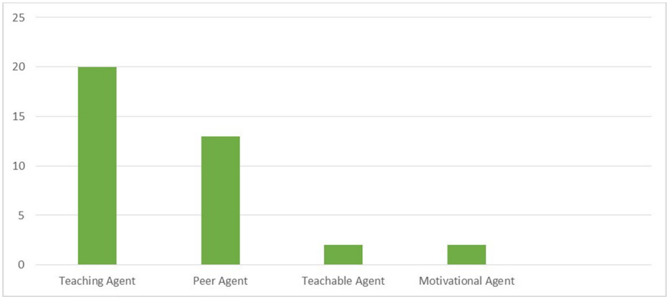
- Roles: 20 (55.55%) chatbots were teaching agents, 13 (36.11%) peer agents, 2 teachable agents, and 2 motivational agents.
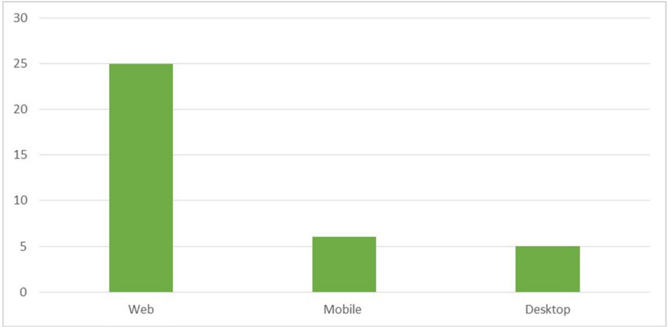
- Platforms: 25 (69.44%) operated on the web, 6 (16.66%) on mobile, and 5 (13.88%) on desktop.
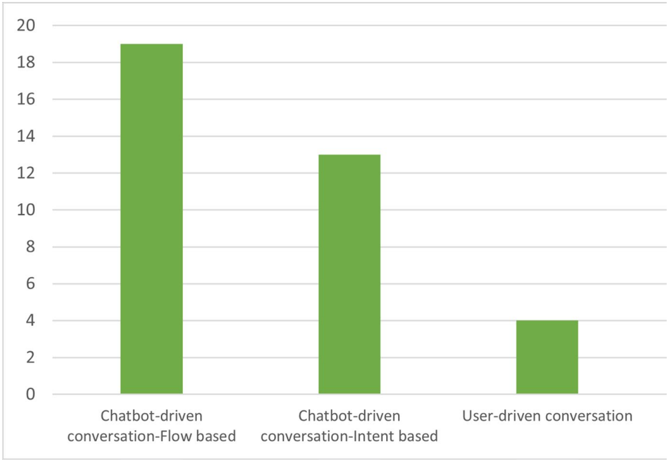
- Interaction styles: 88.88% used chatbot-driven conversation; 52.77% were flow-based, 36.11% intent-based, and 4 (11.11%) were user-driven.
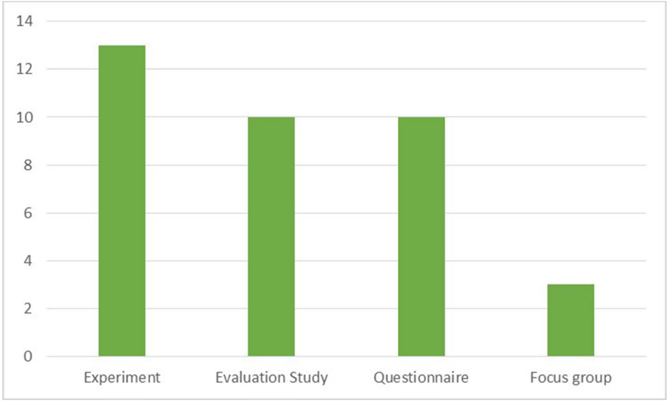
- Evaluation and outcomes: 13 (36.11%) used experiments, 10 (27.77%) evaluation studies, 10 (27.77%) questionnaires, and 3 (8.22%) focus groups; 8 experiments produced statistically significant improved learning, with other studies reporting improved engagement, interest, and subjective satisfaction.
Methods
- Systematic review following Keele et al. (2007), with seven research questions covering educational field, platform, role, interaction style, design principles, empirical evidence, and challenges/limitations.
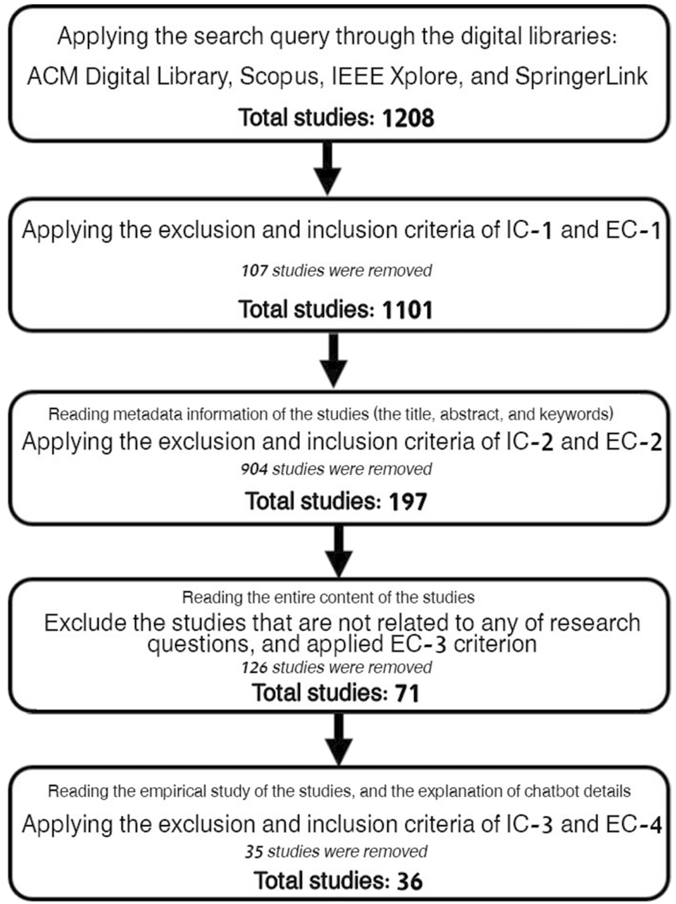
- Searched ACM Digital Library, Scopus, IEEE Xplore, and SpringerLink for January 2011–April 2021 using Boolean terms for chatbot/conversational agent/pedagogical agent and education/learning/learner/teaching/teacher/student.
- From 1,208 initial articles, applied inclusion/exclusion criteria to select 36 papers; four authors worked in pairs to cross-check selection and classification.
Limitations
- Stated: the review was restricted to January 2011–April 2021 and four digital libraries (ACM, Scopus, IEEE Xplore, SpringerLink), so relevant articles in other libraries such as Web of Science may have been missed.
- Stated: exclusion criteria applied to 1,208 initial articles may have introduced bias (e.g., excluding short papers with original ideas or papers without sufficient evidence), and classification may have been somewhat inaccurate due to researchers’ diverse experience, mitigated by cross-checking.
- Evident from the text: many evaluations rely on questionnaires or small focus groups (e.g., focus groups with 10 participants), and the review notes that none of the surveyed articles explicitly relied on usability heuristics or assessed a distinct chatbot personality.
Model-written summary. Check it against the paper before relying on it.
Integrity signals
Registry
Cites
Statistics
Figures
Verification
Claims the paper makes
13 Valid · 5 Not valid · 53 Not checked · 119 Own results and interpretations
Every source the paper cites for this claim was checked and supports it.
In the paper
“only one study (Wollny et al., 2021) analyzed the educational roles the chatbots are playing”
§ Interacting with educational chatbots: A systematic review > 3 Related work
What the sources say
- Supportedcites Wollny et al., 2021 matched to “Are We There Yet? - A Systematic Literature Review on Chatbots in Education” (2021) source
The Methods (Analysis) identify pedagogical roles as a question used to code the reviewed publications. The Results (Pedagogical Roles) and Discussion (Answer to Research Questions) analyze those roles as Learning, Assisting, and Mentoring. The citation identifies Wollny et al. as the study doing that analysis; “only one” describes the citing authors’ selection of related studies. (LLM, conf=0.91)
plain- Asserted: passes — The authors put it forward as true.
- Checkable: passes — It can be checked against evidence.
- Load-bearing: passes — The paper’s conclusions depend on it.
- Based: passes — The paper gives a reason why it holds.
- Supported
The cited sources support only part of this claim — read each source’s verdict below.
In the paper
“Only four studies (Hwang & Chang, 2021;Wollny et al., 2021;Smutny & Schreiberova, 2020;Winkler & Söllner, 2018) examined the field of application.”
§ Interacting with educational chatbots: A systematic review > 3 Related work
What the sources say
- Not matchedcites Hwang & Chang, 2021
An author–year citation the paper’s reference list doesn’t settle. We don’t search these by name.
- Supportedcites Wollny et al., 2021 matched to “Are We There Yet? - A Systematic Literature Review on Chatbots in Education” (2021) source
The Related Work section discusses application clusters for educational chatbots, and the Results section examines their domains. Wollny et al. is therefore a study of the field of application; the count of four refers to the citing authors’ list of studies, not a finding attributed to Wollny et al. (LLM, conf=0.92)
- Supportedcites Smutny & Schreiberova, 2020 matched to “Chatbots for learning: A review of educational chatbots for the Facebook Messenger” (2020) source
The Discussion states that this study reviewed educational chatbots by subject matter, and Table 1 lists the subject-matter categories. That supports citing it as a study that examined the field of application; the count of four studies is the citing authors’ description of their selected literature. (LLM, conf=0.90)
plain- Asserted: passes — The authors put it forward as true.
- Checkable: passes — It can be checked against evidence.
- Load-bearing: unclear — It is unclear whether the paper’s conclusions depend on it.
- Based: passes — The paper gives a reason why it holds.
- Not matched
The sources with a verdict support this claim; the rest weren’t checked yet, have no full text we could read, or their verdicts aren’t rated yet.
In the paper
“some teaching agents recommended tutorials to students based upon learning styles (Redondo-Hernández & Pérez-Marín, 2011), students' historical learning (Coronado et al., 2018), and pattern matching (Ondáš et al., 2019).”
§ Interacting with educational chatbots: A systematic review > Teaching agents
What the sources say
- Not matchedcites Redondo-Hernández & Pérez-Marín, 2011
An author–year citation the paper’s reference list doesn’t settle. We don’t search these by name.
- Supportedcites Coronado et al., 2018 matched to “A cognitive assistant for learning java featuring social dialogue” (2018) source
Section 4 (Design of a teaching agent) states that 'The agent behaviours and decision making are based on the information provided by i) the properties and relations given by the domain model, ii) the stages in the learning path, and iii) the historical student queries stored in the KB', and describes the teaching agent's proactive behaviours 'Suggest related content to learn about' (analysing the topics of the student's last queries) and 'Suggest follow up topics to learn' (using the learning path refined by students' behaviour). Section 5 adds that 'Since it stores the students progress, in successive conversations, the same concepts will not be suggested as relevant', i.e. recommendations driven by the student's learning history, which is what the citing sentence attributes here (rendering the suggested learning content as 'tutorials'). (LLM, conf=0.82)
- Not checked — no full text of the sourcecites Ondáš et al., 2019 matched to “How chatbots can be involved in the education process” (2019) source
plainstates a cause- Asserted: passes — The authors put it forward as true.
- Checkable: passes — It can be checked against evidence.
- Load-bearing: unclear — It is unclear whether the paper’s conclusions depend on it.
- Based: passes — The paper gives a reason why it holds.
- Not matched
The cited sources support only part of this claim — read each source’s verdict below.
In the paper
“With this approach, the students received 12% more accurate answers than those given chatbots without personalized learning materials.”
§ Interacting with educational chatbots: A systematic review > 5.5 RQ5 -What are the principles used to guide the design of the educational chatbots?
What the sources say
- Partly supportedcites Latham et al., 2011 matched to “Oscar: An Intelligent Adaptive Conversational Agent Tutoring System” (2011) sourceExperimental — accuracy not yet measured
The Experimental section reports that students given learning materials matched to their learning styles averaged 73% correct answers, versus 61% for students given mismatched materials; the Conclusions describe this as 12% more correct answers. The study measured students’ answers, not answers students received from chatbots, and its comparator was mismatched material within Oscar rather than chatbots without personalized materials. (LLM, conf=0.90)
plainstates a cause- Asserted: passes — The authors put it forward as true.
- Checkable: passes — It can be checked against evidence.
- Load-bearing: unclear — It is unclear whether the paper’s conclusions depend on it.
- Based: passes — The paper gives a reason why it holds.
- Partly supported
The cited sources support only part of this claim — read each source’s verdict below.
In the paper
“Our results are similar to those reported in (Smutny & Schreiberova, 2020) which classified most chatbots as teaching agents that recommend content, conducted formative assessments, and set learning goals.”
§ Interacting with educational chatbots: A systematic review > 6 Discussion and future research directions
What the sources say
- Partly supportedcites Smutny & Schreiberova, 2020 matched to “Chatbots for learning: A review of educational chatbots for the Facebook Messenger” (2020) sourceExperimental — accuracy not yet measured
Table 2 (section 5, Conclusions; page unavailable) lists recommending learning content, quiz feedback, and setting goals as teaching-related quality attributes. The Discussion reports that all ten top-ranked chatbots used quizzes or a question-and-answer module. The paper does not say it classified most chatbots as teaching agents that performed all three functions. (LLM, conf=0.86)
plain- Asserted: passes — The authors put it forward as true.
- Checkable: passes — It can be checked against evidence.
- Load-bearing: unclear — It is unclear whether the paper’s conclusions depend on it.
- Based: passes — The paper gives a reason why it holds.
- Partly supported
86 more claims
Create a free account to see all 190 claims and to verify the 6 references still open.
- Probably not a substantial claim. 78
- It may state two separate claims as one. 31
- Borderline: one of the tests for a substantial claim is unclear. 2
- The quote only partly states this claim. 1
Claims other papers make about this one
Each is checked against this paper’s own text: does it say what the citing paper says it does?
The source backs part of the claim, not all of it — or backs it for a different population, condition or comparison.
In the citing paper
“chatbots, including ChatGPT, have demonstrated the potential to reshape and revolutionize education, creating new, novel opportunities for enhancing the learning process and outcomes [83], facilitating different learning approaches, and offering a range of pedagogical benefits [19, 43, 72]”
From A systematic literature review of empirical research on ChatGPT in education (2024) · cites this paper as [43]
Experimental — accuracy not yet measuredThe source backs part of the claim, not all of it — or backs it for a different population, condition or comparison.
In the citing paper
“Chatbots allow learners to engage in conversations anytime and anywhere, free from time and space constraints. Learners can interact with chatbots, lower tension and stress levels, and engage in repetitive learning [36].”
From Development and effects of a chatbot education program for self-directed learning in nursing students (2025) · cites this paper as [36]
Experimental — accuracy not yet measuredThe cited source says what the claim attributes to it.
In the citing paper
“This contrasts with earlier studies such as Kuhail et al. (2023) and Huang et al. (2022), which emphasized motivation and engagement as key affordances of chatbots.”
From Motivations and Affordances of ChatGPT Usage for College Students’ Learning (2025) · cites this paper as Kuhail et al. (2023)
In the citing paper
“Erosion of human relations: The emphasis on AI-driven verbal communication tools may inadvertently contribute to the erosion of nonverbal communication competencies and social skills among learners and educators2,85,86.”
From On opportunities and challenges of large multimodal foundation models in education (2025) · cites this paper as [85]
In the citing paper
“chatbots have been shown to be effective in various roles when engaging with students, including teaching agents, peer agents, teachable agents, and motivational agents [3].”
From Interacting with a Chatbot-Based Advising System: Understanding the Effect of Chatbot Personality and User Gender on Behavior (2022) · cites this paper as [3]
3 more claims about this paper
Create a free account to see every claim other papers make about this one.
Self-check
Percentages, sums and reported differences re-computed from the paper’s own numbers.
Each contradiction between two passages listed here was confirmed by an independent check.
Rated minor: it would not touch a result — a value no result rests on, a p-value that stays on the same side of the significance level, or a conflict that is clerical, resolved elsewhere in the paper, or outside its own findings.
In the paper
§ Interacting with educational chatbots: A systematic review > 6 Discussion and future research directions
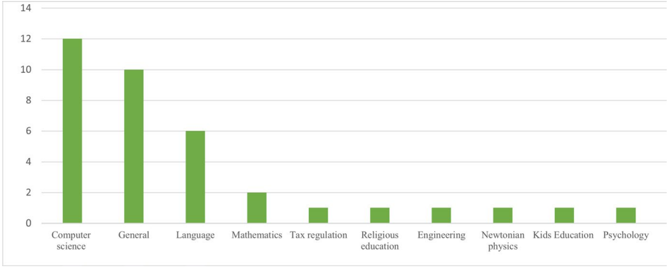
“More than a third of the chatbots were developed to teach computer science topics, including programming languages and networks.”
§ Interacting with educational chatbots: A systematic review > 5 Results
“12 articles; 33.33%) developed chatbots used to teach computer science”
Rated minor: it would not touch a result — a value no result rests on, a p-value that stays on the same side of the significance level, or a conflict that is clerical, resolved elsewhere in the paper, or outside its own findings.
In the paper
§ Interacting with educational chatbots: A systematic review > 5.3 RQ3 -What role do the educational chatbots play when interacting with students?
“four roles (teaching agents, peer agents, teachable agents, and peer agents)”
§ Interacting with educational chatbots: A systematic review > 5.3 RQ3 -What role do the educational chatbots play when interacting with students?
“Only two studies used chatbots as teachable agents, and two studies used them as motivational agents.”
Rated minor: it would not touch a result — a value no result rests on, a p-value that stays on the same side of the significance level, or a conflict that is clerical, resolved elsewhere in the paper, or outside its own findings.
In the paper
§ Interacting with educational chatbots: A systematic review > 5 Results
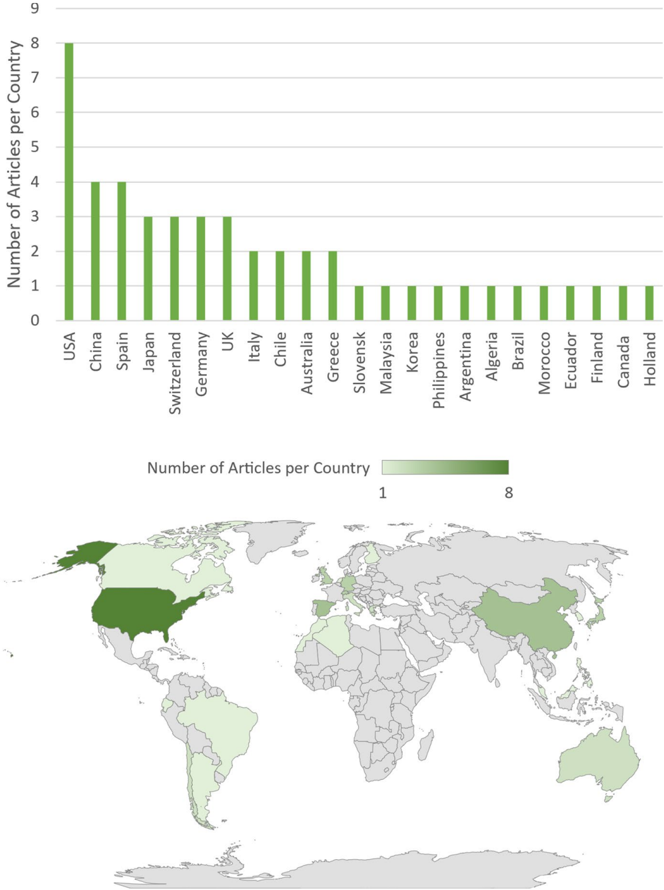
“The vast majority of selected articles were written or co-written by researchers from American universities.”
§ Interacting with educational chatbots: A systematic review > 5 Results
“the research that emerged from all European universities combined was the highest in the number of articles (19 articles).Asian universities have contributed 10 articles, while American universities contributed 9 articles.”
Citations
Cites
(2002) · Cited by 13,211
Hattie, J., & Timperley, H. (2007) · Review of Educational Research · doi:10.3102/003465430298487 · Cited by 12,905 · cited 1×
“• Lack of Feedback Feedback is a crucial element that affects learning in various environments (Hattie and Timperley, 2007).”
BackgroundELIZA—a computer program for the study of natural language communication between man and machine
Weizenbaum, J. (1966) · Communications of the ACM · doi:10.1145/365153.365168 · Cited by 4,452
International Journal of Scientific and Research Publications
(2022) · International Journal of Scientific and Research Publications · doi:10.29322/ijsrp · Cited by 2,691
Morgan, D. L. (1996) · Annual Review of Sociology · doi:10.1146/annurev.soc.22.1.129 · Cited by 2,353
Nass, C., Steuer, J., & Tauber, E. R. (1994) · Proceedings of the SIGCHI Conference on Human Factors in Computing Systems · doi:10.1145/191666.191703 · Cited by 2,148 · cited 1×
“…words such as “family” or “together” (Hirsh et al., 2009), words that are regarded as positive emotionally such as “like” or “nice” (Hirsh et al., 2009), words indicating assurance such as “sure” (Nass et al., 1994), as well as certain emojis (Völkel et al., 2019), as suggested by the literature.”
Encyclopedia of the Sciences of Learning
(2012) · doi:10.1007/978-1-4419-1428-6 · Cited by 1,091
Key Concepts in Social Research
Payne, G., & Payne, J. (2004) · doi:10.4135/9781849209397 · Cited by 975
Effectiveness of Intelligent Tutoring Systems: A Meta-Analytic Review
Kulik, J. A., & Fletcher, J. D. (2016) · Review of Educational Research · doi:10.3102/0034654315581420 · Cited by 930 · cited 1×
“Teaching agents play the role of human teachers and can present instructions, illustrate examples, ask questions (Wambs-ganss et al., 2020), and provide immediate feedback (Kulik & Fletcher, 2016).”
BackgroundChatbots applications in education: A systematic review
Okonkwo, C. W., & Ade-Ibijola, A. (2021) · Computers and Education: Artificial Intelligence · doi:10.1016/j.caeai.2021.100033 · Cited by 879
Chatbots for learning: A review of educational chatbots for the Facebook Messenger
Smutny, P., & Schreiberova, P. (2020) · Computers & Education · doi:10.1016/j.compedu.2020.103862 · Cited by 770 · cited 6×
“Smutny and Schreiberova (2020) examined chatbots as a learning aid for Facebook Mes-senger.”
BackgroundMethodInfluentialGroup Cognition: Computer Support for Building Collaborative Knowledge
Stahl, G. (2006) · The MIT Press eBooks · doi:10.7551/mitpress/3372.001.0001 · Cited by 694
Unleashing the Potential of Chatbots in Education: A State-Of-The-Art Analysis
Winkler, R., & Soellner, M. (2018) · Academy of Management Proceedings · doi:10.5465/ambpp.2018.15903abstract · Cited by 581 · cited 21×
“…such as the field of application (Smutny & Schreiberova, 2020; Wollny et al., 2021; Hwang & Chang, 2021), objectives and learning experience (Winkler & Söllner, 2018; Cunningham-Nelson et al., 2019; Pérez et al., 2020; Wollny et al., 2021; Hwang & Chang, 2021), how chatbots are applied…”
BackgroundResultInfluentialNass, C., Steuer, J., & Tauber, E. R. (1994) · Conference companion on Human factors in computing systems - CHI '94 · doi:10.1145/259963.260288 · Cited by 579
Chaves, A. P., & Gerosa, M. A. (2021) · International Journal of Human–Computer Interaction · doi:10.1080/10447318.2020.1841438 · Cited by 572 · cited 1×
“Research suggests that users treat chatbots as if they were humans (Chaves & Gerosa, 2021), and thus chatbots are increasingly built to have a personality.”
BackgroundThe impact of animated interface agents: a review of empirical research
DEHN, D. M., & VAN MULKEN, S. (2000) · International Journal of Human-Computer Studies · doi:10.1006/ijhc.1999.0325 · Cited by 567
End-User Development: An Emerging Paradigm
Lieberman, H., Paternò, F., Klann, M., & Wulf, V. (2006) · Human-Computer Interaction Series · doi:10.1007/1-4020-5386-x_1 · Cited by 561
Are We There Yet? - A Systematic Literature Review on Chatbots in Education
Wollny, S., Schneider, J., Di Mitri, D., Weidlich, J., Rittberger, M., & Drachsler, H. (2021) · Frontiers in Artificial Intelligence · doi:10.3389/frai.2021.654924 · Cited by 557 · cited 13×
“…found out that chat-bots motivate students, keep them engaged, and grant them immediate assistance, Field of application (Winkler & Söllner, 2018; Wollny et al., 2021; Hwang & Chang, 2021; Smutny & Schreiberova, 2020) Objectives and learning experiences (Winkler & Söllner, 2018;…”
BackgroundResultInfluentialConversational Agents in Health Care: Scoping Review and Conceptual Analysis
Tudor Car, L., Dhinagaran, D. A., Kyaw, B. M., Kowatsch, T., Joty, S., Theng, Y.-L., & Atun, R. (2020) · Journal of Medical Internet Research · doi:10.2196/17158 · Cited by 553 · cited 1×
“Concerning the platform, chatbots can be deployed via messaging apps such as Telegram, Facebook Messenger, and Slack (Car et al., 2020), standalone web or phone applications, or integrated into smart devices such as television sets.”
BackgroundA New Chatbot for Customer Service on Social Media
Xu, A., Liu, Z., Guo, Y., Sinha, V., & Akkiraju, R. (2017) · Proceedings of the 2017 CHI Conference on Human Factors in Computing Systems · doi:10.1145/3025453.3025496 · Cited by 550
A review of opportunities and challenges of chatbots in education
Hwang, G.-J., & Chang, C.-Y. (2023) · Interactive Learning Environments · doi:10.1080/10494820.2021.1952615 · Cited by 530 · cited 12×
“…2020) Objectives and learning experiences (Winkler & Söllner, 2018; Cunningham-Nelson et al., 2019; Pérez et al., 2020; Wollny et al., 2021; Hwang & Chang, 2021) How it is applied (Winkler & Söllner, 2018; Cunningham-Nelson et al., 2019; Wollny et al., 2021) Design approaches (Winkler &…”
BackgroundMethodResultInfluentialFreeLing 3.0: Towards Wider Multilinguality
Padró, L., & Stanilovsky, E. (2012) · Language Resources and Evaluation Conference (LREC) · doi:10.63317/4etcsxkc5akn · Cited by 489
Rediscovering the use of chatbots in education: A systematic literature review
Pérez, J. Q., Daradoumis, T., & Puig, J. M. M. (2020) · Computer Applications in Engineering Education · doi:10.1002/cae.22326 · Cited by 483
Fryer, L. K., Ainley, M., Thompson, A., Gibson, A., & Sherlock, Z. (2017) · Computers in Human Behavior · doi:10.1016/j.chb.2017.05.045 · Cited by 448
D'mello, S., & Graesser, A. (2012) · ACM Transactions on Interactive Intelligent Systems · doi:10.1145/2395123.2395128 · Cited by 388
When Are Tutorial Dialogues More Effective Than Reading?
VanLehn, K., Graesser, A. C., Jackson, G. T., Jordan, P., Olney, A., & Rosé, C. P. (2007) · Cognitive Science · doi:10.1080/03640210709336984 · Cited by 378 · cited 1×
“Furthermore, conversational agents have been used to meet a variety of educational needs such as question-answering (Feng et al., 2006), tutoring (Heffernan & Croteau, 2004; VanLehn et al., 2007), and language learning (Heffernan & Croteau, 2004; VanLehn et al., 2007).”
BackgroundTeachable Agents and the Protégé Effect: Increasing the Effort Towards Learning
Chase, C. C., Chin, D. B., Oppezzo, M. A., & Schwartz, D. L. (2009) · Journal of Science Education and Technology · doi:10.1007/s10956-009-9180-4 · Cited by 347
Chatbots: changing user needs and motivations
Brandtzaeg, P. B., & Følstad, A. (2018) · Interactions · doi:10.1145/3236669 · Cited by 322
Laitinen, H. (1970) · Analytical Chemistry · doi:10.1021/ac60288a601 · Cited by 289
Oh, K.-J., Lee, D., Ko, B., & Choi, H.-J. (2017) · 2017 18th IEEE International Conference on Mobile Data Management (MDM) · doi:10.1109/mdm.2017.64 · Cited by 285
Exploring feedback and student characteristics relevant for personalizing feedback strategies
Narciss, S., Sosnovsky, S., Schnaubert, L., Andrès, E., Eichelmann, A., Goguadze, G., & Melis, E. (2014) · Computers & Education · doi:10.1016/j.compedu.2013.09.011 · Cited by 260
Chatbot: An Education Support System for Student
Clarizia, F., Colace, F., Lombardi, M., Pascale, F., & Santaniello, D. (2018) · Lecture Notes in Computer Science · doi:10.1007/978-3-030-01689-0_23 · Cited by 260
Bringing Chatbots into education: Towards Natural Language Negotiation of Open Learner Models
Kerlyl, A., Hall, P., & Bull, S. (2007) · Applications and Innovations in Intelligent Systems XIV · doi:10.1007/978-1-84628-666-7_14 · Cited by 244
Encyclopedia of the Sciences of Learning
(2012) · Choice Reviews Online · doi:10.5860/choice.50-1234 · Cited by 237
ALICE Chatbot: Trials and Outputs
AbuShawar, B., & Atwell, E. (2015) · Computación y Sistemas · doi:10.13053/cys-19-4-2326 · Cited by 222
The design of motivational agents and avatars
Baylor, A. L. (2011) · Educational Technology Research and Development · doi:10.1007/s11423-011-9196-3 · Cited by 199 · cited 3×
“When interacting with students, chatbots have taken various roles such as teaching agents, peer agents, teachable agents, and motivational agents (Chhibber & Law, 2019; Baylor, 2011; Kerry et al., 2008).”
BackgroundMethodUser Interface Design: A Software Engineering Perspective
Lauesen, S. (2004) · Cited by 190
The Design and Impact of the Pedagogical Agent: A Systematic Literature Review
Martha, A. S. D., & Santoso, H. B. (2019) · The Journal of Educators Online · doi:10.9743/jeo.2019.16.1.8 · Cited by 179
Winkler, R., Hobert, S., Salovaara, A., Söllner, M., & Leimeister, J. M. (2020) · Proceedings of the 2020 CHI Conference on Human Factors in Computing Systems · doi:10.1145/3313831.3376781 · Cited by 177 · cited 8×
“As a result, they became frustrated (Winkler et al., 2020) and could not wholly engage in the learning process (Verleger & Pembridge, 2018; Qin et al.”
BackgroundMethodInfluentialFølstad, A., Skjuve, M. B., & Brandtzæg, P. B. (2019) · Lecture notes in computer science · doi:10.1007/978-3-030-17705-8_13 · Cited by 176
Embodied conversational agents in computer assisted language learning
Wik, P., & Hjalmarsson, A. (2009) · Speech Communication · doi:10.1016/j.specom.2009.05.006 · Cited by 168
A Survey of Design Techniques for Conversational Agents
Ramesh, K., Ravishankaran, S., Joshi, A., & Chandrasekaran, K. (2017) · Communications in Computer and Information Science · doi:10.1007/978-981-10-6544-6_31 · Cited by 163
(2011) · Advances in Game-Based Learning · doi:10.4018/978-1-60960-495-0 · Cited by 163
Architecture for Building Conversational Agents That Support Collaborative Learning
Kumar, R., & Rosé, C. P. (2011) · IEEE Transactions on Learning Technologies · doi:10.1109/tlt.2010.41 · Cited by 160 · cited 1×
“Moreover, chatbots may interact with students individually (Hobert & Meyer von Wolff, 2019) or support collaborative learning activities (Chaudhuri et al., 2009; Tegos et al., 2014; Kumar & Rose, 2010; Stahl, 2006; Walker et al., 2011).”
BackgroundLook Like Me: Matching Robot Personality via Gaze to Increase Motivation
Andrist, S., Mutlu, B., & Tapus, A. (2015) · Proceedings of the 33rd Annual ACM Conference on Human Factors in Computing Systems · doi:10.1145/2702123.2702592 · Cited by 159 · cited 2×
“Other personalities have also been attributed to chatbots, such as casual and formal personalities, where a formal chatbot uses a standardized language with proper grammar and punctuation, whereas a casual chatbot includes everyday, informal language (Andrist et al., 2015; Cafaro et al., 2016).”
BackgroundMetatraits of the Big Five Differentially Predict Engagement and Restraint of Behavior
Hirsh, J. B., DeYoung, C. G., & Peterson, J. B. (2009) · Journal of Personality · doi:10.1111/j.1467-6494.2009.00575.x · Cited by 157 · cited 3×
“…uses family-oriented words such as “family” or “together” (Hirsh et al., 2009), words that are regarded as positive emotionally such as “like” or “nice” (Hirsh et al., 2009), words indicating assurance such as “sure” (Nass et al., 1994), as well as certain emojis (Völkel et al., 2019), as…”
BackgroundInfluentialVillegas-Ch, W., Arias-Navarrete, A., & Palacios-Pacheco, X. (2020) · Sustainability · doi:10.3390/su12041500 · Cited by 152 · cited 5×
“Villegas-Ch et al. (2020) noted that the lack of assessments and exercises coupled with the absence of the feedback mechanism negatively affected the chatbot’s success.”
BackgroundInfluential(1992) · Open Research Online (The Open University) · Cited by 150
A Tool for Introducing Computer Science with Automatic Formative Assessment
Benotti, L., Martinez, M. C., & Schapachnik, F. (2018) · IEEE Transactions on Learning Technologies · doi:10.1109/tlt.2017.2682084 · Cited by 141 · cited 3×
“The matching could be done using pattern matching as discussed in (Benotti et al., 2017; Clarizia et al., 2018) or simply by relying on a specific conversational tool such as Dialogflow 9 as in (Mendez et al., 2020; Lee et al., 2020; Ondáš et al., 2019).”
BackgroundMethodI hate you! Disinhibition with virtual partners
Angeli, A. D., & Brahnam, S. (2008) · Interacting with Computers · doi:10.1016/j.intcom.2008.02.004 · Cited by 140
ArgueTutor: An Adaptive Dialog-Based Learning System for Argumentation Skills
Wambsganss, T., Kueng, T., Soellner, M., & Leimeister, J. M. (2021) · Proceedings of the 2021 CHI Conference on Human Factors in Computing Systems · doi:10.1145/3411764.3445781 · Cited by 138
An Educational Chatbot for Answering Queries
Sinha, S., Basak, S., Dey, Y., & Mondal, A. (2019) · Advances in intelligent systems and computing · doi:10.1007/978-981-13-7403-6_7 · Cited by 128
A review of chatbots in education: Practical steps forward
Cunningham, S., Boles, W., Trouton, L., & Margerison, E. (2019) · QUT ePrints (Queensland University of Technology) · Cited by 123
First Impressions in Human--Agent Virtual Encounters
Cafaro, A., Vilhjálmsson, H. H., & Bickmore, T. (2016) · ACM Transactions on Computer-Human Interaction · doi:10.1145/2940325 · Cited by 120 · cited 1×
“Other personalities have also been attributed to chatbots, such as casual and formal personalities, where a formal chatbot uses a standardized language with proper grammar and punctuation, whereas a casual chatbot includes everyday, informal language (Andrist et al., 2015; Cafaro et al., 2016).”
BackgroundKester, L., Kirschner, P. A., & van Merriënboer, J. J. G. (2005) · British Journal of Educational Psychology · doi:10.1348/000709904x19254 · Cited by 115 · cited 1×
“Many studies claim that students learn better when the chatbot is represented by a personalized method rather than a non-personalized one (Kester et al., 2005).”
BackgroundAn intelligent discussion-bot for answering student queries in threaded discussions
Feng, D., Shaw, E., Kim, J., & Hovy, E. (2006) · Proceedings of the 11th international conference on Intelligent user interfaces · doi:10.1145/1111449.1111488 · Cited by 114
How chatbots influence marketing
Kaczorowska-Spychalska, D. (2019) · Management · doi:10.2478/manment-2019-0015 · Cited by 113
Conversational Agents in E-Learning
Kerry, A., Ellis, R., & Bull, S. (2009) · Springer eBooks · doi:10.1007/978-1-84882-215-3_13 · Cited by 113
Usability Heuristics for Touchscreen-based Mobile Devices
Inostroza, R., Rusu, C., Roncagliolo, S., Jimenez, C., & Rusu, V. (2012) · 2012 Ninth International Conference on Information Technology - New Generations · doi:10.1109/itng.2012.134 · Cited by 110
Walker, E., Rummel, N., & Koedinger, K. R. (2011) · International Journal of Computer-Supported Collaborative Learning · doi:10.1007/s11412-011-9111-2 · Cited by 108
Chou, C.-Y., & Zou, N.-B. (2020) · International Journal of Educational Technology in Higher Education · doi:10.1186/s41239-020-00233-y · Cited by 102
“Interacting with a conversational agent system for educational purposes in online courses.”
Song, D., Oh, E. Y., & Rice, M. (2017) · 2017 10th International Conference on Human System Interactions (HSI) · doi:10.1109/hsi.2017.8005002 · Cited by 101 · cited 6×
“Song et al. (2017) describe reflection as an intellectual activity that supports the course’s weekly reflection for online learners.”
BackgroundInfluentialEncyclopedia of the Sciences of Learning
(2012) · Reference Reviews · doi:10.1108/09504121211278133 · Cited by 93
Tegos, S., Demetriadis, S., & Karakostas, A. (2015) · Computers & Education · doi:10.1016/j.compedu.2015.07.014 · Cited by 90 · cited 3×
“Collaborative learning has been demonstrated to be beneficial in improving students’ knowledge and improving the students’ critical thinking and argumentation (Tegos et al., 2015).”
BackgroundMethodA Pilot Study Integrating an AI-driven Chatbot in an Introductory Programming Course
Verleger, M., & Pembridge, J. (2018) · 2018 IEEE Frontiers in Education Conference (FIE) · doi:10.1109/fie.2018.8659282 · Cited by 86
Tegos, S., Demetriadis, S., & Tsiatsos, T. (2014) · International Journal of Artificial Intelligence in Education · doi:10.1007/s40593-013-0007-3 · Cited by 85
Shin, D., Chotiyaputta, V., & Zaid, B. (2022) · Computers in Human Behavior · doi:10.1016/j.chb.2021.107007 · Cited by 84
Usability heuristics for touchscreen-based mobile devices: update
Inostroza, R., Rusu, C., Roncagliolo, S., & Rusu, V. (2013) · Proceedings of the 2013 Chilean Conference on Human - Computer Interaction · doi:10.1145/2535597.2535602 · Cited by 82
Ruan, S., Willis, A., Xu, Q., Davis, G. M., Jiang, L., Brunskill, E., & Landay, J. A. (2019) · Proceedings of the Sixth (2019) ACM Conference on Learning @ Scale · doi:10.1145/3330430.3333643 · Cited by 81
Cognitive anatomy of tutor learning: Lessons learned with SimStudent.
Matsuda, N., Yarzebinski, E., Keiser, V., Raizada, R., Cohen, W. W., Stylianides, G. J., & Koedinger, K. R. (2013) · Journal of Educational Psychology · doi:10.1037/a0031955 · Cited by 79
King, F. B. (2002) · The Internet and Higher Education · doi:10.1016/s1096-7516(02)00085-4 · Cited by 77
Visualizing Student Opinion Through Text Analysis
Cunningham-Nelson, S., Baktashmotlagh, M., & Boles, W. (2019) · IEEE Transactions on Education · doi:10.1109/te.2019.2924385 · Cited by 75
EnglishBot: An AI-Powered Conversational System for Second Language Learning
Ruan, S., Jiang, L., Xu, Q., Liu, Z., Davis, G. M., Brunskill, E., & Landay, J. A. (2021) · 26th International Conference on Intelligent User Interfaces · doi:10.1145/3397481.3450648 · Cited by 71
Rodrigo, M. M. T., Baker, R. S. J. D., Agapito, J., Nabos, J., Repalam, M. C., Reyes, S. S., & San Pedro, M. O. C. Z. (2012) · IEEE Transactions on Affective Computing · doi:10.1109/t-affc.2011.41 · Cited by 70 · cited 4×
“A few other subjects were targeted by the educational chatbots, such as engineering (Mendez et al., 2020), religious education (Alobaidi et al., 2013), psychology (Hayashi, 2013), and mathematics (Rodrigo et al., 2012).”
BackgroundInfluentialCharacterizing Visual Programming Approaches for End-User Developers: A Systematic Review
Kuhail, M. A., Farooq, S., Hammad, R., & Bahja, M. (2021) · IEEE Access · doi:10.1109/access.2021.3051043 · Cited by 69
Self-citationBuilding a Social Conversational Pedagogical Agent: Design Challenges and Methodological approaches
Gulz, A., Haake, M., Silvervarg, A., Sjödén, B., & Veletsianos, G. (2011) · Conversational Agents and Natural Language Interaction · doi:10.4018/978-1-60960-617-6.ch006 · Cited by 65
How chatbots can be involved in the education process
Ondas, S., Pleva, M., & Hladek, D. (2019) · 2019 17th International Conference on Emerging eLearning Technologies and Applications (ICETA) · doi:10.1109/iceta48886.2019.9040095 · Cited by 65 · cited 10×
“Another example is the study presented in (Ondáš et al., 2019), where the authors evaluated various aspects of a chatbot used in the education process, including helpfulness, whether users wanted more features in the chatbot, and subjective satisfaction.”
BackgroundMethodInfluentialA Look at the Roles of Look & Roles in Embodied Pedagogical Agents – A User Preference Perspective
Haake, M., & Gulz, A. (2009) · International Journal of Artificial Intelligence in Education · doi:10.3233/irg-2009-19(1)03 · Cited by 59
“Using a multiplatform chatbot as an online tutor in a university course.”
Lee, L.-K., Fung, Y.-C., Pun, Y.-W., Wong, K.-K., Yu, M. T.-Y., & Wu, N.-I. (2020) · 2020 International Symposium on Educational Technology (ISET) · doi:10.1109/iset49818.2020.00021 · Cited by 57 · cited 9×
“For instance, the chatbot presented in (Lee et al., 2020) aims to increase learning effectiveness by allowing students to ask questions related to the course materials.”
BackgroundMethodInfluentialLecturer's Apprentice: A Chatbot for Assisting Novice Programmers
Ismail, M., & Ade-Ibijola, A. (2019) · 2019 International Multidisciplinary Information Technology and Engineering Conference (IMITEC) · doi:10.1109/imitec45504.2019.9015857 · Cited by 54
Chatbot Personalities Matters: Improving the User Experience of Chatbot Interfaces
Smestad, T. L., & Volden, F. (2019) · Lecture Notes in Computer Science · doi:10.1007/978-3-030-17705-8_15 · Cited by 52
End-user adoption of animated interface agentsin everyday work applications
Serenko, A., Bontis, N., & Detlor, B. (2007) · Behaviour & Information Technology · doi:10.1080/01449290500260538 · Cited by 51
Understanding Emoji Interpretation through User Personality and Message Context
Völkel, S. T., Buschek, D., Pranjic, J., & Hussmann, H. (2019) · Proceedings of the 21st International Conference on Human-Computer Interaction with Mobile Devices and Services · doi:10.1145/3338286.3340114 · Cited by 51
A cognitive assistant for learning java featuring social dialogue
Coronado, M., Iglesias, C. A., Carrera, Á., & Mardomingo, A. (2018) · International Journal of Human-Computer Studies · doi:10.1016/j.ijhcs.2018.02.004 · Cited by 46
Engaging Collaborative Learners with Helping Agents
Sourish, C., Rohit, K., Iris, H., & Penstein, R. C. (2009) · Frontiers in Artificial Intelligence and Applications · doi:10.3233/978-1-60750-028-5-365 · Cited by 44
e-JAVA Chatbot for Learning Programming Language: A Post-Pandemic Alternative Virtual Tutor
Daud, S. H. M. (2020) · International Journal of Emerging Trends in Engineering Research · doi:10.30534/ijeter/2020/67872020 · Cited by 44
A Conversational Agent to Improve Response Quality in Course Evaluations
Wambsganss, T., Winkler, R., Söllner, M., & Leimeister, J. M. (2020) · Extended Abstracts of the 2020 CHI Conference on Human Factors in Computing Systems · doi:10.1145/3334480.3382805 · Cited by 43
“I Like Your Shirt” - Dialogue Acts for Enabling Social Talk in Conversational Agents
Klüwer, T. (2011) · Lecture notes in computer science · doi:10.1007/978-3-642-23974-8_2 · Cited by 42
A Digital Coach That Provides Affective and Social Learning Support to Low-Literate Learners
Schouten, D. G. M., Venneker, F., Bosse, T., Neerincx, M. A., & Cremers, A. (2017) · IEEE Transactions on Learning Technologies · doi:10.1109/tlt.2017.2698471 · Cited by 38
Critical Literature Review on Chatbots in Education
Thomas, H. (2020) · International Journal of Trend in Scientific Research and Development · Cited by 34
IBM Watson Application as FAQ Assistant about Moodle
Oliveira, J. D. S., Espindola, D. B., Barwaldt, R., Ribeiro, L. M., & Pias, M. (2019) · 2019 IEEE Frontiers in Education Conference (FIE) · doi:10.1109/fie43999.2019.9028667 · Cited by 32
Brewer, R. N., Findlater, L., Kaye, J. '., Lasecki, W., Munteanu, C., & Weber, A. (2018) · Companion of the 2018 ACM Conference on Computer Supported Cooperative Work and Social Computing · doi:10.1145/3272973.3273006 · Cited by 32 · cited 1×
“Voice-based chat-bots are more accessible to older adults and some special-need people (Brewer et al., 2018).”
BackgroundExamining User Preference for Agreeableness in Chatbots
Völkel, S. T., & Kaya, L. (2021) · CUI 2021 - 3rd Conference on Conversational User Interfaces · doi:10.1145/3469595.3469633 · Cited by 31 · cited 2×
“In fact, researchers have also used the Big Five model to explain the personalities a chatbot can have when interacting with users (Völkel & Kaya, 2021; McCrae & Costa, 2008).”
BackgroundMethodChatbot Application using Search Engines and Teaching Methods
Anghelescu, P., & Nicolaescu, S. V. (2018) · International Conference on Electronics, Computers and Artificial Intelligence (ECAI) · doi:10.1109/ecai.2018.8678948 · Cited by 30
Curiosity Notebook: A Platform for Learning by Teaching Conversational Agents
Law, E., Baghaei Ravari, P., Chhibber, N., Kulic, D., Lin, S., Pantasdo, K. D., Ceha, J., Suh, S., & Dillen, N. (2020) · Extended Abstracts of the 2020 CHI Conference on Human Factors in Computing Systems · doi:10.1145/3334480.3382783 · Cited by 28
Effective Learning of Tax Regulations using Different Chatbot Techniques
Mellado, R., Ugalde, A. F., & Lobos, M. B. (2020) · Advances in Science Technology and Engineering Systems Journal · doi:10.25046/aj050652 · Cited by 26
Adaptive Tutoring in an Intelligent Conversational Agent System
Latham, A., Crockett, K. A., McLean, D., & Edmonds, B. (2012) · Transactions on computational science · doi:10.1007/978-3-642-34645-3_7 · Cited by 24
Chatbots: A Tool to Supplement the Future Faculty Mentoring of Doctoral Engineering Students
Mendez, S., Johanson, K., Martin Conley, V., Gosha, K., A Mack, N., Haynes, C., & A Gerhardt, R. (2020) · International Journal of Doctoral Studies · doi:10.28945/4579 · Cited by 23 · cited 4×
“A few other subjects were targeted by the educational chatbots, such as engineering (Mendez et al., 2020), religious education (Alobaidi et al., 2013), psychology (Hayashi, 2013), and mathematics (Rodrigo et al., 2012).”
BackgroundMethodInfluential(2013) · Cited by 22
PathBot: An Intelligent Chatbot for Guiding Visitors and Locating Venues
Mabunda, K., & Ade-Ibijola, A. (2019) · 2019 6th International Conference on Soft Computing & Machine Intelligence (ISCMI) · doi:10.1109/iscmi47871.2019.9004411 · Cited by 21
UniBud: A Virtual Academic Adviser
Alkhoori, A., Kuhail, M. A., & Alkhoori, A. (2020) · Annual Undergraduate Research Conference on Applied Computing (URC) · doi:10.1109/urc49805.2020.9099191 · Cited by 20
Self-citationAdaptive e-Learning AI-Powered Chatbot based on Multimedia Indexing
Janati, S. E., Maach, A., & El, D. (2020) · International Journal of Advanced Computer Science and Applications · doi:10.14569/ijacsa.2020.0111238 · Cited by 20 · cited 4×
“(Janati et al., 2020) Peer agent, chatbot driven N/A High effectiveness”
BackgroundMethodInfluentialHeffernan, N. T., & Croteau, E. A. (2004) · Lecture notes in computer science · doi:10.1007/978-3-540-30139-4_46 · Cited by 19
Enriching Synchronous Collaboration in Online Courses with Configurable Conversational Agents
Tegos, S. D., Psathas, G., Tsiatsos, Τ., Katsanos, C., Καρακώστας, Α., Tsibanis, C., & Demetriadis, S. (2020) · Lecture notes in computer science · doi:10.1007/978-3-030-49663-0_34 · Cited by 16
Rexy, A Configurable Application for Building Virtual Teaching Assistants
Benedetto, L., & Cremonesi, P. (2019) · Lecture notes in computer science · doi:10.1007/978-3-030-29384-0_15 · Cited by 13
Ayedoun, E., Hayashi, Y., & Seta, K. (2017) · Lecture Notes in Computer Science · doi:10.1007/978-3-319-61425-0_40 · Cited by 12 · cited 5×
“• Affective learning Affective learning is a form of empathetic feedback given to the learner to keep the interest, attention, or desire to learn (Ayedoun et al., 2017).”
BackgroundMethodInfluentialUsing Conversational Agents To Support Learning By Teaching
Chhibber, N., & Law, E. (2019) · arXiv · doi:10.48550/arxiv.1909.13443 · Cited by 11 · cited 1×
“When interacting with students, chatbots have taken various roles such as teaching agents, peer agents, teachable agents, and motivational agents (Chhibber & Law, 2019; Baylor, 2011; Kerry et al., 2008).”
BackgroundOscar: An Intelligent Adaptive Conversational Agent Tutoring System
Latham, A., Crockett, K., McLean, D., & Edmonds, B. (2011) · Lecture Notes in Computer Science · doi:10.1007/978-3-642-22000-5_58 · Cited by 10 · cited 4×
“Other studies discussed a scenario-based approach to teaching with teaching agents (Latham et al., 2011; D’mello & Graesser, 2013).”
BackgroundMethodInfluentialA Multimodal Conversational Agent for Personalized Language Learning
Griol, D., Baena, I. N., Molina, J. M., & Sanchis, A. (2014) · Advances in intelligent systems and computing · doi:10.1007/978-3-319-07596-9_2 · Cited by 8
Designing a Conversational Agent as a Formative Course Evaluation Tool
Wambsganß, T., Winkler, R., Schmid, P., & Söllner, M. (2020) · doi:10.30844/wi_2020_k7-wambsganss · Cited by 7
A chatbot as an environment for carrying out the group decision making process.
Chukhno, O., Chukhno, N., Samouylov, K. E., & Shorgin, S. Y. (2019) · Cited by 6
The EducAgent Platform: Intelligent Conversational Agents for E-Learning Applications
Griol, D., Garcı́a, J., & Molina, J. M. (2011) · Advances in intelligent and soft computing · doi:10.1007/978-3-642-19937-0_15 · Cited by 5
CUSTOMIZABLE VISUALIZATIONS WITH FORMULA-LINKED BUILDING BLOCKS
(2012) · doi:10.5220/0003863207680771 · Cited by 2
Self-citationInterpreting learners' traces in collaborative learning environments
Zedadra, A., Lafifi, Y., & Zedadra, O. (2014) · International Symposium ISKO-Maghreb: Concepts and Tools for Knowledge Management (ISKO-Maghreb) · doi:10.1109/isko-maghreb.2014.7033472 · Cited by 2
Research works printed but not linked: 7
- 4. Benotti, L., Martnez, M.C., & Schapachnik, F. (2018). Atool for introducing computer science with auto- matic formative assessment. IEEE Transactions on Learning Technologies, 11(2), 179-192. https:// doi. org/ 10. 1109/ TLT. 2017. 26820 · DOI · Paper page
- 33. Ruttkay, Z., & Pelachaud, C. (2006). From browstotrust: Evaluating embodied conversational agents Vol. 7. Berlin: Springer Science & Business Media.
- 38. Shneiderman, B., Plaisant, C., Cohen, M.S, Jacobs, S., Elmqvist, N., & Diakopoulos, N. (2016). Design- ingthe user interface: strategies for effective human-computer interaction. London: Pearson.
- 54. Bradeško, L., & Mladenić, D. (2012). A survey of chatbot systemsthrough a loebner prize competition. In Proceedings of Slovenian language technologies society eighth conference of language technolo- gies (pp. 34-37).
- 72. Hobert, S., & Meyer von Wolff, R. (2019). Say helloto your new automatedtutor-a structured literature review on pedagogical conversational agents.
- 86. Laurillard, D. (2013). Rethinking university teaching: A conversational framework for the effective use of learning technologies. Routledge.
- 102. Qin, C., Huang, W., & Hew, K.F. (2020). Usingthe community of inquiry framework to develop an educational chatbot: lesson learned from a mobile instant messaging learning environment. In Proceedings ofthe 28th international conference on computers in education.
Cited by
What if the devil is my guardian angel: ChatGPT as a case study of using chatbots in education
Tlili, A., Shehata, B., Adarkwah, M. A., Bozkurt, A., Hickey, D. T., Huang, R., & Agyemang, B. (2023) · Smart Learning Environments · doi:10.1186/s40561-023-00237-x · Cited by 2,003
ChatGPT for Language Teaching and Learning
Kohnke, L., Moorhouse, B. L., & Zou, D. (2023) · RELC Journal · doi:10.1177/00336882231162868 · Cited by 1,371
Role of AI chatbots in education: systematic literature review
Labadze, L., Grigolia, M., & Machaidze, L. (2023) · International Journal of Educational Technology in Higher Education · doi:10.1186/s41239-023-00426-1 · Cited by 1,043
Large Language Models in Medical Education: Opportunities, Challenges, and Future Directions
Abd-alrazaq, A., AlSaad, R., Alhuwail, D., Ahmed, A., Healy, P. M., Latifi, S., Aziz, S., Damseh, R., Alabed Alrazak, S., & Sheikh, J. (2023) · JMIR Medical Education · doi:10.2196/48291 · Cited by 722
“When developing generative AI technologies, it is also essential to adhere to user-focused design principles while taking into account the social, emotional, cognitive, and pedagogical dimensions [65].”
BackgroundJeon, J., & Lee, S. (2023) · Education and Information Technologies · doi:10.1007/s10639-023-11834-1 · Cited by 696
“…to predefined dialogue paths or feature simplistic question-and-answer dialogue structures (for a review on existing educational chatbots, see Kuhail et al., 2022), this exponentially advanced chatbot can generate answers according to the context of a given prompt, and thus, can engage in a…”
BackgroundInfluential
Metadata
- Authors
- Kuhail, M. A., Alturki, N., Alramlawi, S., & Alhejori, K.
- Affiliations
- Zayed University (AE)
- Princess Nourah bint Abdulrahman University (SA)
- Corresponding author
- Alturki, Nazik
- Venue
- Education and Information Technologies
- Published
- 2022-07-09
- Volume
- 28
- Issue
- 1
- Pages
- 973-1018
- ISSN
- 1360-2357 (ISSN-L)
- 1573-7608
- OpenAlex
- W4284991798
- Cited by
- 841
- References
- 110
- Citations by year
- 2026: 201 · 2025: 253 · 2024: 248 · 2023: 133 · 2022: 4
- FWCI
- 11.12
- Type
- journal article
- Language
- en
- Open access
- hybrid
- doi.org
- Licence
- cc-by
- creativecommons.org/licenses/by/4.0 (tdm)
- creativecommons.org/licenses/by/4.0 (vor)
- Locations
- Education and Information Technologies (publishedVersion, cc-by)
- Topics
- Physical Sciences › Computer Science › Artificial Intelligence › Intelligent Tutoring Systems and Adaptive Learning
- Social Sciences › Education › Artificial Intelligence in Education
- Social Sciences › Business, Management and Accounting › Marketing › AI in Service Interactions
- Keywords
- educational chatbots, personalized learning, peer agents, chatbot personality, student satisfaction, chatbot evaluation, chatbot usability
About these checks
Registry, retraction, Cites and statistics results are computed, not judged, with one exception: a printed reference that no index lists is read once by a model before it counts as a citation error. Claims are extracted by a model and kept only when their quote appears verbatim in the text; each cited source is then checked, with a model’s help, for whether it says what the claim relies on. Those verdicts can be wrong — read the claim’s quote and the cited source before relying on one.
The claim verdicts this report counts are experimental: their accuracy is not yet measured.
A language model drew the claims from the paper on 2026-10-10, under version 3 of the claim definition (model deepseek-v4.1-flash, prompt extract-v3).
A second model labelled each claim on 2026-10-10 (model jev-1.13-20260917, definition revision gold-guideline-v0.2).
Cited sources are checked with a language model’s help (gpt-6-sol and qwen3.8-omni-flash).
Statistics and arithmetic are recomputed, not judged.
Confidence bands are shown only for fields calibrated on our annotated test set. None is calibrated yet, so no band is shown.
What counts as a claim ›How we measure confidence ›How we check this ›
Are you an author, or do you see a problem with this page? Request a review
Data sources
Bibliographic data: Semantic Scholar, OpenAlex, Crossref.
Contains information from the Semantic Scholar Academic Graph Datasets, made available under the ODC Attribution License (ODC-BY 1.0).
Semantic Scholar’s data is described in: Kinney, R., et al. (2023). The Semantic Scholar Open Data Platform. arXiv:2301.10140.
