

Looking at Mental Effort Appraisals through a Metacognitive Lens: Are they Biased?
Open accessThe DOI matches its Crossref record; 103 of the 103 references it cites were found in a registry or an index.
Abstract
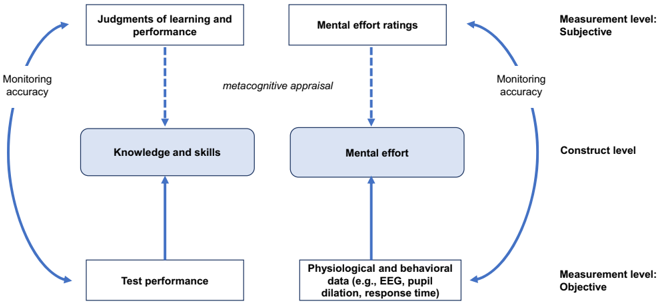
A central factor in research guided by the Cognitive Load Theory (CLT) is the mental effort people invest in performing a task. Mental effort is commonly assessed by asking people to report their effort throughout performing, learning, or problem-solving tasks. Although this measurement is considered reliable and valid in CLT research, metacognitive research provides robust evidence that self-appraisals of performance are often biased. In this review, we consider the possibility that mental effort appraisals may also be biased. In particular, we review signs for covariations and mismatches between subjective and objective measures of effort. Our review suggests that subjective and most objective effort measures appear reliable and valid when evaluated in isolation, because they discriminate among tasks of varying complexity. However, not much is known about their mutual correspondence—that is, whether subjective measures covariate with objective measures. Moreover, there is evidence that people utilize heuristic cues when appraising their effort, similar to utilization of heuristic cues underlying metacognitive appraisals of performance. These cues are identified by exposing biases—mismatch in effects of cue variations on appraisals and performance. The review concludes with a research agenda in which we suggest applying the well-established methodologies for studying biases in self-appraisals of performance in metacognitive research to investigating effort appraisals. One promising method could be to determine the covariation of effort appraisals and objective effort measures as an indicator of the resolution of effort appraisals.
Overview
The claims and statistics of this paper haven’t been checked yet.
Free: it reads the open-access text and checks the first 5 claims that cite a source we can check. Create a free account to check every claim.
Integrity signals
Registry
Cites
Statistics
Figures
Verification
Claims the paper makes
The claims and statistics of this paper haven’t been checked yet.
Free: it reads the open-access text and checks the first 5 claims that cite a source we can check. Create a free account to check every claim.
Claims other papers make about this one
Each is checked against this paper’s own text: does it say what the citing paper says it does?
The source backs part of the claim, not all of it — or backs it for a different population, condition or comparison.
In the citing paper
“Instead, learners derive them dynamically through several sources of information such as their effort beliefs, prior task experience, current level of fatigue, interest in the task, and fluency of processing.”
From Worth the Effort: the Start and Stick to Desirable Difficulties (S2D2) Framework (2023) · cites this paper as Scheiter et al., 2020
Experimental — accuracy not yet measuredThe cited source says what the claim attributes to it.
In the citing paper
“That is, self-reports of effort through ratings on a Likert-type scale should not be viewed as objective reflections of effort based solely on the difficulty of a task.”
From Worth the Effort: the Start and Stick to Desirable Difficulties (S2D2) Framework (2023) · cites this paper as Scheiter et al., 2020
In the citing paper
“Irrespective of what operationalization is chosen, it is important to note that it is not trivial to evaluate and conceptualize effort (see extensive discussions in Baars et al., 2020;Scheiter et al., 2020).”
From Motivation-Achievement Cycles in Learning: a Literature Review and Research Agenda (2022) · cites this paper as Scheiter et al., 2020
Self-check
Percentages, sums and reported differences re-computed from the paper’s own numbers.
The self-check needs the paper’s full text.
Citations
Cites
A social-cognitive approach to motivation and personality.
Dweck, C. S., & Leggett, E. L. (1988) · Psychological Review · doi:10.1037/0033-295x.95.2.256 · Cited by 9,745 · cited 1×
“According to Dweck and Leggett (1988), students differ in their implicit theories of intelligence (or mindsets), in that some perceive ability as malleable (growth mindset), whereas others perceive it as fixed.”
BackgroundShiffrin, R. M., & Schneider, W. (1977) · Psychological Review · doi:10.1037/0033-295x.84.2.127 · Cited by 7,335 · cited 1×
“Effort is assumed to result from controlled (as compared to automatic) processing of taskrelevant information (cf. Shiffrin and Schneider 1977).”
BackgroundCognitive Architecture and Instructional Design
Sweller, J., van Merrienboer, J. J. G., & Paas, F. G. W. C. (1998) · Educational Psychology Review · doi:10.1023/a:1022193728205 · Cited by 6,023 · cited 4×
“…speaking. either hinder task performance by overloading the cognitive system with unnecessary cognitive processing (i.e., extraneous cognitive load, Sweller et al. 1998) or foster performance by stimulating cognitive processes relevant for learning (i.e., germane cognitive load, Sweller et al.…”
BackgroundInfluentialSweller, J., Ayres, P., & Kalyuga, S. (2011) · doi:10.1007/978-1-4419-8126-4 · Cited by 5,531
Sweller, J. (2011) · Psychology of Learning and Motivation · doi:10.1016/b978-0-12-387691-1.00002-8 · Cited by 4,856
Sweller, J. (2012) · Encyclopedia of the Sciences of Learning · doi:10.1007/978-1-4419-1428-6_446 · Cited by 4,405
Metamemory: A Theoretical Framework and New Findings
Nelson, T. O. (1990) · Psychology of Learning and Motivation · doi:10.1016/s0079-7421(08)60053-5 · Cited by 2,583 · cited 2×
“…the timing of metacognitive judgments, it has been shown that the later they are required (i.e., themore experience a person has acquired with the task), the more accurate they are; nevertheless, even retrospective judgments are prone to biases (Leonesio and Nelson 1990; Siedlecka et al. 2016).”
BackgroundCognitive Load Measurement as a Means to Advance Cognitive Load Theory
Paas, F., Tuovinen, J. E., Tabbers, H., & Van Gerven, P. W. M. (2003) · Educational Psychologist · doi:10.1207/s15326985ep3801_8 · Cited by 2,527 · cited 3×
“Xie and Salvendy (2000) discussed how cognitive load fluctuates during task performance, while we in the following apply their reasoning to mental effort (see also Paas et al. 2003).”
BackgroundCognitive Architecture and Instructional Design: 20 Years Later
Sweller, J., van Merriënboer, J. J. G., & Paas, F. (2019) · Educational Psychology Review · doi:10.1007/s10648-019-09465-5 · Cited by 2,337 · cited 3×
“Readers interested in recently introduced alternatives to this assumption are referred to Sweller et al. 2019 3 We refer in this review to the body of Metacognitive research dealing with monitoring and control of regulatory decisions.”
BackgroundPaas, F. G. W. C. (1992) · Journal of Educational Psychology · doi:10.1037/0022-0663.84.4.429 · Cited by 2,150 · cited 9×
“Unfortunately, most studies, including the ones introducing the mental effort item (e.g. Paas 1992; Paas and van Merriënboer 1994b), do not report the exact wording of the question about effort.”
BackgroundMethodInfluential
Cited by
ChatGPT improves creative problem-solving performance in university students: An experimental study
Urban, M., Děchtěrenko, F., Lukavský, J., Hrabalová, V., Svacha, F., Brom, C., & Urban, K. (2024) · Computers & Education · doi:10.1016/j.compedu.2024.105031 · Cited by 396
Motivation-Achievement Cycles in Learning: a Literature Review and Research Agenda
Vu, T., Magis-Weinberg, L., Jansen, B. R. J., van Atteveldt, N., Janssen, T. W. P., Lee, N. C., van der Maas, H. L. J., Raijmakers, M. E. J., Sachisthal, M. S. M., & Meeter, M. (2022) · Educational Psychology Review · doi:10.1007/s10648-021-09616-7 · Cited by 224
Making an Effort Versus Experiencing Load
Klepsch, M., & Seufert, T. (2021) · Frontiers in Education · doi:10.3389/feduc.2021.645284 · Cited by 79
“Not only contemporary approaches of linking research on cognitive load with research on self-regulation refer to the distinction of invested effort vs. experienced load (see also Schnaubert and Schneider, 2020) but also current research on measurement issues of cognitive load.”
BackgroundWorth the Effort: the Start and Stick to Desirable Difficulties (S2D2) Framework
de Bruin, A. B. H., Biwer, F., Hui, L., Onan, E., David, L., & Wiradhany, W. (2023) · Educational Psychology Review · doi:10.1007/s10648-023-09766-w · Cited by 109
Seufert, T. (2020) · Educational Psychology Review · doi:10.1007/s10648-020-09574-6 · Cited by 72
Carpenter, S. K., Endres, T., & Hui, L. (2020) · Educational Psychology Review · doi:10.1007/s10648-020-09562-w · Cited by 132
“Given the inherent effort involved in retrieval, it is particularly important to measure this effort in valid and reliable ways (see Scheiter et al. 2020), understand how the diagnosticity of effort as a cue may be influenced by additional factors such as students ’ prior knowledge and task design…”
Understanding effort regulation: Comparing ‘Pomodoro’ breaks and self‐regulated breaks
Biwer, F., Wiradhany, W., Egbrink, M. G. A. O., & de Bruin, A. B. H. (2023) · British Journal of Educational Psychology · doi:10.1111/bjep.12593 · Cited by 105
Eitel, A., Endres, T., & Renkl, A. (2020) · Educational Psychology Review · doi:10.1007/s10648-020-09559-5 · Cited by 97
“First of all, students are likely to differ in their willingness to invest mental effort into learning as an act of self-control, even though such differences are hardly considered in the context of cognitive load theory this far (see also Scheiter et al. 2020, for recent criticism).”
BackgroundHow Does Cognitive Load Interact with Self-Regulated Learning? A Dynamic and Integrative Model
Wang, T., & Lajoie, S. P. (2023) · Educational Psychology Review · doi:10.1007/s10648-023-09794-6 · Cited by 95
“The accuracy of mental effort appraisals is typically represented by the gap between subjective effort appraisals and objectively measured mental effort by physiological and behavioral data (de Bruin & van Merriënboer, 2017; Scheiter et al., 2020).”
BackgroundRubrics enhance accuracy and reduce cognitive load in self-assessment
Krebs, R., Rothstein, B., & Roelle, J. (2022) · Metacognition and Learning · doi:10.1007/s11409-022-09302-1 · Cited by 56
Grund, A., Fries, S., Nückles, M., Renkl, A., & Roelle, J. (2024) · Educational Psychology Review · doi:10.1007/s10648-024-09852-7 · Cited by 68
“…may enrich cognitively oriented research because cognitive load appraisals, as the most common approach to operationalize mental effort (e.g., Scheiter et al., 2020), are seen to reflect the cognitive resources allocated or invested by the learning individual to accommodate task demands…”
InfluentialHoch, E., Sidi, Y., Ackerman, R., Hoogerheide, V., & Scheiter, K. (2023) · Educational Psychology Review · doi:10.1007/s10648-023-09779-5 · Cited by 50
“Finally, by relating subjective appraisals of cognitive load to metacognitive appraisals, the present study contributes to bridging the CLT and metacognitive research paradigms (de Bruin et al., 2020; Scheiter et al., 2020).”
BackgroundInfluentialSelf-citationHui, L., de Bruin, A. B. H., Donkers, J., & van Merriënboer, J. J. G. (2022) · Applied Cognitive Psychology · doi:10.1002/acp.3933 · Cited by 33
Mind wandering increases linearly with text difficulty
Kahmann, R., Ozuer, Y., Zedelius, C. M., & Bijleveld, E. (2022) · Psychological Research · doi:10.1007/s00426-021-01483-9 · Cited by 32
Wang, T., Zheng, J., Tan, C., & Lajoie, S. P. (2023) · Journal of Computer Assisted Learning · doi:10.1111/jcal.12824 · Cited by 42
Heitmann, S., Grund, A., Fries, S., Berthold, K., & Roelle, J. (2021) · Learning and Instruction · doi:10.1016/j.learninstruc.2021.101526 · Cited by 32
Khan, S. M. F. A., & Suhluli, S. A. (2025) · Technologies · doi:10.3390/technologies13110486 · Cited by 50
“To maximize engagement, self-reported cognitive load biases may influence perspectives and engagement ratings, emphasizing the necessity for precise evaluation and task design [42,43].”
Wang, T., Li, S., Huang, X., Pan, Z., & Lajoie, S. P. (2022) · Education and Information Technologies · doi:10.1007/s10639-022-11357-1 · Cited by 31
“In addition, cognitive load can be utilized as a cue to make metacognitive judgments during SRL (de Bruin & van Merriënboer, 2017 ; Scheiter et al., 2020 ).”
David, L., Biwer, F., Baars, M., Wijnia, L., PAAS, F. G. W. C., & de Bruin, A. B. H. (2024) · Educational Psychology Review · doi:10.1007/s10648-024-09903-z · Cited by 37
“This is often also referred to as data-driven effort (Koriat et al., 2006) which learners experience passively (Seufert, 2018; for an overview, see Scheiter et al., 2020).”
Kastaun, M., Meier, M., Küchemann, S., & Kühn, J. (2021) · Frontiers in Psychology · doi:10.3389/fpsyg.2021.703857 · Cited by 37
Ackerman, R. (2023) · Educational Psychology Review · doi:10.1007/s10648-023-09771-z · Cited by 29
Self-citationYudintseva, A. (2024) · Computers & Education X Reality · doi:10.1016/j.cexr.2024.100076 · Cited by 38
Psychische Belastung und deren Herausforderungen
Ferreira, Y., & Vogt, J. (2021) · Zeitschrift für Arbeitswissenschaft · doi:10.1007/s41449-021-00292-5 · Cited by 24
“Scheiter et al. (2020) merken hierzu an, dass die subjektive Bewertung von Anstrengung und Leistung bei der Arbeit auf Heuristiken und Verzerrungen beruhen könnte und möglicherweise nicht zwangsläufig mit den zur Verfügung stehenden kognitiven Ressourcen zur Aufgabenbewältigung verknüpft sind.”
BackgroundCunff, A. L., Giampietro, V., & Dommett, E. J. (2024) · Education Sciences · doi:10.3390/educsci14050516 · Cited by 31
Urban, K., & Urban, M. (2025) · Metacognition and Learning · doi:10.1007/s11409-025-09421-5 · Cited by 30
“This reliance on heuristic cues can lead to biases in metacognitive judgments, potentially causing individuals to misjudge their actual performance (Scheiter et al., 2020 ).”
Styn, A., Scheiter, K., Fischer, M. R., Shiozawa, T., Behrmann, F., Steffan, A., Kugelmann, D., & Berndt, M. (2022) · Anatomical Sciences Education · doi:10.1002/ase.2237 · Cited by 25
Self-citationWirth, J., Weber-Reuter, X.-L., Schuster, C., Fleischer, J., Leutner, D., & Stebner, F. (2025) · Educational Psychology Review · doi:10.1007/s10648-024-09983-x · Cited by 30
“Although these ratings might be biased (Scheiter et al., 2020), we consider the adaptation of invested mental effort to the subjectively experienced required mental effort to be an important aspect of meta-cognitive regulation.”
Mindset and effort during a self-adapted arithmetic task: Variable- and person-oriented approaches
Janssen, T. W. P., Nieuwenhuis, S., Altikulaç, S., Tuong, V. V., Meeter, M., Bonte, M. L., Jansen, B. R. J., Magis‐Weinberg, L., & van Atteveldt, N. (2022) · Learning and Motivation · doi:10.1016/j.lmot.2022.101840 · Cited by 19
Froese, L., & Roelle, J. (2022) · Metacognition and Learning · doi:10.1007/s11409-022-09293-z · Cited by 21
“Although these measures are merely subjective appraisals that could be biased by several factors (for an elaborate discussion, see Scheiter et al., 2020), they could prove informative when expert example standards would not entail beneficial effects on judgment accuracy in particular.”
de Bruin, A. B. H., Janssen, E. M., Waldeyer, J., & Stebner, F. (2025) · Educational Psychology Review · doi:10.1007/s10648-025-10042-2 · Cited by 13
“These findings align with prior work by Scheiter et al. (2020), who argued that mental effort ratings are not objective indicators of task load.”
Schnaubert, L., & Schneider, S. (2022) · Frontiers in Education · doi:10.3389/feduc.2021.648319 · Cited by 27
“Our research as well as other current approaches viewing mental effort through a metacognitive lens (e.g., Scheiter et al., 2020) suggest that monitoring mental load and mental effort is more than just a fall-out, but may actually be relevant for forming metacognitive judgments.”
BackgroundMethodInfluentialYang, Z., Zhu, L., He, Q., Li, X., Zhang, J., & Tang, Y. (2024) · Physiology & Behavior · doi:10.1016/j.physbeh.2024.114779 · Cited by 18
“The scale scores range from 1 (I invested very, very low mental effort) to 9 (I invested very, very high mental effort) [36 – 38].”
Noroozi, S., & Karami, H. (2022) · Language Testing in Asia · doi:10.1186/s40468-022-00163-8 · Cited by 23
Self-regulation of Flow: Creating “Seemingly Effortless” Learning Among Higher Education Students
Hui, L., Rovers, S. F. E., van Merriënboer, J. J. G., Donkers, J. H. H. L. M., & de Bruin, A. B. H. (2025) · International Journal of Educational Research · doi:10.1016/j.ijer.2025.102573 · Cited by 15
Are performance appraisals in the public sector fair? EXPLORING bias and best practices
Tarigan, A. R. I. M., Gustomo, A., & Bangun, Y. R. (2025) · Cogent Business & Management · doi:10.1080/23311975.2025.2458760 · Cited by 27
“…decision-making, thereby affecting the fairness of performance appraisals (Zanasi & Ruini, 2018). studies by Hristov and arcelus-ulibarrena (2023) and scheiter et al. (2020) show how cognitive biases influence appraisal accuracy, suggesting that behavioral strategies and improved feedback systems…”
Scheiter, K. (2025) · Educational Psychology Review · doi:10.1007/s10648-025-10037-z · Cited by 11
“One line of research that needs to be critically reconsidered is the use of physiological measures such as pupillometry, skin conductance, heart rate, brain measures, etc. (Ayres et al., 2021; Scheiter et al., 2020).”
InfluentialSelf-citationWhen effort fails: Instances and reasons for effort-performance decoupling
Wolff, W., Hack, L., Halperin, I., Holgado, D., Englert, C., Zech, A., Schüler, J., Bieleke, M., Shenhav, A., & Martarelli, C. (2026) · Neuroscience & Biobehavioral Reviews · doi:10.1016/j.neubiorev.2026.106978 · Cited by 9
Effects of Signaling and Practice Types in Video-Based Software Training
Ragazou, V., & Karasavvidis, I. (2023) · Education Sciences · doi:10.3390/educsci13060602 · Cited by 7
“A recent review study [8] suggested that the mixed results related to this mental construct may be due to individual differences (i.”
BackgroundMethodInfluentialRagazou, V., & Karasavvidis, I. (2021) · Journal of Computers in Education · doi:10.1007/s40692-021-00198-5 · Cited by 6
“This study contributes to the literature by measuring mental effort as it can be a holistic approach to evaluate learning outcomes (Scheiter et al., 2020).”
BackgroundLiu, Z., Zuo, H., Feng, J., & Lu, Y. (2025) · Computer Applications in Engineering Education · doi:10.1002/cae.70100 · Cited by 5
“These findings suggest that students who used ChatGPT believe they are performing well and investing greater effort, yet this may not translate into actual performance, as the effectiveness of subjective effort appraisals can be influenced by cognitive biases or other factors [26].”
Pupillometry Studies of Listening Effort: Implications for Clinical Audiology
Kuchinsky, S. E., & Milvae, K. D. (2024) · Springer eBooks · doi:10.1007/978-3-031-54896-3_8 · Cited by 6
Krieglstein, F., Beege, M., Wesenberg, L., Rey, G. D., & Schneider, S. (2024) · Educational Psychology Review · doi:10.1007/s10648-024-09980-0 · Cited by 10
“Similarly, from a metacognitive perspective, it has been argued that self-appraisals of mental effort may be biased (Baars et al., 2020; Scheiter et al., 2020).”
Research Methods in Multimedia Learning
Jarodzka, H. (2021) · Cambridge University Press eBooks · doi:10.1017/9781108894333.006 · Cited by 6
Ragazou, V., & Karasavvidis, I. (2021) · Interactive Technology and Smart Education · doi:10.1108/itse-05-2021-0091 · Cited by 5
Bolton, F. J., Te’eni, D., & Toch, E. (2022) · International Journal of Human-Computer Interaction · doi:10.1080/10447318.2022.2137915 · Cited by 3
“The mental load is the subjective effort applied by a person who is trying to manage the applied task loading (Hart & Staveland, 1988; Scheiter et al., 2020).”
BackgroundRuitenburg, S. K., Guldemont, P., Kirschner, P. A., Jarodzka, H., & Camp, G. (2025) · Applied Cognitive Psychology · doi:10.1002/acp.70032 · Cited by 4
Efklides, A., Gonida, E. Ν., & Kikas, E. (2026) · Educational Psychology Review · doi:10.1007/s10648-026-10154-3 · Cited by 5
Grillo, A. R., Corneau, G. M., & Vrshek‐Schallhorn, S. (2023) · Psychoneuroendocrinology · doi:10.1016/j.psyneuen.2023.106308 · Cited by 3
Kessel, K. V., Ashburner, M., & Risko, E. F. (2023) · Quarterly Journal of Experimental Psychology · doi:10.1177/17470218231186609 · Cited by 4
“Furthermore, given the clear differences between data-and goal-driven effort that we and others have observed, one could further argue that the cues utilised, at least to some extent may differ across judgements (see Scheiter et al., 2020).”
BackgroundUdvardi-Lakos, N., Weirich, M., Asbrand, J., & Renkl, A. (2024) · Frontiers in Psychology · doi:10.3389/fpsyg.2024.1387095 · Cited by 4
“In worked examples, learners can focus on understanding how principles of a skill are applied to example problems and transfer that knowledge to similar problems (Anderson et al., 1997; Renkl, 2014; Scheiter, 2020).”
BackgroundEye-tracking as a lens into meta-reasoning
Dhengre, S., Ackerman, R., & Rothrock, L. (2025) · Thinking & Reasoning · doi:10.1080/13546783.2025.2558592 · Cited by 1
“Among the tools extensively studied in psychology and human factors research to understand cognitive processing, physiological measures offer several benefits for predicting success and confidence (see Scheiter et al., 2020 for a review regarding its potential).”
Self-citationVettese, A. (2024) · Carleton University's Institutional Repository (MacOdrum Library, Carleton University) · doi:10.22215/etd/2024-15924 · Cited by 1
Zhang, C., Zhang, Z., Yang, D., Ashourizadeh, S., & Li, L. (2021) · Frontiers in Psychology · doi:10.3389/fpsyg.2021.697989 · Cited by 1
“For the inverted U shape, this implies that when evaluation experience is high, evaluators are allowed to correctly identify the objectively maximizing option (Scheiter et al., 2020).”
BackgroundMethodInfluentialFostering self-regulated learning: the role of perceived mental effort
Hui, L. (2021) · Research Publications (Maastricht University) · doi:10.26481/dis.20211206lh · Cited by 20
Mayer, R. E., & Fiorella, L. (2021) · Cambridge University Press eBooks · doi:10.1017/9781108894333.002 · Cited by 2
Vettese, A., & Pozzulo, J. (2025) · Journal of Police and Criminal Psychology · doi:10.1007/s11896-025-09742-w
“Stereotypes are commonly used in trial by jurors to reduce cognitive effort (Gail-lot et al. 2009), as evaluating trial evidence requires attention and processing, also known as “cognitive load” (Scheiter et al. 2020).”
Judgments of effort and associated cues are influenced by stimulus context
Ashburner, M., & Risko, E. F. (2025) · Consciousness and Cognition · doi:10.1016/j.concog.2025.103873
“One recent perspective on perceptions of effort has examined them as a type of metacognitive judgment (Dunn & Risko, 2016; Dunn, Gaspar, & Risko, 2019; Efklides, et al., 2006; Koriat, 1997; Raijmakers et al., 2017; Scheiter, Ackerman, & Hoogerheide, 2020).”
Rague, J., Feldon, D., Feng, Z., & Litson, K. (2025) · Educational Psychology · doi:10.1080/01443410.2026.2667882
“Increased cognitive load on working memory poses a challenge for learners’ academic performance because working memory is finite (Scheiter et al., 2020).”
Leveraging AI-Generated Illustrations for Deeper Understanding of Complex Concepts in Education
Lastra-Cid, L., & Román-González, . (2025) · Signals and communication technology · doi:10.1007/978-3-031-96855-6_14
Zeitlhofer, I., Adlesgruber, M. A. M., & Zumbach, J. (2025) · Psychology Learning & Teaching · doi:10.1177/14757257251405080 · Cited by 1
“…presents a signi fi cant challenge in the fi eld of psychology learning and teaching, as recent research indicates that learners often hold questionable beliefs regarding the effectiveness of various learning strategies (e.g., Carpenter et al., 2022; Hui et al., 2021, 2022; Scheiter et al., 2020).”
Torres, A. P., & Toplak, M. E. (2026) · Journal of Attention Disorders · doi:10.1177/10870547261428879 · Cited by 1
“Drawing on metacognitive accounts integrated with CLT, ratings of effort and task difficulty can be conceptualized in terms of goal-driven and data-driven effort (Koriat et al., 2006; Scheiter et al., 2020).”
Resource-rational allocation of metacognitive resources in value-based multi-attribute choice
Cash, T. N., & Oppenheimer, D. M. (2026) · Thinking & Reasoning · doi:10.1080/13546783.2026.2722961
Metadata
- Authors
- Scheiter, K., Ackerman, R., & Hoogerheide, V.
- Affiliations
- Leibniz-Institut für Wissensmedien (DE)
- Technion – Israel Institute of Technology (IL)
- Utrecht University (NL)
- Corresponding author
- Scheiter, Katharina
- Venue
- Educational Psychology Review
- Published
- 2020-08-01
- Volume
- 32
- Issue
- 4
- Pages
- 1003-1027
- ISSN
- 1040-726X (ISSN-L)
- 1573-336X
- OpenAlex
- W3046851904
- Cited by
- 63
- References
- 103
- Citations by year
- 2026: 4 · 2025: 15 · 2024: 10 · 2023: 9 · 2022: 9 · 2021: 13 · 2020: 3
- FWCI
- 8.21
- Type
- journal article
- Language
- en
- Open access
- hybrid
- doi.org
- Licence
- cc-by
- creativecommons.org/licenses/by/4.0 (tdm)
- creativecommons.org/licenses/by/4.0 (vor)
- Locations
- Educational Psychology Review (publishedVersion, cc-by)
- Utrecht University Repository (Utrecht University) (submittedVersion, other-oa)
- Funders
- Eberhard Karls Universität Tübingen
- Topics
- Social Sciences › Psychology › Experimental and Cognitive Psychology › Visual and Cognitive Learning Processes
- Social Sciences › Psychology › Developmental and Educational Psychology › Innovative Teaching and Learning Methods
- Life Sciences › Neuroscience › Cognitive Neuroscience › Memory Processes and Influences
- Keywords
- cognitive load theory, metacognition, heuristic cues, task complexity
About these checks
Registry, retraction, Cites and statistics results are computed, not judged, with one exception: a printed reference that no index lists is read once by a model before it counts as a citation error. Claims are extracted by a model and kept only when their quote appears verbatim in the text; each cited source is then checked, with a model’s help, for whether it says what the claim relies on. Those verdicts can be wrong — read the claim’s quote and the cited source before relying on one.
Statistics and arithmetic are recomputed, not judged.
Confidence bands are shown only for fields calibrated on our annotated test set. None is calibrated yet, so no band is shown.
What counts as a claim ›How we measure confidence ›How we check this ›
Are you an author, or do you see a problem with this page? Request a review
Data sources
Bibliographic data: Semantic Scholar, OpenAlex, Crossref.
Contains information from the Semantic Scholar Academic Graph Datasets, made available under the ODC Attribution License (ODC-BY 1.0).
Semantic Scholar’s data is described in: Kinney, R., et al. (2023). The Semantic Scholar Open Data Platform. arXiv:2301.10140.
