

Looking at Mental Effort Appraisals through a Metacognitive Lens: Are they Biased?
Open accessThe DOI matches its Crossref record; 103 of the 103 references it cites were found in a registry or an index.
Abstract
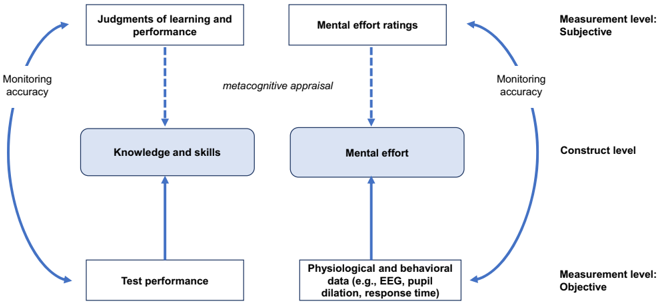
A central factor in research guided by the Cognitive Load Theory (CLT) is the mental effort people invest in performing a task. Mental effort is commonly assessed by asking people to report their effort throughout performing, learning, or problem-solving tasks. Although this measurement is considered reliable and valid in CLT research, metacognitive research provides robust evidence that self-appraisals of performance are often biased. In this review, we consider the possibility that mental effort appraisals may also be biased. In particular, we review signs for covariations and mismatches between subjective and objective measures of effort. Our review suggests that subjective and most objective effort measures appear reliable and valid when evaluated in isolation, because they discriminate among tasks of varying complexity. However, not much is known about their mutual correspondence—that is, whether subjective measures covariate with objective measures. Moreover, there is evidence that people utilize heuristic cues when appraising their effort, similar to utilization of heuristic cues underlying metacognitive appraisals of performance. These cues are identified by exposing biases—mismatch in effects of cue variations on appraisals and performance. The review concludes with a research agenda in which we suggest applying the well-established methodologies for studying biases in self-appraisals of performance in metacognitive research to investigating effort appraisals. One promising method could be to determine the covariation of effort appraisals and objective effort measures as an indicator of the resolution of effort appraisals.
Overview
The claims and statistics of this paper haven’t been checked yet.
Free: it reads the open-access text and checks the first 5 claims that cite a source we can check. Create a free account to check every claim.
Integrity signals
Registry
Cites
Statistics
Figures
Verification
Claims the paper makes
The claims and statistics of this paper haven’t been checked yet.
Free: it reads the open-access text and checks the first 5 claims that cite a source we can check. Create a free account to check every claim.
Claims other papers make about this one
Each is checked against this paper’s own text: does it say what the citing paper says it does?
The source backs part of the claim, not all of it — or backs it for a different population, condition or comparison.
In the citing paper
“Instead, learners derive them dynamically through several sources of information such as their effort beliefs, prior task experience, current level of fatigue, interest in the task, and fluency of processing.”
From Worth the Effort: the Start and Stick to Desirable Difficulties (S2D2) Framework (2023) · cites this paper as Scheiter et al., 2020
Experimental — accuracy not yet measuredThe cited source says what the claim attributes to it.
In the citing paper
“That is, self-reports of effort through ratings on a Likert-type scale should not be viewed as objective reflections of effort based solely on the difficulty of a task.”
From Worth the Effort: the Start and Stick to Desirable Difficulties (S2D2) Framework (2023) · cites this paper as Scheiter et al., 2020
In the citing paper
“Irrespective of what operationalization is chosen, it is important to note that it is not trivial to evaluate and conceptualize effort (see extensive discussions in Baars et al., 2020;Scheiter et al., 2020).”
From Motivation-Achievement Cycles in Learning: a Literature Review and Research Agenda (2022) · cites this paper as Scheiter et al., 2020
Self-check
Percentages, sums and reported differences re-computed from the paper’s own numbers.
The self-check needs the paper’s full text.
Citations
Cites
A social-cognitive approach to motivation and personality.
Dweck, C. S., & Leggett, E. L. (1988) · Psychological Review · doi:10.1037/0033-295x.95.2.256 · Cited by 9,745 · cited 1×
“According to Dweck and Leggett (1988), students differ in their implicit theories of intelligence (or mindsets), in that some perceive ability as malleable (growth mindset), whereas others perceive it as fixed.”
BackgroundShiffrin, R. M., & Schneider, W. (1977) · Psychological Review · doi:10.1037/0033-295x.84.2.127 · Cited by 7,335 · cited 1×
“Effort is assumed to result from controlled (as compared to automatic) processing of taskrelevant information (cf. Shiffrin and Schneider 1977).”
BackgroundCognitive Architecture and Instructional Design
Sweller, J., van Merrienboer, J. J. G., & Paas, F. G. W. C. (1998) · Educational Psychology Review · doi:10.1023/a:1022193728205 · Cited by 6,023 · cited 4×
“…speaking. either hinder task performance by overloading the cognitive system with unnecessary cognitive processing (i.e., extraneous cognitive load, Sweller et al. 1998) or foster performance by stimulating cognitive processes relevant for learning (i.e., germane cognitive load, Sweller et al.…”
BackgroundInfluentialSweller, J., Ayres, P., & Kalyuga, S. (2011) · doi:10.1007/978-1-4419-8126-4 · Cited by 5,531
Sweller, J. (2011) · Psychology of Learning and Motivation · doi:10.1016/b978-0-12-387691-1.00002-8 · Cited by 4,856
Sweller, J. (2012) · Encyclopedia of the Sciences of Learning · doi:10.1007/978-1-4419-1428-6_446 · Cited by 4,405
Metamemory: A Theoretical Framework and New Findings
Nelson, T. O. (1990) · Psychology of Learning and Motivation · doi:10.1016/s0079-7421(08)60053-5 · Cited by 2,583 · cited 2×
“…the timing of metacognitive judgments, it has been shown that the later they are required (i.e., themore experience a person has acquired with the task), the more accurate they are; nevertheless, even retrospective judgments are prone to biases (Leonesio and Nelson 1990; Siedlecka et al. 2016).”
BackgroundCognitive Load Measurement as a Means to Advance Cognitive Load Theory
Paas, F., Tuovinen, J. E., Tabbers, H., & Van Gerven, P. W. M. (2003) · Educational Psychologist · doi:10.1207/s15326985ep3801_8 · Cited by 2,527 · cited 3×
“Xie and Salvendy (2000) discussed how cognitive load fluctuates during task performance, while we in the following apply their reasoning to mental effort (see also Paas et al. 2003).”
BackgroundCognitive Architecture and Instructional Design: 20 Years Later
Sweller, J., van Merriënboer, J. J. G., & Paas, F. (2019) · Educational Psychology Review · doi:10.1007/s10648-019-09465-5 · Cited by 2,337 · cited 3×
“Readers interested in recently introduced alternatives to this assumption are referred to Sweller et al. 2019 3 We refer in this review to the body of Metacognitive research dealing with monitoring and control of regulatory decisions.”
BackgroundPaas, F. G. W. C. (1992) · Journal of Educational Psychology · doi:10.1037/0022-0663.84.4.429 · Cited by 2,150 · cited 9×
“Unfortunately, most studies, including the ones introducing the mental effort item (e.g. Paas 1992; Paas and van Merriënboer 1994b), do not report the exact wording of the question about effort.”
BackgroundMethodInfluentialMetacognition in Educational Theory and Practice
(1998) · Routledge eBooks · doi:10.4324/9781410602350 · Cited by 2,119
Flawed Self-Assessment: Implications for Health, Education, and the Workplace
Dunning, D., Heath, C., & Suls, J. M. (2004) · Psychological Science in the Public Interest · doi:10.1111/j.1529-1006.2004.00018.x · Cited by 1,865 · cited 1×
“Typically, biases in metacognitive judgments are reflected in overconfidence, which has been found across samples of children, adolescents, and adults, and in various domains (see Bjork et al. 2013; Destan andRoebers 2015; Dunning et al. 2004; Fiedler et al. 2019, for reviews).”
BackgroundWhen More Pain Is Preferred to Less: Adding a Better End
Kahneman, D., Fredrickson, B. L., Schreiber, C. A., & Redelmeier, D. A. (1993) · Psychological Science · doi:10.1111/j.1467-9280.1993.tb00589.x · Cited by 1,502 · cited 1×
“That is, experienced high peaks in effort and task difficulty as well as serial position both seem to contribute to later appraisals given after the end of the experience (cf. peak-end effect, Kahneman et al. 1993).”
BackgroundSelf-Regulated Learning: Beliefs, Techniques, and Illusions
Bjork, R. A., Dunlosky, J., & Kornell, N. (2013) · Annual Review of Psychology · doi:10.1146/annurev-psych-113011-143823 · Cited by 1,468 · cited 3×
“Two prominent research areas where student appraisals play a major role are informed byCognitive Load Theory (CLT; Sweller et al. 2011; Sweller et al. 1998) and Metacognition (see Bjork et al. 2013; Fiedler et al. 2019, for reviews).”
BackgroundMonitoring one’s own knowledge during study: A cue-utilization approach to judgments of learning
Koriat, A. (1997) · Journal of Experimental Psychology: General · doi:10.1037/0096-3445.126.4.349 · Cited by 1,363 · cited 4×
“Heuristic cues are valid as long as they have high cue diagnosticity (Koriat 1997).”
BackgroundMethodInfluentialPaas, F. G. W. C., & Van Merriënboer, J. J. G. (1994) · Journal of Educational Psychology · doi:10.1037/0022-0663.86.1.122 · Cited by 1,198
Pupil Size in Relation to Mental Activity during Simple Problem-Solving
Hess, E. H., & Polt, J. M. (1964) · Science · doi:10.1126/science.143.3611.1190 · Cited by 1,169 · cited 1×
“Starting with the seminal paper by Hess and Polt (1964), it has been shown repeatedly that the pupil dilates with increases in cognitive processing demands (e.g., Richter and Scheiter 2019; Scharinger et al. 2015; Szulewski et al. 2017; Zu et al. 2019).”
BackgroundSisk, V. F., Burgoyne, A. P., Sun, J., Butler, J. L., & Macnamara, B. N. (2018) · Psychological Science · doi:10.1177/0956797617739704 · Cited by 1,159 · cited 1×
“Notably, these differences in mindset have been shown to have an effect, though small, on a variety of motivational and cognitive aspects related to learning and achievement (Peng and Tullis in press; Sisk et al. 2018).”
BackgroundDevelopment of an instrument for measuring different types of cognitive load
Leppink, J., Paas, F., Van der Vleuten, C. P. M., Van Gog, T., & Van Merriënboer, J. J. G. (2013) · Behavior Research Methods · doi:10.3758/s13428-013-0334-1 · Cited by 1,066
Instructional control of cognitive load in the training of complex cognitive tasks
Paas, F. G. W. C., & Van Merriënboer, J. J. G. (1994) · Educational Psychology Review · doi:10.1007/bf02213420 · Cited by 968
Direct Measurement of Cognitive Load in Multimedia Learning
Brunken, R., Plass, J. L., & Leutner, D. (2003) · Educational Psychologist · doi:10.1207/s15326985ep3801_7 · Cited by 896 · cited 1×
“Second, as discussed in detail below, effort measures are typically based on either subjective self-reports or objective behavioral (e.g., response time) and physiological measures (e.g., eye tracking, EEG; see Brünken et al. 2003; Sweller et al. 2011, for reviews).”
BackgroundAccuracy of metacognitive monitoring affects learning of texts.
Thiede, K. W., Anderson, M. C. M., & Therriault, D. (2003) · Journal of Educational Psychology · doi:10.1037//0022-0663.95.1.66 · Cited by 826 · cited 6×
“Metacognitive studies have shown that conditions that support better resolution yield better restudy choices than conditions with weaker resolution (Thiede et al. 2003).”
BackgroundInfluentialInferring mental states from neuroimaging data: from reverse inference to large-scale decoding
Poldrack, R. A. (2011) · Neuron · doi:10.1016/j.neuron.2011.11.001 · Cited by 821 · cited 1×
“Accordingly, the interpretation of physiological effort measures is affected by what has been called the reverse inference problem in neuroscience (Poldrack 2011).”
BackgroundUsing Electroencephalography to Measure Cognitive Load
Antonenko, P., Paas, F., Grabner, R., & van Gog, T. (2010) · Educational Psychology Review · doi:10.1007/s10648-010-9130-y · Cited by 742 · cited 1×
“Changes in theta and alpha waves have been validated as indicators of cognitive processing demands (cf. for reviews Antonenko et al. 2010; Scharinger 2018).”
BackgroundMeasurement of Cognitive Load in Instructional Research
Paas, F. G. W. C., van Merriënboer, J. J. G., & Adam, J. J. (1994) · Perceptual and Motor Skills · doi:10.2466/pms.1994.79.1.419 · Cited by 731 · cited 9×
“Similarly, Paas et al. (1994) were unable to find evidence that heart rate variability could detect variations in task difficulty.”
BackgroundMethodInfluentialHeart rate variability and cognitive function: a systematic review
Forte, G., Favieri, F., & Casagrande, M. (2019) · Frontiers in Neuroscience · doi:10.3389/fnins.2019.00710 · Cited by 587 · cited 1×
“Notably, there are a number of health-related physical and cognitive conditions that affect interindividual variability and responsiveness of the heart rate and that may occlude intra-individual changes due to task demands (see Forte et al. 2019).”
BackgroundInstructional Efficiency: Revisiting the Original Construct in Educational Research
van Gog, T., & Paas, F. (2008) · Educational Psychologist · doi:10.1080/00461520701756248 · Cited by 473 · cited 2×
“Accordingly, Paas proposed the effort item, which (with some variability in its formulation and scaling) is used in the majority of CLT research (van Gog and Paas 2008).”
BackgroundMethodStanton, N. A. (2022) · Ergonomics · doi:10.1080/00140139.2021.2005272 · Cited by 425
Koriat, A., Ma'ayan, H., & Nussinson, R. (2006) · Journal of Experimental Psychology: General · doi:10.1037/0096-3445.135.1.36 · Cited by 422 · cited 6×
“These cues are sometimes valid, in that they predict changes in performance (high cue diagnosticity, e.g., Koriat et al. 2006; Thompson et al. 2013), but also often not tightly associated with performance fluctuations (low cue diagnosticity, e.g., Metcalfe and Finn 2008; Rabinowitz et al. 1982;…”
BackgroundMethodInfluentialEvidence that judgments of learning are causally related to study choice
METCALFE, J., & FINN, B. (2008) · Psychonomic Bulletin & Review · doi:10.3758/pbr.15.1.174 · Cited by 409 · cited 5×
“…guide regulatory decisions that people take regarding withholding or providing answers and regarding further investment of effort for restudying, seeking help, or giving up (e.g., Koriat and Ackerman 2010; Krebs and Roebers 2010; Metcalfe and Finn 2008; Thiede et al. 2003; Undorf et al. 2020).”
BackgroundMethodInfluentialGaining Insight Into the “Aha” Experience
Topolinski, S., & Reber, R. (2010) · Current Directions in Psychological Science · doi:10.1177/0963721410388803 · Cited by 404 · cited 1×
“…research, where learning and answering time is discussed extensively as an indicator of effort among adults and children (e.g., Koriat et al. 2014a; see Baars et al. 2020) and was even manipulated for leading people to believe that the task required more or less effort (Topolinski and Reber 2010).”
BackgroundPaas, F., Tuovinen, J. E., van Merriënboer, J. J. G., & Aubteen Darabi, A. (2005) · Educational Technology Research and Development · doi:10.1007/bf02504795 · Cited by 401 · cited 2×
“Effort has a motivational aspect to it (Feldon et al. 2019; Paas et al. 2005; see also Eitel et al. 2020).”
BackgroundMeta-Reasoning: Monitoring and Control of Thinking and Reasoning
Ackerman, R., & Thompson, V. A. (2017) · Trends in Cognitive Sciences · doi:10.1016/j.tics.2017.05.004 · Cited by 400 · cited 1×
“…by borrowing well-established methods and concepts for determining the accuracy of subjective appraisals from metacognition research (cf. Ackerman and Thompson (2017); Bjork et al. (2013) for reviews), we shed light on the question of whether mental effort appraisals may also be biased…”
MethodSelf-citationPsycho-physiological measures for assessing cognitive load
Haapalainen, E., Kim, S., Forlizzi, J. F., & Dey, A. K. (2010) · Proceedings of the 12th ACM international conference on Ubiquitous computing · doi:10.1145/1864349.1864395 · Cited by 382 · cited 1×
“In contrast, Haapalainen et al. (2010) as well as Larmuseau et al. (2019) found no differences in EDA as a function of task complexity.”
BackgroundUsing subjective measures to detect variations of intrinsic cognitive load within problems
Ayres, P. (2006) · Learning and Instruction · doi:10.1016/j.learninstruc.2006.09.001 · Cited by 381 · cited 2×
“subjective appraisals of task difficulty (Ayres 2006).”
Methodvan Merriënboer, J. J. G., Schuurman, J. G., de Croock, M. B. M., & Paas, F. G. W. C. (2002) · Learning and Instruction · doi:10.1016/s0959-4752(01)00020-2 · Cited by 378 · cited 1×
“For instance, students have reported less effort and were more successful when working on completion problems or learning from worked examples compared with solving the same problems without instructional support (Paas 1992; Van Harsel, Hoogerheide et al. 2019; van Merriënboer et al. 2002).”
BackgroundAssessment of Cognitive Load in Multimedia Learning Using Dual-Task Methodology
Brünken, R., Steinbacher, S., Plass, J. L., & Leutner, D. (2002) · Experimental Psychology · doi:10.1027//1618-3169.49.2.109 · Cited by 335 · cited 1×
“Thus, we do not address dual task performance, which is used for measuring mental load in the main task in the presence (relative to the absence) of a secondary task (e.g., Brünken et al. 2002), or subjective appraisals of task difficulty (Ayres 2006).”
MethodAZEVEDO, R., MOOS, D. C., JOHNSON, A. M., & CHAUNCEY, A. D. (2010) · Educational Psychologist · doi:10.1080/00461520.2010.515934 · Cited by 324
Signaling text-picture relations in multimedia learning: A comprehensive meta-analysis
Richter, J., Scheiter, K., & Eitel, A. (2016) · Educational Research Review · doi:10.1016/j.edurev.2015.12.003 · Cited by 295 · cited 1×
“Consistent with previous research (Richter et al. 2016 2018), students with low prior knowledge, but not those with high prior knowledge, showed better learning outcomes when text-picture signals had been included rather than excluded in the multimedia materials.”
ResultSelf-citationKantowitz, B. H. (1987) · Advances in psychology · Cited by 290
Braithwaite, J., Watson, D., Jones, R., & Rowe, M. (2013) · CTIT technical reports series · Cited by 273
Xie, B., & Salvendy, G. (2000) · Work & Stress · doi:10.1080/026783700417249 · Cited by 247 · cited 3×
“Xie and Salvendy (2000) discussed how cognitive load fluctuates during task performance, while we in the following apply their reasoning to mental effort (see also Paas et al. 2003).”
BackgroundMeasuring Mental Workload with EEG+fNIRS
Aghajani, H., Garbey, M., & Omurtag, A. (2017) · Frontiers in Human Neuroscience · doi:10.3389/fnhum.2017.00359 · Cited by 236 · cited 1×
“Moreover, Aghajani et al. 2017 found evidence that combining EEG parameters with markers simultaneously obtained with NIRS significantly improved discrimination between tasks complexity levels compared with using EEG alone.”
ResultThe interplay between self-regulation in learning and cognitive load
Seufert, T. (2018) · Educational Research Review · doi:10.1016/j.edurev.2018.03.004 · Cited by 227 · cited 1×
“In the present review, we adhere to a call by De Bruin and van Merriënboer (2017) and Seufert (2018) to link CLT and metacognition research.”
MethodDo different metamemory judgments tap the same underlying aspects of memory?
Leonesio, R. J., & Nelson, T. O. (1990) · Journal of Experimental Psychology: Learning, Memory, and Cognition · doi:10.1037//0278-7393.16.3.464 · Cited by 225 · cited 1×
“…the timing of metacognitive judgments, it has been shown that the later they are required (i.e., themore experience a person has acquired with the task), the more accurate they are; nevertheless, even retrospective judgments are prone to biases (Leonesio and Nelson 1990; Siedlecka et al. 2016).”
BackgroundEffects of process-oriented worked examples on troubleshooting transfer performance
van Gog, T., Paas, F., & van Merriënboer, J. J. G. (2006) · Learning and Instruction · doi:10.1016/j.learninstruc.2006.02.003 · Cited by 223 · cited 1×
“Nevertheless, there have also been misalignments where instructional conditions affected effort ratings, which were not accompanied by corresponding changes in task performance though (e.g., van Gog et al. 2006).”
ResultCognitive Load as Motivational Cost
Feldon, D. F., Callan, G., Juth, S., & Jeong, S. (2019) · Educational Psychology Review · doi:10.1007/s10648-019-09464-6 · Cited by 218 · cited 1×
“Effort has a motivational aspect to it (Feldon et al. 2019; Paas et al. 2005; see also Eitel et al. 2020).”
BackgroundThompson, V. A., Turner, J. A. P., Pennycook, G., Ball, L. J., Brack, H., Ophir, Y., & Ackerman, R. (2013) · Cognition · doi:10.1016/j.cognition.2012.09.012 · Cited by 215 · cited 1×
“These cues are sometimes valid, in that they predict changes in performance (high cue diagnosticity, e.g., Koriat et al. 2006; Thompson et al. 2013), but also often not tightly associated with performance fluctuations (low cue diagnosticity, e.g., Metcalfe and Finn 2008; Rabinowitz et al. 1982;…”
BackgroundSelf-citationSchmeck, A., Opfermann, M., van Gog, T., Paas, F., & Leutner, D. (2015) · Instructional Science · doi:10.1007/s11251-014-9328-3 · Cited by 206
Synthesizing Cognitive Load and Self-regulation Theory: a Theoretical Framework and Research Agenda
de Bruin, A. B. H., Roelle, J., Carpenter, S. K., Baars, M., & EFG-MRE (2020) · Educational Psychology Review · doi:10.1007/s10648-020-09576-4 · Cited by 196
Nickel, P., & Nachreiner, F. (2003) · Human Factors: The Journal of the Human Factors and Ergonomics Society · doi:10.1518/hfes.45.4.575.27094 · Cited by 167 · cited 1×
“While the subjective effort ratings reflected differences in task design, the analysis of heart rate variability revealed only differences between active and resting states, but reflected no more fine-grained sensitivity (see also Nickel and Nachreiner 2003).”
BackgroundThe influence of leads on cognitive load and learning in a hypertext environment
Antonenko, P. D., & Niederhauser, D. S. (2010) · Computers in Human Behavior · doi:10.1016/j.chb.2009.10.014 · Cited by 154 · cited 3×
“Interestingly, the authors of the aforementioned studies interpret it either as an issue concerning the validity of the subjective appraisals (e.g., Antonenko and Niederhauser 2010) or of the objective measures (Paas et al. 1994).”
BackgroundYan, V. X., Bjork, E. L., & Bjork, R. A. (2016) · Journal of Experimental Psychology: General · doi:10.1037/xge0000177 · Cited by 153 · cited 1×
“Research has shown consistently that interleaved practice is more effective than blocked practice (see Yan et al. 2016, for a review).”
BackgroundThe diminishing criterion model for metacognitive regulation of time investment.
Ackerman, R. (2014) · Journal of Experimental Psychology: General · doi:10.1037/a0035098 · Cited by 152 · cited 2×
“In most metacognitive studies, resolution is applied with at least ten items per participant (e.g., Ackerman 2014; Koriat et al. 2006; Metcalfe and Finn 2008).”
MethodSelf-citationde Bruin, A. B. H., & van Merriënboer, J. J. G. (2017) · Learning and Instruction · doi:10.1016/j.learninstruc.2017.06.001 · Cited by 146
Koriat, A. (2008) · Memory & Cognition · doi:10.3758/mc.36.2.416 · Cited by 143 · cited 2×
“In the study by Miele et al. (2011), students with a fixed mindset were more likely to apply the easily learned = easily remembered heuristic (Koriat 2008).”
BackgroundKirk-Johnson, A., Galla, B. M., & Fraundorf, S. H. (2019) · Cognitive Psychology · doi:10.1016/j.cogpsych.2019.101237 · Cited by 142 · cited 3×
“…study times for difficult as compared with easy items) as an indication that they had reached the limits of their ability, and, in turn, expected to achieve less successful recall (i.e., low judgments of learning) of items that they found more effortful to learn (see also Kirk-Johnson et al. 2019).”
BackgroundMethodInfluentialCarpenter, S. K., Endres, T., & Hui, L. (2020) · Educational Psychology Review · doi:10.1007/s10648-020-09562-w · Cited by 132 · cited 1×
“…as expected, they evaluated interleaved practice as being less effective, and chose it less often as the preferred strategy for future study (see also Carpenter et al. 2020, regarding the interpretation of higher effort associated with retrieval practice as indicating ineffective learning).”
BackgroundTiming and Frequency of Mental Effort Measurement: Evidence in Favour of Repeated Measures
van Gog, T., Kirschner, F., Kester, L., & Paas, F. (2012) · Applied Cognitive Psychology · doi:10.1002/acp.2883 · Cited by 130 · cited 5×
“Van Gog et al. (2012) investigated how immediate effort ratings provided after each task item relate to a single rating provided at the end of the task sequence (i.e., a delayed rating).”
BackgroundResultInfluentialAging and Metamemory: the Roles of Relatedness and Imagery
Rabinowitz, J. C., Ackerman, B. P., Craik, F. I. M., & Hinchley, J. L. (1982) · Journal of Gerontology · doi:10.1093/geronj/37.6.688 · Cited by 121 · cited 2×
“Overall, people tend to underestimate in their metacognitive judgments effects of individual differences and task-related characteristics on performance, and reflect more upon perceived difficulty variations across task items (e.g., Rabinowitz et al. 1982).”
BackgroundChoice latency as a cue for children’s subjective confidence in the correctness of their answers
Koriat, A., & Ackerman, R. (2010) · Developmental Science · doi:10.1111/j.1467-7687.2009.00907.x · Cited by 120 · cited 1×
“…guide regulatory decisions that people take regarding withholding or providing answers and regarding further investment of effort for restudying, seeking help, or giving up (e.g., Koriat and Ackerman 2010; Krebs and Roebers 2010; Metcalfe and Finn 2008; Thiede et al. 2003; Undorf et al. 2020).”
BackgroundSelf-citationA meta-analysis and systematic review of reactivity to judgements of learning
Double, K. S., Birney, D. P., & Walker, S. A. (2018) · Memory · doi:10.1080/09658211.2017.1404111 · Cited by 120 · cited 1×
“…in the recent years because of mixed results, with no satisfactory theoretical understanding regarding the conditions that make judgments reactive (see Double et al. 2018, for a meta-analysis regarding judgments of learning; see Double and Birney 2019, for a review of effects on problem solving).”
ResultThe Role of Mental Effort in Fostering Self-Regulated Learning with Problem-Solving Tasks
van Gog, T., Hoogerheide, V., & van Harsel, M. (2020) · Educational Psychology Review · doi:10.1007/s10648-020-09544-y · Cited by 118 · cited 1×
“…is fundamental from a learning and instruction perspective, because they are pivotal to explaining instructional design effects discussed within the CLT as well as to designing effective interventions and training programs (e.g., Mirza et al. 2019; Raaijmakers et al. 2018; van Gog et al. 2020).”
BackgroundSelf-citationOverconfidence in children's multi-trial judgments of learning
Finn, B., & Metcalfe, J. (2014) · Learning and Instruction · doi:10.1016/j.learninstruc.2014.01.001 · Cited by 117 · cited 1×
“An examination of calibration distinguishes between a well-calibrated assessment, a positive bias (overconfidence), and a negative bias (underconfidence) (e.g., Finn and Metcalfe 2014; Sidi et al. 2017).”
BackgroundWhat are the metacognitive costs of young children’s overconfidence?
Destan, N., & Roebers, C. M. (2015) · Metacognition and Learning · doi:10.1007/s11409-014-9133-z · Cited by 110
Siedlecka, M., Paulewicz, B., & Wierzchoń, M. (2016) · Frontiers in Psychology · doi:10.3389/fpsyg.2016.00218 · Cited by 109 · cited 2×
“…the timing of metacognitive judgments, it has been shown that the later they are required (i.e., themore experience a person has acquired with the task), the more accurate they are; nevertheless, even retrospective judgments are prone to biases (Leonesio and Nelson 1990; Siedlecka et al. 2016).”
BackgroundDetecting Users’ Cognitive Load by Galvanic Skin Response with Affective Interference
Nourbakhsh, N., Chen, F., Wang, Y., & Calvo, R. A. (2017) · ACM Transactions on Interactive Intelligent Systems · doi:10.1145/2960413 · Cited by 105 · cited 2×
“Finally, Nourbakhsh et al. (2017) used learners’ skin response (EDA) to distinguish between arithmetic learning tasks of different complexity.”
BackgroundMethodHoogerheide, V., Renkl, A., Fiorella, L., Paas, F., & van Gog, T. (2019) · Journal of Educational Psychology · doi:10.1037/edu0000272 · Cited by 105 · cited 2×
“For instance, students have reported less effort and were more successful when working on completion problems or learning from worked examples compared with solving the same problems without instructional support (Paas 1992; Van Harsel, Hoogerheide et al. 2019; van Merriënboer et al. 2002).”
BackgroundSelf-citationThe Relation Between Students’ Effort and Monitoring Judgments During Learning: A Meta-analysis
Baars, M., Wijnia, L., de Bruin, A., & Paas, F. (2020) · Educational Psychology Review · doi:10.1007/s10648-020-09569-3 · Cited by 101 · cited 5×
“…effort ratings and metacognitive judgments have shown to be stronger than those between objective effort measures and metacognitive judgments (Baars et al. 2020), suggesting that the prior may share a common denominator, namely, the subjective appraisal process, that eventually yields higher…”
BackgroundInfluentialMeasurement of cognitive load in multimedia learning: a comparison of different objective measures
Korbach, A., Brünken, R., & Park, B. (2017) · Instructional Science · doi:10.1007/s11251-017-9413-5 · Cited by 98 · cited 1×
“Korbach et al. (2017) applied subjective and objective effort measures in the presence of seductive details.”
MethodEitel, A., Endres, T., & Renkl, A. (2020) · Educational Psychology Review · doi:10.1007/s10648-020-09559-5 · Cited by 95 · cited 1×
“Effort has a motivational aspect to it (Feldon et al. 2019; Paas et al. 2005; see also Eitel et al. 2020).”
BackgroundDoes Easily Learned Mean Easily Remembered?: It Depends on Your Beliefs About Intelligence
Miele, D. B., Finn, B., & Molden, D. C. (2011) · Psychological Science · doi:10.1177/0956797610397954 · Cited by 92 · cited 1×
“In the study by Miele et al. (2011), students with a fixed mindset were more likely to apply the easily learned = easily remembered heuristic (Koriat 2008).”
BackgroundUnderstanding metacognitive inferiority on screen by exposing cues for depth of processing
Sidi, Y., Shpigelman, M., Zalmanov, H., & Ackerman, R. (2017) · Learning and Instruction · doi:10.1016/j.learninstruc.2017.01.002 · Cited by 91 · cited 2×
“An examination of calibration distinguishes between a well-calibrated assessment, a positive bias (overconfidence), and a negative bias (underconfidence) (e.g., Finn and Metcalfe 2014; Sidi et al. 2017).”
BackgroundSelf-citationChildren's strategic regulation, metacognitive monitoring, and control processes during test taking
Krebs, S. S., & Roebers, C. M. (2010) · British Journal of Educational Psychology · doi:10.1348/000709910x485719 · Cited by 88 · cited 1×
“…guide regulatory decisions that people take regarding withholding or providing answers and regarding further investment of effort for restudying, seeking help, or giving up (e.g., Koriat and Ackerman 2010; Krebs and Roebers 2010; Metcalfe and Finn 2008; Thiede et al. 2003; Undorf et al. 2020).”
BackgroundKoriat, A., Ackerman, R., Adiv, S., Lockl, K., & Schneider, W. (2014) · Journal of Experimental Psychology: General · doi:10.1037/a0031768 · Cited by 85 · cited 4×
“For instance, as reviewed above, priming of mindset (Fisher and Oyserman 2017) and the wording of the question by which effort appraisals are elicited (Koriat et al. 2014b) were found to affect people’s perceptions of effort as being either data-driven or goaldriven.”
BackgroundSelf-citationAssessing interpretations of experienced ease and difficulty as motivational constructs.
Fisher, O., & Oyserman, D. (2017) · Motivation Science · doi:10.1037/mot0000055 · Cited by 85 · cited 4×
“Effort can have a negative connotation referring to the strain imposed by a task or it can have a positive connotation referring to the engagement a person shows with the task (Fisher and Oyserman 2017).”
BackgroundInfluentialMotivational aspects of cognitive load theory.
Schnotz, W., Fries, S., & Horz, H. (2009) · Cited by 83
Brucker, B., Ehlis, A., Häußinger, F. B., Fallgatter, A. J., & Gerjets, P. H. (2014) · Learning and Instruction · doi:10.1016/j.learninstruc.2014.11.003 · Cited by 76 · cited 1×
“NIRS is an optical-imaging technology for measuring brain activity used for learning and instruction research (Brucker et al. 2015).”
MethodJudgments of learning depend on how learners interpret study effort.
Koriat, A., Nussinson, R., & Ackerman, R. (2014) · Journal of Experimental Psychology: Learning, Memory, and Cognition · doi:10.1037/xlm0000009 · Cited by 73 · cited 4×
“For instance, as reviewed above, priming of mindset (Fisher and Oyserman 2017) and the wording of the question by which effort appraisals are elicited (Koriat et al. 2014b) were found to affect people’s perceptions of effort as being either data-driven or goaldriven.”
BackgroundSelf-citationScharinger, C., Kammerer, Y., & Gerjets, P. (2015) · PLOS ONE · doi:10.1371/journal.pone.0130608 · Cited by 69 · cited 2×
“Using eye tracking, Scharinger et al. (2015) demonstrated increases in pupil dilation as a function of increasing task complexity.”
BackgroundSignaling text–picture relations in multimedia learning: The influence of prior knowledge.
Richter, J., Scheiter, K., & Eitel, A. (2017) · Journal of Educational Psychology · doi:10.1037/edu0000220 · Cited by 64
Self-citationLarmuseau, C., Vanneste, P., Cornelis, J. P., Desmet, P., & Depaepe, F. (2019) · Frontline Learning Research · doi:10.14786/flr.v7i2.403 · Cited by 62 · cited 1×
“In contrast, Haapalainen et al. (2010) as well as Larmuseau et al. (2019) found no differences in EDA as a function of task complexity.”
BackgroundHeuristic Cues for Meta-Reasoning Judgments: Review and Methodology
Ackerman, R. (2019) · Psihologijske teme · doi:10.31820/pt.28.1.1 · Cited by 56 · cited 4×
“In particular, Ackerman (2019) presented a taxonomy for considering heuristic cues and explained methodologies for doing so in Meta-Reasoning research—metacognitive processes associated with reasoning, problem solving, and decision making.”
BackgroundSelf-citationRichter, J., & Scheiter, K. (2019) · Instructional Science · doi:10.1007/s11251-019-09492-3 · Cited by 56 · cited 3×
“Richter and Scheiter (2019) documented signs for a dissociation between subjective appraisals and objective effort measures.”
BackgroundMethodSelf-citationMeta-reasoning: What can we learn from meta-memory?
Ackerman, R., & Thompson, V. A. (2014) · doi:10.4324/9781315819525-17 · Cited by 53
Self-citationEffects of performance feedback valence on perceptions of invested mental effort
Raaijmakers, S. F., Baars, M., Schaap, L., Paas, F., & van Gog, T. (2017) · Learning and Instruction · doi:10.1016/j.learninstruc.2016.12.002 · Cited by 52 · cited 1×
“Raaijmakers et al. (2017) had students work on problem-solving tasks.”
Zu, T., Hutson, J., Loschky, L. C., & Rebello, N. S. (2020) · Journal of Educational Psychology · doi:10.1037/edu0000441 · Cited by 51 · cited 1×
“Starting with the seminal paper by Hess and Polt (1964), it has been shown repeatedly that the pupil dilates with increases in cognitive processing demands (e.g., Richter and Scheiter 2019; Scharinger et al. 2015; Szulewski et al. 2017; Zu et al. 2019).”
BackgroundRaaijmakers, S. F., Baars, M., PAAS, F. G. W. C., van Merriënboer, J. J. G., & van Gog, T. (2018) · Applied Cognitive Psychology · doi:10.1002/acp.3392 · Cited by 45 · cited 1×
“…is fundamental from a learning and instruction perspective, because they are pivotal to explaining instructional design effects discussed within the CLT as well as to designing effective interventions and training programs (e.g., Mirza et al. 2019; Raaijmakers et al. 2018; van Gog et al. 2020).”
BackgroundAckerman, R., Parush, A., Nassar, F., & Shtub, A. (2015) · Computers in Human Behavior · doi:10.1016/j.chb.2015.07.041 · Cited by 42 · cited 1×
“There are two prominent measures of monitoring accuracy, calibration and resolution (see Ackerman et al. 2016; De Bruin and van Merriënboer 2017, for reviews).”
BackgroundSelf-citationEffects of different sequences of examples and problems on motivation and learning
van Harsel, M., Hoogerheide, V., Verkoeijen, P., & van Gog, T. (2019) · Contemporary Educational Psychology · doi:10.1016/j.cedpsych.2019.03.005 · Cited by 42
Self-citationDoes domain matter? Monitoring accuracy across domains
Dentakos, S., Saoud, W., Ackerman, R., & Toplak, M. E. (2019) · Metacognition and Learning · doi:10.1007/s11409-019-09198-4 · Cited by 42 · cited 2×
“Comparisons between itemized and summative metacognitive judgments of success are scarce (e.g., Dentakos et al. 2019; Rivers, Dunlosky, and Joynes 2019).”
BackgroundSelf-citationDo confidence ratings prime confidence?
Double, K. S., & Birney, D. P. (2019) · Psychonomic Bulletin & Review · doi:10.3758/s13423-018-1553-3 · Cited by 38 · cited 1×
“…in the recent years because of mixed results, with no satisfactory theoretical understanding regarding the conditions that make judgments reactive (see Double et al. 2018, for a meta-analysis regarding judgments of learning; see Double and Birney 2019, for a review of effects on problem solving).”
ResultUsing pen input features as indices of cognitive load
Ruiz, N., Taib, R., Shi, Y. (., Choi, E., & Chen, F. (2007) · Proceedings of the 9th international conference on Multimodal interfaces · doi:10.1145/1322192.1322246 · Cited by 34 · cited 1×
“Nevertheless, research has shown that phasic EDA can be a reliable indicator of cognitive load (e.g., Ruiz et al. 2007).”
BackgroundRemembered Utility of Unpleasant and Pleasant Learning Experiences: Is All Well that Ends Well?
Hoogerheide, V., & PAAS, F. G. W. C. (2012) · Applied Cognitive Psychology · doi:10.1002/acp.2890 · Cited by 31 · cited 1×
“Research has indeed shown that sequencing learning experiences to end with the most pleasant (i.e., least effortful) partly improved the valence of children’s memories of learning vocabulary or receiving peer feedback (e.g., Hoogerheide and Paas 2012; Hoogerheide et al. 2018).”
BackgroundSelf-citationAgency attributions of mental effort during self-regulated learning
Koriat, A. (2017) · Memory & Cognition · doi:10.3758/s13421-017-0771-7 · Cited by 25 · cited 2×
“They achieved this by only changing the phrasing of the question on the appraisal scale to be “1 (The paragraph required little study) to 9 (The paragraph required a great deal of study) “for activating assessment of data-driven effort (or mental load) versus “1 (I chose to invest little study) to 9 (I chose to invest…”
BackgroundThe contribution of classroom exams to formative evaluation of concept-level knowledge
Rivers, M. L., Dunlosky, J. T., & Joynes, R. L. (2019) · Contemporary Educational Psychology · doi:10.1016/j.cedpsych.2019.101806 · Cited by 24 · cited 1×
“Comparisons between itemized and summative metacognitive judgments of success are scarce (e.g., Dentakos et al. 2019; Rivers, Dunlosky, and Joynes 2019).”
BackgroundPUPILLOMETRY AS A TOOL TO STUDY EXPERTISE IN MEDICINE
Szulewski, A., Kelton, D., & Howes, D. W. (2017) · Frontline Learning Research · doi:10.14786/flr.v5i3.256 · Cited by 23 · cited 1×
“Starting with the seminal paper by Hess and Polt (1964), it has been shown repeatedly that the pupil dilates with increases in cognitive processing demands (e.g., Richter and Scheiter 2019; Scharinger et al. 2015; Szulewski et al. 2017; Zu et al. 2019).”
BackgroundHoogerheide, V., Vink, M., Finn, B., Raes, A. K., & PAAS, F. G. W. C. (2017) · Cognition & Emotion · doi:10.1080/02699931.2017.1362375 · Cited by 20 · cited 2×
“, least effortful) partly improved the valence of children’s memories of learning vocabulary or receiving peer feedback (e.g., Hoogerheide and Paas 2012; Hoogerheide et al. 2018).”
BackgroundSelf-citationTheories of intelligence influence self-regulated study choices and learning.
Peng, Y., & Tullis, J. G. (2019) · Journal of Experimental Psychology Learning Memory and Cognition · doi:10.1037/xlm0000740 · Cited by 18
Metacognition: Monitoring and Controlling One’s Own Knowledge, Reasoning and Decisions
Fiedler, K., Ackerman, R., & Scarampi, C. (2019) · University Library Heidelberg · doi:10.17885/heiup.470.c6669 · Cited by 18
Self-citationSignaling Text-Picture Relations in Multimedia Learning: The Influence of Prior Knowledge
Richter, J. (2017) · Universitätsbibliothek Tübingen · doi:10.15496/publikation-16021 · Cited by 17
Fixation-related EEG frequency band power analysis
Scharinger, C. (2018) · Frontline Learning Research · doi:10.14786/flr.v6i3.373 · Cited by 17 · cited 3×
“In particular, EEG studies have revealed decreases in EEG alpha frequency band power at parietal electrodes and increases in frontal-central EEG theta frequency band power with increasing task complexity (see Scharinger 2018, for a review).”
BackgroundMethodSelf-management of cognitive load
Mirza, F., Agostinho, S., Tindall-Ford, S. K., Paas, F., & Chandler, P. (2019) · Advances in Cognitive Load Theory · doi:10.4324/9780429283895-13 · Cited by 10 · cited 1×
“…is fundamental from a learning and instruction perspective, because they are pivotal to explaining instructional design effects discussed within the CLT as well as to designing effective interventions and training programs (e.g., Mirza et al. 2019; Raaijmakers et al. 2018; van Gog et al. 2020).”
Background
Cited by
ChatGPT improves creative problem-solving performance in university students: An experimental study
Urban, M., Děchtěrenko, F., Lukavský, J., Hrabalová, V., Svacha, F., Brom, C., & Urban, K. (2024) · Computers & Education · doi:10.1016/j.compedu.2024.105031 · Cited by 396
Motivation-Achievement Cycles in Learning: a Literature Review and Research Agenda
Vu, T., Magis-Weinberg, L., Jansen, B. R. J., van Atteveldt, N., Janssen, T. W. P., Lee, N. C., van der Maas, H. L. J., Raijmakers, M. E. J., Sachisthal, M. S. M., & Meeter, M. (2022) · Educational Psychology Review · doi:10.1007/s10648-021-09616-7 · Cited by 224
Making an Effort Versus Experiencing Load
Klepsch, M., & Seufert, T. (2021) · Frontiers in Education · doi:10.3389/feduc.2021.645284 · Cited by 79
“Not only contemporary approaches of linking research on cognitive load with research on self-regulation refer to the distinction of invested effort vs. experienced load (see also Schnaubert and Schneider, 2020) but also current research on measurement issues of cognitive load.”
BackgroundWorth the Effort: the Start and Stick to Desirable Difficulties (S2D2) Framework
de Bruin, A. B. H., Biwer, F., Hui, L., Onan, E., David, L., & Wiradhany, W. (2023) · Educational Psychology Review · doi:10.1007/s10648-023-09766-w · Cited by 109
Seufert, T. (2020) · Educational Psychology Review · doi:10.1007/s10648-020-09574-6 · Cited by 72
Metadata
- Authors
- Scheiter, K., Ackerman, R., & Hoogerheide, V.
- Affiliations
- Leibniz-Institut für Wissensmedien (DE)
- Technion – Israel Institute of Technology (IL)
- Utrecht University (NL)
- Corresponding author
- Scheiter, Katharina
- Venue
- Educational Psychology Review
- Published
- 2020-08-01
- Volume
- 32
- Issue
- 4
- Pages
- 1003-1027
- ISSN
- 1040-726X (ISSN-L)
- 1573-336X
- OpenAlex
- W3046851904
- Cited by
- 63
- References
- 103
- Citations by year
- 2026: 4 · 2025: 15 · 2024: 10 · 2023: 9 · 2022: 9 · 2021: 13 · 2020: 3
- FWCI
- 8.21
- Type
- journal article
- Language
- en
- Open access
- hybrid
- doi.org
- Licence
- cc-by
- creativecommons.org/licenses/by/4.0 (tdm)
- creativecommons.org/licenses/by/4.0 (vor)
- Locations
- Educational Psychology Review (publishedVersion, cc-by)
- Utrecht University Repository (Utrecht University) (submittedVersion, other-oa)
- Funders
- Eberhard Karls Universität Tübingen
- Topics
- Social Sciences › Psychology › Experimental and Cognitive Psychology › Visual and Cognitive Learning Processes
- Social Sciences › Psychology › Developmental and Educational Psychology › Innovative Teaching and Learning Methods
- Life Sciences › Neuroscience › Cognitive Neuroscience › Memory Processes and Influences
- Keywords
- cognitive load theory, metacognition, heuristic cues, task complexity
About these checks
Registry, retraction, Cites and statistics results are computed, not judged, with one exception: a printed reference that no index lists is read once by a model before it counts as a citation error. Claims are extracted by a model and kept only when their quote appears verbatim in the text; each cited source is then checked, with a model’s help, for whether it says what the claim relies on. Those verdicts can be wrong — read the claim’s quote and the cited source before relying on one.
Statistics and arithmetic are recomputed, not judged.
Confidence bands are shown only for fields calibrated on our annotated test set. None is calibrated yet, so no band is shown.
What counts as a claim ›How we measure confidence ›How we check this ›
Are you an author, or do you see a problem with this page? Request a review
Data sources
Bibliographic data: Semantic Scholar, OpenAlex, Crossref.
Contains information from the Semantic Scholar Academic Graph Datasets, made available under the ODC Attribution License (ODC-BY 1.0).
Semantic Scholar’s data is described in: Kinney, R., et al. (2023). The Semantic Scholar Open Data Platform. arXiv:2301.10140.
