

Understanding Cognitive Load in Digital and Online Learning: a New Perspective on Extraneous Cognitive Load
Open accessThe DOI matches its Crossref record; 122 of the 122 references it cites were found in a registry or an index; 16 of the 63 sources its claims cite were checked for support.
Abstract
Abstract Cognitive load theory has been a major influence for the field of educational psychology. One of the main guidelines of the theory is that extraneous cognitive load should be reduced to leave sufficient cognitive resources for the actual learning to take place. In recent years, research regarding various design factors, in particular from the field of digital and online learning, have challenged this assumption. Interactive learning media, immersion, disfluency, realism, and redundant elements constitute five major challenges, since these design factors have been shown to induce task-irrelevant cognitive load, i.e., extraneous load, while still promoting motivation and learning. However, currently there is no unified approach to integrate such effects into cognitive load theory. By including aspects of constructive alignment, an approach aimed at fostering deep forms of learning in order to achieve specific learning outcomes, we devise a strategy to balance cognitive load in digital learning. Most importantly, we suggest considering both the positive and negative effects on cognitive load that certain design factors of digital learning can cause. In addition, a number of research results highlight that some types of positive effects of digital learning can only be detected using a suitable assessment method. This strategy of aligning cognitive load with desired learning outcomes will be useful for formulating theory-guided and empirically testable hypotheses, but can be particularly helpful for practitioners to embrace emerging technologies while minimizing potential extraneous drawbacks.
Overview
CoChat Summary
TL;DR
This review argues that five digital/online learning design factors—interactive media, immersion, disfluency, realism, and redundant/emotional-design elements—can induce extraneous cognitive load while still promoting motivation or learning. It proposes a cost-benefit model and “cognitive load alignment” strategy that links design factors, germane processing, and assessment methods rather than simply minimizing extraneous load.
Key findings
- The paper identifies five challenges to cognitive load theory: interactive learning media, immersion, disfluency, realism/detailed visualizations, and redundant elements/emotional design; these can raise task-irrelevant load yet sometimes improve learning or motivation.
- Immersion findings are mixed: Makransky et al. (2019) found immersive VR did not significantly affect retention versus written instruction but increased transfer scores, enjoyment, and motivation; Frederiksen et al. (2020) found highly immersive VR surgical simulator training decreased various learning process variables compared with less immersive settings.
- Disfluency and realism show non-linear patterns: Seufert et al. (2017) used three text-legibility levels and found low legibility descriptively increased learning versus a fluid control, with the only significant recall difference favoring medium over high disfluency; Skulmowski and Rey (2020b) reported higher retention for realistic parts alongside higher extraneous load ratings for one high-detail combination, termed the “realism paradox.”
- Emotional design/redundancy can help: Plass et al. (2014, Exp. 2) found colors increased comprehension, while transfer showed an interaction where the no-color version benefited from anthropomorphization but the colorized version did not; Bateman et al. (2010) found better long-term recall for embellished charts, with no significant short-term recall differences.
Methods
- Theoretical/conceptual review; no new empirical sample, data, or statistical analysis are reported.
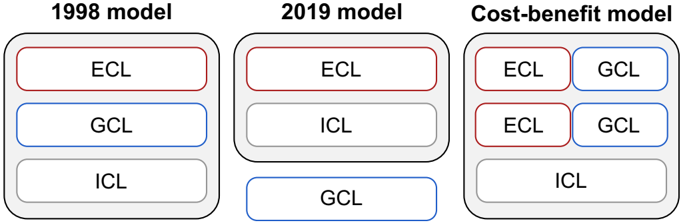
- The authors review the 1998 and 2019 cognitive load theory models, recent reconceptualizations, motivation research, and five digital-learning challenge areas.
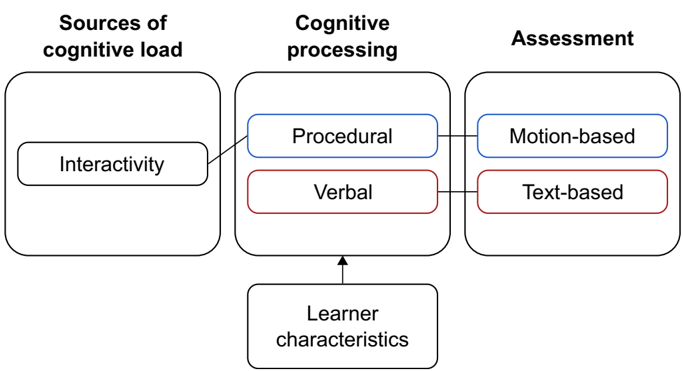
- They synthesize these with constructive alignment to propose a cost-benefit model and a cognitive load alignment strategy linking design factors, germane processing, and assessment methods.
Limitations
- The paper states that new experiments explicitly devised to test cognitive load alignment are needed, particularly in large-scale real-world learning settings; smaller-scale studies could provide initial data for computational modeling and validation.
- The paper states that more research is needed to model these relationships more precisely and quantifiably, to develop exact guidelines on how much extraneous load is acceptable, and to investigate the temporal dynamics of load induction.
- Evident from the text: as a conceptual review, it presents no original empirical test of the proposed model, and no systematic search or selection method is described; the disfluency effect is also described as unstable with unclear reasons.
Model-written summary. Check it against the paper before relying on it.
Integrity signals
Registry
Cites
Statistics
Figures
Verification
Claims the paper makes
15 Valid · 3 Not valid · 38 Not checked · 58 Own results and interpretations
The cited sources support only part of this claim — read each source’s verdict below.
In the paper
“When learners had used these full-body controls instead of low-interactivity keyboard controls during the learning phase of this study, their test performance was higher if they used a highly interactive test method involving a graphics tablet instead of a mouse.”
What the sources say
- Partly supportedcites Johnson-Glenberg & Megowan-Romanowicz, 2017 matched to “Embodied science and mixed reality: How gesture and motion capture affect physics education” (2017) sourceExperimental — accuracy not yet measured
Split into 2 atoms — 0 confirmed, 2 partially supported, 0 disputed, 0 misattributed, 0 unverifiable. Expand the claim to see per-atom verdicts.
plainstates a cause- Asserted: passes — The authors put it forward as true.
- Checkable: passes — It can be checked against evidence.
- Load-bearing: passes — The paper’s conclusions depend on it.
- Based: passes — The paper gives a reason why it holds.
- Partly supported
The sources with a verdict support this claim; the rest weren’t checked yet, have no full text we could read, or their verdicts aren’t rated yet.
In the paper
“recent investigations centering on the new affordances of digital and online learning have brought to light several results that can pose a challenge for the theory (e.g., Brom et al., 2018; Skulmowski et al., 2016; Skulmowski & Rey, 2020b).”
What the sources say
- Not checked — no full text of the sourcecites Brom et al., 2018 matched to “How effective is emotional design? A meta-analysis on facial anthropomorphisms and pleasant colors during multimedia learning” (2018) source
- Not checked — no full text of the sourcecites Skulmowski et al., 2016 matched to “Embodied learning using a tangible user interface: The effects of haptic perception and selective pointing on a spatial learning task” (2016) source
- Supportedcites Skulmowski & Rey, 2020b matched to “The realism paradox: Realism can act as a form of signaling despite being associated with cognitive load” (2020) source
Section 9.2, “Implications for cognitive load theory,” explicitly says the study’s results might pose a challenge to the theory. This supports the point for which this paper is cited; the sentence’s other citations can account for the reference to several investigations. (LLM, conf=0.93)
plainstates an association- Asserted: passes — The authors put it forward as true.
- Checkable: passes — It can be checked against evidence.
- Load-bearing: passes — The paper’s conclusions depend on it.
- Based: passes — The paper gives a reason why it holds.
Every source the paper cites for this claim was checked and supports it.
In the paper
“The major change from the 1998 model is that Sweller et al. (2019) have removed germane load from the additive equation of total load, but rather a dimension now called ' germane processing. '”
What the sources say
- Supportedcites Sweller et al., 2019 matched to “Cognitive Architecture and Instructional Design: 20 Years Later” (2019) source
In “Categories of Cognitive Load” (page unavailable), the authors say germane cognitive load no longer contributes to total load as a load in its own right; instead, it redistributes working-memory resources toward learning. “Measuring Cognitive Load” says only intrinsic and extraneous load remain basic categories, and “Instructional Effects Reported in 1998” uses the term “germane processing.” (LLM, conf=0.92)
plain- Asserted: passes — The authors put it forward as true.
- Checkable: passes — It can be checked against evidence.
- Load-bearing: passes — The paper’s conclusions depend on it.
- Based: passes — The paper gives a reason why it holds.
- Supported
The sources with a verdict support this claim; the rest weren’t checked yet, have no full text we could read, or their verdicts aren’t rated yet.
In the paper
“Newer research highlights that extraneous load can be divided into different components that might require different measurement strategies (Hollender et al., 2010; Skulmowski & Rey, 2020a).”
What the sources say
- Not checked — no full text of the sourcecites Hollender et al., 2010 matched to “Integrating cognitive load theory and concepts of human–computer interaction” (2010) source
- Supportedcites Skulmowski & Rey, 2020a matched to “Subjective cognitive load surveys lead to divergent results for interactive learning media” (2020) source
Section 9 says there may be multiple types of extraneous load, distinguishing demands from visuospatial arrangement and interactive controls. It also concludes that survey usefulness depends on context and that cognitive-load surveys cannot be used interchangeably in all instructional settings. (LLM, conf=0.93)
hedged- Asserted: passes — The authors put it forward as true.
- Checkable: passes — It can be checked against evidence.
- Load-bearing: passes — The paper’s conclusions depend on it.
- Based: passes — The paper gives a reason why it holds.
The cited sources support only part of this claim — read each source’s verdict below.
In the paper
“In the example of interactivity, a motion-based assessment type can be considered a well-aligned test type, since interactive controls may trigger procedural learning as a form of germane processing (Johnson-Glenberg & Megowan-Romanowicz, 2017).”
What the sources say
- Partly supportedcites Johnson-Glenberg & Megowan-Romanowicz, 2017 matched to “Embodied science and mixed reality: How gesture and motion capture affect physics education” (2017) sourceExperimental — accuracy not yet measured
The Discussion’s “Test sensitivity” section reports that a gesture-facilitated Wacom assessment was more closely aligned with embodied learning and revealed greater gains than a keyboard test. The “Being active” section suggests that controlling content through congruent gestures may deepen learning, but the paper does not characterize this as procedural learning or germane processing. (LLM, conf=0.85)
hedgedstates a possible cause- Asserted: passes — The authors put it forward as true.
- Checkable: passes — It can be checked against evidence.
- Load-bearing: passes — The paper’s conclusions depend on it.
- Based: passes — The paper gives a reason why it holds.
- Partly supported
45 more claims · 4 with their cited sources checked
Create a free account to see all 114 claims and every source verdict.
- It may state two separate claims as one. 25
- Probably not a substantial claim. 49
Claims other papers make about this one
Each is checked against this paper’s own text: does it say what the citing paper says it does?
The source backs part of the claim, not all of it — or backs it for a different population, condition or comparison.
In the citing paper
“Prior studies have primarily examined cognitive offloading from a cognitive and functional perspective, emphasizing its role in reducing memory demands, altering information retention, or redistributing cognitive load (Skulmowski and Xu, 2022; Sun et al., 2025).”
From Cognitive offloading through digital tools and its relationship with critical thinking, task persistence, and learning depth (2026) · cites this paper as Skulmowski and Xu, 2022
Experimental — accuracy not yet measuredThe source backs part of the claim, not all of it — or backs it for a different population, condition or comparison.
In the citing paper
“Previous studies have similarly noted that critical thinking and deep learning can be directly influenced by how learners interact with digital information environments, beyond motivational factors alone (Skulmowski and Xu, 2022; Almulla and Al-Rahmi, 2023).”
From Cognitive offloading through digital tools and its relationship with critical thinking, task persistence, and learning depth (2026) · cites this paper as Skulmowski and Xu, 2022
Experimental — accuracy not yet measuredThe source backs part of the claim, not all of it — or backs it for a different population, condition or comparison.
In the citing paper
“This suggests that higher-order cognitive outcomes may be shaped by both internal beliefs and the structural affordances provided by digital tools, such as access to diverse information sources and opportunities for comparison and reflection.”
From Cognitive offloading through digital tools and its relationship with critical thinking, task persistence, and learning depth (2026) · cites this paper as Skulmowski and Xu, 2022
Experimental — accuracy not yet measuredThe source backs part of the claim, not all of it — or backs it for a different population, condition or comparison.
In the citing paper
“educational computer games ('serious games') often require learners to internalize the rules of such a game, thereby causing extraneous cognitive load”
From The Cognitive Architecture of Digital Externalization (2023) · cites this paper as Skulmowski & Xu, 2022
Experimental — accuracy not yet measuredThe check wasn’t confident either way, so it gives no verdict — never disputed.
In the citing paper
“While these studies have provided foundational insights into how digital tools reshape cognitive processes, they have paid limited attention to how habitual offloading practices influence learners' self-perceptions as competent thinkers.”
From Cognitive offloading through digital tools and its relationship with critical thinking, task persistence, and learning depth (2026) · cites this paper as Skulmowski and Xu, 2022
Experimental — accuracy not yet measured
1 more claim about this paper
Create a free account to see every claim other papers make about this one.
Citations
Cites
Cognitive Load During Problem Solving: Effects on Learning
Sweller, J. (1988) · Cognitive Science · doi:10.1016/0364-0213(88)90023-7 · Cited by 11,048 · cited 2×
“…a new component of this model (in comparison to an even earlier version of the model which consisted only the intrinsic and extraneous cognitive load; Sweller, 1988), the germane load (Sweller et al., 1998; see, e.g., Kalyuga, 2011, for an overview of the debate surrounding this component).”
BackgroundRyan, R. M., & Deci, E. L. (2020) · Contemporary Educational Psychology · doi:10.1016/j.cedpsych.2020.101860 · Cited by 6,037
Cognitive Architecture and Instructional Design
Sweller, J., van Merrienboer, J. J. G., & Paas, F. G. W. C. (1998) · Educational Psychology Review · doi:10.1023/a:1022193728205 · Cited by 6,023
Six views of embodied cognition
Wilson, M. (2002) · Psychonomic Bulletin & Review · doi:10.3758/bf03196322 · Cited by 4,782
Enhancing teaching through constructive alignment
Biggs, J. (1996) · Higher Education · doi:10.1007/bf00138871 · Cited by 4,084 · cited 3×
“One such approach is constructive alignment (Biggs, 1996).”
BackgroundInfluentialCognitive Load Theory and the Format of Instruction
Chandler, P., & Sweller, J. (1991) · Cognition and Instruction · doi:10.1207/s1532690xci0804_2 · Cited by 2,894
Cognitive Load Measurement as a Means to Advance Cognitive Load Theory
Paas, F., Tuovinen, J. E., Tabbers, H., & Van Gerven, P. W. M. (2003) · Educational Psychologist · doi:10.1207/s15326985ep3801_8 · Cited by 2,527
Cognitive Architecture and Instructional Design: 20 Years Later
Sweller, J., van Merriënboer, J. J. G., & Paas, F. (2019) · Educational Psychology Review · doi:10.1007/s10648-019-09465-5 · Cited by 2,337
Element Interactivity and Intrinsic, Extraneous, and Germane Cognitive Load
Sweller, J. (2010) · Educational Psychology Review · doi:10.1007/s10648-010-9128-5 · Cited by 2,020
Immersive Interfaces for Engagement and Learning
Dede, C. (2009) · Science · doi:10.1126/science.1167311 · Cited by 1,707
Cited by
Items 301–400 of 656
Jiang, L., Liu, Y., Wiley, J. F., Zhang, C., Wang, X., & Hu, Y. (2025) · Cancer Care Research Online · doi:10.1097/cr9.0000000000000069 · Cited by 2
Improving online anti-phishing training using cognitive large language models
Malloy, T., Fang, F., & González, C. (2025) · Computers in Human Behavior · doi:10.1016/j.chb.2025.108760 · Cited by 9
Izadyar, N., Li, L., Chen, S., & O'Brien, D. (2025) · Buildings · doi:10.3390/buildings15020165 · Cited by 3
Isnaniah, I., Marlina, M., & Ningsih, R. P. (2025) · Salud Ciencia y Tecnología · doi:10.56294/saludcyt20252214 · Cited by 9
From Movement to Learning: Leveraging Vr Behavioral Metrics to Evaluate Cognitive Load and CuriosityPreprint
Poupard, M., Larrue, F., Bertrand, M. M., et al. (2025) · SSRN Electronic Journal · doi:10.2139/ssrn.5168402 · Cited by 1
Cognition and Emotion in Multimedia Learning—A Perspective Based on Cognitive Load Theory
郑, 千. (2023) · Advances in Social Sciences · doi:10.12677/ass.2023.1212951 · Cited by 2
Wei, S., & Shin, Y. (2025) · Cogent Education · doi:10.1080/2331186x.2025.2510082 · Cited by 5
Alghammas, A. A. (2025) · Journal of English Language Teaching and Applied Linguistics · doi:10.32996/jeltal.2025.7.3.4 · Cited by 1
Trends and Effects of Psychological and Cognitive Load in Education
Firdaus, T., Amelia, A., Alifiyah, F. L. N., Nahdliyah, A. S., & Fausiyeh, F. (2025) · Journal of Education and Learning Reviews · doi:10.60027/jelr.2025.1084 · Cited by 4
Guo, J.-X., Chen, S.-C., & Zheng, M.-C. (2026) · Smart Cities · doi:10.3390/smartcities9010008 · Cited by 3
Incorporate Global Information from Entire Datasets for Knowledge Tracing via Mini-Batch Input
Zhao, H., & Fu, T. (2025) · IEEE International Conference on Acoustics Speech and Signal Processing · doi:10.1109/icassp49660.2025.10887970 · Cited by 1
TIPTAB: A tangible interactive projection tabletop for virtual experiments
Yuan, Q., Wang, R., Pan, Z., Meng, Q., Xu, S., Wang, Z., & Liu, J. (2022) · Computer Applications in Engineering Education · doi:10.1002/cae.22524 · Cited by 3
Empowering self-directed learners through digital innovation and open educational practices
Laubscher, D. J. (2026) · NWU self-directed learning series · doi:10.4102/aosis.2025.bk546 · Cited by 4
Revolutionizing Household Finance: A User-Centered Platform for Holistic Financial Management
Dang, H., & Ding, F. (2026) · Lecture notes in computer science · doi:10.1007/978-3-032-13164-5_2 · Cited by 3
Daltoè, T., Appel, T., Stark, P., Brucker, B., Dreher, A., Fauth, B., Friesen, M. E., Gerjets, P. H., Hansen, L., Trautwein, U., et al. (2025) · Learning and Instruction · doi:10.1016/j.learninstruc.2025.102260 · Cited by 1
Moin, H., Zafar, S., Ashraf, R., Majeed, S., & Asad, M. (2026) · BMC Medical Education · doi:10.1186/s12909-026-08766-y · Cited by 3
MyBioethics: How Ed-Tech Enables Discovery-Driven Empirical Bioethics Research
Janhonen, J., Värttö, M., & Saxén, H. (2024) · Digital Society · doi:10.1007/s44206-024-00119-w · Cited by 2
Lin, Y.-T. (2025) · International Journal of Information and Education Technology · doi:10.18178/ijiet.2025.15.1.2213 · Cited by 3
Teaching and learning anatomy online in South Africa during the COVID-19 pandemic
Keet, K. A., Lunn‐Collier, R., Dermott, K.-A. D. M., & Layman‐Lemphane, J. I. (2022) · International Conference on Higher Education Advances (HEAd) · doi:10.4995/head22.2022.14456 · Cited by 1
Ponce, H. R., Mayer, R. E., Sitthiworachart, J., López, M., & Méndez, E. E. (2025) · Instructional Science · doi:10.1007/s11251-025-09746-3 · Cited by 1
Dusanek, V., & Kollar, I. (2025) · Psychology Learning & Teaching · doi:10.1177/14757257251407698 · Cited by 5
Shan, Q. (2025) · Journal of Islamic Elementary Education · doi:10.32806/islamentary.v3i2.847 · Cited by 1
Schöni, L., Roch, N., Carles, V., Sievers, H., Strohmeier, M., Mayer, P., & Zimmermann, V. (2026) · Information and Computer Security · doi:10.1108/ics-02-2025-0059 · Cited by 2
Song, R., Alias, A. B., & Jamaludin, K. A. (2026) · Frontiers in Education · doi:10.3389/feduc.2026.1760298 · Cited by 6
Kim, M.-S., & Lee, S. (2025) · Journal of Digital Contents Society · doi:10.9728/dcs.2025.26.3.599 · Cited by 1
Günbatar, M. S. (2023) · PJDOL · doi:10.30971/pjdol.v9i1.1401 · Cited by 1
Wuwen, Z., Yu, H., Xia, M., Yang, M., & Ja, J. (2026) · Education and Information Technologies · doi:10.1007/s10639-026-14030-z · Cited by 2
Intercultural education through an online field course during the COVID-19 pandemic
Divon, S. A., & Ghosal, S. (2024) · Intercultural Education · doi:10.1080/14675986.2024.2348409 · Cited by 2
Wang, J., Du, Y., & Jin, Q. (2026) · Computers and Education Artificial Intelligence · doi:10.1016/j.caeai.2026.100676 · Cited by 1
ViSTAR: Virtual Skill Training with Augmented Reality with 3D Avatars and LLM coaching agent
Lee, C., Saiki, H., Lin, T., Ikeda, E., Suzuki, K., Chen, Z., & Pfister, H. (2026) · CHI Conference on Human Factors in Computing Systems · doi:10.1145/3772318.3790634 · Cited by 7
Srinivasan, P. (2023) · Communications in computer and information science · doi:10.1007/978-3-031-36001-5_16 · Cited by 2
Student Extraneous Load Analysis in Online-Based Plant Tissue Structure Learning
Ermayanti, E., Susanti, R., Santoso, L. M., Huzaifah, S., & Deluciana, C. N. (2023) · Jurnal Penelitian Pendidikan IPA · doi:10.29303/jppipa.v9i5.2400 · Cited by 2
Bara, M. A. (2023) · Preprints.org · doi:10.20944/preprints202301.0109.v1 · Cited by 1
Seprum, P., Chang, S., & Wongwatkit, C. (2025) · Interactive Learning Environments · doi:10.1080/10494820.2025.2503227 · Cited by 4
Gorbunova, A., Adamovich, K. A., Savelyev, A., & Costley, J. (2025) · The Internet and Higher Education · doi:10.1016/j.iheduc.2025.101073 · Cited by 3
Li, W., & Wang, S. (2026) · International Journal of Distance Education Technologies · doi:10.4018/ijdet.411905 · Cited by 2
Two-part onboarding for game-based learning environments
Vidaković, M., Lara, M., Duchi, L., Whitcomb, A., & PAAS, F. G. W. C. (2023) · Frontiers in Education · doi:10.3389/feduc.2023.980881 · Cited by 7
Hardey, M., & Pimblett, C. (2026) · Education Innovations Systems and Future Learning · doi:10.1108/eisfl-12-2025-0065 · Cited by 4
Designing Effective Learning Games
Rye, S., Sousa, M., & Sousa, C. (2025) · Springer eBooks · doi:10.1007/978-3-031-78523-8_4 · Cited by 2
Exploring the impact of interactive digital tools on learning outcomes in higher education
Zhang, Y. (2025) · International Journal of Inclusive Education · doi:10.1080/13603116.2025.2540821 · Cited by 6
A heuristic design toolkit for web conferencing software based on self-determination theory
Wu, M., Shen, X., Zhang, L., Liu, X., Zhang, H., & Hu, Y. (2023) · Computer Standards & Interfaces · doi:10.1016/j.csi.2023.103831 · Cited by 6
Gaze-based Prediction of Cognitive Load in Augmented Reality ETRA026
Nerella, G., Gan, D., David-John, B., & Alghofaili, R. (2026) · Proceedings of the ACM on Human-Computer Interaction · doi:10.1145/3806040 · Cited by 1
The evolution of cMOOC learners’ resource use behaviour
Bai, Y.-Q., Chen, L., Zhou, X.-Y., Xiao, J., & He, X. (2024) · Interactive Learning Environments · doi:10.1080/10494820.2024.2437542 · Cited by 1
AI-Assisted Educational Design: Academic-GPT Collaboration for Assessment CreationPreprint
Chan, K. C., Lokuge, S., Fahmideh, M., & Lane, M. (2024) · SSRN Electronic Journal · doi:10.2139/ssrn.4996532 · Cited by 1
Pina, J., Bernal-Berdun, E., Martin, D., Malpica, S., Real, C., Barquero, A., Julián, P. A., Lázaro, J. M., Martín-Yebra, A., Masiá, B., et al. (2025) · Proceedings - International Symposium on Mixed and Augmented Reality, ISMAR · doi:10.1109/ismar67309.2025.00054 · Cited by 5
Bayrambas, F., & Şendurur, E. (2023) · Education and Information Technologies · doi:10.1007/s10639-023-12241-2 · Cited by 1
Liu, I.-F., & Hung, H.-C. (2025) · Interactive Learning Environments · doi:10.1080/10494820.2025.2494159 · Cited by 1
Student’s feelings and perceptions of working in ad-hoc virtual teams before and after COVID-19
Gafni, R., & Marsal, C. (2024) · Online Journal of Applied Knowledge Management · doi:10.36965/ojakm.2024.12(2)15-39
Marin, D. C., Iosim, I., Rad, D., Stoian, C. D., Măduța, C., & Rad, G. (2026) · Sustainability · doi:10.3390/su18104709 · Cited by 1
Mobile–neural friendly architecture for limiting exposure to traumatic scenes
Periola, A. A., Alonge, A. A., & Ogudo, K. A. (2024) · Soft Computing · doi:10.1007/s00500-024-10312-1 · Cited by 1
Bu, L., Cui, B., Chen, H., Pan, W., & Li, H. (2025) · Behaviour and Information Technology · doi:10.1080/0144929x.2025.2604586 · Cited by 2
Song, K., Liu, Y., & Xu, P. (2025) · Brain and Behavior · doi:10.1002/brb3.70934 · Cited by 1
Balconi, M., Rovelli, K., Magni, G., Genovese, L. A., Mauri, M., Sajno, E., Sansoni, M., Gaspari, S. D., Serino, S., Lernia, D. D., et al. (2026) · Trends in Neuroscience and Education · doi:10.1016/j.tine.2026.100281 · Cited by 1
When AI support shapes affect in L2 writing: Task-specific emotions across genre-based writing tasks
Jiang, Z., Huang, Z., & Yang, N. (2026) · System · doi:10.1016/j.system.2026.104041 · Cited by 3
Dubach, J., Schelleis, N., Bölsterli, K., Cacchione, T., Martarelli, C., Probst, M., & Tempelmann, S. (2022) · Verlag Julius Klinkhardt eBooks · doi:10.35468/5935-15 · Cited by 1
The Potency of Google Sites to Enhance Students Performance in Research Skills
Sagita, S., Rahmat, A., Priyandoko, D., & Sriyati, S. (2023) · Pedagonal Jurnal Ilmiah Pendidikan · doi:10.55215/pedagonal.v7i2.8843 · Cited by 14
Hasson, R. E., Tam, T., Myers, L., Schwartz, A., & Li, A. (2026) · JMIR Human Factors · doi:10.2196/83427 · Cited by 2
Boosting Artistic Creativity in Chinese Primary School Children via AI Technology
He, S., & Zhang, M. (2025) · International Conference on Digital Systems and Design Innovation (DSDI) · doi:10.1145/3759275.3759295 · Cited by 4
Hermita, M., Rohani, A., Syah, R. D., Suhatril, R. J., & Sartika, S. (2026) · Cogent Education · doi:10.1080/2331186x.2026.2644679 · Cited by 5
Engel-Hermann, P., & Skulmowski, A. (2026) · Trends in Neuroscience and Education · doi:10.1016/j.tine.2026.100289 · Cited by 1
Self-citationHumanizing the Digital Classroom: The Educator's Role in Fostering Connection Amidst Technology
Asrifan, A., Wajdi, F., Ishak, S., & Alwi, A. (2025) · IGI Global eBooks · doi:10.4018/979-8-3373-0771-8.ch005 · Cited by 5
Sujatha, U., & Rajasekaran, V. (2023) · SSRN Electronic Journal · doi:10.2139/ssrn.4635235 · Cited by 1
Ji, H., Li, Y., Zhang, Y., Zhang, H., Hu, X., & Luo, Y. (2026) · CHI Conference on Human Factors in Computing Systems · doi:10.1145/3772318.3791751 · Cited by 1
Beyond the Screen: Cultivating Joy, Creativity, and Well-Being in Online Learning Environments
Beattie, E. N. (2024) · Advances in educational technologies and instructional design book series · doi:10.4018/979-8-3693-4407-1.ch001 · Cited by 3
Impact of innovative educational entrepreneurship on career guidance and employment
Dongmei, S. (2025) · Education and Information Technologies · doi:10.1007/s10639-025-13761-9 · Cited by 1
Amirbekova, E., Shertayeva, N., Korobeynikova, E., & Aysina, T. (2024) · Open Learning The Journal of Open Distance and e-Learning · doi:10.1080/02680513.2024.2390436 · Cited by 5
Kim, H., Kim, M., & Han, Y. (2025) · Applied Sciences · doi:10.3390/app15169155 · Cited by 4
Le mappe argomentative come comparator di feedback interno: un laboratorio per studenti universitari
Crudele, F., & Raffaghelli, J. E. (2023) · EDUCATION SCIENCES AND SOCIETY · doi:10.3280/ess1-2023oa15297 · Cited by 2
Rai, J. S., Kathuria, S., Kaur, H., Singh, A., & Itani, M. N. (2026) · Computers and Education Artificial Intelligence · doi:10.1016/j.caeai.2026.100596 · Cited by 5
Managing learning demands through mobile AI: A cognitive load perspective on ChatGPT use in Nepal
Sharma, S., & Khadka, A. (2026) · Mobile Media & Communication · doi:10.1177/20501579251407518 · Cited by 2
Interface Layout of Different AI Agents in Human-Computer Cooperation
Wang, L., Tang, W., Tang, X., Wang, H., Xue, C., & Gan, L. (2025) · International Journal of Human-Computer Interaction · doi:10.1080/10447318.2025.2551057 · Cited by 1
The Effect of Incremental Scaffolds in Experimentation on Cognitive Load
Hülsmann, M., Stiller, C., & Wilde, M. (2024) · Science Journal of Education · doi:10.11648/j.sjedu.20241201.11 · Cited by 5
Development and Psychometric Validation of a Novel Parental Digital Competence Scale (Preprint)Preprint
Jia, Y., Li, Y., Qin, S., et al. (2024) · doi:10.2196/preprints.56742 · Cited by 1
Shahin, M., Maghanaki, M., & Chen, F. F. (2026) · Big Data and Cognitive Computing · doi:10.3390/bdcc10070215 · Cited by 1
Aruleba, K., Esenogho, E., & Modisane, C. (2026) · Discover Education · doi:10.1007/s44217-026-01134-4 · Cited by 6
Teaching behind the Screen: Emotional Labor of Iranian Language Teachers in Online Classes
Boroughani, T., Rivera, H. H., & Xodabande, I. (2025) · Springer eBooks · doi:10.1007/978-981-95-2569-0_8 · Cited by 3
Study on internalization of knowledge and its effect on online learning among university students
Ramu, N., Bengalur, M. D., Choudhury, S., Krishnapriya, V., Rajendran, N. K., Wani, T. A., & Chaudhary, A. (2025) · Multidisciplinary Reviews · doi:10.31893/multirev.2025ss0105 · Cited by 3
Innovation and the Role of Emerging Technologies
Lai, P. K., & Markauskaitė, L. (2023) · University development and administration · doi:10.1007/978-981-99-4170-4_7 · Cited by 1
Özçelik, N. P., Ekşi, G. Y., & Kic-Drgas, J. (2025) · Innovation in Language Learning and Teaching · doi:10.1080/17501229.2025.2585680 · Cited by 2
Holovatenko, T. (2023) · Advances in educational technologies and instructional design book series · doi:10.4018/978-1-6684-7015-2.ch004 · Cited by 1
A metacognitive approach to learning and performance in human-AI interaction
Fan, Y., Yan, L., Molenaar, I., Greiff, S., & Gašević, D. (2026) · Communications Psychology · doi:10.1038/s44271-026-00548-y · Cited by 1
“Rather than expanding cognitive capacity, human learners may improve task performance by reducing interference and optimising the allocation of existing cognitive resources, including through cognitive of fl oading 51,61 – 63 .”
Aligning E-Learning with Pedagogical Theory and PracticePreprint
Logo, M. (2023) · SSRN Electronic Journal · doi:10.2139/ssrn.4451024 · Cited by 1
Kamal, Y. (2025) · SSRN Electronic Journal · doi:10.2139/ssrn.5935797 · Cited by 1
Improving User Experience in Culinary Exploration Website Through Contextual User Interface Approach
Lewandi, S., Tanaya, L. A., & Anderies (2026) · International Conference on Emerging Technologies and Engineering Systems (ICETES) · doi:10.1109/icetes68504.2026.11518652
Feel it to learn it!—Cognitive and motivational effects of haptic learning materials
Erdmann, H. S., Montag, M. J., Büscher, L., & Zander, S. (2026) · Frontiers in Psychology · doi:10.3389/fpsyg.2026.1753336
Wang, X., Zhao, M., Tang, Y., Chen, H., Xu, H., & Guo, J. (2026) · Frontiers in Education · doi:10.3389/feduc.2026.1814782
Guslinda, Suarman, Sumarno, & Putra, Z. H. (2026) · Multidisciplinary Science Journal · doi:10.31893/multiscience.2026761
Uslu, O. (2026) · Journal of Technology in Behavioral Science · doi:10.1007/s41347-026-00721-4
Wang, N., & Li, J. (2026) · Frontiers in Psychology · doi:10.3389/fpsyg.2026.1798104 · Cited by 1
Future-Focused Educational Planning Strategies in Diverse Higher Education Institutions
Devamani, E. D., Pandian, R. D., & Selvalakshmi, V. (2026) · IGI Global eBooks · doi:10.4018/979-8-3373-7680-6.ch004
Guan, Y., Ke, W., Tan, Y., & Luo, Y. (2026) · SSRN Electronic Journal · doi:10.2139/ssrn.6347118
Musa, G., & Okoro, R. N. (2026) · Currents in Pharmacy Teaching and Learning · doi:10.1016/j.cptl.2026.102604 · Cited by 1
The Influence of Context-Aware Mobile Interaction on Concentration in Art Appreciation Teaching
Zhang, Q., & Hao, Y. (2026) · International Journal of Mobile Human Computer Interaction · doi:10.4018/ijmhci.422095
Neurodiversity and Cognitive Load in Online Learning: A Pilot EEG and Eye-Tracking Study
Cunff, A. L., Dommett, E. J., & Giampietro, V. (2025) · Neurodiversity · doi:10.1177/27546330251400677 · Cited by 2
Metadata
- Authors
- Skulmowski, A., & Xu, K. M.
- Affiliations
- Karlsruhe University of Education (DE)
- Open University of the Netherlands (NL)
- Corresponding author
- Skulmowski, Alexander
- Venue
- Educational Psychology Review
- Published
- 2021-06-28
- Volume
- 34
- Issue
- 1
- Pages
- 171-196
- ISSN
- 1040-726X (ISSN-L)
- 1573-336X
- OpenAlex
- W3176376210
- Cited by
- 678
- References
- 120
- Citations by year
- 2026: 244 · 2025: 196 · 2024: 112 · 2023: 77 · 2022: 44 · 2021: 5
- FWCI
- 57.43
- Type
- journal article
- Language
- en
- Open access
- hybrid
- doi.org
- Licence
- cc-by
- creativecommons.org/licenses/by/4.0 (tdm)
- creativecommons.org/licenses/by/4.0 (vor)
- Locations
- Educational Psychology Review (publishedVersion, cc-by)
- DSpace (Open University in the Netherlands) (publishedVersion, cc-by)
- DSpace (Open University in the Netherlands) (submittedVersion, cc-by)
- Funders
- Pädagogische Hochschule Karlsruhe
- Topics
- Social Sciences › Psychology › Experimental and Cognitive Psychology › Visual and Cognitive Learning Processes
- Social Sciences › Education › Online and Blended Learning
- Social Sciences › Psychology › Developmental and Educational Psychology › Innovative Teaching and Learning Methods
- Keywords
- cognitive load theory, extraneous cognitive load, online learning, constructive alignment, immersion, disfluency, realism (computer graphics), interactive learning media, deep learning, learning outcomes
About these checks
Registry, retraction, Cites and statistics results are computed, not judged, with one exception: a printed reference that no index lists is read once by a model before it counts as a citation error. Claims are extracted by a model and kept only when their quote appears verbatim in the text; each cited source is then checked, with a model’s help, for whether it says what the claim relies on. Those verdicts can be wrong — read the claim’s quote and the cited source before relying on one.
The claim verdicts this report counts are experimental: their accuracy is not yet measured.
A language model drew the claims from the paper on 2026-09-29, under version 3 of the claim definition (model deepseek-v4.1-flash, prompt extract-v3).
A second model labelled each claim on 2026-09-29 (model jev-1.13-20260917, definition revision gold-guideline-v0.2).
Cited sources are checked with a language model’s help (gpt-6-sol).
Statistics and arithmetic are recomputed, not judged.
Confidence bands are shown only for fields calibrated on our annotated test set. None is calibrated yet, so no band is shown.
What counts as a claim ›How we measure confidence ›How we check this ›
Are you an author, or do you see a problem with this page? Request a review
Data sources
Bibliographic data: Semantic Scholar, OpenAlex, Crossref.
Contains information from the Semantic Scholar Academic Graph Datasets, made available under the ODC Attribution License (ODC-BY 1.0).
Semantic Scholar’s data is described in: Kinney, R., et al. (2023). The Semantic Scholar Open Data Platform. arXiv:2301.10140.
