

Understanding Cognitive Load in Digital and Online Learning: a New Perspective on Extraneous Cognitive Load
Open accessThe DOI matches its Crossref record; 122 of the 122 references it cites were found in a registry or an index; 16 of the 63 sources its claims cite were checked for support.
Abstract
Abstract Cognitive load theory has been a major influence for the field of educational psychology. One of the main guidelines of the theory is that extraneous cognitive load should be reduced to leave sufficient cognitive resources for the actual learning to take place. In recent years, research regarding various design factors, in particular from the field of digital and online learning, have challenged this assumption. Interactive learning media, immersion, disfluency, realism, and redundant elements constitute five major challenges, since these design factors have been shown to induce task-irrelevant cognitive load, i.e., extraneous load, while still promoting motivation and learning. However, currently there is no unified approach to integrate such effects into cognitive load theory. By including aspects of constructive alignment, an approach aimed at fostering deep forms of learning in order to achieve specific learning outcomes, we devise a strategy to balance cognitive load in digital learning. Most importantly, we suggest considering both the positive and negative effects on cognitive load that certain design factors of digital learning can cause. In addition, a number of research results highlight that some types of positive effects of digital learning can only be detected using a suitable assessment method. This strategy of aligning cognitive load with desired learning outcomes will be useful for formulating theory-guided and empirically testable hypotheses, but can be particularly helpful for practitioners to embrace emerging technologies while minimizing potential extraneous drawbacks.
Overview
CoChat Summary
TL;DR
This review argues that five digital/online learning design factors—interactive media, immersion, disfluency, realism, and redundant/emotional-design elements—can induce extraneous cognitive load while still promoting motivation or learning. It proposes a cost-benefit model and “cognitive load alignment” strategy that links design factors, germane processing, and assessment methods rather than simply minimizing extraneous load.
Key findings
- The paper identifies five challenges to cognitive load theory: interactive learning media, immersion, disfluency, realism/detailed visualizations, and redundant elements/emotional design; these can raise task-irrelevant load yet sometimes improve learning or motivation.
- Immersion findings are mixed: Makransky et al. (2019) found immersive VR did not significantly affect retention versus written instruction but increased transfer scores, enjoyment, and motivation; Frederiksen et al. (2020) found highly immersive VR surgical simulator training decreased various learning process variables compared with less immersive settings.
- Disfluency and realism show non-linear patterns: Seufert et al. (2017) used three text-legibility levels and found low legibility descriptively increased learning versus a fluid control, with the only significant recall difference favoring medium over high disfluency; Skulmowski and Rey (2020b) reported higher retention for realistic parts alongside higher extraneous load ratings for one high-detail combination, termed the “realism paradox.”
- Emotional design/redundancy can help: Plass et al. (2014, Exp. 2) found colors increased comprehension, while transfer showed an interaction where the no-color version benefited from anthropomorphization but the colorized version did not; Bateman et al. (2010) found better long-term recall for embellished charts, with no significant short-term recall differences.
Methods
- Theoretical/conceptual review; no new empirical sample, data, or statistical analysis are reported.
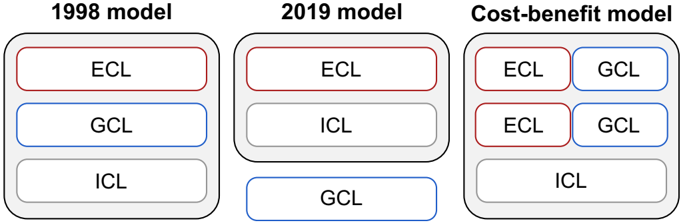
- The authors review the 1998 and 2019 cognitive load theory models, recent reconceptualizations, motivation research, and five digital-learning challenge areas.
- They synthesize these with constructive alignment to propose a cost-benefit model and a cognitive load alignment strategy linking design factors, germane processing, and assessment methods.
Limitations
- The paper states that new experiments explicitly devised to test cognitive load alignment are needed, particularly in large-scale real-world learning settings; smaller-scale studies could provide initial data for computational modeling and validation.
- The paper states that more research is needed to model these relationships more precisely and quantifiably, to develop exact guidelines on how much extraneous load is acceptable, and to investigate the temporal dynamics of load induction.
- Evident from the text: as a conceptual review, it presents no original empirical test of the proposed model, and no systematic search or selection method is described; the disfluency effect is also described as unstable with unclear reasons.
Model-written summary. Check it against the paper before relying on it.
Integrity signals
Registry
Cites
Statistics
Figures
Verification
Claims the paper makes
15 Valid · 3 Not valid · 38 Not checked · 58 Own results and interpretations
The cited sources support only part of this claim — read each source’s verdict below.
In the paper
“When learners had used these full-body controls instead of low-interactivity keyboard controls during the learning phase of this study, their test performance was higher if they used a highly interactive test method involving a graphics tablet instead of a mouse.”
What the sources say
- Partly supportedcites Johnson-Glenberg & Megowan-Romanowicz, 2017 matched to “Embodied science and mixed reality: How gesture and motion capture affect physics education” (2017) sourceExperimental — accuracy not yet measured
Split into 2 atoms — 0 confirmed, 2 partially supported, 0 disputed, 0 misattributed, 0 unverifiable. Expand the claim to see per-atom verdicts.
plainstates a cause- Asserted: passes — The authors put it forward as true.
- Checkable: passes — It can be checked against evidence.
- Load-bearing: passes — The paper’s conclusions depend on it.
- Based: passes — The paper gives a reason why it holds.
- Partly supported
The sources with a verdict support this claim; the rest weren’t checked yet, have no full text we could read, or their verdicts aren’t rated yet.
In the paper
“recent investigations centering on the new affordances of digital and online learning have brought to light several results that can pose a challenge for the theory (e.g., Brom et al., 2018; Skulmowski et al., 2016; Skulmowski & Rey, 2020b).”
What the sources say
- Not checked — no full text of the sourcecites Brom et al., 2018 matched to “How effective is emotional design? A meta-analysis on facial anthropomorphisms and pleasant colors during multimedia learning” (2018) source
- Not checked — no full text of the sourcecites Skulmowski et al., 2016 matched to “Embodied learning using a tangible user interface: The effects of haptic perception and selective pointing on a spatial learning task” (2016) source
- Supportedcites Skulmowski & Rey, 2020b matched to “The realism paradox: Realism can act as a form of signaling despite being associated with cognitive load” (2020) source
Section 9.2, “Implications for cognitive load theory,” explicitly says the study’s results might pose a challenge to the theory. This supports the point for which this paper is cited; the sentence’s other citations can account for the reference to several investigations. (LLM, conf=0.93)
plainstates an association- Asserted: passes — The authors put it forward as true.
- Checkable: passes — It can be checked against evidence.
- Load-bearing: passes — The paper’s conclusions depend on it.
- Based: passes — The paper gives a reason why it holds.
Every source the paper cites for this claim was checked and supports it.
In the paper
“The major change from the 1998 model is that Sweller et al. (2019) have removed germane load from the additive equation of total load, but rather a dimension now called ' germane processing. '”
What the sources say
- Supportedcites Sweller et al., 2019 matched to “Cognitive Architecture and Instructional Design: 20 Years Later” (2019) source
In “Categories of Cognitive Load” (page unavailable), the authors say germane cognitive load no longer contributes to total load as a load in its own right; instead, it redistributes working-memory resources toward learning. “Measuring Cognitive Load” says only intrinsic and extraneous load remain basic categories, and “Instructional Effects Reported in 1998” uses the term “germane processing.” (LLM, conf=0.92)
plain- Asserted: passes — The authors put it forward as true.
- Checkable: passes — It can be checked against evidence.
- Load-bearing: passes — The paper’s conclusions depend on it.
- Based: passes — The paper gives a reason why it holds.
- Supported
The sources with a verdict support this claim; the rest weren’t checked yet, have no full text we could read, or their verdicts aren’t rated yet.
In the paper
“Newer research highlights that extraneous load can be divided into different components that might require different measurement strategies (Hollender et al., 2010; Skulmowski & Rey, 2020a).”
What the sources say
- Not checked — no full text of the sourcecites Hollender et al., 2010 matched to “Integrating cognitive load theory and concepts of human–computer interaction” (2010) source
- Supportedcites Skulmowski & Rey, 2020a matched to “Subjective cognitive load surveys lead to divergent results for interactive learning media” (2020) source
Section 9 says there may be multiple types of extraneous load, distinguishing demands from visuospatial arrangement and interactive controls. It also concludes that survey usefulness depends on context and that cognitive-load surveys cannot be used interchangeably in all instructional settings. (LLM, conf=0.93)
hedged- Asserted: passes — The authors put it forward as true.
- Checkable: passes — It can be checked against evidence.
- Load-bearing: passes — The paper’s conclusions depend on it.
- Based: passes — The paper gives a reason why it holds.
The cited sources support only part of this claim — read each source’s verdict below.
In the paper
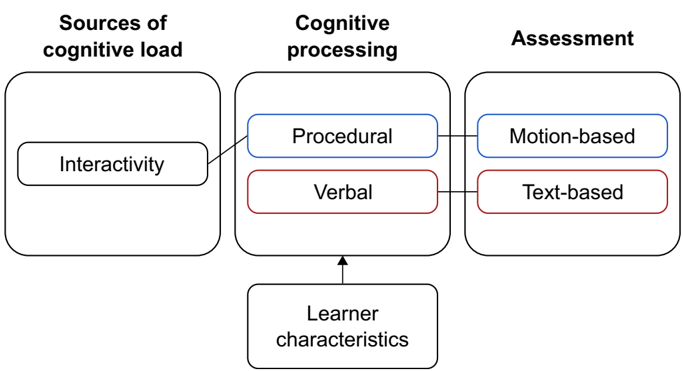
“In the example of interactivity, a motion-based assessment type can be considered a well-aligned test type, since interactive controls may trigger procedural learning as a form of germane processing (Johnson-Glenberg & Megowan-Romanowicz, 2017).”
What the sources say
- Partly supportedcites Johnson-Glenberg & Megowan-Romanowicz, 2017 matched to “Embodied science and mixed reality: How gesture and motion capture affect physics education” (2017) sourceExperimental — accuracy not yet measured
The Discussion’s “Test sensitivity” section reports that a gesture-facilitated Wacom assessment was more closely aligned with embodied learning and revealed greater gains than a keyboard test. The “Being active” section suggests that controlling content through congruent gestures may deepen learning, but the paper does not characterize this as procedural learning or germane processing. (LLM, conf=0.85)
hedgedstates a possible cause- Asserted: passes — The authors put it forward as true.
- Checkable: passes — It can be checked against evidence.
- Load-bearing: passes — The paper’s conclusions depend on it.
- Based: passes — The paper gives a reason why it holds.
- Partly supported
45 more claims · 4 with their cited sources checked
Create a free account to see all 114 claims and every source verdict.
- It may state two separate claims as one. 25
- Probably not a substantial claim. 49
Claims other papers make about this one
Each is checked against this paper’s own text: does it say what the citing paper says it does?
The source backs part of the claim, not all of it — or backs it for a different population, condition or comparison.
In the citing paper
“Prior studies have primarily examined cognitive offloading from a cognitive and functional perspective, emphasizing its role in reducing memory demands, altering information retention, or redistributing cognitive load (Skulmowski and Xu, 2022; Sun et al., 2025).”
From Cognitive offloading through digital tools and its relationship with critical thinking, task persistence, and learning depth (2026) · cites this paper as Skulmowski and Xu, 2022
Experimental — accuracy not yet measuredThe source backs part of the claim, not all of it — or backs it for a different population, condition or comparison.
In the citing paper
“Previous studies have similarly noted that critical thinking and deep learning can be directly influenced by how learners interact with digital information environments, beyond motivational factors alone (Skulmowski and Xu, 2022; Almulla and Al-Rahmi, 2023).”
From Cognitive offloading through digital tools and its relationship with critical thinking, task persistence, and learning depth (2026) · cites this paper as Skulmowski and Xu, 2022
Experimental — accuracy not yet measuredThe source backs part of the claim, not all of it — or backs it for a different population, condition or comparison.
In the citing paper
“This suggests that higher-order cognitive outcomes may be shaped by both internal beliefs and the structural affordances provided by digital tools, such as access to diverse information sources and opportunities for comparison and reflection.”
From Cognitive offloading through digital tools and its relationship with critical thinking, task persistence, and learning depth (2026) · cites this paper as Skulmowski and Xu, 2022
Experimental — accuracy not yet measuredThe source backs part of the claim, not all of it — or backs it for a different population, condition or comparison.
In the citing paper
“educational computer games ('serious games') often require learners to internalize the rules of such a game, thereby causing extraneous cognitive load”
From The Cognitive Architecture of Digital Externalization (2023) · cites this paper as Skulmowski & Xu, 2022
Experimental — accuracy not yet measuredThe check wasn’t confident either way, so it gives no verdict — never disputed.
In the citing paper
“While these studies have provided foundational insights into how digital tools reshape cognitive processes, they have paid limited attention to how habitual offloading practices influence learners' self-perceptions as competent thinkers.”
From Cognitive offloading through digital tools and its relationship with critical thinking, task persistence, and learning depth (2026) · cites this paper as Skulmowski and Xu, 2022
Experimental — accuracy not yet measured
1 more claim about this paper
Create a free account to see every claim other papers make about this one.
Citations
Cites
Cognitive Load During Problem Solving: Effects on Learning
Sweller, J. (1988) · Cognitive Science · doi:10.1016/0364-0213(88)90023-7 · Cited by 11,048 · cited 2×
“…a new component of this model (in comparison to an even earlier version of the model which consisted only the intrinsic and extraneous cognitive load; Sweller, 1988), the germane load (Sweller et al., 1998; see, e.g., Kalyuga, 2011, for an overview of the debate surrounding this component).”
BackgroundRyan, R. M., & Deci, E. L. (2020) · Contemporary Educational Psychology · doi:10.1016/j.cedpsych.2020.101860 · Cited by 6,037
Cognitive Architecture and Instructional Design
Sweller, J., van Merrienboer, J. J. G., & Paas, F. G. W. C. (1998) · Educational Psychology Review · doi:10.1023/a:1022193728205 · Cited by 6,023
Six views of embodied cognition
Wilson, M. (2002) · Psychonomic Bulletin & Review · doi:10.3758/bf03196322 · Cited by 4,782
Enhancing teaching through constructive alignment
Biggs, J. (1996) · Higher Education · doi:10.1007/bf00138871 · Cited by 4,084 · cited 3×
“One such approach is constructive alignment (Biggs, 1996).”
BackgroundInfluentialCognitive Load Theory and the Format of Instruction
Chandler, P., & Sweller, J. (1991) · Cognition and Instruction · doi:10.1207/s1532690xci0804_2 · Cited by 2,894
Cognitive Load Measurement as a Means to Advance Cognitive Load Theory
Paas, F., Tuovinen, J. E., Tabbers, H., & Van Gerven, P. W. M. (2003) · Educational Psychologist · doi:10.1207/s15326985ep3801_8 · Cited by 2,527
Cognitive Architecture and Instructional Design: 20 Years Later
Sweller, J., van Merriënboer, J. J. G., & Paas, F. (2019) · Educational Psychology Review · doi:10.1007/s10648-019-09465-5 · Cited by 2,337
Element Interactivity and Intrinsic, Extraneous, and Germane Cognitive Load
Sweller, J. (2010) · Educational Psychology Review · doi:10.1007/s10648-010-9128-5 · Cited by 2,020
Immersive Interfaces for Engagement and Learning
Dede, C. (2009) · Science · doi:10.1126/science.1167311 · Cited by 1,707
What the Student Does: teaching for enhanced learning
Biggs, J. (1999) · Higher Education Research & Development · doi:10.1080/0729436990180105 · Cited by 1,332
The Use of Worked Examples as a Substitute for Problem Solving in Learning Algebra
Sweller, J., & Cooper, G. A. (1985) · Cognition and Instruction · doi:10.1207/s1532690xci0201_3 · Cited by 1,214
Cognitive load theory, educational research, and instructional design: some food for thought
de Jong, T. (2010) · Instructional Science · doi:10.1007/s11251-009-9110-0 · Cited by 1,180 · cited 4×
“It needs to be noted that the specificity of instructional goals has been considered in previous discussions of CLT (e.g., de Jong, 2010; Kalyuga & Singh, 2016).”
BackgroundInfluentialExpertise Reversal Effect and Its Implications for Learner-Tailored Instruction
Kalyuga, S. (2007) · Educational Psychology Review · doi:10.1007/s10648-007-9054-3 · Cited by 1,056 · cited 3×
“A number of CLT researchers also explicitly refer to the notions of costs and benefits when discussing cognitive load (e.g., Kalyuga, 2007, 2012; Kalyuga & Singh, 2016).”
BackgroundMayer, R. E., Heiser, J., & Lonn, S. (2001) · Journal of Educational Psychology · doi:10.1037/0022-0663.93.1.187 · Cited by 1,029
Instructional control of cognitive load in the training of complex cognitive tasks
Paas, F. G. W. C., & Van Merriënboer, J. J. G. (1994) · Educational Psychology Review · doi:10.1007/bf02213420 · Cited by 968
Pictorial Illustrations Still Improve Students' Learning from Text
Carney, R. N., & Levin, J. R. (2002) · Educational Psychology Review · doi:10.1023/a:1013176309260 · Cited by 873
What the student does: teaching for enhanced learning
Biggs, J. (2012) · Higher Education Research & Development · doi:10.1080/07294360.2012.642839 · Cited by 863
How seductive details do their damage: A theory of cognitive interest in science learning.
Harp, S. F., & Mayer, R. E. (1998) · Journal of Educational Psychology · doi:10.1037/0022-0663.90.3.414 · Cited by 855
Embodied Cognition is Not What you Think it is
Wilson, A. D., & Golonka, S. (2013) · Frontiers in Psychology · doi:10.3389/fpsyg.2013.00058 · Cited by 807
Makransky, G., & Lilleholt, L. (2018) · Educational Technology Research and Development · doi:10.1007/s11423-018-9581-2 · Cited by 796
THE SPLIT‐ATTENTION EFFECT AS A FACTOR IN THE DESIGN OF INSTRUCTION
CHANDLER, P., & SWELLER, J. (1992) · British Journal of Educational Psychology · doi:10.1111/j.2044-8279.1992.tb01017.x · Cited by 767
A Reconsideration of Cognitive Load Theory
Schnotz, W., & Kürschner, C. (2007) · Educational Psychology Review · doi:10.1007/s10648-007-9053-4 · Cited by 755
Serious games as new educational tools: how effective are they? A meta‐analysis of recent studies
Girard, C., Ecalle, J., & Magnan, A. (2013) · Journal of Computer Assisted Learning · doi:10.1111/j.1365-2729.2012.00489.x · Cited by 725
Cognitive Load Theory: How Many Types of Load Does It Really Need?
Kalyuga, S. (2011) · Educational Psychology Review · doi:10.1007/s10648-010-9150-7 · Cited by 725 · cited 3×
“…a new component of this model (in comparison to an even earlier version of the model which consisted only the intrinsic and extraneous cognitive load; Sweller, 1988), the germane load (Sweller et al., 1998; see, e.g., Kalyuga, 2011, for an overview of the debate surrounding this component).”
BackgroundBlasco-Arcas, L., Buil, I., Hernández-Ortega, B., & Sese, F. J. (2013) · Computers & Education · doi:10.1016/j.compedu.2012.10.019 · Cited by 568
Emotional design in multimedia learning: Effects of shape and color on affect and learning
Plass, J. L., Heidig, S., Hayward, E. O., Homer, B. D., & Um, E. (2014) · Learning and Instruction · doi:10.1016/j.learninstruc.2013.02.006 · Cited by 550 · cited 1×
“Between these two extremes, there are several examples for a medium level of interactivity, such as controllable sliders (e.g., Homer & Plass, 2014) or movable elements in simulations (e.g., Kalet et al., 2012).”
BackgroundMakransky, G., Borre‐Gude, S., & Mayer, R. E. (2019) · Journal of Computer Assisted Learning · doi:10.1111/jcal.12375 · Cited by 532
Moreno, R., & Mayer, R. E. (2000) · Journal of Educational Psychology · doi:10.1037/0022-0663.92.1.117 · Cited by 530
Incorporating motivation into multimedia learning
Mayer, R. E. (2014) · Learning and Instruction · doi:10.1016/j.learninstruc.2013.04.003 · Cited by 524
Paas, F., & Sweller, J. (2012) · Educational Psychology Review · doi:10.1007/s10648-011-9179-2 · Cited by 502
The Transfer of Scientific Principles Using Concrete and Idealized Simulations
Goldstone, R. L., & Son, J. Y. (2005) · Journal of the Learning Sciences · doi:10.1207/s15327809jls1401_4 · Cited by 452
Choi, H.-H., van Merriënboer, J. J. G., & Paas, F. (2014) · Educational Psychology Review · doi:10.1007/s10648-014-9262-6 · Cited by 413
Four Ways of Considering Emotion in Cognitive Load Theory
Plass, J. L., & Kalyuga, S. (2019) · Educational Psychology Review · doi:10.1007/s10648-019-09473-5 · Cited by 404
Useful junk?: the effects of visual embellishment on comprehension and memorability of charts
Bateman, S., Mandryk, R. L., Gutwin, C., Genest, A., McDine, D., & Brooks, C. (2010) · Proceedings of the SIGCHI Conference on Human Factors in Computing Systems · doi:10.1145/1753326.1753716 · Cited by 404
Paas, F., Tuovinen, J. E., van Merriënboer, J. J. G., & Aubteen Darabi, A. (2005) · Educational Technology Research and Development · doi:10.1007/bf02504795 · Cited by 401
Emotional Design in Digital Media for Learning
Plass, J. L., & Kaplan, U. (2016) · Emotions, Technology, Design, and Learning · doi:10.1016/b978-0-12-801856-9.00007-4 · Cited by 377 · cited 1×
“In numerous studies, it has been shown that introducing minor visual cues that trigger positive emotions (such as warm colors and child-like faces) can enhance learning (e.g., Brom et al., 2018; Plass & Kaplan, 2016).”
BackgroundWho benefits from learning with 3D models? the case of spatial ability
Huk, T. (2006) · Journal of Computer Assisted Learning · doi:10.1111/j.1365-2729.2006.00180.x · Cited by 354
Thirty years of research on online learning
Mayer, R. E. (2019) · Applied Cognitive Psychology · doi:10.1002/acp.3482 · Cited by 337
Interactivity in multimedia learning: An integrated model
Domagk, S., Schwartz, R. N., & Plass, J. L. (2010) · Computers in Human Behavior · doi:10.1016/j.chb.2010.03.003 · Cited by 331
Spatial Ability: Its Influence on Learning with Visualizations—a Meta-Analytic Review
Höffler, T. N. (2010) · Educational Psychology Review · doi:10.1007/s10648-010-9126-7 · Cited by 328
Integrating cognitive load theory and concepts of human–computer interaction
Hollender, N., Hofmann, C., Deneke, M., & Schmitz, B. (2010) · Computers in Human Behavior · doi:10.1016/j.chb.2010.05.031 · Cited by 328
Collaborative embodied learning in mixed reality motion-capture environments: Two science studies.
Johnson-Glenberg, M. C., Birchfield, D. A., Tolentino, L., & Koziupa, T. (2014) · Journal of Educational Psychology · doi:10.1037/a0034008 · Cited by 328
Benefits of emotional design in multimedia instruction
Mayer, R. E., & Estrella, G. (2014) · Learning and Instruction · doi:10.1016/j.learninstruc.2014.02.004 · Cited by 328
An Evolutionarily Informed Education Science
GEARY, D. C. (2008) · Educational Psychologist · doi:10.1080/00461520802392133 · Cited by 324
Fortune favors the ( ): Effects of disfluency on educational outcomes
Diemand-Yauman, C., Oppenheimer, D. M., & Vaughan, E. B. (2011) · Cognition · doi:10.1016/j.cognition.2010.09.012 · Cited by 321
Revising the redundancy principle in multimedia learning.
Mayer, R. E., & Johnson, C. I. (2008) · Journal of Educational Psychology · doi:10.1037/0022-0663.100.2.380 · Cited by 316
Embodied learning: introducing a taxonomy based on bodily engagement and task integration
Skulmowski, A., & Rey, G. D. (2018) · Cognitive Research: Principles and Implications · doi:10.1186/s41235-018-0092-9 · Cited by 310
Self-citationCognitive Load Theory for the Design of Medical Simulations
Fraser, K. L., Ayres, P., & Sweller, J. (2015) · Simulation in Healthcare: The Journal of the Society for Simulation in Healthcare · doi:10.1097/sih.0000000000000097 · Cited by 306
The evolution of cognitive load theory and its application to medical education
Leppink, J., & Van den Heuvel, A. (2015) · Perspectives on Medical Education · doi:10.1007/s40037-015-0192-x · Cited by 299
Instructional Alignment: Searching for a Magic Bullet
Cohen, S. A. (1987) · Educational Researcher · doi:10.2307/1175370 · Cited by 299
Stull, A. T., & Mayer, R. E. (2007) · Journal of Educational Psychology · doi:10.1037/0022-0663.99.4.808 · Cited by 295
Frederiksen, J. G., Sørensen, S. M. D., Konge, L., Svendsen, M. B. S., Nobel-Jørgensen, M., Bjerrum, F., & Andersen, S. A. W. (2020) · Surgical Endoscopy · doi:10.1007/s00464-019-06887-8 · Cited by 294
Learning with serious games: Is fun playing the game a predictor of learning success?
Iten, N., & Petko, D. (2016) · British Journal of Educational Technology · doi:10.1111/bjet.12226 · Cited by 294
Ten Steps to Complex Learning: A Systematic Approach to Four-Component Instructional Design
van Merriënboer, J. J. G., & Kirschner, P. A. (2017) · Routledge eBooks · doi:10.4324/9781315113210 · Cited by 292
The impact of background music on adult listeners: A meta-analysis
Kämpfe, J., Sedlmeier, P., & Renkewitz, F. (2011) · Psychology of Music · doi:10.1177/0305735610376261 · Cited by 285
Eye movement during skill acquisition: More evidence for the information-reduction hypothesis.
Haider, H., & Frensch, P. A. (1999) · Journal of Experimental Psychology: Learning, Memory, and Cognition · doi:10.1037//0278-7393.25.1.172 · Cited by 272
Developing Personalized Education: A Dynamic Framework
Tetzlaff, L., Schmiedek, F., & Brod, G. (2021) · Educational Psychology Review · doi:10.1007/s10648-020-09570-w · Cited by 266
Design factors for educationally effective animations and simulations
Plass, J. L., Homer, B. D., & Hayward, E. O. (2009) · Journal of Computing in Higher Education · doi:10.1007/s12528-009-9011-x · Cited by 248
Xie, B., & Salvendy, G. (2000) · Work & Stress · doi:10.1080/026783700417249 · Cited by 247
Rethinking the Boundaries of Cognitive Load Theory in Complex Learning
Kalyuga, S., & Singh, A.-M. (2016) · Educational Psychology Review · doi:10.1007/s10648-015-9352-0 · Cited by 241 · cited 4×
“A number of CLT researchers also explicitly refer to the notions of costs and benefits when discussing cognitive load (e.g., Kalyuga, 2007, 2012; Kalyuga & Singh, 2016).”
BackgroundMethodInfluentialThe Role of Information Reduction in Skill Acquisition
Haider, H., & Frensch, P. A. (1996) · Cognitive Psychology · doi:10.1006/cogp.1996.0009 · Cited by 236
A functional neuroimaging study of motivation and executive function
Taylor, S. F., Welsh, R. C., Wager, T. D., Luan Phan, K., Fitzgerald, K. D., & Gehring, W. J. (2004) · NeuroImage · doi:10.1016/j.neuroimage.2003.10.032 · Cited by 222 · cited 1×
“The overlap in brain activity found in the study supports the assumption of a connection between motivation and working memory (Taylor et al., 2004).”
ResultCognitive Load as Motivational Cost
Feldon, D. F., Callan, G., Juth, S., & Jeong, S. (2019) · Educational Psychology Review · doi:10.1007/s10648-019-09464-6 · Cited by 218
Knogler, M., Harackiewicz, J. M., Gegenfurtner, A., & Lewalter, D. (2015) · Contemporary Educational Psychology · doi:10.1016/j.cedpsych.2015.08.004 · Cited by 217
What does germane load mean? An empirical contribution to the cognitive load theory
Debue, N., & van de Leemput, C. (2014) · Frontiers in Psychology · doi:10.3389/fpsyg.2014.01099 · Cited by 209
Embodied science and mixed reality: How gesture and motion capture affect physics education
Johnson-Glenberg, M. C., & Megowan-Romanowicz, C. (2017) · Cognitive Research: Principles and Implications · doi:10.1186/s41235-017-0060-9 · Cited by 191 · cited 4×
“This result highlights that the benefits of learning with higher levels of interactivity can be best detected using similarly interactive test methods (Johnson-Glenberg & Megowan-Romanowicz, 2017).”
BackgroundMethodInfluentialEffects of goal specificity on means–ends analysis and learning.
Sweller, J., & Levine, M. (1982) · Journal of Experimental Psychology: Learning, Memory, and Cognition · doi:10.1037/0278-7393.8.5.463 · Cited by 182 · cited 1×
“…of the task, or other affordances of the learning environment (Schnotz & Kürschner, 2007), for instance visual factors (such as split-attention resulting from a spatial separation of related content; Chandler & Sweller, 1992) or different instruction approaches (Sweller & Levine, 1982).”
BackgroundThe effects of realism in learning with dynamic visualizations
Scheiter, K., Gerjets, P. H., Huk, T., Imhof, B., & Kammerer, Y. (2008) · Learning and Instruction · doi:10.1016/j.learninstruc.2008.08.001 · Cited by 172
From Theory to Practice: The Application of Cognitive Load Theory to the Practice of Medicine
Szulewski, A., Howes, D., van Merriënboer, J. J. G., & Sweller, J. (2021) · Academic Medicine · doi:10.1097/acm.0000000000003524 · Cited by 171
Berney, S., Bétrancourt, M., Molinari, G., & Hoyek, N. (2015) · Anatomical Sciences Education · doi:10.1002/ase.1524 · Cited by 168
Prior Knowledge Principle in Multimedia Learning
Kalyuga, S. (2005) · The Cambridge Handbook of Multimedia Learning · doi:10.1017/cbo9780511816819.022 · Cited by 166
Studying Visual Displays: How to Instructionally Support Learning
Renkl, A., & Scheiter, K. (2017) · Educational Psychology Review · doi:10.1007/s10648-015-9340-4 · Cited by 165
Neuroimaging of cognitive load in instructional multimedia
Whelan, R. R. (2007) · Educational Research Review · doi:10.1016/j.edurev.2006.11.001 · Cited by 165 · cited 3×
“He concludes that intrinsic load can be regarded as “ maintenance and manipulation demands placed on the prefrontal cortex ” (Whelan, 2007, p. 7).”
BackgroundInfluentialBaceviciute, S., Terkildsen, T., & Makransky, G. (2021) · Computers & Education · doi:10.1016/j.compedu.2020.104122 · Cited by 163
Brom, C., Stárková, T., & D'Mello, S. K. (2018) · Educational Research Review · doi:10.1016/j.edurev.2018.09.004 · Cited by 163
Drawing Boundary Conditions for Learning by Drawing
Fiorella, L., & Zhang, Q. (2018) · Educational Psychology Review · doi:10.1007/s10648-018-9444-8 · Cited by 161
Klingenberg, S., Jørgensen, M. L. M., Dandanell, G., Skriver, K., Mottelson, A., & Makransky, G. (2020) · British Journal of Educational Technology · doi:10.1111/bjet.13029 · Cited by 158
Schwamborn, A., Thillmann, H., Opfermann, M., & Leutner, D. (2010) · Computers in Human Behavior · doi:10.1016/j.chb.2010.05.028 · Cited by 149
Dankbaar, M. E. W., Alsma, J., Jansen, E. E. H., van Merrienboer, J. J. G., van Saase, J. L. C. M., & Schuit, S. C. E. (2016) · Advances in Health Sciences Education · doi:10.1007/s10459-015-9641-x · Cited by 147
Harris, D., Wilson, M., & Vine, S. (2020) · Virtual Reality · doi:10.1007/s10055-019-00422-9 · Cited by 146
Skulmowski, A., Pradel, S., Kühnert, T., Brunnett, G., & Rey, G. D. (2016) · Computers & Education · doi:10.1016/j.compedu.2015.10.011 · Cited by 136
Self-citationTen Steps to Complex Learning: A New Approach to Instruction and Instructional Design
Kirschner, P. A., & van Merriënboer, J. J. G. (2008) · Sage eBooks · doi:10.4135/9781412964012.n26 · Cited by 122
van Merriënboer, J. J. G., & Krammer, H. P. M. (1987) · Instructional Science · doi:10.1007/bf00120253 · Cited by 120
Hawlitschek, A., & Joeckel, S. (2017) · Computers in Human Behavior · doi:10.1016/j.chb.2017.01.040 · Cited by 119
Leopold, C., Sumfleth, E., & Leutner, D. (2013) · Learning and Instruction · doi:10.1016/j.learninstruc.2013.02.003 · Cited by 108
Andersen, M. S., & Makransky, G. (2021) · Journal of Computer Assisted Learning · doi:10.1111/jcal.12478 · Cited by 104
Reducing verbal redundancy in multimedia learning: An undesired desirable difficulty?
Yue, C. L., Bjork, E. L., & Bjork, R. A. (2013) · Journal of Educational Psychology · doi:10.1037/a0031971 · Cited by 98
Xu, K. M., Koorn, P., de Koning, B., Skuballa, I. T., Lin, L., Henderikx, M., Marsh, H. W., Sweller, J., & Paas, F. (2021) · Journal of Educational Psychology · doi:10.1037/edu0000631 · Cited by 96
Self-citationGiving Learning a Helping Hand: Finger Tracing of Temperature Graphs on an iPad
Agostinho, S., Tindall-Ford, S., Ginns, P., Howard, S. J., Leahy, W., & Paas, F. (2015) · Educational Psychology Review · doi:10.1007/s10648-015-9315-5 · Cited by 94
Instructional benefits of spoken words: A review of cognitive load factors
Kalyuga, S. (2012) · Educational Research Review · doi:10.1016/j.edurev.2011.12.002 · Cited by 93
Schmidgall, S. P., Eitel, A., & Scheiter, K. (2019) · Learning and Instruction · doi:10.1016/j.learninstruc.2018.01.006 · Cited by 92
Brucker, B., Scheiter, K., & Gerjets, P. H. (2014) · Computers in Human Behavior · doi:10.1016/j.chb.2014.03.077 · Cited by 91
Eitel, A., Kühl, T., Scheiter, K., & Gerjets, P. (2014) · Applied Cognitive Psychology · doi:10.1002/acp.3004 · Cited by 85
High correlation between performance on a virtual‐reality simulator and real‐life cataract surgery
Thomsen, A. S. S., Smith, P., Subhi, Y., la Cour, M., Tang, L., Saleh, G. M., & Konge, L. (2016) · Acta Ophthalmologica · doi:10.1111/aos.13275 · Cited by 84
Motivational aspects of cognitive load theory.
Schnotz, W., Fries, S., & Horz, H. (2009) · Cited by 83
Doyle, M., & Furnham, A. F. (2011) · Thinking Skills and Creativity · doi:10.1016/j.tsc.2011.09.002 · Cited by 81
Nebel, S., Beege, M., Schneider, S., & Rey, G. D. (2020) · Frontiers in Education · doi:10.3389/feduc.2020.00144 · Cited by 78
Song, H. S., Pusic, M., Nick, M. W., Sarpel, U., Plass, J. L., & Kalet, A. L. (2014) · Computers & Education · doi:10.1016/j.compedu.2013.09.017 · Cited by 69
Homer, B. D., & Plass, J. L. (2014) · Computers in Human Behavior · doi:10.1016/j.chb.2014.03.041 · Cited by 63
Temporal pattern of emotions and cognitive load during simulation training and debriefing
Fraser, K. L., & McLaughlin, K. (2018) · Medical Teacher · doi:10.1080/0142159x.2018.1459531 · Cited by 62
Kalet, A., Song, H. S., Sarpel, U., Schwartz, R., Brenner, J., Ark, T. K., & Plass, J. (2012) · Medical Teacher · doi:10.3109/0142159x.2012.706727 · Cited by 62
Imlig-Iten, N., & Petko, D. (2018) · Simulation & Gaming · doi:10.1177/1046878118779088 · Cited by 61
The effects of different levels of disfluency on learning outcomes and cognitive load
Seufert, T., Wagner, F., & Westphal, J. (2017) · Instructional Science · doi:10.1007/s11251-016-9387-8 · Cited by 56
Cheng, M., Huang, W., & Hsu, M. (2020) · British Journal of Educational Technology · doi:10.1111/bjet.12896 · Cited by 54
Confirmatory Factor Analysis of Cognitive Load Ratings Supports a Two-Factor Model
Jiang, D., & Kalyuga, S. (2020) · The Quantitative Methods for Psychology · doi:10.20982/tqmp.16.3.p216 · Cited by 51
Skulmowski, A., & Rey, G. D. (2020) · Human Behavior and Emerging Technologies · doi:10.1002/hbe2.190 · Cited by 50 · cited 11×
“At the same time, one combination which contained a particularly large amount of realistic details received higher extraneous load ratings (Skulmowski & Rey, 2020b).”
BackgroundResultInfluentialSelf-citationSubjective cognitive load surveys lead to divergent results for interactive learning media
Skulmowski, A., & Rey, G. D. (2020) · Human Behavior and Emerging Technologies · doi:10.1002/hbe2.184 · Cited by 47 · cited 11×
“At the same time, one combination which contained a particularly large amount of realistic details received higher extraneous load ratings (Skulmowski & Rey, 2020b).”
BackgroundResultInfluentialSelf-citationXie, H., Zhou, Z., & Liu, Q. (2018) · Educational Psychology Review · doi:10.1007/s10648-018-9442-x · Cited by 46
Design Factors for Effective Science Simulations: Representation of Information
Plass, J. L., Homer, B. D., Milne, C. E., Jordan, T., Kalyuga, S., Kim, M. C., & Lee, H. (2009) · International Journal of Gaming and Computer-Mediated Simulations · doi:10.4018/jgcms.2009010102 · Cited by 46
Realistic details in visualizations require color cues to foster retention
Skulmowski, A., & Rey, G. D. (2018) · Computers & Education · doi:10.1016/j.compedu.2018.03.012 · Cited by 43
Self-citationSkulmowski, A., & Rey, G. D. (2020) · Human Behavior and Emerging Technologies · doi:10.1002/hbe2.209 · Cited by 40
Self-citationRole of Interactivity in Learning from Engineering Animations
Pedra, A., Mayer, R. E., & Albertin, A. L. (2015) · Applied Cognitive Psychology · doi:10.1002/acp.3137 · Cited by 40
Dwyer, F. M. (1969) · Programmed Learning and Educational Technology · doi:10.1080/1355800690060301 · Cited by 38
The topic of instructional design in research journals: a citation analysis for the years 1980-2008.
Ozcinar, Z. (2009) · Australasian Journal of Educational Technology · doi:10.14742/ajet.1129 · Cited by 31
Kremer, T., Mamede, S., van den Broek, W. W., Schmidt, H. G., Nunes, M. D. P. T., & Martins, M. A. (2019) · Perspectives on Medical Education · doi:10.1007/s40037-019-00525-8 · Cited by 28
Ginns, P., Hu, F., & Bobis, J. (2020) · Applied Cognitive Psychology · doi:10.1002/acp.3732 · Cited by 27
Kalyuga, S., & Plass, A. J. L. (2017) · Cognitive Load Measurement and Application · doi:10.4324/9781315296258-5 · Cited by 24
Memory-related cognitive load effects in an interrupted learning task: A model-based explanation
Wirzberger, M., Borst, J. P., Krems, J. F., & Rey, G. D. (2020) · Trends in Neuroscience and Education · doi:10.1016/j.tine.2020.100139 · Cited by 22
Gaming as a training tool to train cognitive skills in Emergency Care: how effective is it?
Dankbaar, M. E. W., Roozeboom, M. B., Oprins, E. A. P. B., Rutten, F., van Saase, J., van Merriënboer, J. J. G., & Schuit, S. C. E. (2014) · Springer eBooks · doi:10.1007/978-3-658-07141-7_3 · Cited by 5
Dwyer, F. M. (1968) · Perceptual and Motor Skills · doi:10.2466/pms.1968.27.2.351
Harris, D., Wilson, M., & Vine, S. J. (2019) · doi:10.31234/osf.io/pm5ht
Cited by
Gkintoni, E., Antonopoulou, H., Sortwell, A., & Halkiopoulos, C. (2025) · Brain Sciences · doi:10.3390/brainsci15020203 · Cited by 309
Cognitive and emotional engagement while learning with VR: The perspective of multimodal methodology
Dubovi, I. (2022) · Computers & Education · doi:10.1016/j.compedu.2022.104495 · Cited by 237
Poupard, M., Larrue, F., Sauzeon, H., & Tricot, A. (2022) · HAL · doi:10.1111/bjet.13503 · Cited by 10
Westphal, M., Vössing, M., Satzger, G., Yom‐Tov, G. B., & Rafaeli, A. (2023) · Computers in Human Behavior · doi:10.1016/j.chb.2023.107714 · Cited by 186
Yeganeh, L. N., Fenty, N. S., Chen, Y., Simpson, A. M., & Hatami, M. (2025) · Future Internet · doi:10.3390/fi17020063 · Cited by 227
Metadata
- Authors
- Skulmowski, A., & Xu, K. M.
- Affiliations
- Karlsruhe University of Education (DE)
- Open University of the Netherlands (NL)
- Corresponding author
- Skulmowski, Alexander
- Venue
- Educational Psychology Review
- Published
- 2021-06-28
- Volume
- 34
- Issue
- 1
- Pages
- 171-196
- ISSN
- 1040-726X (ISSN-L)
- 1573-336X
- OpenAlex
- W3176376210
- Cited by
- 678
- References
- 120
- Citations by year
- 2026: 244 · 2025: 196 · 2024: 112 · 2023: 77 · 2022: 44 · 2021: 5
- FWCI
- 57.43
- Type
- journal article
- Language
- en
- Open access
- hybrid
- doi.org
- Licence
- cc-by
- creativecommons.org/licenses/by/4.0 (tdm)
- creativecommons.org/licenses/by/4.0 (vor)
- Locations
- Educational Psychology Review (publishedVersion, cc-by)
- DSpace (Open University in the Netherlands) (publishedVersion, cc-by)
- DSpace (Open University in the Netherlands) (submittedVersion, cc-by)
- Funders
- Pädagogische Hochschule Karlsruhe
- Topics
- Social Sciences › Psychology › Experimental and Cognitive Psychology › Visual and Cognitive Learning Processes
- Social Sciences › Education › Online and Blended Learning
- Social Sciences › Psychology › Developmental and Educational Psychology › Innovative Teaching and Learning Methods
- Keywords
- cognitive load theory, extraneous cognitive load, online learning, constructive alignment, immersion, disfluency, realism (computer graphics), interactive learning media, deep learning, learning outcomes
About these checks
Registry, retraction, Cites and statistics results are computed, not judged, with one exception: a printed reference that no index lists is read once by a model before it counts as a citation error. Claims are extracted by a model and kept only when their quote appears verbatim in the text; each cited source is then checked, with a model’s help, for whether it says what the claim relies on. Those verdicts can be wrong — read the claim’s quote and the cited source before relying on one.
The claim verdicts this report counts are experimental: their accuracy is not yet measured.
A language model drew the claims from the paper on 2026-09-29, under version 3 of the claim definition (model deepseek-v4.1-flash, prompt extract-v3).
A second model labelled each claim on 2026-09-29 (model jev-1.13-20260917, definition revision gold-guideline-v0.2).
Cited sources are checked with a language model’s help (gpt-6-sol).
Statistics and arithmetic are recomputed, not judged.
Confidence bands are shown only for fields calibrated on our annotated test set. None is calibrated yet, so no band is shown.
What counts as a claim ›How we measure confidence ›How we check this ›
Are you an author, or do you see a problem with this page? Request a review
Data sources
Bibliographic data: Semantic Scholar, OpenAlex, Crossref.
Contains information from the Semantic Scholar Academic Graph Datasets, made available under the ODC Attribution License (ODC-BY 1.0).
Semantic Scholar’s data is described in: Kinney, R., et al. (2023). The Semantic Scholar Open Data Platform. arXiv:2301.10140.
