

Understanding Cognitive Load in Digital and Online Learning: a New Perspective on Extraneous Cognitive Load
Open accessThe DOI matches its Crossref record; 122 of the 122 references it cites were found in a registry or an index; 16 of the 63 sources its claims cite were checked for support.
Abstract
Abstract Cognitive load theory has been a major influence for the field of educational psychology. One of the main guidelines of the theory is that extraneous cognitive load should be reduced to leave sufficient cognitive resources for the actual learning to take place. In recent years, research regarding various design factors, in particular from the field of digital and online learning, have challenged this assumption. Interactive learning media, immersion, disfluency, realism, and redundant elements constitute five major challenges, since these design factors have been shown to induce task-irrelevant cognitive load, i.e., extraneous load, while still promoting motivation and learning. However, currently there is no unified approach to integrate such effects into cognitive load theory. By including aspects of constructive alignment, an approach aimed at fostering deep forms of learning in order to achieve specific learning outcomes, we devise a strategy to balance cognitive load in digital learning. Most importantly, we suggest considering both the positive and negative effects on cognitive load that certain design factors of digital learning can cause. In addition, a number of research results highlight that some types of positive effects of digital learning can only be detected using a suitable assessment method. This strategy of aligning cognitive load with desired learning outcomes will be useful for formulating theory-guided and empirically testable hypotheses, but can be particularly helpful for practitioners to embrace emerging technologies while minimizing potential extraneous drawbacks.
Overview
CoChat Summary
TL;DR
This review argues that five digital/online learning design factors—interactive media, immersion, disfluency, realism, and redundant/emotional-design elements—can induce extraneous cognitive load while still promoting motivation or learning. It proposes a cost-benefit model and “cognitive load alignment” strategy that links design factors, germane processing, and assessment methods rather than simply minimizing extraneous load.
Key findings
- The paper identifies five challenges to cognitive load theory: interactive learning media, immersion, disfluency, realism/detailed visualizations, and redundant elements/emotional design; these can raise task-irrelevant load yet sometimes improve learning or motivation.
- Immersion findings are mixed: Makransky et al. (2019) found immersive VR did not significantly affect retention versus written instruction but increased transfer scores, enjoyment, and motivation; Frederiksen et al. (2020) found highly immersive VR surgical simulator training decreased various learning process variables compared with less immersive settings.
- Disfluency and realism show non-linear patterns: Seufert et al. (2017) used three text-legibility levels and found low legibility descriptively increased learning versus a fluid control, with the only significant recall difference favoring medium over high disfluency; Skulmowski and Rey (2020b) reported higher retention for realistic parts alongside higher extraneous load ratings for one high-detail combination, termed the “realism paradox.”
- Emotional design/redundancy can help: Plass et al. (2014, Exp. 2) found colors increased comprehension, while transfer showed an interaction where the no-color version benefited from anthropomorphization but the colorized version did not; Bateman et al. (2010) found better long-term recall for embellished charts, with no significant short-term recall differences.
Methods
- Theoretical/conceptual review; no new empirical sample, data, or statistical analysis are reported.
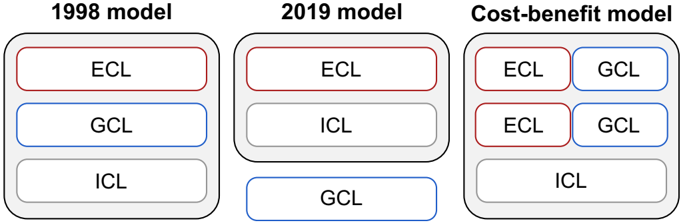
- The authors review the 1998 and 2019 cognitive load theory models, recent reconceptualizations, motivation research, and five digital-learning challenge areas.
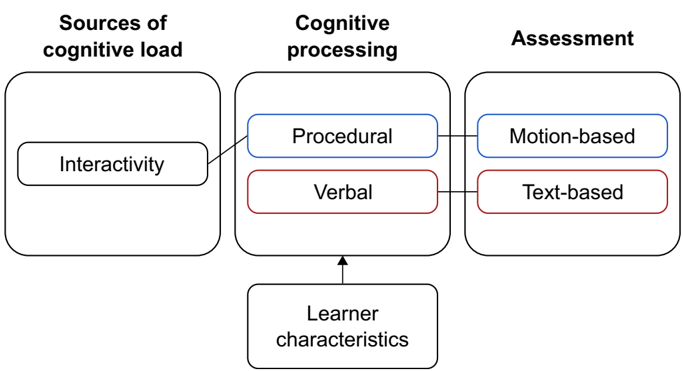
- They synthesize these with constructive alignment to propose a cost-benefit model and a cognitive load alignment strategy linking design factors, germane processing, and assessment methods.
Limitations
- The paper states that new experiments explicitly devised to test cognitive load alignment are needed, particularly in large-scale real-world learning settings; smaller-scale studies could provide initial data for computational modeling and validation.
- The paper states that more research is needed to model these relationships more precisely and quantifiably, to develop exact guidelines on how much extraneous load is acceptable, and to investigate the temporal dynamics of load induction.
- Evident from the text: as a conceptual review, it presents no original empirical test of the proposed model, and no systematic search or selection method is described; the disfluency effect is also described as unstable with unclear reasons.
Model-written summary. Check it against the paper before relying on it.
Integrity signals
Registry
Cites
Statistics
Figures
Verification
Claims the paper makes
15 Valid · 3 Not valid · 38 Not checked · 58 Own results and interpretations
The cited sources support only part of this claim — read each source’s verdict below.
In the paper
“When learners had used these full-body controls instead of low-interactivity keyboard controls during the learning phase of this study, their test performance was higher if they used a highly interactive test method involving a graphics tablet instead of a mouse.”
What the sources say
- Partly supportedcites Johnson-Glenberg & Megowan-Romanowicz, 2017 matched to “Embodied science and mixed reality: How gesture and motion capture affect physics education” (2017) sourceExperimental — accuracy not yet measured
Split into 2 atoms — 0 confirmed, 2 partially supported, 0 disputed, 0 misattributed, 0 unverifiable. Expand the claim to see per-atom verdicts.
plainstates a cause- Asserted: passes — The authors put it forward as true.
- Checkable: passes — It can be checked against evidence.
- Load-bearing: passes — The paper’s conclusions depend on it.
- Based: passes — The paper gives a reason why it holds.
- Partly supported
The sources with a verdict support this claim; the rest weren’t checked yet, have no full text we could read, or their verdicts aren’t rated yet.
In the paper
“recent investigations centering on the new affordances of digital and online learning have brought to light several results that can pose a challenge for the theory (e.g., Brom et al., 2018; Skulmowski et al., 2016; Skulmowski & Rey, 2020b).”
What the sources say
- Not checked — no full text of the sourcecites Brom et al., 2018 matched to “How effective is emotional design? A meta-analysis on facial anthropomorphisms and pleasant colors during multimedia learning” (2018) source
- Not checked — no full text of the sourcecites Skulmowski et al., 2016 matched to “Embodied learning using a tangible user interface: The effects of haptic perception and selective pointing on a spatial learning task” (2016) source
- Supportedcites Skulmowski & Rey, 2020b matched to “The realism paradox: Realism can act as a form of signaling despite being associated with cognitive load” (2020) source
Section 9.2, “Implications for cognitive load theory,” explicitly says the study’s results might pose a challenge to the theory. This supports the point for which this paper is cited; the sentence’s other citations can account for the reference to several investigations. (LLM, conf=0.93)
plainstates an association- Asserted: passes — The authors put it forward as true.
- Checkable: passes — It can be checked against evidence.
- Load-bearing: passes — The paper’s conclusions depend on it.
- Based: passes — The paper gives a reason why it holds.
Every source the paper cites for this claim was checked and supports it.
In the paper
“The major change from the 1998 model is that Sweller et al. (2019) have removed germane load from the additive equation of total load, but rather a dimension now called ' germane processing. '”
What the sources say
- Supportedcites Sweller et al., 2019 matched to “Cognitive Architecture and Instructional Design: 20 Years Later” (2019) source
In “Categories of Cognitive Load” (page unavailable), the authors say germane cognitive load no longer contributes to total load as a load in its own right; instead, it redistributes working-memory resources toward learning. “Measuring Cognitive Load” says only intrinsic and extraneous load remain basic categories, and “Instructional Effects Reported in 1998” uses the term “germane processing.” (LLM, conf=0.92)
plain- Asserted: passes — The authors put it forward as true.
- Checkable: passes — It can be checked against evidence.
- Load-bearing: passes — The paper’s conclusions depend on it.
- Based: passes — The paper gives a reason why it holds.
- Supported
The sources with a verdict support this claim; the rest weren’t checked yet, have no full text we could read, or their verdicts aren’t rated yet.
In the paper
“Newer research highlights that extraneous load can be divided into different components that might require different measurement strategies (Hollender et al., 2010; Skulmowski & Rey, 2020a).”
What the sources say
- Not checked — no full text of the sourcecites Hollender et al., 2010 matched to “Integrating cognitive load theory and concepts of human–computer interaction” (2010) source
- Supportedcites Skulmowski & Rey, 2020a matched to “Subjective cognitive load surveys lead to divergent results for interactive learning media” (2020) source
Section 9 says there may be multiple types of extraneous load, distinguishing demands from visuospatial arrangement and interactive controls. It also concludes that survey usefulness depends on context and that cognitive-load surveys cannot be used interchangeably in all instructional settings. (LLM, conf=0.93)
hedged- Asserted: passes — The authors put it forward as true.
- Checkable: passes — It can be checked against evidence.
- Load-bearing: passes — The paper’s conclusions depend on it.
- Based: passes — The paper gives a reason why it holds.
The cited sources support only part of this claim — read each source’s verdict below.
In the paper
“In the example of interactivity, a motion-based assessment type can be considered a well-aligned test type, since interactive controls may trigger procedural learning as a form of germane processing (Johnson-Glenberg & Megowan-Romanowicz, 2017).”
What the sources say
- Partly supportedcites Johnson-Glenberg & Megowan-Romanowicz, 2017 matched to “Embodied science and mixed reality: How gesture and motion capture affect physics education” (2017) sourceExperimental — accuracy not yet measured
The Discussion’s “Test sensitivity” section reports that a gesture-facilitated Wacom assessment was more closely aligned with embodied learning and revealed greater gains than a keyboard test. The “Being active” section suggests that controlling content through congruent gestures may deepen learning, but the paper does not characterize this as procedural learning or germane processing. (LLM, conf=0.85)
hedgedstates a possible cause- Asserted: passes — The authors put it forward as true.
- Checkable: passes — It can be checked against evidence.
- Load-bearing: passes — The paper’s conclusions depend on it.
- Based: passes — The paper gives a reason why it holds.
- Partly supported
45 more claims · 4 with their cited sources checked
Create a free account to see all 114 claims and every source verdict.
- It may state two separate claims as one. 25
- Probably not a substantial claim. 49
Claims other papers make about this one
Each is checked against this paper’s own text: does it say what the citing paper says it does?
The source backs part of the claim, not all of it — or backs it for a different population, condition or comparison.
In the citing paper
“Prior studies have primarily examined cognitive offloading from a cognitive and functional perspective, emphasizing its role in reducing memory demands, altering information retention, or redistributing cognitive load (Skulmowski and Xu, 2022; Sun et al., 2025).”
From Cognitive offloading through digital tools and its relationship with critical thinking, task persistence, and learning depth (2026) · cites this paper as Skulmowski and Xu, 2022
Experimental — accuracy not yet measuredThe source backs part of the claim, not all of it — or backs it for a different population, condition or comparison.
In the citing paper
“Previous studies have similarly noted that critical thinking and deep learning can be directly influenced by how learners interact with digital information environments, beyond motivational factors alone (Skulmowski and Xu, 2022; Almulla and Al-Rahmi, 2023).”
From Cognitive offloading through digital tools and its relationship with critical thinking, task persistence, and learning depth (2026) · cites this paper as Skulmowski and Xu, 2022
Experimental — accuracy not yet measuredThe source backs part of the claim, not all of it — or backs it for a different population, condition or comparison.
In the citing paper
“This suggests that higher-order cognitive outcomes may be shaped by both internal beliefs and the structural affordances provided by digital tools, such as access to diverse information sources and opportunities for comparison and reflection.”
From Cognitive offloading through digital tools and its relationship with critical thinking, task persistence, and learning depth (2026) · cites this paper as Skulmowski and Xu, 2022
Experimental — accuracy not yet measuredThe source backs part of the claim, not all of it — or backs it for a different population, condition or comparison.
In the citing paper
“educational computer games ('serious games') often require learners to internalize the rules of such a game, thereby causing extraneous cognitive load”
From The Cognitive Architecture of Digital Externalization (2023) · cites this paper as Skulmowski & Xu, 2022
Experimental — accuracy not yet measuredThe check wasn’t confident either way, so it gives no verdict — never disputed.
In the citing paper
“While these studies have provided foundational insights into how digital tools reshape cognitive processes, they have paid limited attention to how habitual offloading practices influence learners' self-perceptions as competent thinkers.”
From Cognitive offloading through digital tools and its relationship with critical thinking, task persistence, and learning depth (2026) · cites this paper as Skulmowski and Xu, 2022
Experimental — accuracy not yet measured
1 more claim about this paper
Create a free account to see every claim other papers make about this one.
Citations
Cites
Cognitive Load During Problem Solving: Effects on Learning
Sweller, J. (1988) · Cognitive Science · doi:10.1016/0364-0213(88)90023-7 · Cited by 11,048 · cited 2×
“…a new component of this model (in comparison to an even earlier version of the model which consisted only the intrinsic and extraneous cognitive load; Sweller, 1988), the germane load (Sweller et al., 1998; see, e.g., Kalyuga, 2011, for an overview of the debate surrounding this component).”
BackgroundRyan, R. M., & Deci, E. L. (2020) · Contemporary Educational Psychology · doi:10.1016/j.cedpsych.2020.101860 · Cited by 6,037
Cognitive Architecture and Instructional Design
Sweller, J., van Merrienboer, J. J. G., & Paas, F. G. W. C. (1998) · Educational Psychology Review · doi:10.1023/a:1022193728205 · Cited by 6,023
Six views of embodied cognition
Wilson, M. (2002) · Psychonomic Bulletin & Review · doi:10.3758/bf03196322 · Cited by 4,782
Enhancing teaching through constructive alignment
Biggs, J. (1996) · Higher Education · doi:10.1007/bf00138871 · Cited by 4,084 · cited 3×
“One such approach is constructive alignment (Biggs, 1996).”
BackgroundInfluentialCognitive Load Theory and the Format of Instruction
Chandler, P., & Sweller, J. (1991) · Cognition and Instruction · doi:10.1207/s1532690xci0804_2 · Cited by 2,894
Cognitive Load Measurement as a Means to Advance Cognitive Load Theory
Paas, F., Tuovinen, J. E., Tabbers, H., & Van Gerven, P. W. M. (2003) · Educational Psychologist · doi:10.1207/s15326985ep3801_8 · Cited by 2,527
Cognitive Architecture and Instructional Design: 20 Years Later
Sweller, J., van Merriënboer, J. J. G., & Paas, F. (2019) · Educational Psychology Review · doi:10.1007/s10648-019-09465-5 · Cited by 2,337
Element Interactivity and Intrinsic, Extraneous, and Germane Cognitive Load
Sweller, J. (2010) · Educational Psychology Review · doi:10.1007/s10648-010-9128-5 · Cited by 2,020
Immersive Interfaces for Engagement and Learning
Dede, C. (2009) · Science · doi:10.1126/science.1167311 · Cited by 1,707
Cited by
Items 401–500 of 656
Yustiana, S., & Afandi, M. (2026) · IJORER International Journal of Recent Educational Research · doi:10.46245/ijorer.v7i4.1512
Dubey, Y. K., Kumar, P., Chandel, A. K., & Vishwakarma, S. (2026) · International Conference Big Data and Machine Learning · doi:10.1109/icbdml68582.2026.11544640
Evaluating Multimedia Design Principles for Verbal Content in VRLEs
Belani, M., & Singh, P. (2026) · ACM International Conference on Interactive Media Experiences · doi:10.1145/3788851.3805023
Delgado, P. A. S. (2026) · REDU Revista de Docencia Universitaria · doi:10.4995/redu.2026.24926
Pengembangan Gim Peracikan Jamu sebagai Media Edukasi dan Pelestarian dengan Unity dan WebGL
Putra, I. G. E. P. D. P., Dananjaya, M. W. P., Gama, A. W. O., & Sukadana, I. W. (2026) · Indonesian Journal of Innovation Multidisipliner Research · doi:10.69693/ijim.v4i3.2140
Fasano, R. D. (2022) · Digital Repository Service (Northeastern University) · doi:10.17760/d20476871 · Cited by 2
Zuo, Y., & Wang, C. (2026) · Lecture notes in computer science · doi:10.1007/978-3-032-13022-8_15
Apeadido, S., Owusu-Fordjour, C., & Alhassan, M. (2026) · Discover Artificial Intelligence · doi:10.1007/s44163-026-02113-2
Nugroho, R. A., Taufik, I. N., Puspita, Y., & Noh, N. M. (2026) · IJORER International Journal of Recent Educational Research · doi:10.46245/ijorer.v7i4.1241
Mostafaei, F., Nazari, F., & Moyedfar, H. (2025) · مجله علمی دانشگاه علوم پزشکی رفسنجان · doi:10.61186/jrums.23.11.990
Improving usability of the virtual InPACT teacher training modules: a case study (Preprint)Preprint
Hasson, R. E., Tam, T., Myers, L., et al. (2025) · doi:10.2196/preprints.83427
Bu, L., Hou, Y., Cui, B., Han, Y., Zhang, D., & Guan, J. (2026) · SSRN Electronic Journal · doi:10.2139/ssrn.6253743
Kasman, R. A., Fuad, M., Agussalim, H., Imranah, I., Fadli, M., Tuljannah, N., & Fathanah, S. Y. E. (2026) · Jurnal Penelitian Pendidikan IPA · doi:10.29303/jppipa.v12i6.15189
Khomokhoana, P. J., & Fouché, R. C. (2026) · Discover Education · doi:10.1007/s44217-026-01829-8
Oktavianti, B., Lahjie, A. A., Bone, H., & Lahaya, I. A. (2026) · Journal of Accounting Education · doi:10.1016/j.jaccedu.2026.101050
Teachers’ reflections on web based English instruction in rural Thai primary schools
Changkwian, W. (2026) · Discover Education · doi:10.1007/s44217-026-01737-x · Cited by 1
An eye-tracking study on the effect of teacher image in Chinese teaching short videos
Dong, H., Jin, X., Gong, J., & Dong, X. (2026) · Frontiers in Psychology · doi:10.3389/fpsyg.2026.1748769
Barongoy, M. A. (2025) · Psychology and Education A Multidisciplinary Journal · doi:10.70838/pemj.481007 · Cited by 1
Embracing the Digital Age in Contemporary Classrooms
Young, K. (2025) · IGI Global eBooks · doi:10.4018/979-8-3693-1293-3.ch012
Synergy of Islamic Religious Education in Increasing Literacy and Access to Sharia Finance
Puadah, P., Akasyah, D., Hardjadinata, H., Edi, D., & Harun, H. M. F. (2025) · JURNAL IQRA · doi:10.25217/ji.v10i1.6338 · Cited by 5
Interdisciplinary Contributions to ACTA
(2025) · IGI Global eBooks · doi:10.4018/979-8-3693-7733-8.ch012
Andrzejewska, M., Stolińska, A., & Baran, W. (2025) · Applied Sciences · doi:10.3390/app152111503 · Cited by 1
Niwanputri, G. S., Tob-Ogu, A., & Hosseinzadeh, M. (2025) · ACM SIGIR International Conference on Theory of Information Retrieval (ICTIR) · doi:10.1145/3731120.3744615 · Cited by 2
Ji, S., Mokmin, N. A. M., & Wang, J. (2025) · British Journal of Special Education · doi:10.1111/1467-8578.70038 · Cited by 2
Müller, A. H. (2026) · Springer eBooks · doi:10.1007/978-3-658-50476-2_19
Wahida, Ramly, Dalle, A., Rijal, S., & Setialaksana, W. (2026) · Higher Education Skills and Work-based Learning · doi:10.1108/heswbl-12-2025-0586
LearnForge: An AI-Powered Intelligent Learning Assistant with RAG-Based Document Intelligence
Nitishkumar, R. J., & Ranjini, R. (2026) · International Conference on Intelligent Systems and Computational Networks (ICISCN) · doi:10.1109/iciscn67954.2026.11566245
Scott, R., & Qian, M. (2026) · SSRN Electronic Journal · doi:10.2139/ssrn.7445584
Li, Q. (2026) · The Asia-Pacific Education Researcher · doi:10.1007/s40299-026-01119-9 · Cited by 1
Designing for Sustainable Learning: Pre-Service Physics Teachers as Digital Content Creators
Pazilah, F. N., Rafiq, K. R. M., & Yusof, N. M. (2026) · Communications in computer and information science · doi:10.1007/978-3-032-33997-3_19
Tuğtekin, E. B., & Dursun, Ö. Ö. (2025) · International Journal of Human-Computer Interaction · doi:10.1080/10447318.2025.2554304
Ekizer, F. N., & Asma, B. (2026) · Hacettepe University Journal of Education · doi:10.16986/hunefd.1755298 · Cited by 3
Deng, W., Zhang, H., Zhao, Z., & Huang, H. (2026) · Frontiers in Psychology · doi:10.3389/fpsyg.2026.1894026
Reid, J.-L., Augustus, J., & Gardner, P. L. (2026) · Research in Post-Compulsory Education · doi:10.1080/13596748.2026.2721870
Gestaltung von Lernumgebungen für Softskill-Training und Coaching in Virtual Reality
Werning, E. (2023) · Springer eBooks · doi:10.1007/978-3-662-67893-0_3
Students’ Perspectives on Interaction in Asynchronous Courses in Higher Education
Yang, H., & Wong, R. (2026) · TechTrends · doi:10.1007/s11528-026-01187-0
Feng, Z., & Huang, K. (2026) · Frontiers in Psychology · doi:10.3389/fpsyg.2026.1879982
Poupard, M., Larrue, F., Bertrand, M. M., Liguoro, D., Sauzeon, H., & Tricot, A. (2026) · Educational Psychology Review · doi:10.1007/s10648-026-10170-3 · Cited by 2
Борисенко, Н. А., Ganicheva, A., Mironova, K. V., et al. (2025) · Psychological Science and Education · doi:10.17759/pse.2025300309
Enhancing Immersive Training: How Environmental Context Influences User Experience and Performance
Machado, R., Rodrigues, R., Gonçalves, G., Barroso, J., Melo, M., & Bessa, M. (2025) · International Conference on Graphics and Interaction (ICGI) · doi:10.1109/icgi68463.2025.11302746
Santhosh Kumar, S., Khan, A. K., & Shinde, S. (2026) · Education and Information Technologies · doi:10.1007/s10639-026-14046-5 · Cited by 1
Lessons from the Narratives of Pedagogical Challenges of Public Elementary School Teachers
Tablazon, P., & Oraiz, C. (2025) · Psychology and Education A Multidisciplinary Journal · doi:10.70838/pemj.370108
Sharif, M. R., Yahaya, W. A. J. W., & Ismail, I. M. (2026) · International Journal of Education Psychology and Counseling · doi:10.35631/ijepc.1162018
What Does Inclusion Mean Online? College Students' Perspectives in Digital Classrooms
Parijal, N.-A. M., Absil, N. T., Alvarado, H. A. L., & Jackaria, P. M. (2026) · IGI Global eBooks · doi:10.4018/979-8-3373-8785-7.ch007
Exploring the Impact of Digital Design on Augmented Cognition
Limon, S., Ogata, B., & Ogawa, M.-B. C. (2025) · Lecture notes in computer science · doi:10.1007/978-3-031-93724-8_9 · Cited by 1
Mozolewski, M., Bobek, S., & Nalepa, G. J. (2026) · SSRN Electronic Journal · doi:10.2139/ssrn.7422878
Phanumartwiwath, A., Chen, I.-C., & Lu, A. C. C. (2026) · International Journal of Training and Development · doi:10.1111/ijtd.70045
Reynaert, V., Pascart, T., Walenczak, S., & Witte, B. D. (2026) · Lecture notes in computer science · doi:10.1007/978-3-032-33500-5_23
William, E. (2026) · Journalism and Media · doi:10.3390/journalmedia7030182
DuBois, D., Triki, A., & Kouhizadeh, M. (2026) · International Journal of Physical Distribution & Logistics Management · doi:10.1108/ijpdlm-08-2025-0423 · Cited by 1
Improving post-pandemic online learning experiences for minority students: An exploratory study
Cramer, E. M., Kwitonda, J. C., Sun, W., & Hazzazi, N. (2025) · Learning Environments Research · doi:10.1007/s10984-025-09562-z · Cited by 1
Teymouri, R. (2024) · SSRN Electronic Journal · doi:10.2139/ssrn.4963429
Zhao, W., Guo, Z., Zhou, Y., Tu, Y., Huang, C., & Huang, Q. (2026) · International Journal of STEM Education · doi:10.1186/s40594-026-00647-6
Visual and Auditory Learning Styles in Mathematics Learning in the Digital Era for College Students
Takdirmin, T., & Juhari, A. (2026) · ETDC Indonesian Journal of Research and Educational Review · doi:10.51574/ijrer.v5i3.5003 · Cited by 2
Gomar-Rodrigo, C., Simeón, R., Agenjos-Moreno, A., & Bautista, A. S. (2026) · Applied Sciences · doi:10.3390/app16199594
Visualizing Multimodal UX and Human Motion data in 3D scenes
Robert, F., Quere, C., Menin, A., Wu, H.-Y., & Winckler, M. A. A. (2026) · Journal of the Brazilian Computer Society · doi:10.5753/jbcs.2026.8218
Maliuta, L., Rudan, V., Vladymyr, O., Humeniuk, H. B., & Zhukovskyy, V. (2026) · doi:10.55056/ceur-ws.org/vol-4159/paper15.pdf · Cited by 1
Virtual reality for cardiology case-based learning
Riener, K. W., Subramaniam, A., Miller, J. R., Al-Abcha, A. K., Bird, J., Tan, N., & Simard, T. (2026) · Frontiers in Virtual Reality · doi:10.3389/frvir.2026.1841021
Zhang, Y., Sun, X., & Ma, J. (2025) · Learning and Instruction · doi:10.1016/j.learninstruc.2025.102299 · Cited by 2
Tram, N. L. N., Dung, T. B., Vinh, T. T. T., & Nhi, N. T. T. (2026) · Tourism and Hospitality · doi:10.3390/tourhosp7090265
Biagioni, G. (2026) · Communications in computer and information science · doi:10.1007/978-3-032-17915-9_14
Cognitive Load Factors in Online Home-Based Learning
Nordin, N. A., & Halim, N. D. A. (2024) · Innovative Teaching and Learning Journal · doi:10.11113/itlj.v8.159 · Cited by 2
The Influence of Single-Channel Disfluency in Two-Channel Video Learning Materials
熊, 雪. (2024) · Advances in Social Sciences · doi:10.12677/ass.2024.136503
Parent, D. W., Rhee, J., Parent, E., Shapiro, A., & Shaikh, S. (2022) · IEEE Frontiers in Education Conference (FIE) · doi:10.1109/fie56618.2022.9962517
The more, the worse? The influence of the seductive detail amount on learning
Wesenberg, L., Jansen, S., Krieglstein, F., Meusel, F., Schneider, S., Valtin, G., & Rey, G. D. (2026) · Instructional Science · doi:10.1007/s11251-026-09781-8
Kochetkova, N. P. (2025) · Педагогика и просвещение · doi:10.7256/2454-0676.2025.2.74068 · Cited by 2
Crafting Global Information in Mini-Batches for Knowledge Tracing
Zhao, H., Wang, Y., & Sun, J. (2026) · Lecture notes in computer science · doi:10.1007/978-981-95-3906-2_32
Hartanto, A., Jatisunda, M. G., Taufik, A., & Aligaya, D. C. (2026) · Riemann Research of Mathematics and Mathematics Education · doi:10.38114/riemann.v8i2.219
Designing and Organizing Online Course Content
Stephen, J. S. (2026) · Springer texts in education · doi:10.1007/978-3-032-19818-1_6
Liu, M., Zhang, P., Wu, Y., Pan, L., & Li, L. (2026) · Nursing Open · doi:10.1002/nop2.70855
Adaptive Software Energy Feedback for Long-Term User Engagement
Zaragoza, T., Noureddine, A., & Expósito, E. (2026) · Lecture notes in computer science · doi:10.1007/978-3-032-30699-9_1
Man, S. S., Ding, M., Zhang, Z., Qin, Z., Gong, X., & Chan, A. H. S. (2026) · International Journal of Human-Computer Interaction · doi:10.1080/10447318.2026.2712809
Bendjebar, S., Lafifi, Y., Boudjehem, R., & Laouissi, A. (2026) · Journal of Eye Movement Research · doi:10.3390/jemr19020041 · Cited by 1
Widiasih, W., Ismail, I., Aprianti, R., Zakirman, Z., & Chaw, E. P. (2026) · Jurnal Ilmiah Pendidikan Fisika Al-Biruni · doi:10.24042/jipfalbiruni.v15i1.30902
Li, C., Xi, N., Bampouni, E., Holopainen, J., Ahmad, A., Legaki, N.-Z., & Hamari, J. (2026) · Behaviour and Information Technology · doi:10.1080/0144929x.2026.2686146
Development of an Automated Tool for Searching Research Materials in the Learning Process
Токова, О. В. (2026) · Information Technologies and Systems (Інформаційні технології та системи) · doi:10.15407/intechsys.2026.02.046
Scholl, D., & Küth, S. (2026) · Teaching and Teacher Education · doi:10.1016/j.tate.2026.105600
Kartiwi, M., Gunawan, T. S., Abdullah, Z. S., Abdullah, L. M., & Subiyakto, A. (2025) · International Conference on Education Technology and Computer · doi:10.1109/icetc66579.2025.11387500 · Cited by 1
Javier, M., & Nistal, C. (2025) · Psychology and Education A Multidisciplinary Journal · doi:10.70838/pemj.460602
Zhang, Z., & An, F. (2026) · Studies In Educational Evaluation · doi:10.1016/j.stueduc.2026.101605 · Cited by 3
Meihan, S., Li, J., & Zhu, X. (2026) · Journal of the Society for Information Display · doi:10.1002/jsid.70094
Impact of BioWeb on Grade 12 STEM students’ academic performance in General Biology 2
Tidor, C. M. (2026) · QualiSearch Journal of Educational Research and Practice · doi:10.66437/qjerp.v2i7.008
Multimodal learning attention and cognitive load assessment based on brain-computer interface and AI
Yang, Y. (2026) · Discover Artificial Intelligence · doi:10.1007/s44163-026-01942-5
From perception to anticipation: The cognitive architecture of interaction
Atkinson, R. C. (2026) · Elsevier eBooks · doi:10.1016/b978-0-443-41359-9.00016-x
Wahyuni, D. S., Sindu, I. G. P., Arsa, I. K. S., & Sanatang, S. (2025) · Interactive Technology and Smart Education · doi:10.1108/itse-12-2024-0317 · Cited by 4
Metadata
- Authors
- Skulmowski, A., & Xu, K. M.
- Affiliations
- Karlsruhe University of Education (DE)
- Open University of the Netherlands (NL)
- Corresponding author
- Skulmowski, Alexander
- Venue
- Educational Psychology Review
- Published
- 2021-06-28
- Volume
- 34
- Issue
- 1
- Pages
- 171-196
- ISSN
- 1040-726X (ISSN-L)
- 1573-336X
- OpenAlex
- W3176376210
- Cited by
- 678
- References
- 120
- Citations by year
- 2026: 244 · 2025: 196 · 2024: 112 · 2023: 77 · 2022: 44 · 2021: 5
- FWCI
- 57.43
- Type
- journal article
- Language
- en
- Open access
- hybrid
- doi.org
- Licence
- cc-by
- creativecommons.org/licenses/by/4.0 (tdm)
- creativecommons.org/licenses/by/4.0 (vor)
- Locations
- Educational Psychology Review (publishedVersion, cc-by)
- DSpace (Open University in the Netherlands) (publishedVersion, cc-by)
- DSpace (Open University in the Netherlands) (submittedVersion, cc-by)
- Funders
- Pädagogische Hochschule Karlsruhe
- Topics
- Social Sciences › Psychology › Experimental and Cognitive Psychology › Visual and Cognitive Learning Processes
- Social Sciences › Education › Online and Blended Learning
- Social Sciences › Psychology › Developmental and Educational Psychology › Innovative Teaching and Learning Methods
- Keywords
- cognitive load theory, extraneous cognitive load, online learning, constructive alignment, immersion, disfluency, realism (computer graphics), interactive learning media, deep learning, learning outcomes
About these checks
Registry, retraction, Cites and statistics results are computed, not judged, with one exception: a printed reference that no index lists is read once by a model before it counts as a citation error. Claims are extracted by a model and kept only when their quote appears verbatim in the text; each cited source is then checked, with a model’s help, for whether it says what the claim relies on. Those verdicts can be wrong — read the claim’s quote and the cited source before relying on one.
The claim verdicts this report counts are experimental: their accuracy is not yet measured.
A language model drew the claims from the paper on 2026-09-29, under version 3 of the claim definition (model deepseek-v4.1-flash, prompt extract-v3).
A second model labelled each claim on 2026-09-29 (model jev-1.13-20260917, definition revision gold-guideline-v0.2).
Cited sources are checked with a language model’s help (gpt-6-sol).
Statistics and arithmetic are recomputed, not judged.
Confidence bands are shown only for fields calibrated on our annotated test set. None is calibrated yet, so no band is shown.
What counts as a claim ›How we measure confidence ›How we check this ›
Are you an author, or do you see a problem with this page? Request a review
Data sources
Bibliographic data: Semantic Scholar, OpenAlex, Crossref.
Contains information from the Semantic Scholar Academic Graph Datasets, made available under the ODC Attribution License (ODC-BY 1.0).
Semantic Scholar’s data is described in: Kinney, R., et al. (2023). The Semantic Scholar Open Data Platform. arXiv:2301.10140.
