

Education, Gender, and Cohort Fertility in the Nordic Countries
Open accessThe DOI matches its Crossref record; 71 of the 73 references it cites were found in a registry or an index; 27 of the 83 sources its claims cite were checked for support.
Abstract
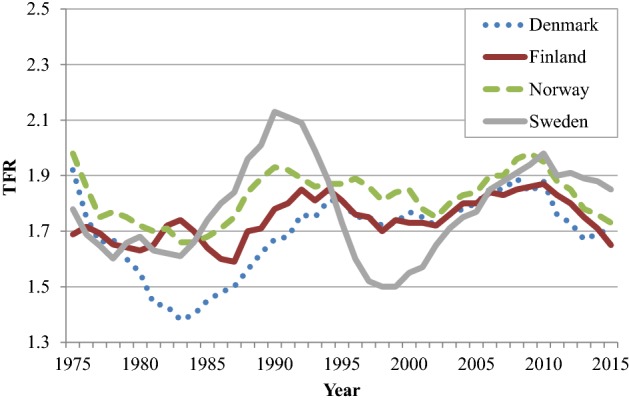
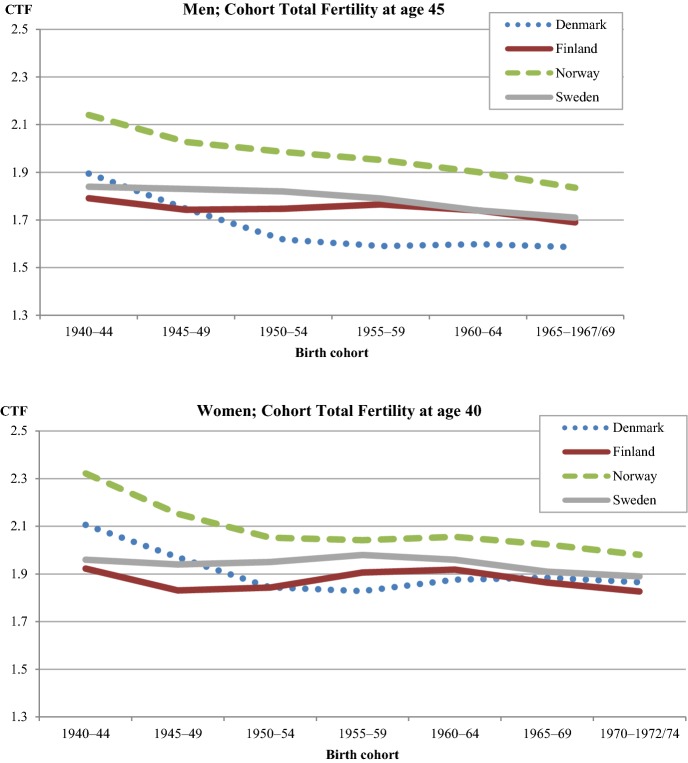
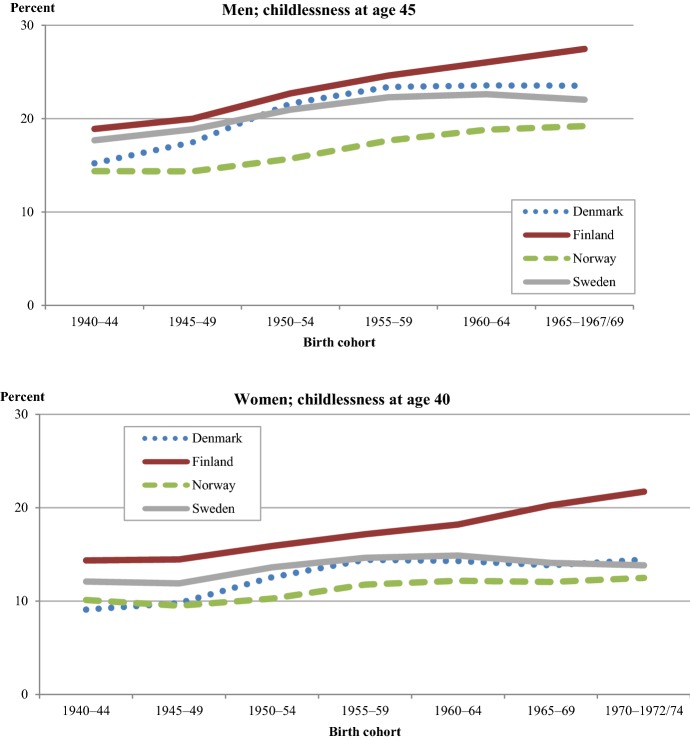
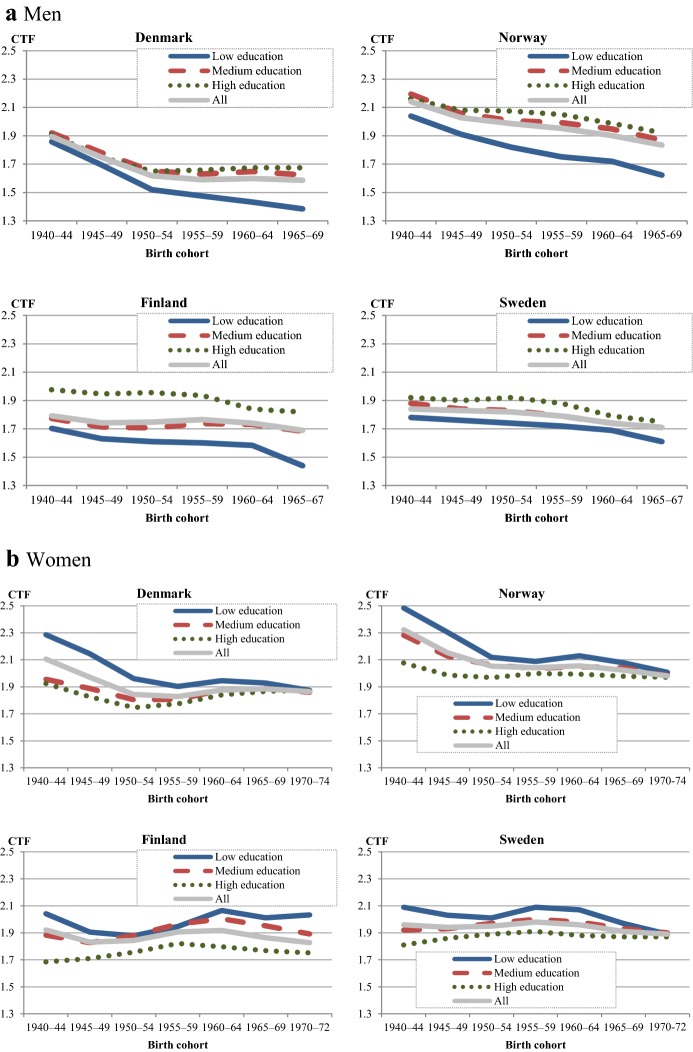
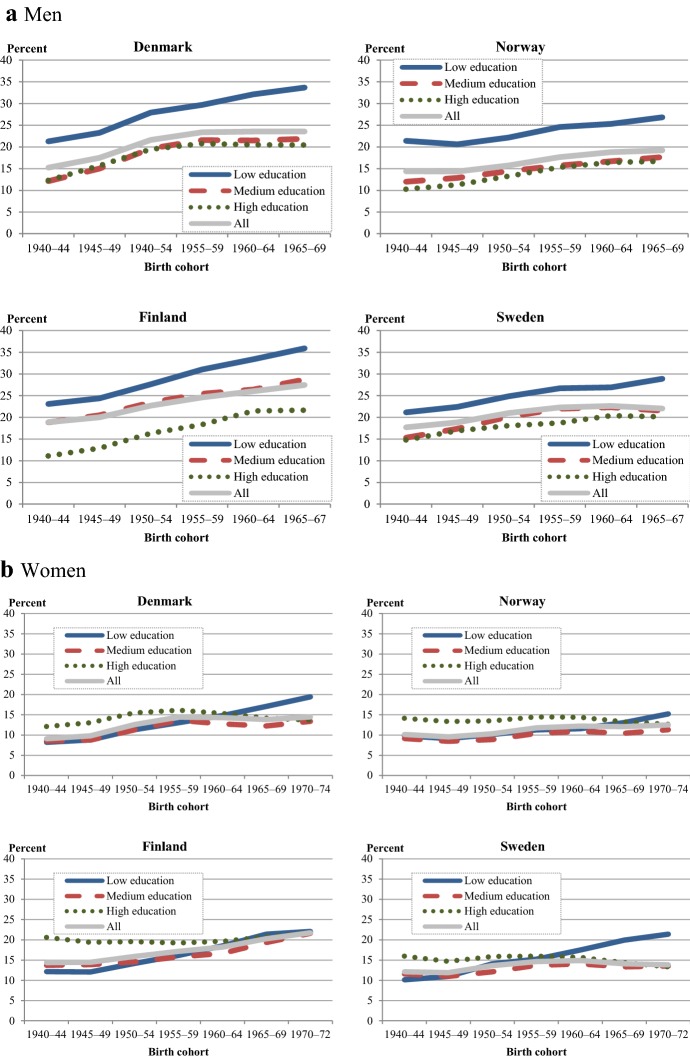
Systematic comparisons of fertility developments based on education, gender and country context are rare. Using harmonized register data, we compare cohort total fertility and ultimate childlessness by gender and educational attainment for cohorts born beginning in 1940 in four Nordic countries. Cohort fertility (CTF) initially declined in all four countries, although for cohorts born in the 1950s and later, the CTF remained stable or declined only modestly. Childlessness, which had been increasing, has plateaued in Denmark, Norway and Sweden. Women's negative educational gradient in relation to total fertility has vanished, except in Finland, while men's positive gradient has persisted. The highest level of men's childlessness appears among the least educated. In the oldest female cohorts, childlessness was highest among the highly educated, but these patterns have changed over the cohorts as childlessness has increased among the low educated and remained relatively stable among higher educated women. In Denmark, Norway and Sweden, childlessness is now highest among the least educated women. We witness both a new gender similarity and persistent (among men) and new (among women) educational disparities in childbearing outcomes in the Nordic region. Overall, the number of low educated has decreased remarkably over time. These population segments face increasing social and economic disadvantages that are reflected as well in their patterns of family formation.
Overview
CoChat Summary
TL;DR
Using harmonized Nordic register data, this study compares cohort total fertility and ultimate childlessness by gender and education across Denmark, Finland, Norway, and Sweden for cohorts born since the 1940s. It finds stable or modestly declining cohort fertility, plateauing childlessness in most countries, a vanished female educational fertility gradient except in Finland, and persistent male educational disparities.
Key findings
- Cohort fertility remained fairly stable in the Nordic region; female CTF stayed close to replacement level, while men’s CTF was somewhat lower, with Danish men having the lowest CTF at 1.6 among cohorts born since the 1950s.
- Ultimate childlessness increased from the 1940s cohorts but plateaued in Denmark, Norway, and Sweden; Finland’s youngest cohorts had high childlessness at 27% for men and 21% for women, while Norway had the lowest levels at 12% for women and 19% for men.
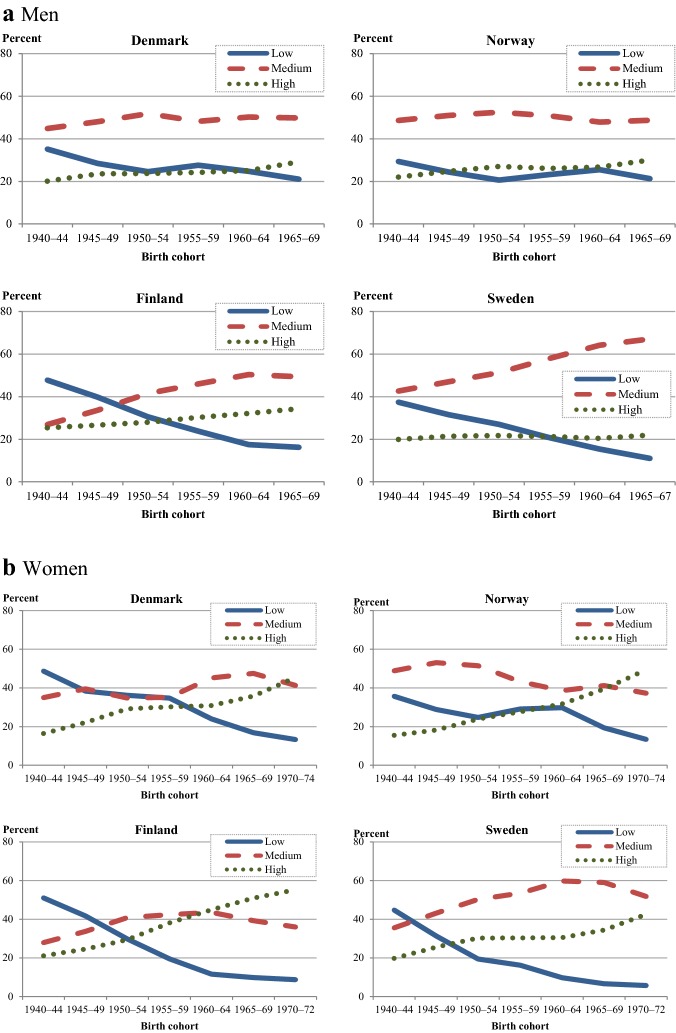
- Women’s negative educational gradient in total fertility vanished in Denmark, Norway, and Sweden but persisted in Finland; men’s positive educational gradient persisted, with low-educated men consistently having the lowest CTF and highest childlessness.
- In older female cohorts, childlessness was highest among the highly educated, but in the youngest cohorts in Denmark, Norway, and Sweden it was highest among the least educated; among low-educated men born 1965–69, childlessness at age 45 was 34–36% in Denmark and Finland and 27–29% in Norway and Sweden.
Methods
- The study uses individual-level population register data covering the entire populations of Denmark, Norway, and Sweden and an 11% random sample of Finland.
- It follows a birth-cohort design for cohorts born 1940–1967/69 for men and 1940–1972/74 for women, measuring completed cohort fertility and ultimate childlessness at age 45 for men and age 40 for women.
- Education is measured at the same age as fertility outcomes using harmonized ISCED categories: low (ISCED 0–2), medium (ISCED 3–4), and high (ISCED 5–6); results are presented descriptively by cohort, gender, education, and country.
Limitations
- The paper states that education and childbearing interact, so results are sensitive to when and how education is measured; it chose to measure education at ages 40/45 alongside fertility outcomes.
- The paper notes that country comparisons may be hampered by differences and changes in educational systems, codings, and classification procedures, though Nordic systems are fairly similar.
- The paper states that fatherhood is sometimes not registered, likely contributing to lower cohort fertility and higher childlessness among men; it also notes that some births beyond ages 40/45 are excluded, and Finnish data cannot distinguish missing education from the lowest educational level. Evident from the text: the analysis is descriptive and does not formally test causal mechanisms.
Model-written summary. Check it against the paper before relying on it.
Integrity signals
Registry
Cites
Statistics
Figures
Verification
Claims the paper makes
22 Valid · 5 Not valid · 22 Not checked · 125 Own results and interpretations
At least one cited source doesn’t support this claim or points to a different paper, and none confirmed it — see the verdicts below.
In the paper
“Compared to research on women’s fertility, research on the fertility of men is scarce and almost uniformly suggests a positive association between men’s educational attainment and their fertility outcomes (Kravdal and Rindfuss 2008; Trimarchi and van Bavel 2017; Tanturri et al. 2015; Miettinen et al. 2015; Nisén et al. 2014, 2017; Nisén 2016).”
§ Education, Gender, and Cohort Fertility in the Nordic Countries > Introduction
What the sources say
- Not checked — no full text of the sourcecites Kravdal and Rindfuss 2008 matched to “Changing Relationships between Education and Fertility: A Study of Women and Men Born 1940 to 1964” (2008) source
- Disputedcites Trimarchi and van Bavel 2017 matched to “Education and the Transition to Fatherhood: The Role of Selection Into Union” (2017) sourceExperimental — accuracy not yet measured
The Introduction describes earlier findings on men's education and the transition to parenthood as inconsistent, not almost uniformly positive. Earlier Empirical Findings gives both negative and positive associations in different countries. The provided passages do not establish whether research on men's fertility is scarce; page numbers are unavailable in our copy. (LLM, conf=0.88)
Checked by a reasoning model — may be wrong.
- Not matchedcites Tanturri et al. 2015
An author–year citation the paper’s reference list doesn’t settle. We don’t search these by name.
hedgedstates an association- Asserted: passes — The authors put it forward as true.
- Checkable: passes — It can be checked against evidence.
- Load-bearing: unclear — It is unclear whether the paper’s conclusions depend on it.
- Based: passes — The paper gives a reason why it holds.
Every source the paper cites for this claim was checked and supports it.
In the paper
“However, recent studies suggest that educational expansion has had only limited effects on patterns and developments in ultimate fertility (Sobotka et al. 2017) and childlessness (Beaujouan et al. 2016) by educational level in continental European countries.”
§ Education, Gender, and Cohort Fertility in the Nordic Countries > Introduction
What the sources say
- Supportedcites Beaujouan et al. 2016 matched to “The limited effect of increasing educational attainment on childlessness trends in twentieth-century Europe, women born 1916–65” (2016) source
Section 4.1 reports that rising educational attainment played a minor role in changing childlessness levels across the European countries studied. Changes in childlessness within educational groups had a much greater impact than changes in educational structure. (LLM, conf=0.89)
hedged- Asserted: passes — The authors put it forward as true.
- Checkable: passes — It can be checked against evidence.
- Load-bearing: unclear — It is unclear whether the paper’s conclusions depend on it.
- Based: passes — The paper gives a reason why it holds.
- Supported
The cited sources support only part of this claim — read each source’s verdict below.
In the paper
“In most European countries, highly educated women are still more likely to remain childless than low-educated women (Wood et al. 2014; Miettinen et al. 2015; Tanturri et al. 2015).”
§ Education, Gender, and Cohort Fertility in the Nordic Countries > Introduction
What the sources say
- Supportedcites Wood et al. 2014 matched to “The educational gradient of childlessness and cohort parity progression in 14 low fertility countries” (2014) source
The Results section states that childlessness is more frequent among highly educated women in all countries studied. This supports the citing sentence’s narrower claim about most European countries, though the study covers 14 low-fertility countries rather than every European country. (LLM, conf=0.93)
- Not matchedcites Miettinen et al. 2015
An author–year citation the paper’s reference list doesn’t settle. We don’t search these by name.
- Not matchedcites Tanturri et al. 2015
An author–year citation the paper’s reference list doesn’t settle. We don’t search these by name.
plainstates an association- Asserted: passes — The authors put it forward as true.
- Checkable: passes — It can be checked against evidence.
- Load-bearing: unclear — It is unclear whether the paper’s conclusions depend on it.
- Based: passes — The paper gives a reason why it holds.
- Supported
Every source the paper cites for this claim was checked and supports it.
In the paper
“Results on the association between education and fertility are therefore sensitive to when (at what age) and how (by which measure) education is measured (Hoem and Kreyenfeld 2006; Kravdal 2004), and the same applies to different methods of studying fertility outcomes.”
§ Education, Gender, and Cohort Fertility in the Nordic Countries > Data and Methods
What the sources say
- Supportedcites Hoem and Kreyenfeld 2006 matched to “Anticipatory analysis and its alternatives in life-course research: Part 1: Education and first childbearing” (2006) source
The Conclusion (section 3, Table 7) reports substantially different first-birth and childlessness estimates when education is measured by final attainment, current attainment, or a method accounting for its changing status over time. The Reflections (section 2.1.2) explain why the timing of educational measurement matters: a degree earned after a fertility decision can otherwise be treated as if it preceded that decision. (LLM, conf=0.93)
- Supportedcites Kravdal 2004 matched to “An Illustration of the Problems Caused by Incomplete Education Histories in Fertility Analyses” (2004) source
The Introduction explains why education measured at the time of data collection can differ from education and enrolment at the age relevant to a birth. The Summary and conclusion says that using education at the end of observation or imputing education histories can produce substantially different fertility-effect estimates. Together, these passages support sensitivity to both when and how education is measured. (LLM, conf=0.92)
plainstates an association- Asserted: passes — The authors put it forward as true.
- Checkable: passes — It can be checked against evidence.
- Load-bearing: passes — The paper’s conclusions depend on it.
- Based: passes — The paper gives a reason why it holds.
- Supported
The cited sources support only part of this claim — read each source’s verdict below.
In the paper
“Therefore, the shorter time spent in stable partnerships is a factor that further links low education to reduced fertility (Trimarchi and van Bavel 2017).”
§ Education, Gender, and Cohort Fertility in the Nordic Countries > Introduction > The Association Between Education and Fertility: Modified by Gender, Institutional Context, and Educational Expansion?
What the sources say
- Partly supportedcites Trimarchi and van Bavel 2017 matched to “Education and the Transition to Fatherhood: The Role of Selection Into Union” (2017) sourceExperimental — accuracy not yet measured
The Results and Discussion report that less-educated men had lower union-formation rates and that this largely explained their lower rates of transition to fatherhood. The paper does not establish that they spent less time in stable partnerships: it studies entry into unions rather than partnership duration, and its findings concern men rather than fertility generally. Page numbers were not available in our copy. (LLM, conf=0.85)
plainstates an association- Asserted: passes — The authors put it forward as true.
- Checkable: passes — It can be checked against evidence.
- Load-bearing: unclear — It is unclear whether the paper’s conclusions depend on it.
- Based: passes — The paper gives a reason why it holds.
- Partly supported
78 more claims · 5 with their cited sources checked
Create a free account to see all 174 claims and to verify the 1 reference still open.
- It may state two separate claims as one. 66
- Probably not a substantial claim. 33
- The quote only partly states this claim. 1
Claims other papers make about this one
Each is checked against this paper’s own text: does it say what the citing paper says it does?
The source backs part of the claim, not all of it — or backs it for a different population, condition or comparison.
In the citing paper
“Currently, in Finland, the childlessness rates are especially high among people with lower education levels, but a comprehensive explanation for this is still lacking.20”
From Association between depression and the likelihood of having children: a nationwide register study in Finland (2023) · cites this paper as [20]
Experimental — accuracy not yet measuredThe cited source says what the claim attributes to it.
In the citing paper
“In the Nordic countries, men with a low level of education have fewer children than men with a high level of education; women with a low level of education tend to have more children than women with a high level of education but only in Finland, whereas in other Nordic countries, the effect of educational differences among women on the number of children disappeared.20,21”
From Association between depression and the likelihood of having children: a nationwide register study in Finland (2023) · cites this paper as [20]
Citations
Cites
Becker, G. S. (1991) · doi:10.4159/9780674020665 · Cited by 10,565
A Theory of Social Interactions
Becker, G. S. (1974) · Journal of Political Economy · doi:10.1086/260265 · Cited by 2,969 · cited 2×
“, investments in the ‘quality’ of children rather than their quantity (Becker 1974; see also Kravdal and Rindfuss 2008).”
BackgroundA Theory of Social Interactions
Becker, G. (1974) · National Bureau of Economic Research · doi:10.3386/w0042 · Cited by 2,530
Population and Development Review
(2010) · Population and Development Review · doi:10.1111/(issn)1728-4457 · Cited by 1,340
The Gender Revolution: A Framework for Understanding Changing Family and Demographic Behavior
Goldscheider, F., Bernhardt, E., & Lappegård, T. (2015) · Population and Development Review · doi:10.1111/j.1728-4457.2015.00045.x · Cited by 1,209 · cited 2×
“Scholars further argue that if men take more caring responsibilities and share family work more equally with their partners, fertility levels may be maintained or even increase (McDonald 2000; Esping-Andersen and Billari 2015; Goldscheider et al. 2015; Anderson and Kohler 2015).”
BackgroundSelf-citationGender Equity in Theories of Fertility Transition
McDonald, P. (2000) · Population and Development Review · doi:10.1111/j.1728-4457.2000.00427.x · Cited by 1,154 · cited 4×
“This is mostly attributed to changing gender relations in the public and private spheres (McDonald 2000; Esping-Andersen and Billari 2015; Goldscheider et al.”
BackgroundInfluentialIntroduction to the Special Issue on the Web as Corpus
Kilgarriff, A., & Grefenstette, G. (2003) · Computational Linguistics · doi:10.1162/089120103322711569 · Cited by 929
Re‐theorizing Family Demographics
Esping‐Andersen, G., & Billari, F. C. (2015) · Population and Development Review · doi:10.1111/j.1728-4457.2015.00024.x · Cited by 763 · cited 1×
“This is mostly attributed to changing gender relations in the public and private spheres (McDonald 2000; Esping-Andersen and Billari 2015; Goldscheider et al.”
Background(2011) · European Sociological Review · doi:10.1093/esr/jcr002 · Cited by 652
Education at a Glance 2016: OECD Indicators
OECD (2016) · Education at a Glance · doi:10.1787/eag-2016-en · Cited by 430
Research works printed but not linked: 2
- Hernes H Welfare state and women power: Essays in state feminism 1987 Oslo Norwegian University Press
- Sobotka T., Beaujouan, É., & Brzozowska, Z. (2017). Reversals, diminishing differentials, or stable patterns? Long-term trends in educational gradient in fertility across the developed countries. Presentation at the XVIII International Population Conference (IUSSP), Cape Town, 31 October 2017.
Cited by
Can Policies Stall the Fertility Fall? A Systematic Review of the (Quasi‐) Experimental Literature
Bergsvik, J., Fauske, A., & Hart, R. K. (2021) · Population and Development Review · doi:10.1111/padr.12431 · Cited by 259
Society at a Glance 2024: OECD Social Indicators
OECD (2024) · Society at a Glance · doi:10.1787/918d8db3-en · Cited by 162
Reasons to Postpone Childbearing during Fertility Decline in Finland
Savelieva, K., Jokela, M. M., & Rotkirch, A. (2022) · Marriage & Family Review · doi:10.1080/01494929.2022.2083283 · Cited by 164
Hellstrand, J., Nisén, J., & Myrskylä, M. (2022) · European Journal of Population / Revue européenne de Démographie · doi:10.1007/s10680-022-09605-8 · Cited by 163
“Furthermore, the negative educational gradient in ultimate childlessness has already widened among men in recent years, and the positive gradient is shifting towards a negative association among women (Rotkirch and Miettinen 2017; Jalovaara et al. 2019).”
BackgroundNot Just Later, but Fewer: Novel Trends in Cohort Fertility in the Nordic Countries
Hellstrand, J., Nisén, J., Miranda, V., Fallesen, P., Dommermuth, L., & Myrskylä, M. (2021) · Demography · doi:10.1215/00703370-9373618 · Cited by 136
Self-citationUnderstanding the Positive Effects of the COVID‐19 Pandemic on Women's Fertility in Norway
Lappegård, T., Kornstad, T., Dommermuth, L., & Kristensen, A. P. (2023) · Population and Development Review · doi:10.1111/padr.12539 · Cited by 143
Self-citationTrends in Childlessness Among Highly Educated Men in Sweden
Chudnovskaya, M. (2019) · European Journal of Population / Revue européenne de Démographie · doi:10.1007/s10680-018-9511-3 · Cited by 130
Future fertility trends are shaped at the intersection of gender and social stratification
Lappegård, T. (2020) · Vienna Yearbook of Population Research · doi:10.1553/populationyearbook2020.deb04 · Cited by 124
“…the Nordic countries based on high-quality register data has shown that levels of childlessness are higher among men than among women, with the overall gender difference in ultimate childlessness remaining relatively stable at around 6–10 percentage points across cohorts (Jalovaara et al. 2019).”
BackgroundInfluentialSelf-citationFrom never partnered to serial cohabitors: Union trajectories to childlessness
Jalovaara, M., & Fasang, A. (2017) · Demographic Research · doi:10.4054/demres.2017.36.55 · Cited by 109
“In Finland childlessness has increased continuously and is now the highest among the Nordic countries (Miettinen et al. 2015; Jalovaara et al. 2017).”
BackgroundSelf-citationAlakärppä, O., Sevón, E., Norman, H., & Rönkä, A. K. (2022) · Journal of Youth Studies · doi:10.1080/13676261.2022.2098703 · Cited by 112
“A life-course without children is becoming increasingly common in Finland, particularly among low-educated men and women (Jalovaara et al. 2018; Rotkirch and Miettinen 2017), showing that all young women may not realise their valued functionings for their future family.”
BackgroundCheng, H., Luo, W., Si, S., Xin, X., Peng, Z., Zhou, H., Liu, H., & Yu, Y. (2022) · BMC Public Health · doi:10.1186/s12889-022-13656-1 · Cited by 142
“[43] concluded that in certain higher-income countries, the negative relationship Fig.”
BackgroundHellstrand, J., Nisén, J., & Myrskylä, M. (2020) · Population Studies · doi:10.1080/00324728.2020.1750677 · Cited by 81
Jalovaara, M., Andersson, L., & Miettinen, A. (2022) · Population Studies · doi:10.1080/00324728.2021.1887506 · Cited by 71
“Further, some recent studies have suggested that comparison of men and women is essential, as it would allow sex differences and similarities in socio-economic fertility trends and gradients to be detected (Jalovaara et al. 2018).”
BackgroundResultInfluentialSelf-citationReduced reproductive success is associated with selective constraint on human genes
Gardner, E. J., Neville, M. D. C., Samocha, K. E., Barclay, K., Kolk, M., Niemi, M. E. K., Kirov, G., Martin, H. C., & Hurles, M. E. (2022) · Nature · doi:10.1038/s41586-022-04549-9 · Cited by 72
Mari, G. (2019) · Journal of Marriage and the Family · doi:10.1111/jomf.12600 · Cited by 84
“…analyses carried out in Nordic countries, typically finding persistent or even increasing positive selection of men into parenthood on the basis of wage levels or on antecedents of earning power such as educational attainment (Hart, 2015; Jalovaara et al., 2018; Kravdal & Rindfuss, 2008).”
BackgroundEducational Differences in Cohort Fertility Across Sub-national Regions in Europe
Nisén, J., Klüsener, S., Dahlberg, J., Dommermuth, L., Jasilioniene, A., Kreyenfeld, M. R., Lappegård, T., Li, P., Martikainen, P., Neels, K., et al. (2020) · European Journal of Population / Revue européenne de Démographie · doi:10.1007/s10680-020-09562-0 · Cited by 82
“The magnitude of fertility gradients continues to vary greatly across countries, with Central and Eastern European countries as well as German-speaking countries continuing to witness particularly strong gradients (Beaujouan et al. 2016; Klesment et al. 2014; Neyer and Hoem 2008; Wood et al. 2014).”
Self-citationSpatial variation in fertility across Europe: Patterns and determinants
Campisi, N., Kulu, H., Mikolai, J., Klüsener, S., & Myrskylä, M. (2020) · Population Space and Place · doi:10.1002/psp.2308 · Cited by 84
Miettinen, A., & Jalovaara, M. (2019) · Advances in Life Course Research · doi:10.1016/j.alcr.2019.100320 · Cited by 70
Self-citationLater, Fewer, None? Recent Trends in Cohort Fertility in South Korea
Hwang, J. (2023) · Demography · doi:10.1215/00703370-10585316 · Cited by 53
Hopcroft, R. L. (2021) · Evolution and Human Behavior · doi:10.1016/j.evolhumbehav.2021.03.004 · Cited by 56
Disparities in Children’s Family Experiences by Mother’s Socioeconomic Status: The Case of Finland
Jalovaara, M., & Andersson, G. (2018) · Population Research and Policy Review · doi:10.1007/s11113-018-9485-1 · Cited by 55
Self-citationKolk, M. (2022) · Population Studies · doi:10.1080/00324728.2022.2134578 · Cited by 61
Dudel, C., & Klüsener, S. (2021) · European Journal of Population / Revue européenne de Démographie · doi:10.1007/s10680-020-09575-9 · Cited by 57
“However, in recent years, several studies assessing male fertility based on birth register data have been published (Jalovaara et al. 2017; Bagavos and Tragaki 2017; Dudel and Klüsener 2016, UN Department of Economic and Social Affairs 2015; Nordfalk et al. 2015; Nisén et al. 2014; Carmichael 2013; Lappegård et al. 20…”
Introduction: education and fertility in low-fertility settings
Sobotka, T., Beaujouan, É., & Bavel, J. V. (2018) · Vienna Yearbook of Population Research · doi:10.1553/populationyearbook2017s001 · Cited by 56
“…observed flattening of the educational gradient in fertility in the Nordic countries and Belgium (e.g. Kravdal and Rindfuss 2008; Neels 2012; Jalovaara et al. 2017), as well as in the United States (e.g. review contribution by Adserà in this volume), signals a wider trend across the…”
BackgroundInfluentialMorosow, K., & Kolk, M. (2019) · European Journal of Population / Revue européenne de Démographie · doi:10.1007/s10680-019-09525-0 · Cited by 44
Preconditions to parenthood: changes over time and generations
Bodin, M., Holmström, C., Plantin, L. O., Schmidt, L., Ziebe, S., & Elmerstig, E. (2021) · Reproductive Biomedicine & Society Online · doi:10.1016/j.rbms.2021.03.003 · Cited by 53
“Childlessness is becoming increasingly common among men in the Nordic countries (Jalovaara et al., 2018; Jensen, 2013), and in Sweden, it is most common among men with a low education and low income (Boschini and Sundstro¨m, 2018; Public Health Agency of Sweden, 2019).”
BackgroundThe Influence of Health in Early Adulthood on Male Fertility
Barclay, K., & Kolk, M. (2020) · Population and Development Review · doi:10.1111/padr.12357 · Cited by 44
Disentangling the Swedish fertility decline of the 2010s
Ohlsson‐Wijk, S., & Andersson, G. (2022) · Demographic Research · doi:10.4054/demres.2022.47.12 · Cited by 57
“Moreover, ultimate childlessness is increasingly becoming more prominent among the lower-educated in the Nordic countries (Jalovaara et al. 2019).”
BackgroundSelf-citationJackson, S. S., Adami, H., Andreotti, G., Freeman, L. E. B., de González, A. B., Buring, J. E., Fraser, G. E., Freedman, N. D., Gapstur, S. M., Gierach, G. L., et al. (2020) · Journal of Hepatology · doi:10.1016/j.jhep.2020.04.046 · Cited by 40
Determinants of home care utilization among the Swedish old: nationwide register-based study
Brändström, A., Meyer, A. C., Modig, K., et al. (2021) · European Journal of Ageing · doi:10.1007/s10433-021-00669-9 · Cited by 36
“Recent declines in fertility (Jalovaara et al. 2018) and internationally high levels of single living among the middle-aged and the old (Padyab et al.”
BackgroundLiu, A., Akimova, E. T., Ding, X., Jukarainen, S., Vartiainen, P., Kiiskinen, T., Koskelainen, S., Havulinna, A. S., Gissler, M., Lombardi, S., et al. (2023) · Nature Human Behaviour · doi:10.1038/s41562-023-01763-x · Cited by 31
“In the Nordic countries, there has been a positive association between men’s higher education and fertility 49,59 .”
Brini, E. (2020) · Genus · doi:10.1186/s41118-020-00074-7 · Cited by 34
Mussino, E., Wilson, B., & Andersson, G. (2021) · Demography · doi:10.1215/00703370-9476273 · Cited by 48
Self-citationDivorce in Europe: New Insights in Trends, Causes and Consequences of Relation Break-ups
Mortelmans, D. (2020) · European studies of population · doi:10.1007/978-3-030-25838-2 · Cited by 52
Liang, Q., Zhang, D., Wu, Y., Chen, S., Han, Z., Wang, B., & Wang, H. (2022) · ACS Applied Materials & Interfaces · doi:10.1021/acsami.2c00960 · Cited by 34
Birth cohort changes in fertility ideals: evidence from repeated cross-sectional surveys in Finland
Golovina, K., Nitsche, N., Berg, V., Miettinen, A., Rotkirch, A., & Jokela, M. M. (2023) · European Sociological Review · doi:10.1093/esr/jcad048 · Cited by 52
Kolk, M., & Barclay, K. (2019) · Proceedings of the Royal Society B Biological Sciences · doi:10.1098/rspb.2019.0359 · Cited by 39
Demography of family change in Europe
Sobotka, T., & Berghammer, C. (2021) · Edward Elgar Publishing eBooks · doi:10.4337/9781788975544.00019 · Cited by 63
Delayed first births and completed fertility across the 1940–1969 birth cohorts
Beaujouan, E., Zeman, K., & Nathan, M. (2023) · Demographic Research · doi:10.4054/demres.2023.48.15 · Cited by 29
“…important at a time when low-educated women are showing fertility behaviour that contrasts with the rest of the population: earlier first births, more childlessness, and larger families (Andersson et al. 2022; Brzozowska, Beaujouan, and Zeman 2022; Jalovaara et al. 2019; Rendall et al. 2010).”
BackgroundCampisi, N., Kulu, H., Mikolai, J., Klüsener, S., & Myrskylä, M. (2023) · Applied Spatial Analysis and Policy · doi:10.1007/s12061-022-09467-x · Cited by 28
“Recent research shows that this negative educational gradient no longer holds in some Nordic countries (Jalovaara et al., 2019) and educational differences in fertility across space are small (Nisén et al.”
BackgroundSocial class and fertility: A long-run analysis of Southern Sweden, 1922–2015
Dribe, M., & Smith, C. (2020) · Population Studies · doi:10.1080/00324728.2020.1810746 · Cited by 35
Ghaznavi, C., Sakamoto, H., Yamasaki, L., Nomura, S., Yoneoka, D., Shibuya, K., & Ueda, P. (2022) · PLoS ONE · doi:10.1371/journal.pone.0266835 · Cited by 32
“As such, most previous studies have used fertility outcomes at ages between 40 and 45 in their definitions of cohort total fertility and childlessness [16, 19, 20].”
BackgroundMethodInfluentialEgebark, J. H., Ekström, M., Plug, E., & van Praag, M. (2021) · Journal of Public Economics · doi:10.1016/j.jpubeco.2021.104372 · Cited by 29
“Other recent studies on childlessness in women find the highest share of childless women, as well as the highest IVF (in vitro fertilization) treatment rates among college-educated women (Bitler and Schmidt, 2012; Jalovaara et al., 2017; Lundborg et al., 2017).”
Backgroundvan Wijk, D. C. (2024) · Demographic Research · doi:10.4054/demres.2024.51.26 · Cited by 32
“Finally, increases in the income prerequisites of parenthood offer a plausible explanation for recent shifts in the educational gradient of fertility from negative to positive (Jalovaara et al. 2019).”
BackgroundGoisis, A., Fallesen, P., Séiz, M., Salazar, L., Eremenko, T., & Cozzani, M. (2024) · Fertility and Sterility · doi:10.1016/j.fertnstert.2024.05.149 · Cited by 31
Self-citationKaiser, J., & Lerch, M. (2021) · Environmental Research · doi:10.1016/j.envres.2021.112305 · Cited by 24
Why Do Lower Educated People Separate More Often? Life Strains and the Gradient in Union Dissolution
Hogendoorn, B., Kalmijn, M., & Léopold, T. (2021) · European Sociological Review · doi:10.1093/esr/jcab022 · Cited by 32
“These countries have been forerunners of the expansion of higher education, so that the lower educated represent an increasingly disadvantaged group despite redistributive efforts of the welfare state (Jalovaara et al. , 2019).”
BackgroundWho Gives Birth (First) in Female Same‐Sex Couples in Sweden?
Boye, K., & Evertsson, M. (2020) · Journal of Marriage and the Family · doi:10.1111/jomf.12727 · Cited by 29
Educational field, economic uncertainty, and fertility decline in Finland in 2010–2019
Hellstrand, J., Nisén, J., & Myrskylä, M. (2024) · European Sociological Review · doi:10.1093/esr/jcae001 · Cited by 39
“Within this regime, the Nordic countries share many similar traits in their family policies and childbearing patterns (Andersson et al. , 2009; Jalovaara et al. , 2019).”
InfluentialEducation and Fertility: A Review of Recent Research in Europe
Vasireddy, S., Berrington, A. M., Kuang, B., & Kulu, H. (2023) · Comparative Population Studies · doi:10.12765/cpos-2023-21 · Cited by 43
Bijlsma, M. J., & Wilson, B. (2020) · Journal of the Royal Statistical Society Series A: Statistics in Society · doi:10.1111/rssa.12520 · Cited by 21
“…of childbearing), but in some settings like the Nordic countries this association has weakened over time (Kravdal and Rindfuss, 2008) and appears to have disappeared (see Jalovaara et al. (2018), who also showed that the association between education and fertility is different for women and men).”
BackgroundGolovina, K., Elovainio, M., & Hakulinen, C. (2023) · American Journal of Obstetrics and Gynecology · doi:10.1016/j.ajog.2022.10.016 · Cited by 21
Lazzari, E., Mogi, R., & Canudas‐Romo, V. (2021) · Population Studies · doi:10.1080/00324728.2021.1895291 · Cited by 26
“The traditional educational gradient in relation to total fertility has become substantially less negative (Kravdal and Rindfuss 2008) and has vanished among the most recent cohorts in Denmark, Norway, and Sweden (Jalovaara et al. 2018).”
BackgroundOláh, L. S., Vignoli, D., & Kotowska, I. E. (2021) · Springer eBooks · doi:10.1007/978-3-319-57365-6_23-1 · Cited by 37
Gietel‐Basten, S., & Sobotka, T. (2020) · SocArXiv (OSF Preprints) · doi:10.31235/osf.io/5syef · Cited by 24
Kolk, M., & Barclay, K. (2020) · Intelligence · doi:10.1016/j.intell.2020.101514 · Cited by 25
Fecundity and human birth seasonality in Sweden: a register-based study
Dahlberg, J., & Andersson, G. (2019) · Reproductive Health · doi:10.1186/s12978-019-0754-1 · Cited by 20
“However, in Sweden, it has been found that highly educated women who postpone motherhood also are more likely to have shorter intervals between first and second births [23].”
BackgroundSelf-citationThe increase in non-marital childbearing and its link to educational expansion
Schnor, C., & Jalovaara, M. (2019) · Acta Sociologica · doi:10.1177/0001699319877922 · Cited by 28
“In the most recent birth cohorts, basic-educated women (as well as men) were most likely to remain childless (Jalovaara et al. 2017).”
BackgroundSelf-citationWorld Population Prospects – A Long View
Buettner, T. (2020) · Economie et Statistique / Economics and Statistics · doi:10.24187/ecostat.2020.520d.2030 · Cited by 27
Präg, P., Choi, S., & Monden, C. W. S. (2020) · Demographic Research · doi:10.4054/demres.2020.43.17 · Cited by 19
“In an important study on Nordic countries, Jalovaara et al. (2019) find gender differences in educational disparities in both cohort fertility and childlessness.”
BackgroundGendered division of housework and childcare and women’s intention to have a second child in Spain
Suero, C. (2023) · Genus · doi:10.1186/s41118-023-00182-0 · Cited by 27
“Nevertheless, around 2010, fertility levels in the Nordic countries began to decline without undergoing a parallel reduction in gender equality (Hellstrand et al., 2020, 2021; Jalovaara et al., 2019).”
BackgroundDemographic Theory and Population Ethics
Kolk, M. (2022) · Oxford University Press eBooks · doi:10.1093/oxfordhb/9780190907686.013.4 · Cited by 20
Can time to menopause be predicted?
Tanbo, T. G., & Fedorcsák, P. (2021) · Acta Obstetricia Et Gynecologica Scandinavica · doi:10.1111/aogs.14253 · Cited by 32
Kolk, M. (2019) · Figshare · doi:10.17045/sthlmuni.8283368.v1 · Cited by 17
“For education, researchers still typically find a negative gradient between longer education and fertility (e.g. Preston & Hartnett, 2010; Skirbekk, 2008), but this too is changing in Scandinavia in recent cohorts were gradients are positive for men, and neutral for women (Jalovaara et al., 2018).”
BackgroundResultFertility Response to Economic Recessions in Finland 1991–2015
Hiilamo, H. (2017) · Finnish Yearbook of Population Research · doi:10.23979/fypr.65254 · Cited by 24
“A recent study from Finland shows that childlessness has been most common among low educated men and is increasingly so also for low educated women (Jalovaara et al. 2017).”
BackgroundMethodPartnership dynamics and entry into parenthood: Comparison of Finnish birth cohorts 1969–2000
Rahnu, L., & Jalovaara, M. (2023) · Advances in Life Course Research · doi:10.1016/j.alcr.2023.100548 · Cited by 27
Self-citationHow family background shapes the relationship between human capital and fertility
Kramarz, F., Rosenqvist, O., & Skans, O. N. (2021) · Journal of Population Economics · doi:10.1007/s00148-021-00834-5 · Cited by 19
Lorentzen, T., & Vogt, K. C. (2021) · Journal of Education and Work · doi:10.1080/13639080.2021.2009781 · Cited by 18
Berthelsen, A. S. N., Gamby, A. L. N., Christensen, U., Schmidt, L., & Koert, E. (2021) · Human Reproduction Open · doi:10.1093/hropen/hoab027 · Cited by 15
“A recent register-based study of four Nordic countries including Denmark found increased levels in childlessness in men at age 45, with the highest levels among the least educated (Jalovaara et al., 2019).”
BackgroundReduced reproductive success is associated with selective constraint on human genesPreprint
Gardner, E. J., Neville, M. D. C., Samocha, K. E., Barclay, K. J., Kolk, M., Niemi, M., Kirov, G., Martin, H. C., & Hurles, M. E. (2020) · bioRxiv (Cold Spring Harbor Laboratory) · doi:10.1101/2020.05.26.116111 · Cited by 12
Not just later, but fewer: novel trends in cohort fertility in the Nordic countries
Hellstrand, J., Nisén, J., Miranda, V., Fallesen, P., Dommermuth, L., & Myrskylä, M. (2020) · doi:10.4054/mpidr-wp-2020-007 · Cited by 28
Self-citationSpain’s Persistent Negative Educational Gradient in Fertility
Requena, M. (2021) · European Journal of Population / Revue européenne de Démographie · doi:10.1007/s10680-021-09599-9 · Cited by 17
Cross-Sectional Average Length of Life Childless
Mogi, R., Nisén, J., & Canudas‐Romo, V. (2021) · Demography · doi:10.1215/00703370-8937427 · Cited by 16
Evensen, M., & Lyngstad, T. H. (2020) · Advances in Life Course Research · doi:10.1016/j.alcr.2020.100324 · Cited by 17
“Many countries report increasing rates of childlessness, and there is much scholarly and policy interest in knowing more about why so many men end up without children (Jalovaara et al., 2017).”
BackgroundChildbearing Across Partnerships in Finland and Germany
Jalovaara, M., & Kreyenfeld, M. R. (2020) · European studies of population · doi:10.1007/978-3-030-25838-2_15 · Cited by 15
Self-citationErmisch, J. (2023) · Population Studies · doi:10.1080/00324728.2023.2215224 · Cited by 20
“…2008; Andersson et al. 2009; Musick et al. 2009; Rendall et al. 2010; Nisén et al. 2013; Amin and Behrman 2014; Basten et al. 2014; Wood et al. 2014; Berrington et al. 2015; Tropf and Mande-makers 2017; Jalovaara 2019; Zang 2019; Impiccia-tore and Tomatis 2020; Wood et al. 2020; Nisén et al. 2021).”
Family inequality: On the changing educational gradient of family patterns in Western Germany
Hudde, A., & Engelhardt, H. (2023) · Demographic Research · doi:10.4054/demres.2023.48.20 · Cited by 26
“For men, there is an increasingly positive association (Jalovaara et al. 2018; Kravdal and Rindfuss 2008; Nisén et al. 2021; Skirbekk 2008).”
BackgroundEducational differentials on the transition to first birth in South Korea
Tan, J. (2022) · Social Science Research · doi:10.1016/j.ssresearch.2022.102728 · Cited by 14
Shifting links in the relationship between education and fertility
Wood, J., Klüsener, S., Neels, K., & Myrskylä, M. (2020) · Population Space and Place · doi:10.1002/psp.2342 · Cited by 18
When does family size matter? Sibship size, socioeconomic status and education in England
Sheppard, P., & Monden, C. W. S. (2020) · Evolutionary Human Sciences · doi:10.1017/ehs.2020.54 · Cited by 14
“This is not a simple linear relationship however; research in post-demographic transition countries shows a positive relationship between wealth and fertility within socioeconomic strata, even though there is a general negative trend at higher macro levels (Stulp & Barrett, 2016), although not everywhere (Jalovaara et…”
BackgroundSandström, G., & Marklund, E. (2018) · The History of the Family · doi:10.1080/1081602x.2018.1556721 · Cited by 17
“women with tertiary education have ended up with much lower levels of childlessness than those with only primary education (Jalovaara et al., 2018).”
BackgroundInfluentialIs 40 the New 30? Increasing Reproductive Intentions and Fertility Rates beyond Age 40
Beaujouan, É., & Sobotka, T. (2022) · Optimizing the Management of Fertility in Women over 40 · doi:10.1017/9781009025270.002 · Cited by 12
Measuring sustainable urban development in residential areas of the 20 biggest Finnish cities
Ala-Mantila, S., Kurvinen, A. T., & Karhula, A. (2023) · npj Urban Sustainability · doi:10.1038/s42949-023-00127-8 · Cited by 18
Is Two Still Best? Change in Parity-Specific Fertility Across Education in Low-Fertility Countries
Brzozowska, Z., Beaujouan, É., & Zeman, K. (2022) · Population Research and Policy Review · doi:10.1007/s11113-022-09716-4 · Cited by 17
“Change in Parity‑Specific Fertility Across… Western Europe (Denmark, Finland and France), Southern Europe (Greece, Italy and Spain), Central-Eastern Europe (Czechia, Croatia, Hungary, Slovakia, Slovenia and Russia).”
BackgroundResultInfluentialFertility of Roma Minorities in Central and Eastern Europe
Szabó, L., Kiss, I., Šprocha, B., & Spéder, Z. (2021) · Comparative Population Studies · doi:10.12765/cpos-2021-14 · Cited by 22
Lazzari, E. (2021) · Journal of Population Research · doi:10.1007/s12546-021-09269-x · Cited by 13
“In Denmark, Norway and Sweden, women’s negative educational gradient in relation to completed cohort fertility has vanished and ultimate childlessness is now higher among less-educated women (Jalovaara et al., 2019).”
BackgroundBauer, A., & Boussard, J. (2020) · Economie et Statistique / Economics and Statistics · doi:10.24187/ecostat.2020.520d.2034 · Cited by 15
Chaloupková, J. K., & Hašková, H. (2020) · Advances in Life Course Research · doi:10.1016/j.alcr.2020.100363 · Cited by 14
All-time low period fertility in Finland: drivers, tempo effects, and cohort implications
Hellstrand, J., Nisén, J., & Myrskylä, M. (2019) · doi:10.4054/mpidr-wp-2019-006 · Cited by 17
“…gender equality may benefit different groups of women unequally: while differences in cohort fertility by women’s level of education have converged (Jalovaara et al. 2018), differences in fertility by women’s field of education remain (Hoem, Neyer, and Andersson 2006; Rønsen and Skrede 2010).”
BackgroundInfluentialShifting Parental Age Differences in High‐Income Countries: Insights and Implications
Dudel, C., Cheng, Y. A., & Klüsener, S. (2023) · Population and Development Review · doi:10.1111/padr.12597 · Cited by 17
Lindström, J., Mussino, E., & Oláh, L. S. (2022) · Journal of Population Research · doi:10.1007/s12546-022-09283-7 · Cited by 12
“Sweden is characterised by relatively high and stable cohort fertility (around two children per woman on average), despite strongly fluctuating period fertility rates related to changes in the business cycle, the labour market, and in family policy measures (Jalovaara et al., 2019).”
BackgroundHusband’s income, wife’s income, and number of biological children in the U.S.
Hopcroft, R. L. (2022) · Biodemography and Social Biology · doi:10.1080/19485565.2022.2037070 · Cited by 13
Gender differences in fresh vegetable intake from 1979 to 2017 in Finland
Kähäri, A. (2021) · British Food Journal · doi:10.1108/bfj-09-2021-1004 · Cited by 16
Reasons to postpone childbearing during fertility decline in FinlandPreprint
Golovina, K., Jokela, M. M., & Rotkirch, A. (2021) · doi:10.31235/osf.io/4x3us · Cited by 11
Birth cohort changes in fertility ideals: Evidence from repeated cross-sectional surveys in FinlandPreprint
Golovina, K., Nitsche, N., Berg, V., Miettinen, A., Rotkirch, A., & Jokela, M. M. (2021) · doi:10.31235/osf.io/7vtqm · Cited by 9
Greulich, A., & Toulemon, L. (2023) · Demographic Research · doi:10.4054/demres.2023.49.34 · Cited by 19
Kuang, B., Berrington, A. M., Christison, S., & Kulu, H. (2024) · Demographic Research · doi:10.4054/demres.2024.51.36 · Cited by 11
“In some Nordic countries, the educational gradient of women’s childlessness has completely reversed over time from positive to negative (Jalovaara et al. 2019; Hellstrand, Nisen, and Myrskyla 2020).”
Association between Education and Fertility: New Evidence from the Study in Pakistan
Afreen, K., Ordine, P., & Rose, G. (2024) · Economies · doi:10.3390/economies12100261 · Cited by 16
Own depression, partner's depression, and childlessness: A nationwide register-based study
Kailaheimo-Lönnqvist, S., Moustgaard, H., Martikainen, P., & Myrskylä, M. (2024) · Social Science & Medicine · doi:10.1016/j.socscimed.2024.117356 · Cited by 17
Diverse pathways to permanent childlessness in Singapore: A latent class analysis
Wang, Y., Teerawichitchainan, B., & Ho, C. S. (2024) · Advances in Life Course Research · doi:10.1016/j.alcr.2024.100628 · Cited by 10
Metadata
- Authors
- Jalovaara, M., Neyer, G., Andersson, G., Dahlberg, J., Dommermuth, L., Fallesen, P., & Lappegård, T.
- Affiliations
- University of Turku (FI)
- Stockholm University (SE)
- Statistics Norway (NO)
- University of Oslo (NO)
- Corresponding author
- Jalovaara, Marika
- ORCID
- Venue
- European Journal of Population
- Published
- 2018-06-19
- Volume
- 35
- Issue
- 3
- Pages
- 563-586
- ISSN
- 0168-6577 (ISSN-L)
- 1572-9885
- PMC
- PMC6639448
- OpenAlex
- W2616851367
- Cited by
- 404
- References
- 73
- Citations by year
- 2026: 27 · 2025: 32 · 2024: 146 · 2023: 36 · 2022: 51 · 2021: 46 · 2020: 40 · 2019: 17 · 2018: 4
- FWCI
- 55.13
- Type
- journal article
- Language
- en
- Open access
- hybrid
- doi.org
- Licence
- cc-by
- creativecommons.org/licenses/by/4.0 (tdm)
- Locations
- European Journal of Population / Revue européenne de Démographie (publishedVersion, cc-by)
- PubMed Central (publishedVersion, cc-by)
- PubMed (publishedVersion)
- UTUPub (University of Turku) (submittedVersion)
- UTUPub (University of Turku) (submittedVersion, cc-by)
- RePEc: Research Papers in Economics (submittedVersion)
- NORA - Norwegian Open Research Archives (submittedVersion, cc-by)
- Funders
- Academy of Finland (275030, 293103)
- The Swedish Research Council for Health, Working Life and Welfare - Forte (2006-1515)
- The Rockwool Foundation (1142)
- The Norwegian Research Council (236926/H20)
- Swedish Research Council (Vetenskapsrådet) via the Linnaeus Center for Scoal Policy and Family Dynamics in Europe (SPaDE (49-20078701)
- The Swedish Initiative for Research on Microdata in the Social and Medical Sciences (340-2013-5164)
- Topics
- Social Sciences › Demography › Family Dynamics and Relationships
- Social Sciences › Sociology and Political Science › Intergenerational and Educational Inequality Studies
- Health Sciences › Medicine › Public Health, Environmental and Occupational Health › Reproductive Health and Contraception
- Keywords
- cohort fertility, educational attainment, gender differences in fertility, childlessness, educational gradient, Nordic countries, family formation, Denmark, Norway, Sweden, Finland
About these checks
Registry, retraction, Cites and statistics results are computed, not judged, with one exception: a printed reference that no index lists is read once by a model before it counts as a citation error. Claims are extracted by a model and kept only when their quote appears verbatim in the text; each cited source is then checked, with a model’s help, for whether it says what the claim relies on. Those verdicts can be wrong — read the claim’s quote and the cited source before relying on one.
The claim verdicts this report counts are experimental: their accuracy is not yet measured.
A language model drew the claims from the paper on 2026-10-10, under version 3 of the claim definition (model deepseek-v4.1-flash, prompt extract-v3).
A second model labelled each claim on 2026-10-10 (model jev-1.13-20260917, definition revision gold-guideline-v0.2).
Cited sources are checked with a language model’s help (gpt-6-sol).
Statistics and arithmetic are recomputed, not judged.
Confidence bands are shown only for fields calibrated on our annotated test set. None is calibrated yet, so no band is shown.
What counts as a claim ›How we measure confidence ›How we check this ›
Are you an author, or do you see a problem with this page? Request a review
Data sources
Bibliographic data: Semantic Scholar, OpenAlex, Crossref.
Contains information from the Semantic Scholar Academic Graph Datasets, made available under the ODC Attribution License (ODC-BY 1.0).
Semantic Scholar’s data is described in: Kinney, R., et al. (2023). The Semantic Scholar Open Data Platform. arXiv:2301.10140.
