

Citizens' adoption of an electronic government system: towards a unified view
Open accessThe DOI matches its Crossref record; 118 of the 118 references it cites were found in a registry or an index.
Abstract
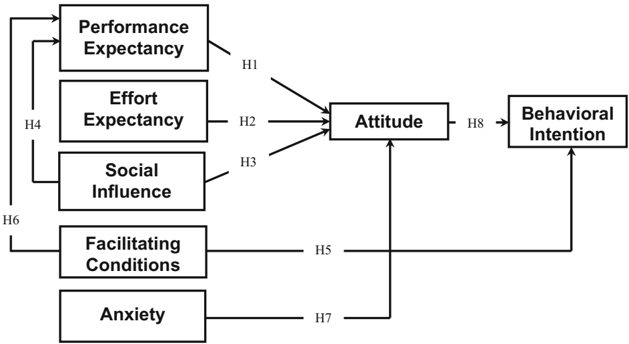
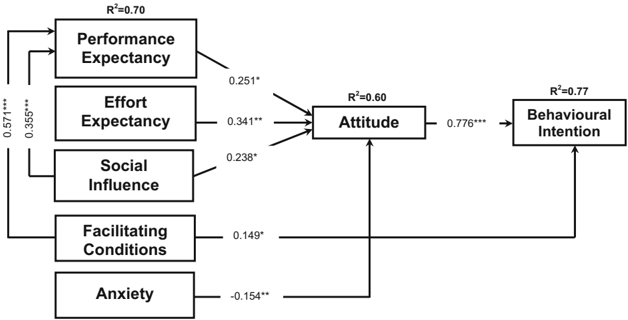
Sluggish adoption of emerging electronic government (eGov) applications continues to be a problem across developed and developing countries. This research tested the nine alternative theoretical models of technology adoption in the context of an eGov system using data collected from citizens of four selected districts in the state of Bihar in India. Analysis of the models indicates that their performance is not up to the expected level in terms of path coefficients, variance in behavioural intention, or the fit indices of the models. In response to the underperformance of the alternative theoretical models to explain the adoption of an eGov system, this research develops a unified model of electronic government adoption and tests it using the same data. The results indicate that the proposed research model outperforms all alternative models of technology adoption by explaining 77 % of variance in behavioural intention, with acceptable values of fit indices and significant relationships between each pair of hypothesised factors.
Overview
The claims and statistics of this paper haven’t been checked yet.
Free: it reads the open-access text and checks the first 5 claims that cite a source we can check. Create a free account to check every claim.
Integrity signals
Registry
Cites
Statistics
Figures
Verification
Claims the paper makes
The claims and statistics of this paper haven’t been checked yet.
Free: it reads the open-access text and checks the first 5 claims that cite a source we can check. Create a free account to check every claim.
Claims other papers make about this one
Each is checked against this paper’s own text: does it say what the citing paper says it does?
The source backs part of the claim, not all of it — or backs it for a different population, condition or comparison.
In the citing paper
“Rana et al. (2016) and Rana et al. (2017) examined electronic government system adoption by citizens from selected cities in India and found that facilitating conditions such as government support in terms of providing training had a positive and significant impact on performance expectancy.”
From Understanding managers’ attitudes and behavioral intentions towards using artificial intelligence for organizational decision-making (2021) · cites this paper as Rana et al., 2017
Experimental — accuracy not yet measured
Self-check
Percentages, sums and reported differences re-computed from the paper’s own numbers.
The self-check needs the paper’s full text.
Citations
Cites
The theory of planned behavior
Ajzen, I. (1991) · Organizational Behavior and Human Decision Processes · doi:10.1016/0749-5978(91)90020-t · Cited by 134,657
Evaluating Structural Equation Models with Unobservable Variables and Measurement Error
Fornell, C., & Larcker, D. F. (1981) · Journal of Marketing Research · doi:10.2307/3151312 · Cited by 109,314 · cited 1×
“AVE, which measures the variation explained by the latent variable as opposed to random measurement error (Netemeyer et al. 1990), ranged from 0.512 to 0.733 for all constructs, thus exceeding the recommended lower limit of 0.50 (Fornell and Larcker 1981).”
BackgroundInfluentialEvaluating structural equation models with unobservable variables and measurement error
Fornell, C., & Larcker, D. F. (1981) · Journal of Marketing Research · doi:10.1177/002224378101800104 · Cited by 109,190
Perceived usefulness, perceived ease of use, and user acceptance of information technology
Davis, F. D. (1989) · MIS Quarterly · doi:10.2307/249008 · Cited by 68,483 · cited 11×
“…2003); CLX: Complexity [Thompson et al. 1991]; EU: Ease of Use (Davis 1989; Davis et al. 1989; Moore and Benbasat 1991); EOU: Perceived Ease of Use (Davis 1989; Davis et al. 1989; Moore and Benbasat 1991); FC: Facilitating Conditions (Thompson et al. 1991; Venkatesh et al. 2003); IMG: Image…”
BackgroundMethodInfluentialUser Acceptance of Information Technology: Toward A Unified View1
Venkatesh, V., Morris, M. G., Davis, G. B., & Davis, F. D. (2003) · MIS Quarterly · doi:10.2307/30036540 · Cited by 45,035 · cited 15×
“Variables including perceived usefulness (TAM/TAM2), relative advantage (DOI, IDT) and outcome expectations (SCT) are similar in nature to performance expectancy (Venkatesh et al. 2003).”
BackgroundMethodInfluentialStructural equation modeling in practice: A review and recommended two-step approach
Anderson, J. C., & Gerbing, D. W. (1988) · Psychological Bulletin · doi:10.1037/0033-2909.103.3.411 · Cited by 41,941 · cited 3×
“Discriminant validity was assessed with the test recommended by Anderson and Gerbing (1988).”
BackgroundMethodRogers, E. M., Singhal, A., & Quinlan, M. M. (2019) · An Integrated Approach to Communication Theory and Research · doi:10.4324/9780203710753-35 · Cited by 37,322
(1975) · PhilPapers (PhilPapers Foundation) · Cited by 36,737
Alternative Ways of Assessing Model Fit
Browne, M. W., & Cudeck, R. (1992) · Sociological Methods & Research · doi:10.1177/0049124192021002005 · Cited by 27,200 · cited 1×
“Finally, RMSEA should be below 0.10 (Browne and Cudeck 1993), but has also been suggested to represent a very good fit if below a more restrictive threshold of 0.08.”
MethodInfluential(1980) · Medical Entomology and Zoology · Cited by 25,810
Research works printed but not linked: 3
- 71. Mujtava, S., & Pandey, P. K. (2012). The E-Governance architecture of global ICT program. International Journal of Computer Science and Telecommunications, 3(5), 136-140.
- 74. Nunnaly, J. (1978). Psychometric theory. New York: McGraw-Hill.
- 84. Rogers, E. M. (1995). Diffusion of innovations (4th ed.). New York: Free Press.
Cited by
Items 301–400 of 424
Irfan, M. (2019) · doi:10.7176/isde/10-2-03 · Cited by 5
Muhammad, S. S., Dey, B. L., Alwi, S. F. S., & Babu, M. M. (2019) · Advances in theory and practice of emerging markets · doi:10.1007/978-3-030-24374-6_14 · Cited by 4
Liu, J., Li, W., Zou, Q., Liu, S., Wang, M., & Zheng, J. (2022) · Aslib Journal of Information Management · doi:10.1108/ajim-04-2022-0201 · Cited by 6
Exploring Impact Factors of Mobile Instant Messenger Users’ Continuance Intention
Liu, H., Lee, K. T., Feng, H., & Bai, S. (2023) · Ingénierie des systèmes d information · doi:10.18280/isi.280109 · Cited by 4
“Adopting the revised Unified Theory of Acceptance and Use of Technology, Dwivedi et al. [15] and Rana et al. [16] established that ATT lies at the heart of people’s adoption intention of information systems.”
Ameen, N., & Willis, R. (2018) · Advances in theory and practice of emerging markets · doi:10.1007/978-3-319-75013-2_14 · Cited by 7
Liu, H. N., Tian, Y., Chan, T. J., Chen, M. H., & Yuan, D. F. (2025) · Journal of Science and Technology Policy Management · doi:10.1108/jstpm-02-2024-0038 · Cited by 3
End-User Approach to Evaluating Costs and Benefits of Smart City Applications
Jadrić, M., Mijač, T., & Ćukušić, M. (2022) · International Journal of E-Services and Mobile Applications · doi:10.4018/ijesma.296579 · Cited by 3
“Although some authors have used the original TAM model and confirmed that usefulness and ease of use positively influence intention to use (Althunibat, Alrawashdeh and Muhairat, 2014; Mensah, 2018), the research gap has not been fully addressed (Rana et al., 2017).”
BackgroundResultThe Effect of Artificial Intelligence Utilizing in Social Media Marketing
Pratika, Y. (2023) · Jurnal Manajemen Universitas Bung Hatta · doi:10.37301/jmubh.v18i2.23211 · Cited by 3
Reveal the Power of E-Filing and Transform Tax Reporting in Indonesia: Using UMEGA Analysis
Prawati, L. D., Karina, M., Putri, G. C. A., & Rachmi, I. F. (2024) · International Conference on Technology Innovation and Its Applications (ICTIIA) · doi:10.1109/ictiia61827.2024.10761185 · Cited by 5
“More than eighty percent of internet users worry that someone could find their personal information online [16].”
Salama, M., & Farag, R. (2024) · International Conference on Decision Aid Sciences and Applications (DASA) · doi:10.1109/dasa63652.2024.10836593 · Cited by 3
Lal, B., Dwivedi, Y. K., Rana, N. P., Frost, D., & Chirara, S. (2018) · Annual International Conference on Digital Government Research · doi:10.1145/3209281.3209369 · Cited by 3
Self-citationDema, H., Syahruni, Irwan, I., & Hamid, H. (2021) · IOP Conference Series Earth and Environmental Science · doi:10.1088/1755-1315/717/1/012033 · Cited by 3
“Electronic government is one of the most interesting concepts emerging in the field of public administration in recent years [1].”
BackgroundSubhani, W., Naz, M. A., Sultan, N., & Nazir, M. U. (2024) · Journal of excellence in social sciences. · doi:10.69565/jess.v2024i3.293 · Cited by 2
Shriya, K., & Velmurugan, T. (2025) · International Journal of Accounting and Economics Studies · doi:10.14419/05tcqc37 · Cited by 2
Citizens' Adoption of E‐Government in Türkiye: Extending the UMEGA
Arslan, Y., & Gürer, M. D. (2025) · The Electronic Journal of Information Systems in Developing Countries · doi:10.1002/isd2.70031 · Cited by 2
“Furthermore, consistent with findings by Ozkan and Kanat (2011), Rana et al. (2017), and Zahid et al. (2022), this research demonstrates a positive effect of effort expectancy on attitude.”
InfluentialSarkar, K., & Badir, Y. F. (2026) · Telematics and Informatics Reports · doi:10.1016/j.teler.2026.100297 · Cited by 4
AI adoption in Thailand's e-government services: A structural equation modeling (SEM) approach
Thitalampoon, S., Boonpalit, A., Thanaphansin, N., & Junlarick, W. (2026) · Social Sciences & Humanities Open · doi:10.1016/j.ssaho.2026.102967 · Cited by 3
Waititu, P., & Plessis, C. D. (2021) · Springer eBooks · doi:10.1007/978-3-030-61089-0_8 · Cited by 2
Use of Social Media in Citizen-Centric Electronic Government Services: A Literature Analysis
Alryalat, M. A. A., Rana, N. P., Sahu, G. P., Dwivedi, Y. K., & Tajvidi, M. (2019) · IGI Global eBooks · doi:10.4018/978-1-5225-8362-2.ch047 · Cited by 2
Self-citationANTESEDEN DARI TEORI UTAUT DAN KONSEKUENSINYA (STUDI EMPIRIS PURCHASE INTENTION GENERASI Z)
Juniarty, J., & Gunawan, V. V. (2021) · Ultima Management Jurnal Ilmu Manajemen · doi:10.31937/manajemen.v13i2.1958 · Cited by 6
BLOCKCHAIN ACCEPTANCE ANALYSIS USING THE UTAUT2 MODEL
Indrawati, I., & Firdaus, N. W. (2022) · TRIKONOMIKA · doi:10.23969/trikonomika.v21i2.5031 · Cited by 3
(2023) · Journal of System and Management Sciences · doi:10.33168/jsms.2023.0421 · Cited by 5
EKSPLORASI NIAT PENGGUNAAN E-GOVERNMENT DI KOTA PADANG MELALUI APLIKASI SI RANCAK
Sari, M. Y., Pujani, V., & Yulihasri (2024) · Journal Publicuho · doi:10.35817/publicuho.v7i1.366 · Cited by 2
Ramadhan, M. D., & Kurnia, K. (2024) · Jurnal Ekonomi Kreatif dan Manajemen Bisnis Digital · doi:10.55047/jekombital.v3i1.760 · Cited by 2
Othmen, M. A. B., Julienne, C., & Shaikh, F. (2024) · Journal of International Food & Agribusiness Marketing · doi:10.1080/08974438.2024.2409109 · Cited by 3
“While the study by Rana et al. (2017) used attitudes as a mediating variable for PE and EE, others have found substantial relationships between attitudes and behavioral intentions to use technology (Dwivedi et al., 2019).”
Salama, M., & Farag, R. (2024) · International Conference on Decision Aid Sciences and Applications (DASA) · doi:10.1109/dasa63652.2024.10836633 · Cited by 2
Christian, M., Yulita, H., Gularso, K., & Sunarno, S. (2024) · Studies in systems, decision and control · doi:10.1007/978-3-031-71649-2_12 · Cited by 5
Gupta, S., Singh, A., & Prashar, S. (2025) · The International Review of Retail Distribution and Consumer Research · doi:10.1080/09593969.2025.2584247 · Cited by 5
“In addition to his highly cited work, ‘being citizens’ adoption of an electronic government system’ (Rana et al. 2017), Rana also studied the adoption of telebanking by Jordanian consumers, examining perceived usefulness, trust and self-efficacy (Alalwan et al. 2016).”
Opportunities and Challenges of Augmented Reality Shopping in Emerging Markets
Abed, S. S. (2018) · Advances in theory and practice of emerging markets · doi:10.1007/978-3-319-75013-2_10 · Cited by 2
Faktor Penentu Kejayaan Sistem Penguatkuasaan dan Pendakwaan Syariah di Malaysia
Khairuddin, N. M. M., Mohamed, H. B., Jenal, R., & Samsudin, M. A. (2020) · Islamiyyat · doi:10.17576/islamiyyat-2021-4301-03 · Cited by 2
Kayal, G. G., Balfaqih, H., Durani, F., Akeel, H., Abukwaik, A. M., & Azudin, N. (2021) · International Journal of Electronic Government Research · doi:10.4018/ijegr.288073 · Cited by 5
Analysis of Consumer Motivation for Using Cryptocurrency in Indonesia
Muttaqin, H. (2023) · doi:10.33258/birci.v6i1.7474 · Cited by 2
The Training Management and Training Outcomes in Construction Industry: A Review
Uwain, M. M. S. B., Azman, A., & Hasline (2023) · International Journal of Scientific and Management Research · doi:10.37502/ijsmr.2023.6402 · Cited by 2
Behavioral Intention to Use Cryptocurrencies Among Bank Employees in the West Bank
Sholi, S., Antonovica, A., Curiel, J. D. E., & Çifçi, M. A. (2025) · Journal of Economy Culture and Society · doi:10.26650/jecs2024-1562786 · Cited by 1
GOVERNO ABERTO DE DADOS E INOVAÇÃO EM SERVIÇOS
Lübeck, R. M., Luciano, E. M., & Wiedenhöft, G. C. (2025) · Revista Brasileira de Gestão e Inovação · doi:10.18226/23190639.v13n1.01 · Cited by 1
A Comparative Review of SaaS Adoption in M-Government Apps
Ashar, A. M., Elias, N. F., Jenal, R., & Lam, M. C. (2025) · doi:10.1109/iceei68459.2025.11330241 · Cited by 1
“Technological capability encompasses facets such as scalability, platform interoperability, real-time processing and mobile responsiveness [28], [31], [32], [33], [34], [35], [36], [37], [38], [39].”
Amin, M. K., Rattanawiboonsom, V., & Bari, M. K. (2026) · IGI Global eBooks · doi:10.4018/979-8-3693-8247-9.ch001 · Cited by 1
Morte-Nadal, T., & Esteban-Navarro, M. Á. (2026) · Journal of Information Science · doi:10.1177/01655515261435201 · Cited by 1
Havi, M., Mirjat, S. A., Mirjat, S. A., & Ahmed, J. (2026) · The Asian Bulletin of Big Data Management · doi:10.62019/8mejmg23 · Cited by 1
Mladen, R., Božidar, (. ). V., Mertik, M., & Daniel, (. ). S. (2026) · doi:10.33700/wbzqn559 · Cited by 1
Ramanchandram, R., Rusuli, M. S. C., Abdullah, S. S., & Andow, H. A. (2026) · International Journal of Entrepreneurship and Management Practices · doi:10.35631/ijemp.934025 · Cited by 1
Kodali, L., & Nandru, P. (2026) · Journal of Science and Technology Policy Management · doi:10.1108/jstpm-10-2025-0487 · Cited by 1
Agozie, D. Q., Nat, M. C., & Edu, S. A. (2020) · Advances in information quality and management · doi:10.4018/978-1-7998-2610-1.ch004 · Cited by 1
J., A. R. P. Z. (2019) · International Journal of Informatics and Computation · doi:10.35842/ijicom.v1i1.8 · Cited by 2
Identifying Costs and Benefits of Smart City Applications from End-users' Perspective
Jadrić, M., Mijač, T., & Ćukušić, M. (2020) · RePEc: Research Papers in Economics · Cited by 1
HUSSAIN, A., ALI, D. M., AHMAD, D. N., KHAN, D. M. M., & DANISH, D. R. Q. (2021) · Journal of Contemporary Issues in Business and Government · doi:10.47750/cibg.2021.27.02.128 · Cited by 1
“Third, several studies suggested a link between usage and mobile banking (Sharma & Sharma, 2019; Zhang et al., 2018; Rana et al., 2017; Zhou, 2012) but to best of my knowledge, no efforts have been made to investigating the mobile banking in the relationship between service quality and adaptive…”
BackgroundMobile Government Service Delivery Challenges in Municipalities
Mtshengu, S., & Mawela, T. (2022) · Lecture notes in business information processing · doi:10.1007/978-3-030-95947-0_20 · Cited by 1
Blockchain-Based Mechanism for Secured Information Exchange in Digital Governance Systems
Shukri, M., Goyal, S. B., & Ibrahim, A. Z. M. (2023) · Lecture notes in networks and systems · doi:10.1007/978-981-99-3716-5_15 · Cited by 1
Tas, N., Huseynov, F., & Kose, B. O. (2024) · Information Development · doi:10.1177/02666669241257191 · Cited by 2
Wahyudi, R., Linawati, N., & Eduardo, F. I. (2024) · JURNAL COMPUTECH & BISNIS · doi:10.56447/jcb.v18i1.281 · Cited by 1
Making Digital File Management Successful: A Grounded Model of DFM Adoption in the Public Sector
Walke, F., Ulmke, F., & Winkler, T. J. (2024) · Hawaii International Conference on System Sciences (HICSS) · doi:10.24251/hicss.2024.244 · Cited by 1
A Systematic Literature Review on ICTD Research by IS Community
Ramadani, L. (2017) · Jurnal Nasional Teknologi dan Sistem Informasi · doi:10.25077/teknosi.v3i2.2017.255-268
The Influence of Values on the Adoption of Educational Technology
Mehta, A. (2018) · White Rose eTheses Online (University of Leeds, The University of Sheffield, University of York) · Cited by 2
Impact of Business Intelligence on Firm’s Performance in Cameroon
Maffock, V. F., Wamba, S. F., & Kamdjoug, J. R. K. (2019) · IFIP advances in information and communication technology · doi:10.1007/978-3-030-20671-0_16
Diskulnetsampita, P., & Tuan, A. K. (2020) · doi:10.46532/jebm.20200904
“For the assessment of variables such as service quality of E-Governance 4 items have been adapted from [29], for perceived usefulness of E-Gov 5 items have been adapted from [30], for perceived ease of use of E-Gov 4 items adapted from [31] and for citizen satisfaction 4 items adapted from [32].”
MethodHariguna, T., & Ruangkanjanases, A. (2020) · REVISTA ARGENTINA DE CLINICA PSICOLOGICA
The Factors Affecting the IoT User Satisfaction in Sinyeong City, China
Chen, P., & Tangthong, S. (2021) · International Conference on Computer and Communications Management (ICCCM) · doi:10.1145/3479162.3479187 · Cited by 1
(2021) · AD ALTA Journal of Interdisciplinary Research · doi:10.33543/110222
Business Perceptions of e-Government Services in Hungary
Bojtor, A. (2022) · Central and Eastern European eDem and eGov Days · doi:10.24989/ocg.v341.16
“Therefore, not only citizens perception [12][13][14], but also business actors’ perceptions should be examined closer [15][16][17].”
BackgroundChapter 8: Conclusion – strategies and policy decisions in the new digital-era governance
Tan, E., & Crompvoets, J. (2022) · Wageningen Academic Publishers eBooks · doi:10.3920/978-90-8686-930-5_8
Subhani, W., Latiff, A. S. A., Wahab, S. A., & Rehman, M. (2023) · Zenodo (CERN European Organization for Nuclear Research) · doi:10.5281/zenodo.8372973
Research Hotspots and Theme Evolution of Mobile Government Services Based on CiteSpace
吴, 私. (2023) · Operations Research and Fuzziology · doi:10.12677/orf.2023.135569
Çalışkan, G., Sevim, B., Aydın, Ç., & Yaşarsoy, E. (2024) · Emerald Group Publishing Limited eBooks · doi:10.1108/978-1-83753-970-320241004
Nasiri, Z., Sharif, R., Nikmaram, A., Farzandipour, M., & Nabovati, E. (2024) · Frontiers in Health Informatics · doi:10.30699/fhi.v13i0.540
CUSTOMER ANXIETY AFTER COVID-19 AND ITS IMPACT TO THE BEHAVIORAL INTENTION AT HYPERMARKET
Fauziah, F., Nardi, N., Fitriansyah, F., Zien, R., & Nurfadillah, M. (2024) · TRIKONOMIKA · doi:10.23969/trikonomika.v23i1.12771
“Higher levels of anxiety are associated with increased avoidance behaviors, as noted in studies such as those by Patil et al. (2020), Sriningsih et al. (2020), and Rana et al. (2017).”
BackgroundResultSTRUCTURAL MODEL THAT DETERMINES THE SUCCESSFUL IMPLEMENTATION OF E-GOVERNMENT
(2024) · Issues in Information Systems · doi:10.48009/3_iis_2024_115 · Cited by 4
“Social influence is the degree to which an individual perceives that others believe he or she should use the new e-government system (Rana et al., 2017).”
Navigating the Future: Blockchain Strategies for Reinventing Retail Supply Chains
Khurana, A., Gawshinde, S., & Aflak, A. A. (2024) · Emerald Group Publishing Limited eBooks · doi:10.1108/978-1-83797-777-220241006
USER ACTIVITIES ON SOCIAL MEDIA: APPLICATION OF SMMA MEASUREMENT SCALE
Šošić, M. M., Vojvodić, K., & Brajković, T. (2024) · Ekonomska misao i praksa · doi:10.17818/emip/2024/2.6
Determinants of the UMEGA model development in the use of the rental payment system
Puspita, D. A., Aufilana, F. S., & Shulthoni, M. (2025) · Journal of Multiperspectives on Accounting Literature · doi:10.22219/jameela.v3i1.37922
El rol de género en el contexto y realidades en las ciencias administrativas
de Tamaulipas, U. A., Tovar, Y. S., Félix, M. Z., & de Tamaulipas, U. A. (2024) · doi:10.29059/luat.403
Ganguly, D., & Kundu, A. (2025) · Springer proceedings in business and economics · doi:10.1007/978-981-96-2548-2_1
Tariq, A., Aziz, F., Fazal, A., Yousaf, B., & Rehman, M. U. (2025) · SSRN Electronic Journal · doi:10.2139/ssrn.5256136
Exploring the role of volunteer service usage in E-government adoption
Fei, S. (2026) · Cities · doi:10.1016/j.cities.2026.107262
The Attitudes of Civil Servants Towards E-Gov Apps
Tsourgiannis, L., Valsamidis, S. I., Perdiki, F., & Karagianni, P. (2025) · Springer proceedings in business and economics · doi:10.1007/978-3-031-90054-9_19
Các nhân tố ảnh hưởng đến ý định sử dụng ví điện tử ZaloPay của Gen Z tại Thành phố Hồ Chí Minh
Thủy, T. T. T., Thắng, N. H., & Duy, D. T. (2025) · VNU JOURNAL OF ECONOMICS AND BUSINESS · doi:10.57110/vnu-jeb.v5i3.421
Public Service Delivery in the Digital Era: A Bibliometric Review
Bellini, F., Leonori, L., & Murè, P. (2025) · Springer proceedings in business and economics · doi:10.1007/978-3-031-80692-6_13
Rathore, P. K., & Saha, E. (2025) · International Conference on Recent Advances in Information Technology · doi:10.1109/rait65068.2025.11088986
“TPB describes that the behavior of an individual is impacted by his/her intention and intention can be influenced by the attitude [19, 20].”
Sarkar, K., & Badir, Y. F. (2025) · International Journal of Human-Computer Interaction · doi:10.1080/10447318.2025.2542880 · Cited by 2
Factors Influencing the Intention to Use E-Government Services: The Case Study in Cambodia
Vandara, M., Ann, S., & Try, S. (2025) · Open Journal of Social Sciences · doi:10.4236/jss.2025.138037
Factors Affecting Intentions to Use E-Learning Systems in Selected Universities in Phnon Penh
Sothearith, T. R. Y. (2022) · ABAC ODI JOURNAL Vision. Action. Outcome · doi:10.14456/abacodijournal.2022.15
Gobierno electrónico y la participación ciudadana en Agro Rural, Dirección Zonal Moquegua, 2021
Chambilla Asqui, A. (2021) · LA Referencia (Red Federada de Repositorios Institucionales de Publicaciones Científicas) · Cited by 3
Guzman Palomino, Z. M. (2021) · LA Referencia (Red Federada de Repositorios Institucionales de Publicaciones Científicas)
Strategies Used by IT Project Managers to Integrate ICTs in the Eastern Caribbean
Roberts, C. S. A. (2020) · ScholarWorks (Walden University) · Cited by 2
Feng, Y. (2024) · University of Malaya Students Repository · Cited by 2
Central and Eastern European e|Dem and e|Gov Days 2021 : Conference Proceedings
(2021) · Repository of the Academy's Library (Library of the Hungarian Academy of Sciences)
Gobierno electrónico y la gestión por resultados de la Gerencia Sub Regional Utcubamba
Chuquipul Diaz, E. A. (2021) · LA Referencia (Red Federada de Repositorios Institucionales de Publicaciones Científicas)
Qutaishat, A. M. A. (2024) · Portuguese National Funding Agency for Science, Research and Technology (RCAAP Project by FCT)
Digital Municipal Service System
Imtiaz, N. (2024) · Theseus (Ammattikorkeakoulujen)
Bitzenhofer, F. (2023) · DSpace repository (University of Tartu)
Céliz Angulo, M. N. (2024) · LA Referencia (Red Federada de Repositorios Institucionales de Publicaciones Científicas)
Ramos Arqui, G. (2022) · LA Referencia (Red Federada de Repositorios Institucionales de Publicaciones Científicas)
Influencia del gobierno electrónico en la gobernabilidad regional de Ucayali, 2021
Acosta Toguchi, E. E. (2021) · LA Referencia (Red Federada de Repositorios Institucionales de Publicaciones Científicas)
Digital Mailboxes : A study of users' experience and acceptance
Kvarnheden, E., & Lindqvist Rovira, B. (2025) · Uppsala University Publications (Uppsala University)
Planeamiento estratégico y gobierno digital en la unidad de gestión educativa local San Martin, 2022
Reátegui Solsol, A. M. (2022) · LA Referencia (Red Federada de Repositorios Institucionales de Publicaciones Científicas)
Wu, H., Zhou, Z., Shi, L., Liu, M., & Zhang, X. (2026) · Frontiers in Public Health · doi:10.3389/fpubh.2026.1961112
Jung, H. S., Hwang, Y. H., & Yoon, H. H. (2026) · International Journal of Tourism Research · doi:10.1002/jtr.70260
Basali, H. F., Fortunato, M. L., Sao-ang, M. G. F., & Yang-yang, V. F. (2026) · Cognizance Journal of Multidisciplinary Studies · doi:10.47760/cognizance.2026.v06i03.013
Analysis of Factors Influencing The Adoption Intention of JakPantau Utilization in Jakarta
Putra, G. R. K., & Mulia, I. C. (2026) · Jurnal Ilmiah Administrasi Publik · doi:10.21776/ub.jiap.2026.012.01.6
Sanchez, O. U. V. (2021) · LA Referencia (Red Federada de Repositorios Institucionales de Publicaciones Científicas)
Metadata
- Authors
- Rana, N. P., Dwivedi, Y. K., Lal, B., Williams, M. D., & Clement, M.
- Affiliations
- Swansea University (GB)
- Nottingham Trent University (GB)
- Corresponding author
- Dwivedi, Yogesh K.
- Venue
- Information Systems Frontiers
- Published
- 2015-11-24
- Volume
- 19
- Issue
- 3
- Pages
- 549-568
- ISSN
- 1387-3326 (ISSN-L)
- 1572-9419
- OpenAlex
- W2218975180
- Cited by
- 373
- References
- 117
- Citations by year
- 2026: 22 · 2025: 24 · 2024: 39 · 2023: 38 · 2022: 38 · 2021: 44 · 2020: 46 · 2019: 56 · 2018: 41 · 2017: 20 · 2016: 4 · 2015: 1
- FWCI
- 143.04
- Type
- journal article
- Language
- en
- Open access
- hybrid
- doi.org
- Locations
- Information Systems Frontiers (publishedVersion, cc-by)
- RePEc: Research Papers in Economics (submittedVersion)
- Bradford Scholars (University of Bradford) (submittedVersion, cc-by)
- Nottingham Trent University's Institutional Repository (Nottingham Trent Repository) (submittedVersion)
- University of Bedfordshire Repository (University of Bedfordshire) (submittedVersion, cc-by-nc-nd)
- Funders
- Nuffield Foundation
- European Commission
- Swansea University
- Israel Science Foundation
- Topics
- Social Sciences › Political Science and International Relations › E-Government and Public Services
- Social Sciences › Decision Sciences › Information Systems and Management › Technology Adoption and User Behaviour
- Social Sciences › Business, Management and Accounting › Organizational Behavior and Human Resource Management › Employer Branding and e-HRM
- Keywords
- e-government, e-government adoption, technology adoption model, behavioral intention, citizens, Bihar, model comparison
About these checks
Registry, retraction, Cites and statistics results are computed, not judged, with one exception: a printed reference that no index lists is read once by a model before it counts as a citation error. Claims are extracted by a model and kept only when their quote appears verbatim in the text; each cited source is then checked, with a model’s help, for whether it says what the claim relies on. Those verdicts can be wrong — read the claim’s quote and the cited source before relying on one.
Statistics and arithmetic are recomputed, not judged.
Confidence bands are shown only for fields calibrated on our annotated test set. None is calibrated yet, so no band is shown.
What counts as a claim ›How we measure confidence ›How we check this ›
Are you an author, or do you see a problem with this page? Request a review
Data sources
Bibliographic data: Semantic Scholar, OpenAlex, Crossref.
Contains information from the Semantic Scholar Academic Graph Datasets, made available under the ODC Attribution License (ODC-BY 1.0).
Semantic Scholar’s data is described in: Kinney, R., et al. (2023). The Semantic Scholar Open Data Platform. arXiv:2301.10140.
