

Citizens' adoption of an electronic government system: towards a unified view
Open accessThe DOI matches its Crossref record; 118 of the 118 references it cites were found in a registry or an index.
Abstract
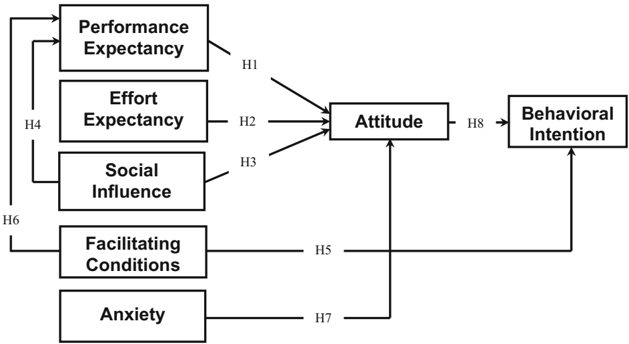
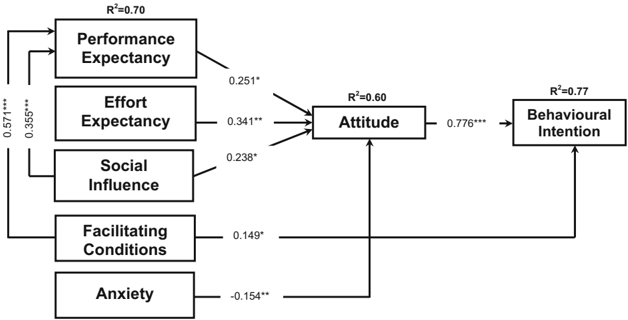
Sluggish adoption of emerging electronic government (eGov) applications continues to be a problem across developed and developing countries. This research tested the nine alternative theoretical models of technology adoption in the context of an eGov system using data collected from citizens of four selected districts in the state of Bihar in India. Analysis of the models indicates that their performance is not up to the expected level in terms of path coefficients, variance in behavioural intention, or the fit indices of the models. In response to the underperformance of the alternative theoretical models to explain the adoption of an eGov system, this research develops a unified model of electronic government adoption and tests it using the same data. The results indicate that the proposed research model outperforms all alternative models of technology adoption by explaining 77 % of variance in behavioural intention, with acceptable values of fit indices and significant relationships between each pair of hypothesised factors.
Overview
The claims and statistics of this paper haven’t been checked yet.
Free: it reads the open-access text and checks the first 5 claims that cite a source we can check. Create a free account to check every claim.
Integrity signals
Registry
Cites
Statistics
Figures
Verification
Claims the paper makes
The claims and statistics of this paper haven’t been checked yet.
Free: it reads the open-access text and checks the first 5 claims that cite a source we can check. Create a free account to check every claim.
Claims other papers make about this one
Each is checked against this paper’s own text: does it say what the citing paper says it does?
The source backs part of the claim, not all of it — or backs it for a different population, condition or comparison.
In the citing paper
“Rana et al. (2016) and Rana et al. (2017) examined electronic government system adoption by citizens from selected cities in India and found that facilitating conditions such as government support in terms of providing training had a positive and significant impact on performance expectancy.”
From Understanding managers’ attitudes and behavioral intentions towards using artificial intelligence for organizational decision-making (2021) · cites this paper as Rana et al., 2017
Experimental — accuracy not yet measured
Self-check
Percentages, sums and reported differences re-computed from the paper’s own numbers.
The self-check needs the paper’s full text.
Citations
Cites
Evaluating Structural Equation Models with Unobservable Variables and Measurement Error
Fornell, C., & Larcker, D. F. (1981) · Journal of Marketing Research · doi:10.2307/3151312 · Cited by 109,314 · cited 1×
“AVE, which measures the variation explained by the latent variable as opposed to random measurement error (Netemeyer et al. 1990), ranged from 0.512 to 0.733 for all constructs, thus exceeding the recommended lower limit of 0.50 (Fornell and Larcker 1981).”
BackgroundInfluentialEvaluating structural equation models with unobservable variables and measurement error
Fornell, C., & Larcker, D. F. (1981) · Journal of Marketing Research · doi:10.1177/002224378101800104 · Cited by 109,190
The theory of planned behavior
Ajzen, I. (1991) · Organizational Behavior and Human Decision Processes · doi:10.1016/0749-5978(91)90020-t · Cited by 90,587
Perceived usefulness, perceived ease of use, and user acceptance of information technology
Davis, F. D. (1989) · MIS Quarterly · doi:10.2307/249008 · Cited by 68,483 · cited 11×
“…2003); CLX: Complexity [Thompson et al. 1991]; EU: Ease of Use (Davis 1989; Davis et al. 1989; Moore and Benbasat 1991); EOU: Perceived Ease of Use (Davis 1989; Davis et al. 1989; Moore and Benbasat 1991); FC: Facilitating Conditions (Thompson et al. 1991; Venkatesh et al. 2003); IMG: Image…”
BackgroundMethodInfluentialUser Acceptance of Information Technology: Toward A Unified View1
Venkatesh, V., Morris, M. G., Davis, G. B., & Davis, F. D. (2003) · MIS Quarterly · doi:10.2307/30036540 · Cited by 45,035 · cited 15×
“Variables including perceived usefulness (TAM/TAM2), relative advantage (DOI, IDT) and outcome expectations (SCT) are similar in nature to performance expectancy (Venkatesh et al. 2003).”
BackgroundMethodInfluentialStructural equation modeling in practice: A review and recommended two-step approach
Anderson, J. C., & Gerbing, D. W. (1988) · Psychological Bulletin · doi:10.1037/0033-2909.103.3.411 · Cited by 41,941 · cited 3×
“Discriminant validity was assessed with the test recommended by Anderson and Gerbing (1988).”
BackgroundMethodRogers, E. M., Singhal, A., & Quinlan, M. M. (2019) · An Integrated Approach to Communication Theory and Research · doi:10.4324/9780203710753-35 · Cited by 37,322
(1975) · PhilPapers (PhilPapers Foundation) · Cited by 36,737
Alternative Ways of Assessing Model Fit
Browne, M. W., & Cudeck, R. (1992) · Sociological Methods & Research · doi:10.1177/0049124192021002005 · Cited by 27,200 · cited 1×
“Finally, RMSEA should be below 0.10 (Browne and Cudeck 1993), but has also been suggested to represent a very good fit if below a more restrictive threshold of 0.08.”
MethodInfluential(1980) · Medical Entomology and Zoology · Cited by 25,810
User Acceptance of Computer Technology: A Comparison of Two Theoretical Models
Davis, F. D., Bagozzi, R. P., & Warshaw, P. R. (1989) · Management Science · doi:10.1287/mnsc.35.8.982 · Cited by 25,709 · cited 24×
“While developing and extending TAM, Venkatesh and Davis (2000) also recognise that subjective norm, which is one of the root constructs of social influence, has an indirect impact on behavioural intention through perceived usefulness (one of the root constructs of performance expectancy).”
BackgroundMethodInfluentialA Theoretical Extension of the Technology Acceptance Model: Four Longitudinal Field Studies
Venkatesh, V., & Davis, F. D. (2000) · Management Science · doi:10.1287/mnsc.46.2.186.11926 · Cited by 23,066 · cited 4×
“As to TAM, although the variance explained (51”
BackgroundInfluentialTesting Structural Equation Models.
Mueller, C. W., Bollen, K. A., & Long, J. S. (1994) · Contemporary Sociology · doi:10.2307/2074955 · Cited by 14,120
The DeLone and McLean Model of Information Systems Success: A Ten-Year Update
(2003) · Journal of Management Information Systems · doi:10.1080/07421222.2003.11045748 · Cited by 11,791 · cited 1×
“…et al. 2015a, b; Seethamraju 2015), whereas other streams have focused on the success of the systems, using IS success models (e.g., Barclay 2008; DeLone and McLean 1992, 2003; Rana et al. 2015a; Seddon 1997; Swar et al.2012), and on IS implementation success at the organisational level…”
MethodBell, E., Bryman, A., & Harley, B. (2022) · Oxford University Press eBooks · doi:10.1093/hebz/9780198869443.001.0001 · Cited by 10,965
Information Systems Success: The Quest for the Dependent Variable
DeLone, W. H., & McLean, E. R. (1992) · Information Systems Research · doi:10.1287/isre.3.1.60 · Cited by 10,697 · cited 1×
“…et al. 2015a, b; Seethamraju 2015), whereas other streams have focused on the success of the systems, using IS success models (e.g., Barclay 2008; DeLone and McLean 1992, 2003; Rana et al. 2015a; Seddon 1997; Swar et al.2012), and on IS implementation success at the organisational level…”
MethodMoore, G. C., & Benbasat, I. (1991) · Information Systems Research · doi:10.1287/isre.2.3.192 · Cited by 9,150 · cited 10×
“…Use (Davis 1989; Davis et al. 1989; Moore and Benbasat 1991); FC: Facilitating Conditions (Thompson et al. 1991; Venkatesh et al. 2003); IMG: Image (Moore and Benbasat 1991; Venkatesh and Davis 2000); OE: Outcome Expectation (Compeau and Higgins 1995b; Compeau et al. 1999); PBC: Perceived…”
BackgroundInfluentialUnderstanding information technology usage: a test of competing models
Taylor, S., & Todd, P. A. (1995) · Information Systems Research · doi:10.1287/isre.6.2.144 · Cited by 8,815 · cited 15×
“This variable is composed of other similar ones, namely subjective norm (TRA, TAM2, TPB and DTPB), social factors (model of PC utilisation) and image (IDT) (Venkatesh et al. 200 3).”
BackgroundMethodResultInfluentialVenkatesh, V. (2000) · Information Systems Research · doi:10.1287/isre.11.4.342.11872 · Cited by 6,664 · cited 2×
“Computer anxiety relates to users ’ general perception of computer usage (Venkatesh 2000).”
BackgroundComputer Self-Efficacy: Development of a Measure and Initial Test
Compeau, D. R., & Higgins, C. A. (1995) · MIS Quarterly · doi:10.2307/249688 · Cited by 6,553 · cited 4×
“…Disagree and [7]=Extremely Agree [Citations indicate those studies from items for various constructs have been fetched] [Legend: AFT: Affect (Compeau and Higgins 1995b; Compeau et al. 1999); ANX: Anxiety (Venkatesh et al. 2003); AT: Attitude (Davis et al. 1989; Fishbein and Ajzen 1975);…”
BackgroundInfluentialMultivariate Data Analysis with Readings.
Rutherford, G. S. W., Hair, J. F., Anderson, R. E., & Tatham, R. L. (1988) · The Statistician · doi:10.2307/2348783 · Cited by 5,830
Multivariate Data Analysis with Readings.
Jolliffe, I. T., Hair, J. F., Anderson, R. E., & Tatham, R. L. (1988) · Journal of the Royal Statistical Society. Series A (Statistics in Society) · doi:10.2307/2983017 · Cited by 5,077
Mathieson, K. (1991) · Information Systems Research · doi:10.1287/isre.2.3.173 · Cited by 4,216 · cited 1×
“TPB research supports this affirmation, showing that attitude can significantly influence the intention to use new IS/IT (Mathieson 1991; Pavlou and Fygenson 2006; Taylor and Todd 1995b).”
ResultAfrican Journal of Business Management
(2026) · AFRICAN JOURNAL OF BUSINESS MANAGEMENT · doi:10.5897/ajbm · Cited by 4,207
Personal Computing: Toward a Conceptual Model of Utilization1
Thompson, R. L., Higgins, C. A., & Howell, J. M. (1991) · MIS Quarterly · doi:10.2307/249443 · Cited by 3,814 · cited 6×
“…al. 1989; Moore and Benbasat 1991); EOU: Perceived Ease of Use (Davis 1989; Davis et al. 1989; Moore and Benbasat 1991); FC: Facilitating Conditions (Thompson et al. 1991; Venkatesh et al. 2003); IMG: Image (Moore and Benbasat 1991; Venkatesh and Davis 2000); OE: Outcome Expectation (Compeau and…”
BackgroundInfluentialE-commerce: the role of familiarity and trust.
Gefen, D. (2000) · Omega · doi:10.1016/s0305-0483(00)00021-9 · Cited by 3,529 · cited 1×
“This ratio for the proposed model is 1.76, which is within the suggested [3-1] bracket (Chin and Todd 1995; Gefen 2000).”
MethodInfluentialInternational Journal of Business and Management
(2017) · International Journal of Business and Management · doi:10.26666/rmp.ijbm · Cited by 2,886
Pavlou, P. A., & Fygenson, M. (2006) · MIS Quarterly · doi:10.2307/25148720 · Cited by 2,685 · cited 16×
“A significant omission in the conceptualisation of the original UTAUT model is the individual who intends to engage or actually engages with the IS/IT, since individual characteristics are not included in the model.”
ResultInfluentialSocial Cognitive Theory and Individual Reactions to Computing Technology: A Longitudinal Study1
Compeau, D., Higgins, C. A., & Huff, S. (1999) · MIS Quarterly · doi:10.2307/249749 · Cited by 2,514 · cited 3×
“…al. 1991; Venkatesh et al. 2003); IMG: Image (Moore and Benbasat 1991; Venkatesh and Davis 2000); OE: Outcome Expectation (Compeau and Higgins 1995b; Compeau et al. 1999); PBC: Perceived Behavioral Control (Ajzen 1991; Taylor and Todd 1995a, b); PU: Perceived Usefulness (Davis 1989; Davis et al.…”
BackgroundInfluentialA Respecification and Extension of the DeLone and McLean Model of IS Success
Seddon, P. B. (1997) · Information Systems Research · doi:10.1287/isre.8.3.240 · Cited by 2,437 · cited 1×
“…2015), whereas other streams have focused on the success of the systems, using IS success models (e.g., Barclay 2008; DeLone and McLean 1992, 2003; Rana et al. 2015a; Seddon 1997; Swar et al.2012), and on IS implementation success at the organisational level (Leonard-Barton and Deschamps 1988).”
Statistically based tests for the number of common factors
Steiger, J. H. (1980) · Medical Entomology and Zoology · Cited by 2,413
J, M., & A, A. K. (2020) · Skyfox Publishing Group eBooks · doi:10.22573/spg.020.bk/s/026 · Cited by 2,013
The Evolution of E‐Government among Municipalities: Rhetoric or Reality?
Moon, M. J. (2002) · Public Administration Review · doi:10.1111/0033-3352.00196 · Cited by 1,959 · cited 2×
“Electronic government (hereafter, eGov) is one of the most interesting concepts to have appeared in the area of public administration in the last few years (Moon 2002; Norris and Moon 2005) and has become a significantly prominent facet of governance (Morgeson et al.”
BackgroundZikmund, W. G. (1984) · Repository of the University of Ljubljana (University of Ljubljana) · Cited by 1,805
Taylor, S., & Todd, P. (1995) · International Journal of Research in Marketing · doi:10.1016/0167-8116(94)00019-k · Cited by 1,567 · cited 15×
“This variable is composed of other similar ones, namely subjective norm (TRA, TAM2, TPB and DTPB), social factors (model of PC utilisation) and image (IDT) (Venkatesh et al. 200 3).”
BackgroundMethodResultInfluentialRe-Examining Perceived Ease of Use and Usefulness: A Confirmatory Factor Analysis
Segars, A. H., & Grover, V. (1993) · MIS Quarterly · doi:10.2307/249590 · Cited by 1,515 · cited 1×
“The GFI and CFI statistics should both be at or above 0.90 (Hoyle 1995), while AGFI should be at or above 0.80 (Chin and Todd 1995; Segars and Grover 1993).”
InfluentialApplication of Social Cognitive Theory to Training for Computer Skills
Compeau, D. R., & Higgins, C. A. (1995) · Information Systems Research · doi:10.1287/isre.6.2.118 · Cited by 1,501 · cited 4×
“…Disagree and [7]=Extremely Agree [Citations indicate those studies from items for various constructs have been fetched] [Legend: AFT: Affect (Compeau and Higgins 1995b; Compeau et al. 1999); ANX: Anxiety (Venkatesh et al. 2003); AT: Attitude (Davis et al. 1989; Fishbein and Ajzen 1975);…”
BackgroundInfluentialE‐Government and the Transformation of Service Delivery and Citizen Attitudes
West, D. M. (2004) · Public Administration Review · doi:10.1111/j.1540-6210.2004.00343.x · Cited by 1,470 · cited 1×
“It is defined as the delivery of government information and services to citizens via the Internet or other digital means (West 2004). eGov services can be broadly categorised as either informational or transactional.”
BackgroundSmith, J. B., & Barclay, D. W. (1997) · Journal of Marketing · doi:10.1177/002224299706100102 · Cited by 1,415
Linking citizen satisfaction with e-government and trust in government
Welch, E. W. (2004) · Journal of Public Administration Research and Theory · doi:10.1093/jopart/mui021 · Cited by 1,222 · cited 1×
“…(hereafter, eGov) is one of the most interesting concepts to have appeared in the area of public administration in the last few years (Moon 2002; Norris and Moon 2005) and has become a significantly prominent facet of governance (Morgeson et al. 2010; Thomas and Streib 2003; Welch et al. 2005).”
BackgroundChin, W. W., & Todd, P. A. (1995) · MIS Quarterly · doi:10.2307/249690 · Cited by 1,202 · cited 3×
“76, which is within the suggested [3-1] bracket (Chin and Todd 1995; Gefen 2000).”
BackgroundMethodInfluentialThe structural equation modeling approach: Basic concepts and fundamental issues.
Hoyle, R. H. (1995) · Cited by 1,095
Some Methods for Respecifying Measurement Models to Obtain Unidimensional Construct Measurement
Anderson, J. C., & Gerbing, D. W. (1982) · Journal of Marketing Research · doi:10.1177/002224378201900407 · Cited by 971 · cited 1×
“While it is neither necessary nor sufficient for a covariance configuration of items to be reliable for results to be uniform, a high composite reliability is always considered significant for a measured construct to be useful (Anderson and Gerbing 1982).”
BackgroundManagerial Influence in the Implementation of New Technology
Leonard-Barton, D., & Deschamps, I. (1988) · Management Science · doi:10.1287/mnsc.34.10.1252 · Cited by 812
1.9 The diffusion of innovations
(1981) · Cultural Transmission and Evolution (MPB-16), Volume 16 · doi:10.1515/9780691209357-012 · Cited by 757
Interpreting British Governance
Bevir, M., & Rhodes, R. A. W. (2003) · Taylor & Francis eBooks · doi:10.4324/9780203352311 · Cited by 756
Beaudry, A., & Pinsonneault, A. (2010) · MIS Quarterly · doi:10.2307/25750701 · Cited by 755 · cited 1×
“Anxiety is considered a deterrent emotion that arises when the individual sees an IT event as a threat and feels that he or she has only partial control over the outcome from the system (Beaudry and Pisonneault 2010).”
BackgroundInformation technology (IT) in Saudi Arabia: Culture and the acceptance and use of IT
Al-Gahtani, S. S., Hubona, G. S., & Wang, J. (2007) · Information & Management · doi:10.1016/j.im.2007.09.002 · Cited by 742 · cited 2×
“requested to state their level of agreement with each item on a 7-point Likert scale, where 1 indicated ‘very strongly disagree’ and 7 meant ‘very strongly agree’ (Al-Gahtani et al. 2007).”
BackgroundAdvancing E-Government at the Grassroots: Tortoise or Hare?
Norris, D. F., & Moon, M. J. (2005) · Public Administration Review · doi:10.1111/j.1540-6210.2005.00431.x · Cited by 645 · cited 4×
“Informational services concern the delivery of government information through Web pages, while transactional services involve two-way transactions between government and citizens that may require horizontal and vertical integration of multiple government agencies (Norris and Moon 2005; Venkatesh et al. 2012).”
BackgroundInfluentialSan Martín, H., & Herrero, Á. (2012) · Tourism Management · doi:10.1016/j.tourman.2011.04.003 · Cited by 637
Plouffe, C. R., Hulland, J. S., & Vandenbosch, M. (2001) · Information Systems Research · doi:10.1287/isre.12.2.208.9697 · Cited by 632 · cited 2×
“Similarities among these variables have been noted in several research studies (Davis et al. 1989; Moore and Benbasat 1991; Plouffe et al. 2001; Thompson et al. 1991).”
BackgroundHung, S.-Y., Chang, C.-M., & Yu, T.-J. (2006) · Government Information Quarterly · doi:10.1016/j.giq.2005.11.005 · Cited by 599 · cited 2×
“For example, analysing the factors determining citizens ’ intention to use an online tax filing and payment system, Hung et al. (2006) found that perceived ease of use significantly influenced individuals ’ attitudes towards this eGov service.”
BackgroundThe New Face of Government: Citizen-Initiated Contacts in the Era of E-Government
Thomas, J. C. (2003) · Journal of Public Administration Research and Theory · doi:10.1093/jopart/mug010 · Cited by 581 · cited 2×
“…(hereafter, eGov) is one of the most interesting concepts to have appeared in the area of public administration in the last few years (Moon 2002; Norris and Moon 2005) and has become a significantly prominent facet of governance (Morgeson et al. 2010; Thomas and Streib 2003; Welch et al. 2005).”
BackgroundIt's all about attitude: revisiting the technology acceptance model
Yang, H.-D., & Yoo, Y. (2004) · Decision Support Systems · doi:10.1016/s0167-9236(03)00062-9 · Cited by 578 · cited 1×
“The role of attitude in explaining technology acceptance is widely acknowledged in prior literature (e.g., Bobbitt and Dabholkar 2001; Kim et al. 2009; Taylor and Todd 1995b; Yang and Yoo 2004).”
ResultThe Electronic Journal of e-Government
(2021) · doi:10.34190/ejeg.18.1 · Cited by 555
Using a modified technology acceptance model in hospitals
AGGELIDIS, V, & CHATZOGLOU, P. (2009) · International Journal of Medical Informatics · doi:10.1016/j.ijmedinf.2008.06.006 · Cited by 553 · cited 1×
“A number of empirical studies (e.g., Aboelmaged 2010; Aggelidis and Chatzoglou 2009; Egea and González 2011; Kim et al. 2010) have advocated the use of attitude as a mediating variable, mediating the effects of perceived usefulness and perceived ease of use in TAM.”
BackgroundAdoption of Mobile Technologies for Chinese Consumers
Park, J., Yang, S. J., & Lehto, X. Y. (2007) · Journal of electronic commerce research · Cited by 523
Analysis of role conflict and role ambiguity in a structural equations framework.
Netemeyer, R. G., Johnston, M. W., & Burton, S. (1990) · Journal of Applied Psychology · doi:10.1037/0021-9010.75.2.148 · Cited by 492 · cited 1×
“AVE, which measures the variation explained by the latent variable as opposed to random measurement error (Netemeyer et al. 1990), ranged from 0.512 to 0.733 for all constructs, thus exceeding the recommended lower limit of 0.50 (Fornell and Larcker 1981).”
BackgroundInfluentialA generalised adoption model for services: A cross-country comparison of mobile health (m-health)
Dwivedi, Y. K., Shareef, M. A., Simintiras, A. C., Lal, B., & Weerakkody, V. (2016) · Government Information Quarterly · doi:10.1016/j.giq.2015.06.003 · Cited by 489 · cited 2×
“…of these addresses the individual acceptance of technology, using intention or usage as a dependent variable (e.g., Ajzen 1991; Davis et al. 1989; Dwivedi et al. 2015a, b; Seethamraju 2015), whereas other streams have focused on the success of the systems, using IS success models (e.g., Barclay…”
BackgroundMethodInfluentialSelf-citationIgbaria, M., & Parasuraman, S. (1989) · Journal of Management · doi:10.1177/014920638901500302 · Cited by 470 · cited 1×
“A significant body of research in IS and psychology has shown the relevance of computer anxiety by demonstrating its impact on attitudes (e.g., Howard and Smith 1986; Igbaria and Chakrabarti 1990; Igbaria and Parasuraman 1989; Morrow et al. 1986; Parasuraman and Igbaria 1990).”
BackgroundComputer anxiety and attitudes towards microcomputer use
IGBARIA, M., & CHAKRABARTI, A. (1990) · Behaviour & Information Technology · doi:10.1080/01449299008924239 · Cited by 459 · cited 1×
“A significant body of research in IS and psychology has shown the relevance of computer anxiety by demonstrating its impact on attitudes (e.g., Howard and Smith 1986; Igbaria and Chakrabarti 1990; Igbaria and Parasuraman 1989; Morrow et al. 1986; Parasuraman and Igbaria 1990).”
BackgroundResearch on information systems failures and successes: Status update and future directions
Dwivedi, Y. K., Wastell, D., Laumer, S., Henriksen, H. Z., Myers, M. D., Bunker, D., Elbanna, A., Ravishankar, M. N., & Srivastava, S. C. (2015) · Information Systems Frontiers · doi:10.1007/s10796-014-9500-y · Cited by 448 · cited 2×
“…of these addresses the individual acceptance of technology, using intention or usage as a dependent variable (e.g., Ajzen 1991; Davis et al. 1989; Dwivedi et al. 2015a, b; Seethamraju 2015), whereas other streams have focused on the success of the systems, using IS success models (e.g., Barclay…”
BackgroundMethodInfluentialSelf-citationLin, F., Fofanah, S. S., & Liang, D. (2011) · Government Information Quarterly · doi:10.1016/j.giq.2010.09.004 · Cited by 414 · cited 1×
“The relationship of perceived usefulness with attitude has been examined in a number of studies (e.g., Hung et al. 2006; Hung et al. 2009; Hung et al. 2013; Lin et al. 2011; Lu et al. 2010) of eGov adoption.”
BackgroundThe New Face of Government: Citizen-Initiated Contacts in the Era of E-Government
Thomas, J. C. (2003) · Journal of Public Administration Research and Theory · doi:10.1093/jpart/mug010 · Cited by 402
Michelle Bobbitt, L., & Dabholkar, P. A. (2001) · International Journal of Service Industry Management · doi:10.1108/eum0000000006092 · Cited by 375 · cited 1×
“The role of attitude in explaining technology acceptance is widely acknowledged in prior literature (e.g., Bobbitt and Dabholkar 2001; Kim et al. 2009; Taylor and Todd 1995b; Yang and Yoo 2004).”
ResultSchaper, L. K., & Pervan, G. P. (2007) · International Journal of Medical Informatics · doi:10.1016/j.ijmedinf.2006.05.028 · Cited by 371 · cited 2×
“A handful of studies (e.g., Lee and Lin 2008; Schaper and Pervan 2007) of technology adoption have also supported the positive and significant impact of facilitating conditions on performance expectancy.”
BackgroundPynoo, B., Devolder, P., Tondeur, J., van Braak, J., Duyck, W., & Duyck, P. (2011) · Computers in Human Behavior · doi:10.1016/j.chb.2010.10.005 · Cited by 334 · cited 6×
“A number of studies (i.e., Park et al. 2007; Pynoo et al. 2007, 2011) have provided significant empirical justification for this relationship.”
BackgroundMethodInfluentialE-Government: A global view and an empirical evaluation of some attributes of citizens
Akman, I., Yazici, A., Mishra, A., & Arifoglu, A. (2005) · Government Information Quarterly · doi:10.1016/j.giq.2004.12.001 · Cited by 328 · cited 1×
“…transforming traditional public services into eGov services, such as cost-efficient delivery, integration of services, reduction of administrative costs, a single integrated view of citizens across all government services, and faster adaptation to meet citizens ’ requirements (Akman et al. 2005).”
BackgroundOr, C. K. L., Karsh, B.-T., Severtson, D. J., Burke, L. J., Brown, R. L., & Brennan, P. F. (2011) · Journal of the American Medical Informatics Association · doi:10.1136/jamia.2010.007336 · Cited by 309
User acceptance of mobile e-government services: An empirical study
Hung, S.-Y., Chang, C.-M., & Kuo, S.-R. (2013) · Government Information Quarterly · doi:10.1016/j.giq.2012.07.008 · Cited by 306 · cited 6×
“In the field of public administration and eGov, a number of studies (e.g., Hung et al. 2009; Hung et al. 2013; Lu et al. 2010; Rana et al. 2015b) support the relationship between attitude and behavioural intention.”
BackgroundInfluentialInternet Banking Adoption in Kuala Lumpur: An Application of UTAUT Model
Sok Foon, Y., & Chan Yin Fah, B. (2011) · International Journal of Business and Management · doi:10.5539/ijbm.v6n4p161 · Cited by 305 · cited 1×
“This inclusion is based on appropriate theoretical foundations (Ajzen 1991; Taylor and Todd 1995b) and empirical findings (e.g., Eckhardt et al. 2009; Foon and Fah 2011; Yeow and Loo 2009) which support the effects of facilitating conditions on behavioural intention.”
BackgroundMisplaced Trust? Exploring the Structure of the E-Government-Citizen Trust Relationship
Morgeson, F. V., VanAmburg, D., & Mithas, S. (2011) · Journal of Public Administration Research and Theory · doi:10.1093/jopart/muq006 · Cited by 300 · cited 1×
“…(hereafter, eGov) is one of the most interesting concepts to have appeared in the area of public administration in the last few years (Moon 2002; Norris and Moon 2005) and has become a significantly prominent facet of governance (Morgeson et al. 2010; Thomas and Streib 2003; Welch et al. 2005).”
BackgroundExplaining physicians’ acceptance of EHCR systems: An extension of TAM with trust and risk factors
Ortega Egea, J. M., & Román González, M. V. (2011) · Computers in Human Behavior · doi:10.1016/j.chb.2010.08.010 · Cited by 287 · cited 1×
“A number of empirical studies (e.g., Aboelmaged 2010; Aggelidis and Chatzoglou 2009; Egea and González 2011; Kim et al. 2010) have advocated the use of attitude as a mediating variable, mediating the effects of perceived usefulness and perceived ease of use in TAM.”
BackgroundWho Influences Whom? Analyzing Workplace Referents’ Social Influence on it Adoption and Non-Adoption
Eckhardt, A., Laumer, S., & Weitzel, T. (2009) · Journal of Information Technology · doi:10.1057/jit.2008.31 · Cited by 287 · cited 1×
“This inclusion is based on appropriate theoretical foundations (Ajzen 1991; Taylor and Todd 1995b) and empirical findings (e.g., Eckhardt et al. 2009; Foon and Fah 2011; Yeow and Loo 2009) which support the effects of facilitating conditions on behavioural intention.”
BackgroundInvestigating success of an e-government initiative: Validation of an integrated IS success model
Rana, N. P., Dwivedi, Y. K., Williams, M. D., & Weerakkody, V. (2015) · Information Systems Frontiers · doi:10.1007/s10796-014-9504-7 · Cited by 283 · cited 3×
“…2015), whereas other streams have focused on the success of the systems, using IS success models (e.g., Barclay 2008; DeLone and McLean 1992, 2003; Rana et al. 2015a; Seddon 1997; Swar et al.2012), and on IS implementation success at the organisational level (Leonard-Barton and Deschamps 1988).”
BackgroundMethodSelf-citationE-file adoption: A study of U.S. taxpayers’ intentions
Schaupp, L. C., Carter, L., & McBride, M. E. (2010) · Computers in Human Behavior · doi:10.1016/j.chb.2009.12.017 · Cited by 278
Development of a Standardized Test of Computer Literacy and a Computer Anxiety Index
Simonson, M. R., Maurer, M., Montag-Torardi, M., & Whitaker, M. (1987) · Journal of Educational Computing Research · doi:10.2190/7chy-5cm0-4d00-6jcg · Cited by 275 · cited 1×
“The emotional aspect of technology usage is expected to be captured through a construct called anxiety, defined as an individual ’ s apprehension or fear when he or she is faced with the possibility of using computers (Simonson et al. 1987).”
BackgroundInformation Systems and Global Diversity
Avgerou, C. (2003) · doi:10.1093/acprof:oso/9780199263424.001.0001 · Cited by 270
Seethamraju, R. (2015) · Information Systems Frontiers · doi:10.1007/s10796-014-9506-5 · Cited by 258 · cited 1×
“…individual acceptance of technology, using intention or usage as a dependent variable (e.g., Ajzen 1991; Davis et al. 1989; Dwivedi et al. 2015a, b; Seethamraju 2015), whereas other streams have focused on the success of the systems, using IS success models (e.g., Barclay 2008; DeLone and McLean…”
MethodInvestigating the role of attitude in technology acceptance from an attitude strength perspective
Kim, Y. J., Chun, J. U., & Song, J. (2009) · International Journal of Information Management · doi:10.1016/j.ijinfomgt.2008.01.011 · Cited by 255 · cited 1×
“The role of attitude in explaining technology acceptance is widely acknowledged in prior literature (e.g., Bobbitt and Dabholkar 2001; Kim et al. 2009; Taylor and Todd 1995b; Yang and Yoo 2004).”
ResultCommunications of the Association for Information Systems
Bandara, W., & Chand, D. R. (2010) · Cited by 252
Do they want it? Do they use it? The ‘Demand-Side’ of e-Government in Australia and New Zealand
Gauld, R., Goldfinch, S., & Horsburgh, S. (2010) · Government Information Quarterly · doi:10.1016/j.giq.2009.12.002 · Cited by 248 · cited 1×
“On the other hand, governments face challenges in deploying transactional eGov services (Al-Sebie and Irani 2005; Gauld et al. 2010), reflected in the low success rate of their implementation across the world (Venkatesh et al. 2012).”
BackgroundGamal Aboelmaged, M. (2010) · Industrial Management & Data Systems · doi:10.1108/02635571011030042 · Cited by 240 · cited 1×
“A number of empirical studies (e.g., Aboelmaged 2010; Aggelidis and Chatzoglou 2009; Egea and González 2011; Kim et al. 2010) have advocated the use of attitude as a mediating variable, mediating the effects of perceived usefulness and perceived ease of use in TAM.”
BackgroundA meta-analysis of existing research on citizen adoption of e-government
Rana, N. P., Dwivedi, Y. K., & Williams, M. D. (2015) · Information Systems Frontiers · doi:10.1007/s10796-013-9431-z · Cited by 238 · cited 3×
“…2015), whereas other streams have focused on the success of the systems, using IS success models (e.g., Barclay 2008; DeLone and McLean 1992, 2003; Rana et al. 2015a; Seddon 1997; Swar et al.2012), and on IS implementation success at the organisational level (Leonard-Barton and Deschamps 1988).”
BackgroundMethodSelf-citationLee, J., Kim, H. J., & Ahn, M. J. (2011) · Government Information Quarterly · doi:10.1016/j.giq.2010.07.007 · Cited by 209 · cited 2×
“The slow adoption of eGov services has been acknowledged by recent studies (e.g., Akkaya et al. 2011; Bwalya and Healy 2010; Lee et al. 2011) and efforts have been made to identify the factors affecting the adoption of such services (e.g., Lu et al. 2010; Schaupp et al. 2010); however, none of…”
BackgroundComputer anxiety in management: myth or reality?
Howard, G. S., & Smith, R. D. (1986) · Communications of the ACM · doi:10.1145/6138.6143 · Cited by 204 · cited 1×
“A significant body of research in IS and psychology has shown the relevance of computer anxiety by demonstrating its impact on attitudes (e.g., Howard and Smith 1986; Igbaria and Chakrabarti 1990; Igbaria and Parasuraman 1989; Morrow et al. 1986; Parasuraman and Igbaria 1990).”
BackgroundKapoor, K. K., Dwivedi, Y. K., & Williams, M. D. (2014) · Information Systems Frontiers · doi:10.1007/s10796-014-9484-7 · Cited by 191 · cited 1×
“5 Comparative analysis of existing technology adoption models 5.1 Review of existing user acceptance and success models Information systems (IS) research has long been concerned with how and why individuals adopt new IT (Dwivedi et al. 2015a, b; Hossain and Quaddus 2015; Kapoor et al. 2015).”
BackgroundInfluentialSelf-citationUser acceptance of intergovernmental services: An example of electronic document management system
Hung, S., Tang, K.-Z., Chang, C., & Ke, C.-D. (2009) · Government Information Quarterly · doi:10.1016/j.giq.2008.07.003 · Cited by 186 · cited 4×
“Similarly, Hung et al. (2009) found that perceived ease of use was a significant predictor of an individual ’ s attitude to using an electronic document management system in Taiwan.”
BackgroundMethodInfluentialAn Empirical Study of Virtual Learning Environment Adoption Using UTAUT
umak, B., Polancic, G., & Hericko, M. (2010) · 2010 Second International Conference on Mobile, Hybrid, and On-Line Learning · doi:10.1109/elml.2010.11 · Cited by 184
Information systems user security: A structured model of the knowing–doing gap
Cox, J. (2012) · Computers in Human Behavior · doi:10.1016/j.chb.2012.05.003 · Cited by 174 · cited 1×
“We also propose that attitude would influence behavioural intention (Fishbein and Ajzen 1975; Davis 1989; Ajzen 1991; Taylor and Todd 1995b), based on prior empirical research (e.g., Chen and Lu 2011; Cox 2012; Zhang and Gutierrez 2007).”
Parasuraman, S., & Igbaria, M. (1990) · International Journal of Man-Machine Studies · doi:10.1016/s0020-7373(08)80006-5 · Cited by 158 · cited 1×
“A significant body of research in IS and psychology has shown the relevance of computer anxiety by demonstrating its impact on attitudes (e.g., Howard and Smith 1986; Igbaria and Chakrabarti 1990; Igbaria and Parasuraman 1989; Morrow et al. 1986; Parasuraman and Igbaria 1990).”
BackgroundHarnessing e-Government Adoption in the SADC Region: a Conceptual Underpinning
Bwalya, K. J., & Healy, M. J. R. (2010) · Electronic Journal of e-Government · Cited by 152
The Interpretive Approach in Political Science: a Symposium
Finlayson, A. (2004) · The British Journal of Politics and International Relations · doi:10.1111/j.1467-856x.2004.t01-6-00131.x · Cited by 148
Chiu, Y. H., Fang, S., & Tseng, C. (2010) · International Journal of Retail & Distribution Management · doi:10.1108/09590551011045357 · Cited by 140 · cited 1×
“However, empirical evidence from a large number of studies (e.g., Chiu et al. 2010; Lee and Lin 2008) on IS/IT adoption suggests that facilitating conditions do significantly affect behavioural intention, even in the presence of performance and effort expectancy.”
BackgroundKim, T. (., Suh, Y. K., Lee, G., & Choi, B. G. (2010) · International Journal of Tourism Research · doi:10.1002/jtr.787 · Cited by 139 · cited 1×
“A number of empirical studies (e.g., Aboelmaged 2010; Aggelidis and Chatzoglou 2009; Egea and González 2011; Kim et al. 2010) have advocated the use of attitude as a mediating variable, mediating the effects of perceived usefulness and perceived ease of use in TAM.”
BackgroundMoving towards maturity: challenges to successful e-government implementation and diffusion
Dwivedi, Y. K., Weerakkody, V., & Janssen, M. (2012) · ACM SIGMIS Database: the DATABASE for Advances in Information Systems · doi:10.1145/2096140.2096142 · Cited by 125 · cited 1×
“…concepts, which are appropriate for exploring technology adoption in general but not for addressing the intricacies surrounding eGov, there is a need for a theory-building exercise as an independent form of research in the eGov context, with IS/IT theories and concepts intact (Dwivedi et al. 2012).”
BackgroundSelf-citationE. Koh, C., R. Prybutok, V., D. Ryan, S., & Andy" Wu, Y. (2010) · Informing Science: The International Journal of an Emerging Transdiscipline · doi:10.28945/1326 · Cited by 120 · cited 22×
“Even UTAUT, which has been a recommended model in most of its implementations, did not perform to expectations when tested with the data gathered for this research.”
BackgroundMethodInfluentialAttitudinal and Behavioral Correlates of Computer Anxiety
Morrow, P. C., Prell, E. R., & McElroy, J. C. (1986) · Psychological Reports · doi:10.2466/pr0.1986.59.3.1199 · Cited by 115 · cited 1×
“A significant body of research in IS and psychology has shown the relevance of computer anxiety by demonstrating its impact on attitudes (e.g., Howard and Smith 1986; Igbaria and Chakrabarti 1990; Igbaria and Parasuraman 1989; Morrow et al. 1986; Parasuraman and Igbaria 1990).”
BackgroundService delivery through mobile-government (mGov): Driving factors and cultural impacts
Shareef, M. A., Kumar, V., Dwivedi, Y. K., & Kumar, U. (2014) · Information Systems Frontiers · doi:10.1007/s10796-014-9533-2 · Cited by 110 · cited 1×
“Prior research (e.g., Hung et al. 2009; Lee and Rao 2009; Lu et al. 2010; Rana et al. 2015a; Schaupp et al. 2010; Shareef et al. 2014) on eGov adoption has largely explored the well-known alternative models of information systems/information technology (IS/IT) such as the technology acceptance…”
MethodSelf-citationDeterminants of relationship quality for IS/IT outsourcing success in public sector
Swar, B., Moon, J., Oh, J., & Rhee, C. (2010) · Information Systems Frontiers · doi:10.1007/s10796-010-9292-7 · Cited by 109 · cited 1×
“…2015), whereas other streams have focused on the success of the systems, using IS success models (e.g., Barclay 2008; DeLone and McLean 1992, 2003; Rana et al. 2015a; Seddon 1997; Swar et al.2012), and on IS implementation success at the organisational level (Leonard-Barton and Deschamps 1988).”
Alshare, K. A., & Lane, P. L. (2011) · Communications of the Association for Information Systems · doi:10.17705/1cais.02834 · Cited by 102 · cited 5×
“For example, Alshare and Lane (2011) obtained similar results regarding the effects of performance and effort expectancy on attitude in a study of students ’ perceived learning outcomes in enterprise resource planning courses.”
BackgroundMethodResultInfluentialSebie, M. A., & Irani, Z. (2005) · Electronic Government, an International Journal · doi:10.1504/eg.2005.007778 · Cited by 96 · cited 1×
“On the other hand, governments face challenges in deploying transactional eGov services (Al-Sebie and Irani 2005; Gauld et al. 2010), reflected in the low success rate of their implementation across the world (Venkatesh et al. 2012).”
BackgroundTowards an integrated measurement of IS project performance: The project performance scorecard
Barclay, C. (2008) · Information Systems Frontiers · doi:10.1007/s10796-008-9083-6 · Cited by 95 · cited 1×
“…1989; Dwivedi et al. 2015a, b; Seethamraju 2015), whereas other streams have focused on the success of the systems, using IS success models (e.g., Barclay 2008; DeLone and McLean 1992, 2003; Rana et al. 2015a; Seddon 1997; Swar et al.2012), and on IS implementation success at the organisational…”
MethodAn empirical study of on-line tax filing acceptance model: Integrating TAM and TPB
Lu, C.-T., Huang, S. Y., & Lo, P.-Y. (2010) · Global Journal of Business Management · doi:10.5897/ajbm.9000068 · Cited by 95
E-government in India: Opportunities and challenges
Monga, A. (2008) · Cited by 86
Lee, J., & Rao, H. R. (2009) · Decision Support Systems · doi:10.1016/j.dss.2009.04.009 · Cited by 82 · cited 2×
“Prior research (e.g., Hung et al. 2009; Lee and Rao 2009; Lu et al. 2010; Rana et al. 2015a; Schaupp et al. 2010; Shareef et al. 2014) on eGov adoption has largely explored the well-known alternative models of information systems/information technology (IS/IT) such as the technology acceptance…”
MethodInformation Technology Acceptance in the Social Services Sector Context: An Exploration
Zhang, W., & Gutierrez, O. (2007) · Social Work · doi:10.1093/sw/52.3.221 · Cited by 80 · cited 1×
“We also propose that attitude would influence behavioural intention (Fishbein and Ajzen 1975; Davis 1989; Ajzen 1991; Taylor and Todd 1995b), based on prior empirical research (e.g., Chen and Lu 2011; Cox 2012; Zhang and Gutierrez 2007).”
Chen, M., & Lu, T. (2011) · Internet Research · doi:10.1108/10662241111176344 · Cited by 60 · cited 1×
“We also propose that attitude would influence behavioural intention (Fishbein and Ajzen 1975; Davis 1989; Ajzen 1991; Taylor and Todd 1995b), based on prior empirical research (e.g., Chen and Lu 2011; Cox 2012; Zhang and Gutierrez 2007).”
Yeow, P. H. P., & Loo, W. H. (2009) · International Journal of Electronic Government Research · doi:10.4018/jegr.2009040103 · Cited by 53 · cited 1×
“This inclusion is based on appropriate theoretical foundations (Ajzen 1991; Taylor and Todd 1995b) and empirical findings (e.g., Eckhardt et al. 2009; Foon and Fah 2011; Yeow and Loo 2009) which support the effects of facilitating conditions on behavioural intention.”
BackgroundA study on users' acceptance behavior to mobile e-books application based on UTAUT model
Gao, T., & Deng, Y. (2012) · 2012 IEEE International Conference on Computer Science and Automation Engineering · doi:10.1109/icsess.2012.6269483 · Cited by 51 · cited 2×
“A fair number of studies (e.g., Gao and Deng 2012; Koh et al. 2010; Lee and Lin 2008; Or et al. 2010) have explored the impact of social influence on individual attitudes to IS/IT use.”
BackgroundE-Government Utilization: Understanding the Impact of Reputation and Risk
Carter, L., Schaupp, L. C., Hobbs, J., & Campbell, R. (2012) · International Journal of Electronic Government Research · doi:10.4018/jegr.2012010105 · Cited by 40 · cited 2×
“Thus, in a study of US taxpayers, Carter et al. (2012) found that facilitating conditions were significant in explaining their intention to use the e-file system.”
BackgroundComponents of Trust Influencing eGovernment Adoption in Germany
Akkaya, C., Obermeier, M., Wolf, P., & Krcmar, H. (2011) · Lecture notes in computer science · doi:10.1007/978-3-642-22878-0_8 · Cited by 38 · cited 1×
“The slow adoption of eGov services has been acknowledged by recent studies (e.g., Akkaya et al. 2011; Bwalya and Healy 2010; Lee et al. 2011) and efforts have been made to identify the factors affecting the adoption of such services (e.g., Lu et al. 2010; Schaupp et al. 2010); however, none of…”
BackgroundInternet Lottery Commerce: An Integrated View of Online Sport Lottery Adoption
Chiu, Y.-T. H., Lee, W.-I., Liu, C.-C., & Liu, L.-Y. (2012) · Journal of Internet Commerce · doi:10.1080/15332861.2012.650990 · Cited by 37 · cited 10×
“This is perhaps not surprising, because individuals may refine their attitudes based on information or stories shared by others who have already adopted similar technologies or information systems (e.g., Chiu et al. 2012; Pynoo et al. 2007; Sumak et al. 2010).”
BackgroundInfluentialDesigning e‐government services: Key service attributes and citizens’ preference structures
Venkatesh, V., Chan, F. K. Y., & Thong, J. Y. L. (2012) · Journal of Operations Management · doi:10.1016/j.jom.2011.10.001 · Cited by 33 · cited 4×
“2010), reflected in the low success rate of their implementation across the world (Venkatesh et al. 2012).”
BackgroundInfluentialHossain, M. A., & Quaddus, M. (2014) · Information Systems Frontiers · doi:10.1007/s10796-013-9482-1 · Cited by 28 · cited 1×
“5 Comparative analysis of existing technology adoption models 5.1 Review of existing user acceptance and success models Information systems (IS) research has long been concerned with how and why individuals adopt new IT (Dwivedi et al. 2015a, b; Hossain and Quaddus 2015; Kapoor et al. 2015).”
BackgroundInfluentialPodcasting Acceptance on Campus: An extension of the UTAUT Model
Lee, V., & Lin, S. (2008) · AIS Electronic Library (AISeL) · Cited by 16
Attitude as a Measure for Acceptance: Monitoring IS Implementation in a Hospital Setting
Pynoo, B., Devolder, P., Voet, T., Vercruysse, J., Adang, L., & Duyck, W. (2007) · Journal of the Association for Information Systems · Cited by 14
India's e-governance: present scenario and future planning
Jangra, S. (2011) · International Journal of Physical and Social Sciences · Cited by 1
Research works printed but not linked: 3
- 71. Mujtava, S., & Pandey, P. K. (2012). The E-Governance architecture of global ICT program. International Journal of Computer Science and Telecommunications, 3(5), 136-140.
- 74. Nunnaly, J. (1978). Psychometric theory. New York: McGraw-Hill.
- 84. Rogers, E. M. (1995). Diffusion of innovations (4th ed.). New York: Free Press.
Cited by
Pappas, I. O., & Woodside, A. G. (2021) · International Journal of Information Management · doi:10.1016/j.ijinfomgt.2021.102310 · Cited by 2,254
Dwivedi, Y. K., Rana, N. P., Jeyaraj, A., Clement, M., & Williams, M. D. (2019) · Information Systems Frontiers · doi:10.1007/s10796-017-9774-y · Cited by 2,137
“Meta-analysis enables results from multiple studies (Glass 1976; Hunter and Schmidt 1990; Rana et al. 2015a; Wu and Du 2012; Wu and Lederer 2009) to be accumulated for estimates of the true effect sizes of relationships.”
BackgroundMethodSelf-citationAdvances in Social Media Research: Past, Present and Future
Kapoor, K. K., Tamilmani, K., Rana, N. P., Patil, P., Dwivedi, Y. K., & Nerur, S. (2018) · Information Systems Frontiers · doi:10.1007/s10796-017-9810-y · Cited by 1,285
“It is noteworthy that dominant IS adoption theories such as Unified Theory of Acceptance and Use of Technology (Dwivedi et al. 2017b, c; Rana et al. 2017; Venkatesh et al. 2003), Technology Acceptance Model (Davis 1989) and Innovation Diffusion Theory (Kapoor et al. 2015) are less widely utilised.”
Self-citationConsumers acceptance of artificially intelligent (AI) device use in service delivery
Gursoy, D., Chi, O. H., Lu, L., & Nunkoo, R. (2019) · International Journal of Information Management · doi:10.1016/j.ijinfomgt.2019.03.008 · Cited by 1,437
Investigating the impact of social media advertising features on customer purchase intention
Alalwan, A. A. (2018) · International Journal of Information Management · doi:10.1016/j.ijinfomgt.2018.06.001 · Cited by 906
“Informativeness was articulated by Rotzoll and Haefner (1990) as the extent to which a firm can provide adequate information based on which customers can make better purchasing decisions.”
BackgroundMethod
Metadata
- Authors
- Rana, N. P., Dwivedi, Y. K., Lal, B., Williams, M. D., & Clement, M.
- Affiliations
- Swansea University (GB)
- Nottingham Trent University (GB)
- Corresponding author
- Dwivedi, Yogesh K.
- Venue
- Information Systems Frontiers
- Published
- 2015-11-24
- Volume
- 19
- Issue
- 3
- Pages
- 549-568
- ISSN
- 1387-3326 (ISSN-L)
- 1572-9419
- OpenAlex
- W2218975180
- Cited by
- 373
- References
- 117
- Citations by year
- 2026: 22 · 2025: 24 · 2024: 39 · 2023: 38 · 2022: 38 · 2021: 44 · 2020: 46 · 2019: 56 · 2018: 41 · 2017: 20 · 2016: 4 · 2015: 1
- FWCI
- 143.04
- Type
- journal article
- Language
- en
- Open access
- hybrid
- doi.org
- Locations
- Information Systems Frontiers (publishedVersion, cc-by)
- RePEc: Research Papers in Economics (submittedVersion)
- Bradford Scholars (University of Bradford) (submittedVersion, cc-by)
- Nottingham Trent University's Institutional Repository (Nottingham Trent Repository) (submittedVersion)
- University of Bedfordshire Repository (University of Bedfordshire) (submittedVersion, cc-by-nc-nd)
- Funders
- Nuffield Foundation
- European Commission
- Swansea University
- Israel Science Foundation
- Topics
- Social Sciences › Political Science and International Relations › E-Government and Public Services
- Social Sciences › Decision Sciences › Information Systems and Management › Technology Adoption and User Behaviour
- Social Sciences › Business, Management and Accounting › Organizational Behavior and Human Resource Management › Employer Branding and e-HRM
- Keywords
- e-government, e-government adoption, technology adoption model, behavioral intention, citizens, Bihar, model comparison
About these checks
Registry, retraction, Cites and statistics results are computed, not judged, with one exception: a printed reference that no index lists is read once by a model before it counts as a citation error. Claims are extracted by a model and kept only when their quote appears verbatim in the text; each cited source is then checked, with a model’s help, for whether it says what the claim relies on. Those verdicts can be wrong — read the claim’s quote and the cited source before relying on one.
Statistics and arithmetic are recomputed, not judged.
Confidence bands are shown only for fields calibrated on our annotated test set. None is calibrated yet, so no band is shown.
What counts as a claim ›How we measure confidence ›How we check this ›
Are you an author, or do you see a problem with this page? Request a review
Data sources
Bibliographic data: Semantic Scholar, OpenAlex, Crossref.
Contains information from the Semantic Scholar Academic Graph Datasets, made available under the ODC Attribution License (ODC-BY 1.0).
Semantic Scholar’s data is described in: Kinney, R., et al. (2023). The Semantic Scholar Open Data Platform. arXiv:2301.10140.
