

Factor Structure, Reliability and Criterion Validity of the Autism-Spectrum Quotient (AQ): A Study in Dutch Population and Patient Groups
Open accessThe DOI matches its Crossref record; 37 of the 38 references it cites were found in a registry or an index.
Abstract
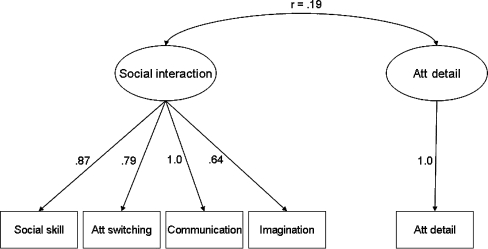
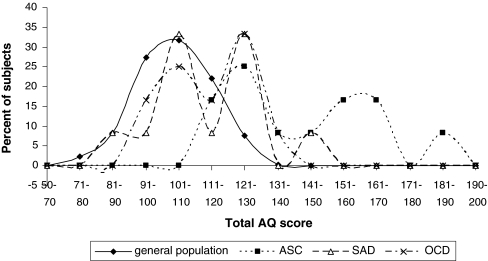
The factor structure of the Dutch translation of the Autism-Spectrum Quotient (AQ; a continuous, quantitative measure of autistic traits) was evaluated with confirmatory factor analyses in a large general population and student sample. The criterion validity of the AQ was examined in three matched patient groups (autism spectrum conditions (ASC), social anxiety disorder, and obsessive-compulsive disorder). A two factor model, consisting of a "Social interaction" factor and "Attention to detail" factor could be identified. The internal consistency and test-retest reliability of the AQ were satisfactory. High total AQ and factor scores were specific to ASC patients. Men scored higher than women and science students higher than non-science students. The Dutch translation of the AQ is a reliable instrument to assess autism spectrum conditions.
Overview
The claims and statistics of this paper haven’t been checked yet.
Free: it reads the open-access text and checks the first 5 claims that cite a source we can check. Create a free account to check every claim.
Integrity signals
Registry
Cites
Statistics
Figures
Verification
Claims the paper makes
The claims and statistics of this paper haven’t been checked yet.
Free: it reads the open-access text and checks the first 5 claims that cite a source we can check. Create a free account to check every claim.
Claims other papers make about this one
Each is checked against this paper’s own text: does it say what the citing paper says it does?
The source backs part of the claim, not all of it — or backs it for a different population, condition or comparison.
In the citing paper
“The test has good internal consistency and test-retest reliability and has been translated into many languages [57, 58].”
From A 'choice', an 'addiction', a way 'out of the lost': Exploring self-injury in autistic people without intellectual disability (2019) · cites this paper as [58]
Experimental — accuracy not yet measuredThe cited source says what the claim attributes to it.
In the citing paper
“High total AQ scores are specific to patients with an ASD and set them apart from both the general population and from patients with SAD [65].”
The check wasn’t confident either way, so it gives no verdict — never disputed.
In the citing paper
“The most widely used measure for adults with ASC is the Adolescent/Adult Sensory Profile (AASP), a 60-item self-report measure that finds differences in sensory processing in more than 90% of adults with ASC [17,19].”
From The Sensory Perception Quotient (SPQ): development and validation of a new sensory questionnaire for adults with and without autism (2014) · cites this paper as [19]
Experimental — accuracy not yet measured
Self-check
Percentages, sums and reported differences re-computed from the paper’s own numbers.
The self-check needs the paper’s full text.
Citations
Cites
Lord, C., Rutter, M., & Le Couteur, A. (1994) · Journal of Autism and Developmental Disorders · doi:10.1007/bf02172145 · Cited by 9,065 · cited 2×
“Keywords Autism Factor analysis Validity Reliability Autism phenotype”
MethodSchermelleh-Engel, K., Moosbrugger, H., & Müller, H. (2003) · Department of Psychology - University of Koblenz-Landau · doi:10.23668/psycharchives.12784 · Cited by 8,975
Lord, C., Risi, S., Lambrecht, L., Cook, E. H., Leventhal, B. L., DiLavore, P. C., Pickles, A., & Rutter, M. (2000) · Journal of Autism and Developmental Disorders · doi:10.1023/a:1005592401947 · Cited by 7,520 · cited 2×
“Keywords Autism Factor analysis Validity Reliability Autism phenotype”
MethodBaron-Cohen, S., Wheelwright, S., Skinner, R., Martin, J., & Clubley, E. (2001) · Journal of Autism and Developmental Disorders · doi:10.1023/a:1005653411471 · Cited by 6,450 · cited 13×
“Both the British (Baron-Cohen et al. 2001) and the Japanese version (Kurita et al. 2005) of the AQ reported good test-retest reliability and moderate internal consistency (Cronbach’s a varying from .63 to .78).”
BackgroundMethodResultInfluentialStructured Clinical Interview for DSM-IV Axis I Disorders
Spitzer, R. L., First, M. B., & Gibbon, M. (1997) · Medical Entomology and Zoology · Cited by 4,096
Autism as a strongly genetic disorder: evidence from a British twin study
Bailey, A., Le Couteur, A., Gottesman, I., Bolton, P., Simonoff, E., Yuzda, E., & Rutter, M. (1995) · Psychological Medicine · doi:10.1017/s0033291700028099 · Cited by 2,461
The extreme male brain theory of autism
Baron-Cohen, S. (2002) · Trends in Cognitive Sciences · doi:10.1016/s1364-6613(02)01904-6 · Cited by 2,007 · cited 2×
“In line with the empathizing–systemizing theory of autism (Baron-Cohen 2002; Baron-Cohen et al. 2005) and findings from previous studies (Baron-Cohen et al. 2001; Hoekstra et al. 2007; Wakabayashi et al. 2006) we expected: (a) AQ scores to be continuously distributed in the general population; (b)…”
ResultThe Extreme Male-Brain Theory of Autism
Baron-Cohen, S. (1999) · Neurodevelopmental Disorders · doi:10.7551/mitpress/4945.003.0023 · Cited by 1,413
Autistic Traits in the General Population: A Twin Study
Constantino, J. N., & Todd, R. D. (2003) · Archives of General Psychiatry · doi:10.1001/archpsyc.60.5.524 · Cited by 1,317 · cited 2×
“continuously distributed in the population (Constantino and Todd 2003; Piven et al. 1997; Spiker et al. 2002).”
BackgroundSex differences in the brain: implications for explaining autism
Baron-Cohen, S., Knickmeyer, R. C., & Belmonte, M. K. (2005) · Science · doi:10.1126/science.1115455 · Cited by 1,145 · cited 2×
“In line with the empathizing–systemizing theory of autism (Baron-Cohen 2002; Baron-Cohen et al. 2005) and findings from previous studies (Baron-Cohen et al. 2001; Hoekstra et al. 2007; Wakabayashi et al. 2006) we expected: (a) AQ scores to be continuously distributed in the general population; (b)…”
ResultA case-control family history study of autism
Bolton, P., Macdonald, H., Pickles, A., Rios, P., Goode, S., Crowson, M., Bailey, A., & Rutter, M. (1994) · Journal of Child Psychology and Psychiatry · doi:10.1111/j.1469-7610.1994.tb02300.x · Cited by 1,094 · cited 2×
“…may lead to a broader phenotype of autistic traits, as reflected in an increased rate of social deficits, impairments in communication and language, a preference for routines and difficulty with change in non-autistic relatives of autistic individuals (Bolton et al. 1994; Bailey et al. 1998).”
BackgroundBroader autism phenotype: evidence from a family history study of multiple-incidence autism families
(1997) · American Journal of Psychiatry · doi:10.1176/ajp.154.2.185 · Cited by 777 · cited 2×
“continuously distributed in the population (Constantino and Todd 2003; Piven et al. 1997; Spiker et al. 2002).”
BackgroundWoodbury-Smith, M. R., Robinson, J., Wheelwright, S., & Baron-Cohen, S. (2005) · Journal of Autism and Developmental Disorders · doi:10.1007/s10803-005-3300-7 · Cited by 771 · cited 2×
“A preliminary study (Woodbury-Smith et al. 2005) reported satisfying ability of the AQ to distinguish between subjects with and without an AS/HFA diagnosis, in a group of 100 referrals to a diagnostic clinic for adults suspected of having AS or HFA.”
BackgroundImpairment in shifting attention in autistic and cerebellar patients
Courchesne, E., Townsend, J., Akshoomoff, N. A., Saitoh, O., Yeung-Courchesne, R., Lincoln, A. J., James, H. E., Haas, R. H., Schreibman, L., & Lau, L. (1994) · Behavioral Neuroscience · doi:10.1037/0735-7044.108.5.848 · Cited by 647
The Autism Spectrum Quotient: Children’s Version (AQ-Child)
Auyeung, B., Baron-Cohen, S., Wheelwright, S., & Allison, C. (2008) · Journal of Autism and Developmental Disorders · doi:10.1007/s10803-007-0504-z · Cited by 600
Intergenerational transmission of subthreshold autistic traits in the general population
Constantino, J. N., & Todd, R. D. (2005) · Biological Psychiatry · doi:10.1016/j.biopsych.2004.12.014 · Cited by 519
Autism: The Phenotype in Relatives
Bailey, A., Palferman, S., Heavey, L., & Le Couteur, A. (1998) · Journal of Autism and Developmental Disorders · doi:10.1023/a:1026048320785 · Cited by 447
A Broader Phenotype of Autism: The Clinical Spectrum in Twins
Le Couteur, A., Bailey, A., Goode, S., Pickles, A., Gottesman, I., Robertson, S., & Rutter, M. (1996) · Journal of Child Psychology and Psychiatry · doi:10.1111/j.1469-7610.1996.tb01475.x · Cited by 442
Methods in Psychological ResearchPreprint
Chow, S. L. (2002) · CogPrints (University of Southampton) · Cited by 439
Austin, E. J. (2005) · Personality and Individual Differences · doi:10.1016/j.paid.2004.04.022 · Cited by 435 · cited 8×
“Previously, an exploratory factor analysis performed in a British student population suggested three underlying factors within the AQ, encompassing Social skill, Details/patterns, and Communication/mind reading (Austin 2005).”
MethodResultInfluentialGenetic influences and infantile autism
FOLSTEIN, S., & RUTTER, M. (1977) · Nature · doi:10.1038/265726a0 · Cited by 400 · cited 2×
“Concordance in dizygotic twins, however, is only 0–5% (Folstein and Rutter 1977; Bailey et al. 1995).”
BackgroundSutcliffe, J. S., Delahanty, R. J., Prasad, H. C., McCauley, J. L., Han, Q., Jiang, L., Li, C., Folstein, S. E., & Blakely, R. D. (2005) · The American Journal of Human Genetics · doi:10.1086/432648 · Cited by 392 · cited 2×
“Recent research suggests that a common genetic pathway, the serotonin transporter gene, could explain a small part of the association between OCD and rigid compulsive behaviors in autism (Ozaki et al. 2003; Sutcliffe et al. 2005).”
BackgroundAutism, affective and other psychiatric disorders: Patterns of familial aggregation
BOLTON, P. F., PICKLES, A., MURPHY, M., & RUTTER, M. (1998) · Psychological Medicine · doi:10.1017/s0033291797006004 · Cited by 387
Piven, J., & Palmer, P. (1999) · American Journal of Psychiatry · doi:10.1176/ajp.156.4.557 · Cited by 364 · cited 1×
“Relatives of autistic individuals are reported to have up to 10-fold higher rates of social phobia compared to control families (Smalley et al. 1995; Piven and Palmer 1999).”
BackgroundThe Autism-Spectrum Quotient (AQ) in Japan: A Cross-Cultural Comparison
Wakabayashi, A., Baron-Cohen, S., Wheelwright, S., & Tojo, Y. (2006) · Journal of Autism and Developmental Disorders · doi:10.1007/s10803-005-0061-2 · Cited by 346
Heritability of Autistic Traits in the General Population
Hoekstra, R. A., Bartels, M., Verweij, C. J. H., & Boomsma, D. I. (2007) · Archives of Pediatrics & Adolescent Medicine · doi:10.1001/archpedi.161.4.372 · Cited by 320
Self-citationAutistic social impairment in the siblings of children with pervasive developmental disorders
Constantino, J. N., Lajonchere, C., Lutz, M., Gray, T., Abbacchi, A., McKenna, K., Singh, D., & Todd, R. D. (2006) · American Journal of Psychiatry · doi:10.1176/appi.ajp.163.2.294 · Cited by 294 · cited 2×
“…using quantitative measurements of autistic traits found elevated scores in relatives of autistic and pervasive developmental disorder patients (Constantino et al. 2006; Bishop et al. 2004) and high scores in children whose parents showed high (but sub-diagnosis) endorsement on autistic traits…”
BackgroundGenetic Studies of Autism: From the 1970s into the Millennium
Rutter, M. (2000) · Journal of Abnormal Child Psychology · doi:10.1023/a:1005113900068 · Cited by 289
Serotonin transporter missense mutation associated with a complex neuropsychiatric phenotype
Ozaki, N., Goldman, D., Kaye, W. H., Plotnicov, K., Greenberg, B. D., Lappalainen, J., Rudnick, G., & Murphy, D. L. (2003) · Molecular Psychiatry · doi:10.1038/sj.mp.4001365 · Cited by 275
Bishop, D. V. M., Maybery, M., Maley, A., Wong, D., Hill, W., & Hallmayer, J. (2004) · Journal of Child Psychology and Psychiatry · doi:10.1111/j.1469-7610.2004.00325.x · Cited by 255
Ronald, A., Happé, F., & Plomin, R. (2005) · Developmental Science · doi:10.1111/j.1467-7687.2005.00433.x · Cited by 250 · cited 2×
“This result is in agreement with findings from a British twin project ( Ronald et al. 2005 ) which assessed both social and non-social behaviors characteristic for autism using parent and teacher ratings.”
ResultKURITA, H., KOYAMA, T., & OSADA, H. (2005) · Psychiatry and Clinical Neurosciences · doi:10.1111/j.1440-1819.2005.01403.x · Cited by 242
Cath, D. C., Ran, N., Smit, J. H., van Balkom, A. J. L. M., & Comijs, H. C. (2008) · Psychopathology · doi:10.1159/000111555 · Cited by 206 · cited 1×
“The last group consisted of three subgroups of psychiatric patients, who were all adult outpatients recruited from the anxiety outpatient services of GGZ Buitenamstel in Amsterdam (see also Cath et al. 2008).”
BackgroundSelf-citationAutism, affective disorders, and social phobia
Smalley, S. L., McCracken, J., & Tanguay, P. (1995) · American Journal of Medical Genetics · doi:10.1002/ajmg.1320600105 · Cited by 197
Spiker, D., Lotspeich, L. J., Dimiceli, S., Myers, R. M., & Risch, N. (2002) · American Journal of Medical Genetics · doi:10.1002/ajmg.10188 · Cited by 193
Obsessive–compulsive behaviors in parents of multiplex autism families
Hollander, E., King, A., Delaney, K., Smith, C. J., & Silverman, J. M. (2003) · Psychiatry Research · doi:10.1016/s0165-1781(02)00304-9 · Cited by 167
Ketelaars, C., Horwitz, E., Sytema, S., Bos, J., Wiersma, D., Minderaa, R., & Hartman, C. A. (2008) · Journal of Autism and Developmental Disorders · doi:10.1007/s10803-007-0358-4 · Cited by 78
Research works printed but not linked: 2
- 1. American Psychiatric Association (2000). Diagnostic and Statistical Manual for Mental Disorders, 4th Ed., Text Revision (DSM-IV-TR). Washington: American Psychiatric Press.
- 26. Neale M. C., Boker S. M., Xie G., Maes H. H. Mx: Statistical modeling. 7. Richmond: VCU; 2006.
Cited by
Allison, C., Auyeung, B., & Baron-Cohen, S. (2012) · Journal of the American Academy of Child & Adolescent Psychiatry · doi:10.1016/j.jaac.2011.11.003 · Cited by 1,016
Why are autism spectrum conditions more prevalent in males?
Baron-Cohen, S., Lombardo, M. V., Auyeung, B., Ashwin, E., Chakrabarti, B., & Knickmeyer, R. (2011) · PLoS Biology · doi:10.1371/journal.pbio.1001081 · Cited by 754
“Adult Autism Spectrum Quotient (AQ) 3 [104,121–124]”
Autism spectrum disorders and autistic traits: A decade of new twin studies
Ronald, A., & Hoekstra, R. A. (2011) · American Journal of Medical Genetics Part B: Neuropsychiatric Genetics · doi:10.1002/ajmg.b.31159 · Cited by 616
“…m en ta l ef fe ct s in de pe n de n t of D N A co de (s ee te xt ) SN P, si n gl e n uc le ot id e po ly m or ph is m ; CN V, co py n um be r va ri at io n ; M Zr , si m ila ri ty be tw ee n M Z tw in s in a pa ir ; D Zr , si m ila ri ty be tw ee n D Z tw in s in a p ai r. Hoekstra et al., 2008].”
BackgroundSelf-citationRuzich, E., Allison, C., Smith, P., Watson, P., Auyeung, B., Ring, H., & Baron-Cohen, S. (2015) · Molecular Autism · doi:10.1186/2040-2392-6-2 · Cited by 610
The Autism Spectrum Quotient: Children’s Version (AQ-Child)
Auyeung, B., Baron-Cohen, S., Wheelwright, S., & Allison, C. (2008) · Journal of Autism and Developmental Disorders · doi:10.1007/s10803-007-0504-z · Cited by 600
Metadata
- Authors
- Hoekstra, R. A., Bartels, M., Cath, D. C., & Boomsma, D. I.
- Affiliations
- Vrije Universiteit Amsterdam (NL)
- Corresponding author
- Hoekstra, Rosa A.
- Venue
- Journal of Autism and Developmental Disorders
- Published
- 2008-02-27
- Volume
- 38
- Issue
- 8
- Pages
- 1555-1566
- ISSN
- 0162-3257 (ISSN-L)
- 1573-3432
- PMC
- PMC2516538
- OpenAlex
- W2150214803
- Cited by
- 651
- References
- 38
- Citations by year
- 2026: 32 · 2025: 33 · 2024: 34 · 2023: 43 · 2022: 26 · 2021: 58 · 2020: 46 · 2019: 46 · 2018: 45 · 2017: 43 · 2016: 29 · 2015: 37 · 2014: 44 · 2013: 36 · 2012: 32
- FWCI
- 11.06
- Type
- journal article
- Language
- en
- Open access
- hybrid
- doi.org
- Licence
- cc-by-nc
- Locations
- Journal of Autism and Developmental Disorders (publishedVersion, cc-by-nc)
- Europe PMC (PubMed Central) (publishedVersion, cc-by-nc)
- PubMed Central (publishedVersion, cc-by-nc)
- PubMed (publishedVersion)
- VU Research Portal (publishedVersion, other-oa)
- Open Research Online (The Open University) (acceptedVersion)
- Digital Academic REpository of VU University Amsterdam (Vrije Universiteit Amsterdam) (submittedVersion)
- Research Portal (King's College London) (submittedVersion, cc-by-nc)
- Data Archiving and Networked Services (DANS) (submittedVersion, other-oa)
- Funders
- Nederlandse Organisatie voor Wetenschappelijk Onderzoek (NWO/ SPI 56-464-14192, 56‐464‐14192, 451–04-034, Spi-56-464-14192, 14192, 575-25-006)
- Topics
- Life Sciences › Neuroscience › Cognitive Neuroscience › Autism Spectrum Disorder Research
- Social Sciences › Decision Sciences › Management Science and Operations Research › Psychometric Methodologies and Testing
- Social Sciences › Psychology › Experimental and Cognitive Psychology › Anxiety, Depression, Psychometrics, Treatment, Cognitive Processes
- Keywords
- Autism Spectrum Quotient, autistic traits, factor structure, criterion validity, Dutch translation, autism spectrum disorder, social anxiety disorder, obsessive-compulsive disorder, social interaction, attention to detail, gender differences, science students
- MeSH terms
- Adolescent, Adult, Autistic Disorder, Mental Disorders, Cross-Cultural Comparison, Female, Humans, Interview, Psychological, Male, Middle Aged, Netherlands, Personality Assessment, Psychometrics, Surveys and Questionnaires, Reference Values, Translating, Reproducibility of Results, Early Diagnosis
About these checks
Registry, retraction, Cites and statistics results are computed, not judged, with one exception: a printed reference that no index lists is read once by a model before it counts as a citation error. Claims are extracted by a model and kept only when their quote appears verbatim in the text; each cited source is then checked, with a model’s help, for whether it says what the claim relies on. Those verdicts can be wrong — read the claim’s quote and the cited source before relying on one.
Statistics and arithmetic are recomputed, not judged.
Confidence bands are shown only for fields calibrated on our annotated test set. None is calibrated yet, so no band is shown.
What counts as a claim ›How we measure confidence ›How we check this ›
Are you an author, or do you see a problem with this page? Request a review
Data sources
Bibliographic data: Semantic Scholar, OpenAlex, Crossref.
Contains information from the Semantic Scholar Academic Graph Datasets, made available under the ODC Attribution License (ODC-BY 1.0).
Semantic Scholar’s data is described in: Kinney, R., et al. (2023). The Semantic Scholar Open Data Platform. arXiv:2301.10140.
