

How teachers’ student voice practices affect student engagement and achievement: exploring choice, receptivity, and responsiveness to student voice as moderators
Open accessThe DOI matches its Crossref record; 48 of the 49 references it cites were found in a registry or an index; 8 of the 62 sources its claims cite were checked for support.
Abstract
Strategies that promote student voice have long been championed as effective ways to enhance student engagement and learning; however, little quantitative research has studied the relationship between student voice practices (SVPs) and student outcomes at the classroom level. Drawing on survey data with 1,751 middle and high school students from one urban district, this study examined how the SVP of seeking students’ input and feedback related to their academic engagement, agency, attendance, and grades. Findings revealed strong associations between this SVP and student engagement. Additionally, results showed that having just one teacher who uses the SVP is associated with significantly greater agency, better math grades, higher grade point averages, and lower absent rates than having no teachers who do so. In models testing interaction effects with choice, responsiveness, and receptivity to student voice, teachers’ receptivity was strongly associated with all outcomes. Few interaction effects were found. This study contributes compelling evidence of the impact of classroom SVPs and teacher receptivity to student voice on desired student outcomes.
Overview
CoChat Summary
TL;DR
This cross-sectional survey of 1,751 middle and high school students in one urban district found that teachers’ use of student voice practices (SVPs), specifically seeking student input/feedback, was strongly associated with greater academic engagement and agency, and with lower absenteeism and higher ELA grades in some models. Teacher receptivity to student voice was the most consistent correlate of all outcomes, while choice and responsiveness showed only limited moderation.
Key findings
- In main-effect models, the number of teachers using SVPs was associated with greater academic engagement (linear β = 0.18, SE = 0.02, p < .001; quadratic β = 0.16, SE = 0.02, p < .001), greater student voice agency (linear β = 0.20, SE = 0.03, p < .001; quadratic β = 0.18, SE = 0.02, p < .001), higher self-reported ELA grades (linear β = 0.06, SE = 0.03, p < .05), and lower absent rates (linear β = −0.10, SE = 0.02, p < .001).
- After adding choice, responsiveness, and receptivity as covariates, SVPs remained significantly associated with academic engagement only (linear β = 0.19, SE = 0.04, p < .001; quadratic β = −0.05, SE = 0.03, p < .05).
- Teacher receptivity was associated with all outcomes: academic engagement (β = 0.21, SE = 0.03, p < .001), student voice agency (β = 0.09, SE = 0.04, p < .05), ELA grade (β = 0.11, SE = 0.03, p < .001), math grade (β = 0.09, SE = 0.03, p < .01), GPA (β = 0.16, SE = 0.04, p < .001), and absent rate (β = −0.10, SE = 0.03, p < .001).
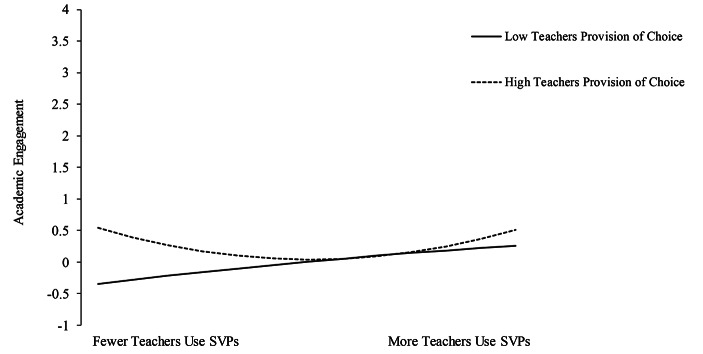
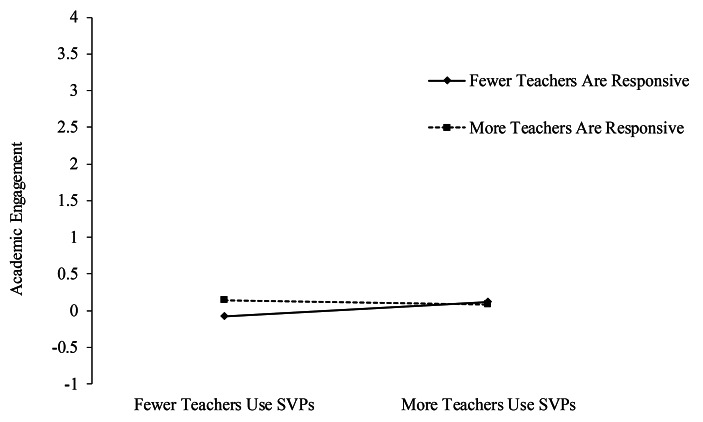
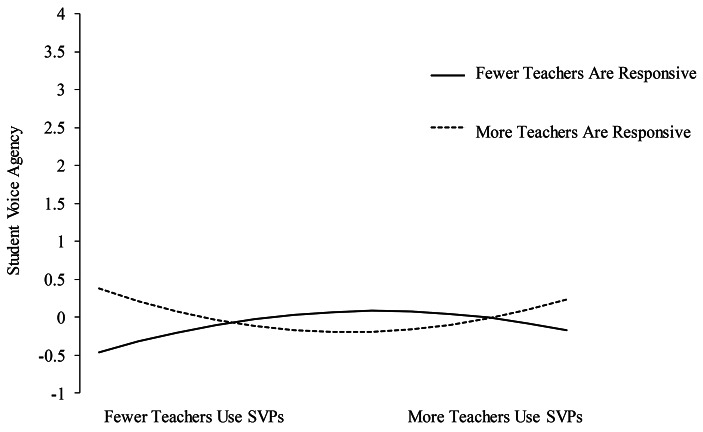
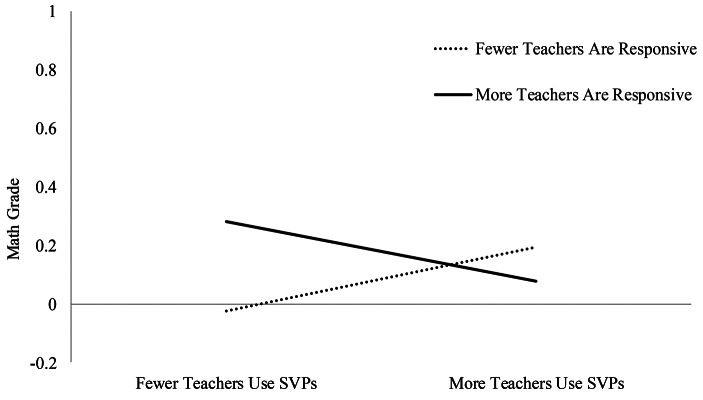
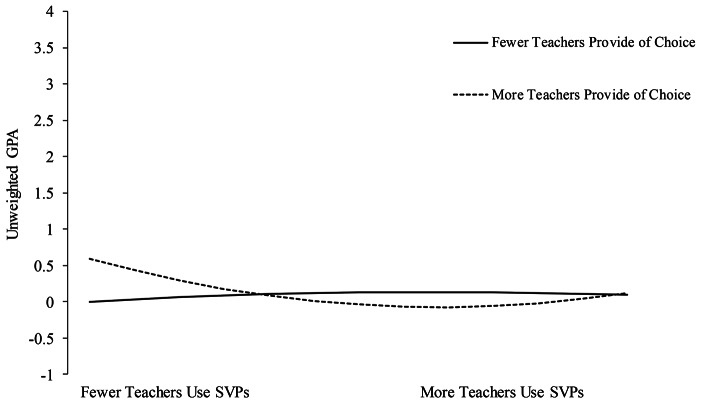
- ANOVA results showed that students reporting one teacher using SVPs had higher GPA (M = 2.83, SD = 0.86) than students reporting no teachers using SVPs (M = 2.61, SD = 0.88); students reporting “some” teachers using SVPs had higher math grades (M = 3.52, SD = 1.21) than those reporting none (M = 3.25, SD = 1.35). Few interaction effects were found; receptivity did not significantly interact with SVPs in any model.
Methods
- Cross-sectional survey administered in winter 2023 to students in two middle schools and two high schools in a large Western U.S. urban district serving approximately 65,000 Pre-K–12 students; N = 1,751, with school response rates ranging from 10% to 58%.
- Measures included an 8-item SVP scale for seeking student input/feedback (α = 0.90), 5-item choice scale (α = 0.82), 3-item teacher receptivity scale (α = 0.84), 4-item teacher responsiveness scale (α = 0.81), 9-item academic engagement scale (α = 0.91), 3-item student voice agency scale (α = 0.74), administrative absent rate, self-reported math and ELA grades, and administrative cumulative GPA.
- Analyses used SPSS for descriptives, correlations, and one-way ANOVA with Tukey post hoc tests; Mplus for regression models with linear and quadratic SVP terms, controls for gender, race/ethnicity, grade level, ELL services, family financial strain, and school site; interaction terms tested choice, receptivity, and responsiveness as moderators, with Johnson–Neyman regions of significance and full-information maximum likelihood estimation.
Limitations
- The paper states that the cross-sectional data prevent causal claims; the study was conducted in one urban district with a diverse but heavily Latiné population, limiting generalizability; it asked how many teachers used practices rather than about specific teachers, making it difficult to disentangle a particular teacher’s SVP effects; and with only two middle and two high schools, school-level differences could not be explored via multigroup modeling.
- Evident from the text: response rates ranged from 10% to 58%, raising possible nonresponse bias; gender non-binary or self-described students were excluded from analyses due to small sample size (n = 63); and the authors note that students faring well academically may be more likely to perceive teachers as receptive, so directionality remains uncertain.
Model-written summary. Check it against the paper before relying on it.
Integrity signals
Registry
Cites
Statistics
Figures
Verification
Claims the paper makes
8 Valid · 0 Not valid · 33 Not checked · 99 Own results and interpretations
The sources with a verdict support this claim; the rest weren’t checked yet, have no full text we could read, or their verdicts aren’t rated yet.
In the paper
“Additionally, fearing that their ideas may be dismissed or misunderstood may lead some students to refrain from sharing ideas in the first place (Biddle & Huffnagel, 2019; Hipolito-Delgado, 2023; Silva, 2001).”
§ How teachers’ student voice practices affect student engagement and achievement: exploring choice, receptivity, and responsiveness to student voice as moderators > Introduction
What the sources say
- Not matchedcites Biddle & Huffnagel, 2019
An author–year citation the paper’s reference list doesn’t settle. We don’t search these by name.
- Not checked — no full text of the sourcecites Hipolito-Delgado, 2023 matched to “Student Voice and Adult Manipulation: Youth Navigating Adult Agendas” (2024) source
- Supportedcites Silva, 2001 matched to “'Squeaky Wheels and Flat Tires': a case study of students as reform participants” (2001) source
In “Power and Position” (page unavailable), a student says she “just shut up” because another student spoke for her without understanding her perspective. The same section describes a student declining to present to the principal because she feared saying the wrong thing. These examples support the qualified claim that such concerns may keep some students from sharing ideas. (LLM, conf=0.86)
hedgedstates a possible cause- Asserted: passes — The authors put it forward as true.
- Checkable: passes — It can be checked against evidence.
- Load-bearing: passes — The paper’s conclusions depend on it.
- Based: passes — The paper gives a reason why it holds.
- Not matched
Every source the paper cites for this claim was checked and supports it.
In the paper
“This indicator of student voice was also indirectly linked to behavioral and cognitive engagement in class, through strengthened student-teacher relationships (Conner et al., 2022).”
§ How teachers’ student voice practices affect student engagement and achievement: exploring choice, receptivity, and responsiveness to student voice as moderators > Student voice and academic outcomes
What the sources say
- Supportedcites Conner et al., 2022 matched to “The Relationship Between Student Voice and Student Engagement in Urban High Schools” (2022) source
The Discussion explicitly links student voice indirectly to behavioral and cognitive engagement through students’ perception of teacher care. The Results describe the pathway: feeling listened to is associated with perceived teacher care, which is linked to cognitive engagement directly and behavioral engagement through competence. (LLM, conf=0.92)
plainstates an association- Asserted: passes — The authors put it forward as true.
- Checkable: passes — It can be checked against evidence.
- Load-bearing: unclear — It is unclear whether the paper’s conclusions depend on it.
- Based: passes — The paper gives a reason why it holds.
- Supported
The cited sources support only part of this claim — read each source’s verdict below.
In the paper
“In two separate studies, student voice (operationalized as student participation in decision-making) was found to be a significant predictor of both affective and cognitive engagement in school (Anderson, 2018; Zeldin et al., 2018).”
§ How teachers’ student voice practices affect student engagement and achievement: exploring choice, receptivity, and responsiveness to student voice as moderators > Student voice and academic outcomes
What the sources say
- Partly supportedcites Anderson, 2018 matched to “Improving wellbeing through student participation at school. Phase 4, Survey report: evaluating the link between student participation and wellbeing in NSW schools” (2018) sourceExperimental — accuracy not yet measured
In Convergent Validity (Table 11; page not provided), Anderson reports statistically significant positive correlations between student participation and both affective and cognitive engagement. The report describes these as associations, not findings that participation was a significant predictor of engagement. Anderson is one of the two studies cited, so this verdict does not assess the other study. (LLM, conf=0.86)
- Not checked — no full text of the sourcecites Zeldin et al., 2018 matched to “How High Schools Become Empowering Communities: A Mixed‐Method Explanatory Inquiry into Youth‐Adult Partnership and School Engagement” (2018) source
plainstates an association- Asserted: passes — The authors put it forward as true.
- Checkable: passes — It can be checked against evidence.
- Load-bearing: unclear — It is unclear whether the paper’s conclusions depend on it.
- Based: passes — The paper gives a reason why it holds.
- Partly supported
The cited sources support only part of this claim — read each source’s verdict below.
In the paper
“At the classroom level, one study using district-wide data found that when students felt their voice was listened to by their teachers, they reported higher affective engagement in their classes.”
§ How teachers’ student voice practices affect student engagement and achievement: exploring choice, receptivity, and responsiveness to student voice as moderators > Student voice and academic outcomes
What the sources say
- Partly supportedcites Conner et al., 2022 matched to “The Relationship Between Student Voice and Student Engagement in Urban High Schools” (2022) sourceExperimental — accuracy not yet measured
The Results report a direct positive association between student voice and affective engagement: students who feel heard by teachers more often also find schoolwork more interesting and enjoyable. But the Methods state that survey responses were aggregated at the school level, so the study does not establish the claimed classroom-level relationship. (LLM, conf=0.88)
plainstates an association- Asserted: passes — The authors put it forward as true.
- Checkable: passes — It can be checked against evidence.
- Load-bearing: unclear — It is unclear whether the paper’s conclusions depend on it.
- Based: passes — The paper gives a reason why it holds.
- Partly supported
The cited sources support only part of this claim — read each source’s verdict below.
In the paper
“In Mercer-Mapstone and colleagues’ (2017) literature review of “pedagogical partnerships”–a particular type of student voice programming in which a student serves as a consultant to a teacher–, 19 studies attested to students’ improved content/disciplinary learning as a result of participation.”
§ How teachers’ student voice practices affect student engagement and achievement: exploring choice, receptivity, and responsiveness to student voice as moderators > Student voice and academic outcomes
What the sources say
- Partly supportedcites Mercer-Mapstone et al. (2017) matched to “A systematic literature review of students as partners in higher education” (2017) sourceExperimental — accuracy not yet measured
Table 3 (p. 12) records improved student content/discipline learning, actual or perceived, in 19 papers. But the review covers a broader range of students-as-partners practices than the citing sentence’s narrower description of students serving as consultants to teachers; it does not establish that all 19 papers concerned that specific arrangement. (LLM, conf=0.86)
plainstates a cause- Asserted: passes — The authors put it forward as true.
- Checkable: passes — It can be checked against evidence.
- Load-bearing: unclear — It is unclear whether the paper’s conclusions depend on it.
- Based: passes — The paper gives a reason why it holds.
- Partly supported
85 more claims
Create a free account to see all 140 claims and to verify the 3 references still open.
- Probably not a substantial claim. 36
- It may state two separate claims as one. 19
- The quote only partly states this claim. 2
Self-check
Percentages, sums and reported differences re-computed from the paper’s own numbers.
Each contradiction between two passages listed here was confirmed by an independent check.
Rated major: it would touch a result — a value a result rests on, reported and recomputed p-values on opposite sides of the significance level, two passages that conflict with no sign which is right, or a cited work retracted before this paper was published.
In the paper
§ How teachers’ student voice practices affect student engagement and achievement: exploring choice, receptivity, and responsiveness to student voice as moderators > Discussion
“we similarly found responsiveness was significantly associated with lower student absent rates in the final model.”
§ How teachers’ student voice practices affect student engagement and achievement: exploring choice, receptivity, and responsiveness to student voice as moderators > Results > Main effect models
“| Responsiveness | | 0.04 (0.05) | 0.10 (0.07) | | − 0.01 (0.05) | − 0.14 (0.06)* | | − 0.08 (0.04) | − 0.09 (0.04) |”
Citations
Cites
School Engagement: Potential of the Concept, State of the Evidence
Fredricks, J. A., Blumenfeld, P. C., & Paris, A. H. (2004) · Review of Educational Research · doi:10.3102/00346543074001059 · Cited by 12,581 · cited 1×
“Academic engagement was assessed using a previously validated, widely-used nine-item measure from the Stanford Survey of Adolescent School Experiences (Pope et al., 2015), which taps affective, behavioral, and cognitive engagement (Fredricks et al., 2004).”
Addressing Moderated Mediation Hypotheses: Theory, Methods, and Prescriptions
Preacher, K. J., Rucker, D. D., & Hayes, A. F. (2007) · Multivariate Behavioral Research · doi:10.1080/00273170701341316 · Cited by 9,973
(2010) · Cited by 7,034
Kuncel, N. R., Credé, M., & Thomas, L. L. (2005) · Review of Educational Research · doi:10.3102/00346543075001063 · Cited by 1,137 · cited 1×
“Although some studies dispute the credibility of student self-reported grades (Kuncel et al., 2005), other research concludes that students can provide accurate and valid indicators of their performance (Wigfield & Wagner, 2005).”
Patall, E. A., Cooper, H., & Robinson, J. C. (2008) · Psychological Bulletin · doi:10.1037/0033-2909.134.2.270 · Cited by 1,101 · cited 1×
“Given compelling research showing that choice in the classroom can promote student engagement and learning (Beymer et al., 2020 ; Patall et al., 2008, 2010 ; Schmidt et al., 2018), it is important to explore whether choice moderates or strengthens the relationship between student voice and student…”
Relationships between student engagement and academic achievement: A meta-analysis
Lei, H., Cui, Y., & Zhou, W. (2018) · Social Behavior and Personality: an international journal · doi:10.2224/sbp.7054 · Cited by 987 · cited 1×
“Because engagement has been well-established as an antecedent to learning and achievement (Lei et al., 2018), student voice scholars have connected SVPs to greater learning and achievement through this mechanism.”
A systematic literature review of students as partners in higher education
Mercer-Mapstone, L., Dvorakova, S. L., Matthews, K. E., Abbot, S., Cheng, B., Felten, P., Knorr, K., Marquis, E., Shammas, R., & Swaim, K. (2017) · International Journal for Students as Partners · doi:10.15173/ijsap.v1i1.3119 · Cited by 626 · cited 2×
“This finding supports a great deal of prior research on the powerful impact of SVPs on student agency (Laux, 2018; Mercer-Mapstone et al., 2017) and suggests that experience with SVPs in the classroom can help build students’ confidence and will to engage in student voice at the school level.”
Anyon, Y., Bender, K., Kennedy, H., & Dechants, J. (2018) · Health Education & Behavior · doi:10.1177/1090198118769357 · Cited by 481 · cited 1×
“…students of color can and do derive important developmental benefits from participating in these opportunities (Hipolito-Delgado et al., 2022 ), and YPAR classes or after-school programs have been linked to some academic benefits, primarily through qualitative research (Anyon et al., 2018).”
The effectiveness and relative importance of choice in the classroom.
Patall, E. A., Cooper, H., & Wynn, S. R. (2010) · Journal of Educational Psychology · doi:10.1037/a0019545 · Cited by 361 · cited 1×
“Given compelling research showing that choice in the classroom can promote student engagement and learning (Beymer et al., 2020 ; Patall et al., 2008, 2010 ; Schmidt et al., 2018), it is important to explore whether choice moderates or strengthens the relationship between student voice and student…”
Mager, U., & Nowak, P. (2012) · Educational Research Review · doi:10.1016/j.edurev.2011.11.001 · Cited by 297
Research works printed but not linked: 6
- Biddle, C. (2017). Trust formation when youth and adults partner for school reform: A case study of supportive structures and challenges. Journal of Organizational and Educational Leadership, 2(2), 1 –15.
- Geurts, E. M. A., Reijs, R. P., Leenders, H. H. M., Jansen, M. W. J., & Hoebe, C. J. P. A. (2024). Co-creation and decision-making with students about teaching and learning: A systematic literature review. Journal of Educational Change, 25, 103–125. 10.1007/s10833-023-09481-x · DOI · Paper page
- Hair, J. F., Black, W. C., Anderson, R. E., & Babin, B. J. (2019). Multivariate data analysis (8th ed.). Cengage Learning.
- Pope, D., Brown, M., & Miles, B. (2015). Overloaded and underprepared: Strategies for stronger schools and healthy, successful kids. Wiley.
- Salisbury, J., Rollins, K., Lang, E., & Spikes, D. (2019). Creating spaces for youth through student voice and critical pedagogy. International Journal of Student Voice, 4 (1), 1–16.
- Wigfield, A., & Wagner, A. L. (2005). Competence, motivation, and identity development during adolescence. In A. Elliott, & C. Dweck (Eds.), Handbook of competence and motivation (pp. 222–239). Guilford Press.
Cited by
Bartlett, T., & Yemini, M. (2025) · Journal of Research on Adolescence · doi:10.1111/jora.70034 · Cited by 21
“This finding aligns with the literature on student voice, autonomy, and motivation, particularly as articulated in self-determination theory (Conner et al., 2024; Evans & Boucher, 2015).”
Student voice and choice in the virtual classroom: engagement strategies
Biaddang, L. M. D., & Caroy, A. A. (2024) · Discover Education · doi:10.1007/s44217-024-00269-6 · Cited by 18
Thomsen, P. N., Krøjgaard, F., Sunde, P. B., & Andrews, P. (2025) · Learning in Context · doi:10.1016/j.lecon.2025.100008 · Cited by 9
Egan, S., O’Donovan, M., & Lafferty, N. (2025) · Social Sciences & Humanities Open · doi:10.1016/j.ssaho.2025.101847 · Cited by 10
Henderson, H., & Shipway, R. (2025) · International Journal of Event and Festival Management · doi:10.1108/ijefm-01-2025-0006 · Cited by 4
Encouraging Teacher Readiness for Designing Student Voice Practices
Mitra, D. L., Saghir, G. A., Conner, J. O., Holquist, S. E., & Wright, N. L. (2025) · Teachers College Record The Voice of Scholarship in Education · doi:10.1177/01614681251355705 · Cited by 7
Self-citationSupporting secondary school science teachers to teach science inquiry skills
Stevenson, E., Dawborn–Gundlach, M., DRIEL, J. H. V., & Krell, M. (2025) · Eurasia Journal of Mathematics Science and Technology Education · doi:10.29333/ejmste/16614 · Cited by 2
“Students provided valuable insights into interesting real-life contexts, reinforcing the benefit of incorporating student views for better engagement (Conner et al., 2025).”
Qu, J., & Bhatta, D. D. (2025) · PLoS ONE · doi:10.1371/journal.pone.0337038 · Cited by 3
“Conversely, lower levels of college, teacher, and peer acceptance, as well as feelings of disconnectedness, are associated with reduced engagement [44,45].”
Deciding when to make noise: A study of youth voice in carceral contexts
Lesnick, J., Wray‐Lake, L., Rosales, G., & Vargas, J. (2026) · Journal of Research on Adolescence · doi:10.1111/jora.70151 · Cited by 1
Slapac, A., Collett, K. S., & Bolton, N. (2026) · Springer international handbooks of education · doi:10.1007/978-3-032-10711-4_52-1 · Cited by 1
Vaičiūnienė, A., & Kazlauskienė, A. (2026) · Learning Culture and Social Interaction · doi:10.1016/j.lcsi.2026.101035 · Cited by 1
Teacher Practice Improvement Tool: A summary of the underpinning research
der Kleij, F. M. V., Medhurst, M., Lasen, M., Rogers, C., & Taylor-Guy, P. (2025) · Australian Council for Educational Research eBooks · doi:10.37517/978-1-74286-781-6
Leadership Styles and Work Performance Among Teachers
Pasco, W., Postrano, E., & Pigao, O. (2025) · Psychology and Education A Multidisciplinary Journal · doi:10.70838/pemj.400105
Metaverse as an Alternative Tool for Learning Ancient Chinese Architecture (ACA) Course
Cui, J. (2025) · IEEE Symposium on Computer Applications & Industrial Electronics (ISCAIE) · doi:10.1109/iscaie64985.2025.11080841
Secondary school students' instructional evaluation scale: Development and validation
Kırmızıoğlu, M. A., & Dinçer, S. (2025) · e-Kafkas Eğitim Araştırmaları Dergisi · doi:10.30900/kafkasegt.1700681 · Cited by 2
“Recent studies indicate that students' perspectives should be given greater importance in the evaluation of teaching processes (Caldwell et al., 2024; Conner, Mitra, Holquist, & Boat, 2025; Holquist, Mitra, Conner, & Wright, 2023; Ouattara, 2025).”
O’Malley, M. D., Greene, J. D., Swami, S., Ahmad, H., Puelicher, T., Sembrano, B., Leonard, A., Parra, I., & Yu, A. W. L. (2025) · Journal of Prevention & Intervention in the Community · doi:10.1080/10852352.2025.2586387
MODELAGEM FUZZY PARA AUXILIAR NA AVALIAÇÃO DO DESEMPENHO ESCOLAR
Neves, E. P., Leal, V. G. R., Duarte, M. A. Q., Lamblém, R. L., & de Araújo, I. C. (2026) · Aracê. · doi:10.56238/arev8n2-082
Empowering Student Voice as Co-creators in Co-Curricular Activities in Secondary Schools in Tanzania
Anselimus, S. M., & Lazaro, A. A. (2025) · Education Journal of Teaching and Learning · doi:10.37759/ejtl.2025.1.2.4
The Impact of Student-Centered Instruction on the Academic Integration of Libyan University Freshman
Dreid, F. (2026) · Al-Qurtas · doi:10.66045/oo34xifghtr
Active Learning in Engineering Education: A Case Study from a Digital Logic Design Course
Mansouri, M. (2026) · Applied Sciences · doi:10.3390/app16062880 · Cited by 2
Hidayanti, V., Kholid, I., & Rahmawati, I. N. (2026) · Tadris Jurnal Keguruan dan Ilmu Tarbiyah · doi:10.24042/tadris.v11i1.28804 · Cited by 1
Basalo, N. E., Nacilla, S. A., Gealon, H. J., Zamora, R., Odrigue, K. J., & Español, S. (2026) · Psychology and Education A Multidisciplinary Journal · doi:10.70838/pemj.530804
Wands, L., Forte, K., Garbett, M., Spence, S., & Yeager, C. (2026) · Nursing Education Perspectives · doi:10.1097/01.nep.0000000000001529
Política pública y prácticas docentes en Colombia
Murillo, E. Y. C., & Londoño, J. V. E. (2026) · Revista Venezolana de Gerencia · doi:10.52080/rvgluz.31.114.25
Lovett, J. M., Schonert-Reichl, K. A., Braun, S. S., Zinsser, K. M., Teasdale, R., & Rogers, A. (2026) · Social and Emotional Learning Research Practice and Policy · doi:10.1016/j.sel.2026.100203 · Cited by 2
Personalized learning strategies for considering students’ interests
Membrive, A., Vizquerra, M. I., & Engel, A. (2026) · Teaching and Teacher Education · doi:10.1016/j.tate.2026.105663
Esmurzayeva, N. M. (2026) · Premier Journal of Economics · doi:10.70389/pjec.100010
Reimagining Assessment: How Co-construction Shifts Agency in Computer Science Classrooms
Sherif, E., Lyons, R., Amaya, I., & Ko, A. J. (2026) · Research on Equity and Sustained Participation in Engineering, Computing, and Technology (RESPECT) · doi:10.1145/3796496.3811802
Ganade, A. M., Sabud, M. C., Origines, D. V., Jr., Ibañez, Z., & Fuentes, A. (2026) · Journal of interdisciplinary perspectives · doi:10.69569/jip.2026.228
Hegseth, W. M. (2026) · Oxford University Press eBooks · doi:10.1093/9780197833049.003.0003
Hegseth, W. M. (2026) · Oxford University Press eBooks · doi:10.1093/9780197833049.003.0009
Hegseth, W. M. (2026) · Oxford University Press eBooks · doi:10.1093/9780197833049.002.0005
Hegseth, W. M. (2026) · Oxford University Press eBooks · doi:10.1093/9780197833049.002.0004
Hegseth, W. M. (2026) · Oxford University Press eBooks · doi:10.1093/9780197833049.003.0006
Hegseth, W. M. (2026) · Oxford University Press eBooks · doi:10.1093/9780197833049.003.0001
Hegseth, W. M. (2026) · Oxford University Press eBooks · doi:10.1093/9780197833049.003.0005
Hegseth, W. M. (2026) · Oxford University Press eBooks · doi:10.1093/9780197833049.003.0004
Hegseth, W. M. (2026) · Oxford University Press eBooks · doi:10.1093/9780197833049.005.0001
Hegseth, W. M. (2026) · Oxford University Press eBooks · doi:10.1093/9780197833049.003.0002
Ritonga, B. S. B., Syahputri, C., Pangaribuan, E. R., & Maulana, M. I. (2026) · Sakaguru. · doi:10.70211/sakaguru.v3i1.649
Véliz, F. S. Q., Parrales, E. J. A., Castillo, A. F. Q., & de Valgas, F. D. R. M. F. (2026) · Saber Estratégico Internacional · doi:10.70577/s.e.v4i3.52
Democracy at work? Rethinking student participation in school improvement
Andersson, E., Jerdborg, S., & Langelotz, L. (2026) · Journal of Educational Change · doi:10.1007/s10833-026-09569-0 · Cited by 3
Examining the Relationship Between Student Voice and Student Outcomes
Mitra, D., Conner, J. O., & Holquist, S. E. (2026) · Springer international handbooks of education · doi:10.1007/978-3-031-88898-4_6-1
Self-citationŠeďová, K., Majcík, M., Babyrádová, V., Vlček, J., & Burešová, K. (2026) · SSRN Electronic Journal · doi:10.2139/ssrn.7397294
Amaro, J. J., Nacilla, S. A., Hornido, C. J., et al. (2026) · Psychology and Education A Multidisciplinary Journal · doi:10.70838/pemj.620205
Hinojosa-Torres, C., Alcalá, D. H., Zavala-Crichton, J. P., et al. (2026) · Journal of Teaching in Physical Education · doi:10.1123/jtpe.2026-0203
Julien, G. (2026) · Journal of Educational Research and Practice. · doi:10.70376/jerp.v4i3.463
Metadata
- Authors
- Conner, J., Mitra, D. L., Holquist, S. E., & Boat, A.
- Affiliations
- Villanova University (US)
- Pennsylvania State University (US)
- Child Trends (US)
- Search Institute (US)
- Corresponding author
- Conner, Jerusha
- Venue
- Journal of Educational Change
- Published
- 2024-07-22
- Volume
- 26
- Issue
- 1
- Pages
- 89-118
- ISSN
- 1389-2843 (ISSN-L)
- 1573-1812
- PMC
- PMC11836230
- OpenAlex
- W4400892859
- Semantic Scholar
- 02fa069ec77ec72db2fca3e3b09b60e5362a1306
- Cited by
- 52
- References
- 49
- Citations by year
- 2026: 38 · 2025: 13 · 2024: 1
- FWCI
- 37.13
- Type
- journal article
- Language
- en
- Open access
- hybrid
- doi.org
- Licence
- cc-by
- creativecommons.org/licenses/by/4.0 (tdm)
- creativecommons.org/licenses/by/4.0 (vor)
- Locations
- Journal of Educational Change (publishedVersion, cc-by)
- PubMed Central (publishedVersion, cc-by)
- PubMed (publishedVersion)
- ScholarSphere (Penn State Libraries) (submittedVersion, cc-by)
- Funders
- Bill and Melinda Gates Foundation (INV-031504)
- Topics
- Social Sciences › Sociology and Political Science › Children's Rights and Participation
- Social Sciences › Education › Higher Education Practises and Engagement
- Social Sciences › Education › Educational Environments and Student Outcomes
- Keywords
- student voice, student engagement, academic performance, teacher responsiveness, student choice, student agency, student attendance, student grades, middle and high school students, urban schools, teaching practice
About these checks
Registry, retraction, Cites and statistics results are computed, not judged, with one exception: a printed reference that no index lists is read once by a model before it counts as a citation error. Claims are extracted by a model and kept only when their quote appears verbatim in the text; each cited source is then checked, with a model’s help, for whether it says what the claim relies on. Those verdicts can be wrong — read the claim’s quote and the cited source before relying on one.
The claim verdicts this report counts are experimental: their accuracy is not yet measured.
A language model drew the claims from the paper on 2026-10-10, under version 3 of the claim definition (model deepseek-v4.1-flash, prompt extract-v3).
A second model labelled each claim on 2026-10-10 (model jev-1.13-20260917, definition revision gold-guideline-v0.2).
Cited sources are checked with a language model’s help (gpt-6-sol).
Statistics and arithmetic are recomputed, not judged.
Confidence bands are shown only for fields calibrated on our annotated test set. None is calibrated yet, so no band is shown.
What counts as a claim ›How we measure confidence ›How we check this ›
Are you an author, or do you see a problem with this page? Request a review
Data sources
Bibliographic data: Semantic Scholar, OpenAlex, Crossref.
Contains information from the Semantic Scholar Academic Graph Datasets, made available under the ODC Attribution License (ODC-BY 1.0).
Semantic Scholar’s data is described in: Kinney, R., et al. (2023). The Semantic Scholar Open Data Platform. arXiv:2301.10140.
