

The Relationship Between Nature Connectedness and Eudaimonic Well-Being: A Meta-analysis
Open accessThe DOI matches its Crossref record; 103 of the 106 references it cites were found in a registry or an index.
Abstract
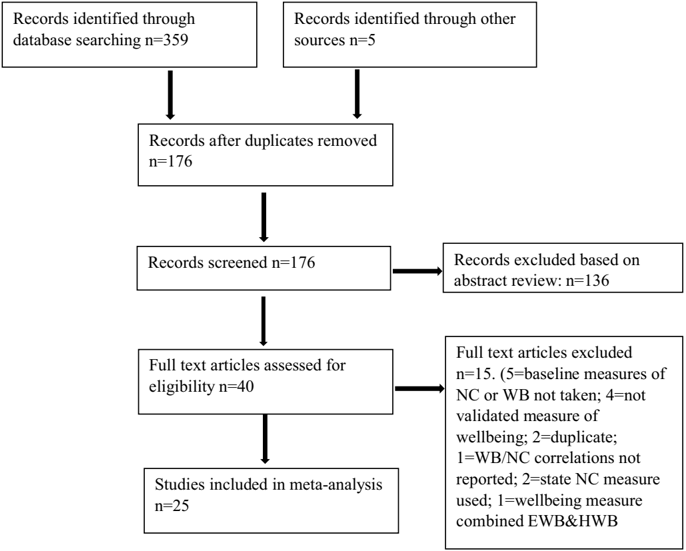
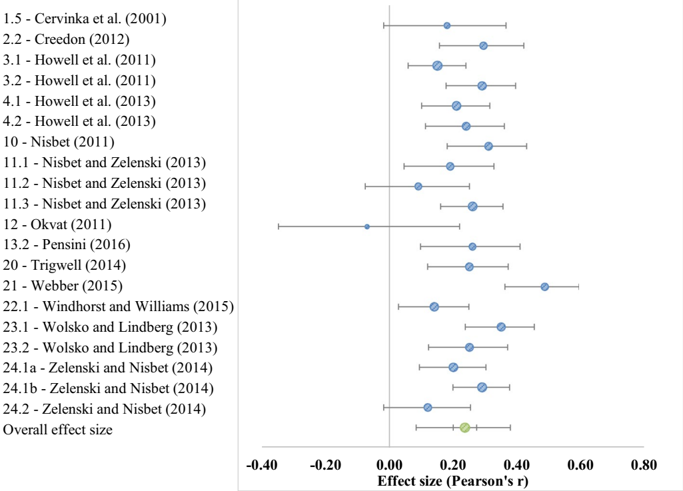
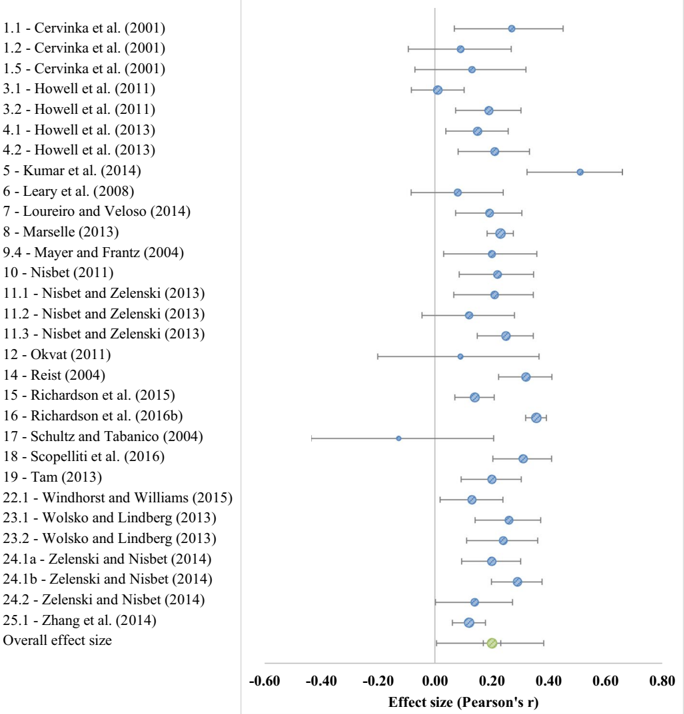
Nature connectedness relates to an individual’s subjective sense of their relationship with the natural world. A recent meta-analysis has found that people who are more connected to nature also tend to have higher levels of self-reported hedonic well-being; however, no reviews have focussed on nature connection and eudaimonic well-being. This meta-analysis was undertaken to explore the relationship of nature connection with eudaimonic well-being and to test the hypothesis that this relationship is stronger than that of nature connection and hedonic well-being. From 20 samples (n = 4758), a small significant effect size was found for the relationship of nature connection and eudaimonic well-being (r = 0.24); there was no significant difference between this and the effect size (from 30 samples n = 11,638) for hedonic well-being (r = 0.20). Of the eudaimonic well-being subscales, personal growth had a moderate effect size which was significantly larger than the effect sizes for autonomy, purpose in life/meaning, self-acceptance, positive relations with others and environmental mastery, but not vitality. Thus, individuals who are more connected to nature tend to have greater eudaimonic well-being, and in particular have higher levels of self-reported personal growth.
Overview
The claims and statistics of this paper haven’t been checked yet.
Free: it reads the open-access text and checks the first 5 claims that cite a source we can check. Create a free account to check every claim.
Integrity signals
Registry
Cites
Statistics
Figures
Verification
Claims the paper makes
The claims and statistics of this paper haven’t been checked yet.
Free: it reads the open-access text and checks the first 5 claims that cite a source we can check. Create a free account to check every claim.
Self-check
Percentages, sums and reported differences re-computed from the paper’s own numbers.
The self-check needs the paper’s full text.
Citations
Cites
Bias in meta-analysis detected by a simple, graphical test
Egger, M., Smith, G. D., Schneider, M., & Minder, C. (1997) · BMJ · doi:10.1136/bmj.315.7109.629 · Cited by 56,722 · cited 1×
“This was explored further using two more tests for publication bias: the Begg test (Begg and Mazumdar 1994) and the Egger test (Egger et al. 1997).”
MethodRyan, R. M., & Deci, E. L. (2000) · American Psychologist · doi:10.1037//0003-066x.55.1.68 · Cited by 54,599 · cited 1×
“As described in Ryan and Deci’s self-determination theory, three basic psychological needs—autonomy, competence and relatedness—are considered essential for psychological growth, integrity and well-being (Ryan and Deci 2000).”
Development and validation of brief measures of positive and negative affect: The PANAS scales.
Watson, D., Clark, L. A., & Tellegen, A. (1988) · Journal of Personality and Social Psychology · doi:10.1037/0022-3514.54.6.1063 · Cited by 32,433
The satisfaction with life scale
Diener, E., Emmons, R. A., Larsen, R. J., & Griffin, S. (1985) · Journal of Personality Assessment · doi:10.1207/s15327752jpa4901_13 · Cited by 31,768
Operating characteristics of a rank correlation test for publication bias
Begg, C. B., & Mazumdar, M. (1994) · Biometrics · doi:10.2307/2533446 · Cited by 16,955 · cited 1×
“This was explored further using two more tests for publication bias: the Begg test (Begg and Mazumdar 1994) and the Egger test (Egger et al.”
MethodHappiness is everything, or is it? Explorations on the meaning of psychological well-being.
Ryff, C. D. (1989) · Journal of Personality and Social Psychology · doi:10.1037/0022-3514.57.6.1069 · Cited by 14,847 · cited 4×
“EWB is often measured with Ryff’s scale of psychological well-being (Ryff 1989), which has six subscales: personal growth relates to being open to new ideas and experiences, and realizing one’s full potential; purpose in life links to the presence of goals in life, and feelings of meaningfulness;…”
BackgroundMethodInfluentialOn Happiness and Human Potentials: A Review of Research on Hedonic and Eudaimonic Well-Being
Ryan, R. M., & Deci, E. L. (2001) · Annual Review of Psychology · doi:10.1146/annurev.psych.52.1.141 · Cited by 11,567 · cited 4×
“(2014) included vitality as a hedonic construct, in this review, vitality was classed as a eudaimonic aspect of well-being because it is often conceptualised as such in the literature (e.g. Ryan and Deci 2001; Wolsko and Lindberg 2013; Zelenski and Nisbet 2014).”
BackgroundInfluentialCohen, J. (1992) · Psychological Bulletin · doi:10.1037//0033-2909.112.1.155 · Cited by 8,771
The restorative benefits of nature: toward an integrative framework
Kaplan, S. (1995) · Journal of Environmental Psychology · doi:10.1016/0272-4944(95)90001-2 · Cited by 6,923 · cited 2×
“…and psychological stress responses result from exposure to nature and thus results in improved well-being, and attention restoration theory (ART; Kaplan 1995) predicts that exposure to nature helps reduce attentional fatigue thus leading to improved cognitive functioning and positive affect.”
BackgroundStress recovery during exposure to natural and urban environments
Ulrich, R. S., Simons, R. F., Losito, B. D., Fiorito, E., Miles, M. A., & Zelson, M. (1991) · Journal of Environmental Psychology · doi:10.1016/s0272-4944(05)80184-7 · Cited by 5,990 · cited 1×
“For example the biophilia hypothesis (Wilson 1984) suggests that people have an innate need to affiliate with nature, and that satisfaction of this need results in well-being benefits such as improved positive affect; stress reduction theory (SRT; Ulrich et al. 1991) predicts that decreased physiological and psycholog…”
BackgroundPositive Psychology Progress: Empirical Validation of Interventions.
Seligman, M. E. P., Steen, T. A., Park, N., & Peterson, C. (2005) · American Psychologist · doi:10.1037/0003-066x.60.5.410 · Cited by 5,947
New well-being measures: Short scales to assess flourishing and positive and negative feelings
Diener, E., Wirtz, D., Tov, W., Kim-Prieto, C., Choi, D.-W., Oishi, S., & Biswas-Diener, R. (2010) · Social Indicators Research · doi:10.1007/s11205-009-9493-y · Cited by 4,980
The meaning in life questionnaire: assessing the presence of and search for meaning in life
Steger, M. F., Frazier, P., Oishi, S., & Kaler, M. (2006) · Journal of Counseling Psychology · doi:10.1037/0022-0167.53.1.80 · Cited by 4,843
The broaden–and–build theory of positive emotions
Fredrickson, B. L. (2004) · Philosophical Transactions of the Royal Society of London. Series B: Biological Sciences · doi:10.1098/rstb.2004.1512 · Cited by 4,214 · cited 5×
“…the nature of this reciprocity may be found in functional theories of positive affect and well-being such as Frederickson’s broaden and build theory (Fredrickson 2004), which proposes that positive emotions, as well as being an indicator of HWB, have an important role in the development of optimal…”
BackgroundResultInfluentialA Measure of Subjective Happiness: Preliminary Reliability and Construct Validation
Lyubomirsky, S., & Lepper, H. S. (1999) · Social Indicators Research · doi:10.1023/a:1006824100041 · Cited by 4,071
Mental illness and/or mental health? Investigating axioms of the complete state model of health
Keyes, C. L. M. (2005) · Journal of Consulting and Clinical Psychology · doi:10.1037/0022-006x.73.3.539 · Cited by 3,357
WILSON, E. O. (1984) · Harvard University Press eBooks · doi:10.4159/9780674045231 · Cited by 3,343
Know thyself and become what you are: a eudaimonic approach to psychological well-being
Ryff, C. D., & Singer, B. H. (2008) · Journal of Happiness Studies · doi:10.1007/s10902-006-9019-0 · Cited by 3,149 · cited 1×
“Ryff described personal growth as perhaps the nearest of all her six subscales to EWB because it is specifically concerned with self-realisation and is akin to Maslow’s concepts of self-actualisation and self-transcendence (Koltko-Rivera 2006; Ryff and Singer 2008).”
MethodThe connectedness to nature scale: A measure of individuals’ feeling in community with nature
Mayer, F. S., & Frantz, C. M. (2004) · Journal of Environmental Psychology · doi:10.1016/j.jenvp.2004.10.001 · Cited by 3,037 · cited 8×
“Individuals commonly report feeling emotionally close to, and an integral part of nature, and this is reflected in the construct of nature connectedness (NC) (Mayer and Frantz 2004).”
BackgroundMethodInfluentialWaterman, A. S. (1993) · Journal of Personality and Social Psychology · doi:10.1037//0022-3514.64.4.678 · Cited by 2,820 · cited 1×
“For example, EWB has been found to relate more strongly than HWB to experiences which enable personal growth and development, and with being challenged and striving to achieve something (Waterman 1993).”
BackgroundOn Energy, Personality, and Health: Subjective Vitality as a Dynamic Reflection of Well‐Being
Ryan, R. M., & Frederick, C. (1997) · Journal of Personality · doi:10.1111/j.1467-6494.1997.tb00326.x · Cited by 2,755 · cited 2×
“They found supporting evidence that vitality is associated with self-actualisation and self-determination, as well as mental health and selfesteem (Ryan and Frederick 1997).”
BackgroundApproaching awe, a moral, spiritual, and aesthetic emotion
Keltner, D., & Haidt, J. (2003) · Cognition and Emotion · doi:10.1080/02699930302297 · Cited by 2,042 · cited 2×
“Nature-induced awe may be triggered by large natural objects, such as mountains or vistas, by natural events such as storms, or by objects with infinite repetition such as fractals, waves and patterns in nature (Keltner and Haidt 2003).”
BackgroundA systematic review of evidence for the added benefits to health of exposure to natural environments
Bowler, D. E., Buyung-Ali, L. M., Knight, T. M., & Pullin, A. S. (2010) · BMC Public Health · doi:10.1186/1471-2458-10-456 · Cited by 1,993
Nisbet, E. K., Zelenski, J. M., & Murphy, S. A. (2009) · Environment and Behavior · doi:10.1177/0013916508318748 · Cited by 1,963 · cited 2×
“A number of authors have suggested that NC may benefit EWB because it provides a route through which basic psychological needs can be met (e.g. Cleary et al. 2017; Howell and Passmore 2013; Nisbet et al. 2009).”
BackgroundMethod(1993) · PubMed · Cited by 1,900
Psychological benefits of greenspace increase with biodiversity.
Fuller, R. A., Irvine, K. N., Devine-Wright, P., Warren, P. H., & Gaston, K. J. (2007) · Biology Letters · doi:10.1098/rsbl.2007.0149 · Cited by 1,549 · cited 2×
“Furthermore, there is evidence that levels of actual or perceived biodiversity (Dallimer et al. 2010; Fuller et al. 2007; Luck et al. 2011), or the degree of landscape heterogeneity (Fuller et al.”
BackgroundApplication of the Theory of Planned Behavior to Leisure Choice
Ajzen, I., & Driver, B. L. (1992) · Journal of Leisure Research · doi:10.1080/00222216.1992.11969889 · Cited by 1,458
Why Is Nature Beneficial?: The Role of Connectedness to Nature
Mayer, F. S., Frantz, C. M., Bruehlman-Senecal, E., & Dolliver, K. (2009) · Environment and Behavior · doi:10.1177/0013916508319745 · Cited by 1,298 · cited 2×
“There is some evidence that NC may mediate the relationship between exposure to nature and well-being (Mayer et al. 2009; Webber et al. 2015; Pensini et al. 2016), but the evidence is not consistent as other studies have found that NC does not influence the relationship between nature exposure and wellbeing (Passmore…”
BackgroundResultHuta, V., & Ryan, R. M. (2010) · Journal of Happiness Studies · doi:10.1007/s10902-009-9171-4 · Cited by 1,291 · cited 5×
“EWB is related to, but distinct from, HWB (Huta and Ryan 2010; Ryan and Deci 2001) and it is likely that eudaimonia and hedonia each influence and nurture the development of the other (Fredrickson 2004).”
BackgroundInfluentialEmotional Affinity toward Nature as a Motivational Basis to Protect Nature
Kals, E., Schumacher, D., & Montada, L. (1999) · Environment and Behavior · doi:10.1177/00139169921972056 · Cited by 1,260
Inclusion with Nature: The Psychology Of Human-Nature Relations
Schultz, P. W. (2002) · Psychology of Sustainable Development · doi:10.1007/978-1-4615-0995-0_4 · Cited by 1,201 · cited 4×
“To further investigate the relationship between NC and well-being, separate meta-analyses were also conducted on the three most common NC measures used (CNS, INS and NR), and, where this information was available, on the subscales of the various well-being measures.”
BackgroundInfluentialThe relationship between nature connectedness and happiness: a meta-analysis
Capaldi, C. A., Dopko, R. L., & Zelenski, J. M. (2014) · Frontiers in Psychology · doi:10.3389/fpsyg.2014.00976 · Cited by 1,183 · cited 2×
“A recent meta-analysis has found that NC and hedonic well-being (HWB) (as measured by positive affect, vitality and life satisfaction) are associated (Capaldi et al. 2014), but there have been no systematic reviews focussing on NC and EWB which provide a qualitative synthesis of research in this area.”
BackgroundHuta, V., & Waterman, A. S. (2014) · Journal of Happiness Studies · doi:10.1007/s10902-013-9485-0 · Cited by 1,127 · cited 2×
“Secondly, Huta and Waterman (2014) highlight the distinction between well-being measures based on cognitive-affective experiences and those based on ways of functioning.”
BackgroundEvaluation of the mental health continuum–short form (MHC–SF) in setswana‐speaking South Africans
Keyes, C. L. M., Wissing, M., Potgieter, J. P., Temane, M., Kruger, A., & van Rooy, S. (2008) · Clinical Psychology & Psychotherapy · doi:10.1002/cpp.572 · Cited by 1,118
Initial development of the student's life satisfaction scale
Huebner, E. S. (1991) · School Psychology International · doi:10.1177/0143034391123010 · Cited by 1,101
Reconsidering happiness: The costs of distinguishing between hedonics and eudaimonia
Kashdan, T. B., Biswas-Diener, R., & King, L. A. (2008) · The Journal of Positive Psychology · doi:10.1080/17439760802303044 · Cited by 1,027
The nature of awe: elicitors, appraisals, and effects on self-concept
Shiota, M. N., Keltner, D., & Mossman, A. (2007) · Cognition and Emotion · doi:10.1080/02699930600923668 · Cited by 1,025
The effect of contact with natural environments on positive and negative affect: A meta-analysis
McMahan, E. A., & Estes, D. (2015) · The Journal of Positive Psychology · doi:10.1080/17439760.2014.994224 · Cited by 833 · cited 4×
“2010; McMahan and Estes 2015), there is growing concern that modern ways of living, particularly in western cultures, undermine our sense of belonging to nature (Bragg 1996; Roszak 1995), and that this may be contributing to increased rates of mental and emotional ill-health (Windhorst and Williams…”
BackgroundInfluentialConnection to Nature: Children’s Affective Attitude Toward Nature
Cheng, J. C.-H., & Monroe, M. C. (2012) · Environment and Behavior · doi:10.1177/0013916510385082 · Cited by 827 · cited 2×
“The Connection to Nature Index (CNI) (Cheng and Monroe 2012) comprises four dimensions: enjoyment of nature, empathy for nature, sense of oneness and sense of responsibility, and the Commitment to Nature scale (COM) (Davis et al.”
BackgroundMeasuring happiness with a single-item scale
Abdel-Khalek, A. M. (2006) · Social Behavior and Personality: an international journal · doi:10.2224/sbp.2006.34.2.139 · Cited by 808
Dallimer, M., Irvine, K. N., Skinner, A. M. J., Davies, Z. G., Rouquette, J. R., Maltby, L. L., Warren, P. H., Armsworth, P. R., & Gaston, K. J. (2012) · BioScience · doi:10.1525/bio.2012.62.1.9 · Cited by 783
Environmental Identity: A Conceptual and an Operational Definition
Clayton, S. (2003) · Identity and the Natural Environment · doi:10.7551/mitpress/3644.003.0005 · Cited by 774
Koltko-Rivera, M. E. (2006) · Review of General Psychology · doi:10.1037/1089-2680.10.4.302 · Cited by 743 · cited 1×
“Ryff described personal growth as perhaps the nearest of all her six subscales to EWB because it is specifically concerned with self-realisation and is akin to Maslow’s concepts of self-actualisation and self-transcendence (Koltko-Rivera 2006; Ryff and Singer 2008).”
MethodEcopsychology: restoring the earth, healing the mind
(1996) · Choice Reviews Online · doi:10.5860/choice.33-4213 · Cited by 738
The NR-6: a new brief measure of nature relatedness
Nisbet, E. K., & Zelenski, J. M. (2013) · Frontiers in Psychology · doi:10.3389/fpsyg.2013.00813 · Cited by 731 · cited 3×
“The importance of this sense of relatedness is evidenced by numerous studies linking NC with a range of well-being measures including hedonic (‘feeling good’) and eudaimonic (‘functioning well’) indicators (e.g. Capaldi et al. 2014; Howell et al. 2011; Nisbet and Zelenski 2013; Pensini et al. 2016).”
BackgroundWaterman, A. S., Schwartz, S. J., Zamboanga, B. L., Ravert, R. D., Williams, M. K., Bede Agocha, V., Yeong Kim, S., & Brent Donnellan, M. (2010) · The Journal of Positive Psychology · doi:10.1080/17439760903435208 · Cited by 722
Engaging with the natural environment: The role of affective connection and identity
Hinds, J., & Sparks, P. (2008) · Journal of Environmental Psychology · doi:10.1016/j.jenvp.2007.11.001 · Cited by 688 · cited 2×
“2012, p. 380), and studies have shown that NC tends to be higher in people who have previous (childhood) experience of nature (Hinds and Sparks 2008) and in those who experience nature more frequently (Mayer and Frantz 2004).”
BackgroundConcepts and measures related to connection to nature: Similarities and differences
Tam, K.-P. (2013) · Journal of Environmental Psychology · doi:10.1016/j.jenvp.2013.01.004 · Cited by 687 · cited 4×
“Tam (2013) concluded that the various measures of NC can be considered as ‘markers of the same underlying construct’.”
BackgroundInfluentialNature connectedness: Associations with well-being and mindfulness
Howell, A. J., Dopko, R. L., Passmore, H.-A., & Buro, K. (2011) · Personality and Individual Differences · doi:10.1016/j.paid.2011.03.037 · Cited by 675 · cited 3×
“The importance of this sense of relatedness is evidenced by numerous studies linking NC with a range of well-being measures including hedonic (‘feeling good’) and eudaimonic (‘functioning well’) indicators (e.g. Capaldi et al. 2014; Howell et al. 2011; Nisbet and Zelenski 2013; Pensini et al. 2016).”
BackgroundHappiness: Unlocking the Mysteries of Psychological Wealth
Diener, E., & Biswas‐Diener, R. (2008) · Wiley eBooks · doi:10.1002/9781444305159 · Cited by 653
Vitalizing effects of being outdoors and in nature
Ryan, R. M., Weinstein, N., Bernstein, J., Brown, K. W., Mistretta, L., & Gagné, M. (2010) · Journal of Environmental Psychology · doi:10.1016/j.jenvp.2009.10.009 · Cited by 613 · cited 1×
“1 3 and is associated with feeling more alive and more engaged with the world, and with being outdoors, in the presence of natural elements (Ryan et al. 2010).”
BackgroundReconsidering happiness: a eudaimonist's perspective
Waterman, A. S. (2008) · The Journal of Positive Psychology · doi:10.1080/17439760802303002 · Cited by 613 · cited 4×
“2008; Waterman 2008).”
BackgroundInfluentialIdentity and the Natural Environment: The Psychological Significance of Nature
(2003) · The MIT Press eBooks · doi:10.7551/mitpress/3644.001.0001 · Cited by 578 · cited 1×
“2007), and the Environmental Identity scale (EID) (Clayton 2003), which examine the extent to which a connection with the environment is part of an individual’s identity.”
Interdependence with the environment: Commitment, interconnectedness, and environmental behavior
Davis, J. L., Green, J. D., & Reed, A. (2009) · Journal of Environmental Psychology · doi:10.1016/j.jenvp.2008.11.001 · Cited by 542 · cited 2×
“The Connection to Nature Index (CNI) (Cheng and Monroe 2012) comprises four dimensions: enjoyment of nature, empathy for nature, sense of oneness and sense of responsibility, and the Commitment to Nature scale (COM) (Davis et al. 2009) assesses the sense of responsibility felt toward the environment, and attitudes abo…”
BackgroundExperiencing Nature: Affective, Cognitive,and Evaluative Development in Children
(2002) · Children and Nature · doi:10.7551/mitpress/1807.003.0006 · Cited by 538
Connectivity With Nature as a Measure of Environmental Values
Dutcher, D. D., Finley, J. C., Luloff, A. E., & Johnson, J. B. (2007) · Environment and Behavior · doi:10.1177/0013916506298794 · Cited by 536 · cited 1×
“2008), the Connectivity with Nature (CWN) scale (Dutcher et al. 2007), and the Environmental Identity scale (EID) (Clayton 2003), which examine the extent to which a connection with the environment is part of an individual’s identity.”
BackgroundWeinstein, N., Przybylski, A. K., & Ryan, R. M. (2009) · Personality and Social Psychology Bulletin · doi:10.1177/0146167209341649 · Cited by 529 · cited 1×
“Howell and Passmore (2013) suggested that the relationship between nature affiliation and well-being could be mediated by a greater sense of social connectedness, and nature connection has been found to promote pro-social behaviour such as altruism and generosity (Weinstein et al. 2009).”
BackgroundPsychology of Sustainable Development
(2002) · Springer eBooks · doi:10.1007/978-1-4615-0995-0 · Cited by 523
Happiness and Feeling Connected: The Distinct Role of Nature Relatedness
Zelenski, J. M., & Nisbet, E. K. (2014) · Environment and Behavior · doi:10.1177/0013916512451901 · Cited by 515 · cited 2×
“(2014) included vitality as a hedonic construct, in this review, vitality was classed as a eudaimonic aspect of well-being because it is often conceptualised as such in the literature (e.g. Ryan and Deci 2001; Wolsko and Lindberg 2013; Zelenski and Nisbet 2014).”
BackgroundResultAre nature lovers happy? On various indicators of well-being and connectedness with nature
Cervinka, R., Röderer, K., & Hefler, E. (2012) · Journal of Health Psychology · doi:10.1177/1359105311416873 · Cited by 390
Self, Identity, and the Natural Environment: Exploring Implicit Connections With Nature1
Schultz, P. W., & Tabanico, J. (2007) · Journal of Applied Social Psychology · doi:10.1111/j.1559-1816.2007.00210.x · Cited by 344
Children and Nature: Psychological, Sociocultural, and Evolutionary Investigations
King, E. W., Jr., P. H. K., & Kellert, S. R. (2003) · Contemporary Sociology · doi:10.2307/1556666 · Cited by 313
White, M. P., Pahl, S., Wheeler, B. W., Depledge, M. H., & Fleming, L. E. (2017) · Health & Place · doi:10.1016/j.healthplace.2017.03.008 · Cited by 299
Silvia, P. J., Fayn, K., Nusbaum, E. C., & Beaty, R. E. (2015) · Psychology of Aesthetics, Creativity, and the Arts · doi:10.1037/aca0000028 · Cited by 294 · cited 1×
“Likewise, the association that NC has with meaning and purpose in life is also in accord with the idea that self-change is brought about when people accommodate new experiences after having contact with nature: people often describe awe-inspiring experiences in nature as giving them a sense of perspective on their lif…”
BackgroundZhang, J. W., Howell, R. T., & Iyer, R. (2014) · Journal of Environmental Psychology · doi:10.1016/j.jenvp.2013.12.013 · Cited by 265
TOWARDS ECOLOGICAL SELF: DEEP ECOLOGY MEETS CONSTRUCTIONIST SELF-THEORY
BRAGG, E. A. (1996) · Journal of Environmental Psychology · doi:10.1006/jevp.1996.0008 · Cited by 257 · cited 2×
“…and Estes 2015), there is growing concern that modern ways of living, particularly in western cultures, undermine our sense of belonging to nature (Bragg 1996; Roszak 1995), and that this may be contributing to increased rates of mental and emotional ill-health (Windhorst and Williams 2015).”
BackgroundMorgan, J., & Farsides, T. (2009) · Journal of Happiness Studies · doi:10.1007/s10902-007-9075-0 · Cited by 249
McMahan, E. A., & Estes, D. (2011) · Social Indicators Research · doi:10.1007/s11205-010-9698-0 · Cited by 249 · cited 2×
“Also worthy of note is the fact that eudaimonia is more likely to be associated with long-term and enduring well-being, whereas HWB is more likely to dissipate in the short-term (McMahan and Estes 2011).”
BackgroundHowell, A. J., Passmore, H.-A., & Buro, K. (2013) · Journal of Happiness Studies · doi:10.1007/s10902-012-9403-x · Cited by 241
Handbook of Environmental Psychology and Quality of Life Research
(2017) · International Handbooks of Quality-of-Life · doi:10.1007/978-3-319-31416-7 · Cited by 232
Relations between urban bird and plant communities and human well-being and connection to nature.
LUCK, G. W., DAVIDSON, P., BOXALL, D., & SMALLBONE, L. (2011) · Conservation Biology · doi:10.1111/j.1523-1739.2011.01685.x · Cited by 228 · cited 1×
“Furthermore, there is evidence that levels of actual or perceived biodiversity (Dallimer et al. 2010; Fuller et al. 2007; Luck et al. 2011), or the degree of landscape heterogeneity (Fuller et al.”
BackgroundExplaining the Paradox: How Pro-Environmental Behaviour can both Thwart and Foster Well-Being
Venhoeven, L., Bolderdijk, J., & Steg, L. (2013) · Sustainability · doi:10.3390/su5041372 · Cited by 221
Wolsko, C., & Lindberg, K. (2013) · Ecopsychology · doi:10.1089/eco.2013.0008 · Cited by 212 · cited 1×
“(2014) included vitality as a hedonic construct, in this review, vitality was classed as a eudaimonic aspect of well-being because it is often conceptualised as such in the literature (e.g. Ryan and Deci 2001; Wolsko and Lindberg 2013; Zelenski and Nisbet 2014).”
BackgroundNoticing nature: Individual and social benefits of a two-week intervention
Passmore, H.-A., & Holder, M. D. (2017) · The Journal of Positive Psychology · doi:10.1080/17439760.2016.1221126 · Cited by 178 · cited 1×
“2016), but the evidence is not consistent as other studies have found that NC does not influence the relationship between nature exposure and wellbeing (Passmore and Howell 2014; Passmore and Holder 2017).”
ResultScopelliti, M., Carrus, G., Adinolfi, C., Suarez, G., Colangelo, G., Lafortezza, R., Panno, A., & Sanesi, G. (2016) · Landscape and Urban Planning · doi:10.1016/j.landurbplan.2015.11.002 · Cited by 175
Cleary, A., Fielding, K. S., Bell, S. L., Murray, Z., & Roiko, A. (2017) · Landscape and Urban Planning · doi:10.1016/j.landurbplan.2016.10.003 · Cited by 165 · cited 4×
“This possibility deserves further consideration, particularly as there is a relative lack of research into the relationship between nature and EWB (Cleary et al. 2017).”
BackgroundInfluentialJorgensen, A., & Gobster, P. H. (2010) · Nature and Culture · doi:10.3167/nc.2010.050307 · Cited by 161 · cited 2×
“2011), or the degree of landscape heterogeneity (Fuller et al. 2007; Jorgensen and Gobster 2010), are linked with well-being and these aspects are therefore worthy of further investigation.”
BackgroundAllo-inclusive identity: Incorporating the social and natural worlds into one's sense of self.
Leary, M. R., Tipsord, J. M., & Tate, E. B. (2008) · Transcending self-interest: Psychological explorations of the quiet ego. · doi:10.1037/11771-013 · Cited by 157 · cited 2×
“Other measures include the Allo-Inclusive identity scale (AII) (Leary et al.”
BackgroundRichardson, M., McEwan, K., Maratos, F., & Sheffield, D. (2016) · Evolutionary Psychological Science · doi:10.1007/s40806-016-0065-5 · Cited by 155
Self-citationPensini, P., Horn, E., & Caltabiano, N. J. (2016) · Children Youth and Environments · doi:10.7721/chilyoutenvi.26.1.0125 · Cited by 144 · cited 4×
“The importance of this sense of relatedness is evidenced by numerous studies linking NC with a range of well-being measures including hedonic (‘feeling good’) and eudaimonic (‘functioning well’) indicators (e.g. Capaldi et al. 2014; Howell et al. 2011; Nisbet and Zelenski 2013; Pensini et al. 2016).”
BackgroundResultInfluentialRichardson, M., Cormack, A., McRobert, L., & Underhill, R. (2016) · PLOS ONE · doi:10.1371/journal.pone.0149777 · Cited by 138
Self-citationAn exploration of the well-being benefits of hedonic and eudaimonic behaviour
Henderson, L. W., Knight, T., & Richardson, B. (2013) · The Journal of Positive Psychology · doi:10.1080/17439760.2013.803596 · Cited by 118
Self, Nature and Well-Being: Sense of Connectedness and Environmental Identity for Quality of Life
Olivos, P., & Clayton, S. (2016) · International handbooks of quality-of-life · doi:10.1007/978-3-319-31416-7_6 · Cited by 109 · cited 1×
“2017; Tam 2013), there are cultural differences in the way in which humans perceive and value nature (Olivos and Clayton 2016), and so our understanding remains limited.”
BackgroundAn Overview of Hedonic and Eudaimonic Well-Being Concepts
Huta, V. (2016) · doi:10.4324/9781315714752-9 · Cited by 107
Capaldi, C., Passmore, H.-A., Ishii, R., Chistopolskaya, K., Vowinckel, J., Nikolaev, E., & Семикин, Г. И. (2017) · Ecopsychology · doi:10.1089/eco.2017.0008 · Cited by 100
Nature Involvement Increases Hedonic and Eudaimonic Well-Being: A Two-Week Experimental Study
Passmore, H.-A., & Howell, A. J. (2014) · Ecopsychology · doi:10.1089/eco.2014.0023 · Cited by 93
Love It or Lose It: The Coming Biophilia Revolution
Orr, D. W. (1993) · Cited by 93
Davis, N., & Gatersleben, B. (2013) · Ecopsychology · doi:10.1089/eco.2013.0016 · Cited by 89 · cited 1×
“NC has been found to correlate strongly with the value of self-transcendence (Tam 2013) and also to predict transcendent and awe-inspiring experiences, particularly in wild nature (Davis and Gatersleben 2013).”
BackgroundNature Connectedness and Eudaimonic Well-Being: Spirituality as a Potential Mediator
Trigwell, J. L., Francis, A. J. P., & Bagot, K. L. (2014) · Ecopsychology · doi:10.1089/eco.2014.0025 · Cited by 82
The Nature of Happiness: Nature Affiliation and Mental Well-Being
Howell, A. J., & Passmore, H. (2012) · Springer eBooks · doi:10.1007/978-94-007-5195-8_11 · Cited by 78 · cited 5×
“In relation to increasing autonomy, nature could be a route through which individuals are enabled to express their personal distinctiveness, and not feel constrained by external influences such as the values imposed by society (Howell and Passmore 2013; Ridder 2005).”
BackgroundResultInfluentialGrowing Up, Naturally: The Mental Health Legacy of Early Nature Affiliation
Windhorst, E., & Williams, A. P. (2015) · Ecopsychology · doi:10.1089/eco.2015.0040 · Cited by 67
The value of life purpose: Purpose as a mediator of faith and well-being
Byron, K., & Miller‐Perrin, C. (2009) · The Journal of Positive Psychology · doi:10.1080/17439760802357867 · Cited by 61
An Exploration of the Value of Naturalness and Wild Nature
Ridder, B. (2007) · Journal of Agricultural and Environmental Ethics · doi:10.1007/s10806-006-9025-6 · Cited by 53 · cited 1×
“Factors such as the degree of naturalness of an environment (the extent to which it is free of human intervention) may also be important in the relationship with EWB (Ridder 2007).”
BackgroundFrey, B. S. (2011) · The American Journal of Psychology · doi:10.5406/amerjpsyc.124.4.0483 · Cited by 45
The Human–Nature Experience: A Phenomenological-Psychoanalytic Perspective
Schweitzer, R., Glab, H. L., & Brymer, E. (2018) · Frontiers in Psychology · doi:10.3389/fpsyg.2018.00969 · Cited by 44
Exercício Físico Outdoor, Bem-Estar e Conectividade com a Natureza
Loureiro, A., & Veloso, S. (2014) · Psico · doi:10.15448/1980-8623.2014.3.19180 · Cited by 40
The well-being of allotment gardeners: A mixed methodological study
Webber, J., Hinds, J., & Camic, P. M. (2015) · Ecopsychology · doi:10.1089/eco.2014.0058 · Cited by 40 · cited 2×
“There is some evidence that NC may mediate the relationship between exposure to nature and well-being (Mayer et al. 2009; Webber et al. 2015; Pensini et al. 2016), but the evidence is not consistent as other studies have found that NC does not influence the relationship between nature exposure and wellbeing (Passmore…”
BackgroundResultA nature relatedness intervention to promote happiness and environmental concern
Nisbet, E. (2011) · Carleton University's Institutional Repository (MacOdrum Library, Carleton University) · doi:10.22215/etd/2011-09488 · Cited by 27
Okvat, H. A. (2011) · Cited by 8
Richardson, M., Sheffield, D., Harvey, C., & Petronzi, D. (2016) · University of Derby Online Research Archive. (University of Derby) · doi:10.13140/rg.2.1.1038.5686 · Cited by 8
Self-citationReorienting Environmentalism to Nature-Inspired-Autonomy
Ridder, B. (2005) · eCite Digital Repository (University of Tasmania) · Cited by 7
Continuing the Conversation on Visioning Ecopsychology
Kahn, P. H. (2014) · Ecopsychology · doi:10.1089/eco.2014.6101 · Cited by 2
Growing Resilience through Interaction with Nature (GRIN)
Marselle, M. R. (2013) · DMU Open Research Archive (De Montfort University) · Cited by 1
Research works printed but not linked: 5
- Bullinger, M., & Kirchberger, I. (1989). SF-36 Fragebogen zum gesundheitszustand [SF-36 health-survey]. Göttingen: Hogrefe.
- Creedon, M. A. (2012). Connectedness to nature and its relationship to meaning in life. Unpublished doc- toral thesis, Massachusetts School of Professional Psychology, MA, USA.
- Kumar, R., Lal, R., Bansal, Y., & Sethi, K. V. K. (2014). Relationship between connectedness to nature and subjective well-being. Indian Journal of Psychological Science, 4, 59-63.
- Reist, D. M. (2004). Materialism vs. an ecological identity: Towards an integrative framework for a psy- chology of sustainable living. Unpublished doctoral thesis, University of Toronto, Toronto, ON.
- Steyer, R., Schwenkmezger, P., Notz, P., & Eid, M. (1997). Der mehrdimensionale befindlichkeitsfragebo- gen (MDBF) [The multidimensional comfort questionnaire (MDBF)]. Göttingen: Hogrefe.
Cited by
Martin, L., White, M. P., Hunt, A., Richardson, M., Pahl, S., & Burt, J. (2020) · Journal of Environmental Psychology · doi:10.1016/j.jenvp.2020.101389 · Cited by 928
“Recent meta-analyses indicate that higher levels of nature connectedness (broadly defined) are positively associated with both higher levels of evaluative and eudaimonic wellbeing (Capaldi et al., 2014; Pritchard et al., 2019) and also more pro-environmental behaviours (Mackay & Schmitt, 2019; Whitburn, Linklater, & A…”
BackgroundSelf-citationChawla, L. (2020) · People and Nature · doi:10.1002/pan3.10128 · Cited by 683
Blue space, health and well-being: A narrative overview and synthesis of potential benefits
White, M. P., Elliott, L. R., Gascon, M., Roberts, B., & Fleming, L. E. (2020) · Environmental Research · doi:10.1016/j.envres.2020.110169 · Cited by 579
Lawrance, E. L., Thompson, R., Newberry Le Vay, J., Page, L., & Jennings, N. (2022) · International Review of Psychiatry · doi:10.1080/09540261.2022.2128725 · Cited by 500
“People with a stronger connection to nature are more satisfied with their lives, have more positive emotions and higher vitality (221,310,311).”
BackgroundPerceived social impacts of tourism and quality-of-life: a new conceptual model
Ramkissoon, H. (2023) · Journal of Sustainable Tourism · doi:10.1080/09669582.2020.1858091 · Cited by 456
“Scholars have evidenced that engagement in physical activities in nature may help reduce anxiety and distress promoting one’s wellbeing (Junot et al., 2018; Pritchard et al., 2020) which is an importantly sought outcome in the current pandemic context (Van Bavel et al.”
Background
Metadata
- Authors
- Pritchard, A., Richardson, M., Sheffield, D., & McEwan, K.
- Affiliations
- University of Derby (GB)
- Corresponding author
- Pritchard, Alison
- Venue
- Journal of Happiness Studies
- Published
- 2019-04-30
- Volume
- 21
- Issue
- 3
- Pages
- 1145-1167
- ISSN
- 1389-4978 (ISSN-L)
- 1573-7780
- OpenAlex
- W2942996956
- Cited by
- 702
- References
- 106
- Citations by year
- 2026: 106 · 2025: 138 · 2024: 122 · 2023: 108 · 2022: 103 · 2021: 77 · 2020: 39 · 2019: 8
- FWCI
- 8.76
- Type
- journal article
- Language
- en
- Open access
- hybrid
- doi.org
- Licence
- cc-by
- creativecommons.org/licenses/by/4.0 (tdm)
- Locations
- Journal of Happiness Studies (publishedVersion, cc-by)
- RePEc: Research Papers in Economics (submittedVersion)
- University of Derby Online Research Archive. (University of Derby) (submittedVersion)
- Topics
- Social Sciences › Psychology › Social Psychology › Psychological Well-being and Life Satisfaction
- Social Sciences › Urban Studies › Urban Green Space and Health
- Social Sciences › Business, Management and Accounting › Tourism, Leisure and Hospitality Management › Recreation, Leisure, Wilderness Management
- Keywords
- nature connection, eudaimonic well-being, hedonic well-being, personal growth, meaning in life, self-acceptance, environmental mastery, vitality, autonomy, positive relationships with others
About these checks
Registry, retraction, Cites and statistics results are computed, not judged, with one exception: a printed reference that no index lists is read once by a model before it counts as a citation error. Claims are extracted by a model and kept only when their quote appears verbatim in the text; each cited source is then checked, with a model’s help, for whether it says what the claim relies on. Those verdicts can be wrong — read the claim’s quote and the cited source before relying on one.
Statistics and arithmetic are recomputed, not judged.
Confidence bands are shown only for fields calibrated on our annotated test set. None is calibrated yet, so no band is shown.
What counts as a claim ›How we measure confidence ›How we check this ›
Are you an author, or do you see a problem with this page? Request a review
Data sources
Bibliographic data: Semantic Scholar, OpenAlex, Crossref.
Contains information from the Semantic Scholar Academic Graph Datasets, made available under the ODC Attribution License (ODC-BY 1.0).
Semantic Scholar’s data is described in: Kinney, R., et al. (2023). The Semantic Scholar Open Data Platform. arXiv:2301.10140.
