

The Relationship Between Nature Connectedness and Eudaimonic Well-Being: A Meta-analysis
Open accessThe DOI matches its Crossref record; 103 of the 106 references it cites were found in a registry or an index.
Abstract
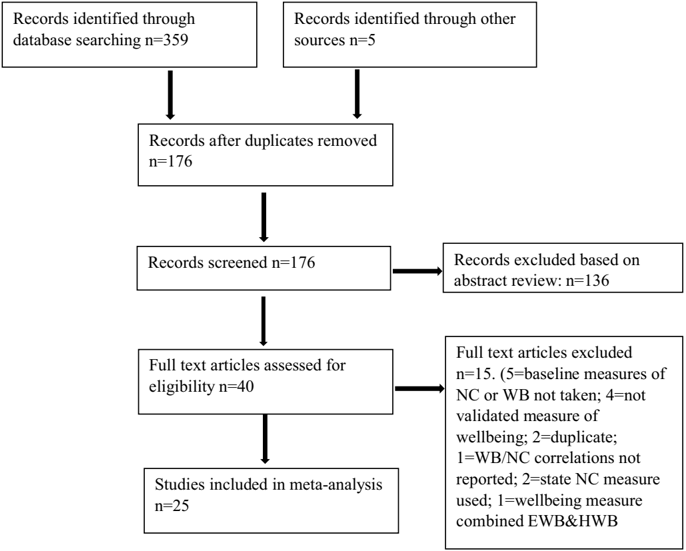
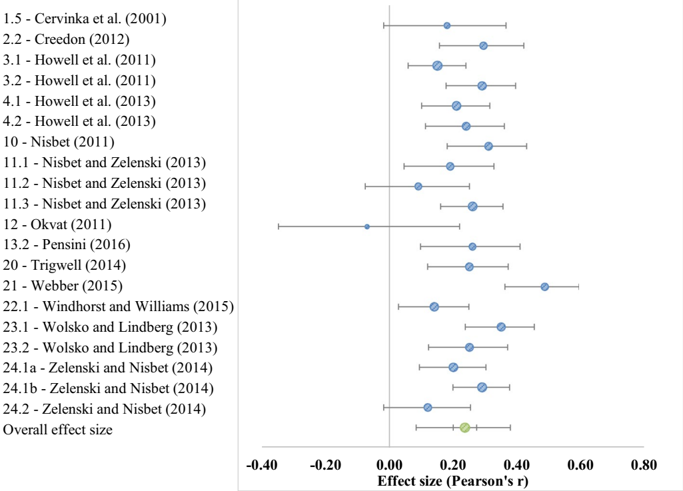
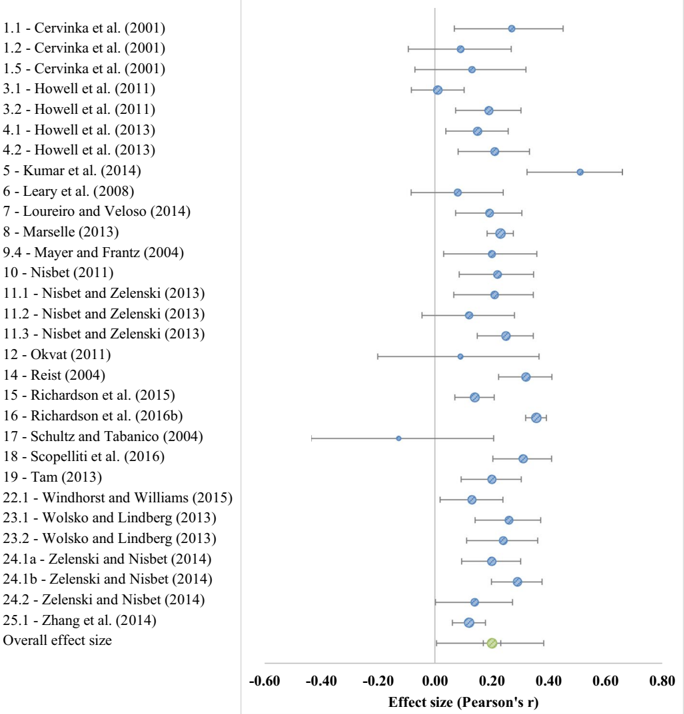
Nature connectedness relates to an individual’s subjective sense of their relationship with the natural world. A recent meta-analysis has found that people who are more connected to nature also tend to have higher levels of self-reported hedonic well-being; however, no reviews have focussed on nature connection and eudaimonic well-being. This meta-analysis was undertaken to explore the relationship of nature connection with eudaimonic well-being and to test the hypothesis that this relationship is stronger than that of nature connection and hedonic well-being. From 20 samples (n = 4758), a small significant effect size was found for the relationship of nature connection and eudaimonic well-being (r = 0.24); there was no significant difference between this and the effect size (from 30 samples n = 11,638) for hedonic well-being (r = 0.20). Of the eudaimonic well-being subscales, personal growth had a moderate effect size which was significantly larger than the effect sizes for autonomy, purpose in life/meaning, self-acceptance, positive relations with others and environmental mastery, but not vitality. Thus, individuals who are more connected to nature tend to have greater eudaimonic well-being, and in particular have higher levels of self-reported personal growth.
Overview
The claims and statistics of this paper haven’t been checked yet.
Free: it reads the open-access text and checks the first 5 claims that cite a source we can check. Create a free account to check every claim.
Integrity signals
Registry
Cites
Statistics
Figures
Verification
Claims the paper makes
The claims and statistics of this paper haven’t been checked yet.
Free: it reads the open-access text and checks the first 5 claims that cite a source we can check. Create a free account to check every claim.
Self-check
Percentages, sums and reported differences re-computed from the paper’s own numbers.
The self-check needs the paper’s full text.
Citations
Cites
Bias in meta-analysis detected by a simple, graphical test
Egger, M., Smith, G. D., Schneider, M., & Minder, C. (1997) · BMJ · doi:10.1136/bmj.315.7109.629 · Cited by 56,722 · cited 1×
“This was explored further using two more tests for publication bias: the Begg test (Begg and Mazumdar 1994) and the Egger test (Egger et al. 1997).”
MethodRyan, R. M., & Deci, E. L. (2000) · American Psychologist · doi:10.1037//0003-066x.55.1.68 · Cited by 54,599 · cited 1×
“As described in Ryan and Deci’s self-determination theory, three basic psychological needs—autonomy, competence and relatedness—are considered essential for psychological growth, integrity and well-being (Ryan and Deci 2000).”
Development and validation of brief measures of positive and negative affect: The PANAS scales.
Watson, D., Clark, L. A., & Tellegen, A. (1988) · Journal of Personality and Social Psychology · doi:10.1037/0022-3514.54.6.1063 · Cited by 32,433
The satisfaction with life scale
Diener, E., Emmons, R. A., Larsen, R. J., & Griffin, S. (1985) · Journal of Personality Assessment · doi:10.1207/s15327752jpa4901_13 · Cited by 31,768
Operating characteristics of a rank correlation test for publication bias
Begg, C. B., & Mazumdar, M. (1994) · Biometrics · doi:10.2307/2533446 · Cited by 16,955 · cited 1×
“This was explored further using two more tests for publication bias: the Begg test (Begg and Mazumdar 1994) and the Egger test (Egger et al.”
MethodHappiness is everything, or is it? Explorations on the meaning of psychological well-being.
Ryff, C. D. (1989) · Journal of Personality and Social Psychology · doi:10.1037/0022-3514.57.6.1069 · Cited by 14,847 · cited 4×
“EWB is often measured with Ryff’s scale of psychological well-being (Ryff 1989), which has six subscales: personal growth relates to being open to new ideas and experiences, and realizing one’s full potential; purpose in life links to the presence of goals in life, and feelings of meaningfulness;…”
BackgroundMethodInfluentialOn Happiness and Human Potentials: A Review of Research on Hedonic and Eudaimonic Well-Being
Ryan, R. M., & Deci, E. L. (2001) · Annual Review of Psychology · doi:10.1146/annurev.psych.52.1.141 · Cited by 11,567 · cited 4×
“(2014) included vitality as a hedonic construct, in this review, vitality was classed as a eudaimonic aspect of well-being because it is often conceptualised as such in the literature (e.g. Ryan and Deci 2001; Wolsko and Lindberg 2013; Zelenski and Nisbet 2014).”
BackgroundInfluentialCohen, J. (1992) · Psychological Bulletin · doi:10.1037//0033-2909.112.1.155 · Cited by 8,771
The restorative benefits of nature: toward an integrative framework
Kaplan, S. (1995) · Journal of Environmental Psychology · doi:10.1016/0272-4944(95)90001-2 · Cited by 6,923 · cited 2×
“…and psychological stress responses result from exposure to nature and thus results in improved well-being, and attention restoration theory (ART; Kaplan 1995) predicts that exposure to nature helps reduce attentional fatigue thus leading to improved cognitive functioning and positive affect.”
BackgroundStress recovery during exposure to natural and urban environments
Ulrich, R. S., Simons, R. F., Losito, B. D., Fiorito, E., Miles, M. A., & Zelson, M. (1991) · Journal of Environmental Psychology · doi:10.1016/s0272-4944(05)80184-7 · Cited by 5,990 · cited 1×
“For example the biophilia hypothesis (Wilson 1984) suggests that people have an innate need to affiliate with nature, and that satisfaction of this need results in well-being benefits such as improved positive affect; stress reduction theory (SRT; Ulrich et al. 1991) predicts that decreased physiological and psycholog…”
Background
Research works printed but not linked: 5
- Bullinger, M., & Kirchberger, I. (1989). SF-36 Fragebogen zum gesundheitszustand [SF-36 health-survey]. Göttingen: Hogrefe.
- Creedon, M. A. (2012). Connectedness to nature and its relationship to meaning in life. Unpublished doc- toral thesis, Massachusetts School of Professional Psychology, MA, USA.
- Kumar, R., Lal, R., Bansal, Y., & Sethi, K. V. K. (2014). Relationship between connectedness to nature and subjective well-being. Indian Journal of Psychological Science, 4, 59-63.
- Reist, D. M. (2004). Materialism vs. an ecological identity: Towards an integrative framework for a psy- chology of sustainable living. Unpublished doctoral thesis, University of Toronto, Toronto, ON.
- Steyer, R., Schwenkmezger, P., Notz, P., & Eid, M. (1997). Der mehrdimensionale befindlichkeitsfragebo- gen (MDBF) [The multidimensional comfort questionnaire (MDBF)]. Göttingen: Hogrefe.
Cited by
Martin, L., White, M. P., Hunt, A., Richardson, M., Pahl, S., & Burt, J. (2020) · Journal of Environmental Psychology · doi:10.1016/j.jenvp.2020.101389 · Cited by 928
“Recent meta-analyses indicate that higher levels of nature connectedness (broadly defined) are positively associated with both higher levels of evaluative and eudaimonic wellbeing (Capaldi et al., 2014; Pritchard et al., 2019) and also more pro-environmental behaviours (Mackay & Schmitt, 2019; Whitburn, Linklater, & A…”
BackgroundSelf-citationChawla, L. (2020) · People and Nature · doi:10.1002/pan3.10128 · Cited by 683
Blue space, health and well-being: A narrative overview and synthesis of potential benefits
White, M. P., Elliott, L. R., Gascon, M., Roberts, B., & Fleming, L. E. (2020) · Environmental Research · doi:10.1016/j.envres.2020.110169 · Cited by 579
Lawrance, E. L., Thompson, R., Newberry Le Vay, J., Page, L., & Jennings, N. (2022) · International Review of Psychiatry · doi:10.1080/09540261.2022.2128725 · Cited by 500
“People with a stronger connection to nature are more satisfied with their lives, have more positive emotions and higher vitality (221,310,311).”
BackgroundPerceived social impacts of tourism and quality-of-life: a new conceptual model
Ramkissoon, H. (2023) · Journal of Sustainable Tourism · doi:10.1080/09669582.2020.1858091 · Cited by 456
“Scholars have evidenced that engagement in physical activities in nature may help reduce anxiety and distress promoting one’s wellbeing (Junot et al., 2018; Pritchard et al., 2020) which is an importantly sought outcome in the current pandemic context (Van Bavel et al.”
BackgroundNature-based outdoor activities for mental and physical health: Systematic review and meta-analysis
Coventry, P. A., Brown, J. E., Pervin, J., Brabyn, S., Pateman, R., Breedvelt, J., Gilbody, S., Stancliffe, R., McEachan, R., & White, P. L. (2021) · SSM - Population Health · doi:10.1016/j.ssmph.2021.100934 · Cited by 453
Kotera, Y., Richardson, M., & Sheffield, D. (2022) · International Journal of Mental Health and Addiction · doi:10.1007/s11469-020-00363-4 · Cited by 313
Self-citationHuman–nature connectedness as a pathway to sustainability: A global meta‐analysis
Barragan‐Jason, G., de Mazancourt, C., Parmesan, C., Singer, M. C., & Loreau, M. (2022) · Conservation Letters · doi:10.1111/conl.12852 · Cited by 286
Poortinga, W., Bird, N., Hallingberg, B., Phillips, R., & Williams, D. (2021) · Landscape and Urban Planning · doi:10.1016/j.landurbplan.2021.104092 · Cited by 286
Richardson, M., Passmore, H., Barbett, L., Lumber, R., Thomas, R., & Hunt, A. (2020) · People and Nature · doi:10.1002/pan3.10117 · Cited by 250
Self-citationA Measure of Nature Connectedness for Children and Adults: Validation, Performance, and Insights
Richardson, M., Hunt, A., Hinds, J., Bragg, R., Fido, D., Petronzi, D., Barbett, L., Clitherow, T., & White, M. (2019) · Sustainability · doi:10.3390/su11123250 · Cited by 247
“A growing body of evidence suggests that nature connectedness has benefits to mental well-being (for reviews see [5,6]) and can also help deliver pro-environmental attitudes and behaviors [7–9].”
BackgroundSelf-citationBarragan-Jason, G., Loreau, M., de Mazancourt, C., Singer, M. C., & Parmesan, C. (2023) · Biological Conservation · doi:10.1016/j.biocon.2022.109842 · Cited by 223
Astell-Burt, T., Hartig, T., Putra, I. G. N. E., Walsan, R., Dendup, T., & Feng, X. (2022) · Science of The Total Environment · doi:10.1016/j.scitotenv.2022.157521 · Cited by 212
Moments, not minutes: The nature-wellbeing relationship
Richardson, M., Passmore, H.-A., Lumber, R., Thomas, R., & Hunt, A. (2021) · International Journal of Wellbeing · doi:10.5502/ijw.v11i1.1267 · Cited by 205
“natural environment plays in our mental health and wellbeing (reviews by Bratman et al., 2019; Capaldi et al., 2014, 2015; Pritchard et al., 2019).”
BackgroundResultInfluentialSelf-citationVirtual reality relaxation for the general population: a systematic review
Riches, S., Azevedo, L., Bird, L., Pisani, S., & Valmaggia, L. (2021) · Social Psychiatry and Psychiatric Epidemiology · doi:10.1007/s00127-021-02110-z · Cited by 196
“This is consistent with previous research that indicates that pleasant and immersive virtual environments support and promote relaxation [41], stress restoration [42], and positive mood [43].”
ResultApplying the pathways to nature connectedness at a societal scale: a leverage points perspective
Richardson, M., Dobson, J., Abson, D. J., Lumber, R., Hunt, A., Young, R., & Moorhouse, B. (2020) · Ecosystems and People · doi:10.1080/26395916.2020.1844296 · Cited by 185
“A recent systematic review shows a relationship between nature connect-edness and both hedonic and eudemonic wellbeing (Pritchard et al. 2019), with empirical work suggesting a causal link to mental wellbeing (McEwan et al. 2019).”
Self-citationCan positive and self-transcendent emotions promote pro-environmental behavior?
Zelenski, J. M., & Desrochers, J. E. (2021) · Current Opinion in Psychology · doi:10.1016/j.copsyc.2021.02.009 · Cited by 182
The affective benefits of nature exposure
Bratman, G. N., Olvera‐Alvarez, H. A., & Gross, J. J. (2021) · Social and Personality Psychology Compass · doi:10.1111/spc3.12630 · Cited by 177
Why garden? – Attitudes and the perceived health benefits of home gardening
Chalmin-Pui, L. S., Griffiths, A., Roe, J., Heaton, T., & Cameron, R. (2021) · Cities · doi:10.1016/j.cities.2021.103118 · Cited by 171
Chan, S. H. M., Qiu, L., Esposito, G., Mai, K. P., Tam, K.-P., & Cui, J. (2023) · Virtual Reality · doi:10.1007/s10055-021-00604-4 · Cited by 164
“2014), eudaimonic well-being (Pritchard et al. 2020), and pro-environmental attitudes (Davis et al.”
BackgroundKettner, H., Gandy, S., Haijen, E. C. H. M., & Carhart-Harris, R. L. (2019) · International Journal of Environmental Research and Public Health · doi:10.3390/ijerph16245147 · Cited by 157
“Specifically, nature relatedness has been found to be associated with lower levels of anxiety [57,60], a greater perceived meaning in life [26,55], higher vitality [61], higher psychological functioning [62], greater happiness and positive affect [55,57,63].”
BackgroundTowards a greater global understanding of wellbeing: A proposal for a more inclusive measure
Lambert, L., Lomas, T., van de Weijer, M. P., Passmore, H. A., Joshanloo, M., Harter, J., Ishikawa, Y., Lai, A., Kitagawa, T., Chen, D., et al. (2020) · International Journal of Wellbeing · doi:10.5502/ijw.v10i2.1037 · Cited by 156
Tourist Wellbeing: Re-Thinking Hedonic and Eudaimonic Dimensions
Filep, S., Moyle, B., & Skavronskaya, L. (2022) · Journal of Hospitality & Tourism Research · doi:10.1177/10963480221087964 · Cited by 181
Improving Nature Connectedness in Adults: A Meta-Analysis, Review and Agenda
Sheffield, D., Butler, C. W., & Richardson, M. (2022) · Sustainability · doi:10.3390/su141912494 · Cited by 183
Self-citationFactors Associated with Teacher Wellbeing: A Meta-Analysis
Zhou, S., Slemp, G. R., & Vella‐Brodrick, D. (2024) · Educational Psychology Review · doi:10.1007/s10648-024-09886-x · Cited by 305
“Although subjective vitality has been considered as a facet of eudaimonic wellbeing (Pritchard et al., 2020), other researchers have argued for its conceptual overlap with high arousal positive emotions in hedonic wellbeing, such as being active and enthusiastic (Capaldi et al., 2014).”
Reese, G., Stahlberg, J., & Menzel, C. (2022) · Virtual Reality · doi:10.1007/s10055-022-00631-9 · Cited by 161
Nghiem, T. P. L., Wong, K. L., Jeevanandam, L., Chang, C., Tan, C. L. Y., Goh, Y., & Carrasco, L. R. (2021) · Urban forestry & urban greening · doi:10.1016/j.ufug.2021.127030 · Cited by 142
Liu, Y., Anne, C., Fielding, K. S., Murray, Z., & Roiko, A. H. (2022) · Landscape and Urban Planning · doi:10.1016/j.landurbplan.2022.104550 · Cited by 159
Actively Noticing Nature (Not Just Time in Nature) Helps Promote Nature Connectedness
Richardson, M., Hamlin, I., Butler, C. W., Thomas, R., & Hunt, A. (2021) · Ecopsychology · doi:10.1089/eco.2021.0023 · Cited by 142
“Recent research has shown that a close relationship with nature helps explain pro-nature conservation actions that support biodiversity (Richardson et al., 2020) as well as pro-environmental behaviors associated with addressing climate change, with causal links being established (Mackay & Schmitt,…”
InfluentialSelf-citationPardini, S., Gabrielli, S., Dianti, M., Novara, C., Zucco, G. M., Mich, O., & Forti, S. (2022) · International Journal of Environmental Research and Public Health · doi:10.3390/ijerph19127237 · Cited by 148
The impacts of nature connectedness on children's well-being: Systematic literature review
Arola, T., Aulake, M., Ott, A., Lindholm, M., Kouvonen, P., Virtanen, P., & Paloniemi, R. (2022) · Journal of Environmental Psychology · doi:10.1016/j.jenvp.2022.101913 · Cited by 144
Richardson, M., Hamlin, I., Elliott, L. R., & White, M. P. (2022) · AMBIO · doi:10.1007/s13280-022-01744-w · Cited by 132
“The data support that the concern that people living urban lives are surrounded by fewer natural habitats which reduces the variety of wildlife and opportunities to experience nature (Pyle 2003; Miller 2005; Soga and Gaston 2016).”
BackgroundSelf-citationSamus, A., Freeman, C., van Heezik, Y., Krumme, K., & Dickinson, K. J. M. (2022) · Journal of Environmental Psychology · doi:10.1016/j.jenvp.2022.101850 · Cited by 128
Pocock, M. J. O., Hamlin, I., Christelow, J., Passmore, H., & Richardson, M. (2023) · People and Nature · doi:10.1002/pan3.10432 · Cited by 120
Self-citationSensing Water: Uncovering Health and Well-Being in the Sea and Surf
Britton, E., & Foley, R. (2020) · Journal of Sport and Social Issues · doi:10.1177/0193723520928597 · Cited by 113
“The themes around well-being that emerged in this study largely focus on emotional well-being, how people feel in place, as well as a sense of personal growth and meaningfulness (Pritchard et al., 2019).”
BackgroundBeery, T. H., Olsson, M. R., & Vitestam, M. (2021) · Journal of Outdoor Recreation and Tourism · doi:10.1016/j.jort.2021.100457 · Cited by 115
Gong, C., Yang, R., & Li, S. (2024) · Landscape and Urban Planning · doi:10.1016/j.landurbplan.2024.105020 · Cited by 89
Liu, H., Nong, H., Ren, H., & Liu, K. (2022) · Landscape and Urban Planning · doi:10.1016/j.landurbplan.2022.104397 · Cited by 106
Nature Connection in Early Childhood: A Quantitative Cross-Sectional Study
Barrable, A., & Booth, D. B. (2020) · Sustainability · doi:10.3390/su12010375 · Cited by 121
“Much research has been undertaken in relation to nature connection, primarily in adults, identifying associations with wellbeing [6,33] and environmental sustainability [4,12,34].”
BackgroundRonen, T., & Kerret, D. (2020) · International Journal of Environmental Research and Public Health · doi:10.3390/ijerph17196968 · Cited by 124
Biodiversity and human health: A scoping review and examples of underrepresented linkages
Robinson, J. M., Breed, A. C., Camargo, A., Redvers, N., & Breed, M. F. (2024) · Environmental Research · doi:10.1016/j.envres.2024.118115 · Cited by 108
Connection to nature and time spent in gardens predicts social cohesion
Oh, R. R. Y., Zhang, Y., Nghiem, L. T. P., Chang, C., Tan, C. L. Y., Quazi, S. A., Shanahan, D. F., Lin, B. B., Gaston, K. J., Fuller, R. A., et al. (2022) · Urban forestry & urban greening · doi:10.1016/j.ufug.2022.127655 · Cited by 95
Eco-Anxiety: A Cascade of Fundamental Existential Anxieties
Passmore, H., Lutz, P. K., & Howell, A. J. (2022) · Journal of Constructivist Psychology · doi:10.1080/10720537.2022.2068706 · Cited by 125
Teixeira, A. S., Gabriel, R., Martinho, J., Santos, M., Faria, A. M., Oliveira, I., & Moreira, H. (2022) · American Journal of Health Promotion · doi:10.1177/08901171221119089 · Cited by 89
Ma, J., Lin, P., & Williams, J. M. (2023) · Current Psychology · doi:10.1007/s12144-023-05112-z · Cited by 106
“…corpus, which several reviews have addressed (e.g., Bowler et al., 2010; Capaldi et al., 2015; Gascon et al., 2015; Hartig et al., 2014; Health Council Netherlands, 2004; Ohly et al., 2016; Pritchard et al., 2020; Richardson et al., 2017; van den Berg et al., 2015; World Health Organization, 2016).”
McEwan, K., Ferguson, F. J., Richardson, M., & Cameron, R. W. F. (2019) · Landscape and Urban Planning · doi:10.1016/j.landurbplan.2019.103687 · Cited by 90
Self-citationThiermann, U. B., & Sheate, W. R. (2020) · Ecological Economics · doi:10.1016/j.ecolecon.2020.106668 · Cited by 96
Nature connectedness boosts the bright side of emotion regulation, which in turn reduces stress
Bakir-Demir, T., Berument, S. K., & Akkaya, S. (2021) · Journal of Environmental Psychology · doi:10.1016/j.jenvp.2021.101642 · Cited by 86
Factors associated with nature connectedness in school-aged children
Price, E. C., Maguire, S., Firth, C., Lumber, R., Richardson, M., & Young, R. P. (2022) · Current Research in Ecological and Social Psychology · doi:10.1016/j.cresp.2022.100037 · Cited by 106
Self-citationEco-anxiety in daily life: Relationships with well-being and pro-environmental behavior
Lutz, P. K., Zelenski, J. M., & Newman, D. B. (2023) · Current Research in Ecological and Social Psychology · doi:10.1016/j.cresp.2023.100110 · Cited by 107
Moving beyond disciplinary silos towards a transdisciplinary model of wellbeing: an invited review
Mead, J., Fisher, Z., & Kemp, A. H. (2021) · Frontiers in Psychology · doi:10.3389/fpsyg.2021.642093 · Cited by 71
“Connection with nature contributes a small to medium effect to hedonic (r = 0.20) and eudaimonic (r = 0.24) wellbeing (Pritchard et al., 2019), and may reflect another fundamental psychological need (Richardson et al., 2020a).”
BackgroundInfluentialWhy does nature enhance psychological well-being?A Self-Determination account
Yang, Y., Cai, H., Yang, Z., Zhao, X., Li, M., Han, R., & Chen, S. X. (2022) · Journal of Environmental Psychology · doi:10.1016/j.jenvp.2022.101872 · Cited by 81
“For example, natural environments may also offer more fresh air and promote physical activity (Frumkin et al., 2017) and strengthen nature connectedness, thereby promoting psychological well-being (Capaldi, Dopko, & Zelenski, 2014; Pritchard, Richardson, Sheffield, & McEwan, 2020).”
The magic of the mundane: The vulnerable web of connections between urban nature and wellbeing
Dobson, J., Birch, J., Brindley, P., Henneberry, J., McEwan, K., Mears, M., Richardson, M., & Jørgensen, A. (2020) · Cities · doi:10.1016/j.cities.2020.102989 · Cited by 89
Self-citationStrzelecka, M., Prince, S., & Boley, B. B. (2021) · Journal of Sustainable Tourism · doi:10.1080/09669582.2021.1995399 · Cited by 90
“It promotes the view of nature connect-edness as a core relational value that covers how we think about nature, our affective relationship with nature, and the extent to which we see ourselves as part of nature (Pritchard et al., 2020; Richardson et al., 2020).”
Gandy, S., Forstmann, M., Carhart-Harris, R. L., Timmermann, C., Luke, D., & Watts, R. (2020) · Health Psychology Open · doi:10.1177/2055102920978123 · Cited by 63
“Both nature relatedness and nature contact appear to have similar and potentially synergistic effects on reducing negative affect (Bratman et al., 2015a; Capaldi et al., 2014; Hamann and Ivtzan, 2016; Lopes et al., 2020; Mayer et al., 2009; McMahan and Estes, 2015; McMahan et al., 2018; Neill et al., 2019; Nisbet et a…”
BackgroundThe value of eudaimonia for understanding relationships among values and pro-environmental behavior
Shin, S., van Riper, C. J., Stedman, R. C., & Suski, C. D. (2022) · Journal of Environmental Psychology · doi:10.1016/j.jenvp.2022.101778 · Cited by 76
The importance of Forest School and the pathways to nature connection
Cudworth, D., & Lumber, R. (2021) · Journal of Outdoor and Environmental Education · doi:10.1007/s42322-021-00074-x · Cited by 84
Meuwese, D., Dijkstra, K., Maas, J., & Koole, S. L. (2021) · Journal of Environmental Psychology · doi:10.1016/j.jenvp.2021.101594 · Cited by 91
Menhas, R., Yang, L., Saqib, Z. A., Younas, M. S., & Saeed, M. M. (2024) · Frontiers in Public Health · doi:10.3389/fpubh.2024.1228271 · Cited by 80
Swami, V., Barron, D. S., Todd, J., Horne, G., & Furnham, A. F. (2020) · Body Image · doi:10.1016/j.bodyim.2020.06.004 · Cited by 71
The transformative virtual experience paradigm: the case of Airbnb’s online experience
Wong, I. A., Lu, M. V., Lin, S. K., & Lin, Z. (2022) · International Journal of Contemporary Hospitality Management · doi:10.1108/ijchm-12-2021-1554 · Cited by 68
Lengieza, M. L., Aviste, R., & Richardson, M. (2023) · Sustainability · doi:10.3390/su151612175 · Cited by 82
Self-citationMusitu-Ferrer, D., León-Moreno, C., Callejas-Jerónimo, J. E., Ibáñez, M. E., & Ochoa, G. M. (2019) · International Journal of Environmental Research and Public Health · doi:10.3390/ijerph16142461 · Cited by 74
“numerous studies have described the relationships between empathy and connectedness with nature environment and health [157], well-being [158,159] and happiness [160].”
BackgroundResilience: Safety in the Aftermath of Traumatic Stressor Experiences
Matheson, K., Asokumar, A., & Anisman, H. (2020) · Frontiers in Behavioral Neuroscience · doi:10.3389/fnbeh.2020.596919 · Cited by 86
“Moreover, connection to nature was associated with self-reported personal growth (Pritchard et al., 2020).”
BackgroundSamus, A., Freeman, C., Dickinson, K. J. M., & van Heezik, Y. (2022) · Urban forestry & urban greening · doi:10.1016/j.ufug.2022.127519 · Cited by 65
Nature engagement for human and nature’s well-being during the Corona pandemic
Richardson, M., & Hamlin, I. (2021) · Journal of Public Mental Health · doi:10.1108/jpmh-02-2021-0016 · Cited by 56
Self-citationOverbury, K., Conroy, B. W., & Marks, E. M. (2023) · Journal of Environmental Psychology · doi:10.1016/j.jenvp.2023.102073 · Cited by 77
Bacevičienė, M., & Jankauskienė, R. (2022) · International Journal of Environmental Research and Public Health · doi:10.3390/ijerph19042098 · Cited by 70
“Recent meta-analysis concluded that individuals who are more connected to nature tend to have greater eudaimonic well-being and have higher levels of self-reported personal grow [38].”
BackgroundEvaluating Dual Ecological and Well-Being Benefits from an Urban Restoration Project
de Bell, S., Graham, H. M., & White, P. C. L. (2020) · Sustainability · doi:10.3390/su12020695 · Cited by 58
“Neighborhood green space has been positively associated with health for men of all ages, with benefits seen only for older women [59,60], although a recent meta-analysis of nature connection and wellbeing found no effect of gender or age [61].”
BackgroundPro-Environmental Behavior, Connectedness to Nature, and Wellbeing Dimensions among Granada Students
Ibáñez‐Rueda, N., Guillén-Royo, M., & Guardiola, J. (2020) · Sustainability · doi:10.3390/su12219171 · Cited by 70
“Connectedness to nature appears to be a key factor contributing to positive psychological functioning [21].”
BackgroundBiophilic Design Patterns for Primary Schools
Ghaziani, R., Lemon, M., & Atmodiwirjo, P. (2021) · Sustainability · doi:10.3390/su132112207 · Cited by 74
“The important role that the natural environment plays in maintaining and enhancing mental health and wellbeing has been well established [6,7].”
BackgroundMeasuring Actions for Nature—Development and Validation of a Pro-Nature Conservation Behaviour Scale
Barbett, L., Stupple, E. J. N., Sweet, M. J., Schofield, M., & Richardson, M. (2020) · Sustainability · doi:10.3390/su12124885 · Cited by 59
Self-citationEnsuring that nature-based solutions for climate mitigation address multiple global challenges
Donatti, C. I., Andrade, Á., Cohen-Shacham, E., Fedele, G., Hou-Jones, X., & Robyn, B. (2022) · One Earth · doi:10.1016/j.oneear.2022.04.010 · Cited by 59
Bowers, E. P., Larson, L. R., & Parry, B. J. (2021) · Frontiers in Psychology · doi:10.3389/fpsyg.2021.688574 · Cited by 76
“, pro-environmental and social justice behaviors) may be even more pronounced (Clayton andOpotow, 2003;Mayer et al., 2009; Nisbet et al., 2011; Cervinka et al., 2012; Zelenski and Nisbet, 2014; Capaldi et al., 2015; Pfattheicher et al., 2016; Bihari and Jaiswal, 2020; Martin et al., 2020; Pritchard et al., 2020).”
BackgroundIrvine, K. N., Fisher, J. C., Bentley, P. R., Nawrath, M., Dallimer, M., Austen, G. E., Fish, R. D., & Davies, Z. G. (2022) · Journal of Environmental Psychology · doi:10.1016/j.jenvp.2022.101921 · Cited by 55
Mead, J. P., Fisher, Z., Tree, J. J., Wong, P. T. P., & Kemp, A. H. (2021) · Frontiers in Psychology · doi:10.3389/fpsyg.2021.647951 · Cited by 50
“20) (Pritchard et al., 2020) is associated with small to medium effect sizes.”
BackgroundInfluentialKeenan, R., Lumber, R., Richardson, M., & Sheffield, D. (2021) · Journal of Public Mental Health · doi:10.1108/jpmh-02-2021-0029 · Cited by 56
Self-citationThe Potential for Outdoor Nature-Based Interventions in the Treatment and Prevention of Depression
Owens, M., & Bunce, H. L. I. (2022) · Frontiers in Psychology · doi:10.3389/fpsyg.2022.740210 · Cited by 56
“, 2018), improving wellbeing (Martin et al., 2020; Pritchard et al., 2020; Pirchio et al., 2021) and improved sleep (Shin et al.”
BackgroundAyahuasca: A review of historical, pharmacological, and therapeutic aspects
Ruffell, S., Crosland‐Wood, M., Palmer, R., Netzband, N., Tsang, W., Weiss, B., Gandy, S., Cowley‐Court, T., Halman, A., McHerron, D., et al. (2023) · Psychiatry and Clinical Neurosciences Reports · doi:10.1002/pcn5.146 · Cited by 75
Gallegos-Riofrío, C. A., Arab, H., Carrasco-Torrontegui, A., & Gould, R. K. (2022) · Current Research in Environmental Sustainability · doi:10.1016/j.crsust.2022.100148 · Cited by 55
Estévez, P. J., Yáñez‐Araque, B., Ruiz‐Palomino, P., & Gutiérrez-Broncano, S. (2023) · Technological Forecasting and Social Change · doi:10.1016/j.techfore.2023.122410 · Cited by 57
Ward, C., Palmer, A. K., Brockett, B., Costanza, R., Hatfield, J. H., Kubiszewski, I., Langford, P., Pickett, K. E., & Willis, C. (2023) · People and Nature · doi:10.1002/pan3.10507 · Cited by 57
“A substantial body of research suggests that spending time in natural environments, described in this paper as greenspaces, is associated with physical and mental well-being benefits (Bowler et al., 2010; Collins et al., 2020; Douglas, 2012; Pritchard et al., 2020).”
BackgroundChan, S. H. M., Qiu, L., & Xie, T. (2023) · Computers in Human Behavior · doi:10.1016/j.chb.2023.107926 · Cited by 62
Stubbington, R., Acreman, M., Acuña, V., Boon, P. J., Boulton, A. J., England, J., Gilvear, D., Sykes, T., & Wood, P. J. (2020) · People and Nature · doi:10.1002/pan3.10113 · Cited by 51
“In Western cultures, the psychological (and likely aesthetic) benefits of experiencing and interacting with an ecosystem can promote a connection to a physical environment (i.e. a sense of place; Russell et al., 2013) and are valued (Pritchard, Richardson, Sheffield, & McEwan, 2019).”
BackgroundPsychedelics and potential benefits in “healthy normals”: A review of the literature
Gandy, S. (2019) · Journal of Psychedelic Studies · doi:10.1556/2054.2019.029 · Cited by 59
Nature relatedness: A protective factor for snake and spider fears and phobias
Zsido, A. N., Coelho, C. M., & Polák, J. (2022) · People and Nature · doi:10.1002/pan3.10303 · Cited by 48
Liu, Y., Yu, C., & Damberg, S. (2021) · International Journal of Sports Marketing and Sponsorship · doi:10.1108/ijsms-12-2020-0232 · Cited by 54
Thompson, R., Fisher, H. L., Dewa, L. H., Hussain, T., Kabba, Z., & Toledano, M. B. (2021) · Child and Adolescent Mental Health · doi:10.1111/camh.12520 · Cited by 69
Hakoköngäs, E. J., & Puhakka, R. (2021) · Leisure Sciences · doi:10.1080/01490400.2021.1877584 · Cited by 73
Disconnected: What Can We Learn from Individuals with Very Low Nature Connection?
Barrable, A., & Booth, D. B. (2022) · International Journal of Environmental Research and Public Health · doi:10.3390/ijerph19138021 · Cited by 59
“The former finding agrees with previous literature [11,12] and the measures are comparable in size.”
BackgroundResultBorkel, L. F., Rojas‐Hernández, J., Henríquez‐Hernández, L. A., Santana, Á., & Hernández, D. J. Q. (2023) · Expert Review of Clinical Pharmacology · doi:10.1080/17512433.2023.2295997 · Cited by 57
“The latter should include pre-session connection with nature because nature relatedness predicts higher wellbeing and personal-growth [79].”
BackgroundNature guided imagery: An intervention to increase connectedness to nature
Coughlan, A., Ross, E., Nikles, D., Cesare, E. D., Tran, C., & Pensini, P. (2022) · Journal of Environmental Psychology · doi:10.1016/j.jenvp.2022.101759 · Cited by 52
Barrable, A., Booth, D. B., Adams, D., & Beauchamp, G. (2021) · International Journal of Environmental Research and Public Health · doi:10.3390/ijerph18094785 · Cited by 52
“The reasons behind these calls are usually centred around two core aspects of nature connection: its positive association with increased wellbeing [5,6]; and pro-environmental attitudes and behaviours [7–9].”
BackgroundTu’itahi, S., Watson, H., Egan, R., Parkes, M. W., & Hancock, T. (2021) · Global Health Promotion · doi:10.1177/17579759211062261 · Cited by 62
“world continue to inspire spiritual wellbeing (40), spiritually related positive effect (41) and eudaimonic wellbeing (42).”
BackgroundRelationships between people and nature: Nature connectedness and relational environmental values
Lengieza, M. L., & Aviste, R. (2024) · Current Opinion in Psychology · doi:10.1016/j.copsyc.2024.101984 · Cited by 70
Alves, S. M., Gulwadi, G. B., & Nilsson, P. (2022) · Frontiers in Psychology · doi:10.3389/fpsyg.2021.793175 · Cited by 58
“Consequently, the significance of feeling connected with nature is important in enhancing psychological growth and involves more than just spending time in nature (Pritchard et al., 2020).”
BackgroundCitizen perceptions and values associated with ecosystem services from European grassland landscapes
Tindale, S. J., Vicario‐Modroño, V., Gallardo‐Cobos, R., Hunter, E., Miškolci, S., Newell‐Price, P., Sánchez‐Zamora, P., Sonnevelt, M., Ojo, M., McInnes, K. J., et al. (2023) · Land Use Policy · doi:10.1016/j.landusepol.2023.106574 · Cited by 50
“Recent studies have shown causal links between nature connectedness and mental wellbeing (Pritchard et al., 2020), as well as more pro-environmental behaviours (Richardson et al., 2020).”
BackgroundAşan, K., Alrawadıeh, Z., & Altınay, L. (2023) · Current Issues in Tourism · doi:10.1080/13683500.2023.2213881 · Cited by 48
“Eudaimonic tourist well-being of individuals with high CTN can also be positively a ff ected based on a ffi liation and competence in nature activities in the long term (Pritchard et al., 2020).”
BackgroundParental factors affecting children's nature connectedness
Wu, H., Ji, R., & Jin, H. (2023) · Journal of Environmental Psychology · doi:10.1016/j.jenvp.2023.101977 · Cited by 48
Thomson, E. E., & Roach, S. P. (2023) · Frontiers in Psychology · doi:10.3389/fpsyg.2023.1241400 · Cited by 39
“…most cases exhibited a positive association with mental health: across many studies, it has been associated with greater well-being, whether hedonic (Capaldi et al., 2014) or eudaimonic (Pritchard et al., 2020), and lower depression, anxiety, and stress (Richardson, 2019; Bakir-Demir et al., 2021).”
Background
Metadata
- Authors
- Pritchard, A., Richardson, M., Sheffield, D., & McEwan, K.
- Affiliations
- University of Derby (GB)
- Corresponding author
- Pritchard, Alison
- Venue
- Journal of Happiness Studies
- Published
- 2019-04-30
- Volume
- 21
- Issue
- 3
- Pages
- 1145-1167
- ISSN
- 1389-4978 (ISSN-L)
- 1573-7780
- OpenAlex
- W2942996956
- Cited by
- 702
- References
- 106
- Citations by year
- 2026: 106 · 2025: 138 · 2024: 122 · 2023: 108 · 2022: 103 · 2021: 77 · 2020: 39 · 2019: 8
- FWCI
- 8.76
- Type
- journal article
- Language
- en
- Open access
- hybrid
- doi.org
- Licence
- cc-by
- creativecommons.org/licenses/by/4.0 (tdm)
- Locations
- Journal of Happiness Studies (publishedVersion, cc-by)
- RePEc: Research Papers in Economics (submittedVersion)
- University of Derby Online Research Archive. (University of Derby) (submittedVersion)
- Topics
- Social Sciences › Psychology › Social Psychology › Psychological Well-being and Life Satisfaction
- Social Sciences › Urban Studies › Urban Green Space and Health
- Social Sciences › Business, Management and Accounting › Tourism, Leisure and Hospitality Management › Recreation, Leisure, Wilderness Management
- Keywords
- nature connection, eudaimonic well-being, hedonic well-being, personal growth, meaning in life, self-acceptance, environmental mastery, vitality, autonomy, positive relationships with others
About these checks
Registry, retraction, Cites and statistics results are computed, not judged, with one exception: a printed reference that no index lists is read once by a model before it counts as a citation error. Claims are extracted by a model and kept only when their quote appears verbatim in the text; each cited source is then checked, with a model’s help, for whether it says what the claim relies on. Those verdicts can be wrong — read the claim’s quote and the cited source before relying on one.
Statistics and arithmetic are recomputed, not judged.
Confidence bands are shown only for fields calibrated on our annotated test set. None is calibrated yet, so no band is shown.
What counts as a claim ›How we measure confidence ›How we check this ›
Are you an author, or do you see a problem with this page? Request a review
Data sources
Bibliographic data: Semantic Scholar, OpenAlex, Crossref.
Contains information from the Semantic Scholar Academic Graph Datasets, made available under the ODC Attribution License (ODC-BY 1.0).
Semantic Scholar’s data is described in: Kinney, R., et al. (2023). The Semantic Scholar Open Data Platform. arXiv:2301.10140.
