

The DOI matches its Crossref record; 45 of the 49 references it cites were found in a registry or an index, and 4 are not checked yet.
Social Intelligence and Academic Achievement as Predictors of Adolescent Popularity
Open accessAbstract
This study compared the effects of social intelligence and cognitive intelligence, as measured by academic achievement, on adolescent popularity in two school contexts. A distinction was made between sociometric popularity, a measure of acceptance, and perceived popularity, a measure of social dominance. Participants were 512, 14-15 year-old adolescents (56% girls, 44% boys) in vocational and college preparatory schools in Northwestern Europe. Perceived popularity was significantly related to social intelligence, but not to academic achievement, in both contexts. Sociometric popularity was predicted by an interaction between academic achievement and social intelligence, further qualified by school context. Whereas college bound students gained sociometric popularity by excelling both socially and academically, vocational students benefited from doing well either socially or academically, but not in combination. The implications of these findings were discussed.
Overview
The claims and statistics of this paper haven’t been checked yet.
Run the check — free, no account needed. It reads the open-access text and checks the sources it cites.
Integrity signals
Registry
Cites
Statistics
Figures
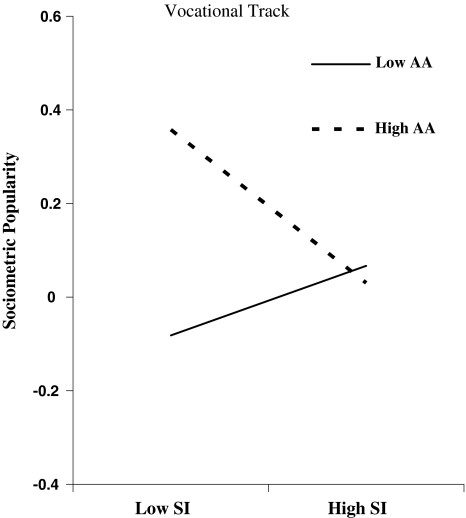
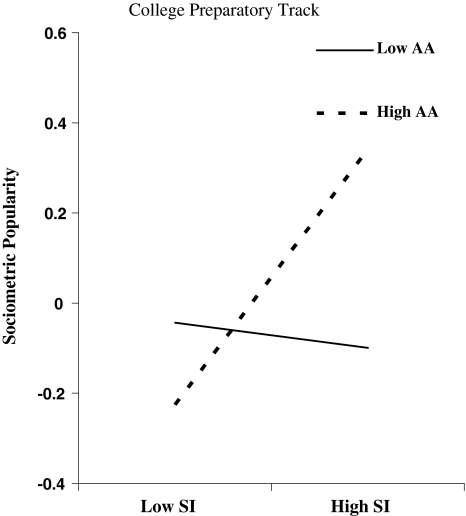
Verification
Claims the paper makes
The claims and statistics of this paper haven’t been checked yet.
Run the check — free, no account needed. It reads the open-access text and checks the sources it cites.
Claims other papers make about this one
Each is checked against this paper’s own text: does it say what the citing paper says it does?
The cited source doesn’t support the claim as written.
In the citing paper
“Therefore, it is only natural that a number of studies have consistently confirmed correlations between the social intelligence of children and their sociometric peer status (Lease, Kennedy, Axelrod, 2002; Meijs et al., 2010).”
From The The effects of cognitive, social, and emotional intelligence on children’s sociometric status in a new peer group (2023) · cites this paper as Meijs et al., 2010
Checked by a reasoning model — may be wrong.
Experimental — accuracy not yet measuredThe source backs part of the claim, not all of it — or backs it for a different population, condition or comparison.
In the citing paper
“according to some authors the effect of the latter on peer status depends on the norms of the group. Academic achievement leads to higher status only if it is prioritized in the classroom, but where other skills are prioritized, it may not lead to high social status (Meijs et al., 2010).”
From The The effects of cognitive, social, and emotional intelligence on children’s sociometric status in a new peer group (2023) · cites this paper as Meijs et al., 2010
Experimental — accuracy not yet measured
Self-check
Percentages, sums and reported differences re-computed from the paper’s own numbers.
The self-check needs the paper’s full text.
Citations
Cites
Multiple regression: testing and interpreting interactions
(1992) · Choice Reviews Online · doi:10.5860/choice.29-3352 · Cited by 36,647
A Handbook of Child Psychology
(1932) · Nature · doi:10.1038/130331a0 · Cited by 10,133
(1991) · Cited by 7,187
Peer Interactions, Relationships, and Groups
Rubin, K. H., Bukowski, W. M., & Parker, J. G. (2007) · Handbook of Child Psychology · doi:10.1002/9780470147658.chpsy0310 · Cited by 2,755
Social, emotional, and personality development
Eisenberg, N., & Damon, W. (1998) · Wiley eBooks · Cited by 1,903
Holmbeck, G. N. (2002) · Journal of Pediatric Psychology · doi:10.1093/jpepsy/27.1.87 · Cited by 1,866
Multiple Regression: Testing and Interpreting Interactions
Toothaker, L. E., Aiken, L. S., & West, S. G. (1994) · Journal of the Operational Research Society · doi:10.2307/2583960 · Cited by 1,741
Newcomb, A. F., Bukowski, W. M., & Pattee, L. (1993) · Psychological Bulletin · doi:10.1037/0033-2909.113.1.99 · Cited by 1,464
A biopsychosocial model of the development of chronic conduct problems in adolescence.
Dodge, K. A., & Pettit, G. S. (2003) · Developmental Psychology · doi:10.1037//0012-1649.39.2.349 · Cited by 1,297
Cillessen, A. H. N., & Mayeux, L. (2004) · Child Development · doi:10.1111/j.1467-8624.2004.00660.x · Cited by 1,013
Self-citationEmotional Intelligence and Social Interaction
Lopes, P. N., Brackett, M. A., Nezlek, J. B., Schütz, A., Sellin, I., & Salovey, P. (2004) · Personality and Social Psychology Bulletin · doi:10.1177/0146167204264762 · Cited by 916 · cited 2×
“For example, it is possible that social intelligence skills, such as the ability to accurately read a peer’s emotions and respond appropriately and empathically, are strongly related to liking and acceptance (cf. Lopes et al. 2004) but not to dominance.”
BackgroundFive-Factor Model of personality and Performance in Jobs Involving Interpersonal Interactions
Mount, M., Barrick, M., & Stewart, G. (1998) · Human Performance · doi:10.1207/s15327043hup1102&3_3 · Cited by 832
Five-Factor Model of personality and Performance in Jobs Involving Interpersonal Interactions
Mount, M. K., Barrick, M. R., & Stewart, G. L. (1998) · Human Performance · doi:10.1080/08959285.1998.9668029 · Cited by 829
Heterogeneity of popular boys: Antisocial and prosocial configurations.
Rodkin, P. C., Farmer, T. W., Pearl, R., & Acker, R. M. V. (2000) · Developmental Psychology · doi:10.1037//0012-1649.36.1.14 · Cited by 782
A Behavioral Analysis of Emerging Social Status in Boys' Groups
Coie, J. D., & Kupersmidt, J. B. (1983) · Child Development · doi:10.2307/1129803 · Cited by 739 · cited 2×
“Sociometrically popular students are prosocial and helpful to their peers (Coie and Kupersmidt 1983).”
BackgroundWentzel, K. R., & Caldwell, K. (1997) · Child Development · doi:10.1111/j.1467-8624.1997.tb01994.x · Cited by 729
Sociometric Popularity and Peer-Perceived Popularity: Two Distinct Dimensions of Peer Status
Parkhurst, J. T., & Hopmeyer, A. (1998) · The Journal of Early Adolescence · doi:10.1177/0272431698018002001 · Cited by 677
Peer Power: Preadolescent Culture and Identity
Brayfield, A. A., Adler, P. A., & Adler, P. (1999) · Contemporary Sociology A Journal of Reviews · doi:10.2307/2655303 · Cited by 668
Hawley, P. H. (2003) · Merrill-palmer Quarterly · doi:10.1353/mpq.2003.0013 · Cited by 642
Relations between Social Competence and Academic Achievement in Early Adolescence
Wentzel, K. R. (1991) · Child Development · doi:10.1111/j.1467-8624.1991.tb01589.x · Cited by 637
Children's perceptions of popular and unpopular peers: A multimethod assessment.
LaFontana, K. M., & Cillessen, A. H. N. (2002) · Developmental Psychology · doi:10.1037/0012-1649.38.5.635 · Cited by 616
Self-citationThe Cycle of Popularity: Interpersonal Relations Among Female Adolescents
Eder, D. J. (1985) · Sociology of Education · doi:10.2307/2112416 · Cited by 581
Understanding Popularity in the Peer System
Cillessen, A. H. N., & Rose, A. J. (2005) · Current Directions in Psychological Science · doi:10.1111/j.0963-7214.2005.00343.x · Cited by 561
Self-citationSocialization to Gender Roles: Popularity among Elementary School Boys and Girls
Adler, P. A., Kless, S. J., & Adler, P. (1992) · Sociology of Education · doi:10.2307/2112807 · Cited by 555
Journal of Youth and Adolescence
(2013) · Journal of Youth and Adolescence · doi:10.1007/10964.1573-6601 · Cited by 502
Social Skills Training with Children and Young People: Theory, Evidence and Practice
Spence, S. H. (2003) · Child and Adolescent Mental Health · doi:10.1111/1475-3588.00051 · Cited by 490
The Tromsø Social Intelligence Scale, a self‐report measure of social intelligence
Silvera, D. H., Martinussen, M., & Dahl, T. I. (2001) · Scandinavian Journal of Psychology · doi:10.1111/1467-9450.00242 · Cited by 431
Wentzel, K. R., & Caldwell, K. (1997) · Child Development · doi:10.2307/1132301 · Cited by 379
Children's Social Constructions of Popularity
Lease, A. M., Kennedy, C. A., & Axelrod, J. L. (2002) · Social Development · doi:10.1111/1467-9507.00188 · Cited by 354
Relations between Social Competence and Academic Achievement in Early Adolescence
Wentzel, K. R. (1991) · Child Development · doi:10.2307/1131152 · Cited by 354
A Social Information Processing Model of Social Competence in Children
Dodge, K. (2014) · Psychology Press eBooks · doi:10.4324/9781315802343-7 · Cited by 325
Laird, R. D., JORDAN, K. Y., Dodge, K. A., Pettit, G. S., & Bates, J. E. (2001) · Development and Psychopathology · doi:10.1017/s0954579401002085 · Cited by 323
Relationships as Developmental Contexts
(1999) · Psychology Press eBooks · doi:10.4324/9781410601902 · Cited by 240
Quantile regression methods for recursive structural equation models
Ma, L., & Koenker, R. W. (2005) · Journal of Econometrics · doi:10.1016/j.jeconom.2005.07.003 · Cited by 209
Developmental trajectories of adolescent popularity: A growth curve modelling analysis
Cillessen, A. H. N., & Borch, C. A. (2006) · Journal of Adolescence · doi:10.1016/j.adolescence.2006.05.005 · Cited by 201
Self-citationPopularity in Early Adolescence: Prosocial and Antisocial Subtypes
de Bruyn, E. H., & Cillessen, A. H. N. (2006) · Journal of Adolescent Research · doi:10.1177/0743558406293966 · Cited by 188
Self-citationPeer power preadolescent culture and identity
Adler, P. A., & Adler, P. T. (1998) · Cited by 135
The Attributes Adolescents Associate with Peer Popularity and Teacher Preference
Gorman, A., Kim, J. L., & Schimmelbusch, A. (2002) · Journal of School Psychology · doi:10.1016/s0022-4405(02)00092-4 · Cited by 121
Children in classrooms: peer status, status distribution and mental well-being
Östberg, V. (2003) · Social Science & Medicine · doi:10.1016/s0277-9536(02)00006-0 · Cited by 108
Educational Stratification and Students’ Social Bonding to School
Berends, M. (1995) · British Journal of Sociology of Education · doi:10.1080/0142569950160304 · Cited by 108
A Multiperspective Comparison of Peer Sociometric Status Groups in Childhood and Adolescence
Hatzichristou, C., & Hopf, D. (1996) · Child Development · doi:10.1111/j.1467-8624.1996.tb01784.x · Cited by 94
The Nature of Children’s Stereotypes of Popularity
LaFontana, K. M., & Cillessen, A. H. N. (1998) · Social Development · doi:10.1111/1467-9507.00069 · Cited by 94
Self-citationHeterogeneity of Girls’ Consensual Popularity: Academic and Interpersonal Behavioral Profiles
de Bruyn, E. H., & Cillessen, A. H. N. (2006) · Journal of Youth and Adolescence · doi:10.1007/s10964-005-9023-4 · Cited by 71
Self-citationFrentz, C., Gresham, F., & Elliott, S. (1991) · Journal of School Psychology · doi:10.1016/s0022-4405(05)80003-2 · Cited by 65
Hartup, W. W. (1995) · Journal of Social and Personal Relationships · doi:10.1177/0265407595124012 · Cited by 64
A Multiperspective Comparison of Peer Sociometric Status Groups in Childhood and Adolescence
Hatzichristou, C., & Hopf, D. (1996) · Child Development · doi:10.2307/1131881 · Cited by 55
The role of reciprocity and proximity in junior high school friendships
Clark, M. L., & Ayers, M. (1988) · Journal of Youth and Adolescence · doi:10.1007/bf01537882 · Cited by 54
Knowing the Sounds: Friendship as a Developmental Context
Newcomb, A. F., Bukowski, W. M., & Bagwell, C. L. (1999) · Psychology Press eBooks · doi:10.4324/9781410601902-11 · Cited by 54
Senior, A. M., & Anderson, B. T. (1993) · The Urban Review · doi:10.1007/bf01112110 · Cited by 13
Cited by
Sorted by citations
Clueless or Powerful? Identifying Subtypes of Bullies in Adolescence
Peeters, M., Cillessen, A. H. N., & Scholte, R. H. J. (2009) · Journal of Youth and Adolescence · doi:10.1007/s10964-009-9478-9 · Cited by 174
Self-citationRyan, A. M., North, E. A., & Ferguson, S. (2019) · Elsevier eBooks · doi:10.1016/b978-0-12-813413-9.00006-1 · Cited by 149
Garandeau, C. F., Ahn, H., & Rodkin, P. C. (2011) · Developmental Psychology · doi:10.1037/a0025271 · Cited by 123
van den Berg, Y. H. M., Lansu, T. A. M., & Cillessen, A. H. N. (2020) · Journal of Adolescence · doi:10.1016/j.adolescence.2020.07.010 · Cited by 122
Self-citationClinical and Mental Health Issues in Counseling the Gifted Individual
Cross, J. R., & Cross, T. L. (2015) · Journal of Counseling & Development · doi:10.1002/j.1556-6676.2015.00192.x · Cited by 107
Metadata
- Authors
- Meijs, N., Cillessen, A. H. N., Scholte, R. H. J., Segers, E., & Spijkerman, R.
- Affiliations
- Radboud University Nijmegen (NL)
- University of Connecticut (US)
- Corresponding author
- Meijs, Noortje
- Venue
- Journal of Youth and Adolescence
- Published
- 2008-12-09
- Volume
- 39
- Issue
- 1
- Pages
- 62-72
- ISSN
- 0047-2891 (ISSN-L)
- 1573-6601
- PMC
- PMC2796964
- OpenAlex
- W2147742033
- Cited by
- 117
- References
- 46
- Citations by year
- 2026: 3 · 2025: 1 · 2024: 8 · 2023: 7 · 2022: 10 · 2021: 9 · 2020: 8 · 2019: 7 · 2018: 12 · 2017: 6 · 2016: 12 · 2015: 13 · 2014: 8 · 2013: 6 · 2012: 2
- FWCI
- 2.23
- Type
- journal article
- Language
- en
- Open access
- hybrid
- doi.org
- Licence
- cc-by-nc
- Locations
- Journal of Youth and Adolescence (publishedVersion, cc-by-nc)
- PubMed Central (publishedVersion, cc-by-nc)
- PubMed (publishedVersion)
- Radboud Repository (Radboud University) (submittedVersion, other-oa)
- Radboud Repository (Radboud University) (submittedVersion)
- Topics
- Social Sciences › Psychology › Social Psychology › Bullying, Victimization, and Aggression
- Social Sciences › Psychology › Clinical Psychology › Child and Adolescent Psychosocial and Emotional Development
- Social Sciences › Education › Social Skills and Education
- Keywords
- social intelligence, academic performance, sociometric popularity, perceived popularity, social dominance, school context, vocational schools, college preparatory schools
- MeSH terms
- Achievement, Adolescent, Adolescent Behavior, Educational Measurement, Europe, Female, Humans, Interpersonal Relations, Male, Peer Group, Surveys and Questionnaires, Self Concept, Social Adjustment, Social Behavior, Social Perception, Emotional Intelligence
About these checks
Registry, retraction, Cites and statistics results are computed, not judged, with one exception: a printed reference that no index lists is read once by a model before it counts as a citation error. Claims are extracted by a model and kept only when their quote appears verbatim in the text; each cited source is then checked, with a model’s help, for whether it says what the claim relies on. Those verdicts can be wrong — read the claim’s quote and the cited source before relying on one.
Statistics and arithmetic are recomputed, not judged.
Confidence bands are shown only for fields calibrated on our annotated test set. None is calibrated yet, so no band is shown.
What counts as a claim ›How we measure confidence ›How we check this ›
Are you an author, or do you see a problem with this page? Request a review
