

High-Temperature Oxidation of FeCr(Ni) Alloys: The Behaviour After Breakaway
Open accessThe DOI matches its Crossref record; 22 of the 22 references it cites were found in a registry or an index.
Abstract
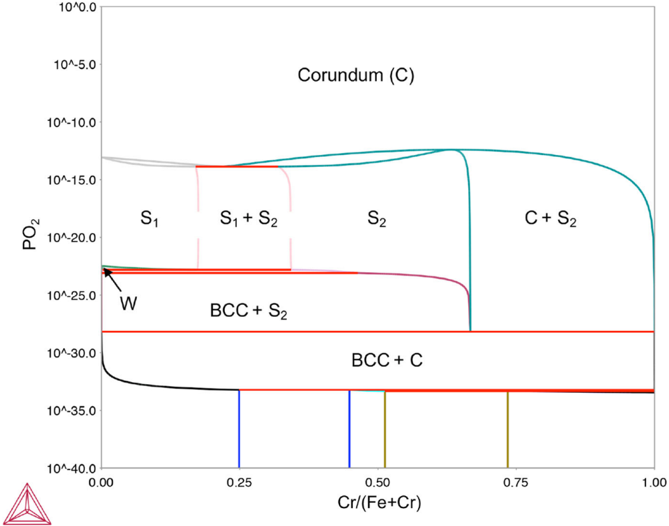
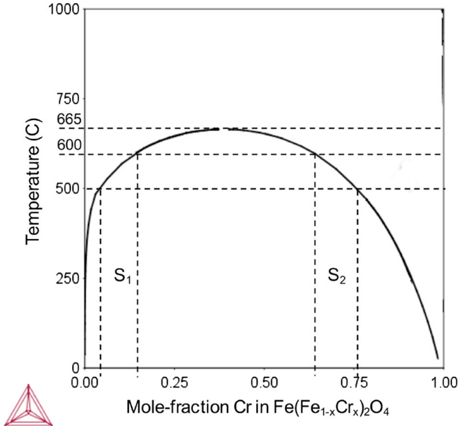
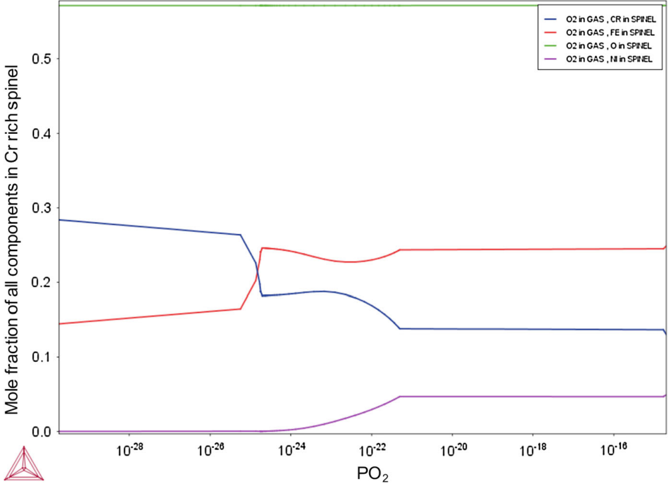
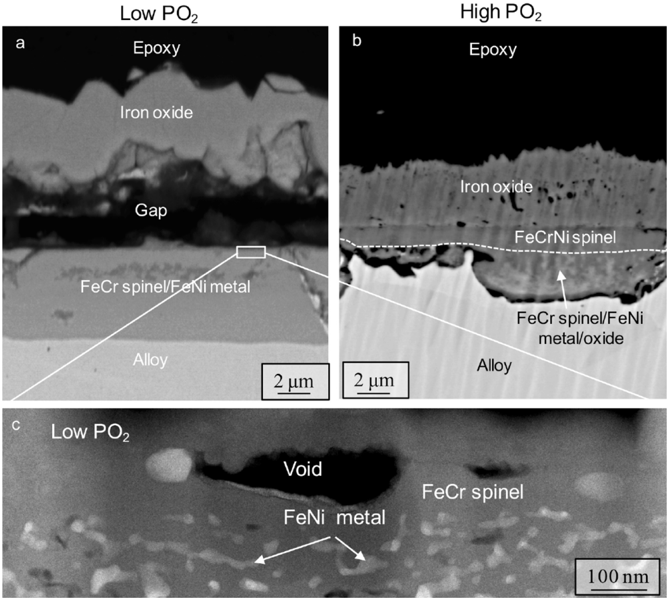
The oxidation of an austenitic FeCr(Ni) steel at 600 °C in H 2 O + KCl + O 2 /H 2 + H 2 O + Ar environments is studied up to 168 h. The oxidation behaviour after “breakaway” is investigated by microstructural investigations, and thermodynamic calculations (Thermo-Calc) on the FeCr(Ni)–O system are used to interpret the results. The characteristic “breakaway” scale morphology exhibits an outward-growing iron oxide and a bottom layer consisting of inward-growing spinel oxide and reaction zones containing Cr-rich oxide precipitates and Cr-depleted metal. The equilibrium calculations show that a miscibility gap appears in the FeCr spinel oxide below 665 °C influencing the microstructure of the inward-growing scale. Equilibrium calculations on the FeCrNi–O system show that Ni is not expected to enter the spinel oxide in low oxygen activity conditions, in accordance with observations.
Overview
The claims and statistics of this paper haven’t been checked yet.
Free: it reads the open-access text and checks the first 5 claims that cite a source we can check. Create a free account to check every claim.
Integrity signals
Registry
Cites
Statistics
Figures
Verification
Claims the paper makes
The claims and statistics of this paper haven’t been checked yet.
Free: it reads the open-access text and checks the first 5 claims that cite a source we can check. Create a free account to check every claim.
Claims other papers make about this one
Each is checked against this paper’s own text: does it say what the citing paper says it does?
The source backs part of the claim, not all of it — or backs it for a different population, condition or comparison.
In the citing paper
“This is in good agreement with previous studies [24-26,31], indicating that both these type of oxides have grown in part by internal oxidation.”
From The influence of Nickel on the corrosion protection of FeCrNi alloys after breakaway corrosion at 600 °C (2024) · cites this paper as [26]
Experimental — accuracy not yet measuredThe source backs part of the claim, not all of it — or backs it for a different population, condition or comparison.
In the citing paper
“The oxide precipitates were concluded to be of spinel type and the reaction zone was explained by a miscibility gap present in both the FeCr and FeCrNi system at 600 • C.”
From Beyond breakaway corrosion – Influence of chromium, nickel and aluminum on corrosion of iron-based alloys at 600 °C (2020) · cites this paper as [27]
Experimental — accuracy not yet measuredThe cited source says what the claim attributes to it.
In the citing paper
“Previous studies performed on FeCr [25,37] and FeCrNi [37,26,27] alloys showed that the reaction zone was composed of Cr-rich oxide precipitates and Cr-depleted metal.”
From Beyond breakaway corrosion – Influence of chromium, nickel and aluminum on corrosion of iron-based alloys at 600 °C (2020) · cites this paper as [27]
The cited source says what the claim attributes to it.
In the citing paper
“Regardless of the environments studied, the oxide scales have been composed of an outward-growing almost pure Fe oxide, and an inward-growing oxide with a more complex microstructure and varying composition.”
From The influence of Nickel on the corrosion protection of FeCrNi alloys after breakaway corrosion at 600 °C (2024) · cites this paper as [26]
The cited source says what the claim attributes to it.
In the citing paper
“This is in good agreement with previous studies performed with STEM/EDX on commercial Fe18Cr10Ni alloys [26] with an almost identical microstructure as observed in the present study.”
From The influence of Nickel on the corrosion protection of FeCrNi alloys after breakaway corrosion at 600 °C (2024) · cites this paper as [26]
2 more claims about this paper
Create a free account to see every claim other papers make about this one.
Self-check
Percentages, sums and reported differences re-computed from the paper’s own numbers.
The self-check needs the paper’s full text.
Citations
Cites
Thermo-Calc & DICTRA, computational tools for materials science
Andersson, J.-O., Helander, T., Höglund, L., Shi, P., & Sundman, B. (2002) · Calphad · doi:10.1016/s0364-5916(02)00037-8 · Cited by 4,322
Asteman, H., Svensson, J.-E., Norell, M., & Johansson, L.-G. (2000) · Oxidation of Metals · doi:10.1023/a:1004642310974 · Cited by 325
Self-citationAn assessment of the Fe-O system
Sundman, B. (1991) · Journal of Phase Equilibria · doi:10.1007/bf02645709 · Cited by 254
Meier, G. H., Jung, K., Mu, N., Yanar, N. M., Pettit, F. S., Pirón Abellán, J., Olszewski, T., Nieto Hierro, L., Quadakkers, W. J., & Holcomb, G. R. (2010) · Oxidation of Metals · doi:10.1007/s11085-010-9215-5 · Cited by 204
Essuman, E., Meier, G. H., Żurek, J., Hänsel, M., Singheiser, L., & Quadakkers, W. J. (2007) · Scripta Materialia · doi:10.1016/j.scriptamat.2007.06.058 · Cited by 172
Halvarsson, M., Tang, J. E., Asteman, H., Svensson, J.-E., & Johansson, L.-G. (2006) · Corrosion Science · doi:10.1016/j.corsci.2005.08.012 · Cited by 146
Self-citationTemperature dependence of oxide scale formation on high-Cr ferritic steels in Ar–H2–H2O
Young, D. J., Zurek, J., Singheiser, L., & Quadakkers, W. J. (2011) · Corrosion Science · doi:10.1016/j.corsci.2011.02.031 · Cited by 126
Othman, N. K., Othman, N. K., Zhang, J., & Young, D. J. (2009) · Corrosion Science · doi:10.1016/j.corsci.2009.08.032 · Cited by 123
Pujilaksono, B., Jonsson, T., Heidari, H., Halvarsson, M., Svensson, J.-E., & Johansson, L.-G. (2011) · Oxidation of Metals · doi:10.1007/s11085-010-9229-z · Cited by 109
Self-citationWater Vapour Effects on Fe–Cr Alloy Oxidation
Othman, N. K., Zhang, J., & Young, D. J. (2009) · Oxidation of Metals · doi:10.1007/s11085-009-9183-9 · Cited by 98
Research works printed but not linked: 1
- B. Pujilaksono, et al., Oxidation of Metals 75, (3-4), 2011 (183-207). · DOI · Paper page
Cited by
Corrosion of FeCrAl alloys used as fuel cladding in nuclear reactors
Jiang, G., Xu, D., Feng, P., Guo, S., Yang, J., & Li, Y. (2021) · Journal of Alloys and Compounds · doi:10.1016/j.jallcom.2021.159235 · Cited by 106
Bai, M., Reddy, L., & Hussain, T. (2018) · Corrosion Science · doi:10.1016/j.corsci.2018.02.047 · Cited by 81
Eklund, J., Jönsson, B., Persdotter, A., Liske, J., Svensson, J.-E., & Jonsson, T. (2018) · Corrosion Science · doi:10.1016/j.corsci.2018.09.004 · Cited by 55
Self-citationPersdotter, A., Eklund, J., Liske, J., & Jonsson, T. (2020) · Corrosion Science · doi:10.1016/j.corsci.2020.108961 · Cited by 44
“This is in good agreement with the results from the microstructural investigation performed in this study, suggesting that the microstructural evolution of the oxide scale formed in the secondary corrosion regime is based on diffusion on both FeCr and FeCrNi, as well as FeCrAl alloys (see Fig.”
Self-citationDu, D., Chen, K., Zhang, L., & Shen, Z. (2020) · Corrosion Science · doi:10.1016/j.corsci.2020.108652 · Cited by 36
“Since FeCr2O4 can also form under the experimental condition according to the thermodynamic properties of the FeCrNi-O system [10].”
BackgroundBehnamian, Y., Mostafaei, A., Kohandehghan, A., Amirkhiz, B. S., Li, J., Zheng, W., Guzonas, D. A., Chmielus, M., Chen, W., & Luo, J. L. (2017) · Materials Characterization · doi:10.1016/j.matchar.2017.07.029 · Cited by 29
Zhou, R., Wang, F., Xu, K., Yuan, Y., Chen, L., Lou, M., Khvan, A. V., & Chang, K. (2023) · Materials Characterization · doi:10.1016/j.matchar.2023.113221 · Cited by 27
Ssenteza, V., Eklund, J., Hanif, I., Liske, J., & Jonsson, T. (2023) · Corrosion Science · doi:10.1016/j.corsci.2022.110896 · Cited by 25
Self-citationErosion-corrosion of 304N austenitic steels in liquid Pb Bi flow perpendicular to steel surface
Li, C., Liu, Y., Zhang, F., Fang, X., & Liu, Z. (2021) · Materials Characterization · doi:10.1016/j.matchar.2021.111054 · Cited by 25
Alkali-wall interactions in a laboratory-scale reactor for chemical looping combustion studies
Andersson, V., Soleimanisalim, A. H., Kong, X., Hildor, F., Leion, H., Mattisson, T., & Pettersson, J. B. C. (2021) · Fuel Processing Technology · doi:10.1016/j.fuproc.2021.106828 · Cited by 25
Eklund, J., Hanif, I., Bigdeli, S., & Jonsson, T. (2022) · Corrosion Science · doi:10.1016/j.corsci.2022.110114 · Cited by 25
Self-citationSsenteza, V., Eklund, J., Bigdeli, S., & Jonsson, T. (2024) · Corrosion Science · doi:10.1016/j.corsci.2023.111654 · Cited by 23
Self-citationEklund, J., Persdotter, A., Hanif, I., Bigdeli, S., & Jonsson, T. (2021) · Corrosion Science · doi:10.1016/j.corsci.2021.109584 · Cited by 23
Self-citationAsokan, V., Eklund, J., Bigdeli, S., & Jonsson, T. (2020) · Corrosion Science · doi:10.1016/j.corsci.2020.109155 · Cited by 26
Self-citationThe long-term corrosion behavior of fecral(Si) alloys after breakaway oxidation at 600 °C
Eklund, J., Persdotter, A., Ssenteza, V., & Jonsson, T. (2023) · Corrosion Science · doi:10.1016/j.corsci.2023.111155 · Cited by 22
Self-citationPhother-Simon, J., Hanif, I., Jonsson, T., & Liske, J. (2024) · Fuel · doi:10.1016/j.fuel.2023.130012 · Cited by 21
Self-citationEklund, J., Paz, M. D., Jönsson, B., Liske, J., Svensson, J., & Jonsson, T. (2019) · Materials and Corrosion · doi:10.1002/maco.201810618 · Cited by 18
Self-citationHigh Entropy Materials - Microstructures and Properties
Zhang, Y. (2022) · IntechOpen eBooks · doi:10.5772/intechopen.100682 · Cited by 19
Weigelt, C., Yaroshevskyi, S., Kerber, F., Brachhold, N., Zienert, T., Adamczyk, A., Vogt, D., Charitos, A., & Aneziris, C. G. (2023) · Open Ceramics · doi:10.1016/j.oceram.2023.100480 · Cited by 16
Khantisopon, K., Tharajak, J., Nawarat, P., Sanpo, N., & Ang, A. S. M. (2022) · Corrosion Science · doi:10.1016/j.corsci.2022.110470 · Cited by 16
The Atmosphere’s Effect on Stainless Steel Slabs’ Oxide Formation in a CH4-Fuelled Reheating Furnace
Laukka, A., Heikkinen, E., & Fabritius, T. M. J. (2021) · Metals · doi:10.3390/met11040621 · Cited by 12
Oxide scale on stainless steels and its effect on sticking during hot-rolling
Kim, S., Lee, S., Kang, H.-G., & Park, J. (2019) · Corrosion Science · doi:10.1016/j.corsci.2019.108357 · Cited by 12
Andersson, V., Kong, X., Leion, H., Mattisson, T., & Pettersson, J. B. C. (2024) · Fuel Processing Technology · doi:10.1016/j.fuproc.2023.108029 · Cited by 11
Ssenteza, V., Jonsson, T., Nockert, J., & Liske, J. (2024) · High Temperature Corrosion of Materials · doi:10.1007/s11085-024-10265-8 · Cited by 5
Self-citationResearch progress in CALPHAD assisted metal additive manufacturing
Hou, Y., Li, X., Cai, W.-D., Chen, Q., Gao, W.-C., He, D., Chen, X.-H., & Su, H. (2024) · China Foundry · doi:10.1007/s41230-024-3146-2 · Cited by 5
“It encompasses topics such as the optimization of process parameters, simulation of microstructure evolution behavior, and prediction of formability and mechanical performance [22-40] .”
Coupling effect of temperature and Cr content on the steam oxidation of Ni-Fe-Cr alloys
Zhang, H., Huang, L., Yang, Z., Chen, J., Liu, Y., Zan, C., & Yuan, J. (2021) · Materials Research Express · doi:10.1088/2053-1591/ac386e · Cited by 4
CALPHAD as a Toolbox to Facilitate the Development of HEAs
Wang, W., & Li, Z. (2022) · IntechOpen eBooks · doi:10.5772/intechopen.105191 · Cited by 4
Persdotter, A., Boll, T., Ssenteza, V., & Jonsson, T. (2024) · Corrosion Science · doi:10.1016/j.corsci.2024.112175 · Cited by 3
“Even though the miscibility gap is thermodynamically predicted, most previous studies performed at 600 ◦ C [13,15,19,25] have not been able to observe a clear separation between Fe-rich and Cr-rich spinel in the inward-growing scale.”
BackgroundResultSelf-citationChoi, J., Lee, J. H., Kim, S. H., Lee, U., Kim, D., & Yoon, Y. S. (2025) · Journal of Nuclear Materials · doi:10.1016/j.jnucmat.2025.156366 · Cited by 3
Andersson, V., Kong, X., Leion, H., Mattisson, T., & Pettersson, J. B. C. (2023) · Fuel Processing Technology · doi:10.1016/j.fuproc.2023.107988 · Cited by 2
Persdotter, A., Larsson, H., Eklund, J., Bigdeli, S., & Jonsson, T. (2024) · Corrosion Science · doi:10.1016/j.corsci.2024.112473 · Cited by 1
Self-citationA Study of the Mechanism of Formation of Composite Oxide Scale on Heat-Resistant Steel 25Cr18Ni9Si2
Wang, H., & Sun, S. (2022) · Metal Science and Heat Treatment · doi:10.1007/s11041-022-00725-w · Cited by 1
Influence of Surface Roughness on the Oxide-Scale Growth of Fe-15Cr Alloy at High Temperature
Zhou, C. H., Zhang, Y., & Pan, R. Y. (2019) · Key engineering materials · doi:10.4028/www.scientific.net/kem.793.67 · Cited by 1
Liu, C., Qi, L., Shen, T., & Wang, Z. G. (2025) · Materials & Design · doi:10.1016/j.matdes.2025.115330 · Cited by 1
Corrosion Characteristics of Candidate Alloys
Xu, D., & Guo, S. (2021) · Springer eBooks · doi:10.1007/978-981-16-5525-8_3
Hooshyar, H., Sattari, M., Jonsson, T., Johansson, L., Svensson, J., & Liske, J. (2023) · SSRN Electronic Journal · doi:10.2139/ssrn.4514530
Self-citationPinho, P. V. B. (2022) · theses.fr (ABES) · doi:10.70675/1cdc1ae2zefe8z4bd7z81fbzfcca78abd074
Metadata
- Authors
- Jonsson, T., Larsson, H., Karlsson, S., Hooshyar, H., Sattari, M., Liske, J., Svensson, J.-E., & Johansson, L.-G.
- Affiliations
- Chalmers University of Technology (SE)
- Corresponding author
- Jonsson, T.
- Venue
- Oxidation of Metals
- Published
- 2017-02-07
- Volume
- 87
- Issue
- 3-4
- Pages
- 333-341
- ISSN
- 0030-770X (ISSN-L)
- 1573-4889
- OpenAlex
- W2586093419
- Cited by
- 37
- References
- 22
- Citations by year
- 2025: 2 · 2024: 5 · 2023: 7 · 2022: 7 · 2021: 7 · 2020: 3 · 2019: 3 · 2018: 2 · 2017: 1
- FWCI
- 2.27
- Type
- journal article
- Language
- en
- Open access
- hybrid
- doi.org
- Locations
- Oxidation of Metals (publishedVersion, cc-by)
- KTH Publication Database DiVA (KTH Royal Institute of Technology) (submittedVersion, other-oa)
- Chalmers Publication Library (Chalmers University of Technology) (submittedVersion)
- Chalmers Research (Chalmers University of Technology) (submittedVersion)
- Funders
- VINNOVA
- Chalmers Tekniska Högskola
- Topics
- Physical Sciences › Materials Science › Surfaces, Coatings and Films › High-Temperature Coating Behaviors
- Physical Sciences › Materials Science › Metals and Alloys › Hydrogen embrittlement and corrosion behaviors in metals
- Physical Sciences › Materials Science › Materials Chemistry › Nuclear Materials and Properties
- Keywords
- high-temperature oxidation, Fe-Cr-Ni alloys, austenitic stainless steel, breakaway oxidation, scale morphology, spinel oxides, miscibility gap, oxygen activity, thermodynamic equilibrium calculations
About these checks
Registry, retraction, Cites and statistics results are computed, not judged, with one exception: a printed reference that no index lists is read once by a model before it counts as a citation error. Claims are extracted by a model and kept only when their quote appears verbatim in the text; each cited source is then checked, with a model’s help, for whether it says what the claim relies on. Those verdicts can be wrong — read the claim’s quote and the cited source before relying on one.
Statistics and arithmetic are recomputed, not judged.
Confidence bands are shown only for fields calibrated on our annotated test set. None is calibrated yet, so no band is shown.
What counts as a claim ›How we measure confidence ›How we check this ›
Are you an author, or do you see a problem with this page? Request a review
Data sources
Bibliographic data: Semantic Scholar, OpenAlex, Crossref.
Contains information from the Semantic Scholar Academic Graph Datasets, made available under the ODC Attribution License (ODC-BY 1.0).
Semantic Scholar’s data is described in: Kinney, R., et al. (2023). The Semantic Scholar Open Data Platform. arXiv:2301.10140.
