

Weight cycling and its effects on muscle mass, sarcopenia and sarcopenic obesity
Open accessThe DOI matches its Crossref record; 72 of the 72 references it cites were found in a registry or an index.
Abstract
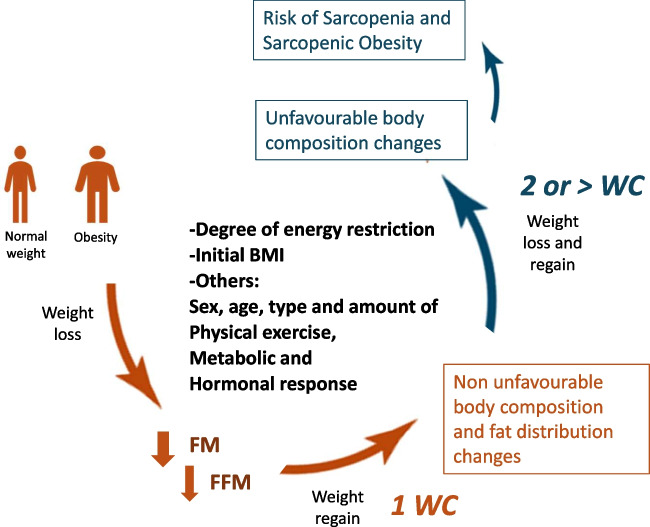
The prevalence of obesity is rising around the world, as the number of subjects dieting and experiencing weight loss followed by unintentional weight regain, the so-called weight cycling (WC). In this narrative review we sought to reveal the effects of WC on body composition as well as to evaluate if WC may represent a risk factor for sarcopenia and sarcopenic obesity. The relative changes in lean and fat compartments after WC have been shown to depend on several factors as the degree of energy deficit, the rate of weight loss and baseline body weight, as well as sex, age, physical activity and subject’s metabolic or hormonal status. Effects of WC on body compartments may be underestimated depending on body composition measurements, interference of physical exercise, number of WC, age and population characteristics. Studies using the most precise methods to assess body composition changes, as well those with higher number of WC and/or including old subjects, show that with WC, lower fat free mass (FFM) is regained with a mismatch between muscle and fat. In addition, when WC is involuntary in old age, it drives and accelerates the age-related loss of FFM, in particular in frail populations. Finally, an association between WC and sarcopenia or sarcopenia obesity, was also observed when evaluating strength together with WC-related body composition changes. In conclusion WC may act as an accelerator of biological aging, and it could be further investigated as a potential risk factor for sarcopenia or sarcopenic obesity.
Overview
The claims and statistics of this paper haven’t been checked yet.
Free: it reads the open-access text and checks the first 5 claims that cite a source we can check. Create a free account to check every claim.
Integrity signals
Registry
Cites
Statistics
Figures
Verification
Claims the paper makes
The claims and statistics of this paper haven’t been checked yet.
Free: it reads the open-access text and checks the first 5 claims that cite a source we can check. Create a free account to check every claim.
Claims other papers make about this one
Each is checked against this paper’s own text: does it say what the citing paper says it does?
The cited source says what the claim attributes to it.
In the citing paper
“A 2025 review on the effects of weight cycling on muscle and sarcopenia suggested that it may lead to disproportionate fat regain, reduced FFM, accelerated age-related muscle loss and an increased risk for functional impairment and disability, particularly in older or frail individuals, contributing to worsened muscle health outcomes including sarcopenic obesity [14].”
From Weighing the risk of GLP-1 treatment in older adults: Should we be concerned about sarcopenic obesity? (2025) · cites this paper as [14]
In the citing paper
“Moreover, weight cycling has previously been associated with lower muscle mass and strength, as well as an increased risk of SO [99, 100].”
From GLP-1 Receptor Agonists for Obesity Management in Older Adults: A Scoping Review on the Risk of Sarcopenia and Sarcopenic Obesity (2026) · doi:10.1007/s13668-026-00777-x · cites this paper as [100]
Self-check
Percentages, sums and reported differences re-computed from the paper’s own numbers.
The self-check needs the paper’s full text.
Citations
Cites
Sarcopenia: revised European consensus on definition and diagnosis
Cruz-Jentoft, A. J., Bahat, G., Bauer, J., Boirie, Y., Bruyère, O., Cederholm, T., Cooper, C., Landi, F., Rolland, Y., Sayer, A. A., et al. (2019) · Age and Ageing · doi:10.1093/ageing/afy169 · Cited by 13,818
Self-citationPhelps, N. H., Singleton, R. K., Zhou, B., Heap, R. A., Mishra, A., Bennett, J. E., Paciorek, C. J., Lhoste, V. P., Carrillo-Larco, R. M., Stevens, G. A., et al. (2024) · The Lancet · doi:10.1016/s0140-6736(23)02750-2 · Cited by 2,544
The Biology of Human Starvation: Volume I
KEYS, A., BROŽEK, J., HENSCHEL, A., MICKELSEN, O., & TAYLOR, H. L. (1950) · doi:10.5749/j.ctv9b2tqv · Cited by 2,039
Boutari, C., & Mantzoros, C. S. (2022) · Metabolism · doi:10.1016/j.metabol.2022.155217 · Cited by 1,068
Definition and Diagnostic Criteria for Sarcopenic Obesity: ESPEN and EASO Consensus Statement
Donini, L. M., Busetto, L., Bischoff, S. C., Cederholm, T., Ballesteros-Pomar, M. D., Batsis, J. A., Bauer, J. M., Boirie, Y., Cruz-Jentoft, A. J., Dicker, D., et al. (2022) · Obesity Facts · doi:10.1159/000521241 · Cited by 1,019
Self-citationHughes, V. A., Frontera, W. R., Roubenoff, R., Evans, W. J., & Singh, M. A. F. (2002) · The American Journal of Clinical Nutrition · doi:10.1093/ajcn/76.2.473 · Cited by 804 · cited 1×
“WC has been indicated as a hypothetical factor that magnifies age-related changes in body composition [57, 60, 61].”
Age-related changes in total and regional fat distribution
Kuk, J. L., Saunders, T. J., Davidson, L. E., & Ross, R. (2009) · Ageing Research Reviews · doi:10.1016/j.arr.2009.06.001 · Cited by 778 · cited 2×
“WC has been indicated as a hypothetical factor that magnifies age-related changes in body composition [57, 60, 61].”
Persistent metabolic adaptation 6 years after “The Biggest Loser” competition
Fothergill, E., Guo, J., Howard, L., Kerns, J. C., Knuth, N. D., Brychta, R., Chen, K. Y., Skarulis, M. C., Walter, M., Walter, P. J., et al. (2016) · Obesity · doi:10.1002/oby.21538 · Cited by 672 · cited 2×
“Similarly, FFM loss was observed, with or without FM increase, in all the other studies with aerobic exercise [38, 45, 47, 48, 50, 51].”
Variability of Body Weight and Health Outcomes in the Framingham Population
Lissner, L., Odell, P. M., D'Agostino, R. B., Stokes, J., Kreger, B. E., Belanger, A. J., & Brownell, K. D. (1991) · New England Journal of Medicine · doi:10.1056/nejm199106273242602 · Cited by 661 · cited 1×
“Moreover, it has been found that WC is associated with increased risk of Type 2 Diabetes [15], poor cardiometabolic outcomes [12, 16, 17] and increased cardiovascular mortality [16, 17], independently of obesity [18].”
Sex, Race/Ethnicity, Socioeconomic Status, and BMI in Relation to Self‐Perception of Overweight
Paeratakul, S., White, M. A., Williamson, D. A., Ryan, D. H., & Bray, G. A. (2002) · Obesity Research · doi:10.1038/oby.2002.48 · Cited by 457 · cited 1×
“Contextually, even the number of subjects who are dieting has increased [3–5] and what is noteworthy is that it is not just people with excess weight who are dieters, but also normal weight subjects [5, 6].”
Newman, A. B., Lee, J. S., Visser, M., Goodpaster, B. H., Kritchevsky, S. B., Tylavsky, F. A., Nevitt, M., & Harris, T. B. (2005) · The American Journal of Clinical Nutrition · doi:10.1093/ajcn/82.4.872 · Cited by 445 · cited 3×
“WC has been indicated as a hypothetical factor that magnifies age-related changes in body composition [57, 60, 61].”
Garrow, J. S., & Summerbell, C. (1995) · PubMed · Cited by 415
French, S. A., Jeffery, R. W., Forster, J. L., McGovern, P. G., Kelder, S. H., & Baxter, J. E. (1994) · PubMed · Cited by 358
Heymsfield, S. B., Gonzalez, M. C. C., Shen, W., Redman, L., & Thomas, D. (2014) · Obesity Reviews · doi:10.1111/obr.12143 · Cited by 350 · cited 1×
“…be also influenced by other factors such as sex, age, presence of inactivity, type and amount of physical activity, subject’s metabolic state or hormonal response [22] as well by the fact that ΔFFM/ΔWeight is larger at the beginning of dieting and then gradually declines as dieting proceeds [26].”
Body-Weight Fluctuations and Outcomes in Coronary Disease
Bangalore, S., Fayyad, R., Laskey, R., DeMicco, D. A., Messerli, F. H., & Waters, D. D. (2017) · New England Journal of Medicine · doi:10.1056/nejmoa1606148 · Cited by 308 · cited 1×
“Moreover, it has been found that WC is associated with increased risk of Type 2 Diabetes [15], poor cardiometabolic outcomes [12, 16, 17] and increased cardiovascular mortality [16, 17], independently of obesity [18].”
Weight Regain in U.S. Adults Who Experienced Substantial Weight Loss, 1999–2002
Weiss, E. C., Galuska, D. A., Kettel Khan, L., Gillespie, C., & Serdula, M. K. (2007) · American Journal of Preventive Medicine · doi:10.1016/j.amepre.2007.02.040 · Cited by 307 · cited 2×
“Even though in this study it was not possible to examine if the weight loss was voluntary, subjects attempting to control their weight had a 1.8 times increased risk of weight regain [10].”
InfluentialMeza-Valderrama, D., Marco, E., Dávalos-Yerovi, V., Muns, M. D., Tejero-Sánchez, M., Duarte, E., & Sánchez-Rodríguez, D. (2021) · Nutrients · doi:10.3390/nu13030761 · Cited by 278 · cited 1×
“In the last decades, a wide consensus has led to a definition of sarcopenia and sarcopenic obesity which is not just based on the amount of muscle mass and fat but that also includes strength and/or physical performance [64–66].”
Prevalence of personal weight control attempts in adults: a systematic review and meta‐analysis
Santos, I., Sniehotta, F. F., Marques, M. M., Carraça, E. V., & Teixeira, P. J. (2017) · Obesity Reviews · doi:10.1111/obr.12466 · Cited by 274
Adipose tissue retains an epigenetic memory of obesity after weight loss
Hinte, L. C., Castellano-Castillo, D., Ghosh, A., Melrose, K., Gasser, E., Noé, F., Massier, L., Dong, H., Sun, W., Hoffmann, A., et al. (2024) · Nature · doi:10.1038/s41586-024-08165-7 · Cited by 269 · cited 1×
“…cellular transcriptional changes, evaluated by the single-nucleus RNA sequencing of mouse and human adipocytes, persist after weight loss suggesting the existence of an “obesogenic memory”, consisting in obesity-induced alterations in the epigenome of adipocytes that accelerate weight gain [30].”
Dieting and weight cycling as risk factors for cardiometabolic diseases: Who is really at risk?
Montani, J. ‐., Schutz, Y., & Dulloo, A. G. (2015) · Obesity Reviews · doi:10.1111/obr.12251 · Cited by 257 · cited 3×
“Moreover, it has been found that WC is associated with increased risk of Type 2 Diabetes [15], poor cardiometabolic outcomes [12, 16, 17] and increased cardiovascular mortality [16, 17], independently of obesity [18].”
Pathways from dieting to weight regain, to obesity and to the metabolic syndrome: An overview
Dulloo, A. G., & Montani, J. ‐. (2015) · Obesity Reviews · doi:10.1111/obr.12250 · Cited by 202 · cited 1×
“Longitudinal studies show that at least one-third of dieters regain more weight than they lost, and in prospective studies adults who were on a diet during childhood and adolescence, present more pronounced weight gain and obesity [11].”
Longitudinal changes in body composition associated with healthy ageing: men, aged 20–96 years
Jackson, A. S., Janssen, I., Sui, X., Church, T. S., & Blair, S. N. (2012) · British Journal of Nutrition · doi:10.1017/s0007114511003886 · Cited by 189
Body composition changes in stable-weight elderly subjects: the effect of sex
Zamboni, M., Zoico, E., Scartezzini, T., Mazzali, G., Tosoni, P., Zivelonghi, A., Gallagher, D., De Pergola, G., Di Francesco, V., & Bosello, O. (2003) · Aging Clinical and Experimental Research · doi:10.1007/bf03324517 · Cited by 170
Self-citationFantin, F., Francesco, V. D., Fontana, G., Zivelonghi, A., Bissoli, L., Zoico, E., Rossi, A., Micciolo, R., Bosello, O., & Zamboni, M. (2007) · The Journals of Gerontology Series A: Biological Sciences and Medical Sciences · doi:10.1093/gerona/62.12.1375 · Cited by 159 · cited 1×
“This net loss of FFM may represent an acceleration of the natural loss of FFM observed even in weight stable adults with ageing [57–62], suggesting that involuntary weight loss and regain may act as an accelerator of biological aging, and that it could be a risk factor for sarcopenia and sarcopenic…”
Self-citationBody Fat Content Influences the Body Composition Response to Nutrition and Exercise
FORBES, G. B. (2000) · Annals of the New York Academy of Sciences · doi:10.1111/j.1749-6632.2000.tb06482.x · Cited by 144 · cited 1×
“2 initial body weight/adiposity: for individuals with a 1000 kcal per day of deficit, ∆FFM/∆Weight is higher in normal weight individuals than in subjects with obesity and declines steeply as body fat increases [21].”
Bosy-Westphal, A., & Müller, M. J. (2015) · International Journal of Obesity · doi:10.1038/ijo.2014.161 · Cited by 133 · cited 1×
“WC may be a new and relatively unexplored driver of sarcopenia and sarcopenic obesity [63].”
Dulloo, A. G., Jacquet, J., Montani, J. ‐., & Schutz, Y. (2015) · Obesity Reviews · doi:10.1111/obr.12253 · Cited by 126 · cited 2×
“…following a body weight loss of more than 25% of the baseline body weight, a mean fat overshooting of 4 kg was found (ranging from 0 to 9 kg) and fat regain was greater in subjects with lowest BMI values, with an inverse relationship between the kg of fat regain and the initial body fat % [13, 23].”
Beavers, K. M., Lyles, M. F., Davis, C. C., Wang, X., Beavers, D. P., & Nicklas, B. J. (2011) · The American Journal of Clinical Nutrition · doi:10.3945/ajcn.110.004895 · Cited by 126 · cited 10×
“%) those who regained weight after 1-year of follow-up had a reduced lean-to fat mass ratio: for every 1 kg of fat lost during the weight-loss intervention, 0.26 kg of lean tissue was lost and for every 1 kg of fat regained over the following year, only 0.12 kg of lean tissue was regained [45].”
Influential(1996) · PubMed · Cited by 122
Field, A. E., Manson, J. E., Taylor, C. B., Willett, W. C., & Colditz, G. A. (2004) · International Journal of Obesity · doi:10.1038/sj.ijo.0802728 · Cited by 122 · cited 1×
“Association between WC and increased risk of eating disorders has been also observed [19].”
Bosy-Westphal, A., Schautz, B., Lagerpusch, M., Pourhassan, M., Braun, W., Goele, K., Heller, M., Glüer, C.-C., & Müller, M. J. (2013) · International Journal of Obesity · doi:10.1038/ijo.2013.1 · Cited by 111
Murphy, R. A., Patel, K. V., Kritchevsky, S. B., Houston, D. K., Newman, A. B., Koster, A., Simonsick, E. M., Tylvasky, F. A., Cawthon, P. M., Harris, T. B., et al. (2014) · Journal of the American Geriatrics Society · doi:10.1111/jgs.12954 · Cited by 109 · cited 8×
“…and elderly subjects with involuntary weight loss and regain had similar LBM and FM at the end of the follow-up period, but patients with involuntary weight loss and regain showed the greatest % CV of FM increase, as well as the greatest % CV of LBM decrease, compared to the other groups [55].”
InfluentialWadden, T. A., Bartlett, S. J., Letizia, K. A., Foster, G., Stunkard, A. J., & Conill, A. M. (1992) · American Journal of Clinical Nutrition · doi:10.1093/ajcn/56.1.203s · Cited by 109 · cited 6×
“…each other for the magnitude and the timing of weight loss and regain, but mostly for the number of weight cycles considered Eleven out of 23 studies examined body composition changes after only one WC [35–38, 40, 45–49, 51] and the others after two or more [31–34, 39, 41–44, 50, 52, 53] (Table 1).”
InfluentialLee, J. S., Visser, M., Tylavsky, F. A., Kritchevsky, S. B., Schwartz, A. V., Sahyoun, N., Harris, T. B., Newman, A. B., & Study, F. T. H. A. (2010) · The Journals of Gerontology Series A: Biological Sciences and Medical Sciences · doi:10.1093/gerona/glp042 · Cited by 108 · cited 5×
“This suggests that involuntary weight loss and regain may lead to a progressive loss in FFM at even relatively modest amounts of weight loss and regain in at-risk populations with overweight and obesity [54, 56].”
Influentialvan Dale, D., & Saris, W. H. M. (1989) · American Journal of Clinical Nutrition · doi:10.1093/ajcn/49.3.409 · Cited by 102
Pownall, H. J., Bray, G. A., Wagenknecht, L. E., Walkup, M. P., Heshka, S., Hubbard, V. S., Hill, J., Kahn, S. E., Nathan, D. M., Schwartz, A. V., et al. (2015) · Obesity · doi:10.1002/oby.21005 · Cited by 94 · cited 10×
“Similarly, FFM loss was observed, with or without FM increase, in all the other studies with aerobic exercise [38, 45, 47, 48, 50, 51].”
InfluentialPrevalence of Weight Cycling and its Relation to Health Indicators in Finland
Lahti‐Koski, M., Männistö, S., Pietinen, P., & Vartiainen, E. (2005) · Obesity Research · doi:10.1038/oby.2005.45 · Cited by 90 · cited 2×
“…of WC was conducted in Finland with data obtained from the National FIN-RISK 1997 survey, in a wide representative sample of men and women, through the administration of a questionnaire investigating the number of voluntary weight loss and involuntary regain in a 10-year follow-up period [9].”
Rossi, A. P., Rubele, S., Calugi, S., Caliari, C., Pedelini, F., Soave, F., Chignola, E., Vittoria Bazzani, P., Mazzali, G., Dalle Grave, R., et al. (2019) · Obesity · doi:10.1002/oby.22493 · Cited by 90 · cited 9×
“…147 females with BMI > 30 kg/m 2 participating in an inpatient nutritional and rehabilitative treatment, WC was retrospectively evaluated and defined subjects as non-weight cyclers (0–1 weight cycle), mild weight cyclers (2–5 weight cycles), or severe weight cyclers (6 or more weight cycles) [52].”
InfluentialSelf-citationVoluntary weight loss: systematic review of early phase body composition changes
Heymsfield, S. B., Thomas, D., Nguyen, A. M., Peng, J. Z., Martin, C., Shen, W., Strauss, B., Bosy‐Westphal, A., & Muller, M. J. (2011) · Obesity Reviews · doi:10.1111/j.1467-789x.2010.00767.x · Cited by 88 · cited 1×
“…be also influenced by other factors such as sex, age, presence of inactivity, type and amount of physical activity, subject’s metabolic state or hormonal response [22] as well by the fact that ΔFFM/ΔWeight is larger at the beginning of dieting and then gradually declines as dieting proceeds [26].”
Strychar, I. M., Lavoie, M.-È., Messier, L., Karelis, A. D., Doucet, É., Prud’homme, D., Fontaine, J., & RABASA-LHORET, R. P. R. (2009) · Journal of the American Dietetic Association · doi:10.1016/j.jada.2008.12.026 · Cited by 86
(1991) · PubMed · Cited by 85
Garrow, J. S., & Seidell, J. C. (1998) · European Journal of Clinical Nutrition · doi:10.1038/sj.ejcn.1600534 · Cited by 84
Loss of body nitrogen on fasting,
Forbes, G., & Drenick, E. (1979) · American Journal of Clinical Nutrition · doi:10.1093/ajcn/32.8.1570 · Cited by 73 · cited 1×
“Changes in body weight, negative or positive, involve fat free mass (FFM) and fat mass (FM) [20–25].”
Updates on Methods for Body Composition Analysis: Implications for Clinical Practice
Thomas, D. M., Crofford, I., Scudder, J., Oletti, B., Deb, A., & Heymsfield, S. (2025) · Current Obesity Reports · doi:10.1007/s13679-024-00593-w · Cited by 73 · cited 1×
“The precision of these methods differs and thus their capacity to detect true changes in body compartments after weight changes [67–69].”
Effect of a weight cycle on visceral fat accumulation
Kooy, K. V. D., Leenen, R. C. A., Seidell, J. C., Deurenberg, P., & Hautvast, J. (1993) · American Journal of Clinical Nutrition · doi:10.1093/ajcn/58.6.853 · Cited by 72
Dulloo, A. G. (2021) · Obesity Reviews · doi:10.1111/obr.13189 · Cited by 70 · cited 3×
“…during weight loss and may persist suppressed during weight recovery by a magnitude that has been shown to be proportional to the state of depletion of the fat stores [28] as well as by the fraction of the body’s protein mobilized as an energy reserve, as important as the initial body fat % [27].”
Byrne, N. M., Weinsier, R. L., Hunter, G. R., Desmond, R., Patterson, M. A., Darnell, B. E., & Zuckerman, P. A. (2003) · The American Journal of Clinical Nutrition · doi:10.1093/ajcn/77.6.1368 · Cited by 69 · cited 10×
“Most of the papers that present data on the effects of WC on body composition were conducted in in patients with over-weight and obesity [31, 33–38, 40–42, 44–53], involved in weight control programs, and only a few in normal weight subjects [32, 39, 43].”
InfluentialEffects of intentional weight cycling on non-obese young women
Kajioka, T., Tsuzuku, S., Shimokata, H., & Sato, Y. (2002) · Metabolism · doi:10.1053/meta.2002.29976 · Cited by 63 · cited 8×
“Most of the papers that present data on the effects of WC on body composition were conducted in in patients with over-weight and obesity [31, 33–38, 40–42, 44–53], involved in weight control programs, and only a few in normal weight subjects [32, 39, 43].”
InfluentialNewman, A. B., Visser, M., Kritchevsky, S. B., Simonsick, E. M., Cawthon, P. M., & Harris, T. B. (2023) · The Journals of Gerontology Series A · doi:10.1093/gerona/glad167 · Cited by 54
Effects of weight cycling on the resting energy expenditure and body composition of obese women
Wadden, T. A., Foster, G. D., Stunkard, A. J., & Conill, A. M. (1996) · International Journal of Eating Disorders · doi:10.1002/(sici)1098-108x(199601)19:1<5::aid-eat2>3.0.co;2-t · Cited by 50 · cited 7×
“In particular, in the majority of studies, after 1 weight cycle, body fat distribution, anthropometrically evaluated through waist to hip ratio (WHR), was unchanged in both adult men [46] and women with obesity [36, 38, 46].”
InfluentialManore, M., Berry, T., Skinner, J. S., & Carroll, S. (1991) · American Journal of Clinical Nutrition · doi:10.1093/ajcn/54.1.41 · Cited by 44 · cited 8×
“Most of the papers that present data on the effects of WC on body composition were conducted in in patients with over-weight and obesity [31, 33–38, 40–42, 44–53], involved in weight control programs, and only a few in normal weight subjects [32, 39, 43].”
InfluentialWeight cycling and cardiovascular risk factors in obesity
Graci, S., Izzo, G., Savino, S., Cattani, L., Lezzi, G., Berselli, M. E., Balzola, F., Liuzzi, A., & Petroni, M. L. (2003) · International Journal of Obesity · doi:10.1038/sj.ijo.0802537 · Cited by 43 · cited 10×
“However, in this study, the positive correlation between WC and FM% disappeared after adjustment for age and BMI [41].”
InfluentialWeight Loss during Fasting: Implications for the Obese
Forbes, G. B. (1970) · American Journal of Clinical Nutrition · doi:10.1093/ajcn/23.9.1212 · Cited by 42
The Impact of Weight Cycling on Health and Obesity
Wang, H., He, W., Yang, G., Zhu, L., & Liu, X. (2024) · Metabolites · doi:10.3390/metabo14060344 · Cited by 35 · cited 4×
“Among individuals attempting to lose weight, WC has been found to be more prevalent in women and in athletes who need to meet specific weight categories [7, 8].”
InfluentialMeasuring the impact of weight cycling on body composition: a methodological challenge
Bosy-Westphal, A., & Müller, M. J. (2014) · Current Opinion in Clinical Nutrition and Metabolic Care · doi:10.1097/mco.0000000000000092 · Cited by 33 · cited 3×
“In these studies, the fact that body composition changes are small and close to the limit of precision of each method makes difficult to interpret their results [67].”
Association of Weight Fluctuation With Mortality in Japanese Adults
Cologne, J., Takahashi, I., French, B., Nanri, A., Misumi, M., Sadakane, A., Cullings, H. M., Araki, Y., & Mizoue, T. (2019) · JAMA Network Open · doi:10.1001/jamanetworkopen.2019.0731 · Cited by 33 · cited 1×
“Moreover, it has been found that WC is associated with increased risk of Type 2 Diabetes [15], poor cardiometabolic outcomes [12, 16, 17] and increased cardiovascular mortality [16, 17], independently of obesity [18].”
Weight cycling in adults with severe obesity: A longitudinal study
Ghoch, M. E., Calugi, S., & Grave, R. D. (2017) · Nutrition & Dietetics · doi:10.1111/1747-0080.12387 · Cited by 32
Skeletal muscle estimation: A review of techniques and their applications
Rodriguez, C., Mota, J. D., Palmer, T. B., Heymsfield, S. B., & Tinsley, G. M. (2024) · Clinical Physiology and Functional Imaging · doi:10.1111/cpf.12874 · Cited by 32
Yates, T., Biddle, G. J. H., Henson, J., Edwardson, C. L., Arsenyadis, F., Goff, L. M., Papamargaritis, D., Webb, D. R., Khunti, K., & Davies, M. J. (2024) · Diabetes, Obesity and Metabolism · doi:10.1111/dom.15400 · Cited by 31 · cited 8×
“…confounders, subjects who experienced invol-untary weight loss and regain (defined as weight loss of ≥ 5% between baseline and 12 months, regained between 12 and 24 months) at the end of the follow-up lost 1.50 kg in FFM with no change in FM, even after adjustment for potential confounders [56].”
InfluentialThe physiological effects of weight-cycling: A review of current evidence
Sanaya, N., Janusaite, M., Dalamaga, M., & Magkos, F. (2024) · Current Obesity Reports · doi:10.1007/s13679-023-00539-8 · Cited by 31 · cited 4×
“Among individuals attempting to lose weight, WC has been found to be more prevalent in women and in athletes who need to meet specific weight categories [7, 8].”
InfluentialAnastasiou, C. A., Yannakoulia, M., Pirogianni, V., Rapti, G., Sidossis, L. S., & Kavouras, S. A. (2010) · Journal of the American Dietetic Association · doi:10.1016/j.jada.2009.10.040 · Cited by 29 · cited 8×
“Most of the papers that present data on the effects of WC on body composition were conducted in in patients with over-weight and obesity [31, 33–38, 40–42, 44–53], involved in weight control programs, and only a few in normal weight subjects [32, 39, 43].”
InfluentialAdipocytes control food intake and weight regain via Vacuolar-type H+ ATPase
Zapata, R. C., Carretero, M., Reis, F. C. G., Chaudry, B. S., Ofrecio, J. M., Zhang, D., Šášik, R., Ciaraldi, T. P., Petrascheck, M., & Osborn, O. (2022) · Nature Communications · doi:10.1038/s41467-022-32764-5 · Cited by 25
Pélissier, L., Bagot, S., Miles-Chan, J. L., Pereira, B., Boirie, Y., Duclos, M., Dulloo, A. G., Isacco, L., & Thivel, D. (2023) · British Journal Of Nutrition · doi:10.1017/s0007114523000132 · Cited by 21 · cited 1×
“Several observations seem to show that WC is associated with future weight gain more in normal weight than in subjects with obesity [12–14].”
Yoo, H., Kim, B.-T., Park, Y.-W., Park, K., Kim, C., & Joo, N. (2009) · Journal of Korean Medical Science · doi:10.3346/jkms.2010.25.1.49 · Cited by 20 · cited 10×
“Most of the papers that present data on the effects of WC on body composition were conducted in in patients with over-weight and obesity [31, 33–38, 40–42, 44–53], involved in weight control programs, and only a few in normal weight subjects [32, 39, 43].”
InfluentialChmelo, E. A., Beavers, D. P., Lyles, M. F., Marsh, A. P., Nicklas, B. J., & Beavers, K. M. (2016) · Nutrition & Diabetes · doi:10.1038/nutd.2016.8 · Cited by 15 · cited 10×
“In this study, during a follow-up period of 18 months, weight loss and regain were associated with a regain in fat rather than in muscle, also at the thigh level, despite the fact that their calorie restriction program was associated with strength training [49].”
InfluentialZamboni, M. M., Armellini, F., Turcato, E., Micciolo, R., Desideri, S., Bergamo-Andreis, I. A., & Bosello, O. (1996) · Obesity Research · doi:10.1002/j.1550-8528.1996.tb00269.x · Cited by 14
Self-citationGaesser, G. A. (2022) · Reviews in Cardiovascular Medicine · doi:10.31083/j.rcm2311364 · Cited by 14 · cited 1×
“Moreover, it has been found that WC is associated with increased risk of Type 2 Diabetes [15], poor cardiometabolic outcomes [12, 16, 17] and increased cardiovascular mortality [16, 17], independently of obesity [18].”
Lifetime Weight Cycling and Central Fat Distribution in Females With Obesity: A Brief Report
Tannir, H., Itani, L., Masri, D. E., Kreidieh, D., & Ghoch, M. E. (2020) · Diseases · doi:10.3390/diseases8020008 · Cited by 13 · cited 10×
“…[53], conducted on 129 adult women with BMI > 30 kg/m 2 , participants with more WC presented a significant higher FM, and trunk FM than non-weight cycling subjects, after adjustment for age and FFM; moreover, weight cycling women had a significant lower FFM% than non-weight cycling subjects [53].”
InfluentialRepeated lifestyle interventions lead to progressive weight loss: A retrospective review chart study
Dandanell, S., Ritz, C., Verdich, E., Dela, F., & Helge, J. W. (2017) · Scandinavian Journal of Public Health · doi:10.1177/1403494817693709 · Cited by 12
Jackson, S. E., Warr, W., Brown, J., Hartmann‐Boyce, J., Jebb, S. A., Tudor, K., Shahab, L., & Aveyard, P. N. (2024) · BMJ Open · doi:10.1136/bmjopen-2024-086764 · Cited by 4
Weight Cycling and Body Composition in Obese Women
Hammer, R. L., McCombs, D., & Fisher, A. (1998) · Women in Sport and Physical Activity Journal · doi:10.1123/wspaj.7.1.1 · Cited by 2 · cited 10×
“In particular, in the majority of studies, after 1 weight cycle, body fat distribution, anthropometrically evaluated through waist to hip ratio (WHR), was unchanged in both adult men [46] and women with obesity [36, 38, 46].”
InfluentialExercise and FFM during diet-induced weight loss.
Gb, F. (1994) · PubMed · Cited by 2
Research works printed but not linked: 1
- Wadden TA and VanItallie T. Treatment of the seriously obese patient. The Guilford Press. New York 1992. Yang MU, vanItallie TB. Effects of energy restriction on body composition and nitrogen balance in obese individuals. Pp 83–106.
Cited by
Prokopidis, K., Daly, R. M., & Suetta, C. (2025) · The Journal of nutrition, health and aging · doi:10.1016/j.jnha.2025.100652 · Cited by 40
“…suggested that it may lead to disproportionate fat regain, reduced FFM, accelerated age-related muscle loss and an increased risk for functional impairment and disability, particularly in older or frail individuals, contributing to worsened muscle health outcomes including sarcopenic obesity [14].”
Effect of Incretin-Based and Nonpharmacologic Weight Loss on Body Composition: A Systematic Review
Batsis, J. A., Gavras, A., Gross, D. C., Cheever, C. R., da Silva, B. R., Filho, L. F. M., Jones, E. P., Batchek, D. J., Khandpekar, S. G., Patel, R., et al. (2026) · Annals of Internal Medicine · doi:10.7326/annals-25-00478 · Cited by 34
Self-citationGLP-1-derived therapies and sarcopenia: plea for a specific focus on at risk special populations
Scheen, A. J. (2025) · Diabetes & Metabolism · doi:10.1016/j.diabet.2025.101708 · Cited by 28
Looking beyond fat in obesity: the frequently overlooked importance of muscle mass
Hegazi, R. A. F., & Halpern, B. (2025) · Reviews in Endocrine and Metabolic Disorders · doi:10.1007/s11154-025-09986-1 · Cited by 22
“Zamboni M et al., et al. bring an important real-world clinical problem– weight cycling– to light, reviewing the literature on whether “yoyo diets” could impair body composition on the long term [ 16].”
Barazzoni, R., Sievenpiper, J. L., Genton, L., Kendall, C. W. C., Ballesteros-Pomar, M. D., Giosuè, A., Boirie, Y., Chiavaroli, L., Cederholm, T., Aas, A., et al. (2025) · Clinical Nutrition · doi:10.1016/j.clnu.2025.10.007 · Cited by 19
Metadata
- Authors
- Zamboni, M., Giani, A., Fantin, F., Rossi, A. P., Mazzali, G., & Zoico, E.
- Affiliations
- University of Verona (IT)
- University of Trento (IT)
- Ca' Foncello Hospital (IT)
- Corresponding author
- Zamboni, Mauro
- Venue
- Reviews in Endocrine and Metabolic Disorders
- Published
- 2025-04-15
- Volume
- 26
- Issue
- 5
- Pages
- 767-783
- ISSN
- 1389-9155 (ISSN-L)
- 1573-2606
- PMC
- PMC12534291
- OpenAlex
- W4409457860
- Cited by
- 24
- References
- 71
- Citations by year
- 2026: 15 · 2025: 9
- FWCI
- 3.14
- Type
- journal article
- Language
- en
- Open access
- hybrid
- doi.org
- Licence
- cc-by
- creativecommons.org/licenses/by/4.0 (tdm)
- creativecommons.org/licenses/by/4.0 (vor)
- Locations
- Reviews in Endocrine and Metabolic Disorders (publishedVersion, cc-by)
- Europe PMC (PubMed Central) (publishedVersion, cc-by)
- PubMed (publishedVersion)
- Institutional Research Information System (Università degli Studi di Trento) (submittedVersion, cc-by)
- Funders
- Università degli Studi di Verona
- Topics
- Health Sciences › Medicine › Physiology (medical) › Nutrition and Health in Aging
- Health Sciences › Medicine › Physiology (medical) › Body Composition Measurement Techniques
- Social Sciences › Psychology › Clinical Psychology › Eating Disorders and Behaviors
- Keywords
- weight cycling, weight regain, sarcopenia, sarcopenic obesity, muscle mass, fat-free mass, body composition, negative energy balance, frailty, aging, muscle strength, obesity
- MeSH terms
- Aging, Animals, Body Composition, Body Weight, Humans, Obesity, Organ Size, Muscle, Skeletal, Sarcopenia
About these checks
Registry, retraction, Cites and statistics results are computed, not judged, with one exception: a printed reference that no index lists is read once by a model before it counts as a citation error. Claims are extracted by a model and kept only when their quote appears verbatim in the text; each cited source is then checked, with a model’s help, for whether it says what the claim relies on. Those verdicts can be wrong — read the claim’s quote and the cited source before relying on one.
Statistics and arithmetic are recomputed, not judged.
Confidence bands are shown only for fields calibrated on our annotated test set. None is calibrated yet, so no band is shown.
What counts as a claim ›How we measure confidence ›How we check this ›
Are you an author, or do you see a problem with this page? Request a review
Data sources
Bibliographic data: Semantic Scholar, OpenAlex, Crossref.
Contains information from the Semantic Scholar Academic Graph Datasets, made available under the ODC Attribution License (ODC-BY 1.0).
Semantic Scholar’s data is described in: Kinney, R., et al. (2023). The Semantic Scholar Open Data Platform. arXiv:2301.10140.
