

The rate of growth in scientific publication and the decline in coverage provided by Science Citation Index
Open accessThe DOI matches its Crossref record; 46 of the 48 references it cites were found in a registry or an index.
Abstract
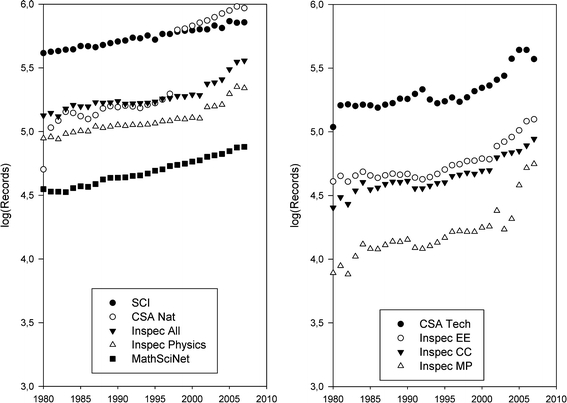
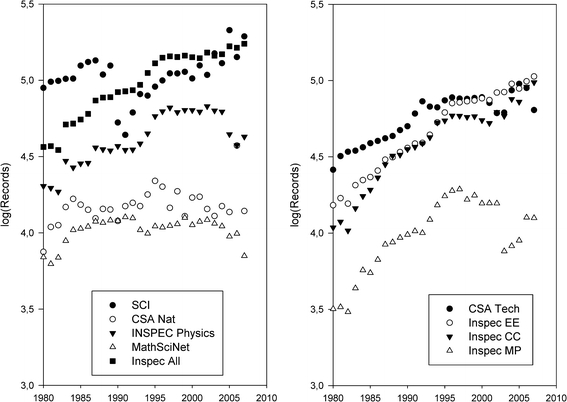
The growth rate of scientific publication has been studied from 1907 to 2007 using available data from a number of literature databases, including Science Citation Index (SCI) and Social Sciences Citation Index (SSCI). Traditional scientific publishing, that is publication in peer-reviewed journals, is still increasing although there are big differences between fields. There are no indications that the growth rate has decreased in the last 50 years. At the same time publication using new channels, for example conference proceedings, open archives and home pages, is growing fast. The growth rate for SCI up to 2007 is smaller than for comparable databases. This means that SCI was covering a decreasing part of the traditional scientific literature. There are also clear indications that the coverage by SCI is especially low in some of the scientific areas with the highest growth rate, including computer science and engineering sciences. The role of conference proceedings, open access archives and publications published on the net is increasing, especially in scientific fields with high growth rates, but this has only partially been reflected in the databases. The new publication channels challenge the use of the big databases in measurements of scientific productivity or output and of the growth rate of science. Because of the declining coverage and this challenge it is problematic that SCI has been used and is used as the dominant source for science indicators based on publication and citation numbers. The limited data available for social sciences show that the growth rate in SSCI was remarkably low and indicate that the coverage by SSCI was declining over time. National Science Indicators from Thomson Reuters is based solely on SCI, SSCI and Arts and Humanities Citation Index (AHCI). Therefore the declining coverage of the citation databases problematizes the use of this source.
Overview
The claims and statistics of this paper haven’t been checked yet.
Free: it reads the open-access text and checks the first 5 claims that cite a source we can check. Create a free account to check every claim.
Integrity signals
Registry
Cites
Statistics
Figures
Verification
Claims the paper makes
The claims and statistics of this paper haven’t been checked yet.
Free: it reads the open-access text and checks the first 5 claims that cite a source we can check. Create a free account to check every claim.
Claims other papers make about this one
Each is checked against this paper’s own text: does it say what the citing paper says it does?
The cited source says what the claim attributes to it.
In the citing paper
“The rate at which new papers are added to the scientific literature has steadily increased in recent decades [28,29].”
From The natural selection of bad science (2016) · cites this paper as [28]
Self-check
Percentages, sums and reported differences re-computed from the paper’s own numbers.
The self-check needs the paper’s full text.
Citations
Cites
An index to quantify an individual’s scientific research output
Hirsch, J. E. (2005) · Proceedings of the National Academy of Sciences · doi:10.1073/pnas.0507655102 · Cited by 11,669 · cited 1×
“The Hirsch Index (Hirsch 2005) is one example of a science indicator derived from SCI.”
BackgroundThe Matthew Effect in Science: The reward and communication systems of science are considered.
Merton, R. K. (1968) · Science · doi:10.1126/science.159.3810.56 · Cited by 6,720 · cited 2×
“This conclusion is supported with a reference to Bradford’s Law (Bradford 1950; Garfield 1972, 1979), a bibliometric version of the Pareto Law, often called the Matthew Principle: ‘to him that hath shall be given’ ( Merton 1968, 1988 ).”
(1968) · PubMed · Cited by 4,803
Price, D. J. D. S. (1963) · Columbia University Press eBooks · doi:10.7312/pric91844 · Cited by 4,264 · cited 1×
“…interest of about 7% per annum, thus doubling in size every 10–15 years, growing by a factor of 10 every half century, and by something like a factor of a million in the 300 years which separate us from the seventeenth-century invention of the scientific paper when the process began’’ (Price 1965).”
BackgroundScience and Engineering Indicators
Washington, E., & Warren, M. E. (2004) · Cited by 2,822
Garfield, E. (1972) · Science · doi:10.1126/science.178.4060.471 · Cited by 2,788
Citation Indexing-Its Theory and Application in Science, Technology, and Humanities
Goodwin, J., & Garfield, E. (1980) · Technology and Culture · doi:10.2307/3104125 · Cited by 1,639
Science and Engineering Indicators
Bond, J. S., Humphrey, D. C., Paton, K. L., Hightower, A. M., Suter, L. E., Johnson, J. M., Pollak, M., Jankowski, J. E., Lehming, R., Rausch, L. M., et al. (1993) · Defense Technical Information Center (DTIC) · Cited by 1,631
The Matthew Effect in Science, II: Cumulative Advantage and the Symbolism of Intellectual Property
Merton, R. K. (1988) · Isis · doi:10.1086/354848 · Cited by 1,397 · cited 2×
“This conclusion is supported with a reference to Bradford’s Law (Bradford 1950; Garfield 1972, 1979), a bibliometric version of the Pareto Law, often called the Matthew Principle: ‘to him that hath shall be given’ ( Merton 1968, 1988 ).”
MethodMeho, L. I., & Yang, K. (2007) · Journal of the American Society for Information Science and Technology · doi:10.1002/asi.20677 · Cited by 974 · cited 5×
“…than by using the two other sources and also that there is only a limited overlap between the citations found through Google Scholar and those found using the Web of Science (Meho 2006; Meho and Yang 2007; Bar-Ilan 2008; Kousha and Thelwall 2008; Vaughan and Shaw 2008, and references therein).”
BackgroundMethodInfluential
Research works printed but not linked: 9
- Björk, B.-C., Roos, A., & Lauro, M. (2008). Global annual volume of peer reviewed scholarly articles and the share available via Open Access options. Proceedings ELPUB2008 Conference on Electronic Publishing. Toronto, Canada, June 2008, pp. 1–10. Retrieved December 9, 2008 from http://elpub.scix.net.
- Bradford SC Documentation, Washington DC, Public Affairs Office. See: Bradford, S.C. (1953) 1950 Documentation, London Crosby Lockwood & Sons
- Google. (2008). About Google Scholar, support for scholarly publishers. Retrieved November 19, 2008 from http://scholar.google.com.
- Larsen, P.O., & von Ins, M. (2009). The steady growth of scientific publication and the declining coverage provided by science citation index. In B. Larsen & J. Leta (Eds.), Proceedings of ISSI 2009—the 12th international conference of the international society for scientometrics and informetrics, Rio de Janeiro, Brazil (Vol. 2, pp. 597–606). Published by BIREME/PAHO/WHO and Federal University of Rio de Janeiro, 2009. ISSN 2175-1935.
- Reed Elsevier. (2008). Scopus. Retrieved November 19, 2008 from http://www.reed-elsevier.com.
- Testa, J. (2008b). Regional content expansion in web of science: Opening borders to exploration (pp. 1–3). Retrieved December 7, 2008 from http://www.thomsonreuters.com/business_units/scientific/free/essays/regionalcontent/.
- Thomson Reuters. (2008b). Conference proceedings citation index. Retrieved January 15, 2009 from http://www.thomsonreuters.com/products_services/scientific/Conf_Proceedings_Citation_Index.
- Thomson Reuters. (2009a). ISI web of knowledge, journal citation reports, science edition and social sciences edition. Retrieved February 1, 2009.
- Thomson Reuters. (2009b). ISI web of knowledge, journal citation reports, science edition and social sciences edition. Retrieved July 30, 2009.
Cited by
Items 1,001–1,003 of 1,003
Jovanović, M., Yildirim, B., & Wallraff-Alsdorf, S. (2026) · Springer eBooks · doi:10.1007/978-3-030-68332-0_21-1
Growth with limited (human) intelligencePreprint
Cabello, M. (2026) · SSRN Electronic Journal · doi:10.2139/ssrn.6742738
CiteGuard: Faithful Citation Attribution for LLMs via Retrieval-Augmented Validation
Choi, Y. M., Guo, X., Fung, Y. R., & Wang, Q. (2025) · arXiv · doi:10.48550/arxiv.2510.17853
“However, conducting such practices has been increasingly difficult due to the rapid growth in the number of scientific publications (Larsen and Von Ins, 2010; Bornmann and Mutz, 2015).”
Metadata
- Authors
- Larsen, P. O., & von Ins, M.
- Corresponding author
- Larsen, Peder Olesen
- Venue
- Scientometrics
- Published
- 2010-03-10
- Volume
- 84
- Issue
- 3
- Pages
- 575-603
- ISSN
- 0138-9130 (ISSN-L)
- 1588-2861
- PMC
- PMC2909426
- OpenAlex
- W2057954853
- Semantic Scholar
- d13eb74d54385c1e1ea70a6ff536c086fa6e7422
- Cited by
- 964
- References
- 48
- Citations by year
- 2026: 27 · 2025: 49 · 2024: 58 · 2023: 65 · 2022: 65 · 2021: 81 · 2020: 99 · 2019: 65 · 2018: 83 · 2017: 74 · 2016: 82 · 2015: 78 · 2014: 60 · 2013: 49 · 2012: 15
- FWCI
- 25.46
- Type
- journal article
- Language
- en
- Open access
- hybrid
- doi.org
- Licence
- cc-by-nc
- creativecommons.org/licenses/by-nc/2.0 (tdm)
- Locations
- Scientometrics (publishedVersion, cc-by-nc)
- PubMed Central (publishedVersion, cc-by-nc)
- PubMed (publishedVersion)
- RePEc: Research Papers in Economics (acceptedVersion)
- Funders
- Statens Serum Institut
- Topics
- Social Sciences › Library and Information Sciences › scientometrics and bibliometrics research
- Social Sciences › Library and Information Sciences › Library Science and Information
- Social Sciences › Psychology › Experimental and Cognitive Psychology › Psychology Research and Bibliometrics
- Keywords
- Science Citation Index, Social Science Citation Index, peer-reviewed journals, open access archives, science indicators, engineering sciences
About these checks
Registry, retraction, Cites and statistics results are computed, not judged, with one exception: a printed reference that no index lists is read once by a model before it counts as a citation error. Claims are extracted by a model and kept only when their quote appears verbatim in the text; each cited source is then checked, with a model’s help, for whether it says what the claim relies on. Those verdicts can be wrong — read the claim’s quote and the cited source before relying on one.
Statistics and arithmetic are recomputed, not judged.
Confidence bands are shown only for fields calibrated on our annotated test set. None is calibrated yet, so no band is shown.
What counts as a claim ›How we measure confidence ›How we check this ›
Are you an author, or do you see a problem with this page? Request a review
Data sources
Bibliographic data: Semantic Scholar, OpenAlex, Crossref.
Contains information from the Semantic Scholar Academic Graph Datasets, made available under the ODC Attribution License (ODC-BY 1.0).
Semantic Scholar’s data is described in: Kinney, R., et al. (2023). The Semantic Scholar Open Data Platform. arXiv:2301.10140.
