

The rate of growth in scientific publication and the decline in coverage provided by Science Citation Index
Open accessThe DOI matches its Crossref record; 46 of the 48 references it cites were found in a registry or an index.
Abstract
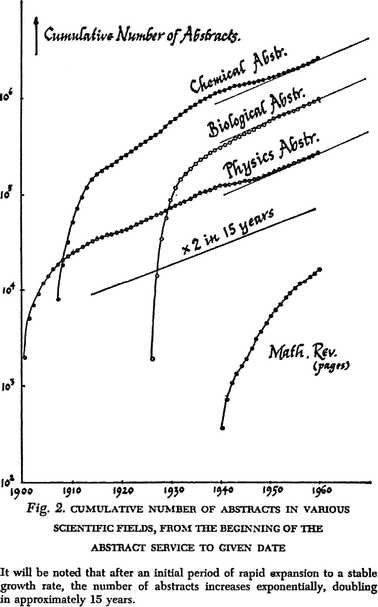
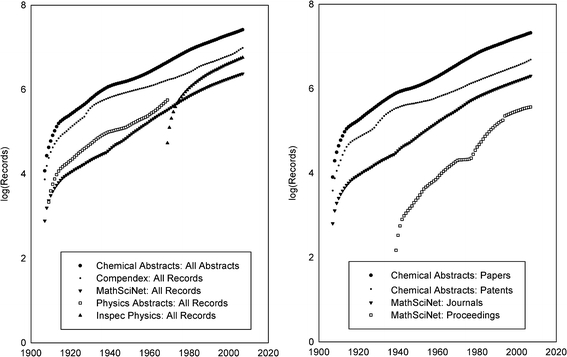
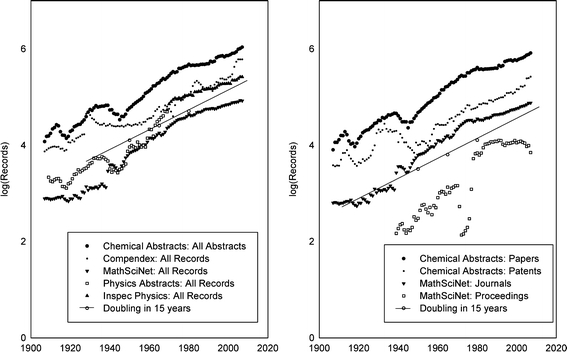
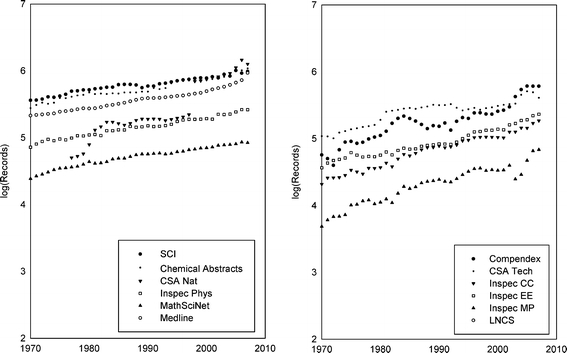
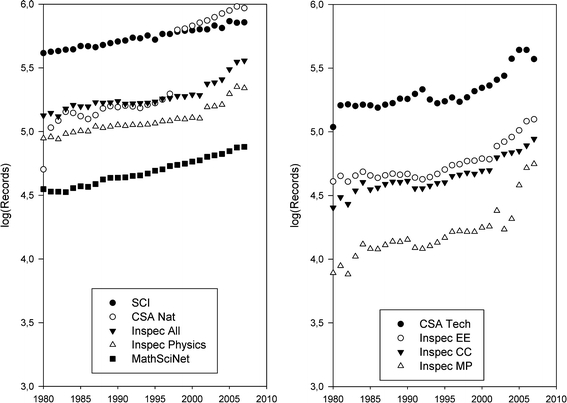
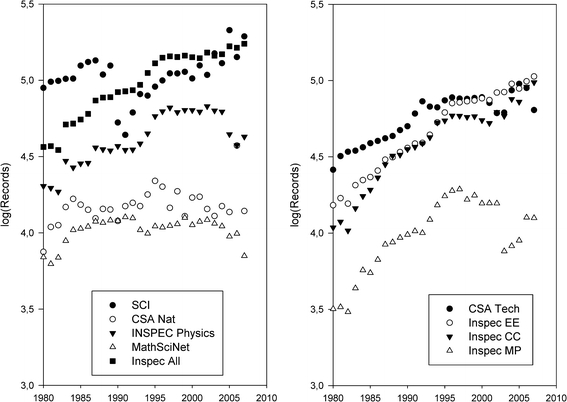
The growth rate of scientific publication has been studied from 1907 to 2007 using available data from a number of literature databases, including Science Citation Index (SCI) and Social Sciences Citation Index (SSCI). Traditional scientific publishing, that is publication in peer-reviewed journals, is still increasing although there are big differences between fields. There are no indications that the growth rate has decreased in the last 50 years. At the same time publication using new channels, for example conference proceedings, open archives and home pages, is growing fast. The growth rate for SCI up to 2007 is smaller than for comparable databases. This means that SCI was covering a decreasing part of the traditional scientific literature. There are also clear indications that the coverage by SCI is especially low in some of the scientific areas with the highest growth rate, including computer science and engineering sciences. The role of conference proceedings, open access archives and publications published on the net is increasing, especially in scientific fields with high growth rates, but this has only partially been reflected in the databases. The new publication channels challenge the use of the big databases in measurements of scientific productivity or output and of the growth rate of science. Because of the declining coverage and this challenge it is problematic that SCI has been used and is used as the dominant source for science indicators based on publication and citation numbers. The limited data available for social sciences show that the growth rate in SSCI was remarkably low and indicate that the coverage by SSCI was declining over time. National Science Indicators from Thomson Reuters is based solely on SCI, SSCI and Arts and Humanities Citation Index (AHCI). Therefore the declining coverage of the citation databases problematizes the use of this source.
Overview
The claims and statistics of this paper haven’t been checked yet.
Free: it reads the open-access text and checks the first 5 claims that cite a source we can check. Create a free account to check every claim.
Integrity signals
Registry
Cites
Statistics
Figures
Verification
Claims the paper makes
The claims and statistics of this paper haven’t been checked yet.
Free: it reads the open-access text and checks the first 5 claims that cite a source we can check. Create a free account to check every claim.
Claims other papers make about this one
Each is checked against this paper’s own text: does it say what the citing paper says it does?
The cited source says what the claim attributes to it.
In the citing paper
“The rate at which new papers are added to the scientific literature has steadily increased in recent decades [28,29].”
From The natural selection of bad science (2016) · cites this paper as [28]
Self-check
Percentages, sums and reported differences re-computed from the paper’s own numbers.
The self-check needs the paper’s full text.
Citations
Cites
An index to quantify an individual’s scientific research output
Hirsch, J. E. (2005) · Proceedings of the National Academy of Sciences · doi:10.1073/pnas.0507655102 · Cited by 11,669 · cited 1×
“The Hirsch Index (Hirsch 2005) is one example of a science indicator derived from SCI.”
BackgroundThe Matthew Effect in Science: The reward and communication systems of science are considered.
Merton, R. K. (1968) · Science · doi:10.1126/science.159.3810.56 · Cited by 6,720 · cited 2×
“This conclusion is supported with a reference to Bradford’s Law (Bradford 1950; Garfield 1972, 1979), a bibliometric version of the Pareto Law, often called the Matthew Principle: ‘to him that hath shall be given’ ( Merton 1968, 1988 ).”
(1968) · PubMed · Cited by 4,803
Price, D. J. D. S. (1963) · Columbia University Press eBooks · doi:10.7312/pric91844 · Cited by 4,264 · cited 1×
“…interest of about 7% per annum, thus doubling in size every 10–15 years, growing by a factor of 10 every half century, and by something like a factor of a million in the 300 years which separate us from the seventeenth-century invention of the scientific paper when the process began’’ (Price 1965).”
BackgroundScience and Engineering Indicators
Washington, E., & Warren, M. E. (2004) · Cited by 2,822
Garfield, E. (1972) · Science · doi:10.1126/science.178.4060.471 · Cited by 2,788
Citation Indexing-Its Theory and Application in Science, Technology, and Humanities
Goodwin, J., & Garfield, E. (1980) · Technology and Culture · doi:10.2307/3104125 · Cited by 1,639
Science and Engineering Indicators
Bond, J. S., Humphrey, D. C., Paton, K. L., Hightower, A. M., Suter, L. E., Johnson, J. M., Pollak, M., Jankowski, J. E., Lehming, R., Rausch, L. M., et al. (1993) · Defense Technical Information Center (DTIC) · Cited by 1,631
The Matthew Effect in Science, II: Cumulative Advantage and the Symbolism of Intellectual Property
Merton, R. K. (1988) · Isis · doi:10.1086/354848 · Cited by 1,397 · cited 2×
“This conclusion is supported with a reference to Bradford’s Law (Bradford 1950; Garfield 1972, 1979), a bibliometric version of the Pareto Law, often called the Matthew Principle: ‘to him that hath shall be given’ ( Merton 1968, 1988 ).”
MethodMeho, L. I., & Yang, K. (2007) · Journal of the American Society for Information Science and Technology · doi:10.1002/asi.20677 · Cited by 974 · cited 5×
“…than by using the two other sources and also that there is only a limited overlap between the citations found through Google Scholar and those found using the Web of Science (Meho 2006; Meho and Yang 2007; Bar-Ilan 2008; Kousha and Thelwall 2008; Vaughan and Shaw 2008, and references therein).”
BackgroundMethodInfluential
Research works printed but not linked: 9
- Björk, B.-C., Roos, A., & Lauro, M. (2008). Global annual volume of peer reviewed scholarly articles and the share available via Open Access options. Proceedings ELPUB2008 Conference on Electronic Publishing. Toronto, Canada, June 2008, pp. 1–10. Retrieved December 9, 2008 from http://elpub.scix.net.
- Bradford SC Documentation, Washington DC, Public Affairs Office. See: Bradford, S.C. (1953) 1950 Documentation, London Crosby Lockwood & Sons
- Google. (2008). About Google Scholar, support for scholarly publishers. Retrieved November 19, 2008 from http://scholar.google.com.
- Larsen, P.O., & von Ins, M. (2009). The steady growth of scientific publication and the declining coverage provided by science citation index. In B. Larsen & J. Leta (Eds.), Proceedings of ISSI 2009—the 12th international conference of the international society for scientometrics and informetrics, Rio de Janeiro, Brazil (Vol. 2, pp. 597–606). Published by BIREME/PAHO/WHO and Federal University of Rio de Janeiro, 2009. ISSN 2175-1935.
- Reed Elsevier. (2008). Scopus. Retrieved November 19, 2008 from http://www.reed-elsevier.com.
- Testa, J. (2008b). Regional content expansion in web of science: Opening borders to exploration (pp. 1–3). Retrieved December 7, 2008 from http://www.thomsonreuters.com/business_units/scientific/free/essays/regionalcontent/.
- Thomson Reuters. (2008b). Conference proceedings citation index. Retrieved January 15, 2009 from http://www.thomsonreuters.com/products_services/scientific/Conf_Proceedings_Citation_Index.
- Thomson Reuters. (2009a). ISI web of knowledge, journal citation reports, science edition and social sciences edition. Retrieved February 1, 2009.
- Thomson Reuters. (2009b). ISI web of knowledge, journal citation reports, science edition and social sciences edition. Retrieved July 30, 2009.
Cited by
Items 301–400 of 1,003
Brint, S., & Carr, C. E. (2017) · Minerva · doi:10.1007/s11024-017-9330-4 · Cited by 20
The narrowing of literature use and the restricted mobility of papers in the sciences
Varga, A. (2022) · Proceedings of the National Academy of Sciences · doi:10.1073/pnas.2117488119 · Cited by 19
Research focuses and trends in literacy within education: A bibliometric analysis
Ho, Y., Al‐Moraissi, E. A., Christidis, N., & Christidis, M. (2023) · Cogent Education · doi:10.1080/2331186x.2023.2287922 · Cited by 19
“It is also this desire that has given a vast number of publications, rapidly increasing over the past century (Larsen & von Ins, 2010).”
BackgroundMapping Ceramics Research and Its Evolution
Deville, S., & Stevenson, A. J. (2015) · Journal of the American Ceramic Society · doi:10.1111/jace.13699 · Cited by 19
Trends in anesthesiology research: a machine learning approach to theme discovery and summarization
Rusanov, A., Miotto, R., & Weng, C. (2018) · JAMIA Open · doi:10.1093/jamiaopen/ooy009 · Cited by 18
“In anesthesiology, as in most established scientific disciplines, the amount of available information is increasing at an exponential rate, a phenomenon which has been attributed to both the increasing rate at which scientific literature is published and to the growth in publications in less traditional venues such as…”
BackgroundThe 100 Most Cited Papers in the History of the American Surgical Association
Landreneau, J. P., Weaver, M., Delaney, C. P., Aminian, A., Dimick, J. B., Lillemoe, K. D., & Schauer, P. R. (2019) · Annals of Surgery · doi:10.1097/sla.0000000000003633 · Cited by 17
Rigor and reproducibility for data analysis and design in the behavioral sciences
Hildebrandt, T., & Prenoveau, J. M. (2020) · Behaviour Research and Therapy · doi:10.1016/j.brat.2020.103552 · Cited by 20
Ranking Papers by their Short-Term Scientific Impact
Kanellos, I., Vergoulis, T., Sacharidis, D., Dalamagas, T., & Vassiliou, Y. (2021) · IEEE International Conference on Data Engineering (ICDE) · doi:10.1109/icde51399.2021.00190 · Cited by 18
“As the number of papers published grows at an increasing rate [19,4], discerning the important papers, especially among the recent publications, becomes a hard task.”
BackgroundAl-Azzawi, R., Halvorsen, P. A., & Risør, T. (2021) · BMC Family Practice · doi:10.1186/s12875-021-01574-x · Cited by 19
“Research on this topic has shown an increase over the three decades reflecting recognition of its importance, but numbers are small when compared to the rise of published scientific literature in general [74].”
ResultIndustry 4.0 and the small business something behind the technology: A literature review
Dias, L. (2022) · Serbian Journal of Management · doi:10.5937/sjm17-36382 · Cited by 19
“The publication of academic papers is a phenomenon with a very significant regular and continuous growth for several decades (Larsen & von Ins, 2010; Bornmann, 2021).”
BackgroundWalker, K. E., Baldwin, C. L., Conroy, G., Applegate, G., Archer-Lean, C., Arthington, A. H., Behrendorff, L., Gilby, B. L., Hadwen, W. L., Henderson, C. J., et al. (2022) · Coasts · doi:10.3390/coasts2030009 · Cited by 21
LePere‐Schloop, M., & Nesbit, R. (2022) · Nonprofit and Voluntary Sector Quarterly · doi:10.1177/08997640221119728 · Cited by 17
“WoS changed their editorial policy to specifically increase the international coverage of their journal index (Basu, 2010; Larsen & Von Ins, 2010; Michels & Schmoch, 2012; Testa, 2011).”
BackgroundPicinin, C. T., Pìlatti, L. A., Kovaleski, J. L., Graeml, A. R., & Pedroso, B. (2016) · Scientometrics · doi:10.1007/s11192-016-2070-7 · Cited by 17
Calculation errors in bibliometrics : The case of CAGR
Elango, B. (2019) · Collnet Journal of Scientometrics and Information Management · doi:10.1080/09737766.2019.1694397 · Cited by 21
New Methods for Metadata Extraction from Scientific LiteraturePreprint
Tkaczyk, D. (2017) · arXiv (Cornell University) · doi:10.48550/arxiv.1710.10201 · Cited by 21
“Instead we used the text annotations from the ground truth files to assign labels to zones automatically, while the zones, lines and words themselves were constructed using our extraction and segmentation tools.”
BackgroundInfluentialRevised JNLPBA Corpus: A Revised Version of Biomedical NER Corpus for Relation Extraction TaskPreprint
Huang, M.-S., Lai, P., Tsai, R. T., & Hsu, W. (2019) · arXiv (Cornell University) · doi:10.48550/arxiv.1901.10219 · Cited by 19
Hooper, R., Goyal, N., Blok, K., & Scholten, L. (2024) · Policy Sciences · doi:10.1007/s11077-024-09548-3 · Cited by 18
“First, the exponential growth in policy-relevant research increases resource and time requirements even as time-critical policy advice is more in demand (Bornmann & Mutz, 2015 ; Larsen & Von Ins, 2010 ; Nunez-Mir et al., 2016 ).”
Gil‐Clavel, S., Wagenblast, T., & Filatova, T. (2025) · PLoS ONE · doi:10.1371/journal.pone.0318784 · Cited by 18
“This is increasingly necessary as the amount of literature grows exponentially [44], including in the CCA domain [46].”
Shaping Science for Increasing Interdependence and Specialization
Utzerath, C., & Fernández, G. (2017) · Trends in Neurosciences · doi:10.1016/j.tins.2016.12.005 · Cited by 16
Publication performance and trends in bruxism research: A bibliometric analysis
Al‐Moraissi, E. A., Ho, Y., & Christidis, N. (2023) · Journal of Oral Rehabilitation · doi:10.1111/joor.13544 · Cited by 16
“7 This since knowledge of the present literature provides a better understanding of disease causes, processes and management to the modern health professional.”
BackgroundBIP! Finder: Facilitating Scientific Literature Search by Exploiting Impact-Based Ranking
Vergoulis, T., Chatzopoulos, S., Kanellos, I., Deligiannis, P. K., Tryfonopoulos, C., & Dalamagas, T. (2019) · ACM International Conference on Information and Knowledge Management (CIKM) · doi:10.1145/3357384.3357850 · Cited by 19
“In the last decades, the growth rate of scientific articles has been increasing, a trend that is expected to continue [7].”
BackgroundSobkowicz, P. (2015) · Journal of Artificial Societies and Social Simulation · doi:10.18564/jasss.2750 · Cited by 21
Seel, N. M., & Zierer, K. (2019) · Research in Comparative and International Education · doi:10.1177/1745499919846189 · Cited by 21
Wouters, P. F., Thelwall, M. A., Kousha, K., Waltman, L., de Rijcke, S., & Franssen, T. (2015) · Cited by 17
Evaluating the potential risks of employing large language models in peer review
Zhu, L., Lai, Y., Xie, J., Mou, W., Huang, L., Qi, C., Yang, T., Jiang, A., Gan, W., Zeng, D., et al. (2025) · Clinical and Translational Discovery · doi:10.1002/ctd2.70067 · Cited by 23
Comprehensive review of academic search systems: evolution, analysis, and future research directions
Khalid, S., Almutairi, S. S., Namoun, A., Khan, J., Khattak, H. A., & Shah, H. (2025) · Social Network Analysis and Mining · doi:10.1007/s13278-025-01476-1 · Cited by 19
“It enhances the search experience through refined filters based on popularity, influence, citation count, publication The accelerating growth of scientific publications, a trend projected to continue (Larsen and Von Ins 2010), underscores the necessity of such AI-enhanced platforms.”
Fütterer, T., Campos, D., Gfrörer, T., Lavelle-Hill, R. E., Murayama, K., & Scherer, R. (2025) · Learning and Individual Differences · doi:10.1016/j.lindif.2025.102849 · Cited by 18
Soil erosion in geomorphological studies: Recent trends and future directions
Quesada‐Román, A., Montalván-Burbano, N., Camacho, M. E., Kariminejad, N., Islam, A., & Domazetović, F. (2025) · Progress in Physical Geography Earth and Environment · doi:10.1177/03091333251354852 · Cited by 16
“This growth re-fl ects a broader global trend across most scienti fi c disciplines, driven by the expansion of academic journals, the rise in the number of published issues, and the increasing number of active researchers worldwide (Bornmann and Mutz, 2015; Larsen and Von Ins, 2010).”
Levels of evidence and journal impact factor in oral and maxillofacial surgery: a 15-year follow-up
Nabil, S., & Samman, N. (2020) · International Journal of Oral and Maxillofacial Surgery · doi:10.1016/j.ijom.2020.11.021 · Cited by 15
Estudio comparativo de cinco revistas de Ciencias del Deporte indizadas en WoS
Villamón, M., Job, I., Valcárcel, J. V., & Devís‐Devís, J. (2012) · Dipòsit Digital de Documents de la UAB (Universitat Autònoma de Barcelona) · Cited by 15
Setting standards for medical writing in orthopaedics
Mauffrey, C. P., Scarlat, M. M., & Pecina, M. M. (2013) · International Orthopaedics · doi:10.1007/s00264-013-2189-6 · Cited by 15
“Today, the number of journals and papers published has increased dramatically [1], most of them with arguable clinical impact.”
BackgroundTrends in marine climate change research in the Nordic region since the first IPCC report
Pedersen, M. W., Kokkalis, A., Bárðarson, H., Bonanomi, S., Boonstra, W. J., Butler, W., Diekert, F., Fouzai, N., Holma, M., Holt, R. E., et al. (2015) · Climatic Change · doi:10.1007/s10584-015-1536-6 · Cited by 15
Research Culture in Indian Universities
Patel, P. J. (2016) · Social Change · doi:10.1177/0049085716635398 · Cited by 15
Reporting of data analysis methods in psychiatric journals: Trends from 1996 to 2018
Nieminen, P. A., & Kaur, J. (2019) · International Journal of Methods in Psychiatric Research · doi:10.1002/mpr.1784 · Cited by 16
Ioannoni, V., Vitale, T., Costa, C., & Elliott, I. (2020) · Scientometrics · doi:10.1007/s11192-020-03352-5 · Cited by 12
The Edited Collection: Pasts, Present and Futures
Webster, P. (2020) · Cambridge University Press eBooks · doi:10.1017/9781108683647 · Cited by 24
EU27 and USA leadership in fruit and vegetable research: a bibliometric study from 2000 to 2009
Tatry, M., Fournier, D., Jeannequin, B., & Dosba, F. (2013) · Scientometrics · doi:10.1007/s11192-013-1160-z · Cited by 15
A meta-database of peatland palaeoecology in Great Britain
Payne, R. J., Ratcliffe, J. L., Andersen, R., & Flitcroft, C. E. (2016) · Palaeogeography Palaeoclimatology Palaeoecology · doi:10.1016/j.palaeo.2016.05.025 · Cited by 18
Determining the biases and consistencies in the evidence for conservation
Christie, A. P. (2021) · Apollo (University of Cambridge) · doi:10.17863/cam.68583 · Cited by 15
Borges, L., Fischer, B. B., Mazoni, A., & Bascur, J. P. (2025) · Cogent Education · doi:10.1080/2331186x.2025.2563708 · Cited by 15
“Moreover, traditional academic publishing continues to grow across research fields (Larsen & Von Ins, 2010), with scientific collaboration becoming increasingly important even in historically less collaborative fields of knowledge (Wuchty et al., 2007).”
Impact of GPT on the Academic Ecosystem
Cai, Y., Deng, Q., Lv, T., Zhang, W., & Zhou, Y. (2024) · Science & Education · doi:10.1007/s11191-024-00561-9 · Cited by 17
“These two factors together determine that with the support of GPT, the efficiency of human knowledge acquisition is likely to improve rapidly.”
BioKGrapher: Initial evaluation of automated knowledge graph construction from biomedical literature
Schäfer, H., Idrissi-Yaghir, A., Arzideh, K., Damm, H., Pakull, T. M. G., Schmidt, C. S., Bahn, M., Lodde, G. C., Livingstone, E., Schadendorf, D., et al. (2024) · Computational and Structural Biotechnology Journal · doi:10.1016/j.csbj.2024.10.017 · Cited by 19
Schulz, R., & Bundschuh, M. (2020) · Springer eBooks · doi:10.1007/978-3-030-49480-3_3 · Cited by 17
Mapping the (anti-)corruption field: key topics and changing trends, 1968–2020
Alvarez, J. P., & Sanz, I. P. (2021) · Journal of Computational Social Science · doi:10.1007/s42001-021-00110-2 · Cited by 22
Understanding online collaboration technology adoption by researchers – a model and empirical study
Bullinger, A. C., Renken, U., & Moeslein, K. M. (2011) · AIS Electronic Library (AISeL) · Cited by 15
Open-Access Databases as Unprecedented Resources and Drivers of Cultural Change in Fisheries Science
McManamay, R. A., & Utz, R. M. (2014) · Fisheries · doi:10.1080/03632415.2014.946128 · Cited by 17
Tudománymetria és neveléstudomány
Nagy, G. (2016) · Iskolakultúra · doi:10.17543/iskkult.2016.2.50 · Cited by 16
Citation Analysis for Biomedical and Health Sciences Journals Published in Korea
Oh, J., Chang, H., Kim, J. A., Choi, M., Park, Z., Cho, Y., & Lee, E.-G. (2017) · Healthcare Informatics Research · doi:10.4258/hir.2017.23.3.218 · Cited by 14
“Globally, the number of scholarly journal publications in the biomedical and health science field has risen sharply in recent years [1].”
BackgroundThe preferences of Chinese LIS journal articles in citing works outside the discipline
Chen, C., Li, Q., Deng, Z., Chiu, K., & Wang, P. (2017) · Journal of Documentation · doi:10.1108/jd-04-2017-0057 · Cited by 14
A burden of knowledge creation in academic research: evidence from publication data
Schweitzer, S., & Brendel, J. (2017) · Industry and Innovation · doi:10.1080/13662716.2020.1716693 · Cited by 17
“As Larsen and von Ins (2010) note, there is no perfect solution for accommodating both potential effects in one analysis.”
Assessing the Scholarly Reach of Terman’s Work
Hodges, J., Mun, R. U., Oveross, M. E., & Ottwein, J. K. (2020) · Gifted Child Quarterly · doi:10.1177/0016986220928322 · Cited by 15
“In our analysis, we use Larsen and von Ins’ (2010) and Bornmann and Mutz’s (2015) benchmarks to compare how Terman’s studies might compare with an article with similar citations.”
MethodThe Future of Benthic Indicators: Moving up to the Intertidal
Spilmont, N. (2013) · Open Journal of Marine Science · doi:10.4236/ojms.2013.32a008 · Cited by 14
“It is, however, well known that the growth rate of scientific publication is almost constantly raising [21,22].”
BackgroundMethodHähnke, V. D., Bolton, E., & Bryant, S. H. (2015) · Journal of Cheminformatics · doi:10.1186/s13321-015-0076-4 · Cited by 15
“If the count of scientific publications [48] and known chemical substances [49, 50] illustrated in Fig.”
BackgroundLibrary and information science research in BRICS countries
Tripathi, M., Jeevan, V. K. J., Babbar, P., & Mahemei, L. K. (2018) · Information and Learning Sciences · doi:10.1108/ils-10-2017-0101 · Cited by 21
Junying, F., Frietsch, R., & Tagscherer, U. (2013) · RePEc: Research Papers in Economics · doi:10.24406/publica-fhg-296538 · Cited by 14
Adapted Sport: A Bibliometric Analysis
Pisà-Canyelles, J., Pérez‐Gómez, J., Castillo-Paredes, A., Denche-Zamorano, Á. M., Pastor-Cisneros, R., Siquier-Coll, J., My works are correct, B. M. I. A. A. I. S. R. L. M. T. I. D. A.-M., & Mendoza-Muñoz, M. (2023) · Retos · doi:10.47197/retos.v50.99441 · Cited by 13
“However, there are few researchers studying AS, resulting in a low citation ratio (Larsen & von Ins, 2010).”
BackgroundPaying reviewers and regulating the number of papers may help fix the peer-review process
Seghier, M. L. (2025) · F1000Research · doi:10.12688/f1000research.148985.4 · Cited by 17
Schatz, G. (2014) · Nature Reviews Molecular Cell Biology · doi:10.1038/nrm3807 · Cited by 13
Bibliometric analysis of parasitological research in iran and Turkey: a comparative study.
Rashidi, A., Rahimi, B., & Delirrad, M. (2013) · PubMed Central · Cited by 13
Data exchange standards to support and acknowledge peer‐review activity
Paglione, L., & Lawrence, R. N. (2015) · Learned Publishing · doi:10.1087/20150411 · Cited by 13
Vision & Change: Why It Matters
McLaughlin, J., & Metz, A. M. (2016) · The American Biology Teacher · doi:10.1525/abt.2016.78.6.456 · Cited by 17
SwICS: Section-Wise In-Text Citation Score
Khan, A. M., Shahid, A., Afzal, M. T., Nazar, F., Alotaibi, F. S., & Alyoubi, K. H. (2019) · IEEE Access · doi:10.1109/access.2019.2942322 · Cited by 14
ArtSim: Improved Estimation of Current Impact for Recent Articles
Chatzopoulos, S., Vergoulis, T., Kanellos, I., Dalamagas, T., & Tryfonopoulos, C. (2020) · Communications in computer and information science · doi:10.1007/978-3-030-55814-7_27 · Cited by 13
“With the growth rate of scientific articles continuously increasing [8], the reliable assessment of their scientific impact is now more valuable than ever.”
BackgroundA never-ending search for the truth: Thermodynamics in the uncertain era of the internet
Frenkel, M. (2014) · The Journal of Chemical Thermodynamics · doi:10.1016/j.jct.2014.12.016 · Cited by 13
Evaluation of a Case-based Urology Learning Program
Mishra, K., Snow-Lisy, D. C., Ross, J. H., Goldfarb, D. A., Goldman, H. B., & Campbell, S. C. (2013) · Urology · doi:10.1016/j.urology.2013.09.007 · Cited by 13
Reading Between the Lines: A Computational Bibliometric Analysis on Emotion Regulation
Fernández‐Álvarez, J., Cipresso, P., Colombo, D., Botella, C., & Riva, G. (2018) · Lecture notes of the Institute for Computer Sciences, Social Informatics and Telecommunications Engineering · doi:10.1007/978-3-030-01093-5_16 · Cited by 15
“In order to see that this growth is not a mere effect of the general increase of scientific publications [13], 3 other constructs that are convergent to emotion regulation, such as emotional intelligence, emotional reactivity and mental control were also included in the chart (Fig.”
Digital transformation of academic medicine: Breaking barriers, borders, and boredom
Hanke, R. E., Gibbons, A. T., Berazaluce, A. M. C., & Ponsky, T. A. (2019) · Journal of Pediatric Surgery · doi:10.1016/j.jpedsurg.2019.10.037 · Cited by 13
A Systematic Approach to Map the Research Articles’ Sections to IMRAD
Ahmed, I., & Afzal, M. T. (2020) · IEEE Access · doi:10.1109/access.2020.3009021 · Cited by 13
“The amount is believed to get doubled after every five-year [1].”
BackgroundThe Pioneering Role of Sci in Post Publication Public Peer Review (P4R)
Abdin, A. Y., Nasim, M. J., Ney, Y., & Jacob, C. (2021) · Publications · doi:10.20944/preprints202101.0395.v1 · Cited by 14
Sharma, B. M., Kalina, J., Whaley, P., & Scheringer, M. (2021) · Environment International · doi:10.1016/j.envint.2021.106437 · Cited by 14
The Challenge of Ensuring Persistency of Identifier Systems in the World of Ever-Changing Technology
Car, N. N. J., Golodoniuc, P., & Klump, J. (2017) · Data Science Journal · doi:10.5334/dsj-2017-013 · Cited by 13
“Larsen and von Ins (2010) chart the rate of growth of scientific publications in the 20 th century and numerous sources chart the exponential growth in digital data in the early decades of the 21 st century, such as King (2011) and Stadd (2013).”
BackgroundSection-wise indexing and retrieval of research articles
Shahid, A., & Afzal, M. T. (2017) · Cluster Computing · doi:10.1007/s10586-017-0914-4 · Cited by 13
“The publishing venues such as journals, conferences, and open archives are also increasing [1].”
BackgroundDiscovering ethnic minority business research directions using text mining and topic modelling
Moro, S., Pires, G. D., Rita, P., Cortez, P. C., & Ramos, R. F. (2022) · Journal of Research in Marketing and Entrepreneurship · doi:10.1108/jrme-01-2022-0004 · Cited by 18
Lee, S., Heinen, S., Khan, D., & von Lilienfeld, O. A. (2024) · Machine Learning Science and Technology · doi:10.1088/2632-2153/ad2f52 · Cited by 18
Presente y futuro de las revistas científicas
Dinu, N.-R., & Baiget, T. (2019) · Scire representación y organización del conocimiento · doi:10.54886/scire.v25i1.4611 · Cited by 12
Ecological processes associated with different animal taxa in urban environments
Evans, M. J., Barton, P. S., Westgate, M. J., Soga, M., Fujita, G., & Miyashita, T. (2021) · Ecosphere · doi:10.1002/ecs2.3712 · Cited by 12
Global trends in smoking cessation research from 2002 to 2021: A bibliometric and visual analysis
Xu, Y., Gu, Z., Zhang, Y., He, M., Gerber, B. S., Sadasivam, R. S., Liu, F., & Wang, Z. (2022) · Preventive Medicine Reports · doi:10.1016/j.pmedr.2022.101991 · Cited by 13
Doherty, C. (2023) · PLoS ONE · doi:10.1371/journal.pone.0284133 · Cited by 12
“Today, students in medicine, nursing, radiography and physiotherapy have at their disposal a catalogue of audio, video, text and mixed realitybased media on different content sharing platforms to support their learning needs [2].”
BackgroundMund, C., & Neuhäusler, P. (2015) · Journal of Informetrics · doi:10.1016/j.joi.2015.09.004 · Cited by 14
Boukacem‐Zeghmouri, C. (2015) · Les Enjeux de l information et de la communication · doi:10.3917/enic.016.0049 · Cited by 14
Developing educators for continuing professional development
Mack, H. G., Sandhu, S. S., & Filipe, H. P. (2016) · Canadian Journal of Ophthalmology · doi:10.1016/j.jcjo.2016.03.008 · Cited by 13
Bibliografia naukometryczno-bibliometryczno-informetryczna (wybór)
Kokowski, M. (2015) · Prace Komisji Historii Nauki PAU · doi:10.4467/23921749pkhn_pau.16.009.5265 · Cited by 15
Consensus‐based journal rankings: A complementary tool for bibliometric evaluation
Aledo, J. A., Gámez, J. A., Molina, D., & Suárez, A. R. (2018) · Journal of the Association for Information Science and Technology · doi:10.1002/asi.24040 · Cited by 12
Suominen, A., Haoshu, P., & Ranaei, S. (2018) · Technological Forecasting and Social Change · doi:10.1016/j.techfore.2018.10.008 · Cited by 13
“This increase of 704 % in publication numbers is the product of research uptake and is much higher than the overall growth of scientific publishing, which is approximately 5% per year (Larsen and Ins, 2010).”
BackgroundThe h-index and multi-author hm-index for individual researchers in condensed matter physics
Tietze, A., & Hofmann, P. (2019) · Scientometrics · doi:10.1007/s11192-019-03051-w · Cited by 13
Ramos, M. B., Falavigna, A., Abduljabbar, F. H., Rabau, O., Ferland, C. E., Weber, M. H., Ouellet, J. A., & Teles, A. R. (2019) · World Neurosurgery · doi:10.1016/j.wneu.2019.07.146 · Cited by 12
Identifying the Central Figure of a Scientific Paper
Yang, S. T., Lee, P.-S., Kazakova, L., Joshi, A., Oh, B. M., West, J. D., & Howe, B. (2019) · IAPR International Conference on Document Analysis and Recognition (ICDAR) · doi:10.1109/icdar.2019.00173 · Cited by 16
“Plus, the overwhelming scale of scientific publications [26], [27] that are published every year.”
BackgroundValentine Joseph Owan, P. D., & Owan, M. V. (2021) · Mediterranean Journal of Social & Behavioral Research · doi:10.30935/mjosbr/10805 · Cited by 12
Pearce, M. W., Lindsay, D., Méndez, D., Crowe, M., Emtage, N. F., & Jones, R. E. (2021) · International journal of doctoral studies · doi:10.28945/4875 · Cited by 14
Review of key performance indicators for measuring innovation process performance
Nappi, V., & Kelly, K. R. (2022) · International Journal of Entrepreneurship and Innovation Management · doi:10.1504/ijeim.2022.10045044 · Cited by 15
Chang, W.-Y., Garner, M., Basner, J. E., Weinberg, B. A., & Owen-Smith, J. D. (2022) · Harvard Data Science Review · doi:10.1162/99608f92.1e23fb3f · Cited by 13
Water Resources Science, Policy, and Politics for the Florida Everglades
Graf, W. L. (2013) · Annals of the Association of American Geographers · doi:10.1080/00045608.2013.754684 · Cited by 12
Mangroves: A Threatened Ecosystem Under-Utilized as a Resource for Scientific Research
Beys‐da‐Silva, W. O., Santi, L., & Guimarães, J. A. (2014) · Journal of Sustainable Development · doi:10.5539/jsd.v7n5p40 · Cited by 12
Human Computer Interaction Meets Psychophysiology: A Critical Perspective
Spapé, M., Filetti, M., Eugster, M. J. A., Jacucci, G., & Ravaja, N. (2015) · Lecture notes in computer science · doi:10.1007/978-3-319-24917-9_16 · Cited by 12
“Of course, scientific production in general continues to grow [13], but it is fair to say that up until 1993, EEG was a fairly uncommon interest for HCI, with ca.”
BackgroundHusemann, M., Rogers, R., Meyer, S. T., & Habel, J. C. (2017) · Humanities and Social Sciences Communications · doi:10.1057/palcomms.2017.32 · Cited by 14
Topology-driven trend analysis for drug discovery
Lv, Y., Ding, Y., Song, M., & Duan, Z. (2018) · Journal of Informetrics · doi:10.1016/j.joi.2018.07.007 · Cited by 13
The representative works of scientists
Zhou, J., Zeng, A., Fan, Y., & Di, Z. (2018) · Scientometrics · doi:10.1007/s11192-018-2918-0 · Cited by 13
Weak evidence of country- and institution-related status bias in the peer review of abstracts
Nielsen, M. W., Baker, C. F., Brady, E., Petersen, M. B., & Andersen, J. P. (2021) · eLife · doi:10.7554/elife.64561 · Cited by 20
Editorial: Increased Manuscript Submissions Prompt Journals to Make Hard Choices
Leopold, S. S. (2015) · Clinical Orthopaedics and Related Research · doi:10.1007/s11999-014-4129-1 · Cited by 12
“One quantitative analysis suggested that the volume of scientific manuscript submissions to journals doubles every 15 years or so [7].”
BackgroundBornmann, L., & Mutz, R. (2014) · arXiv · doi:10.48550/arxiv.1402.4578 · Cited by 11
Metadata
- Authors
- Larsen, P. O., & von Ins, M.
- Corresponding author
- Larsen, Peder Olesen
- Venue
- Scientometrics
- Published
- 2010-03-10
- Volume
- 84
- Issue
- 3
- Pages
- 575-603
- ISSN
- 0138-9130 (ISSN-L)
- 1588-2861
- PMC
- PMC2909426
- OpenAlex
- W2057954853
- Semantic Scholar
- d13eb74d54385c1e1ea70a6ff536c086fa6e7422
- Cited by
- 964
- References
- 48
- Citations by year
- 2026: 27 · 2025: 49 · 2024: 58 · 2023: 65 · 2022: 65 · 2021: 81 · 2020: 99 · 2019: 65 · 2018: 83 · 2017: 74 · 2016: 82 · 2015: 78 · 2014: 60 · 2013: 49 · 2012: 15
- FWCI
- 25.46
- Type
- journal article
- Language
- en
- Open access
- hybrid
- doi.org
- Licence
- cc-by-nc
- creativecommons.org/licenses/by-nc/2.0 (tdm)
- Locations
- Scientometrics (publishedVersion, cc-by-nc)
- PubMed Central (publishedVersion, cc-by-nc)
- PubMed (publishedVersion)
- RePEc: Research Papers in Economics (acceptedVersion)
- Funders
- Statens Serum Institut
- Topics
- Social Sciences › Library and Information Sciences › scientometrics and bibliometrics research
- Social Sciences › Library and Information Sciences › Library Science and Information
- Social Sciences › Psychology › Experimental and Cognitive Psychology › Psychology Research and Bibliometrics
- Keywords
- Science Citation Index, Social Science Citation Index, peer-reviewed journals, open access archives, science indicators, engineering sciences
About these checks
Registry, retraction, Cites and statistics results are computed, not judged, with one exception: a printed reference that no index lists is read once by a model before it counts as a citation error. Claims are extracted by a model and kept only when their quote appears verbatim in the text; each cited source is then checked, with a model’s help, for whether it says what the claim relies on. Those verdicts can be wrong — read the claim’s quote and the cited source before relying on one.
Statistics and arithmetic are recomputed, not judged.
Confidence bands are shown only for fields calibrated on our annotated test set. None is calibrated yet, so no band is shown.
What counts as a claim ›How we measure confidence ›How we check this ›
Are you an author, or do you see a problem with this page? Request a review
Data sources
Bibliographic data: Semantic Scholar, OpenAlex, Crossref.
Contains information from the Semantic Scholar Academic Graph Datasets, made available under the ODC Attribution License (ODC-BY 1.0).
Semantic Scholar’s data is described in: Kinney, R., et al. (2023). The Semantic Scholar Open Data Platform. arXiv:2301.10140.
