

The rate of growth in scientific publication and the decline in coverage provided by Science Citation Index
Open accessThe DOI matches its Crossref record; 46 of the 48 references it cites were found in a registry or an index.
Abstract
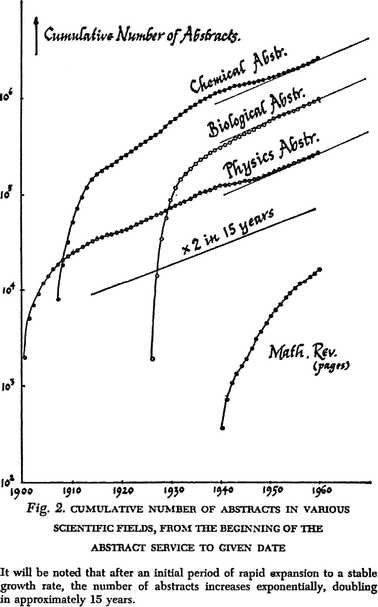
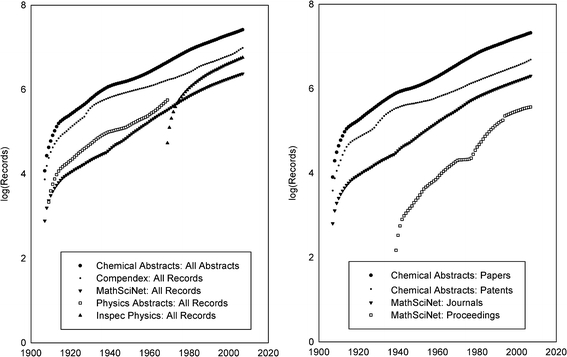
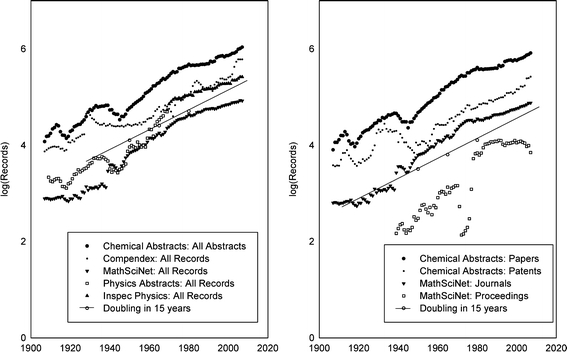
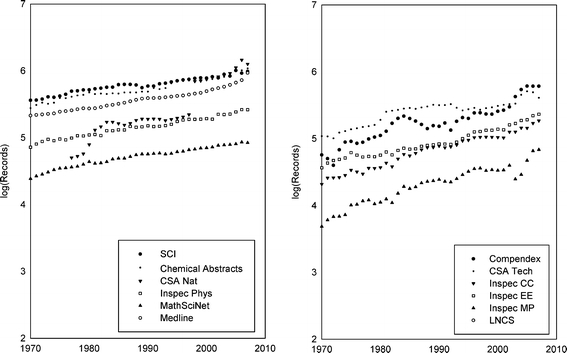
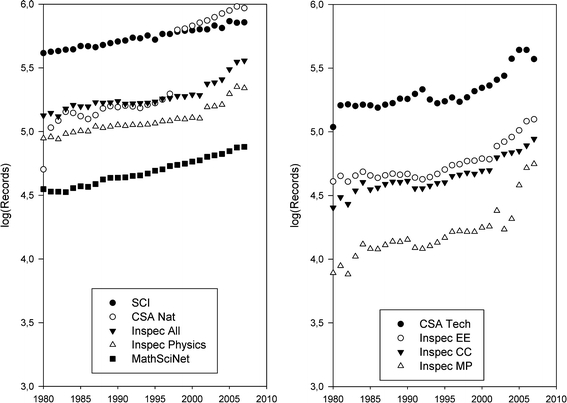
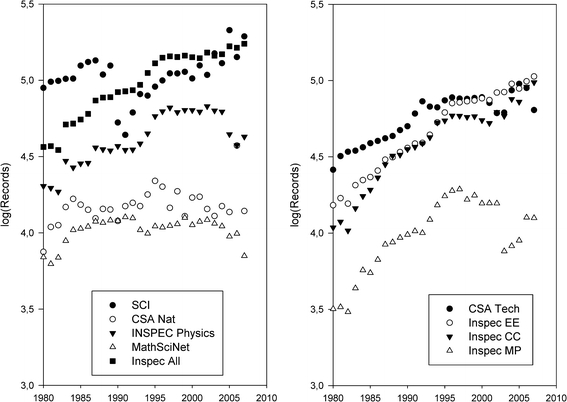
The growth rate of scientific publication has been studied from 1907 to 2007 using available data from a number of literature databases, including Science Citation Index (SCI) and Social Sciences Citation Index (SSCI). Traditional scientific publishing, that is publication in peer-reviewed journals, is still increasing although there are big differences between fields. There are no indications that the growth rate has decreased in the last 50 years. At the same time publication using new channels, for example conference proceedings, open archives and home pages, is growing fast. The growth rate for SCI up to 2007 is smaller than for comparable databases. This means that SCI was covering a decreasing part of the traditional scientific literature. There are also clear indications that the coverage by SCI is especially low in some of the scientific areas with the highest growth rate, including computer science and engineering sciences. The role of conference proceedings, open access archives and publications published on the net is increasing, especially in scientific fields with high growth rates, but this has only partially been reflected in the databases. The new publication channels challenge the use of the big databases in measurements of scientific productivity or output and of the growth rate of science. Because of the declining coverage and this challenge it is problematic that SCI has been used and is used as the dominant source for science indicators based on publication and citation numbers. The limited data available for social sciences show that the growth rate in SSCI was remarkably low and indicate that the coverage by SSCI was declining over time. National Science Indicators from Thomson Reuters is based solely on SCI, SSCI and Arts and Humanities Citation Index (AHCI). Therefore the declining coverage of the citation databases problematizes the use of this source.
Overview
The claims and statistics of this paper haven’t been checked yet.
Free: it reads the open-access text and checks the first 5 claims that cite a source we can check. Create a free account to check every claim.
Integrity signals
Registry
Cites
Statistics
Figures
Verification
Claims the paper makes
The claims and statistics of this paper haven’t been checked yet.
Free: it reads the open-access text and checks the first 5 claims that cite a source we can check. Create a free account to check every claim.
Claims other papers make about this one
Each is checked against this paper’s own text: does it say what the citing paper says it does?
The cited source says what the claim attributes to it.
In the citing paper
“The rate at which new papers are added to the scientific literature has steadily increased in recent decades [28,29].”
From The natural selection of bad science (2016) · cites this paper as [28]
Self-check
Percentages, sums and reported differences re-computed from the paper’s own numbers.
The self-check needs the paper’s full text.
Citations
Cites
An index to quantify an individual’s scientific research output
Hirsch, J. E. (2005) · Proceedings of the National Academy of Sciences · doi:10.1073/pnas.0507655102 · Cited by 11,669 · cited 1×
“The Hirsch Index (Hirsch 2005) is one example of a science indicator derived from SCI.”
BackgroundThe Matthew Effect in Science: The reward and communication systems of science are considered.
Merton, R. K. (1968) · Science · doi:10.1126/science.159.3810.56 · Cited by 6,720 · cited 2×
“This conclusion is supported with a reference to Bradford’s Law (Bradford 1950; Garfield 1972, 1979), a bibliometric version of the Pareto Law, often called the Matthew Principle: ‘to him that hath shall be given’ ( Merton 1968, 1988 ).”
(1968) · PubMed · Cited by 4,803
Price, D. J. D. S. (1963) · Columbia University Press eBooks · doi:10.7312/pric91844 · Cited by 4,264 · cited 1×
“…interest of about 7% per annum, thus doubling in size every 10–15 years, growing by a factor of 10 every half century, and by something like a factor of a million in the 300 years which separate us from the seventeenth-century invention of the scientific paper when the process began’’ (Price 1965).”
BackgroundScience and Engineering Indicators
Washington, E., & Warren, M. E. (2004) · Cited by 2,822
Garfield, E. (1972) · Science · doi:10.1126/science.178.4060.471 · Cited by 2,788
Citation Indexing-Its Theory and Application in Science, Technology, and Humanities
Goodwin, J., & Garfield, E. (1980) · Technology and Culture · doi:10.2307/3104125 · Cited by 1,639
Science and Engineering Indicators
Bond, J. S., Humphrey, D. C., Paton, K. L., Hightower, A. M., Suter, L. E., Johnson, J. M., Pollak, M., Jankowski, J. E., Lehming, R., Rausch, L. M., et al. (1993) · Defense Technical Information Center (DTIC) · Cited by 1,631
The Matthew Effect in Science, II: Cumulative Advantage and the Symbolism of Intellectual Property
Merton, R. K. (1988) · Isis · doi:10.1086/354848 · Cited by 1,397 · cited 2×
“This conclusion is supported with a reference to Bradford’s Law (Bradford 1950; Garfield 1972, 1979), a bibliometric version of the Pareto Law, often called the Matthew Principle: ‘to him that hath shall be given’ ( Merton 1968, 1988 ).”
MethodMeho, L. I., & Yang, K. (2007) · Journal of the American Society for Information Science and Technology · doi:10.1002/asi.20677 · Cited by 974 · cited 5×
“…than by using the two other sources and also that there is only a limited overlap between the citations found through Google Scholar and those found using the Web of Science (Meho 2006; Meho and Yang 2007; Bar-Ilan 2008; Kousha and Thelwall 2008; Vaughan and Shaw 2008, and references therein).”
BackgroundMethodInfluential
Research works printed but not linked: 9
- Björk, B.-C., Roos, A., & Lauro, M. (2008). Global annual volume of peer reviewed scholarly articles and the share available via Open Access options. Proceedings ELPUB2008 Conference on Electronic Publishing. Toronto, Canada, June 2008, pp. 1–10. Retrieved December 9, 2008 from http://elpub.scix.net.
- Bradford SC Documentation, Washington DC, Public Affairs Office. See: Bradford, S.C. (1953) 1950 Documentation, London Crosby Lockwood & Sons
- Google. (2008). About Google Scholar, support for scholarly publishers. Retrieved November 19, 2008 from http://scholar.google.com.
- Larsen, P.O., & von Ins, M. (2009). The steady growth of scientific publication and the declining coverage provided by science citation index. In B. Larsen & J. Leta (Eds.), Proceedings of ISSI 2009—the 12th international conference of the international society for scientometrics and informetrics, Rio de Janeiro, Brazil (Vol. 2, pp. 597–606). Published by BIREME/PAHO/WHO and Federal University of Rio de Janeiro, 2009. ISSN 2175-1935.
- Reed Elsevier. (2008). Scopus. Retrieved November 19, 2008 from http://www.reed-elsevier.com.
- Testa, J. (2008b). Regional content expansion in web of science: Opening borders to exploration (pp. 1–3). Retrieved December 7, 2008 from http://www.thomsonreuters.com/business_units/scientific/free/essays/regionalcontent/.
- Thomson Reuters. (2008b). Conference proceedings citation index. Retrieved January 15, 2009 from http://www.thomsonreuters.com/products_services/scientific/Conf_Proceedings_Citation_Index.
- Thomson Reuters. (2009a). ISI web of knowledge, journal citation reports, science edition and social sciences edition. Retrieved February 1, 2009.
- Thomson Reuters. (2009b). ISI web of knowledge, journal citation reports, science edition and social sciences edition. Retrieved July 30, 2009.
Cited by
Items 101–200 of 1,003
Chen, Y., Wu, J., Haschler, I., Majeed, A., Chen, T., & Wetter, T. C. (2011) · PLoS ONE · doi:10.1371/journal.pone.0021404 · Cited by 65
Marion, S., Davies, A. L., Demšar, U., Irvine, R. J., Stephens, P. A., & Long, J. (2020) · Global Ecology and Conservation · doi:10.1016/j.gecco.2020.e00917 · Cited by 74
Bite-size science and its undesired side effects
Bertamini, M., & Munafò, M. R. (2012) · Perspectives on Psychological Science · doi:10.1177/1745691611429353 · Cited by 62
The Scientometric Bubble Considered Harmful
Génova, G., Hernán Astudillo, R., & Fraga, A. (2015) · Science and Engineering Ethics · doi:10.1007/s11948-015-9632-6 · Cited by 65
MetaBUS as a vehicle for facilitating meta-analysis
Bosco, F. A., Uggerslev, K. L., & Steel, P. (2016) · Human Resource Management Review · doi:10.1016/j.hrmr.2016.09.013 · Cited by 68
Rezaeian, M., Montazeri, H., & Loonen, R. (2017) · Technological Forecasting and Social Change · doi:10.1016/j.techfore.2017.02.027 · Cited by 62
The prospects for family business in research universities
Stewart, A., & Miner, A. S. (2011) · Journal of Family Business Strategy · doi:10.1016/j.jfbs.2011.01.005 · Cited by 67
Five Strategies to Effectively Use Online Resources in Emergency Medicine
Thoma, B., Joshi, N. K., Trueger, N. S., Chan, T. M., & Lin, M. (2014) · Annals of Emergency Medicine · doi:10.1016/j.annemergmed.2014.05.029 · Cited by 63
“INTRODUCTION For health professions learners of all levels, staying abreast of the literature can seem like an insurmountable task as the number of clinically oriented articles continues to grow at an increasing rate.(1,2) Fortunately, there has been a veritable explosion of online secondary resources that endeavor to…”
BackgroundParameterization Guidelines and Considerations for Hydrologic Models
Malone, R. W., Yagow, G., Baffaut, C., Gitau, M. W., Qi, Z., Amatya, D. M., Parajuli, P. B., Bonta, J. V., & Green, T. R. (2015) · Transactions of the ASABE · doi:10.13031/trans.58.10709 · Cited by 64
Emerging approaches in literature-based discovery: techniques and performance review
Sebastian, Y., Siew, E.-G., & Orimaye, S. O. (2017) · The Knowledge Engineering Review · doi:10.1017/s0269888917000042 · Cited by 69
Three questions: How can taxonomists survive and thrive worldwide?
Orr, M. C., Ascher, J. S., Bai, M., Chesters, D., & Zhu, C. (2020) · Megataxa · doi:10.11646/megataxa.1.1.4 · Cited by 63
Wilder, E. I., & Walters, W. H. (2021) · Scholarly Assessment Reports · doi:10.29024/sar.36 · Cited by 70
Homophily and missing links in citation networks
Ciotti, V., Bonaventura, M., Nicosia, V., Panzarasa, P., & Latora, V. (2016) · EPJ Data Science · doi:10.1140/epjds/s13688-016-0068-2 · Cited by 81
“[4] Larsen PO, Von Ins M (2010) The rate of growth in scientific publication and the decline in coverage provided by science citation index.”
BackgroundZanotto, S. R., Haeffner, C., & Guimarães, J. A. (2016) · Scientometrics · doi:10.1007/s11192-016-2126-8 · Cited by 62
“…do Rio Grande do Sul - UFRGS, Av. Bento Gonçalves, 9500, C.P. 15005, CEP 91501-970 Porto Alegre, RS, Brazil is necessary to take in consideration the level of international cooperation because, as seen here, it can and in fact it does create false impression of the real contribution of countries.”
BackgroundEconomic Evaluations of the Health Impacts of Weather-Related Extreme Events: A Scoping Review
Schmitt, L. H. M., Graham, H. M., & White, P. C. L. (2016) · International Journal of Environmental Research and Public Health · doi:10.3390/ijerph13111105 · Cited by 64
“6% per year over 1997-2006 for scientific publications in Pubmed Medline 139 for instance [22]) and suggests that the economic evaluation of the health consequences of extreme 140”
BackgroundAUGUR: Forecasting the Emergence of New Research Topics
Salatino, A. A., Osborne, F., & Motta, E. (2018) · ACM/IEEE Joint Conference on Digital Libraries · doi:10.1145/3197026.3197052 · Cited by 69
“Nowadays, we are experiencing a rapid growth of the number of research publications produced each year [1],”
Jiao, C., Li, K., & Fang, Z. (2023) · Scientific Data · doi:10.1038/s41597-023-02625-x · Cited by 65
Powell, J. J. W., & Dusdal, J. (2017) · Minerva · doi:10.1007/s11024-017-9327-z · Cited by 57
Jappe, A., Pithan, D. M., & Heinze, T. (2018) · PLoS ONE · doi:10.1371/journal.pone.0199031 · Cited by 62
Knowledge dynamics and sources of eco-innovation: Mapping the Green Chemistry community
Epicoco, M., Oltra, V., & Jean, M. S. (2013) · Technological Forecasting and Social Change · doi:10.1016/j.techfore.2013.03.006 · Cited by 65
Forecasting trends of development of psychology from a bibliometric perspective
Krampen, G., von Eye, A., & Schui, G. (2011) · Scientometrics · doi:10.1007/s11192-011-0357-2 · Cited by 55
Electrochemical biosensors in healthcare services: bibliometric analysis and recent developments
Yunus, G., Singh, R., Sindhu, R., & Kuddus, M. (2023) · PeerJ · doi:10.7717/peerj.15566 · Cited by 57
Text mining resources for the life sciences
Przybyła, P., Shardlow, M., Aubin, S., Bossy, R., de Castilho, R. E., Piperidis, S., McNaught, J., & Ananiadou, S. (2016) · Database · doi:10.1093/database/baw145 · Cited by 59
Chertow, M. R., Kanaoka, K. S., & Park, J. (2021) · Journal of Industrial Ecology · doi:10.1111/jiec.13099 · Cited by 58
van Bellen, S., Alperín, J. P., & Larivière, V. (2025) · PLoS ONE · doi:10.1371/journal.pone.0327015 · Cited by 65
“This suggests that the growth of WoS has not followed that of scholarship [39] and that its indexing gap is growing.”
A century of citation classics in otolaryngology–head and neck surgery journals revisited
Coelho, D. H., Edelmayer, L., & Fenton, J. E. (2013) · The Laryngoscope · doi:10.1002/lary.24573 · Cited by 53
The 100 Most Cited Articles in Facial Trauma: A Bibliometric Analysis
Tahim, A., Patel, K., Bridle, C., & Holmes, S. (2016) · Journal of Oral and Maxillofacial Surgery · doi:10.1016/j.joms.2016.06.175 · Cited by 53
“Similarly, with the expansion of academic publication in recent years, there is an ongoing increase in publication and citation rate, thus introducing further biases when using citations per year as a proxy for article influence.(119) Other biases include citation accuracy, which has been investigated in OMS, and is c…”
BackgroundBiomedical named entity recognition and linking datasets: survey and our recent development
Huang, M.-S., Lai, P.-T., Lin, P.-Y., You, Y.-T., Tsai, R. T., & Hsu, W.-L. (2020) · Briefings in Bioinformatics · doi:10.1093/bib/bbaa054 · Cited by 64
QUANTIFYING THE LIFE CYCLE OF SCHOLARLY ARTICLES ACROSS FIELDS OF ECONOMIC RESEARCH
Anauati, M. V., Galiani, S., & Gálvez, R. H. (2014) · Economic Inquiry · doi:10.1111/ecin.12292 · Cited by 60
Colangelo, M. T., Meleti, M., Guizzardi, S., Calciolari, E., & Galli, C. (2025) · Big Data and Cognitive Computing · doi:10.3390/bdcc9030067 · Cited by 62
Engineering the Global University Rankings: Gold Standards, Limitations and Implications
Mussard, M., & James, A. P. (2018) · IEEE Access · doi:10.1109/access.2017.2789326 · Cited by 52
A scientometric analysis of suicide research: 1990–2018
Cai, Z., Chang, Q., & Yip, P. S. F. (2020) · Journal of Affective Disorders · doi:10.1016/j.jad.2020.01.121 · Cited by 52
Data Access and Research Transparency in the Quantitative Tradition
Lupia, A., & Alter, G. C. (2013) · PS Political Science & Politics · doi:10.1017/s1049096513001728 · Cited by 59
Dynamic managerial capabilities: A critical synthesis and future directions
Baishya, S., Karna, A., Mahapatra, D., Kumar, S., & Mukherjee, D. (2024) · Journal of Business Research · doi:10.1016/j.jbusres.2024.115015 · Cited by 56
Drug Information Services Today: Current Role and Future Perspectives in Rational Drug Therapy
Reppe, L. A., Spigset, O., & Schjøtt, J. D. (2016) · Clinical Therapeutics · doi:10.1016/j.clinthera.2015.12.019 · Cited by 56
Open Access as a Crude Solution to a Hold‐Up Problem in the Two‐Sided Market for Academic Journals
McCabe, M. J., & Snyder, C. M. (2018) · Journal of Industrial Economics · doi:10.1111/joie.12167 · Cited by 59
“As documented by McCabe [2004] and Bergstrom et al.”
Lozada-Martínez, I. D., Hernández-Páez, D. A., Moreno, O. F., Picón‐Jaimes, Y. A., & Bermúdez, V. (2025) · Publications · doi:10.3390/publications13010007 · Cited by 57
“Despite significant variation across fields, the rate of scientific publications has steadily increased over the past century, making it progressively more challenging to track the evolution of broad areas such as biomedical literature (Larsen & von Ins, 2010; Bornmann & Mutz, 2015).”
A measure for the impact of research
Aragón, A. M. (2013) · Scientific Reports · doi:10.1038/srep01649 · Cited by 52
Wenger, J., & Stern, T. (2019) · Biofuels, Bioproducts and Biorefining · doi:10.1002/bbb.2021 · Cited by 49
Costa, A. M., Mancini, S. D., Paes, M. X., Ugaya, C. M. L., de Medeiros, G. A., & de Souza, R. G. (2022) · The International Journal of Life Cycle Assessment · doi:10.1007/s11367-022-02057-6 · Cited by 49
“2018), and has significant coverage in engineering sciences (Larsen and von Ins 2010; Mostafa Hatami et al.”
BackgroundLuwa, J. K., Bamutaze, Y., Mwanjalolo, J.-G. M., Waiswa, D., Pilesjö, P., & Bagula, E. M. (2020) · African Geographical Review · doi:10.1080/19376812.2020.1832547 · Cited by 55
“On a national scale, however, increased demand for forest products, lack of policy implementation, and agricultural area expansion have been reported as major drivers of LULCC in addition to population Li et al. (2016), Zhang et al. (2017), and Jagger and Kittner (2017).”
BackgroundInfluentialAbbasi, E., Bazrafkan, L., Faghihi, S. A., Azizi, K., & Moemenbellah‐Fard, M. D. (2025) · BMC Medical Education · doi:10.1186/s12909-025-06713-x · Cited by 48
“…well as the needs of society, indicating the need to review the education of medical sciences in such a way that the educational programs have a changing state so that they can provide the necessary medical personnel who are ready to face the problems of the 21st century. to have, to educate [7].”
Trends in Biodiversity Research — A Bibliometric Assessment
Stork, H., & Astrin, J. J. (2014) · Open Journal of Ecology · doi:10.4236/oje.2014.47033 · Cited by 56
“However, since 2008, this increase rate is dropping (14% in 2010; 10% in 2011; 6% in 2012), leading to a rate which lies currently around a standard growth level of scientific literature, below 10% per year [19] [17] [20].”
BackgroundKlimek, P., Jovanovic, A. S., Egloff, R., & Schneider, R. (2016) · Scientometrics · doi:10.1007/s11192-016-1926-1 · Cited by 57
Irreproducibility in searches of scientific literature: A comparative analysis
Pozsgai, G., Löveï, G. L., Vasseur, L., Gurr, G. M., Batáry, P., Korponai, J. L., Littlewood, N. A., Liu, J., Móra, A., Obrycki, J. J., et al. (2021) · Ecology and Evolution · doi:10.1002/ece3.8154 · Cited by 50
“It is also estimated to include 160 million individual scientific publications in 2014 (Orduna-Malea et al., 2015), providing a high coverage in several scientific areas (Larsen & von Ins, 2010 and references therein).”
Transitive Reduction of Citation Networks
Clough, J. R., Evans, T., & Loach, T. (2014) · Figshare · doi:10.6084/m9.figshare.834935.v8 · Cited by 46
Using Machine Learning to Uncover Latent Research Topics in Fishery Models
Syed, S., & Weber, C. T. (2018) · Reviews in Fisheries Science & Aquaculture · doi:10.1080/23308249.2017.1416331 · Cited by 47
A multi-disciplinary perspective on emergent and future innovations in peer review
Tennant, J. P., Dugan, J. M., Graziotin, D., Jacques, D. C., Waldner, F., Mietchen, D., Elkhatib, Y., B. Collister, L., Pikas, C. K., Crick, T., et al. (2017) · F1000Research · doi:10.12688/f1000research.12037.2 · Cited by 38
Exploring the Impact of Generative AI on Peer Review: Insights from Journal Reviewers
Ebadi, S., Nejadghanbar, H., Salman, A. R., & Khosravi, H. (2025) · Journal of Academic Ethics · doi:10.1007/s10805-025-09604-4 · Cited by 44
“Some studies suggest that the number of scientific papers submitted to journals doubles approximately every 15 years (Larsen & Von Ins, 2010).”
Keserű, G. M., Soós, T., & Kappe, C. O. (2014) · Chemical Society Reviews · doi:10.1039/c3cs60423c · Cited by 44
The global evolution of scientific collaboration networks between cities (1999–2014)
Maisonobe, M., Grossetti, M., Milard, B., Eckert, D., Jégou, L., & Hamilton, P. (2016) · Revue Française de Sociologie · doi:10.3917/rfs.573.0417 · Cited by 44
Wildland–Urban Interface: Definition and Physical Fire Risk Mitigation Measures, a Systematic Review
Taccaliti, F., Marzano, R., Bell, T. L., & Lingua, E. (2023) · Fire · doi:10.3390/fire6090343 · Cited by 45
Azria, D., Blanquer, S., Verdier, J.-M., & Belamie, E. (2017) · Journal of Materials Chemistry B · doi:10.1039/c7tb01599b · Cited by 41
Akimowicz, M., Vyn, R. J., Cummings, H., & Landman, K. (2018) · Journal of Rural Studies · doi:10.1016/j.jrurstud.2018.04.012 · Cited by 50
Färber, M., & Ao, L. (2022) · Quantitative Science Studies · doi:10.1162/qss_a_00183 · Cited by 54
“Evaluating the cumulative number of papers associated with the different fields of study over the years, we can confirm the exponential growth of scientific output shown by Larsen and von Ins (2010).”
BackgroundLarge Scale Subject Category Classification of Scholarly Papers With Deep Attentive Neural Networks
Kandimalla, B., Rohatgi, S., Wu, J. F., & Giles, C. L. (2021) · Frontiers in Research Metrics and Analytics · doi:10.3389/frma.2020.600382 · Cited by 48
Review of “CiteSpace: A Practical Guide For Mapping Scientific Literature” by Chaomei Chen
Niazi, M. A. (2016) · Complex Adaptive Systems Modeling · doi:10.1186/s40294-016-0036-5 · Cited by 45
A literature for all conservationists, everywhere?
Fisher, M. (2014) · Oryx · doi:10.1017/s0030605314001094 · Cited by 41
Laying the Foundations for Scientometric Research: A Data Science Approach
Perron, B. E., Victor, B. G., Hodge, D. R., Salas‐Wright, C. P., Vaughn, M. G., & Taylor, R. J. (2016) · Research on Social Work Practice · doi:10.1177/1049731515624966 · Cited by 47
OVERVIEW OF HEAT PIPE STUDIES DURING THE PERIOD 2010-2015
Lips, S., Sartre, V., Lefèvre, F., Khandekar, S., & Bonjour, J. (2016) · Interfacial phenomena and heat transfer · doi:10.1615/interfacphenomheattransfer.2016016345 · Cited by 41
An analysis of factors contributing to PubMed's growth
Vardakas, K. Z., Tsopanakis, G., Poulopoulou, A., & Falagas, M. E. (2015) · Journal of Informetrics · doi:10.1016/j.joi.2015.06.001 · Cited by 47
Gricman, Ł., Vogel, C., & Pleiss, J. (2015) · Proteins Structure Function and Bioinformatics · doi:10.1002/prot.24840 · Cited by 40
Speed kills, speed thrills: constraining and enabling accelerations in academic work-life
Vostal, F. (2014) · Globalisation Societies and Education · doi:10.1080/14767724.2014.959895 · Cited by 40
Picturing Science: Design Patterns in Graphical Abstracts
Hullman, J. R., & Bach, B. (2018) · Lecture notes in computer science · doi:10.1007/978-3-319-91376-6_19 · Cited by 40
“The overwhelming scale of scientific publishing—partly accelerated though digital publishing [15]—increases the number of articles that must be consulted in the research process.”
BackgroundМазов, Н. А., & Гуреев, В. Н. (2016) · Scientific and Technical Information Processing · doi:10.3103/s0147688216030035 · Cited by 40
How are topics born? Understanding the research dynamics preceding the emergence of new areas
Salatino, A. A., Osborne, F., & Motta, E. (2017) · PeerJ Computer Science · doi:10.7717/peerj-cs.119 · Cited by 31
Citation classics in paediatric dentistry: a bibliometric study on the 100 most-cited articles
Garcovich, D., Martínez, L. M., & Martín, M. A. (2019) · European Archives of Paediatric Dentistry · doi:10.1007/s40368-019-00483-z · Cited by 39
Phylotastic! Making tree-of-life knowledge accessible, reusable and convenient
Stoltzfus, A., Lapp, H., Matasci, N., Deus, H., Sidlauskas, B. L., Zmasek, C. M., Vaidya, G., Pontelli, E., Cranston, K., Vos, R. A., et al. (2013) · BMC Bioinformatics · doi:10.1186/1471-2105-14-158 · Cited by 42
“Nevertheless, the number of phylogeny publications has been growing at a rate considerably above the base-line growth of scientific publishing (e.g., compare [3] with [4]).”
BackgroundAesthetics in the age of digital humanities
Naukkarinen, O., & Bragge, J. (2016) · Journal of AESTHETICS & CULTURE · doi:10.3402/jac.v8.30072 · Cited by 41
“In fact, he or she cannot even access a tiny fraction of it, since in general the growth rate of traditional scientific publishing has been increasing for the last 50 years, and the number of publications using new channels such as open-access journals is growing rapidly.(1) The latest studies show that the growth of…”
BackgroundScience of Scientific Team Science: A survey
Yu, S., Bedru, H. D., Lee, I., & Xia, F. (2019) · Computer Science Review · doi:10.1016/j.cosrev.2018.12.001 · Cited by 39
Mayta‐Tovalino, F., Pacheco‐Mendoza, J., Soriano, A. M. D., Pérez-Vargas, F., Munive-Degregori, A., & Luza, S. (2021) · International Journal of Dentistry · doi:10.1155/2021/5510209 · Cited by 42
A bibliometric analysis of diffuse large B-cell lymphoma research from 2001 to 2020
Jiang, J., Lv, W., & Chen, N. (2022) · Computers in Biology and Medicine · doi:10.1016/j.compbiomed.2022.105565 · Cited by 39
Innovative strategies in critical care education
Tainter, C. “., Wong, N. L., & Bittner, E. A. (2015) · Journal of Critical Care · doi:10.1016/j.jcrc.2015.02.001 · Cited by 37
“The totality ofmedical knowledge continues to increase at a dramatic pace [1,2], and each generation of learners has a greater deal of material to master than any preceding generation.”
BackgroundInformation Seeking Behaviors, Attitudes, and Choices of Academic Chemists
Gordon, I. D., Meindl, P. E., WHITE, M. J., & Szigeti, K. (2018) · Science & Technology Libraries · doi:10.1080/0194262x.2018.1445063 · Cited by 37
“While technology is supposed to help researchers work faster and more efficiently, researchers are increasingly feeling inundated and overwhelmed by information choices (Cantrill et al. 2017; CAS 2017; Larsen and Ins 2010; Levitin 2014; Pain 2016; Siebert, Machesky, and Insall 2015).”
BackgroundSchwingshackl, L., Schwarzer, G., Rücker, G., & Meerpohl, J. J. (2019) · Advances in Nutrition · doi:10.1093/advances/nmz036 · Cited by 37
“With the tremendous increase in scientific publications (3), the methodologic approach of narrative reviews is becoming less useful for the description of the consequences of an intervention or exposure, and systematic approaches to summarizing the scientific literature should become the preferred option (4).”
Insights into relevant knowledge extraction techniques: a comprehensive review
Shahid, A., Afzal, M. T., Abdar, M., Basiri, M. E., Zhou, X., Yen, N. Y., & Chang, J.-W. (2019) · The Journal of Supercomputing · doi:10.1007/s11227-019-03009-y · Cited by 41
Spam emails in academia: issues and costs
da Silva, J. A. T., Al‐Khatib, A., & Tsigaris, P. (2019) · Scientometrics · doi:10.1007/s11192-019-03315-5 · Cited by 40
Educational Scholarship in the Digital Age: A Scoping Review and Analysis of Scholarly Products
Thoma, B., Chan, T. M., Benitez, J., & Lin, M. P. (2014) · The Winnower · doi:10.15200/winn.141827.76331 · Cited by 40
Schwingshackl, L., Schlesinger, S., Devleesschauwer, B., HOFFMANN, G. E., Bechthold, A., Schwedhelm, C., Iqbal, K., Knüppel, S., & Boeing, H. (2018) · Proceedings of The Nutrition Society · doi:10.1017/s0029665118000125 · Cited by 38
“With the tremendous increase of scientific publications((10)), the methodology of narrative reviews has become less useful and systematic approaches have become the preferred option.”
Reasons for Manuscript Rejection After Peer Review From the Journal Headache
Hesterman, C. M., Szperka, C. L., & Turner, D. P. (2018) · Headache The Journal of Head and Face Pain · doi:10.1111/head.13343 · Cited by 37
“With the advent of online submissions and the rising pressure to publish for academic advancement, there has been a substantial uptick in submissions to biomedical journals, with some subspecialties noting an almost exponential growth curve trends.(27,28) In the field of headache, the volume of articles published has…”
BackgroundWhat’s next? Forecasting scientific research trends
Ofer, D., Kaufman, H., & Linial, M. (2024) · Heliyon · doi:10.1016/j.heliyon.2023.e23781 · Cited by 22
“, Science Citation Index (SCI) [4]), and the establishment of a keyword annotation scheme (e.”
BackgroundA golden age of general relativity? Some remarks on the history of general relativity
Goenner, H. (2017) · General Relativity and Gravitation · doi:10.1007/s10714-017-2203-1 · Cited by 37
“4 Of course, all such indicators do have their weaknesses [20].”
BackgroundMIT at SemEval-2017 Task 10: Relation Extraction with Convolutional Neural Networks
Lee, J. Y., Dernoncourt, F., & Szolovits, P. (2017) · International Workshop on Semantic Evaluation (SemEval) · doi:10.18653/v1/s17-2171 · Cited by 42
FinRED: A Dataset for Relation Extraction in Financial Domain
Sharma, S., Nayak, T., Bose, A., Meena, A. K., Dasgupta, K., Ganguly, N., & Goyal, P. (2022) · International World Wide Web Conference (WWW) · doi:10.1145/3487553.3524637 · Cited by 70
Approaches for studying fish production: Do river and lake researchers have different perspectives?
Wurtsbaugh, W. A., Heredia, N. A., Laub, B. G., Meredith, C. S., Mohn, H. E., Null, S. E., Pluth, D. A., Roper, B. B., Saunders, W. C., Stevens, D. K., et al. (2014) · Canadian Journal of Fisheries and Aquatic Sciences · doi:10.1139/cjfas-2014-0210 · Cited by 40
Sathianathen, N. J., Lane, R., III, Murphy, D. G., Loeb, S., Bakker, C., Lamb, A. D. G., & Weight, C. (2019) · Journal of Medical Internet Research · doi:10.2196/12288 · Cited by 35
“Furthermore, the fleeting nature of Web-based attention is partly a reflection of the sheer volume of scientific work entering the literature [11].”
Backgroundde Klerk, P., Couwenberg, J., & Joosten, H. (2015) · Palaeogeography Palaeoclimatology Palaeoecology · doi:10.1016/j.palaeo.2015.08.024 · Cited by 34
Perspective: Data infrastructure for high throughput materials discovery
Pfeif, E. A., & Kroenlein, K. (2016) · APL Materials · doi:10.1063/1.4942634 · Cited by 34
Koch, F., Kabisch, S., & Krellenberg, K. (2017) · Sustainability · doi:10.3390/su10010058 · Cited by 41
“This reflects on the one hand the increasing scientific production in terms of articles in general, especially since the 2000s [38,39].”
BackgroundKnowledge recency to the birth of Nobel Prize-winning articles: Gender, career stage, and country
Liang, G., Hou, H., Ding, Y., & Hu, Z. (2020) · Journal of Informetrics · doi:10.1016/j.joi.2020.101053 · Cited by 36
Single vs. Multi-Label: The Issues, Challenges and Insights of Contemporary Classification Schemes
Sajid, N. A., Rahman, A., Ahmad, M., Musleh, D. A., Ahmed, M. I. B., Alassaf, R. A., Chabani, S. R., Ahmed, M. S., Salam, A. A., & Alkhulaifi, D. (2023) · Applied Sciences · doi:10.3390/app13116804 · Cited by 38
Authorship trends in the Journal of Orthopaedic Research: A bibliometric analysis
Seetharam, A., Ali, M. T., Wang, C. Y., Schultz, K. E., Fischer, J. P., Lunsford, S., Whipple, E. C., Loder, R. T., & Kacena, M. A. (2018) · Journal of Orthopaedic Research® · doi:10.1002/jor.24054 · Cited by 34
“Indeed, more research is being done in all fields and this holds true for medicine.(31) Further, for the United States, an Accreditation Council for Graduate Medical Education (ACGME) requirement of orthopaedic residency programs is that all residents must pursue scholarly activity, which can ultimately produce more p…”
Varga, A. (2019) · Proceedings of the National Academy of Sciences · doi:10.1073/pnas.1905819116 · Cited by 39
Top 100 Cited Articles on Back Pain Research: A Citation Analysis
Huang, W., Wang, L., Wang, B., Yu, L., & Yu, X. (2016) · Spine · doi:10.1097/brs.0000000000001736 · Cited by 35
Time series-based bibliometric analysis of the dynamics of scientific production
Varela, S. E. M., & Díaz, H. (2018) · Scientometrics · doi:10.1007/s11192-018-2728-4 · Cited by 40
Impact-Based Ranking of Scientific Publications: A Survey and Experimental Evaluation
Kanellos, I., Vergoulis, T., Sacharidis, D., Dalamagas, T., & Vassiliou, Y. (2019) · IEEE Transactions on Knowledge and Data Engineering · doi:10.1109/tkde.2019.2941206 · Cited by 38
“IN the last decades, the growth rate of scientific publications, colloquially called papers, has been increasing — a trend that is expected to continue [1], [2].”
BackgroundMartín, M. A., Lipani, E., Lorenzo, A. A., Aiuto, R., & Garcovich, D. (2020) · Orthodontics and Craniofacial Research · doi:10.1111/ocr.12396 · Cited by 33
Caschili, S., Montis, A. D., Ganciu, A., Ledda, A., & Barra, M. (2014) · Environmental Impact Assessment Review · doi:10.1016/j.eiar.2014.03.003 · Cited by 38
Authorship trends in software engineering
Fernandes, J. M. (2014) · Scientometrics · doi:10.1007/s11192-014-1331-6 · Cited by 36
PDFMEF: A Multi-Entity Knowledge Extraction Framework for Scholarly Documents and Semantic Search
Wu, J. F., Killian, J., Yang, H., Williams, K., Choudhury, S. R., Tuarob, S., Caragea, C., & Giles, C. L. (2015) · International Conference on Knowledge Capture · doi:10.1145/2815833.2815834 · Cited by 33
Metadata
- Authors
- Larsen, P. O., & von Ins, M.
- Corresponding author
- Larsen, Peder Olesen
- Venue
- Scientometrics
- Published
- 2010-03-10
- Volume
- 84
- Issue
- 3
- Pages
- 575-603
- ISSN
- 0138-9130 (ISSN-L)
- 1588-2861
- PMC
- PMC2909426
- OpenAlex
- W2057954853
- Semantic Scholar
- d13eb74d54385c1e1ea70a6ff536c086fa6e7422
- Cited by
- 964
- References
- 48
- Citations by year
- 2026: 27 · 2025: 49 · 2024: 58 · 2023: 65 · 2022: 65 · 2021: 81 · 2020: 99 · 2019: 65 · 2018: 83 · 2017: 74 · 2016: 82 · 2015: 78 · 2014: 60 · 2013: 49 · 2012: 15
- FWCI
- 25.46
- Type
- journal article
- Language
- en
- Open access
- hybrid
- doi.org
- Licence
- cc-by-nc
- creativecommons.org/licenses/by-nc/2.0 (tdm)
- Locations
- Scientometrics (publishedVersion, cc-by-nc)
- PubMed Central (publishedVersion, cc-by-nc)
- PubMed (publishedVersion)
- RePEc: Research Papers in Economics (acceptedVersion)
- Funders
- Statens Serum Institut
- Topics
- Social Sciences › Library and Information Sciences › scientometrics and bibliometrics research
- Social Sciences › Library and Information Sciences › Library Science and Information
- Social Sciences › Psychology › Experimental and Cognitive Psychology › Psychology Research and Bibliometrics
- Keywords
- Science Citation Index, Social Science Citation Index, peer-reviewed journals, open access archives, science indicators, engineering sciences
About these checks
Registry, retraction, Cites and statistics results are computed, not judged, with one exception: a printed reference that no index lists is read once by a model before it counts as a citation error. Claims are extracted by a model and kept only when their quote appears verbatim in the text; each cited source is then checked, with a model’s help, for whether it says what the claim relies on. Those verdicts can be wrong — read the claim’s quote and the cited source before relying on one.
Statistics and arithmetic are recomputed, not judged.
Confidence bands are shown only for fields calibrated on our annotated test set. None is calibrated yet, so no band is shown.
What counts as a claim ›How we measure confidence ›How we check this ›
Are you an author, or do you see a problem with this page? Request a review
Data sources
Bibliographic data: Semantic Scholar, OpenAlex, Crossref.
Contains information from the Semantic Scholar Academic Graph Datasets, made available under the ODC Attribution License (ODC-BY 1.0).
Semantic Scholar’s data is described in: Kinney, R., et al. (2023). The Semantic Scholar Open Data Platform. arXiv:2301.10140.
