

The rate of growth in scientific publication and the decline in coverage provided by Science Citation Index
Open accessThe DOI matches its Crossref record; 46 of the 48 references it cites were found in a registry or an index.
Abstract
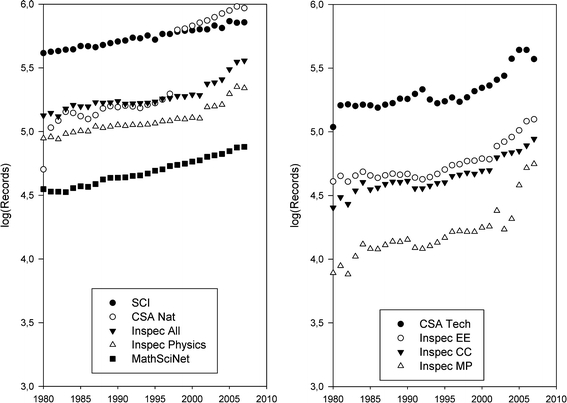
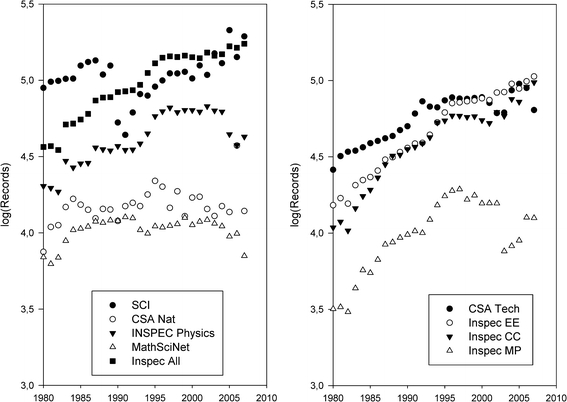
The growth rate of scientific publication has been studied from 1907 to 2007 using available data from a number of literature databases, including Science Citation Index (SCI) and Social Sciences Citation Index (SSCI). Traditional scientific publishing, that is publication in peer-reviewed journals, is still increasing although there are big differences between fields. There are no indications that the growth rate has decreased in the last 50 years. At the same time publication using new channels, for example conference proceedings, open archives and home pages, is growing fast. The growth rate for SCI up to 2007 is smaller than for comparable databases. This means that SCI was covering a decreasing part of the traditional scientific literature. There are also clear indications that the coverage by SCI is especially low in some of the scientific areas with the highest growth rate, including computer science and engineering sciences. The role of conference proceedings, open access archives and publications published on the net is increasing, especially in scientific fields with high growth rates, but this has only partially been reflected in the databases. The new publication channels challenge the use of the big databases in measurements of scientific productivity or output and of the growth rate of science. Because of the declining coverage and this challenge it is problematic that SCI has been used and is used as the dominant source for science indicators based on publication and citation numbers. The limited data available for social sciences show that the growth rate in SSCI was remarkably low and indicate that the coverage by SSCI was declining over time. National Science Indicators from Thomson Reuters is based solely on SCI, SSCI and Arts and Humanities Citation Index (AHCI). Therefore the declining coverage of the citation databases problematizes the use of this source.
Overview
The claims and statistics of this paper haven’t been checked yet.
Free: it reads the open-access text and checks the first 5 claims that cite a source we can check. Create a free account to check every claim.
Integrity signals
Registry
Cites
Statistics
Figures
Verification
Claims the paper makes
The claims and statistics of this paper haven’t been checked yet.
Free: it reads the open-access text and checks the first 5 claims that cite a source we can check. Create a free account to check every claim.
Claims other papers make about this one
Each is checked against this paper’s own text: does it say what the citing paper says it does?
The cited source says what the claim attributes to it.
In the citing paper
“The rate at which new papers are added to the scientific literature has steadily increased in recent decades [28,29].”
From The natural selection of bad science (2016) · cites this paper as [28]
Self-check
Percentages, sums and reported differences re-computed from the paper’s own numbers.
The self-check needs the paper’s full text.
Citations
Cites
An index to quantify an individual’s scientific research output
Hirsch, J. E. (2005) · Proceedings of the National Academy of Sciences · doi:10.1073/pnas.0507655102 · Cited by 11,669 · cited 1×
“The Hirsch Index (Hirsch 2005) is one example of a science indicator derived from SCI.”
BackgroundThe Matthew Effect in Science: The reward and communication systems of science are considered.
Merton, R. K. (1968) · Science · doi:10.1126/science.159.3810.56 · Cited by 6,720 · cited 2×
“This conclusion is supported with a reference to Bradford’s Law (Bradford 1950; Garfield 1972, 1979), a bibliometric version of the Pareto Law, often called the Matthew Principle: ‘to him that hath shall be given’ ( Merton 1968, 1988 ).”
(1968) · PubMed · Cited by 4,803
Price, D. J. D. S. (1963) · Columbia University Press eBooks · doi:10.7312/pric91844 · Cited by 4,264 · cited 1×
“…interest of about 7% per annum, thus doubling in size every 10–15 years, growing by a factor of 10 every half century, and by something like a factor of a million in the 300 years which separate us from the seventeenth-century invention of the scientific paper when the process began’’ (Price 1965).”
BackgroundScience and Engineering Indicators
Washington, E., & Warren, M. E. (2004) · Cited by 2,822
Garfield, E. (1972) · Science · doi:10.1126/science.178.4060.471 · Cited by 2,788
Citation Indexing-Its Theory and Application in Science, Technology, and Humanities
Goodwin, J., & Garfield, E. (1980) · Technology and Culture · doi:10.2307/3104125 · Cited by 1,639
Science and Engineering Indicators
Bond, J. S., Humphrey, D. C., Paton, K. L., Hightower, A. M., Suter, L. E., Johnson, J. M., Pollak, M., Jankowski, J. E., Lehming, R., Rausch, L. M., et al. (1993) · Defense Technical Information Center (DTIC) · Cited by 1,631
The Matthew Effect in Science, II: Cumulative Advantage and the Symbolism of Intellectual Property
Merton, R. K. (1988) · Isis · doi:10.1086/354848 · Cited by 1,397 · cited 2×
“This conclusion is supported with a reference to Bradford’s Law (Bradford 1950; Garfield 1972, 1979), a bibliometric version of the Pareto Law, often called the Matthew Principle: ‘to him that hath shall be given’ ( Merton 1968, 1988 ).”
MethodMeho, L. I., & Yang, K. (2007) · Journal of the American Society for Information Science and Technology · doi:10.1002/asi.20677 · Cited by 974 · cited 5×
“…than by using the two other sources and also that there is only a limited overlap between the citations found through Google Scholar and those found using the Web of Science (Meho 2006; Meho and Yang 2007; Bar-Ilan 2008; Kousha and Thelwall 2008; Vaughan and Shaw 2008, and references therein).”
BackgroundMethodInfluential
Research works printed but not linked: 9
- Björk, B.-C., Roos, A., & Lauro, M. (2008). Global annual volume of peer reviewed scholarly articles and the share available via Open Access options. Proceedings ELPUB2008 Conference on Electronic Publishing. Toronto, Canada, June 2008, pp. 1–10. Retrieved December 9, 2008 from http://elpub.scix.net.
- Bradford SC Documentation, Washington DC, Public Affairs Office. See: Bradford, S.C. (1953) 1950 Documentation, London Crosby Lockwood & Sons
- Google. (2008). About Google Scholar, support for scholarly publishers. Retrieved November 19, 2008 from http://scholar.google.com.
- Larsen, P.O., & von Ins, M. (2009). The steady growth of scientific publication and the declining coverage provided by science citation index. In B. Larsen & J. Leta (Eds.), Proceedings of ISSI 2009—the 12th international conference of the international society for scientometrics and informetrics, Rio de Janeiro, Brazil (Vol. 2, pp. 597–606). Published by BIREME/PAHO/WHO and Federal University of Rio de Janeiro, 2009. ISSN 2175-1935.
- Reed Elsevier. (2008). Scopus. Retrieved November 19, 2008 from http://www.reed-elsevier.com.
- Testa, J. (2008b). Regional content expansion in web of science: Opening borders to exploration (pp. 1–3). Retrieved December 7, 2008 from http://www.thomsonreuters.com/business_units/scientific/free/essays/regionalcontent/.
- Thomson Reuters. (2008b). Conference proceedings citation index. Retrieved January 15, 2009 from http://www.thomsonreuters.com/products_services/scientific/Conf_Proceedings_Citation_Index.
- Thomson Reuters. (2009a). ISI web of knowledge, journal citation reports, science edition and social sciences edition. Retrieved February 1, 2009.
- Thomson Reuters. (2009b). ISI web of knowledge, journal citation reports, science edition and social sciences edition. Retrieved July 30, 2009.
Cited by
Items 601–700 of 1,003
GROWTH OF SCIENTIFIC PUBLICATIONS: AN ANALYSIS OF TOP TEN COUNTRIES
Elango, B. (2018) · Library philosophy and practice · Cited by 9
Need for a change in scientific publishing
Risnes, S. (2018) · Nordic Perspectives on Open Science · doi:10.7557/11.4509 · Cited by 4
A Scientometric Analysis of the 50 Most Cited Articles for Reconstruction of the Lower Extremity
Mbaidjol, Z., Rothenberger, J. M., & Chetany, R. (2019) · Surgery Research and Practice · doi:10.1155/2019/3068028 · Cited by 4
Tracing the path from social attention to scientific impact
Sheikh, A., & Brown, S. K. (2019) · Cardiovascular Research · doi:10.1093/cvr/cvz276 · Cited by 4
Example-Based Learning as a Guide for Revising a Peer-Reviewed Manuscript
Tang, K. S., Cheng, D. L., Wu, W., & Greenberg, P. B. (2020) · Medical Science Educator · doi:10.1007/s40670-020-01009-9 · Cited by 4
Umapathy, A., Radhakrishnan, K., Jain, K., & Singh, R. K. (2020) · Workshop on Scholarly Document Processing (SDP) · doi:10.18653/v1/2020.sdp-1.34 · Cited by 4
Trends in Pediatric Versus Adult Ophthalmology Publications Over 15 Years
Mimouni, M., Segal, O., Mimouni, F. B., & Nemet, A. Y. (2015) · Journal of Pediatric Ophthalmology & Strabismus · doi:10.3928/01913913-20150520-02 · Cited by 4
Williams, M., Bray, B. E., Greenes, R. A., McCusker, J. P., Middleton, B., Perry, G., Platt, J. E., Richesson, R., Rubin, J. C., & Wheeler, T. R. (2021) · Learning Health Systems · doi:10.1002/lrh2.10301 · Cited by 4
“breakout time to review results of a survey they had conducted of CBK repositories, and their current practices related to the TRUST Principles for data repositories: (1) Transparency, (2) Responsibility, (3) User Focus, (4) Sustainability, and (5) Technology.”
BackgroundMethodColmers-Gray, I. N., Aguilar, L. S., Gauri, A., Ha, D. J., & Stauffer, B. A. (2022) · AEM Education and Training · doi:10.1002/aet2.10761 · Cited by 4
AnthraxKP: a knowledge graph-based, Anthrax Knowledge Portal mined from biomedical literature
Feng, B., & Gao, J. (2022) · Database · doi:10.1093/database/baac037 · Cited by 5
Norton, S. B., Webb, J. A., Schofield, K. A., Nichols, S. J., Ogden, R., Bennett, M. G., Lee, S., Ridley, C. E., Gibbs, D. A., & Collins, A. (2018) · Freshwater Science · doi:10.1086/697965 · Cited by 4
Academic publishing as a social media paradigm
Payne, M. E., Ngo, L. B., & Apon, A. (2013) · IEEE International Conference on Big Data (BigData) · doi:10.1109/bigdata.2013.6691763 · Cited by 4
“Every year, this is expected to grow at the rate of roughly 14% [15].”
BackgroundSome Consequences of Refusing to Participate in Peer Review
Dacso, C. C. (2014) · IEEE Journal of Translational Engineering in Health and Medicine · doi:10.1109/jtehm.2015.2392271 · Cited by 4
“In 2007, Larsen and Von Ins [1] estimated the number of scientific publications at about 24 000.”
BackgroundThe information milieu of remote sensing: an overview
Blake, L., & Warner, T. A. (2014) · Reference Services Review · doi:10.1108/rsr-06-2013-0032 · Cited by 4
Credit allocation for research institutes
Wang, J., Guo, Q., Yang, K., Han, J., & Liu, J.-G. (2017) · Europhysics Letters (EPL) · doi:10.1209/0295-5075/118/48001 · Cited by 4
Croker, J. D., & Bydder, S. A. (2018) · Journal of Medical Imaging and Radiation Oncology · doi:10.1111/1754-9485.12721 · Cited by 4
“Although this approach has been validated as a reliable source of articles,(13) the rate of growth in scientific publications and journals has not been matched by a similar rate in growth of the scientific citation index, meaning that some publications may not be captured by the large databases such as PubMed.(14) Als…”
Christie, A. P., Amano, T., Martin, P. A., Shackelford, G. E., Simmons, B. I., & Sutherland, W. J. (2022) · Journal of Applied Ecology · doi:10.1111/1365-2664.14154 · Cited by 5
How to Write a Good Scientific Paper: Significance
Mack, C. A. (2014) · Journal of Micro/Nanopatterning Materials and Metrology · doi:10.1117/1.jmm.13.2.020101 · Cited by 4
“This represents a doubling of the number of scientific papers every 20 years or so, a rate that has been relatively constant for over 300 years.(9,10) If you are like me, your inbox overflows with invitations to publish in new journals you have never heard of.”
BackgroundLatent Variable Modeling for Networks and Text: Algorithms, Models and Evaluation Techniques
Foulds, J. R. (2014) · eScholarship (California Digital Library) · Cited by 3
Validation and Topic-driven Ranking for Biomedical Hypothesis Generation SystemsPreprint
Sybrandt, J., & Safro, I. (2018) · bioRxiv (Cold Spring Harbor Laboratory) · doi:10.1101/263897 · Cited by 5
“But while the foundation of published knowledge grows [24], so does the difficulty in surveying it.”
BackgroundParticipatory Design: an Approach for Involving Teachers as Design Partners
Tuhkala, A. (2019) · Jyväskylä University Digital Archive (University of Jyväskylä) · Cited by 17
Know your enemy : Genomes of biological control agents
Ferguson, K. (2020) · doi:10.18174/511993 · Cited by 4
Open Access as a Crude Solution to a Hold-up Problem in the Two-Sided Market for Academic Journals
McCabe, M. J., & Snyder, C. (2016) · National Bureau of Economic Research · doi:10.3386/w22220 · Cited by 8
Rivera-López, B. (2019) · Thesis Commons (OSF Preprints) · doi:10.31237/osf.io/8cypr_v1 · Cited by 4
Publication Performance and Trends in Dental Anxiety Research: A Comprehensive Bibliometric Analysis
Ho, Y., Vautard, R., Schibbye, R., & Christidis, N. (2026) · International Journal of Dentistry · doi:10.1155/ijod/5530537 · Cited by 3
Kryachko, E. S. (2018) · Cultural psychology of education · doi:10.1007/978-3-319-96035-7_17 · Cited by 3
The History and Evolution of Gang Scholarship: A Topic Modeling and Change Point Detection Approach
Gravel, J. (2024) · Oxford University Press eBooks · doi:10.1093/oxfordhb/9780197618158.013.22 · Cited by 4
A bibliometric analysis on laparoscopic pelvic floor surgery from 1996–2022
Li, G.-S., Lu, M., Peng, G.-L., & Zhou, Q. (2024) · European Journal of Obstetrics & Gynecology and Reproductive Biology · doi:10.1016/j.ejogrb.2024.08.018 · Cited by 3
Research trends on ecology and management of Quercus species.
Marañón, T., Díaz, C., Ramos, I. M. P., & Villar, R. (2014) · Ecosistemas · doi:10.7818/ecos.2014.23-2.16 · Cited by 9
Interactions between Data Mining and Natural Language Processing
Cellier, P., Charnois, T., Hotho, A., Matwin, S., & Moens, M. (2014) · Cited by 3
Accountability and High Impact Journals in the Health Sciences
Buchan, A. M. J. (2017) · Publications · doi:10.3390/publications5010005 · Cited by 3
Ph.d.-kandidater og forskningsprosessen. Bibliotekets bidrag
Gullbekk, E., Rullestad, T., & Calvo, M. C. T. I. (2012) · Cited by 4
CANCROX: a cross-species cancer therapy database
de Ávila, P. M., Silva, D. C. V. E., Bernardo, P. C. D. M., da Silva, R. G. T. M., Fachin, A. L., Marins, M., & Caritá, E. C. (2019) · Database · doi:10.1093/database/baz044 · Cited by 3
“According to the National Cancer Institute site, this drug is used for the treatment of the following cancers: acute lymphoblastic leukemia, chronic eosinophilic leukemia, chronic myelogenous leukemia, dermatofibrosarcoma protuberans, gastrointestinal stromal tumor, myelodysplastic/myeloproliferative neoplasms and sys…”
BackgroundInfluentialEl metablog OpenMethods o cómo abrir la investigación en Humanidades Digitales
Riande, G. D. R., & Tóth-Czifra, E. (2019) · Hipertext net Revista Académica sobre Documentación Digital y Comunicación Interactiva · doi:10.31009/hipertext.net.2019.i19.05 · Cited by 3
Assessment of Academic Performance at Akdeniz University
Alkan, T. Y., Özbek, F., Günay, M., San, B. T., & Kitapçı, O. (2020) · Lecture notes on data engineering and communications technologies · doi:10.1007/978-3-030-36178-5_87 · Cited by 3
Open Scientific Data - Why Choosing and Reusing the RIGHT DATA Matters
Lipton, V. (2020) · IntechOpen eBooks · doi:10.5772/intechopen.87201 · Cited by 8
Game of Tenure: the role of “hidden” citations on researchers’ ranking in Ecology
Benítez‐López, A., & Santini, L. (2020) · Frontiers of Biogeography · doi:10.21425/f5fbg45195 · Cited by 3
Lund, B. D. (2021) · The Library Quarterly · doi:10.1086/714319 · Cited by 3
de Britto, F. A., Ferreira, T. C., Nunes, L. P., & Parreiras, F. S. (2021) · International conference Recent advances in natural language processing · doi:10.26615/978-954-452-072-4_008 · Cited by 3
Further improvements on estimating the popularity of recently published papers
Chatzopoulos, S., Vergoulis, T., Kanellos, I., Dalamagas, T., & Tryfonopoulos, C. (2021) · Quantitative Science Studies · doi:10.1162/qss_a_00165 · Cited by 3
Quality of the Systematic Reviews in Cochrane Gynecological Cancer Group and Their Understudied RCTs
Hajebrahimi, S., Akbari, N. D., Kamanaj, A. H., Hassannezhad, S., Aminizadeh, S., Darvishi, F., HajEbrahimi, R., & Salehi‐Pourmehr, H. (2022) · The Journal of Obstetrics and Gynecology of India · doi:10.1007/s13224-022-01655-6 · Cited by 3
“With the expansion of medical sciences and increasing the number of research journals, we would like to ensure the quality of those articles [1, 2].”
BackgroundDigital Transformation of Research Communications: Academic Journal as an Electronic
Semenov, E. V., Sokolov, D. V., & Gaydin, B. (2022) · Science management theory and practice · doi:10.19181/smtp.2022.4.2.18 · Cited by 3
Sequence-Based Extractive Summarisation for Scientific Articles
Kershaw, D., & Koeling, R. (2022) · International World Wide Web Conference (WWW) · doi:10.1145/3487553.3524652 · Cited by 3
How to Write a Contemporary Scientific Article?
Krasnov, V. M. (2022) · Education Research International · doi:10.1155/2022/5156888 · Cited by 3
The Effect of Knowledge Graph Schema on Classifying Future Research Suggestions
Alivanistos, D., Bijl, S. V. D., Cochez, M., & van Harmelen, F. (2024) · Lecture notes in computer science · doi:10.1007/978-3-031-65794-8_10 · Cited by 3
Centorrino, G., Naciti, V., & Rupo, D. (2024) · Corporate Social Responsibility and Environmental Management · doi:10.1002/csr.2967 · Cited by 3
Krampen, G., Schui, G., Ferring, D., & Bauer, H. P. W. (2014) · Psychologische Rundschau · doi:10.1026/0033-3042/a000196 · Cited by 3
Ten‐year publication trends in dermatology in mainland C hina
Xin, S., Mauro, J., Mauro, T. M., Elias, P. M., & Man, M. (2013) · International Journal of Dermatology · doi:10.1111/ijd.12272 · Cited by 3
Niklas, K. J., Owens, T. G., & Wayne, R. (2013) · BioScience · doi:10.1525/bio.2013.63.10.8 · Cited by 3
The mismeasure of monkeys: education policy research and the evolution of social capital
Gearin, B. (2017) · Journal of Education Policy · doi:10.1080/02680939.2017.1309071 · Cited by 4
Chun, J., Kang, B., & Kim, C. (2018) · Journal of the Korean Society for Marine Environment & Energy · doi:10.7846/jkosmee.2018.21.1.30 · Cited by 3
Research Hypothesis Generation Using Link Prediction in a Bipartite Graph
Kim, J., & Segev, A. (2018) · IEEE International Conference on Big Data (BigData) · doi:10.1109/bigdata.2018.8622645 · Cited by 3
“We suggest a method for generating research hypotheses by extracting knowledge from the massive amounts of published literature growing at an exponential rate [1].”
MethodBerning, C., & Weiß, B. (2015) · Quality & Quantity · doi:10.1007/s11135-015-0238-5 · Cited by 3
Editorial 24/2: Electronic Markets and journal sections
Alt, R., & Österle, H. (2014) · Electronic Markets · doi:10.1007/s12525-014-0159-5 · Cited by 3
The anti-dam protest cycle: evidence from Asia
Kirchherr, J. (2017) · Oxford University Research Archive (ORA) (University of Oxford) · doi:10.5287/ora-nb14em5m4 · Cited by 3
Based on evidence or preferences? A guide to assertiveness in decision making
do Sacramento, M. D. S., de Sousa, J. V. L., Andrade, A. M., & Petto, J. (2020) · Revista Brasileira de Fisiologia do Exercício · doi:10.33233/rbfex.v19i5.4415 · Cited by 3
Simplifying Impact Prediction for Scientific ArticlesPreprint
Vergoulis, T., Kanellos, I., Giannopoulos, G., & Dalamagas, T. (2020) · arXiv (Cornell University) · doi:10.48550/arxiv.2012.15192 · Cited by 4
“Due to the large growth rate in the number of published research works [9], a large number of articles will be retrieved for almost any subject of interest.”
BackgroundBeyond Journals and Peer Review: Towards a More Flexible Ecosystem for Scholarly CommunicationPreprint
Wood, M. (2020) · Preprints.org · doi:10.20944/preprints202012.0612.v1 · Cited by 3
Evolution of High-Impact Journals in Education and Educational Research
Li, Y. (2026) · Journal for STEM Education Research · doi:10.1007/s41979-026-00184-5 · Cited by 3
“The inclusion of specific journals may vary over time due to citation performance and other factors, including periods of declining coverage (Larsen & von Ins, 2010).”
Chang, Y., Li, Z., Zhang, H., Kong, Y., Wu, Y., So, H. K.-H., Guo, Z., Zhu, L., & Wong, N. (2025) · Proceedings of the 2025 Conference on Empirical Methods in Natural Language Processing · doi:10.18653/v1/2025.emnlp-main.790 · Cited by 2
kOre: Using Linked Data for OpenScience Information Integration.
Ermilov, I., Hoeffner, K., Lehmann, J., & Mouromtsev, D. I. (2015) · Cited by 2
Gill, G. (2016) · Muma Case Review · doi:10.28945/3553 · Cited by 2
Ebert, L., Huettemann, S., & Mueller, R. M. (2023) · Hawaii International Conference on System Sciences (HICSS) · doi:10.24251/hicss.2023.076 · Cited by 4
Park, S., Carroll, M., Esteve, L., & Singh, K. (2024) · ASEE Annual Conference & Exposition · doi:10.18260/1-2--47414 · Cited by 3
Augmenting Systematic Literature Reviews: A Human-AI Collaborative Framework
Brîncoveanu, C., Carl, K. V., Witzki, A., & Hinz, O. F. (2025) · Lecture notes in computer science · doi:10.1007/978-3-032-02813-6_1 · Cited by 3
Sarker, M. R., Pasha, M., Thompson, B., King, M., Hutson, D., Wiley, R. L., Kunwar, N., Canfield, D. R., Adkins, S., Rothschild, H., et al. (2025) · O&G Open · doi:10.1097/og9.0000000000000113 · Cited by 2
Ho, Y., Canales, G. D. L. T., & Christidis, N. (2025) · Pain Practice · doi:10.1111/papr.70088 · Cited by 2
The Rise, Impact, and Imbalances of Big-Team Psychology
Coles, N. A., Takayanagi, J. F. G. B., Grant, G. L., & Basnight-Brown, D. M. (2026) · Psychological Science · doi:10.1177/09567976261433459 · Cited by 2
“It is well established that the number of articles published in science tends to increase year to year (Larsen & Von Ins, 2010).”
VectorSage: enhancing PubMed article retrieval with advanced semantic search
Wijesekara, Y., Brahma, R., Lotfi, M., Vollmer, M., & Kaderali, L. (2026) · Bioinformatics Advances · doi:10.1093/bioadv/vbag116 · Cited by 2
“Over the last century, there has been no sign of a reduction in the growth rate of the publication of scientific literature (Larsen 2010).”
From Profiles to Promising Paths: A Semantic Group Recommender for Novel Academic Topic Discovery
Ayala-Tipan, C., Recalde, L., & Loza-Aguirre, E. (2026) · Information · doi:10.3390/info17070715 · Cited by 2
Does Iran Scientific Development Support Its Sustainable Development?
Nasiri, A., Hussain, Z., Hussain, Z., Kochin, D., Hussain, Z., Kochin, D., & Kochin, D. (2015) · Journal of Sustainable Development · doi:10.5539/jsd.v8n3p89 · Cited by 2
“Citations are also subjective and often websites will state different number of citations for the same thing (Larsen and Ins, 2010), taking this into account it could be worth looking at several databases for citations to get a better picture of the true extent; and finally, often journals are found through different…”
BackgroundInfluentialLeydesdorff, L., & Bornmann, L. (2010) · Cited by 3
YSO: Avoin ja monikielinen perusta yhteentoimivalle sisällönkuvailulle
Niininen, S., Nykyri, S., & Suominen, O. (2017) · Informaatiotutkimus · doi:10.23978/inf.68904 · Cited by 2
“Influence” in Historical Explanation: Mary Morgan’s Traveling Facts and the Context of Influence
Mata, T. J. F. (2018) · Research in the history of economic thought and methodology · doi:10.1108/s0743-41542018000036b006 · Cited by 2
Anzt, H., Cojean, T., & Kühn, E. (2019) · PAMM · doi:10.1002/pamm.201900490 · Cited by 2
“Particularly the growing field of scientific computing – the melting pot where domain scientists, mathematicians, data scientists, and machine learning enthusiasts team up to address scientific problems with sophisticated algorithms and compute power – experiences an explosion of scientific publications [2].”
BackgroundFlaws (and quality) in research today: can artificial intelligence intervene?
Siristatidis, C. S., & Pouliakis, A. (2020) · Systems Biology in Reproductive Medicine · doi:10.1080/19396368.2020.1749727 · Cited by 2
Antoniou, S. A., Tsokani, S., Mavridis, D., Agresta, F., Cano, M. L., Muysoms, F. E., Morales‐Conde, S., Bonjer, H.-J., van Veldhoven, T., & Francis, N. K. (2020) · Surgical Endoscopy · doi:10.1007/s00464-020-07494-8 · Cited by 2
“Recent years have seen an explosion in the number of published research, probably as a result of enhanced communication though the web and the establishment of a research culture in the medical community [3].”
BackgroundWilliams, M., Richesson, R., Bray, B. E., Greenes, R. A., McIntosh, L. D., Middleton, B., Perry, G., Platt, J. E., & Shaffer, C. (2020) · Learning Health Systems · doi:10.1002/lrh2.10255 · Cited by 2
The Changing Face of Biological Research and the Growing Role of Biosecurity
Dunaway, N., & Berger, K. M. (2021) · Advanced sciences and technologies for security applications · doi:10.1007/978-3-030-69464-7_6 · Cited by 3
Hersh, W. (2020) · Health informatics · doi:10.1007/978-3-030-47686-1_2 · Cited by 2
A bibliometric analysis of the top 100 most-cited articles on keratoconus
Yang, K., Xu, L., Zhu, M., Wang, S., Fan, Q., Gu, Y., Wang, Y., Wang, Q., Guo, K., Pang, C., et al. (2022) · International Ophthalmology · doi:10.1007/s10792-022-02334-1 · Cited by 2
“The number of publications and citations was low before the 1990s, possibly because the early electronic database might not have captured all the publications [19].”
BackgroundTrend Summary by SCOPUS Literature Analysis on Machine Learning Assisted BIPV Research
Lee, J.-H., You, S., Kim, C. K., Oh, M., Kim, B., Kang, Y.-H., & Kim, H. (2022) · Journal of the Korean Solar Energy Society · doi:10.7836/kses.2022.42.3.013 · Cited by 2
A Vám- és Pénzügyőri Tanszék publikációs teljesítménye 2012–2021 között
Szabó, A., Magasvári, A., & Erdős, Á. (2022) · Belügyi Szemle · doi:10.38146/bsz.2022.10.10 · Cited by 2
Perceptions of conducting academic ELT research: the case of Iranian graduate-level students
Hajizadeh, A., Mohammadi, S., & Khodadust, M. R. (2023) · Research in Post-Compulsory Education · doi:10.1080/13596748.2023.2166696 · Cited by 2
“For example, acquiring basic research skills (Kardash 2000; Kremmer and Bringle 1990; Mackey and Gass 2022; Terrell 2019), enhancing students’ understanding of scientific knowledge (Ryder, Leach, and Driver 1999), and describing the epistemological development of participants (Rauckhorst 2001; Rathnakar 2018) are amon…”
BackgroundGlory or Despair? Mapping Fifty Years of Scientific Publications of Dhaka University
Islam, M. A., Islam, M. S., & Akter, R. (2023) · Science & Technology Libraries · doi:10.1080/0194262x.2023.2212724 · Cited by 2
Hiltunen, T. (2023) · Studies in corpus linguistics · doi:10.1075/scl.111.08hil · Cited by 2
Quantifying research publication efficiency: A comparative analysis of the HY-index and the h-index
Alzahrani, M. S. J., Youssef, H. M., & Alghamdi, N. A. (2023) · International Journal of ADVANCED AND APPLIED SCIENCES · doi:10.21833/ijaas.2023.11.004 · Cited by 2
Monroy, G. J., Uribe, M. Y. C., & Otero, B. B. (2021) · Acta Odontológica Colombiana · doi:10.15446/aoc.v11n2.91853 · Cited by 2
Théorie de la régulation, un nouvel état des savoirs
Laurent, C. (2023) · Dunod eBooks · doi:10.3917/dunod.boyer.2023.01.0148 · Cited by 2
Gallagher, J. R., Avgoustopoulos, R. E., Hamilton, A., & Seilkhanova, T. (2024) · AI & Society · doi:10.1007/s00146-024-02049-0 · Cited by 4
“Academic publication across nearly all metrics has accelerated, including the number of published articles (Larsen and Von Ins 2010; Hyland 2021; Park et al. 2023) and the number of references per article (Garfield 1980; Ortega 2008; Rose-wiles and Marzabadi 2018; Gallagher et al. 2023).”
HOW TO IMPACT WITH ELECTRONIC RESOURCES IN ACADEMIC LIBRARIES
Talikoti, S. C. (2024) · ShodhKosh Journal of Visual and Performing Arts · doi:10.29121/shodhkosh.v5.i5.2024.1976 · Cited by 2
Emergence of group size disparity in growing networks with adoption
Sun, J., & Karimi, F. (2024) · Communications Physics · doi:10.1038/s42005-024-01799-z · Cited by 2
Electrochemical-Based Biosensors for the Detection and Diagnosis of Common Pathogens
Savaş, S. (2025) · Biomedical engineering · doi:10.5772/intechopen.1007871 · Cited by 6
A review of trends and patterns in transportation journals from 2000 to 2024
Wandelt, S., Zheng, C., & Sun, X. (2025) · Transportation Research Interdisciplinary Perspectives · doi:10.1016/j.trip.2025.101406 · Cited by 6
Imran, A., & Pasta, M. Q. (2024) · International Multi-Topic Conference · doi:10.1109/inmic64792.2024.11004418 · Cited by 2
“Databases that provide longer historical coverage can facilitate trend analysis and retrospective studies in research [20].”
Development of a graduate school EAP course for engineers
Vanbaelen, R., & Harrison, J. (2015) · IEEE International Professional Communication Conference (ProComm) · doi:10.1109/ipcc.2015.7235781 · Cited by 2
Evaluation of an Electronic Platform for Problem Based Learning for Subspecialty Fellows
Mishra, K., Ross, J. H., Goldfarb, D. A., Goldman, H. B., & Campbell, S. C. (2015) · Urology Practice · doi:10.1016/j.urpr.2014.10.005 · Cited by 2
“From 1997 to 2006 the number of studies published in the medical sciences increased at an annual rate of 6%, corresponding to a 13-year doubling time.(4) These challenges are magnified among fellows since they are often deeply invested in research and have increased clinical responsibility as well as the added role of…”
BackgroundBach, M. P. (2015) · Business Systems Research Journal · doi:10.1515/bsrj-2015-0006 · Cited by 2
Grammatical means of textual cohesion in appellate court decisions
Entralgo, J., Salager‐Meyer, F., & Briceño, M. L. (2015) · LFE. Revista de lenguas para fines específicos/Revista de lenguas para fines específicos · doi:10.20420/rlfe.2015.0012 · Cited by 2
Metadata
- Authors
- Larsen, P. O., & von Ins, M.
- Corresponding author
- Larsen, Peder Olesen
- Venue
- Scientometrics
- Published
- 2010-03-10
- Volume
- 84
- Issue
- 3
- Pages
- 575-603
- ISSN
- 0138-9130 (ISSN-L)
- 1588-2861
- PMC
- PMC2909426
- OpenAlex
- W2057954853
- Semantic Scholar
- d13eb74d54385c1e1ea70a6ff536c086fa6e7422
- Cited by
- 964
- References
- 48
- Citations by year
- 2026: 27 · 2025: 49 · 2024: 58 · 2023: 65 · 2022: 65 · 2021: 81 · 2020: 99 · 2019: 65 · 2018: 83 · 2017: 74 · 2016: 82 · 2015: 78 · 2014: 60 · 2013: 49 · 2012: 15
- FWCI
- 25.46
- Type
- journal article
- Language
- en
- Open access
- hybrid
- doi.org
- Licence
- cc-by-nc
- creativecommons.org/licenses/by-nc/2.0 (tdm)
- Locations
- Scientometrics (publishedVersion, cc-by-nc)
- PubMed Central (publishedVersion, cc-by-nc)
- PubMed (publishedVersion)
- RePEc: Research Papers in Economics (acceptedVersion)
- Funders
- Statens Serum Institut
- Topics
- Social Sciences › Library and Information Sciences › scientometrics and bibliometrics research
- Social Sciences › Library and Information Sciences › Library Science and Information
- Social Sciences › Psychology › Experimental and Cognitive Psychology › Psychology Research and Bibliometrics
- Keywords
- Science Citation Index, Social Science Citation Index, peer-reviewed journals, open access archives, science indicators, engineering sciences
About these checks
Registry, retraction, Cites and statistics results are computed, not judged, with one exception: a printed reference that no index lists is read once by a model before it counts as a citation error. Claims are extracted by a model and kept only when their quote appears verbatim in the text; each cited source is then checked, with a model’s help, for whether it says what the claim relies on. Those verdicts can be wrong — read the claim’s quote and the cited source before relying on one.
Statistics and arithmetic are recomputed, not judged.
Confidence bands are shown only for fields calibrated on our annotated test set. None is calibrated yet, so no band is shown.
What counts as a claim ›How we measure confidence ›How we check this ›
Are you an author, or do you see a problem with this page? Request a review
Data sources
Bibliographic data: Semantic Scholar, OpenAlex, Crossref.
Contains information from the Semantic Scholar Academic Graph Datasets, made available under the ODC Attribution License (ODC-BY 1.0).
Semantic Scholar’s data is described in: Kinney, R., et al. (2023). The Semantic Scholar Open Data Platform. arXiv:2301.10140.
