

The rate of growth in scientific publication and the decline in coverage provided by Science Citation Index
Open accessThe DOI matches its Crossref record; 46 of the 48 references it cites were found in a registry or an index.
Abstract
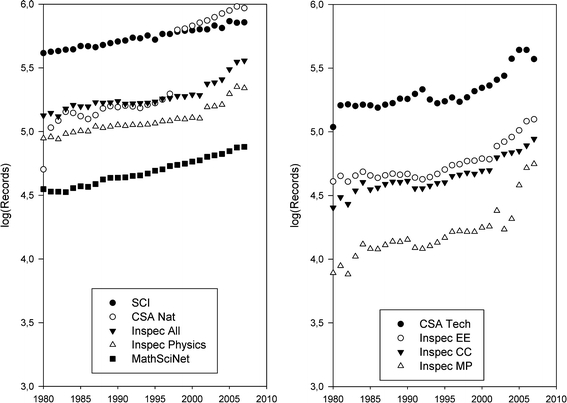
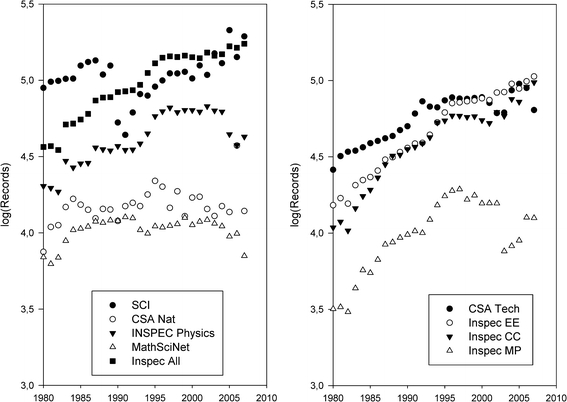
The growth rate of scientific publication has been studied from 1907 to 2007 using available data from a number of literature databases, including Science Citation Index (SCI) and Social Sciences Citation Index (SSCI). Traditional scientific publishing, that is publication in peer-reviewed journals, is still increasing although there are big differences between fields. There are no indications that the growth rate has decreased in the last 50 years. At the same time publication using new channels, for example conference proceedings, open archives and home pages, is growing fast. The growth rate for SCI up to 2007 is smaller than for comparable databases. This means that SCI was covering a decreasing part of the traditional scientific literature. There are also clear indications that the coverage by SCI is especially low in some of the scientific areas with the highest growth rate, including computer science and engineering sciences. The role of conference proceedings, open access archives and publications published on the net is increasing, especially in scientific fields with high growth rates, but this has only partially been reflected in the databases. The new publication channels challenge the use of the big databases in measurements of scientific productivity or output and of the growth rate of science. Because of the declining coverage and this challenge it is problematic that SCI has been used and is used as the dominant source for science indicators based on publication and citation numbers. The limited data available for social sciences show that the growth rate in SSCI was remarkably low and indicate that the coverage by SSCI was declining over time. National Science Indicators from Thomson Reuters is based solely on SCI, SSCI and Arts and Humanities Citation Index (AHCI). Therefore the declining coverage of the citation databases problematizes the use of this source.
Overview
The claims and statistics of this paper haven’t been checked yet.
Free: it reads the open-access text and checks the first 5 claims that cite a source we can check. Create a free account to check every claim.
Integrity signals
Registry
Cites
Statistics
Figures
Verification
Claims the paper makes
The claims and statistics of this paper haven’t been checked yet.
Free: it reads the open-access text and checks the first 5 claims that cite a source we can check. Create a free account to check every claim.
Claims other papers make about this one
Each is checked against this paper’s own text: does it say what the citing paper says it does?
The cited source says what the claim attributes to it.
In the citing paper
“The rate at which new papers are added to the scientific literature has steadily increased in recent decades [28,29].”
From The natural selection of bad science (2016) · cites this paper as [28]
Self-check
Percentages, sums and reported differences re-computed from the paper’s own numbers.
The self-check needs the paper’s full text.
Citations
Cites
An index to quantify an individual’s scientific research output
Hirsch, J. E. (2005) · Proceedings of the National Academy of Sciences · doi:10.1073/pnas.0507655102 · Cited by 11,669 · cited 1×
“The Hirsch Index (Hirsch 2005) is one example of a science indicator derived from SCI.”
BackgroundThe Matthew Effect in Science: The reward and communication systems of science are considered.
Merton, R. K. (1968) · Science · doi:10.1126/science.159.3810.56 · Cited by 6,720 · cited 2×
“This conclusion is supported with a reference to Bradford’s Law (Bradford 1950; Garfield 1972, 1979), a bibliometric version of the Pareto Law, often called the Matthew Principle: ‘to him that hath shall be given’ ( Merton 1968, 1988 ).”
(1968) · PubMed · Cited by 4,803
Price, D. J. D. S. (1963) · Columbia University Press eBooks · doi:10.7312/pric91844 · Cited by 4,264 · cited 1×
“…interest of about 7% per annum, thus doubling in size every 10–15 years, growing by a factor of 10 every half century, and by something like a factor of a million in the 300 years which separate us from the seventeenth-century invention of the scientific paper when the process began’’ (Price 1965).”
BackgroundScience and Engineering Indicators
Washington, E., & Warren, M. E. (2004) · Cited by 2,822
Garfield, E. (1972) · Science · doi:10.1126/science.178.4060.471 · Cited by 2,788
Citation Indexing-Its Theory and Application in Science, Technology, and Humanities
Goodwin, J., & Garfield, E. (1980) · Technology and Culture · doi:10.2307/3104125 · Cited by 1,639
Science and Engineering Indicators
Bond, J. S., Humphrey, D. C., Paton, K. L., Hightower, A. M., Suter, L. E., Johnson, J. M., Pollak, M., Jankowski, J. E., Lehming, R., Rausch, L. M., et al. (1993) · Defense Technical Information Center (DTIC) · Cited by 1,631
The Matthew Effect in Science, II: Cumulative Advantage and the Symbolism of Intellectual Property
Merton, R. K. (1988) · Isis · doi:10.1086/354848 · Cited by 1,397 · cited 2×
“This conclusion is supported with a reference to Bradford’s Law (Bradford 1950; Garfield 1972, 1979), a bibliometric version of the Pareto Law, often called the Matthew Principle: ‘to him that hath shall be given’ ( Merton 1968, 1988 ).”
MethodMeho, L. I., & Yang, K. (2007) · Journal of the American Society for Information Science and Technology · doi:10.1002/asi.20677 · Cited by 974 · cited 5×
“…than by using the two other sources and also that there is only a limited overlap between the citations found through Google Scholar and those found using the Web of Science (Meho 2006; Meho and Yang 2007; Bar-Ilan 2008; Kousha and Thelwall 2008; Vaughan and Shaw 2008, and references therein).”
BackgroundMethodInfluential
Research works printed but not linked: 9
- Björk, B.-C., Roos, A., & Lauro, M. (2008). Global annual volume of peer reviewed scholarly articles and the share available via Open Access options. Proceedings ELPUB2008 Conference on Electronic Publishing. Toronto, Canada, June 2008, pp. 1–10. Retrieved December 9, 2008 from http://elpub.scix.net.
- Bradford SC Documentation, Washington DC, Public Affairs Office. See: Bradford, S.C. (1953) 1950 Documentation, London Crosby Lockwood & Sons
- Google. (2008). About Google Scholar, support for scholarly publishers. Retrieved November 19, 2008 from http://scholar.google.com.
- Larsen, P.O., & von Ins, M. (2009). The steady growth of scientific publication and the declining coverage provided by science citation index. In B. Larsen & J. Leta (Eds.), Proceedings of ISSI 2009—the 12th international conference of the international society for scientometrics and informetrics, Rio de Janeiro, Brazil (Vol. 2, pp. 597–606). Published by BIREME/PAHO/WHO and Federal University of Rio de Janeiro, 2009. ISSN 2175-1935.
- Reed Elsevier. (2008). Scopus. Retrieved November 19, 2008 from http://www.reed-elsevier.com.
- Testa, J. (2008b). Regional content expansion in web of science: Opening borders to exploration (pp. 1–3). Retrieved December 7, 2008 from http://www.thomsonreuters.com/business_units/scientific/free/essays/regionalcontent/.
- Thomson Reuters. (2008b). Conference proceedings citation index. Retrieved January 15, 2009 from http://www.thomsonreuters.com/products_services/scientific/Conf_Proceedings_Citation_Index.
- Thomson Reuters. (2009a). ISI web of knowledge, journal citation reports, science edition and social sciences edition. Retrieved February 1, 2009.
- Thomson Reuters. (2009b). ISI web of knowledge, journal citation reports, science edition and social sciences edition. Retrieved July 30, 2009.
Cited by
Items 501–600 of 1,003
Worm geomorphology: Lessons from Darwin
Tsikalas, S. G., & Whitesides, C. J. (2013) · Progress in Physical Geography Earth and Environment · doi:10.1177/0309133313481789 · Cited by 7
Korea Citation Index and Its Macro Bibliometrics
Kim, S.-H., Choi, T., Yoon, A., & Seol, S. (2013) · Asian Journal of Innovation and Policy · doi:10.7545/ajip.2013.2.2.194 · Cited by 7
Task-oriented search for evidence-based medicine
Koopman, B., Russell, J., & Zuccon, G. (2017) · International Journal on Digital Libraries · doi:10.1007/s00799-017-0209-7 · Cited by 7
The Use of Deceased Controls in Epidemiologic Research: A Systematic Review
Murphy, B., Ibrahim, J., Bugeja, L. C., Schumann, J., & Cicuttini, F. (2017) · American Journal of Epidemiology · doi:10.1093/aje/kwx052 · Cited by 7
Extracting Core Claims from Scientific Articles
Jansen, T., & Kuhn, T. (2017) · Communications in computer and information science · doi:10.1007/978-3-319-67468-1_3 · Cited by 7
“The number of scientific articles is rapidly growing [8].”
BackgroundCamargo, É. B., Pereira, A. C. E. D. S., Gliardi, J. D. M., Pereira, D. C. R., Puga, M. E. D. S., da Silva, É. T., & Elias, F. T. S. (2017) · CADERNOS IBERO-AMERICANOS DE DIREITO SANITÁRIO · doi:10.17566/ciads.v6i4.410 · Cited by 9
AI, autonomous machines and human awareness: Towards shared machine-human contexts in medicine
Miller, D. D., & Wood, E. A. (2020) · Elsevier eBooks · doi:10.1016/b978-0-12-820543-3.00010-9 · Cited by 10
Berning, C., & Weiß, B. (2015) · Quality & Quantity · doi:10.1007/s11135-015-0182-4 · Cited by 8
Ensemble Learning Model for Medical Text Classification
Abdennour, G. B., Gasmi, K., & Ejbali, R. (2023) · Lecture notes in computer science · doi:10.1007/978-981-99-7254-8_1 · Cited by 7
Mining Information from Collections of Papers: Illustrative Analysis of Groundwater and Disease
Zhang, Y., Ji, X., Ibaraki, M., & Schwartz, F. W. (2018) · Ground Water · doi:10.1111/gwat.12804 · Cited by 9
Gu, X., & Blackmore, K. L. (2019) · Journal of the Association for Information Science and Technology · doi:10.1002/asi.24195 · Cited by 7
Fuoco, D. (2015) · doi:10.7287/peerj.preprints.813v1 · Cited by 7
Electronic Markets on the impact factor
Alt, R., Militzer-Horstmann, C., & Zimmermann, H. (2016) · Electronic Markets · doi:10.1007/s12525-016-0222-5 · Cited by 7
Urging medical students to publish: Advantages, disadvantages and new challenges
Rached, G., Hobeika, C. S., Karam, E., Kourié, H. R., & Kattan, J. G. (2018) · Bulletin du Cancer · doi:10.1016/j.bulcan.2018.04.005 · Cited by 7
Context-Based URL Classification for Open Access Datasets and Software in Scholarly Documents
Salsabil, L., Obadage, R. R., Banerjee, B., Abeysinghe, Y., Alam, S., Färber, M., Ingram, W. A., Fox, E. A., & Wu, J. (2025) · ACM/IEEE Joint Conference on Digital Libraries · doi:10.1109/jcdl67857.2025.00031 · Cited by 6
“However, manually identifying OADS-URLs can be time-consuming and does not scale with the rapid growth of scholarly documents [9].”
Veeramani, R., & Arunkumar, V. (2026) · Future Business Journal · doi:10.1186/s43093-026-00815-8 · Cited by 9
Identifying Priority Science Information Needs for Managing Public Lands
Carter, S. K., Haby, T. S., Samuel, E. M., Foster, A. C., Meineke, J. K., McCall, L. E., Burton, M. K., Domschke, C. T., Espy, L. D., & Gilbert, M. A. (2024) · Environmental Management · doi:10.1007/s00267-024-02080-3 · Cited by 9
“In many fi elds, the number of publications is increasing dramatically (Larsen and von Ins 2010, Engels et al. 2012, Bhattacharya and Shilpa 2016).”
Lee, S. J., Kim, S., Park, S., & Shin, J. C. (2025) · Scientometrics · doi:10.1007/s11192-024-05223-9 · Cited by 6
“Indexing systems such as China’s CSSCI (the Chinese Social Sciences Citation Index), Taiwan’s THCI (the Taiwan Humanities Citation Index) and Korea’s KCI (the Korean Citation Index) play a crucial role as evaluative criteria for publications in SSH fields within their respective countries (Chen, 2004; Shin et al., 202…”
InfluentialIn-text citation’s frequencies-based recommendations of relevant research papers
Shahid, A., Afzal, M. T., Alharbi, A., Aljuaid, H., & Al-Otaibi, S. T. (2021) · PeerJ Computer Science · doi:10.7717/peerj-cs.524 · Cited by 6
Productividad científica de investigadores en ciencias marinas en América Latina
Moya, W., & Rau, J. R. (2022) · Palabra clave · doi:10.24215/18539912e156 · Cited by 6
A journal recommender for article submission using transformers
Michail, S., Ledet, J. W., Alkan, T. Y., İnce, M. N., & Günay, M. (2022) · Scientometrics · doi:10.1007/s11192-022-04609-x · Cited by 8
“With the increasing ease of online publication, the number of journals has increased dramatically (Larsen & Ins, 2010), leading to a very large number of journals covering closely related topics.”
BackgroundMeasuring Open Access - Studies of Web-enabled Innovation in Scientific Journal Publishing
Laakso, M. (2014) · Työväentutkimus Vuosikirja · doi:10.13140/rg.2.1.3928.4083 · Cited by 6
Krampen, G., Weiland, P., & Wiesenhütter, J. (2015) · Scientometrics · doi:10.1007/s11192-015-1573-y · Cited by 6
“…the scientific literature of a discipline better than citation databases such as the multidisciplinary WoS (coverage B20 % of the PSYNDEX-documents in the WoS; see, e.g., Krampen 2009), for which Larsen and von Ins (2010) report in addition a general decline in coverage of scientific publications.”
BackgroundAli, N. Q., Patel, D. V., Lockington, D., & McGhee, C. N. J. (2013) · Asia-Pacific Journal of Ophthalmology · doi:10.1097/apo.0b013e3182a4cf92 · Cited by 6
A SIR epidemic model for citation dynamics
Reia, S. M., & Fontanari, J. F. (2021) · The European Physical Journal Plus · doi:10.1140/epjp/s13360-021-01199-0 · Cited by 7
Big Data in Academic Research: Challenges, Pitfalls, and Opportunities
Raubenheimer, J. (2021) · Policy implications of research in education · doi:10.1007/978-3-030-76841-6_1 · Cited by 6
Zhang, Y., Dai, Z., Zhao, T., Tian, J., Xu, J., & Zhang, J. (2023) · World Neurosurgery · doi:10.1016/j.wneu.2023.01.119 · Cited by 6
Why are we so attached to the “ethno” prefix in Brazil?
Hanazaki, N. (2015) · Scientometrics · doi:10.1007/s11192-015-1540-7 · Cited by 6
Mueller, R. M. (2016) · Hawaii International Conference on System Sciences (HICSS) · doi:10.1109/hicss.2016.653 · Cited by 5
“Both the number of scientific papers published in conference proceedings and journals and the number of researchers accessing these papers have been increasing exponentially over the last decades [20,22], resulting in numbers of articles too large for most scientists to read in their entirety.”
BackgroundAnalyzing the Disciplinary Focus of Universities: Can Rankings Be a One-Size-Fits-All?
Robinson‐García, N., & Jiménez‐Contreras, E. (2016) · Advances in educational marketing, administration, and leadership book series · doi:10.4018/978-1-5225-0819-9.ch009 · Cited by 10
“Journal articles are considered the main communication channel in most fields (Research Information Network, 2009) but the fields of Social Sciences, Humanities and Engineering (Larsen & von Ins, 2010).”
BackgroundKwan, J., Stein, L., Delshad, S. D., Johl, S., Park, H., Martinez, B., Topp, L., & Spiegel, B. M. R. (2016) · The American Journal of Gastroenterology · doi:10.1038/ajg.2016.452 · Cited by 6
Exploring the Fundamental Conceptual Units of Technical Emergence
Suominen, A., & Newman, N. C. (2017) · Portland International Conference on Management of Engineering and Technology (PICMET) · doi:10.23919/picmet.2017.8125287 · Cited by 7
“This limitation is an issue when analyzing activity outside of core science areas covered the journals indexed in these two data sources [31].”
BackgroundSemi-automatic literature mapping of participatory design studies 2006--2016
Tuhkala, A., Kärkkäinen, T., & Nieminen, P. (2018) · Participatory Design Conference · doi:10.1145/3210604.3210621 · Cited by 6
Pertumbuhan Publikasi Ilmiah Dosen di Maluku Pada Portal SINTA Tahun 2017 dan 2019
Anamofa, J. N. (2019) · JAS-PT (Jurnal Analisis Sistem Pendidikan Tinggi Indonesia) · doi:10.36339/jaspt.v3i2.258 · Cited by 6
“Penelitian tentang pertumbuhan publikasi para peneliti dunia pertama kali dikerjakan oleh Derek J. de Solla Price yang melakukan studi terkait publikasi para periode tahun 1650 sampai dengan 1950 (Larsen & Ins, 2010).”
González-Block, M. Á., Arroyo, J., Cetrángolo, O., Ábalos, P. C., Guerrero, R., Knauth, D. R., Ghaffar, A., Pavón-León, P., Sáenz, M. D. R., McQuire, R. G., et al. (2020) · Health Research Policy and Systems · doi:10.1186/s12961-020-00565-1 · Cited by 9
Whelan, J., Ghoniem, M., Médoc, N., Apicella, M., & Beck, E. C. (2021) · BMC Medical Research Methodology · doi:10.1186/s12874-021-01367-x · Cited by 6
“Considering the exponential growth in the scientific literature [3], traditional/manual literature search methods will be limited in their future application as the time and resources required become prohibitive.”
BackgroundMcManus, C., & Neves, A. A. B. (2022) · Collnet Journal of Scientometrics and Information Management · doi:10.1080/09737766.2022.2097896 · Cited by 9
Galimberti, P. (2010) · DOAJ (DOAJ: Directory of Open Access Journals) · doi:10.1234/dj.v1i1.6354 · Cited by 7
Systematic review on the conservation genetics of African savannah elephants
Zacarias, D., Bini, L. M., & Loyola, R. A. (2016) · PeerJ · doi:10.7717/peerj.2567 · Cited by 6
Advice for early-career peer reviewers and authors responding to peer reviews
Silver, P. A. (2016) · Freshwater Science · doi:10.1086/688968 · Cited by 6
Peeters, C., Vijverberg, K., Pouwer, M. G., Westerman, B. A., Boot, M., & Verberne, S. (2025) · BMC Medical Research Methodology · doi:10.1186/s12874-025-02624-z · Cited by 6
“This assessment is particularly important in the context of the growing body of scientific publications available; from 1960 onwards, the number of PubMed records has grown exponentially [1, 2].”
The Kardashian Index: a study of researchers' opinions on twitter 2014–2021
Powell, K., Haslam, A., & Prasad, V. K. (2022) · Scientometrics · doi:10.1007/s11192-022-04281-1 · Cited by 5
“, 2020), there are several limitations to this assertion: (1) Junior scientists—even with stellar publication records—will require time to accrue citations; (2) Individuals working in hot fields with a large number of researchers will accrue more citations and faster than those performing equally meritorious work in s…”
BackgroundThe temporal value of local scientific expertise
Feldman, M. P., Dïbiaggio, L., & Tran, T. (2023) · Industrial and Corporate Change · doi:10.1093/icc/dtac047 · Cited by 7
An Investigation of Current Research Support Services in Hungarian Academic Libraries
Dessa, H., & Dani, E. (2024) · Canadian Journal of Information and Library Science · doi:10.5206/cjils-rcsib.v47i2.17533 · Cited by 5
Kraker, P., Jack, K., Schlögl, C., Trattner, C., & Lindstaedt, S. (2013) · Figshare · doi:10.6084/m9.figshare.696882 · Cited by 5
A decade of database research publications: a look inside
Sakr, S., & Alomari, M. (2011) · Scientometrics · doi:10.1007/s11192-011-0385-y · Cited by 5
“However, the number of conferences or the number of accepted publications per conference can not continue increasing as this will limit the value of these venues gradually (Larsen and Ins 2010).”
BackgroundHishan, S. S., Ramakrishnan, S., & Mansor, N. N. A. (2020) · Rupkatha Journal on Interdisciplinary Studies in Humanities · doi:10.21659/rupkatha.v12n1.42 · Cited by 5
Alcaraz, D. I. M., & Ariza, M. Á. A. (2020) · English Text Construction · doi:10.1075/etc.00035.alc · Cited by 5
Explainable Word-Embeddings for Medical Digital Libraries - A Context-Aware Approach
Wawrzinek, J., Hussaini, S. A. R., Wiehr, O., Pinto, J. M. G., & Balke, W. (2020) · ACM/IEEE Joint Conference on Digital Libraries · doi:10.1145/3383583.3398522 · Cited by 5
Sigler, K., Warren, D. L., Tracy, B. H., Forrestel, E. J., Hogue, G. M., & Dornburg, A. (2021) · Ecosphere · doi:10.1002/ecs2.3878 · Cited by 5
The speed of information propagation in the scientific network distorts biomedical research
Rodriguez‐Esteban, R. (2022) · PeerJ · doi:10.7717/peerj.12764 · Cited by 5
“Regarding the first aspect, the growth of information available for scientific research ( Larsen & von Ins, 2010 ; Bornmann & Mutz, 2015 ) represents a challenge for individual scientists as information seekers ( Landhuis, 2016 ) and producers ( Genova, Astudillo & Fraga, 2016 ).”
BackgroundTrends on Microalgae-Fungi Consortia Research: An Alternative for Biofuel Production?
Moreira, A. B. L., Xavier-Santos, S., Silva, L. D., & Caramori, S. S. (2022) · Frontiers in Microbiology · doi:10.3389/fmicb.2022.903737 · Cited by 5
What if Peer-Review Process Is Killing Thinking-Out-of-the-Box Science?
Riera, R., & Rodríguez, R. A. (2022) · Frontiers in Marine Science · doi:10.3389/fmars.2022.924469 · Cited by 6
Indonesia’s Place in the Research Landscape of Southeast Asia
Fiala, D. (2022) · Unisia · doi:10.20885/unisia.vol40.iss1.art3 · Cited by 9
Citations in Chemistry at the Dawn of Open Science
Ciriminna, R., Angellotti, G., Luque, R., & Pagliaro, M. (2023) · ACS Omega · doi:10.1021/acsomega.3c07037 · Cited by 6
LePere‐Schloop, M., & Nesbit, R. (2024) · Journal of Public Affairs Education · doi:10.1080/15236803.2024.2349477 · Cited by 7
“In the past twenty years, WoS has changed their editorial policy to include more regional journals from around the world, which resulted in adding 1,600 regional journals to WoS 2005 and 2010—almost half of the newly indexed journals (Larsen & Von Ins, 2010; Michels & Schmoch, 2012; Testa, 2011).”
Keeping up to Date: Apps to Stay on Top of the Medical Literature
Capdarest‐Arest, N., & Glassman, N. R. (2015) · Journal of Electronic Resources in Medical Libraries · doi:10.1080/15424065.2015.1065660 · Cited by 5
“Readers today confront an enormous and seemingly overwhelming flood of scientific literature.(1) Libraries are significant providers of access to the scientific literature and most libraries now provide access to the bulk of that literature in electronic as opposed to print format.”
BackgroundDeveloping a Blended Learning Approach to Foster Information Literacy in German Psychology Education
Mayer, A., Leichner, N., Peter, J., Guenther, A., & Krampen, G. (2013) · Procedia - Social and Behavioral Sciences · doi:10.1016/j.sbspro.2013.10.025 · Cited by 5
Identification of Technology Terms in Patents
Anick, P., Verhagen, M., & Pustejovsky, J. D. (2014) · Language Resources and Evaluation Conference (LREC) · doi:10.63317/4h59wbatc6jn · Cited by 5
“Not only do these tasks demand constantly expanding domain expertise but the rate of scientific publication is growing fast (Sharma et al., 2002; Larsen and Ins, 2010).”
BackgroundMeasuring the societal impact of open science - Presentation of a research project
Holmberg, K., Didegah, F., Bowman, S., Bowman, T. D., & Kortelainen, T. (2015) · Informaatiotutkimus · Cited by 11
False positives are statistically inevitable
Fricker, R. D. (2016) · Science · doi:10.1126/science.351.6273.569-c · Cited by 5
EUROPEAN FUNDING - IMPACT ON RESEARCH CAPACITY IN CROATIA
Kotarski, V. (2016) · Review of Innovation and Competitiveness · doi:10.32728/ric.2016.23/3 · Cited by 5
Animal experimental research design in critical care
Merkow, J. S., Hoerauf, J. M., Moss, A. F. D., Brainard, J. C., Mayes, L. M., Fernandez-Bustamante, A., Mikulich‐Gilbertson, S. K., & Bartels, K. (2018) · BMC Medical Research Methodology · doi:10.1186/s12874-018-0526-6 · Cited by 5
Nagy, G., & Molnár, G. (2018) · Magyar Pedagógia · doi:10.17670/mped.2018.3.203 · Cited by 6
Richesson, R., Bray, B. E., Dymek, C., Greenes, R. A., McIntosh, L. D., Middleton, B., Perry, G., Platt, J. E., & Shaffer, C. (2020) · Learning Health Systems · doi:10.1002/lrh2.10222 · Cited by 5
How trustworthy guidelines can impact outcomes
Rochwerg, B. N., Kawano-Dourado, L. B., & Qadir, N. (2021) · Current Opinion in Critical Care · doi:10.1097/mcc.0000000000000858 · Cited by 7
“Although new research is being produced at a faster rate than ever before [1], true practice-changing studies remain rare.”
BackgroundZaveri, A. J., Vissoci, J. R. N., Daraio, C. C., & Pietrobon, R. S. (2013) · Lecture notes in computer science · doi:10.1007/978-3-642-41338-4_16 · Cited by 5
“Europe, as a whole, has a high impact on the global biomedical literature, having contributed with a growing number of articles (210, 433 publications in public health research [23]) and a significant citation impact [22].”
Gureyev, V. N., & Мазов, Н. А. (2021) · Science Editor and Publisher · doi:10.24069/sep-21-03 · Cited by 6
Khan, N., Rubin, J. C., & Williams, M. (2023) · Learning Health Systems · doi:10.1002/lrh2.10357 · Cited by 5
Bibliometric Analysis of Global Research on Scientific Writing
Maral, M. (2024) · DESIDOC Journal of Library & Information Technology · doi:10.14429/djlit.44.3.19534 · Cited by 6
“A study analysing the period 1907-2007 revealed that the number of scientific publications did not decline, but on the contrary, showed a continuous growth trend 3 .”
BackgroundForsman, D. (2012) · Library Management · doi:10.1108/01435121211279867 · Cited by 5
Ferreira, S. (2012) · Knowledge Management for Development Journal · doi:10.1080/19474199.2012.717757 · Cited by 11
Does Longer Copyright Protection Help or Hurt Scientific Knowledge Creation?
Haydari, S., & Smead, R. (2015) · Journal of Artificial Societies and Social Simulation · doi:10.18564/jasss.2720 · Cited by 5
Márquez-Benavides, L., & Baltierra-Trejo, E. (2017) · e-Ciencias de la Información · doi:10.15517/eci.v7i2.26817 · Cited by 5
Choosing Wisely – An international and multimorbid perspective
Battegay, E. J., & Cheetham, M. (2017) · Zeitschrift für Evidenz Fortbildung und Qualität im Gesundheitswesen · doi:10.1016/j.zefq.2017.10.010 · Cited by 5
Scientific knowledge in the age of computation: Explicated, computable and manageable?
Efstathiou, S., Nydal, R., Lægreid, A., & Kuiper, M. T. R. (2019) · THEORIA An International Journal for Theory History and Foundations of Science · doi:10.1387/theoria.20045 · Cited by 5
INDEXING OF MAPING SCIENCE JOURNALS
Stojanovski, J., Frančula, N., & Lapaine, M. (2015) · GEOGRAPHY ENVIRONMENT SUSTAINABILITY · doi:10.24057/2071-9388-2015-8-1-27-52 · Cited by 6
A importância de fundamentos robustos em metodologia científica
Souza, R. (2018) · Jornal Brasileiro de Pneumologia · doi:10.1590/s1806-37562018000500005 · Cited by 5
The Right Job and the Job Right: Novelty, Impact and Journal Stratification in SciencePreprint
Φ, N. C., Agenor, L., & Llopis, Ó. (2019) · SSRN Electronic Journal · doi:10.2139/ssrn.3347326 · Cited by 5
Publish or the Population Perishes: The Challenges of Regional Publishing in Public Health
Binns, C. W., & Low, W. Y. (2019) · Asia Pacific Journal of Public Health · doi:10.1177/1010539519849966 · Cited by 5
Gil‐Clavel, S., & Filatova, T. (2023) · arXiv (Cornell University) · doi:10.48550/arxiv.2306.09737 · Cited by 5
“The fast expansion of research articles hinders researchers from keeping track of the emerging findings in their areas of expertise [13].”
BackgroundSadruddin, S., Poupaki, E., D'Souza, J., Auer, S., Watkins, A., Karasulu, B., Mackus, A. J. M., & Kessels, W. M. M. (2026) · Journal of Vacuum Science & Technology A Vacuum Surfaces and Films · doi:10.1116/6.0005366 · Cited by 7
Zhang, W. (2026) · Frontiers in Built Environment · doi:10.3389/fbuil.2026.1867673 · Cited by 4
The Current Policies of Research Funders and Publishers
Lipton, V. (2020) · IntechOpen eBooks · doi:10.5772/intechopen.91717 · Cited by 4
Topic Analysis of the Literature Reveals the Research Structure: A Case Study in Periodontics
Galli, C., Colangelo, M. T., Meleti, M., Guizzardi, S., & Calciolari, E. (2025) · Big Data and Cognitive Computing · doi:10.3390/bdcc9010007 · Cited by 4
Remote Sensing-Based Advances in Climate Change Impacts on Agricultural Ecosystem Respiration
Mei, X., Chen, T., Li, J., Zhang, F., Hou, J., & Sheng, K. (2025) · Agriculture · doi:10.3390/agriculture15232509 · Cited by 5
Measuring research impact in the 21st century: are alternative metrics the answer?
Dixon, D. L., & Baker, W. L. (2020) · Minerva Cardioangiologica · doi:10.23736/s0026-4725.20.05241-x · Cited by 4
Wawrzinek, J., Pinto, J. M. G., Wiehr, O., & Balke, W. (2020) · Lecture notes in computer science · doi:10.1007/978-3-030-59419-0_30 · Cited by 4
“Today's digital libraries have to manage the exponential growth of scientific publications [5], which results in faster-growing data holdings.”
BackgroundPainting Outside the Lines: Transgressing the Managerial University, Avoiding Forced Creativity
Leitheiser, S., Vezzoni, R., & Hakkarainen, V. (2021) · Springer eBooks · doi:10.1007/978-3-030-84248-2_2 · Cited by 4
Hey, T. (2023) · OECD eBooks · doi:10.1787/7b7b1bce-en · Cited by 5
Buntins, K., Mulders, M., & Schröder, N. (2023) · MedienPädagogik Zeitschrift für Theorie und Praxis der Medienbildung · doi:10.21240/mpaed/54/2023.11.19.x · Cited by 4
Baig, A. A., Gerace, P. G., Khawar, W. I., Graffeo, C. S., Lim, J., Vakharia, K. V., Davies, J. M., Siddiqui, A. H., Reynolds, R. M., & Levy, E. I. (2024) · Journal of neurosurgery · doi:10.3171/2024.4.jns232119 · Cited by 4
Caro, J. (2024) · Chemie Ingenieur Technik · doi:10.1002/cite.202400033 · Cited by 4
Spatial exploration of plant functional types: insights from bibliometric meta-analysis
Kiran, G. S., Mohanta, A., Malhi, R. K. M., Prajapati, P. C., Oza, K. K., & Rajput, S. (2025) · Discover Plants. · doi:10.1007/s44372-025-00203-6 · Cited by 4
“Productivity was determined by counting the number of articles each author published during this period, while influence was measured by the cumulative annual citations each article received [32].”
Total and Foreign-Journal Citedness of Sociologický časopis: The Results of a Citation Analysis
Skovajsa, M. (2014) · Czech Sociological Review · doi:10.13060/00380288.2014.50.5.119 · Cited by 4
La réforme Obama du système américain de soins de santé
Witmeur, R., Désir, D., & Hut, F. (2012) · Courrier hebdomadaire du CRISP · doi:10.3917/cris.2160.0001 · Cited by 6
Second order probabilistic models for within-document novelty detection in academic articles
Park, L. A. F., & Simoff, S. J. (2014) · International ACM SIGIR Conference on Research and Development in Information Retrieval (SIGIR) · doi:10.1145/2600428.2609520 · Cited by 4
“It is becoming increasingly difficult to stay aware of the stateof-the-art in any research field due to the exponential increase in the number of academic publications in journals, magazines, conference proceedings, workshops, and scientific blogs [3].”
BackgroundA method for automated document classification using Wikipedia-derived weighted keywords
Biuk‐Aghai, R. P., & Ng, K. K. (2014) · International Conference on Data and Software Engineering · doi:10.1109/icodse.2014.7062484 · Cited by 4
“Larsen and von Ins studied the growth of science from 1907 until 2007 as measured by the number of SCI/SSCI-indexed publications and reported that well over one million peer-reviewed journal articles are published every year, with an annual growth rate of 2.3% [1].”
BackgroundInfluentialAre there ways to improve the citations of a scientific paper?
Bartoli, E. (2018) · European Journal of Internal Medicine · doi:10.1016/j.ejim.2017.12.006 · Cited by 4
Measuring the Semantic World – How to Map Meaning to High-Dimensional Entity Clusters in PubMed?
Wawrzinek, J., & Balke, W. (2018) · Lecture notes in computer science · doi:10.1007/978-3-030-04257-8_2 · Cited by 4
Metadata
- Authors
- Larsen, P. O., & von Ins, M.
- Corresponding author
- Larsen, Peder Olesen
- Venue
- Scientometrics
- Published
- 2010-03-10
- Volume
- 84
- Issue
- 3
- Pages
- 575-603
- ISSN
- 0138-9130 (ISSN-L)
- 1588-2861
- PMC
- PMC2909426
- OpenAlex
- W2057954853
- Semantic Scholar
- d13eb74d54385c1e1ea70a6ff536c086fa6e7422
- Cited by
- 964
- References
- 48
- Citations by year
- 2026: 27 · 2025: 49 · 2024: 58 · 2023: 65 · 2022: 65 · 2021: 81 · 2020: 99 · 2019: 65 · 2018: 83 · 2017: 74 · 2016: 82 · 2015: 78 · 2014: 60 · 2013: 49 · 2012: 15
- FWCI
- 25.46
- Type
- journal article
- Language
- en
- Open access
- hybrid
- doi.org
- Licence
- cc-by-nc
- creativecommons.org/licenses/by-nc/2.0 (tdm)
- Locations
- Scientometrics (publishedVersion, cc-by-nc)
- PubMed Central (publishedVersion, cc-by-nc)
- PubMed (publishedVersion)
- RePEc: Research Papers in Economics (acceptedVersion)
- Funders
- Statens Serum Institut
- Topics
- Social Sciences › Library and Information Sciences › scientometrics and bibliometrics research
- Social Sciences › Library and Information Sciences › Library Science and Information
- Social Sciences › Psychology › Experimental and Cognitive Psychology › Psychology Research and Bibliometrics
- Keywords
- Science Citation Index, Social Science Citation Index, peer-reviewed journals, open access archives, science indicators, engineering sciences
About these checks
Registry, retraction, Cites and statistics results are computed, not judged, with one exception: a printed reference that no index lists is read once by a model before it counts as a citation error. Claims are extracted by a model and kept only when their quote appears verbatim in the text; each cited source is then checked, with a model’s help, for whether it says what the claim relies on. Those verdicts can be wrong — read the claim’s quote and the cited source before relying on one.
Statistics and arithmetic are recomputed, not judged.
Confidence bands are shown only for fields calibrated on our annotated test set. None is calibrated yet, so no band is shown.
What counts as a claim ›How we measure confidence ›How we check this ›
Are you an author, or do you see a problem with this page? Request a review
Data sources
Bibliographic data: Semantic Scholar, OpenAlex, Crossref.
Contains information from the Semantic Scholar Academic Graph Datasets, made available under the ODC Attribution License (ODC-BY 1.0).
Semantic Scholar’s data is described in: Kinney, R., et al. (2023). The Semantic Scholar Open Data Platform. arXiv:2301.10140.
