

Google Scholar to overshadow them all? Comparing the sizes of 12 academic search engines and bibliographic databases
Open accessThe DOI matches its Crossref record; 61 of the 62 references it cites were found in a registry or an index, and 1 are not checked yet.
Abstract
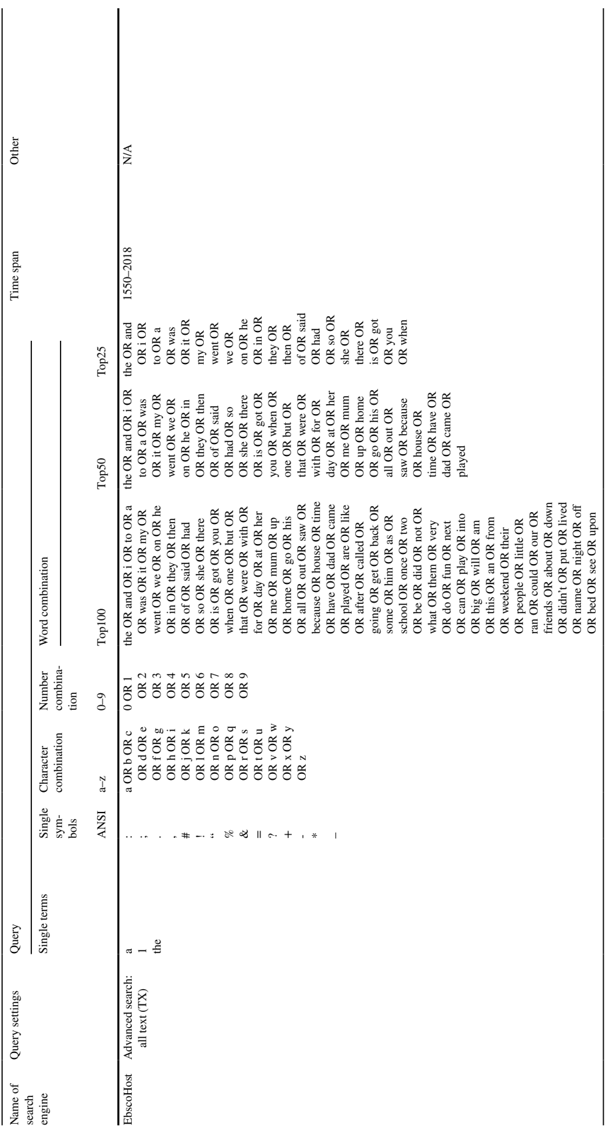
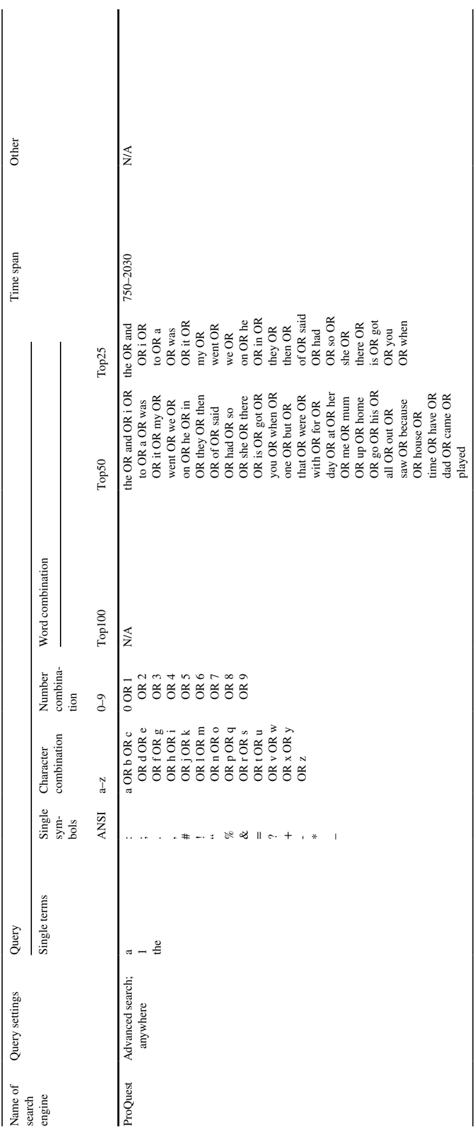
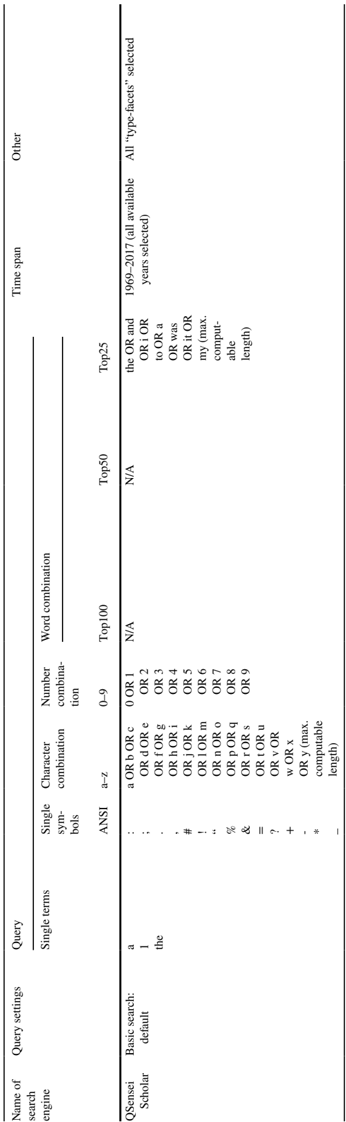
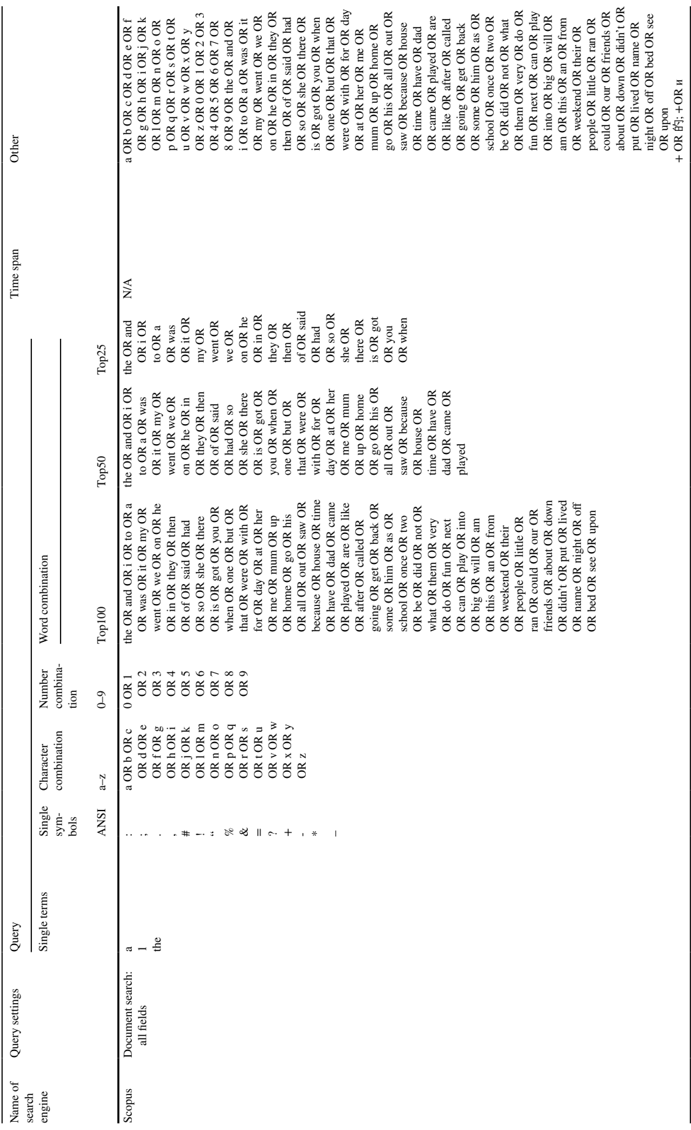
Information on the size of academic search engines and bibliographic databases (ASEBDs) is often outdated or entirely unavailable. Hence, it is difficult to assess the scope of specific databases, such as Google Scholar. While scientometric studies have estimated ASEBD sizes before, the methods employed were able to compare only a few databases. Consequently, there is no up-to-date comparative information on the sizes of popular ASEBDs. This study aims to fill this blind spot by providing a comparative picture of 12 of the most commonly used ASEBDs. In doing so, we build on and refine previous scientometric research by counting query hit data as an indicator of the number of accessible records. Iterative query optimization makes it possible to identify a maximum number of hits for most ASEBDs. The results were validated in terms of their capacity to assess database size by comparing them with official information on database sizes or previous scientometric studies. The queries used here are replicable, so size information can be updated quickly. The findings provide first-time size estimates of ProQuest and EbscoHost and indicate that Google Scholar’s size might have been underestimated so far by more than 50%. By our estimation Google Scholar, with 389 million records, is currently the most comprehensive academic search engine.
Overview
The claims and statistics of this paper haven’t been checked yet.
Free: it reads the open-access text and checks the first 5 claims that cite a source we can check. Create a free account to check every claim.
Integrity signals
Registry
Cites
Statistics
Figures
Verification
Claims the paper makes
The claims and statistics of this paper haven’t been checked yet.
Free: it reads the open-access text and checks the first 5 claims that cite a source we can check. Create a free account to check every claim.
Claims other papers make about this one
Each is checked against this paper’s own text: does it say what the citing paper says it does?
The source backs part of the claim, not all of it — or backs it for a different population, condition or comparison.
In the citing paper
“Unfortunately, the majority of DBs' end users are not usually aware of these limitations and how they can affect the accuracy, reliability, and reproducibility of their task's outcome [15,23].”
From Web of Science (WoS) and Scopus: The Titans of Bibliographic Information in Today’s Academic World (2021) · cites this paper as [23]
Experimental — accuracy not yet measuredThe source backs part of the claim, not all of it — or backs it for a different population, condition or comparison.
In the citing paper
“even when the dates of the last update are indicated to be very recent, the information provided is often clearly not the most recent one, especially regarding the numbers describing DBs coverage, which can confuse users in determining which information they can rely on”
From Web of Science (WoS) and Scopus: The Titans of Bibliographic Information in Today’s Academic World (2021) · cites this paper as [23]
Experimental — accuracy not yet measuredThe cited source says what the claim attributes to it.
In the citing paper
“These characteristics make it the most comprehensive academic search engine [28], removing the need to perform the search in each distinct reputable academic repository.”
From A Review of Design and Evaluation Practices in Mobile Text Entry for Visually Impaired and Blind Persons (2023) · cites this paper as [28]
The cited source says what the claim attributes to it.
In the citing paper
“1 Google Scholar was chosen because it is currently the most comprehensive academic search engine with 389 million records (Gusenbauer, 2019).”
From When Problem Solving Followed by Instruction Works: Evidence for Productive Failure (2021) · cites this paper as Gusenbauer, 2019
The cited source says what the claim attributes to it.
In the citing paper
“In these cases, the convenience and performance of the DB's web interface and provided additional functionalities may also greatly influence the preference of the DB [14,23,24].”
From Web of Science (WoS) and Scopus: The Titans of Bibliographic Information in Today’s Academic World (2021) · cites this paper as [23]
6 more claims about this paper
Create a free account to see every claim other papers make about this one.
Self-check
Percentages, sums and reported differences re-computed from the paper’s own numbers.
The self-check needs the paper’s full text.
Citations
Cites
Martín-Martín, A., Orduna-Malea, E., Thelwall, M., & Delgado López-Cózar, E. (2018) · Journal of Informetrics · doi:10.1016/j.joi.2018.09.002 · Cited by 1,990
Martín-Martín, A., Orduna-Malea, E., Thelwall, M., & López-Cózar, E. D. (2018) · doi:10.31235/osf.io/42nkm · Cited by 1,990
A Comparison between Two Main Academic Literature Collections: Web of Science and Scopus Databases
Chadegani, A. A., Salehi, H., Yunus, M. M., Farhadi, H., Fooladi, M., Farhadi, M., & Ebrahim, N. A. (2013) · Asian Social Science · doi:10.5539/ass.v9n5p18 · Cited by 1,925
Bornmann, L., & Mutz, R. (2015) · Journal of the Association for Information Science and Technology · doi:10.1002/asi.23329 · Cited by 1,576
Accessibility of information on the web
Lawrence, S., & Giles, C. L. (1999) · Nature · doi:10.1038/21987 · Cited by 1,349
The Literature of Bibliometrics, Scientometrics, and Informetrics
Hood, W. W., & Wilson, C. S. (2001) · Scientometrics · doi:10.1023/a:1017919924342 · Cited by 981
Meho, L. I., & Yang, K. (2007) · Journal of the American Society for Information Science and Technology · doi:10.1002/asi.20677 · Cited by 974 · cited 2×
“…have examined ASEBDs individually (Aguillo 2012; Halevi et al. 2017; Mayr and Walter 2007; Orduña-Malea et al. 2015; Hug and Braendle 2017; Harzing 2014) or compared them in pairs or multiples (Meho and Yang 2007; Shultz 2007; Chadegani et al. 2013; Khabsa and Giles 2014; de Winter et al. 2014).”
Search Engines: Information Retrieval in Practice
Croft, B. W., Metzler, D., & Strohman, T. (2009) · Medical Entomology and Zoology · Cited by 797
Online collaboration: Scientists and the social network
Van Noorden, R. (2014) · Nature · doi:10.1038/512126a · Cited by 654
Thelwall, M. (2008) · Journal of Information Science · doi:10.1177/0165551507087238 · Cited by 518 · cited 1×
“2015; Orduña-Malea and Delgado López-Cózar 2014; Hood and Wilson 2001; Thelwall 2008, 2009; Bar-Ilan 2008).”
Background
Research works printed but not linked: 6
- 13. Arts and Humanities Citation Index (1975-present) 4. Conference Proceedings Citation Index-Science (1990-present) 5. Conference Proceedings Citation Index-Social Science and Humanities (1990-pre- sent)
- 19. Data Citation Index (2010-present) 5. Derwent Innovations Index (2010-present) 6. KCI-Korean Journal Database (1980-present) 7. MEDLINE (1950-present)
- Ortega, J. L. (2014). Academic search engines: A quantitative outlook (Chandos information professional series). Oxford: Chandos Publishing.
- 63. Ortega, J. L. (2014). Academic search engines: A quantitative outlook (Chandos information professional series). Oxford: Chandos Publishing. Oxford University Press. (2008). Oxford wordlist. Oxford: Oxford University Press.
- 64. Pederson, J. P. (2001). International directory of company histories (International Directory of Company Histories Ser) (Vol. 40). Farmington Hills: Saint James Press. (Imprint); Cengage Gale.
- 69. Thelwall, M. (Ed.). (2009). Introduction to webometrics: Quantitative web research for the social sciences (Synthesis lectures on information concepts, retrieval, and services) (Vol. 4). San Francisco: Morgan & Claypool Publishers.
Cited by
Items 101–200 of 884
Hamami, M. G. M., & Ismail, Z. H. (2022) · Archives of Computational Methods in Engineering · doi:10.1007/s11831-022-09819-3 · Cited by 49
“This review extracts data from the world’s largest comprehensive academic search engine which is Goggle scholar with the estimation of 389 million records based on Gusenbauer [20] in Scientometrics journal.”
MethodPolíticas públicas e usos de evidências no Brasil : conceitos, métodos, contextos e práticas
Koga, N. M., Palotti, P. L. D. M., Mello, J., & Pinheiro, M. M. S. (2022) · Instituto de Pesquisa Econômica Aplicada (Ipea) eBooks · doi:10.38116/978-65-5635-032-5 · Cited by 50
Kung, J. (2023) · Journal of the Canadian Health Libraries Association / Journal de l'Association des bibliothèques de la santé du Canada · doi:10.29173/jchla29657 · Cited by 48
“For example, Semantic Scholar does not search licensed journals or behind paywalls [4] and a recent study in 2018 found that Google Scholar contained 389 million records while Semantic Scholar had 40 million records [5].”
Integration of Virtual Labs in Science Education: A Systematic Literature Review
Rosli, R., & Ishak, N. A. (2024) · Jurnal Pendidikan Sains Dan Matematik Malaysia · doi:10.37134/jpsmm.vol14.1.8.2024 · Cited by 48
Nieminen, G. S., & Laitinen, E. (2025) · Energy Research & Social Science · doi:10.1016/j.erss.2025.103995 · Cited by 48
Open-Source Implementations of the Reactive Asset Administration Shell: A Survey
Jacoby, M., Baumann, M., Bischoff, T., Mees, H., Müller, J., Stojanović, L., & Volz, F. (2023) · Sensors · doi:10.3390/s23115229 · Cited by 47
“To cover both implementation-and academia-driven implementation we are using GitHub, the self-proclaimed “largest open-source community in the world” [17], and Google Scholar, the presumably largest database of scholarly information [18], as data sources.”
The Implementation of “Smart” Technologies in the Agricultural Sector: A Review
Assimakopoulos, F., Vassilakis, C., Margaris, D., Kotis, K., & Spiliotopoulos, D. (2024) · Information · doi:10.3390/info15080466 · Cited by 48
Carrier, B., Barrios, B., Jolley, B. D., & Navalta, J. W. (2020) · Technologies · doi:10.3390/technologies8040070 · Cited by 48
“Google Scholar was used as the search database, and the single search string which utilized keywords and Boolean operators was: “Running OR Walking OR Biking OR Cycling OR Swimming OR Rowing OR Hiking OR Triathlon OR Exercise + Activity Trackers OR Fitness Trackers OR Wearable Technology OR Wearables + Validity OR Rel…”
BackgroundInfluentialGIS-KG: building a large-scale hierarchical knowledge graph for geographic information science
Du, J., Wang, S., Ye, X., Sinton, D. S., & Kemp, K. K. (2021) · International Journal of Geographical Information Systems · doi:10.1080/13658816.2021.2005795 · Cited by 48
“2018, Gusenbauer 2018), Semantic Scholar (Fricke 2018) and Microsoft Academics (Harzing and Alakangas 2017) scan the entire population of published research during their searches.”
BackgroundSimilarity measures in automated essay scoring systems: A ten-year review
Ramnarain-Seetohul, V., Bassoo, V., & Rosunally, Y. Z. (2022) · Education and Information Technologies · doi:10.1007/s10639-021-10838-z · Cited by 48
“As the most comprehensive academic search engine (Gusenbauer, 2019), Google Scholar was chosen since it indexes papers from a wide range of scholarly publishers and professional societies including Science Direct, IEEE, ACM, Taylor & Francis, Wiley, among others.”
BackgroundSport and fitness app uses: a review of humanities and social science perspectives
Soulé, B., Marchant, G., & Verchère, R. (2021) · European Journal for Sport and Society · doi:10.1080/16138171.2021.1918896 · Cited by 48
Collaborative Model-Driven Software Engineering: A Systematic Update
Dávid, I., Aslam, K., Faridmoayer, S., Malavolta, I., Syriani, E., & Lago, P. (2021) · ACM/IEEE International Conference on Model Driven Engineering Languages and Systems (MODELS) · doi:10.1109/models50736.2021.00035 · Cited by 46
“Google Scholar is considered a comprehensive academic search engine [34], and adequate for updates of systematic literature studies [30].”
BackgroundRettenmeier, M., Möller, M. L. B., & Sauer, A. (2024) · Resources Conservation and Recycling · doi:10.1016/j.resconrec.2024.107786 · Cited by 46
Examining Citations of Natural Language Processing Literature
Mohammad, S. M. (2020) · Proceedings of the conference - Association for Computational Linguistics. Meeting · doi:10.18653/v1/2020.acl-main.464 · Cited by 45
Vuotto, A., Césare, V. D., & Pallotta, N. (2020) · Palabra clave · doi:10.24215/18539912e101 · Cited by 45
“Cabe destacar también el aporte hecho por Gusenbauer (2018), quien analiza y compara el volumen total de datos almacenado en doce motores de búsqueda académicos y bases de datos bibliográficas utilizadas por los investigadores en general.”
BackgroundWeaver, D., Moyle, B., McLennan, C.-L., & Casali, G. L. (2023) · Journal of Environmental Management · doi:10.1016/j.jenvman.2023.119136 · Cited by 46
Ranking educational channels on YouTube: Aspects and issues
Tadbier, W., & Shoufan, A. (2021) · Education and Information Technologies · doi:10.1007/s10639-020-10414-x · Cited by 44
St.Pierre, M., Grawe, P., Bergström, J., & Neuhaus, C. (2021) · Safety Science · doi:10.1016/j.ssci.2021.105593 · Cited by 45
Gusenbauer, M. (2021) · Research Synthesis Methods · doi:10.1002/jrsm.1520 · Cited by 43
Self-citationDeveloping an interactive PBL environment via persuasive gamify elements: a scoping review
Ghani, A. S. A., Rahim, A. F. A., Yusoff, M. S. B., & Hadie, S. N. H. (2022) · Research and Practice in Technology Enhanced Learning · doi:10.1186/s41039-022-00193-z · Cited by 44
“PubMed and Scopus cover a wide range of indexed databases (Balhara, 2012), while Google Scholar is the most comprehensive academic search engine yielding 389 million academic records (Gusenbauer, 2019).”
BackgroundBarriers and enablers of environmental policy coherence: A systematic review
Tchinda, A. F., & Talbot, D. (2023) · Environmental Policy and Governance · doi:10.1002/eet.2057 · Cited by 42
Fitzgerald, J., Ojanperä, S., & O’Clery, N. (2021) · Applied Network Science · doi:10.1007/s41109-021-00371-w · Cited by 42
“Since we sought as comprehensive a dataset as possible, we decided not to consider the academic search engines because, while they are able to access the largest number of records, the query functions for them seem to be unreliable for detailed bibliometric data such as author affiliation (Mingers and Meyer 2017; Guse…”
BackgroundMethodInfluentialOwen, D. C., Lynham, A. J., Smart, S. E., Pardiñas, A. F., & Camacho-Collados, J. (2024) · Journal of Medical Internet Research · doi:10.2196/59225 · Cited by 41
“In general, it is suggested that future research in the domain of mental health status prediction should seek and report data biases to enhance the reliability of findings [27].”
Practical publication metrics for academics
Myers, B. A., & Kahn, K. L. (2021) · Clinical and Translational Science · doi:10.1111/cts.13067 · Cited by 41
Pereira, F. A., & Mugnaini, R. (2023) · Quantitative Science Studies · doi:10.1162/qss_a_00231 · Cited by 40
“Gusenbauer (2019) believes that the mechanisms of academic research, such as Google Scholar (GS) and Microsoft Academic, ensure a supply of robust information on scientific knowledge and various types of documents emerging from both formal and informal kinds of scientific communication.”
BackgroundMenzel, T., & Teubner, T. (2020) · International Journal of Energy Sector Management · doi:10.1108/ijesm-05-2020-0022 · Cited by 40
Black swan: bibliometric analysis and development of research agenda
Parameswar, N., Chaubey, A., & Dhir, S. (2021) · Benchmarking An International Journal · doi:10.1108/bij-08-2020-0443 · Cited by 40
Reputation portability – quo vadis?
Hesse, M., & Teubner, T. (2020) · Electronic Markets · doi:10.1007/s12525-019-00367-6 · Cited by 39
“First, it represents the most comprehensive tool for academic and bibliographic search (Gusenbauer 2019).”
MethodFilep, S., Kondja, A., Wong, C. C., Weber, K., Moyle, B., & Skavronskaya, L. (2023) · Journal of Hospitality Marketing & Management · doi:10.1080/19368623.2023.2290626 · Cited by 41
Tervoort, T., de Oliveira, M. T., Pieters, W., van Gelder, P. H. A. J. M., Olabarriaga, S. D., & Marquering, H. A. (2020) · IEEE Access · doi:10.1109/access.2020.2984376 · Cited by 39
“In order to find studies that cite the three studies mentioned above, we used the search engine Google Scholar, which offers ‘cited by’ searches, and indexes a comprehensive number of scientific databases [20].”
MethodGyőrffy, B., Csuka, G., Herman, P. G., & Török, Á. (2020) · Scientometrics · doi:10.1007/s11192-020-03501-w · Cited by 39
“2018; Gusenbauer 2019).”
Greencoin as an AI-Based Solution Shaping Climate Awareness
Obracht‐Prondzyńska, H., Duda, E., Anacka, H., & Kowal, J. (2022) · International Journal of Environmental Research and Public Health · doi:10.3390/ijerph191811183 · Cited by 39
“4 Specifying the information sources (e.g., databases, registers) used to identify studies and the date when each was last searched: We based our data sources and search strategy on the use of many data sources such as Google Scholar, Scopus, Web of Science, EBSCO, Elsevier, Emerald, Taylor & Francis, ProQuest Central…”
MethodInfluentialToward a preliminary research agenda for the circular economy adoption in Africa
Nijman-Ross, E., Umutesi, J. U., Turay, J., Shamavu, D., Atanga, W. A., & Ross, D. L. (2023) · Frontiers in Sustainability · doi:10.3389/frsus.2023.1061563 · Cited by 39
“Recent research has identified GS as the most comprehensive academic search engine, with 389 million records (Gusenbauer, 2018) and a sensitive enough database to be used alone for systematic reviews (Gehanno et al.”
BackgroundMethodvan der Merwe, T. M. D., Serote, M., & Maloma, M. (2023) · The Electronic Journal of e-Learning · doi:10.34190/ejel.21.5.3075 · Cited by 38
“The Google Scholar index is the most comprehensive of the academic literature (Gusenbauer, 2019).”
BackgroundWhy are there so many definitions of eutrophication?
Pannard, A., Souchu, P., Chauvin, C., Delabuis, M., Gascuel, C., Jeppesen, E., Moal, M. L., Ménesguen, A., Pinay, G., Rabalais, N. N., et al. (2024) · Ecological Monographs · doi:10.1002/ecm.1616 · Cited by 39
Orduña‐Malea, E., Aytaç, S., & Tran, C. Y. (2019) · Scientometrics · doi:10.1007/s11192-019-03208-7 · Cited by 38
“Its coverage was estimated to contain over 170 million documents up to 2013 (Orduna-Malea et al. 2015), figure that has amounted to near the 400 million total records (Gusenbauer 2019; Delgado López-Cózar, Orduna-Malea, and Martín-Martín 2019).”
BackgroundCheerkoot-Jalim, S., & Khedo, K. K. (2020) · Journal of Knowledge Management · doi:10.1108/jkm-09-2019-0524 · Cited by 38
Makhortykh, M., & Wijermars, M. (2021) · Digital Journalism · doi:10.1080/21670811.2021.1970601 · Cited by 40
“…on the size of Google Scholar and user statistics, existing research suggests that the platform is “the most comprehensive academia search engine” (Gusenbauer 2019: 199) and, thus, is the closest option available for acquiring a comprehensive overview of the state of academic research on the…”
BackgroundThe Social Acceptance of Airborne Wind Energy: A Literature Review
Schmidt, H., de Vries, G., Renes, R. J., & Schmehl, R. (2022) · Energies · doi:10.3390/en15041384 · Cited by 45
“We chose the database Google Scholar for the systematic identification of literature because it is the largest general database that scans the entire text for keywords [47].”
MethodPlatform-based product development in the process industry: a systematic literature review
Andersen, R. S., Brunoe, T. D., & Nielsen, K. (2022) · International Journal of Production Research · doi:10.1080/00207543.2022.2044085 · Cited by 38
Clements, R., Alizadeh, T., Kamruzzaman, M., Searle, G., & Legacy, C. (2022) · Journal of Planning Literature · doi:10.1177/08854122221112317 · Cited by 37
Hamblin, R., Plimmer, G., Badar, K., & Lasthuizen, K. (2024) · Public Performance & Management Review · doi:10.1080/15309576.2024.2373178 · Cited by 39
“This, however, reflects its lack of discrimination in terms of where citations were made (and hence quality), and some concerns that it has erroneous records (Gusenbauer, 2019).”
Gusenbauer, M. (2024) · Research Synthesis Methods · doi:10.1002/jrsm.1746 · Cited by 38
“26 Search Smart builds on peer-reviewed research, 5,27,28 introducing and refining various scientometric methods to collect diverse database information (for an overview, see Supplementary Material, Data S1).”
Self-citationEuPPollNet : A European Database of Plant‐Pollinator Networks
Lanuza, J. B., Knight, T. M., Montes‐Pérez, N., Glenny, W., Acuña, P., Albrecht, M., Artamendi, M., Badenhausser, I., Bennett, J. M., Biella, P., et al. (2025) · Global Ecology and Biogeography · doi:10.1111/geb.70000 · Cited by 38
“While Google Scholar lacks reproducibility (Gusenbauer and Haddaway 2020), it still remains the most comprehensive search engine to date (Gusenbauer 2019).”
NLP Scholar: A Dataset for Examining the State of NLP Research.
Mohammad, S. M. (2020) · NPARC · Cited by 37
Fenneman, J., Frankenhuis, W. E., & Todd, P. M. (2022) · Psychological Bulletin · doi:10.1037/bul0000375 · Cited by 40
Kalibatienė, D., & Miliauskaitė, J. (2021) · Informatica · doi:10.15388/21-infor444 · Cited by 38
Positive Aspects of Welfare in Sheep: Current Debates and Future Opportunities
Muhammad, M., Stokes, J. E., & Manning, L. (2022) · Animals · doi:10.3390/ani12233265 · Cited by 36
“Google Scholar for instance is currently the most comprehensive academic search engine (28), while ScienceDirect and Web of Science appear to have a predisposition for animal welfare science articles (29).”
Zhang, H., & Jiang, Y. L. (2021) · Journal of School Violence · doi:10.1080/15388220.2021.1985326 · Cited by 35
A Systematic Review of Soft Skills Taxonomies: Descriptive and Conceptual WorkPreprint
Marle, C. J.-L., Parmentier, F., Coltel, M., Lubart, T., & Borteyrou, X. (2022) · PsyArXiv (OSF Preprints) · doi:10.31234/osf.io/mszgj · Cited by 35
Making sense of “buzzword” as a term through co-occurrences analysis
Malyuga, E. N., & Rimmer, W. (2021) · Heliyon · doi:10.1016/j.heliyon.2021.e07208 · Cited by 35
“…reviews or meta-analyses (see, for example, Gusenbauer and Haddaway, 2019), estimating the difference in referencing found in these systems (see, for example, Anker et al., 2019), or comparing the sizes of academic search engines and bibliographic databases (see, for example, Gusenbauer, 2019).”
BackgroundPanori, A., Mora, L., & Reid, A. (2019) · Journal of Cleaner Production · doi:10.1016/j.jclepro.2019.117850 · Cited by 36
“Unlike Google Scholar, neither Scopus nor Web or Science index grey literature (Gusenbauer, 2019; Haddaway et al., 2015) and therefore this line of enquiry was ruled out.”
MethodThe most influential articles in Helicobacter pylori research: A bibliometric analysis
Bang, C. S., Lee, J. J., & Baik, G. H. (2019) · Helicobacter · doi:10.1111/hel.12589 · Cited by 34
A Systematic Survey on Android API Usage for Data-driven Analytics with Smartphones
Lee, H., Park, J., & Lee, U. (2022) · ACM Computing Surveys · doi:10.1145/3530814 · Cited by 33
“5 Because AS/US APIs are used in various research fields, we searched for papers in the popular literature search engines [78, 107, 149] as in prior review studies, in which papers from different fields can be found, instead of the web library databases of specific domains.”
MethodLim, W., Theng, L. B., & Islam, A. F. M. (2022) · Education and Information Technologies · doi:10.1007/s10639-022-11472-z · Cited by 34
“These databases were selected because they are widely used international academic search engines with many freely accessible resources (Chun et al., 2020; Gusenbauer, 2018; Williamson & Minter, 2019).”
MethodFactors influencing customers’ selection of Islamic home financing: a systematic review
Ibrahim, N., & Sapian, S. M. (2021) · International Journal of Housing Markets and Analysis · doi:10.1108/ijhma-10-2021-0110 · Cited by 33
Alotaibi, F. A., Johnson, F., & Rowley, J. (2022) · Journal of Librarianship and Information Science · doi:10.1177/09610006221111197 · Cited by 34
“contained approximately 160 million documents in 2014 (Orduna-Malea et al., 2015) and by 2019 had more than doubled to 389 million records (Gusenbauer, 2019).”
BackgroundNurrahma, A. H. I., Putri, H. H., & Syahadat, R. M. (2022) · ASEAN Journal of Science and Engineering · doi:10.17509/ajse.v3i2.46148 · Cited by 37
“It, given Google Scholar, has no limits on the language coverage, keywords allowed per search, and list of covered journals (Falagas et al ., 2008; Gusenbauer, 2019).”
BackgroundFrom text to model: Leveraging natural language processing for system dynamics model development
Veldhuis, G. A., Blok, D., de Boer, M., Kalkman, G. J., Bakker, R. M., & van Waas, R. P. M. (2024) · System Dynamics Review · doi:10.1002/sdr.1780 · Cited by 31
The validity of situation awareness for performance: a meta-analysis
Bakdash, J. Z., Marusich, L. R., Cox, K. R., Geuss, M. N., Zaroukian, E. G., & Morris, K. (2021) · Theoretical Issues in Ergonomics Science · doi:10.1080/1463922x.2021.1921310 · Cited by 31
“…parallels with observed dissociations among workload and performance which ‘… occur more frequently than extant explanatory theories imply’ (Hancock and Matthews 2019, 374), although to our knowledge there is not yet a meta-analysis assessing the associations among workload and performance.”
BackgroundSoil Chemical Pollution and Military Actions: A Bibliometric Analysis
Stadler, T., Temesi, Á., & Lakner, Z. (2022) · Sustainability · doi:10.3390/su14127138 · Cited by 31
Bibliometric Analysis of Ophthalmic Journals
Nichols, J. J., Morgan, P. B., Jones, L., & Efron, N. (2023) · JAMA Ophthalmology · doi:10.1001/jamaophthalmol.2023.2062 · Cited by 31
Web-Scale Academic Name Disambiguation: The WhoIsWho Benchmark, Leaderboard, and Toolkit
Chen, B., Zhang, J., Zhang, F., Han, T., Cheng, Y., Li, X., Dong, Y., & Tang, J. (2023) · ACM SIGKDD Conference on Knowledge Discovery and Data Mining (KDD) · doi:10.1145/3580305.3599930 · Cited by 31
“For example, Google Scholar, Bing Academic Search, and AMiner have all indexed about 300 million papers [10, 33, 36].”
BackgroundResilience for freight transportation systems to disruptive events: a review of concepts and metrics
Patnala, P. K., Regehr, J. D., Mehran, B., & Regoui, C. (2023) · Canadian Journal of Civil Engineering · doi:10.1139/cjce-2023-0187 · Cited by 30
Aumann, A., Schnebel, S., & Weitzel, H. (2023) · Frontiers in Education · doi:10.3389/feduc.2023.1190152 · Cited by 30
Zaki, N. H. M., & Ismail, Z. (2021) · Asian Journal of University Education · doi:10.24191/ajue.v17i4.16189 · Cited by 31
“In a study conducted by Gusenbauer (2019), it has been concluded that almost 389 million documents were available in the Google Scholar database while Martin-Martin et al. (2017) concluded that there were 165 million articles journals available in Google Scholar.”
BackgroundMethodGovernance of decentralized autonomous organizations that produce open source software
van Vulpen, P., Siu, J., & Jansen, S. (2023) · Blockchain Research and Applications · doi:10.1016/j.bcra.2023.100166 · Cited by 32
Architectural Design Space for Modelling and Simulation as a Service: A Review
Shahin, M., Babar, M. A., & Chauhan, M. A. (2020) · Journal of Systems and Software · doi:10.1016/j.jss.2020.110752 · Cited by 29
Addington, L. A. (2021) · Race and Justice · doi:10.1177/2153368720988894 · Cited by 29
“The first (and primary) strategy was a systematic search of four databases: Google Scholar, Criminal Justice Abstracts, Education Resources Information Center (ERIC), and PsychINFO (see Gusenbauer, 2019, for a discussion of the inclusiveness of Google Scholar).”
BackgroundOpen Government: Development, Concept, and Future Research Directions
Wirtz, B. W., Becker, M., & Weyerer, J. C. (2022) · International Journal of Public Administration · doi:10.1080/01900692.2021.2019273 · Cited by 29
“Smart Cities in Europe” Revisited: A Meta-Analysis of Smart City Economic Impacts
Caragliu, A., Bo, C. D., & Nijkamp, P. J. (2023) · Journal of Urban Technology · doi:10.1080/10630732.2023.2220136 · Cited by 29
“The choice of Google Scholar as the starting point for our analysis was motivated by the desire to include a wide range of publication outlets (Gusenbauer, 2019), accounting for the variety that characterizes the literature on Smart Cities.”
BackgroundJournal Article Titles Impact Their Citation Rates
Rossi, M. J., & Brand, J. C. (2020) · Arthroscopy The Journal of Arthroscopic and Related Surgery · doi:10.1016/j.arthro.2020.02.018 · Cited by 29
Implementação da educação para a sustentabilidade no Ensino Fundamental: uma revisão
Guedes, A. S. D. V., & da Silva, V. P. (2020) · Research Society and Development · doi:10.33448/rsd-v9i8.5598 · Cited by 28
Leap2Trend: A Temporal Word Embedding Approach for Instant Detection of Emerging Scientific Trends
Dridi, A., Gaber, M. M., Azad, R. M. A., & Bhogal, J. (2019) · IEEE Access · doi:10.1109/access.2019.2957440 · Cited by 31
“Google Scholar is the world’s largest academic search engine in January 2018 with roughly 389 million documents indexed including articles, citations and patents [55].”
BackgroundScholarly publishing and peer review in the Global South: the role of the reviewer
Lor, P. J. (2022) · JLIS it · doi:10.36253/jlis.it-512 · Cited by 28
Evaluation of Social Media Marketing Literature in the Tourism Industry Using PRISMA
Solanki, M. S., & Thomas, J. (2023) · Journal of Creative Communications · doi:10.1177/09732586231202610 · Cited by 28
“EBSCOhost and ScienceDirect have been the preferred search engine, and Google Scholar has been included (Gusenbauer, 2019) as it is presently the most comprehensive search engine for academic papers.”
Shamsir, M. S., Krauss, S. E., Ismail, I. A., Jalil, H. A., Johar, M. A., & Rahman, I. B. A. (2021) · Higher Education Policy · doi:10.1057/s41307-020-00221-x · Cited by 28
“…most comprehensive academic search engine with the largest coverage of literature found in academic search engines and bibliographic databases (ASEBDs), which include subscription-based SCOPUS and Web of Science databases (López-Cózar et al., 2019; Gusenbauer, 2019; Martin-Martin et al., 2017).”
BackgroundSafety of dupilumab in patients with atopic dermatitis: expert opinion
Francuzik, W., Alexiou, A., & Worm, M. (2021) · Expert Opinion on Drug Safety · doi:10.1080/14740338.2021.1939673 · Cited by 28
Mayer, J., & Jochem, R. (2024) · Processes · doi:10.3390/pr12081730 · Cited by 27
Human–Animal Interactions and the Promotion of Social and Emotional Competencies: A Scoping Review
Chan, M. C.-H., Schonert-Reichl, K. A., & Binfet, J.-T. (2022) · Anthrozoös · doi:10.1080/08927936.2022.2042080 · Cited by 27
de Oliveira, L. F., Gomes, A. D. S., Enes, Y. D. S. O., Branco, T. V. C., Pires, R. P., Bolzon, A., & Demo, G. (2022) · SN Social Sciences · doi:10.1007/s43545-022-00482-w · Cited by 27
“Regarding the choice of Web of Science and Socups, they are providers that link several multidisciplinary databases (Gusenbauer 2019), especially related to the social sciences, recognized by the scientific community for the high standard in the quality of peer-reviewed blinded articles…”
BackgroundAkomea-Frimpong, I., Agyekum, A. K., Amoakwa, A. B., Babon-Ayeng, P., & Pariafsai, F. (2023) · Environment Development and Sustainability · doi:10.1007/s10668-023-03464-x · Cited by 28
“First, both search engines outperform other search engines such as Google scholar and PubMed in terms of the accuracy and reliability of searching and retrieving published documents (Falagas et al., 2008; Gusenbauer, 2019).”
Nadmilail, A. I., Matore, M. E. E. M., Maat, S. M., & Sheridan, L. (2023) · Frontiers in Psychology · doi:10.3389/fpsyg.2023.1217321 · Cited by 29
Glover, M., & Phillips, C. V. (2020) · Harm Reduction Journal · doi:10.1186/s12954-020-00359-2 · Cited by 28
“We searched Google Scholar, the most comprehensive collection of scholarly papers [17] using the following broad search string: “(pregn*) AND (nicotin*) AND NOT (rat OR rat* OR mouse OR mice OR goat OR goat*)”.”
Pitts, W. J., Heller, D., Smiley‐McDonald, H., Weimer, B., Grabenauer, M., Bollinger, K., Ropero‐Miller, J., & Pressley, D. (2023) · Journal of Forensic Sciences · doi:10.1111/1556-4029.15269 · Cited by 26
“Google does not share details regarding the exact reach of their searchable area, but recent independent research estimates indicate that Google Scholar includes more than 300 million records [4, 5].”
BackgroundAutomated Context-Aware Vulnerability Risk Management for Patch Prioritization
Mehri, V. A., Arlos, P., & Casalicchio, E. (2022) · Electronics · doi:10.3390/electronics11213580 · Cited by 26
“We conducted our search in Google Scholar because it is a comprehensive academic search engine with 389 million records [39].”
Lechtenberg, F., Farreres, J., Galvan-Cara, A.-L., Somoza-Tornos, A., Espuña, A., & Graells, M. (2022) · Expert Systems with Applications · doi:10.1016/j.eswa.2022.116967 · Cited by 26
Auschra, C., Bartosch, J., & Lohmeyer, N. (2022) · Research Policy · doi:10.1016/j.respol.2021.104410 · Cited by 25
bin Ali, N., & Tanveer, B. (2022) · e-Informatica Software Engineering Journal · doi:10.37190/e-inf220106 · Cited by 25
Delgado‐Quirós, L., Aguillo, I. F., Martín‐Martín, A., López‐Cózar, E. D., Orduña‐Malea, E., & Ortega, J. L. (2023) · Journal of the Association for Information Science and Technology · doi:10.1002/asi.24839 · Cited by 26
“The most illustrative example in our case is Google Scholar, accounted as the largest scholarly information service (Gusenbauer, 2019; Martín-Martín et al., 2021), but with a lower coverage of items that are deposited in Crossref.”
BackgroundAb Initio Flight Training: A Systematic Literature Review
Marques, E., Carim, G., Campbell, C., & Lohmann, G. (2023) · The International Journal of Aerospace Psychology · doi:10.1080/24721840.2022.2162405 · Cited by 25
Systematic review of meta-analysis studies in the tourism and hospitality literature
Ustunel, M. F., Çeliker, N., & Güzeller, C. O. (2021) · European Journal of Tourism Research · doi:10.54055/ejtr.v27i.2145 · Cited by 25
“Google Scholar is considered the most comprehensive search engine, with 389 million records (Gusenbauer, 2019, p.177).”
BackgroundA review of empirical research on game-based digital citizenship education
Liu, J., & Shadiev, R. (2025) · Education and Information Technologies · doi:10.1007/s10639-025-13549-x · Cited by 24
Walters, W. H. (2025) · Proceedings of the National Academy of Sciences · doi:10.1073/pnas.2503051122 · Cited by 25
Belkhiri, K., Onescu, I., & Szitar-Sirbu, M.-A. (2026) · Sustainability · doi:10.3390/su18042068 · Cited by 25
Technology paternalism and smart products: Review, synthesis, and research agenda
Rochi, M. (2023) · Technological Forecasting and Social Change · doi:10.1016/j.techfore.2023.122557 · Cited by 24
Syamsiyah, N., Sulistyowati, L., Noor, T. I., & Setiawan, I. (2023) · Sustainability · doi:10.3390/su152215951 · Cited by 24
Konopik, J. (2023) · IEEE Access · doi:10.1109/access.2023.3336983 · Cited by 24
“WoS was chosen because of its large coverage of academic literature and its ability to serve as a principal resource in literature search, PubMed also qualifies as a principal resource and supplements WoS with an additional coverage of medical related resources [43], [44].”
BackgroundNLP Scholar: An Interactive Visual Explorer for Natural Language Processing Literature
Mohammad, S. M. (2020) · Annual Meeting of the Association for Computational Linguistics: System Demonstrations (ACL Demo) · doi:10.18653/v1/2020.acl-demos.27 · Cited by 24
“However, scientometric researchers estimated that it included about 389 million documents in January 2018 (Gusenbauer, 2019)—making it the world’s largest source of academic information.”
BackgroundDominic, E. D., Mahamed, M., Abdullah, Z., & Hashim, N. B. (2021) · International Journal of Academic Research in Business and Social Sciences · doi:10.6007/ijarbss/v11-i6/10371 · Cited by 26
“…of literature and the most comprehensive academic search engine, found in academic search engines and bibliographic databases (ASEBDs), with the Inclusion of subscription-based SCOPUS, ERA, and Web of Science databases (Lo´pez-Co´zar et al., 2019; Gusenbauer, 2019; Martin-Martin et al., 2017).”
Background
Metadata
- Authors
- Gusenbauer, M.
- Affiliations
- Johannes Kepler University of Linz (AT)
- Corresponding author
- Gusenbauer, Michael
- ORCID
- Gusenbauer, Michael
- Venue
- Scientometrics
- Published
- 2018-11-10
- Volume
- 118
- Issue
- 1
- Pages
- 177-214
- ISSN
- 0138-9130 (ISSN-L)
- 1588-2861
- OpenAlex
- W2900201388
- Semantic Scholar
- ff5f86f2e54c356cec4b4004398f501776c29ffb
- Cited by
- 687
- References
- 60
- Citations by year
- 2026: 55 · 2025: 89 · 2024: 100 · 2023: 113 · 2022: 116 · 2021: 116 · 2020: 78 · 2019: 20
- FWCI
- 40.74
- Type
- journal article
- Language
- en
- Open access
- hybrid
- doi.org
- Licence
- cc-by
- creativecommons.org/licenses/by/4.0 (tdm)
- Locations
- Scientometrics (publishedVersion, cc-by)
- RePEc: Research Papers in Economics (submittedVersion)
- University Library Linz repository (Johannes Kepler Universitat Linz) (submittedVersion, cc-by)
- Topics
- Social Sciences › Library and Information Sciences › scientometrics and bibliometrics research
- Physical Sciences › Computer Science › Information Systems › Web visibility and informetrics
- Social Sciences › Library and Information Sciences › Library Science and Information
- Keywords
- academic search engines, bibliographic databases, Google Scholar, ProQuest, EBSCOhost
About these checks
Registry, retraction, Cites and statistics results are computed, not judged, with one exception: a printed reference that no index lists is read once by a model before it counts as a citation error. Claims are extracted by a model and kept only when their quote appears verbatim in the text; each cited source is then checked, with a model’s help, for whether it says what the claim relies on. Those verdicts can be wrong — read the claim’s quote and the cited source before relying on one.
Statistics and arithmetic are recomputed, not judged.
Confidence bands are shown only for fields calibrated on our annotated test set. None is calibrated yet, so no band is shown.
What counts as a claim ›How we measure confidence ›How we check this ›
Are you an author, or do you see a problem with this page? Request a review
Data sources
Bibliographic data: Semantic Scholar, OpenAlex, Crossref.
Contains information from the Semantic Scholar Academic Graph Datasets, made available under the ODC Attribution License (ODC-BY 1.0).
Semantic Scholar’s data is described in: Kinney, R., et al. (2023). The Semantic Scholar Open Data Platform. arXiv:2301.10140.
